

What “Failure to Render Aid” Really Means — and Why It Matters in Texas
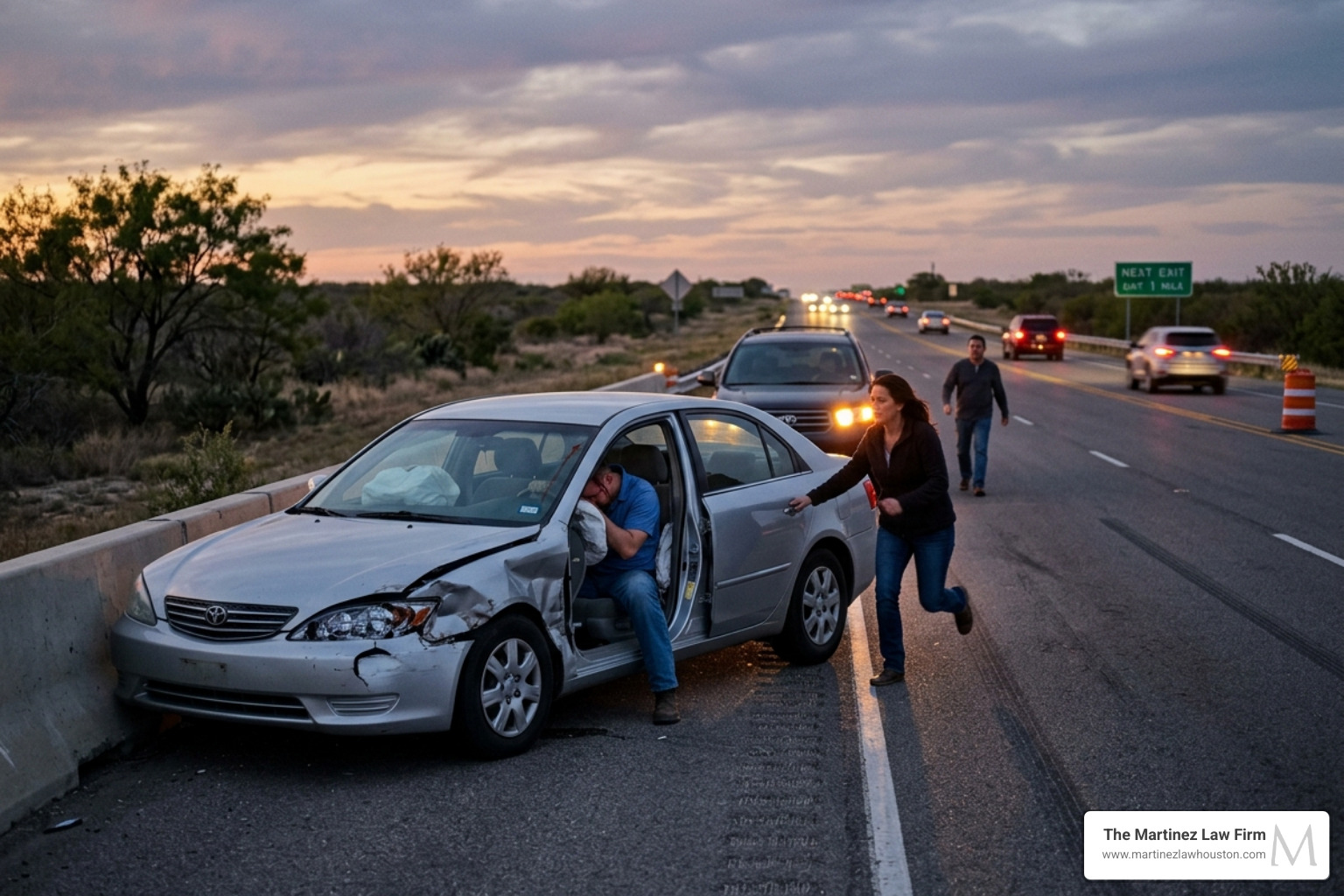
Failure to render aid is a serious criminal offense in Texas that occurs when a driver involved in a vehicle collision leaves the scene without stopping, checking on injured parties, or providing reasonable assistance. Here’s what you need to know at a glance:
- What it is: Leaving the scene of an accident without helping injured people or exchanging required information
- Who it applies to: Any driver involved in a collision — even if they didn’t cause it
- Where it’s governed in Texas: Texas Transportation Code Chapter 550, specifically Sections 550.021 and 550.023
- Potential charges: Ranges from a Class C misdemeanor (property damage only) up to a second-degree felony (if someone dies)
- Key penalties: Fines, jail or prison time, license suspension, and serious civil liability
Most people assume this law only applies to drivers who cause accidents. It doesn’t. In Texas, every driver involved in a collision has a legal duty to stop, check for injuries, and provide help — regardless of fault.
That distinction matters enormously, especially in a city like Houston, where high-traffic corridors like I-10, the 610 Loop, and US-59 see hundreds of accidents every year. A split-second decision to drive away — even in a moment of panic — can turn a car crash into a felony charge.
The consequences aren’t just criminal, either. Failing to stop can trigger insurance coverage denial, civil lawsuits, and mandatory license revocation. And if someone dies, you’re looking at a potential second-degree felony carrying up to 20 years in prison.
Key Takeaways: Failure to Render Aid in Texas
- Leaving the scene is a crime—regardless of fault. In Texas, any driver involved in a crash must stop, check for injuries, and provide information, even if they did not cause the accident.
- Penalties escalate quickly based on injury severity. Charges range from a minor misdemeanor (property damage) to a second-degree felony with up to 20 years in prison if someone dies.
- “Failure to render aid” goes beyond just stopping. You must provide reasonable assistance, such as calling 911 or helping arrange medical care—doing nothing can still lead to criminal charges.
- A single mistake can trigger long-term consequences. Convictions may lead to license suspension, insurance denial, civil lawsuits, and permanent criminal records, even if the initial crash was minor.
- Action step: stop, document, and get help immediately. After any collision, stay at the scene, exchange information, call emergency services, and seek legal guidance before speaking with investigators to protect your rights.
I’m Herman Martinez, founder of The Martinez Law Firm and a former Chief Prosecutor for the Harris County District Attorney’s Office — experience that gives me a rare, inside view of exactly how failure to render aid cases are built and prosecuted. Over more than 25 years of criminal defense work in Houston, I’ve seen how these charges escalate fast and why having the right defense strategy from day one makes all the difference.
The Legal Duty: What is Failure to Render Aid?
When we talk about the Duty to rescue, we are looking at a concept that varies wildly depending on where you are in the world. In many European “civil law” systems, a bystander who sees someone in trouble might actually be legally required to help. However, in the United States and other “common law” systems, you generally don’t have a legal obligation to save a stranger unless you have a “special relationship” with them—like a parent with a child or an employer with an employee.
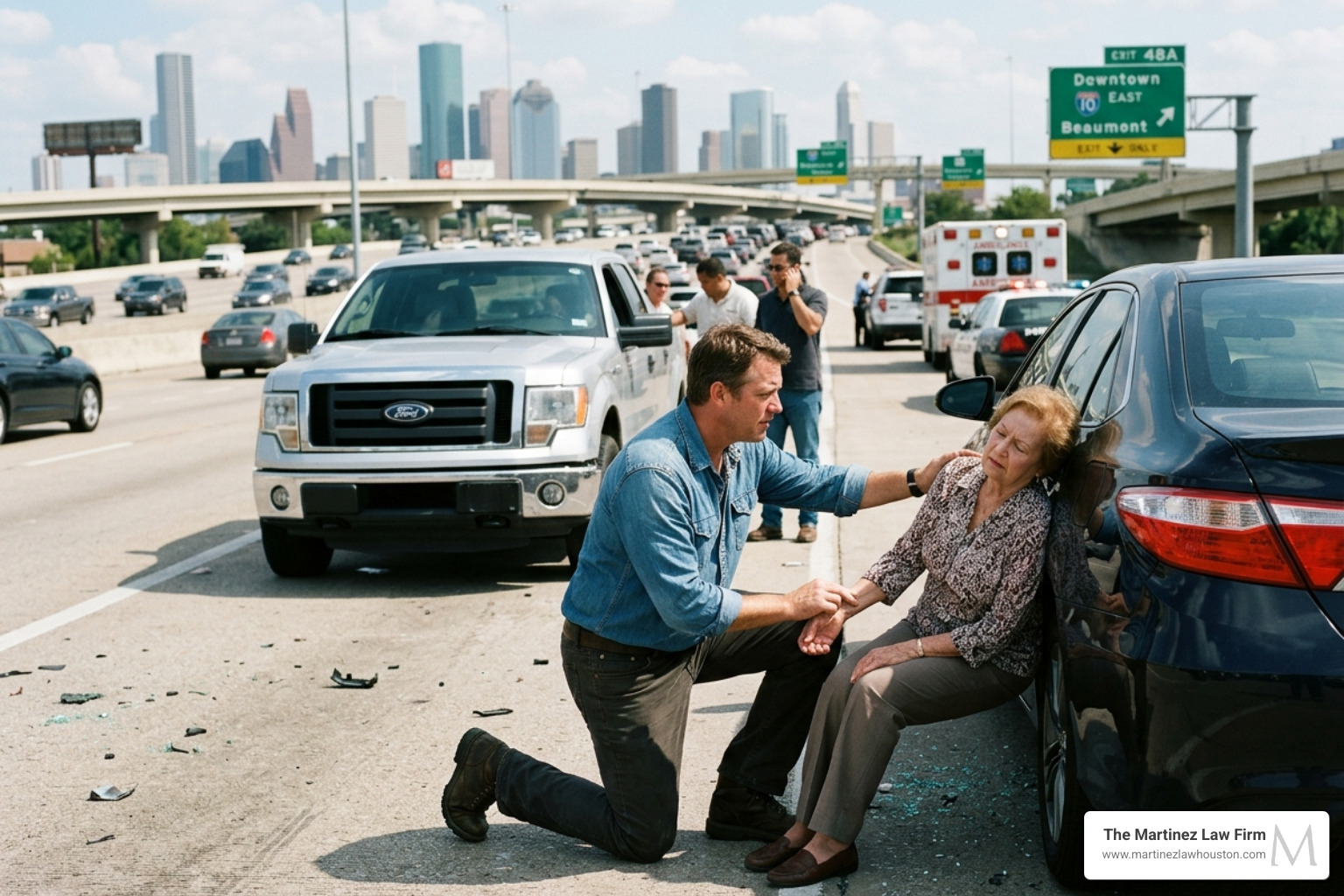
But here is where it gets tricky for Houston drivers: the moment you are involved in a vehicle collision, that “no duty” rule goes out the window. By being part of the incident, you have entered into a statutory obligation. You aren’t just a bystander anymore; you are a participant.
Failure to render aid happens when you fail to provide “reasonable assistance.” This doesn’t mean you have to perform open-heart surgery on the shoulder of I-45. It means you must do what a sensible person would do: call 911, check for a pulse, or arrange for the injured person to get to a hospital if it’s obvious they need medical transport.
A DWI crash can make this issue much worse. If a drunk driver leaves the scene or fails to help an injured person, prosecutors may pursue both intoxication-related charges and failure to render aid. And newer vehicle technology does not erase that duty. Whether you were driving, using advanced driver-assist features, or relying on automation, the legal obligation to stop, report the crash, and make sure help arrives still matters.
Texas Laws and the Houston Driver’s Responsibility
In Texas, we don’t mess around with hit-and-runs. The state recently moved away from the word “accident” in its legal code, replacing it with “collision” to reflect that these events often involve human choice or negligence.
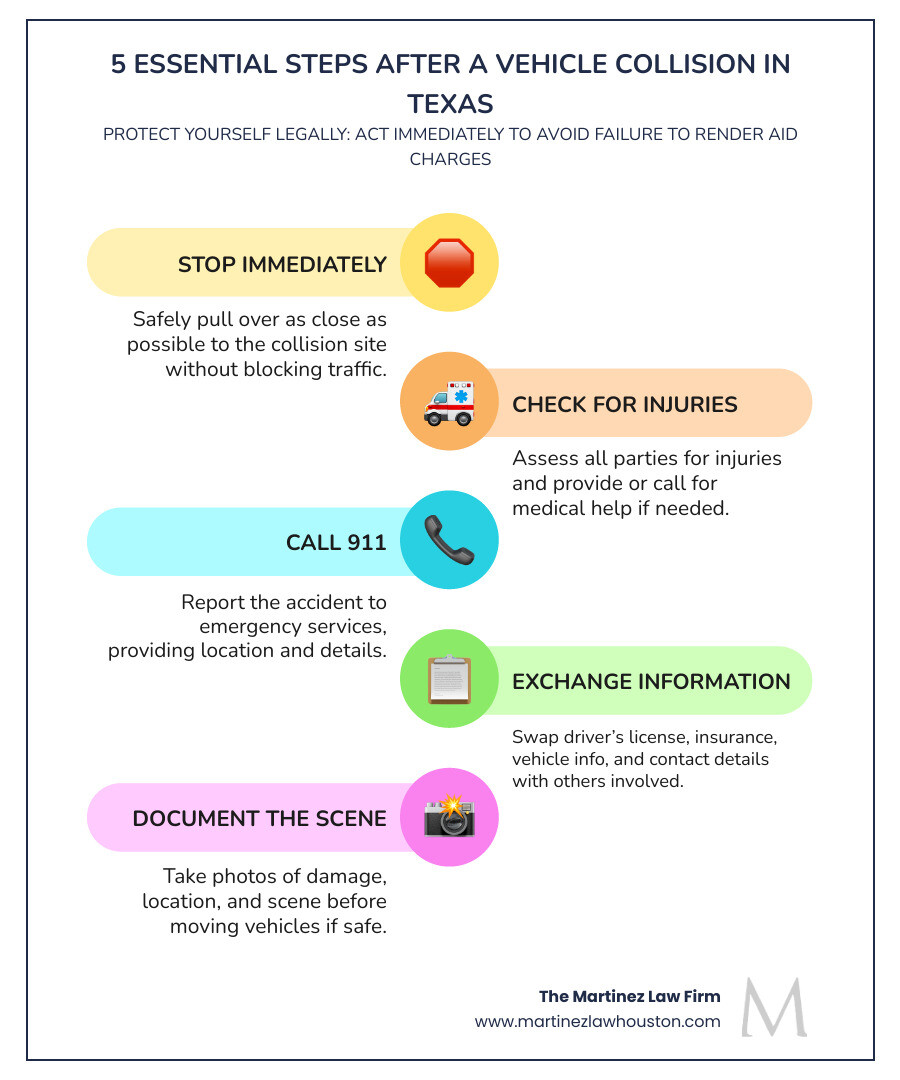
The heavy hitters in the Texas Transportation Code are Sections 550.021 and 550.023. Under Section 550.021, if you are in a collision that results in injury or death, you must:
- Immediately stop your vehicle at the scene (or as close as possible).
- Return to the scene if you didn’t stop initially.
- Determine if anyone needs aid.
- Remain there until you have exchanged information.
Section 550.023 lists exactly what you need to hand over. In Houston, if you don’t provide these items, you’re breaking the law:
- Your name and address.
- The registration number of your vehicle.
- The name of your insurance liability provider.
- Your driver’s license (if requested).
The stakes have never been higher. A New Texas Law Heightens Hit And Run Sentences recently, making the penalties for leaving the scene of a fatal crash just as severe as Intoxicated Manslaughter. This was done specifically to stop people from fleeing a scene to “sober up” before the police arrive. If the collision leads to a fatality, you could face Vehicular Homicide Charges In Texas.

Harris County law enforcement is particularly aggressive about investigating these cases. With the abundance of toll road cameras, dash cams, and doorbell cameras in Houston neighborhoods, the “blind spot” for hit-and-runs is shrinking every day.
Proving Guilt and Navigating Defenses
To convict someone of failure to render aid, a prosecutor has to prove more than just “you weren’t there when the cops arrived.” They have to prove that you knew a collision occurred and that you knew (or should have known) that someone was likely injured.
This is where “willful ignorance” comes in. You can’t just crank up the radio, ignore the loud “thud,” and claim you didn’t know you hit someone. If the circumstances suggest a reasonable person would have known there was an injury, the court will likely find you had the “requisite knowledge.”
However, there are legitimate defenses we use in Houston courts every day. It isn’t always a cut-and-dry case of someone being a “bad person.” Sometimes, things are much more complicated.
Common defenses include:
- Lack of Knowledge: If it was dark, raining heavily, or the impact was so slight that you genuinely didn’t realize a person was involved, this can be a valid defense.
- Self-Preservation/Safety: If you stop in a dangerous area of Houston at 2:00 AM and a crowd begins to act aggressively toward you, leaving the scene to call the police from a safe location might be justified.
- Emergency Situations: If you were rushing someone to the hospital for a life-threatening emergency and had a minor collision, the “necessity” of the situation might play into your defense.
- Identity Defense: Just because your car was involved doesn’t mean you were driving. The prosecution must prove beyond a reasonable doubt that you were the one behind the wheel.
- Involuntary Intoxication: While rare, if you were drugged without your knowledge and were not in control of your faculties, it could impact the “intentional” nature of the crime.
According to research on Failure to Stop and Render Aid: Legal Consequences and Penalties, the prosecution’s easiest path to a conviction is often the defendant’s own statement. This is why we tell our clients: Don’t talk to the police without a lawyer.
The Ripple Effect: Penalties and Civil Liability
If you’re convicted of failure to render aid in Texas, the floor is going to drop out from under you pretty quickly. The law treats these offenses with increasing severity based on how badly the other person was hurt.
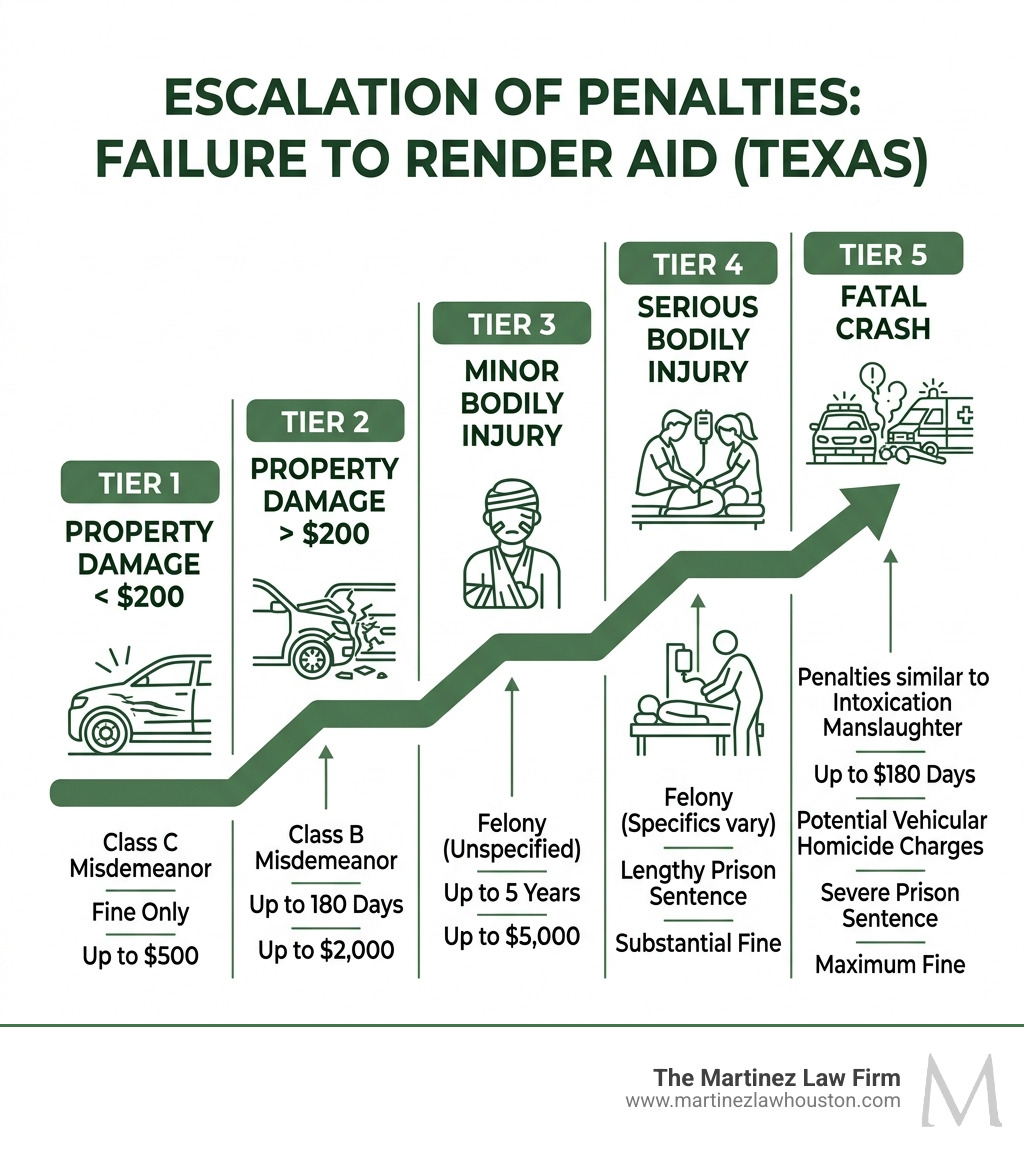
| Severity of Incident | Texas Charge Level | Potential Prison/Jail Time | Max Fine |
|---|---|---|---|
| Property Damage < $200 | Class C Misdemeanor | Fine Only | $500 |
| Property Damage > $200 | Class B Misdemeanor | Up to 180 Days | $2,000 |
| Minor Bodily Injury | Felony (Unspecified) | Up to 5 Years | $5,000 |
| Serious Bodily Injury | 3rd Degree Felony | 2 to 10 Years | $10,000 |
| Death | 2nd Degree Felony | 2 to 20 Years | $10,000 |
One of the most brutal parts of Texas law involves probation. If a judge grants you probation for a collision involving death, there is a mandatory minimum of 120 days in jail that you must serve as a condition of that probation. There is no getting around it.
Beyond the jail cell, you have to worry about the administrative and civil fallout. Your license will likely be suspended or revoked. Insurance companies often use a hit-and-run as a reason to deny coverage or cancel your policy entirely.
Then there are the civil lawsuits. If you flee, a personal injury lawyer will argue that your delay in calling for help made the victim’s injuries worse. This can lead to massive “exemplary damages” meant to punish you. If the collision involved alcohol, you might also be facing Intoxication Assault or Leaving The Scene charges, which carry their own heavy weight.
Frequently Asked Questions about Failure to Render Aid
Is failure to render aid a felony in Texas?
Yes, it very often is. While hitting a mailbox and driving off is a misdemeanor, any collision involving a person’s injury is elevated to a felony. If the injury is “serious bodily injury” (meaning it creates a substantial risk of death or causes permanent disfigurement), it is a third-degree felony. If the person dies, it jumps to a second-degree felony. Even if the injury seems minor at the scene, if you leave, you are risking a felony charge that can follow you for the rest of your life.
How does failure to render aid affect my driver’s license?
Texas is strict about driving privileges. A conviction for failure to render aid typically results in an automatic suspension or revocation of your license. To get it back, you’ll likely have to attend administrative hearings, pay reinstatement fees, and provide proof of “SR-22” high-risk insurance, which is significantly more expensive than standard coverage. In many cases, the suspension lasts for at least one year, but it can be longer depending on your prior driving record.
What counts as “reasonable assistance” at an accident scene?
The law doesn’t expect you to be a doctor, but it does expect you to be helpful. “Reasonable assistance” includes calling 911 immediately. If the injured person is conscious and asks to go to a specific hospital, you are legally required to arrange that transport if it’s safe to do so. If they are unconscious, the “apparent necessity” of the situation dictates that you call for an ambulance. You should not move someone unless they are in immediate danger (like a car fire), as you could make their injuries worse. Simply standing by and waiting for the police is usually the best way to fulfill this duty.
What to Do Next if You’re Facing Failure to Render Aid
Navigating the aftermath of a Houston car crash is overwhelming. Between the adrenaline, the fear, and the confusion of the law, it is easy to make a mistake that changes your life forever. But a mistake at the scene doesn’t have to mean the end of your future.
At The Martinez Law Firm, we believe that everyone deserves a defense that is as aggressive as the prosecution. We leverage Herman Martinez’s experience as a former Chief Prosecutor to anticipate the state’s moves before they make them. We know how Harris County builds these cases, and we know where the cracks in those cases usually hide.
Whether you are facing a misdemeanor for property damage or a serious felony charge, you need a team that understands the local courts and the high stakes involved. We have spent decades achieving proven results for people in Houston, Harris County, and the surrounding areas.
If you’re worried about a failure to render aid charge, don’t wait for the police to knock on your door. Take control of your situation now.
More info about Houston criminal defense services
What Intoxication Assault Really Means in Texas
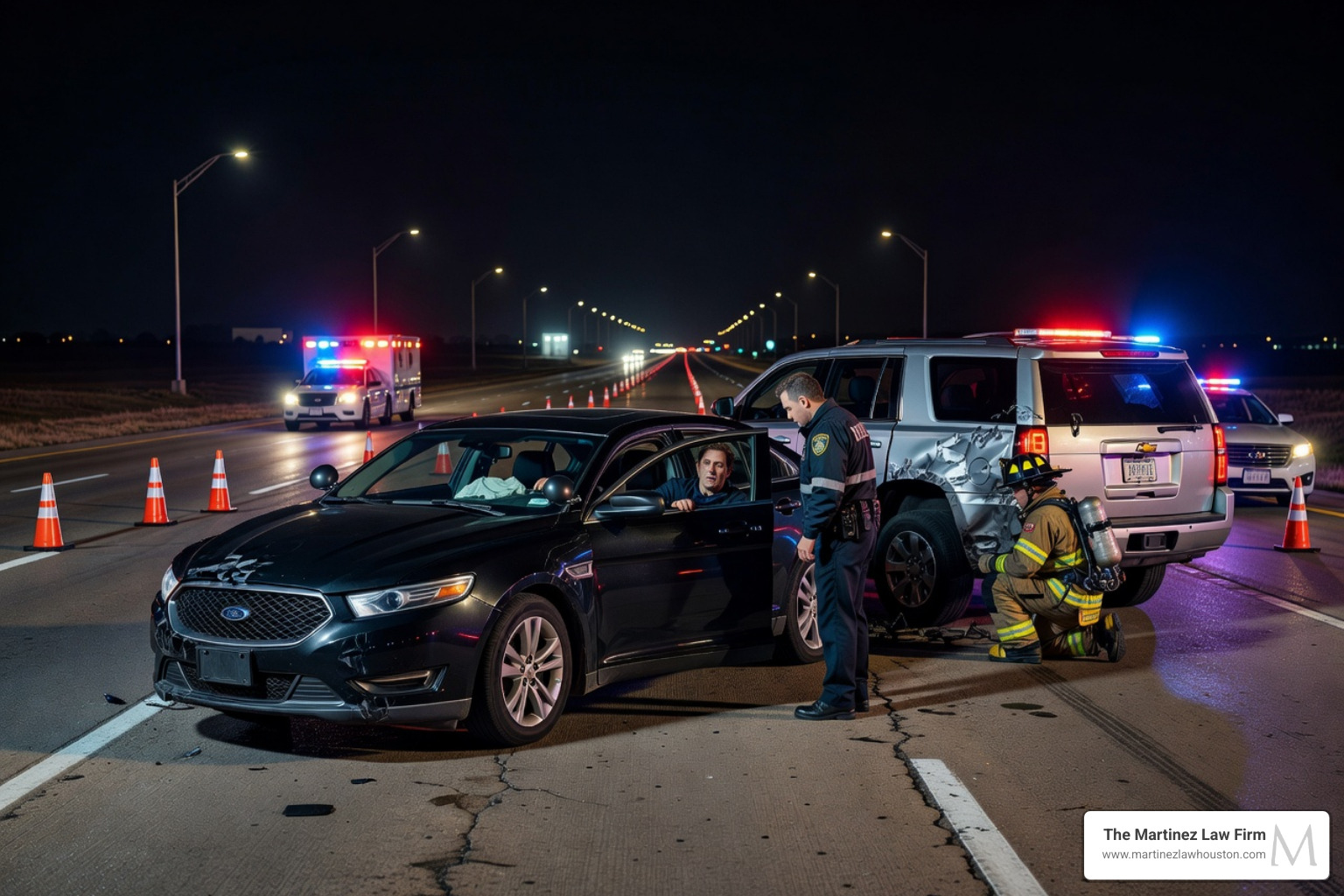
What is intoxication assault is one of the most urgent legal questions a person can face after a serious accident in Texas — and the answer can determine whether you’re looking at a misdemeanor or years behind bars.
Quick Answer: What Is Intoxication Assault in Texas?
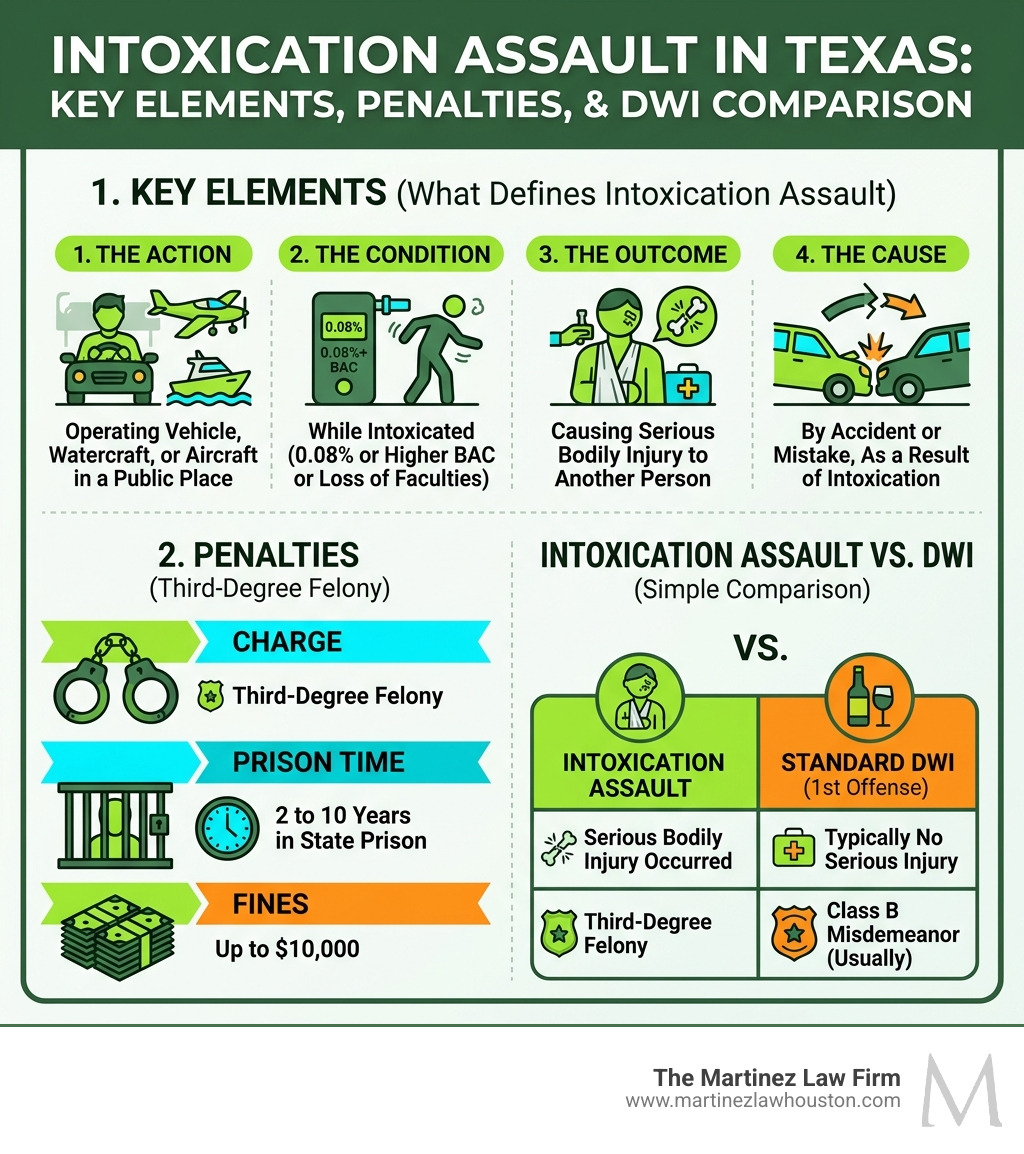
| Element | What the Law Requires |
|---|---|
| The action | Operating a motor vehicle, watercraft, aircraft, or amusement ride in a public place |
| The condition | While intoxicated (BAC of 0.08% or higher, or loss of normal mental/physical faculties) |
| The outcome | Causing serious bodily injury to another person |
| How it happened | By accident or mistake, as a result of the intoxication |
| The charge | Third-degree felony under Texas Penal Code § 49.07 |
| The penalty | 2 to 10 years in prison, fines up to $10,000 |
In plain terms: if you were driving — or boating, or flying — while intoxicated, and someone else was seriously hurt because of it, Texas prosecutors can charge you with a felony. Not a traffic offense. Not a misdemeanor. A felony.
That distinction matters enormously. A standard first-offense DWI in Texas is typically a Class B misdemeanor. Intoxication assault is a completely different level of exposure — one that can follow you for the rest of your life.
Here in Houston, accidents happen on the 610 Loop, on I-10, on Westheimer — and when they involve alcohol and serious injuries, Harris County prosecutors move fast and aggressively. The moment the charge escalates from DWI to intoxication assault, everything changes: the potential prison time, the long-term consequences, and the complexity of your defense.
This isn’t a situation to navigate alone or take lightly. The line between a bad night and a life-altering felony conviction can come down to a single factor — whether the injury qualifies as “serious” under Texas law, or whether your intoxication was actually the cause of the crash.
When a DWI Becomes a Felony
I’m Herman Martinez, founder of The Martinez Law Firm in Houston. With more than 25 years of experience — including time as a Chief Prosecutor for the Harris County District Attorney’s Office and as a City of Houston Judge — I’ve seen intoxication assault cases argued from both sides of the courtroom, and I know exactly what prosecutors look for when building a case for intoxication assault charges. This guide will walk you through everything you need to understand about this charge, what’s at stake, and how a strong defense can make a real difference.
What is intoxication assault in Texas?

When we talk about what is intoxication assault, we are looking directly at Texas Penal Code – PENAL § 49.07. In the eyes of the State of Texas, this isn’t just a “drunk driving accident.” It is a specific felony offense that occurs when someone, by accident or mistake, causes “serious bodily injury” to another person while operating a vehicle in a public place while intoxicated.
One thing that surprises many of our clients in Houston is how broad this law actually is. While most people associate it with cars on the Southwest Freeway, it actually covers:
- Motor Vehicles: Cars, trucks, motorcycles, and even ATVs or golf carts if operated in a public place.
- Watercraft: If you are out on Lake Houston or the San Jacinto River and an accident occurs while you’re impaired, you could face this charge.
- Aircraft: Operating a plane or helicopter while intoxicated.
- Amusement Rides: This even extends to operating or assembling mobile amusement rides. Yes, that means the rides at the Houston Livestock Show and Rodeo are covered under these statutes.
If you want to dive deeper into the specific legal nuances, you can find more info about intoxication assault charges on our dedicated service page.
Understanding what is intoxication assault in the eyes of the law
To the police and prosecutors, the “accident or mistake” part is key. They don’t have to prove you intended to hurt someone. They only have to prove you were intoxicated and that an injury happened as a result.
But what does “intoxicated” actually mean? In Texas, it’s a two-pronged definition:
- The “Per Se” Definition: Having a blood alcohol concentration (BAC) of 0.08% or higher.
- The Subjective Definition: Not having the normal use of your mental or physical faculties because of alcohol, drugs, or a combination of both.
This second part is where things get tricky. Even if your BAC was below 0.08, a Harris County officer might claim you “lost your faculties” based on how you looked or performed on field sobriety tests. In Houston, law enforcement is particularly aggressive with “no-refusal” zones and initiatives, where they can quickly obtain a search warrant for your blood if you refuse a breathalyzer. You can read more about these specific DWI laws in Texas to see how they apply to your situation.
Why the definition of what is intoxication assault matters for your defense
The distinction between a standard DWI and intoxication assault is the presence of “serious bodily injury” (SBI). This isn’t just a scrape or a bruise. Under Texas law, SBI is an injury that creates a substantial risk of death or that causes serious permanent disfigurement or protracted loss or impairment of the function of any bodily member or organ.
If the victim has a broken bone that requires surgery, or a scar that will never go away, a prosecutor will almost certainly push for the felony charge. For a defendant, this is the difference between a few days in jail and a decade in prison.
| Feature | Standard DWI (1st Offense) | Intoxication Assault |
|---|---|---|
| Classification | Class B Misdemeanor | 3rd Degree Felony |
| Jail/Prison Time | Up to 180 Days | 2 to 10 Years |
| Max Fine | $2,000 | $10,000 |
| Criminal Record | Misdemeanor | Permanent Felony |
| License Suspension | 90 to 365 Days | 180 Days to 2 Years |
The Elements Prosecutors Must Prove

When we represent someone in Houston, we look at the case through the lens of the “burden of proof.” The State has to prove every single element of the crime beyond a reasonable doubt. If they miss one, the case falls apart.
The primary elements are:
- Identity: You were the one operating the vehicle.
- Public Place: The incident happened in a place where the public has access (roads, parking lots, etc.).
- Intoxication: You met the legal definition of intoxicated at the time of the accident.
- Causation: Your intoxication caused the injury.
- Serious Bodily Injury: The victim’s injuries meet the high legal threshold of SBI.
Understanding the Texas DWI process guide can help you visualize how these elements are presented in a Harris County court.
Proving Serious Bodily Injury (SBI)
Prosecutors in Harris County don’t just take the victim’s word for it. They use medical records, hospital bills, and expert testimony from doctors to prove the injury was “serious.” We often see the State argue that a “protracted loss of limb” includes anything that takes a long time to heal, like a complex leg fracture. They also lean heavily on “permanent disfigurement.” A small scar on someone’s face might not seem like a felony-level event to you, but to a jury, the prosecution will paint it as a life-altering tragedy.
The Role of Causation in Felony Charges
This is perhaps the most important “battleground” in an intoxication assault case. Texas law requires “but-for” causation. This means the State must prove that the injury would not have happened but for your intoxication.
Imagine this: You are driving with a 0.09 BAC, but another driver runs a red light and hits you. Even though you are technically intoxicated, did your intoxication cause the accident? Or was it the other driver’s negligence? In Houston, with our congested highways and sometimes poorly maintained roads, mechanical failures or third-party negligence are very real factors. Our job is to highlight these “moving parts” to show that the alcohol wasn’t the primary factor. For a deeper look at these rules, check out our DWI DUI Texas complete guide.
Penalties and Long-Term Consequences
If you are convicted of intoxication assault, you are looking at a Third-Degree Felony. In Texas, that carries a prison sentence of 2 to 10 years.
Beyond the time behind bars, the financial and personal toll is staggering:
- Fines: Up to $10,000.
- Community Service: Usually between 160 and 600 hours.
- Driver’s License: A suspension of 180 days to 2 years.
- Ignition Interlock: You will likely be required to install a deep-lung air device in your car, which you must blow into to start the engine. This comes with monthly rental fees and the embarrassment of using it in public.
For more details on the specific tiers of punishment, see our page on DWI penalties in Texas.
Enhancements and Aggravating Factors
The 2-to-10-year range is just the baseline. Certain factors can “enhance” the charge, making the penalties even harsher. For example, if the victim was a peace officer, firefighter, or emergency medical personnel performing their duties, the charge jumps to a Second-Degree Felony (2 to 20 years in prison).
If the accident causes a traumatic brain injury that leaves the victim in a persistent vegetative state, the charge can be elevated to a First-Degree Felony, carrying a potential sentence of 5 to 99 years or life in prison. This is why it’s vital to understand what you need to know about DWI charges before you ever step into a courtroom.
Collateral Impacts of a Felony Record
The “hidden” penalties of a felony conviction in Harris County can be just as damaging as prison time.
- Employment: Many Houston employers will not hire individuals with felony convictions, especially for roles involving driving, finance, or professional licenses.
- Housing: Finding an apartment in Harris County becomes significantly harder when a background check flags a felony.
- Civil Rights: You lose your right to vote (until your sentence is fully discharged) and your right to own or possess a firearm.
- Social Stigma: The label of “felon” stays with you, affecting your reputation in the community and your personal relationships.
Common Defenses and Evidence Challenges
Just because you’ve been charged doesn’t mean you’ll be convicted. We use our experience as former prosecutors to find the holes in the State’s case. You can see the breadth of our DWI lawyer services to understand how we approach these defenses.
Attacking the Scientific Evidence
Blood and breath tests are not infallible. We look for:
- Gas Chromatography Errors: The machines used to test blood samples must be calibrated perfectly. If they aren’t, the results are junk.
- Chain of Custody: If the blood sample sat in a hot police car for three hours before being refrigerated, the alcohol content could change due to fermentation.
- Rising Blood Alcohol: You might have been below 0.08 while driving, but your BAC “rose” by the time you were tested at the station.
- Medical Conditions: Certain conditions like GERD or diabetes can produce “false positives” on breathalyzer tests.
Disputing the Injury Severity
We also challenge the “Serious Bodily Injury” claim. Prosecutors often try to “up-charge” a case by claiming a temporary injury is permanent. We may bring in independent medical experts to review the records and testify that the injury, while unfortunate, does not meet the legal definition of SBI. If we can get the injury downgraded, we might be able to get the entire felony charge reduced to a misdemeanor.
Frequently Asked Questions about Intoxication Assault
How is intoxication assault different from a standard DWI?
The biggest difference is the injury. A standard DWI is about the act of driving while impaired. Intoxication assault is about the result of that driving. If no one is seriously hurt, it’s a misdemeanor. If someone is seriously hurt, it’s a felony. That single factor changes your potential prison time from months to years. You can find more DWI lawyer information regarding these differences on our site.
What should I do immediately after being charged?
First, stay silent. Do not talk to the police, and definitely do not talk to the victim’s insurance company or lawyers without your own attorney present. Second, you only have 15 days from the date of your arrest to request an Administrative License Revocation (ALR) hearing. If you miss this deadline, your license will be automatically suspended. Hiring a local Houston attorney early on is the only way to ensure these deadlines are met and evidence (like dashcam footage or witness statements) is preserved.
Can these charges be reduced to a “Wet Reckless”?
In Texas, there isn’t a formal “wet reckless” statute like in some other states, but plea bargaining is very common. If we can show that the evidence of intoxication is weak or that the injury isn’t actually “serious,” we can often negotiate for a reduced charge, such as a standard DWI or even a regular assault charge, which may carry lighter penalties and avoid a felony record.
Your Next Move Matters Most
Facing an intoxication assault charge in Houston is a terrifying experience, but you don’t have to face it alone. At The Martinez Law Firm, we believe that a split-second mistake shouldn’t cost you the rest of your life. We leverage our deep understanding of the Harris County criminal justice system to provide an aggressive, personalized defense for every client.
If you are struggling with the weight of an arrest and wondering what is intoxication assault going to mean for your future, reach out to us. We know how the other side thinks, and we know how to fight back.
Contact a Houston DWI Lawyer today for a consultation and let’s start building your defense.
The Surprising Legal Risk of Riding a Bike After Drinking in Texas

Can you get a DUI on a bike is one of those questions that sounds almost too simple — like the answer should be obvious. But the honest answer is: it depends, and in Texas, the details matter more than you’d think.
Here’s a quick breakdown for anyone who needs a fast answer:
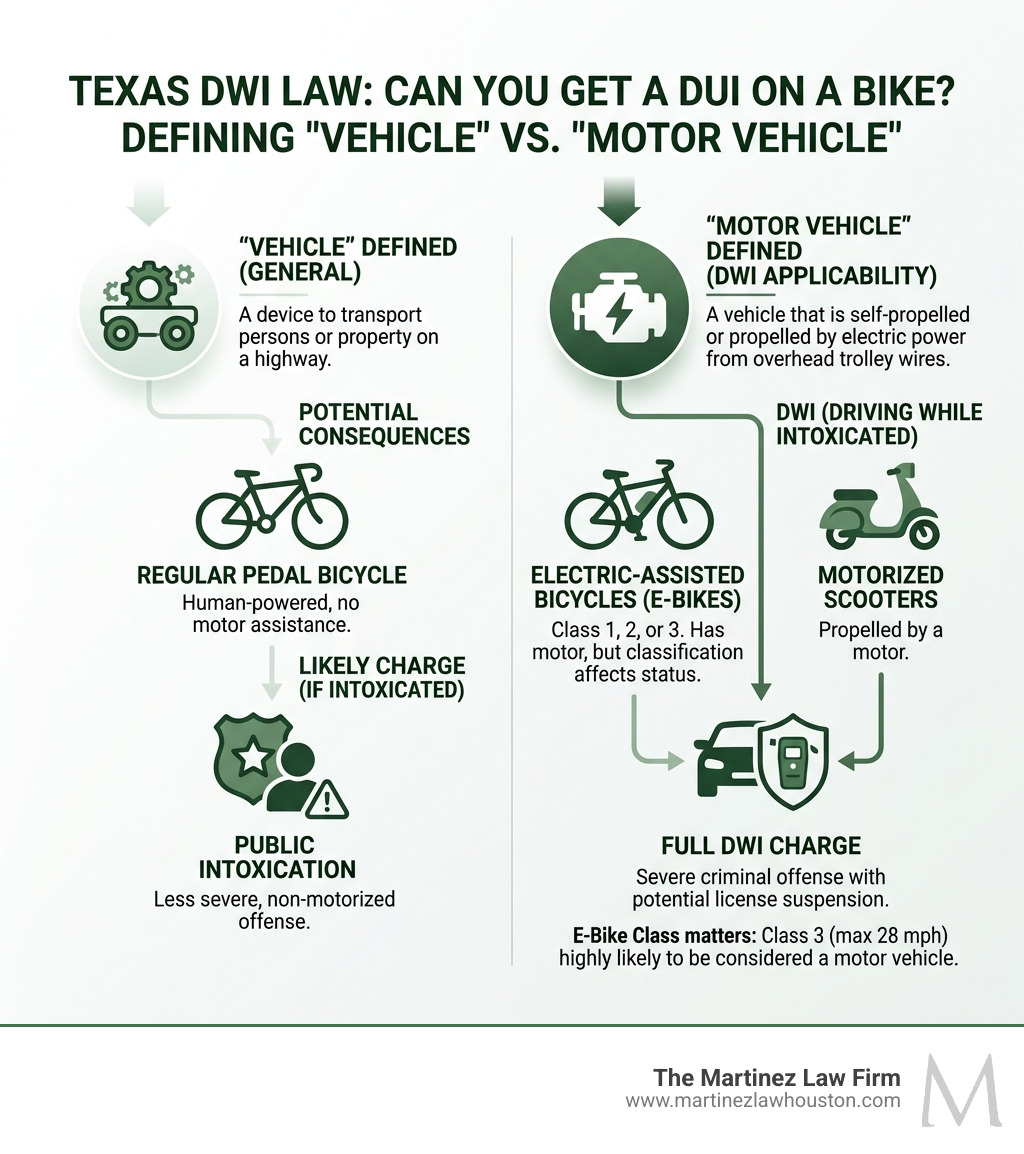
| Scenario | Likely Charge in Texas |
|---|---|
| Riding a regular pedal bike while drunk | Usually not a DWI, but Public Intoxication is possible |
| Riding an e-bike or motorized scooter while drunk | Potentially a full DWI depending on classification |
| Riding any bike while drunk under age 21 | Higher risk — zero tolerance rules apply |
| Riding a Class 3 e-bike (28 mph, motor-assisted) while drunk | Very likely treated as a motor vehicle DWI |
The common assumption in Houston — especially on nights when the patios on Washington Ave are packed — is that hopping on a bike instead of driving is the “responsible” choice. And from a pure safety standpoint, sure, you’re probably not going to hurt someone else as badly. But legally? It’s not the get-out-of-jail-free card most people think it is.
Texas DWI law is built around the concept of a motor vehicle, which is actually good news for traditional cyclists. But that doesn’t mean you’re untouchable. Public Intoxication charges, reckless endangerment, and the very real risk of an accident on a busy road like Westheimer mean that riding drunk still carries serious consequences — legal and otherwise.
One in three fatal bicycle crashes involves alcohol, according to safety data from the National Highway Traffic Safety Administration. That’s not a small number, and Houston police know it.
Key Takeaways
- You usually cannot get a DWI on a regular bicycle in Texas. The law applies to motor vehicles, so pedal bikes typically fall outside DWI charges—but other charges still apply.
- Public Intoxication is the most common risk. If you appear impaired and pose a danger to yourself or others, police can charge you even without a motor vehicle.
- Motorized bikes and scooters change the legal outcome. E-bikes, scooters, and high-speed motor-assisted devices may qualify as motor vehicles, increasing the risk of a full DWI.
- Legal consequences can still be serious. Charges may include fines, possible jail time, and for minors, driver’s license suspension under zero-tolerance rules.
- Safety risks are high even without legal penalties. Alcohol reduces reaction time and control, increasing crash risk—making riding impaired dangerous both legally and physically.
I’m Herman Martinez, founder of The Martinez Law Firm and a former Chief Prosecutor for the Harris County District Attorney’s Office with over 25 years of experience in DWI and criminal defense — and I’ve seen how charges related to can you get a DUI on a bike situations can spiral quickly when people assume they’re in the clear. Whether you’re facing a DWI, a Public Intoxication charge, or something in between, understanding exactly where Texas law draws the line is the first step to protecting yourself.
The Legal Reality: Can You Get a DUI on a Bike?
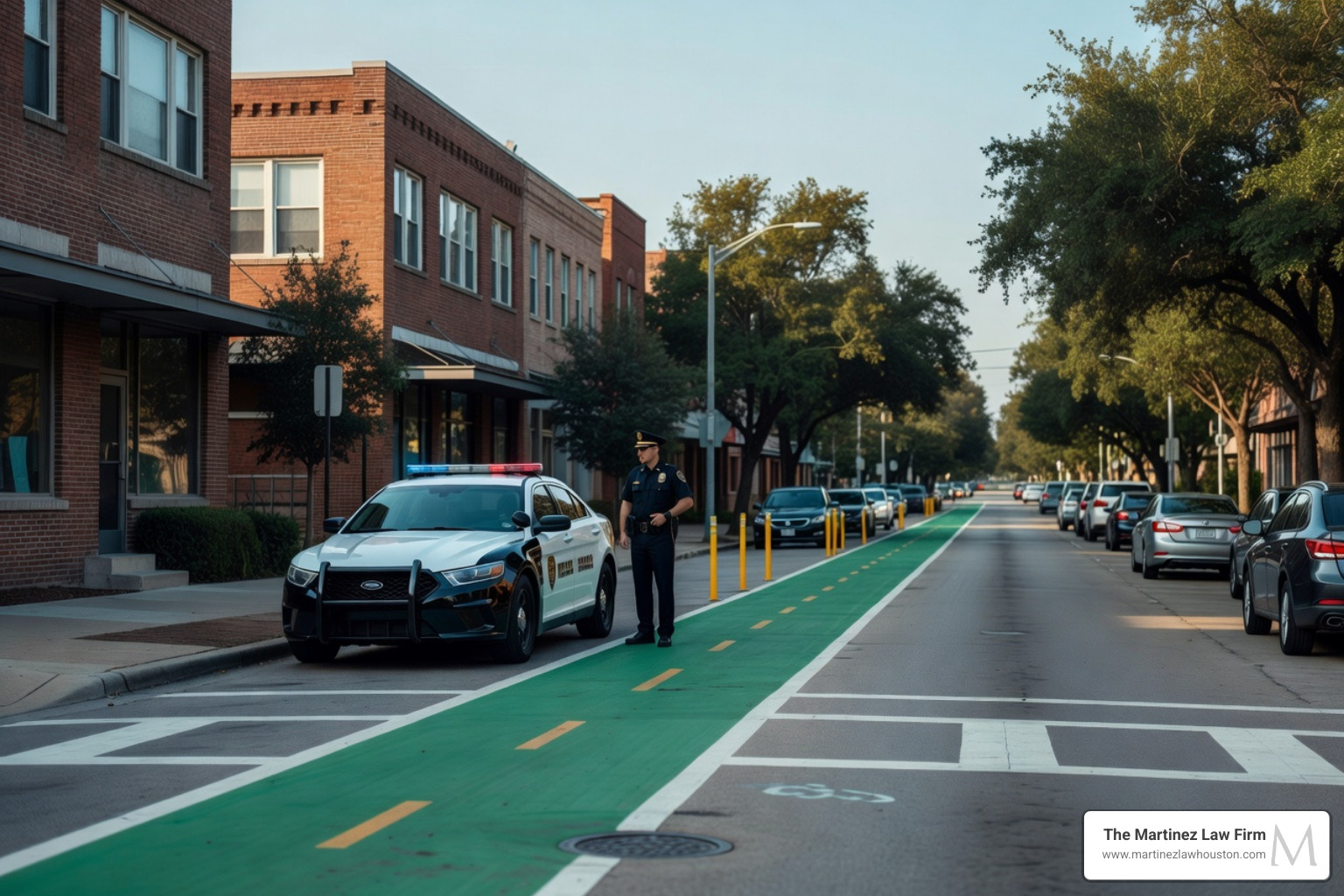
When we talk about the law in Houston, we have to look at the specific phrasing of the Texas Penal Code. In many states, like Florida or California, the law uses the word “vehicle.” In those places, a bicycle is often legally considered a vehicle, meaning you can absolutely get a standard DUI while pedaling.
However, in Texas, the statute specifically targets the operation of a motor vehicle. This nuance is where things get interesting for Houston cyclists. If you are on a traditional, human-powered bicycle, you generally cannot be charged with a DWI (Driving While Intoxicated) because a bike lacks a motor.
But don’t start celebrating with another round just yet. While a DWI might be off the table for a pedal bike, Texas law is broad. We often see cases where the “human power” factor is debated, especially as the line between bikes and motorized transport blurs. For a detailed look at how these charges are structured, you can check out our A Z Guide To DUI And DWI Charges Legal Options.
Location also plays a role in how a patrol officer might perceive your behavior. If you’re wobbling along a dedicated trail like Buffalo Bayou, you’re less likely to draw heat than if you’re swerving down Westheimer Road or Montrose Boulevard. In the eyes of a judge, being intoxicated on a public roadway where you pose a danger to others is a much bigger deal than being tipsy on a secluded dirt path.
Texas Specifics: DWI vs. Public Intoxication

In the Harris County Criminal Justice Center, we see a lot of “creative” charging. Even if the law says you need a motor for a DWI, a Houston cop who sees you falling off your bike in Midtown isn’t just going to wave you home.
If they can’t pin a DWI on you, they will almost certainly pivot to Public Intoxication (PI). Under Texas law, PI occurs when an individual is in a public place while intoxicated to the degree that they may endanger themselves or another person. Since a bicycle offers zero protection and puts you right in the path of Houston traffic, it’s very easy for an officer to argue that you were a danger to yourself.
You can read more about these specific distinctions in our article on Bicycle DWI. The reality of prosecutorial discretion here in Harris County is that they want to keep the roads safe. If you’re creating a hazard, they will find a charge that sticks, even if it’s not the one you expected.
Why the definition of a motor vehicle matters for a DUI on a bike
In Texas, the definition of a motor vehicle is “a device in, on, or by which a person or property is or may be transported or drawn on a highway, except a device used exclusively on stationary rails or tracks.” While that sounds broad enough to include a bicycle, courts have traditionally held that it implies a self-propelled mechanism (an engine).
Our Comprehesive Guide explains that the Texas Transportation Code separates your beach cruiser from your F-150. However, the “operating” part of the law is extremely loose. You don’t necessarily have to be moving to be “operating” a vehicle in the eyes of some overzealous prosecutors.
Penalties and license impacts of a DUI on a bike
One of the biggest fears people have is: “Can they take my driver’s license for a bike ride?”
In Texas, if you are convicted of a standard DWI, your driver’s license is usually suspended. If you are riding a traditional pedal bike and get charged with Public Intoxication, your driver’s license is generally safe. However, there is a major exception: minors.
Texas has a “Zero Tolerance” policy for anyone under 21. If a minor is caught cycling under the influence, they can face a 180-day license suspension, even if they weren’t in a car.
| Charge | Typical Fine | Potential Jail Time | License Impact (Adult) |
|---|---|---|---|
| Public Intoxication | Up to $500 | None (Class C Misdemeanor) | None |
| DWI (1st Offense) | Up to $2,000 | 3 to 180 days | 90 days to 1 year suspension |
| Reckless Endangerment | Up to $4,000 | Up to 1 year | Possible suspension |
E-Bikes, Scooters, and Other “Weird” Vehicles
This is where the “simple” answer gets messy. Houston has seen an explosion of electric rental scooters and e-bikes. If your bike has a motor, can you get a DUI on a bike becomes a much more dangerous “yes.”
Texas law is currently grappling with how to classify these. Generally, if the motor is powerful enough to propel the bike without you pedaling, or if it exceeds certain speed thresholds (like Class 3 e-bikes that hit 28 mph), it starts looking a lot more like a “motor vehicle” to a prosecutor.
And it’s not just bikes. We’ve seen people charged for all sorts of things. If you’re curious about the more “rural” side of Texas law, read our guide on Horse-Based DWIs. Believe it or not, people have been arrested for DWI on riding lawnmowers and even motorized “Cruzin Coolers.”
How e-bike classifications change the rules for a DUI on a bike
E-bikes are categorized into three classes:
- Class 1: Pedal-assist only, stops at 20 mph.
- Class 2: Throttle-assisted, stops at 20 mph.
- Class 3: Pedal-assist only, but goes up to 28 mph.
Because Class 2 and Class 3 bikes rely more heavily on a motor, they occupy a legal gray area. If you are zipping through Downtown Houston on a throttle-powered scooter or a high-speed e-bike while intoxicated, a DWI Lawyer will tell you that the state has a much stronger argument for a full DWI charge than if you were on a 10-speed.
Safety Risks and Common Defenses
Even if you avoid a DWI, riding drunk in Houston is a safety nightmare. Alcohol slows your neural processing by 10% to 30%. That split-second decision to swerve around a pothole or a car door opening on Washington Ave becomes much harder when you’ve had a few.
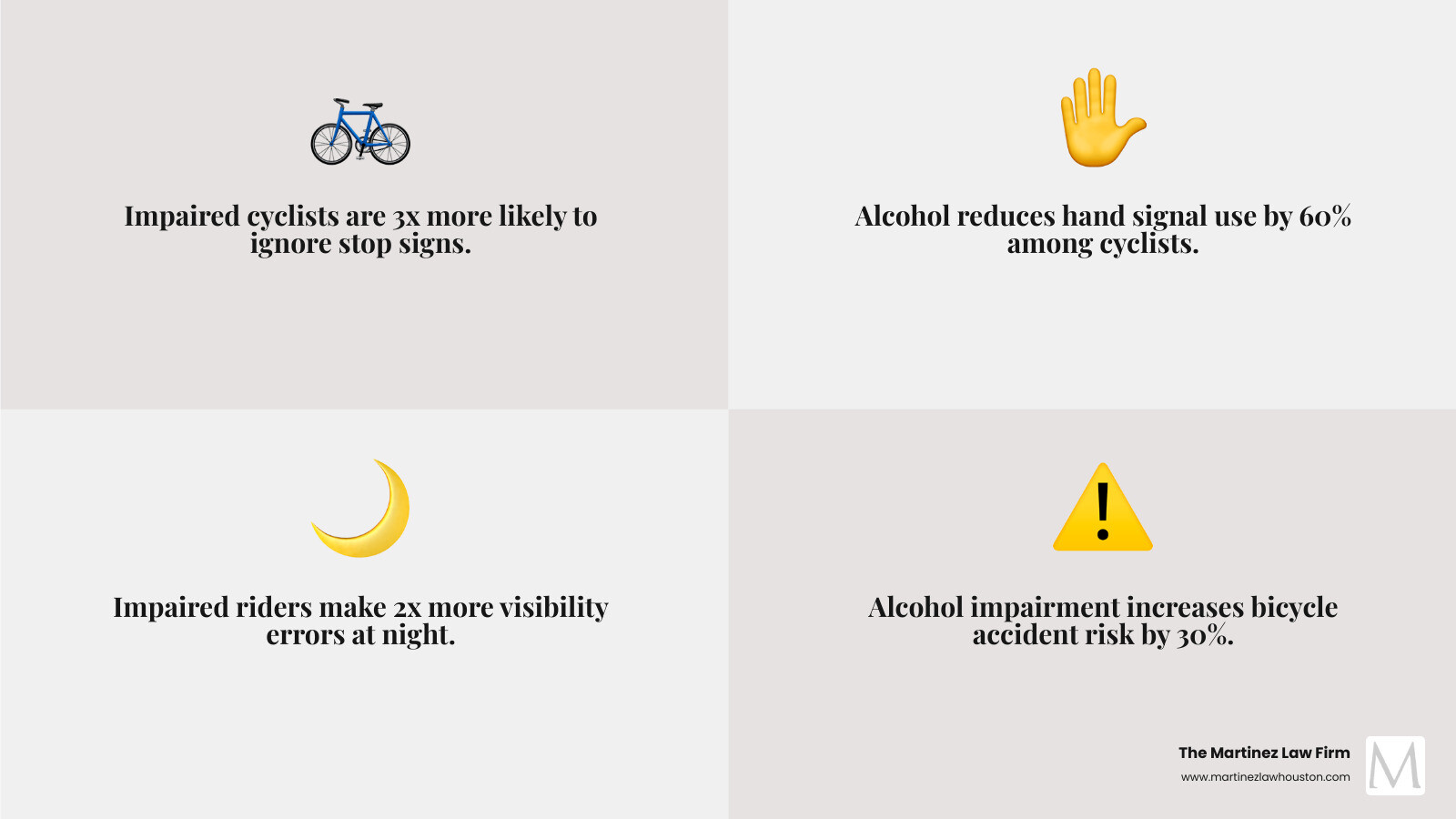
Statistics from the Texas Department of Transportation show that impaired cyclists are:
- 3x more likely to ignore stop signs.
- 60% less likely to use hand signals.
- 2x more likely to make visibility errors at night.
If you are stopped, there are defenses available. Officers often use “Standardized Field Sobriety Tests” (SFSTs) on cyclists. But here’s the catch: those tests were designed for people getting out of cars, not people who just finished a grueling 20-mile ride. Physical exhaustion, leg fatigue, and even the type of shoes you wear for cycling can make you fail a balance test even if you’re stone-cold sober.
Furthermore, breathalyzers can be wonky. Heavy physical exertion causes heavy breathing, which some studies suggest can inflate breath alcohol readings by up to 15%. As your DWI Lawyer, we look at challenging the “probable cause” for the stop. Did the officer pull you over because you were actually impaired, or just because you were a cyclist in a “party” neighborhood at 2:00 AM?
Frequently Asked Questions about Biking and Alcohol
Can I get a DWI on a bicycle in Houston?
The short answer is usually no, provided it’s a standard pedal bike. However, you are almost certain to face a Public Intoxication charge if you are visibly impaired. If the bike is motorized (e-bike or scooter), the risk of a full DWI increases significantly.
Does a bicycle-related arrest affect my CDL?
This is a huge concern for our clients who drive for a living. In Texas, any alcohol-related conviction can threaten a Commercial Driver’s License (CDL). While a PI might not trigger an automatic suspension like a DWI would, your employer may have their own policies, and “any” alcohol-related arrest on your record is bad news for a professional driver.
What are common signs of impairment that lead to a bicycle stop?
Houston police look for:
- Swerving or inability to maintain a straight line.
- Riding against traffic or on sidewalks where prohibited.
- “Blowing” through stop signs or red lights (common on Washington Ave).
- Riding at night without a white front light and a red rear reflector/light (required by Texas law).
The Bottom Line for Texas Cyclists
At The Martinez Law Firm, we know that a “simple” bike ride can turn into a legal nightmare faster than you can say “last call.” Houston is a great city for cycling, but the intersection of alcohol and two wheels is a favorite target for local law enforcement.
Having a former prosecutor like Herman Martinez in your corner is a game-changer. We understand how the Harris County DA’s office thinks, and we know how to spot when a police officer has overstepped their bounds—whether you were in a truck or on a Trek. We provide aggressive, personalized defense for all “weird” vehicle charges to ensure one mistake doesn’t ruin your future.
If you’ve been stopped while riding, don’t wait for the system to decide your fate. Contact an experienced DWI Lawyer today and let us start fighting for you.
What Is the Legal Limit for Alcohol — and Why It Matters More Than You Think
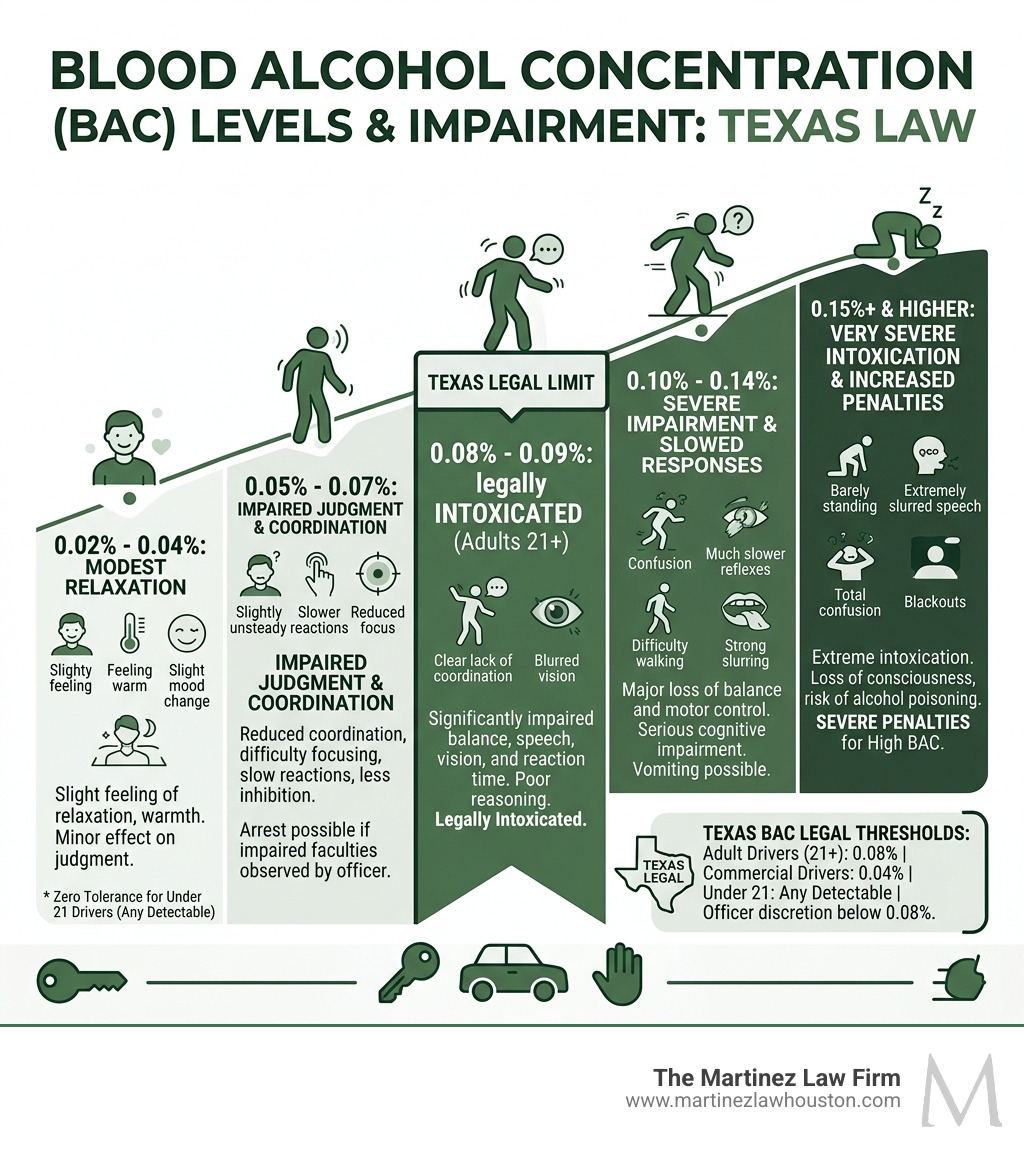
What is the legal limit for alcohol in the United States comes down to one number most drivers know: 0.08% blood alcohol concentration (BAC). But that single number hides a lot of complexity — and in Texas, the consequences of crossing it can follow you for years.
Here’s a quick breakdown:
| Driver Type | Legal BAC Limit |
|---|---|
| Standard adult driver (21+) | 0.08% |
| Commercial driver (CDL) | 0.04% |
| Driver under 21 | Any detectable amount (zero tolerance) |
| Utah (all drivers) | 0.05% |
A few things worth knowing upfront:
- You can be arrested for DWI even below 0.08% if an officer observes signs of impairment.
- In Texas, legal intoxication is defined as a BAC of 0.08% or the loss of normal mental or physical faculties — whichever comes first.
- Penalties escalate sharply with BAC level, repeat offenses, or if a child is in the vehicle.
If you’ve recently been arrested in Houston or anywhere in Texas, the stakes are real. A first-offense DWI can mean up to $2,000 in fines, jail time, and a license suspension of up to a year — and that’s before the state tacks on additional fees that can push total costs far higher.
Key Takeaways
- 0.08% BAC is the standard—but not the full rule. Most adult drivers face a 0.08% limit, but you can still be arrested below that if you show impairment. Texas defines intoxication by BAC or loss of normal function.
- Limits vary by driver type and situation. Commercial drivers face a stricter 0.04% limit, and drivers under 21 have zero tolerance. Some states, like Utah, use a lower 0.05% standard.
- BAC is affected by multiple personal factors. Weight, gender, food intake, and metabolism all impact how quickly you reach the legal limit. On average, the body eliminates alcohol at about 0.015% per hour.
- DWI penalties increase quickly with BAC and circumstances. A first offense can include fines up to $2,000, jail time, and license suspension. A BAC of 0.15% or higher leads to harsher charges and penalties.
- One decision can trigger long-term consequences. Beyond court penalties, drivers may face license suspension, ignition interlock requirements, and lasting record impacts—making prevention and early legal action critical.
I’m Herman Martinez, founder of The Martinez Law Firm in Houston, and with over 25 years of experience in criminal defense — including time as a Chief Prosecutor for the Harris County District Attorney’s Office and as a City of Houston Judge — I’ve seen how misunderstood what is the legal limit for alcohol truly is on both sides of the courtroom. In the sections below, we’ll break down exactly how BAC works, how Texas law applies it, and what your options are if you’re facing a DWI charge.
Understanding Blood Alcohol Content (BAC) and How It’s Measured

When we talk about what is the legal limit for alcohol, we are really talking about Blood Alcohol Content (BAC). Scientifically, this is the weight of alcohol in a certain volume of blood. In the legal world, specifically under blood-alcohol content (BAC) | Wex | US Law | LII / Legal Information Institute, it is expressed as grams of alcohol per 100 milliliters of blood (g/dL).
But unless you’re at a hospital, the police aren’t usually drawing blood on the side of the I-10. Instead, they use a breathalyzer. This device relies on a “partition ratio” of 2100:1. Essentially, the machine assumes that the amount of alcohol in 2100 milliliters of your deep lung breath is the same as the amount in 1 milliliter of your blood. It’s a bit of a mathematical leap, and as we often argue in court, that ratio isn’t the same for everyone.
Understanding How Alcohol Interacts With Your Body is key to knowing why you might feel fine one minute and “over the limit” the next. Alcohol follows a biphasic effect. In the “Buzz Zone” (usually below 0.05% BAC), alcohol acts as a stimulant. You feel talkative, relaxed, and maybe a bit more confident. But once you cross that peak—around 0.055%—the depressant effects take over. This is where coordination drops, judgment slips, and you head toward legal trouble.
If you’re pulled over in Harris County, you might be asked to take Whats A Chemical Test For Dwi. These Dwi Lawyer/Breath Blood Tests are the state’s way of trying to put a hard number on your intoxication. However, these tests aren’t perfect. Everything from your body temperature to your last meal can mess with the results.
What is the legal limit for alcohol for commercial drivers?
If you drive for a living, the rules of the road are much stricter. According to Blood Alcohol Concentration Legal Limits in the U.S. | National Dui Authority, the Federal Motor Carrier Safety Administration (FMCSA) sets the BAC limit for commercial drivers at 0.04%.
That is half the limit of a standard driver. For a large man, one single beer with lunch could potentially put him at or near that 0.04% threshold. It’s also important to note that this doesn’t just apply to “big rigs.” If you are driving a rental truck that requires a CDL, or any vehicle used for commercial purposes, you are held to this higher standard. A conviction at this level isn’t just a legal headache; it’s often a career-ending event, as it usually leads to a disqualification of your commercial driving privileges.
What is the legal limit for alcohol for drivers under 21?
Texas has a “Zero Tolerance” policy for minors. If you are under 21, the Impaired driving and penalties – DUI/DWI guidelines state that it is illegal to drive with any detectable amount of alcohol in your system.
While some states technically set the limit at 0.02% to account for things like mouthwash or naturally occurring alcohol in the body, in Texas, if an officer smells alcohol on a minor’s breath, that’s often enough for a DUI (Driving Under the Influence by a Minor) charge. This is different from a DWI. A minor can be charged with DUI for any amount, but they can still be charged with a full-blown DWI if they meet the 0.08% threshold or show significant impairment. The consequences for a young driver include immediate license revocation and a permanent mark on their record before they’ve even finished college.
What is the legal limit for alcohol in the United States?
For decades, the standard answer for what is the legal limit for alcohol across the U.S. has been 0.08%. This didn’t happen by accident. In the late 90s and early 2000s, the federal government used funding incentives (basically threatening to take away highway repair money) to push every state to adopt the 0.08% “per se” standard.
“Per se” is a fancy Latin term that means “by itself.” In legal terms, if your BAC is 0.08% or higher, the law presumes you are intoxicated. The prosecutor doesn’t necessarily have to prove you were swerving; the number does the talking for them.
However, the landscape is shifting. Blood Alcohol Concentration Limits | APIS – Alcohol Policy Information System tracks these changes, and the most notable outlier is Utah. In 2018, Utah became the first state to drop its limit to 0.05%. The National Transportation Safety Board (NTSB) has recommended that all states follow suit, arguing that impairment begins well before 0.08%.
Here is how Texas stacks up against other major states:
| State | Standard Limit | Commercial (CDL) | Under 21 |
|---|---|---|---|
| Texas | 0.08% | 0.04% | Any Detectable Amount |
| California | 0.08% | 0.04% | 0.01% |
| Pennsylvania | 0.08% | 0.04% | 0.02% |
| Utah | 0.05% | 0.04% | Zero Tolerance |
While Texas remains at 0.08% for now, the push for lower limits is a constant topic in Austin. For now, the 0.08% mark remains the “bright line” for most drivers in Houston.
How Many Drinks Does It Take to Reach the Legal Limit?
This is the million-dollar question we get at the firm all the time. The answer is frustratingly complex because everyone’s body processes alcohol differently. We’ve handled cases where two people drank the exact same amount, but their BAC levels were worlds apart.
First, let’s define a “standard drink.” According to the NIAAA, one drink equals:
- 12 ounces of regular beer (about 5% alcohol).
- 5 ounces of wine (about 12% alcohol).
- 1.5 ounces of distilled spirits (about 40% alcohol or 80 proof).
When you start looking at craft beers (which can be 9% or 10% ABV) or a heavy pour of whiskey at a Houston steakhouse, one “glass” can easily count as two or three standard drinks.
Several Dwi Lawyer/Alcohol Absorption Elimination/Variables In Evaluation Of Effects Of Alcohol come into play:
- Body Weight: A 200-pound man has more blood and water in his body to dilute the alcohol than a 120-pound woman.
- Gender: Women generally have less of the enzyme (alcohol dehydrogenase) that breaks down alcohol, meaning it stays in their system longer and hits harder.
- Food Intake: Eating a big meal before heading out to a Texans game can slow down Dwi Lawyer/Alcohol Absorption Elimination. If your stomach is empty, alcohol hits your bloodstream almost immediately.
- Elimination Rate: On average, the human liver processes alcohol at a rate of about 0.015% per hour. There is no way to speed this up. No amount of coffee, cold water, or “sweating it out” changes that biological clock.
Generally speaking, for a 160-pound man, it takes about 3 to 4 drinks in an hour to reach 0.08%. For a 130-pound woman, it may only take 2 to 3. But remember, the “highest” levels we see aren’t just slightly over. What Is The Highest Blood Alcohol Level You Have Seen involves cases where drivers are at 0.25% or 0.30%—levels that are life-threatening and carry massive legal penalties.
The Real-World Consequences of a DWI in Houston
If you are caught driving over what is the legal limit for alcohol in Houston, you aren’t just dealing with a ticket. You are entering the Harris County criminal justice system.
A first-offense DWI in Texas is typically a Class B Misdemeanor. Here is what you are looking at:
- Jail Time: Between 72 hours and 180 days.
- Fines: Up to $2,000 (plus thousands in mandatory state “super-fines”).
- License Suspension: 90 days to one year.
But it gets worse if your BAC is especially high. If you test at 0.15% or higher, the charge is automatically enhanced to a Class A Misdemeanor. This doubles the potential fine to $4,000 and can land you in jail for up to a year.
We also have to talk about the Administrative License Revocation (ALR) hearing. This is a civil process separate from your criminal case. You only have 15 days from the date of your arrest to request this hearing. If you miss it, your license is automatically suspended, even if you eventually win your criminal case!
Texas also has strict laws regarding child passengers. If you are driving while intoxicated with a passenger under the age of 15, it is considered state jail felony child endangerment. This carries a fine of up to $10,000 and up to two years in a state jail.
Beyond the courtroom, you’ll likely be required to install an Ignition Interlock Device (IID) in your car. This is a mini-breathalyzer that won’t let your car start unless you blow a 0.00%. For many of our clients, the embarrassment of having an IID is just as bad as the fines. You can find more details on these Cheat Sheet To Alcohol Intoxication Symptoms and the Impaired driving and penalties – DUI/DWI official documentation.
Frequently Asked Questions about Alcohol Limits
Is 0.08 always the legal limit for alcohol?
No. As we’ve mentioned, 0.08% is the “per se” limit, but you can be arrested for DWI with a BAC of 0.04%, 0.02%, or even 0.00%. If a Houston police officer pulls you over for swerving and you fail the Field Sobriety Tests (walking the line, the eye test, etc.), they can arrest you for “loss of normal use of mental or physical faculties.” In the eyes of Texas law, you are intoxicated if you are impaired, regardless of what the breathalyzer says. This also applies to drugs—even prescription ones.
Can I lower my BAC quickly with coffee or a cold shower?
We wish we had better news here, but absolutely not. This is one of the most dangerous myths out there. Coffee might make you a “wide-awake drunk,” but it doesn’t do a thing to lower the alcohol concentration in your blood. Your liver is the only organ that can do the work, and it works at a steady pace of roughly 0.015% per hour. If you blow a 0.15%, it will take ten hours for that alcohol to leave your system. Period.
What happens if I refuse a breathalyzer in Texas?
Texas has an “Implied Consent” law. By having a Texas driver’s license, you have technically already agreed to provide a breath or blood sample if arrested for DWI. If you refuse, the state will automatically suspend your license (usually for 180 days for a first refusal).
However, refusing the breathalyzer at the scene doesn’t mean the police won’t get your BAC. In Houston, especially during “no-refusal” weekends, judges are on standby to sign electronic search warrants. This allows the police to take you to a hospital or a station and legally draw your blood, by force if necessary. Challenging these Dwi Lawyer/Breath Blood Tests results requires a deep understanding of the science and the law—something we specialize in.
Know the Limit and Protect Your Future
Navigating what is the legal limit for alcohol is a minefield. Between the science of BAC, the specifics of Texas law, and the aggressive enforcement in Harris County, one mistake can change your life.
At The Martinez Law Firm, we don’t just look at the numbers on a police report; we look for the flaws in the system. We look at whether the breathalyzer was calibrated correctly, whether the blood draw followed the proper chain of custody, and whether the officer had a legal reason to pull you over in the first place.
As a former prosecutor, I know the playbook the state uses to get convictions. We use that knowledge to build a personalized, aggressive defense for every client. If you or a loved one are facing a DWI charge in Houston, don’t wait. The clock on your license suspension is already ticking. Contact a Houston DWI Lawyer today, and let us start fighting for your future.
When a Tragedy Becomes a Criminal Charge: What You Need to Know

Negligent homicide vs manslaughter are two of the most commonly confused criminal charges — and the difference between them could mean years, sometimes decades, of your life.
Here’s the short version:
| Negligent Homicide | Manslaughter | |
|---|---|---|
| Mental state | Failed to perceive a risk | Consciously ignored a known risk |
| Legal term | Criminal negligence | Recklessness |
| Texas classification | State jail felony | Second-degree felony |
| Texas sentence | 180 days – 2 years | 2 – 20 years |
| Example | Left a loaded gun where a child found it | Drove 90 mph through a school zone |
Both charges involve an unintentional death. Neither requires proof that you meant to kill anyone. But the law treats them very differently — because the question isn’t just what happened, it’s what you were thinking when it happened.
That single distinction — whether you were aware of the risk and ignored it, or simply failed to notice a risk a reasonable person would have caught — is what separates a state jail felony from a second-degree felony in Texas.
In Harris County and courtrooms across Houston, prosecutors make this call every day. And the charge they land on shapes everything: the sentence, the bond amount, even whether probation is on the table.
Key Takeaways
- The key difference is mental state. Manslaughter involves recklessness (you knew the risk and ignored it), while negligent homicide involves criminal negligence (you failed to recognize a risk you should have seen).
- Penalties differ significantly in Texas. Manslaughter is a second-degree felony (2–20 years), while negligent homicide is a state jail felony (180 days–2 years).
- Both charges involve unintentional death. The law does not require intent to kill, but it closely examines your awareness and behavior leading up to the incident.
- Real-world situations determine the charge. Actions like extreme speeding or unsafe gun handling often lead to manslaughter, while failure to notice obvious dangers may lead to negligent homicide.
- Charges can be challenged or reduced. A strong defense may argue lack of recklessness, break the chain of causation, or reduce manslaughter to negligent homicide, which can significantly lower penalties.
I’m Herman Martinez, founder of The Martinez Law Firm and a former Chief Prosecutor for the Harris County District Attorney’s Office and City of Houston Judge — experience that gives me an understanding of exactly how these negligent homicide vs manslaughter distinctions play out on both sides of the courtroom. If you or someone you love is facing either of these charges, understanding the legal landscape is the critical first step.
The Core Difference: Negligent Homicide vs Manslaughter
When we walk into a Houston courtroom to defend a client, the battle often isn’t about whether a death occurred. That part is tragically clear. The real fight is over the “mens rea”—a fancy Latin term lawyers use for your “guilty mind” or mental state at the time of the incident.
In Texas, the law doesn’t just look at the result; it looks at your level of awareness. Under Texas Penal Code Chapter 19, criminal homicide is broken down into four categories: capital murder, murder, manslaughter, and criminally negligent homicide.
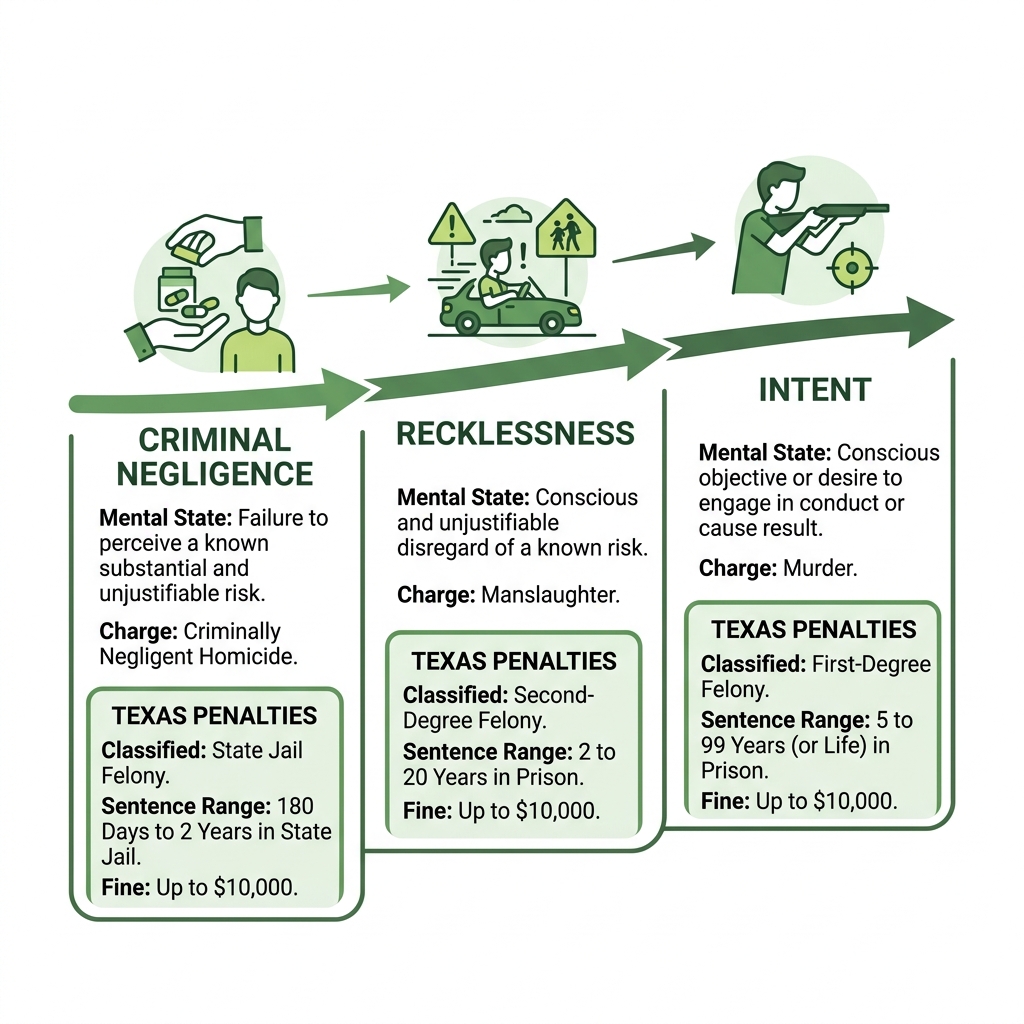
The primary legal distinction between negligent homicide vs manslaughter is the difference between recklessness and criminal negligence.

Think of it like a ladder of culpability. At the bottom, you have a “gross deviation” from the standard of care that any reasonable person in Houston would follow. This is where we find negligent homicide. You didn’t see the danger, but the law says you should have. One rung up is manslaughter, where you actually saw the danger, recognized it was a bad idea, and decided to do it anyway.
| Charge | Culpable Mental State | Texas Felony Level | Punishment Range |
|---|---|---|---|
| Manslaughter | Reckless | Second-Degree | 2 to 20 years in prison |
| Criminally Negligent Homicide | Criminal Negligence | State Jail Felony | 180 days to 2 years in state jail |
In the Harris County court system, the difference between these two rungs is massive. A second-degree felony carries a prison sentence up to 20 years, while a state jail felony tops out at two years.
Understanding Recklessness in Manslaughter
What does it actually mean to be “reckless”? According to Texas Penal Code § 19.04, a person commits manslaughter if they recklessly cause the death of another.
Recklessness is a conscious disregard of a substantial and unjustifiable risk. It’s that moment where a little voice in your head says, “This is dangerous,” and you keep going. You aren’t trying to kill anyone—if you were, you’d be facing murder charges—but you are being extremely irresponsible with human life.
Common scenarios we see in our criminal defense for manslaughter practice include:
- Extreme Speeding: We aren’t talking 10 mph over the limit on I-610. We mean weaving through heavy Houston traffic at 100 mph. You know someone could die; you just assume you’re a good enough driver to avoid it.
- Handling Firearms: Pointing a “cleared” gun at a friend and pulling the trigger. You know guns are dangerous, but you disregarded the risk that a round was still chambered.
- Heat of Passion: Sometimes, a sudden quarrel leads to a reckless act that results in death, though Texas law has specific nuances for how “sudden passion” can mitigate punishment.
The key is awareness. If the prosecutor can prove you knew there was a risk and you blew past it anyway, they’re going for manslaughter.
Defining Criminal Negligence in Negligent Homicide
Now, let’s look at the other side of the negligent homicide vs manslaughter coin. Criminally negligent homicide occurs when a person ought to be aware of a substantial and unjustifiable risk, but they fail to perceive it.
This is more than just a simple “accident” or “oops” moment. It’s not civil negligence (the kind you see in car insurance commercials). It is a “gross deviation” from the standard of care. ome states define this under statutes like ARS Section 13-1102, but in Texas, we look at criminally negligent homicide details through the lens of the “reasonable person.”
Would a reasonable person in Houston have seen the danger? If the answer is yes, and you didn’t, you could be facing a state jail felony.
The legal definition of negligence here involves unintentional harm. You didn’t think anyone would get hurt. You weren’t even considering the possibility. But because you should have been considering it, the state holds you criminally liable.
A classic example is a parent leaving a loaded, unsecured firearm on a nightstand where a curious toddler finds it. The parent didn’t “disregard” the risk in the moment—they likely weren’t thinking about it at all—but they should have perceived the danger of leaving a weapon accessible to a child.
Penalties and Classifications in Texas and Beyond
If you’re standing in a Texas courtroom, the label on your case file changes your entire future.
Texas Penalties
In Texas, manslaughter is a second-degree felony. That means if you’re convicted, you’re looking at 2 to 20 years in a state prison and a fine of up to $10,000. Because it’s a higher-level felony, the stakes for your “normal” life—jobs, housing, voting rights—are devastating.
Criminally negligent homicide is a state jail felony. This is the least serious homicide charge in Texas, but don’t let that fool you. You can still spend up to two years in a state jail facility.
One bit of “good” news for defendants in these cases is that both manslaughter and negligent homicide are generally eligible for probation (community supervision), unlike murder convictions where a jury cannot grant probation.
Looking Across State Lines
It’s interesting to see how other states handle these same tragedies. In Arizona, under Arizona Revised Statutes Section 13-1103, manslaughter is a Class 2 felony with a presumptive 5-year sentence. Their negligent homicide is a Class 4 felony, which is much lighter.
In New York, they use a “Class” system. Criminally negligent homicide is a Class E felony (up to 4 years), while second-degree manslaughter is a Class C felony (up to 15 years).
The Financial Toll: Bond Stats
We often get asked about bail immediately after an arrest. In nearby Tarrant County, data shows a massive spread in bond amounts. While a murder bond might sit at $100,000, manslaughter typically lands around $50,000. Interestingly, intoxication manslaughter—which involves a death caused by a DUI—often sees higher bonds, around $75,000, because the state views drunk driving as an ongoing threat to the community.
Real-World Scenarios: From Roadways to Work Sites
To truly understand negligent homicide vs manslaughter, you have to look at how these laws apply to real life in Houston.
The Dangers of the Road
Vehicular homicide in Texas is one of the most common ways these charges arise. If you are driving sober but being incredibly reckless—racing another car on Westheimer, for instance—and you kill someone, that’s manslaughter.
However, if you are intoxicated, Texas has a specific charge: intoxication manslaughter. This is a second-degree felony, just like regular manslaughter. The law assumes that by choosing to drink and drive, you have created a reckless risk to everyone on the road.
Case Study: Saunders v. State
The Saunders v. State case is a landmark for Texas lawyers. It helped clarify when a defendant is entitled to a “lesser included offense” jury instruction. In that case, the court looked at whether a defendant’s actions were merely negligent or truly reckless. These high-level court battles are exactly why having a former prosecutor on your side matters—we know how the state builds these cases and where the cracks are.
Workplace and Everyday Tragedies
- Construction Sites: If a foreman forgets to double-check a safety harness and a worker falls, that might be negligent homicide. If the foreman knows the harness is frayed, tells the worker to use it anyway, and the worker dies? That’s manslaughter.
- Medical Errors: Most medical mistakes are handled in civil court (malpractice). But if a doctor or nurse is under the influence or skips a standard check that they know is life-critical, it can cross into criminal territory.
- Firearm Mishaps: We see many cases involving “accidental” discharges. The difference usually comes down to whether the person was playing with the gun (reckless) or simply handled it improperly without realizing it was loaded (negligent).
Common Defenses and Reducing Charges
Just because you’ve been charged doesn’t mean the case is closed. Our job is to dig into the evidence and find the truth.
One of the most powerful tools in a defense attorney’s kit is challenging proximate cause. To convict you, the state has to prove that your specific action was the direct cause of the death. If there was an intervening factor—like a mechanical failure in a car or a medical professional’s error at the hospital—it can break the chain of legal responsibility.
When dealing with an intoxication manslaughter defense, we often challenge the validity of the blood or breath tests. If the police didn’t follow the rules, that evidence might get tossed out.
Other common strategies include:
- Lack of Awareness: Proving that you truly had no reason to perceive the risk. If the danger was hidden or unforeseeable, you shouldn’t be held criminally negligent.
- Constitutional Violations: Did the police search your car without a warrant? Did they fail to read you your rights? We look for any “procedural foul” that could lead to a dismissal.
- Factual Innocence: Sometimes, the police simply have the wrong person. Mistaken identity happens more often than people think in chaotic accident scenes.
- Reducing Felony Levels: If the state is overcharging you with manslaughter, we work to provide evidence that your actions were, at worst, negligent. Moving from a second-degree felony to a state jail felony can save you 18 years of your life.
Frequently Asked Questions about Homicide Charges
Can a manslaughter charge be reduced to negligent homicide?
Yes, absolutely. This is one of the most common outcomes in successful defense cases. It often happens through plea bargaining, where the prosecutor realizes their evidence for “recklessness” is weak. It can also happen at trial. If the judge allows a “lesser included offense” instruction, the jury can decide that while you weren’t reckless, you were negligent. This is where “mitigating evidence”—like your clean record or your character—becomes vital.
How do these crimes differ from murder in terms of intent?
The jump from manslaughter to murder is all about intent. Under Texas Penal Code § 19.02, murder requires that you “intentionally or knowingly” caused the death.
- Murder: You meant to kill them, or you knew with near-certainty your actions would kill them.
- Manslaughter: You didn’t mean to kill them, but you were being reckless.
- Negligent Homicide: You didn’t mean to kill them, and you didn’t even realize you were being dangerous (though you should have).
There is no “malice” or premeditation in manslaughter or negligent homicide. They are, in the eyes of the law, tragic accidents where someone is still legally to blame.
What are the typical bond amounts for these crimes in Texas?
While every judge is different, Harris County typically follows a bail schedule. For manslaughter, you might see a bond of $50,000. For intoxication manslaughter, that often jumps to $75,000. Murder bonds are rarely less than $100,000. These amounts are meant to ensure you show up to court, but they can be a massive financial burden. We often file motions for bond reduction to get our clients home while their case is pending.
What This Means for Your Defense
The line between negligent homicide vs manslaughter is thin, but the consequences of crossing it are life-altering. Whether you’re in downtown Houston or the outskirts of Harris County, the legal system is a maze of complex statutes and aggressive prosecutors.
At The Martinez Law Firm, we don’t just see a case number; we see a person whose future is on the line. I’ve spent years on the other side of the aisle as a prosecutor, and I know the tactics the state will use to try and secure a conviction. We use that inside knowledge to build an aggressive, personalized defense for every client.
If you are facing a homicide charge, don’t wait. The earlier we can get involved—reviewing the scene, talking to witnesses, and challenging the state’s narrative—the better your chances of a favorable outcome.
More info about criminal defense services is just a click away. Let us put our experience to work for you. Reach out to us today for a consultation, and let’s start fighting for your freedom.
One Night Out Can Change More Than Your Morning — Here’s How Serious a Public Intoxication Charge Really Is

How serious is a public intoxication charge is a fair question — and the honest answer is: more serious than most people expect, especially when it comes to what it leaves behind.
Here’s a quick breakdown before we get into the details:
| Factor | What You Need to Know |
|---|---|
| Charge Level | Class C misdemeanor in Texas (lowest criminal level) |
| Fine | Up to $500 |
| Jail Time at Conviction | None — but you can be held 6+ hours to sober up |
| Criminal Record | Yes — permanent, unless expunged |
| Long-Term Impact | Employment, housing, professional licenses, student aid |
| Minors | Treated more harshly — license suspension, mandatory education |
So while it won’t land you in prison, it can follow you for years.
Most people arrested for public intoxication (PI) in Houston are genuinely caught off guard. A night out on Washington Avenue, a little too much merriment walking between bars — and suddenly you’re in the back of a squad car. The charge sounds minor. It isn’t always.
Texas law under Penal Code § 49.02 defines public intoxication as appearing in a public place while intoxicated to the degree that you may endanger yourself or another person. That “may endanger” part is doing a lot of work. It’s subjective, it’s up to the officer’s discretion, and it means the bar for a charge can be surprisingly low.
What stings most isn’t the $500 fine. It’s the criminal record that shows up on background checks — for jobs, apartments, school applications, and professional licenses. That part doesn’t go away on its own.
Key Takeaways
- A public intoxication charge in Texas is still a criminal charge — It is a Class C misdemeanor with a fine of up to $500, and while it does not carry jail time after conviction, you can still be held 6+ hours to sober up after arrest.
- The lasting damage is usually the criminal record, not the fine — A PI conviction can appear on background checks for jobs, housing, school, and professional licenses, which is why many people find out too late that the charge is more serious than it sounds.
- Police do not need proof of violence or injury to make the arrest — Under Texas law, officers only need to believe you were in a public place, intoxicated, and might endanger yourself or someone else, which gives them broad discretion.
- First-time offenders may have options to avoid a conviction — In many cases, courts may allow deferred disposition, classes, or community service, but you still need to handle the case carefully if you want to avoid long-term record problems.
- Minors face extra consequences beyond the basic charge — A public intoxication charge for someone under 21 can trigger driver’s license suspension, alcohol education requirements, and added penalties, making the fallout much more severe.
I’m Herman Martinez, founder of The Martinez Law Firm in Houston, and with over 25 years of experience — including time as a Chief Prosecutor for the Harris County District Attorney’s Office and as a City of Houston Judge — I’ve seen how a charge like this is handled on both sides of the courtroom, which gives me a clear picture of just how serious a public intoxication charge can become if not handled correctly. In this guide, I’ll walk you through everything you need to know to protect yourself.
What Exactly is Public Intoxication in Texas?

In Houston, we see a lot of confusion regarding what counts as “illegal” drinking. You might be walking home from a Dynamo game or bar-hopping in Midtown, thinking you’re doing the responsible thing by not driving. Then, a Houston Police Department cruiser pulls over, and suddenly you’re being handcuffed.
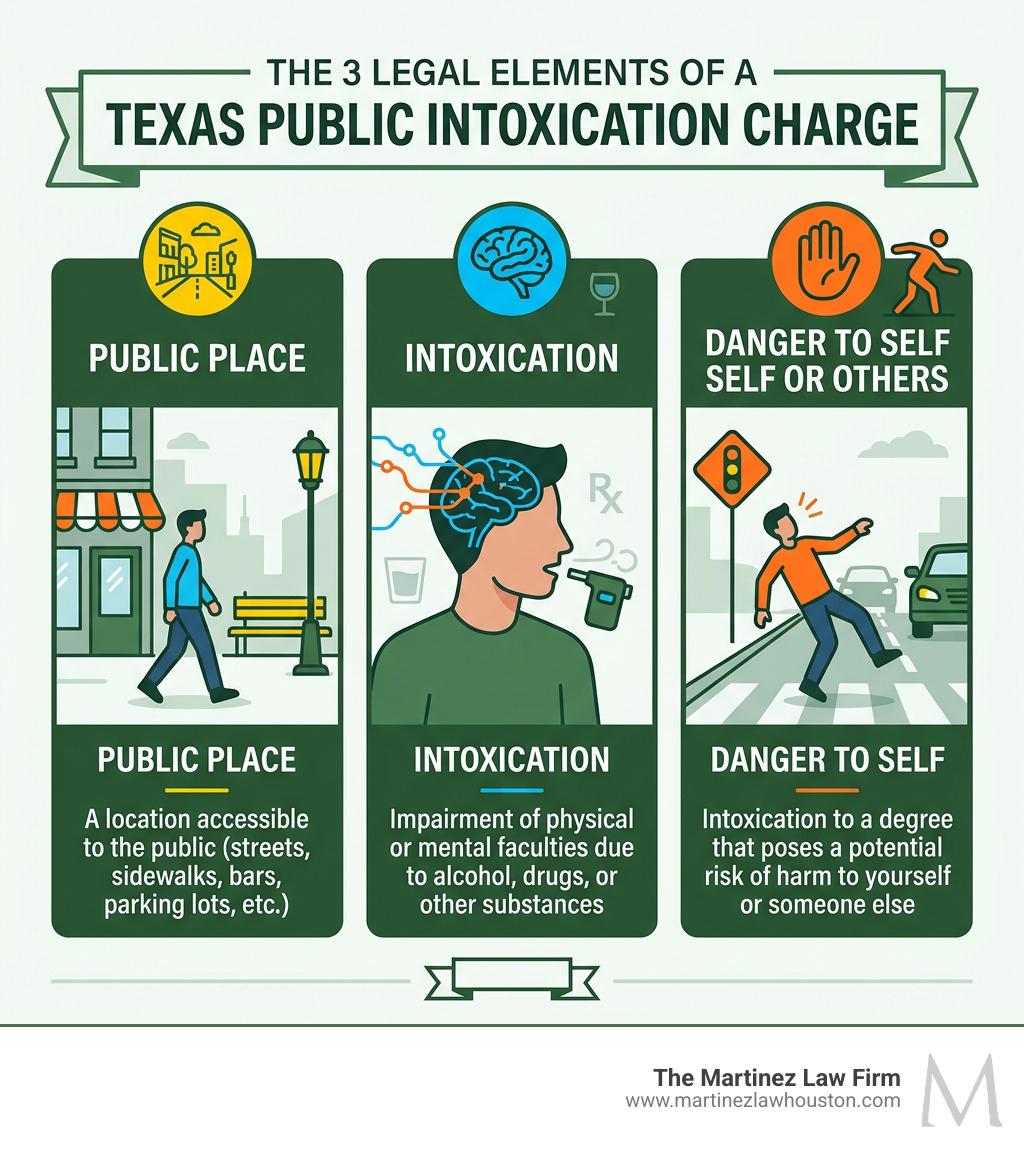
Under Texas Penal Code 49.02, the state doesn’t just care if you’ve been drinking; it cares if you’re a “danger.” To prove public intoxication in Texas, the prosecution has to check three specific boxes:
- You were in a public place: This is defined broadly. It includes streets, sidewalks, bars, restaurants, and even the common areas of your apartment complex.
- You were intoxicated: Texas defines this as not having the normal use of your mental or physical faculties due to alcohol or drugs, or having a BAC of 0.08 or higher.
- You posed a danger: This is the “gray area.” You don’t have to be falling down or picking a fight. If an officer decides you might wander into traffic or you’re too “out of it” to protect yourself from a robbery, they can arrest you.
This third element relies heavily on officer discretion. There is no mandatory breathalyzer test for a PI charge like there is for a DWI. An officer’s subjective observation of your “glossy eyes” or “slurred speech” is often all it takes to initiate an arrest.
How Serious is a Public Intoxication Charge?
If you’re sitting in a holding cell wondering how serious is a public intoxication charge, the immediate legal answer is that it’s a Class C Misdemeanor. In the hierarchy of Texas crimes, this is the lowest level. It’s on the same level as a traffic ticket.
The maximum fine is $500. You won’t be sentenced to jail time as part of your punishment if convicted. However, the experience of the arrest is very real. In Harris County, you will typically spend at least 6 to 24 hours in jail (often called the “drunk tank”) simply to sober up before you are allowed to see a judge or post bail. In some cases, officers may take you to the Harris County Sobering Center instead of jail, but that isn’t a guarantee.
To understand where PI sits compared to other charges, look at this comparison:
| Charge Type | Max Fine | Potential Jail Time | Severity |
|---|---|---|---|
| Public Intoxication | $500 | None (upon conviction) | Class C Misdemeanor |
| Disorderly Conduct | $500 | None (standard) | Class C Misdemeanor |
| DWI (1st Offense) | $2,000 | Up to 180 days | Class B Misdemeanor |
While the DWI penalties are significantly harsher, a PI charge is still a criminal matter. It isn’t a “civil” fine like a parking ticket. It is a criminal prosecution.
Understanding the Long-Term Impact: How Serious is a Public Intoxication Charge on Your Record?
The “hidden” seriousness of a PI charge is the permanent criminal record. If you simply pay the fine, you are pleading “guilty.” That conviction stays on your record forever.
When you apply for a job at a big Houston energy firm or try to rent an apartment in the Heights, a background check will show a “Criminal Conviction for Public Intoxication.” To an employer, this might signal a substance abuse problem or a lack of judgment. It can also complicate professional licensing for nurses, teachers, or lawyers, and it can even impact student financial aid. Knowing what happens after an arrest helps you realize that the paperwork is often more painful than the fine.
Navigating the Legal System: How Serious is a Public Intoxication Charge for a First-Time Offender?
For first-time offenders, there is a silver lining. Houston courts often offer “deferred disposition.” This is essentially a form of probation. You pay the court costs, maybe take an alcohol awareness class or perform community service, and stay out of trouble for a set period (usually 90 to 180 days).
If you finish the requirements, the judge dismisses the case. This is a much better outcome than a conviction, but—and this is a big “but”—the arrest still shows up on your record. You would still need to go through the legal process of expungement to wipe the slate completely clean. We often help clients navigate first-time DWI and related charges to ensure they don’t accidentally ruin their future over one bad night.
Comparing Texas Laws to Other States and Countries
Texas is actually quite strict compared to some other places. In states like Nevada or Montana, public intoxication isn’t even a crime—it’s treated as a public health issue.
In California, under California Penal Code Section 647, it’s a misdemeanor that can carry up to six months in jail, though L.A. prosecutors rarely pursue it. Alabama treats it as a “violation,” while Indiana classifies it as a Class B misdemeanor, which is more severe than Texas.
Internationally, the approach varies wildly. In some European countries, police will simply give you a ride home or to a “detox” station. In Singapore, the laws are famously rigid with high fines. The trend in many U.S. cities is moving toward decriminalization, focusing on treatment centers rather than jail cells, but Houston still leans heavily on the criminal justice side of things.
Defending Against a Public Intoxication Charge in Houston
Just because you were arrested doesn’t mean you have to be convicted. As a criminal defense firm, we look for the “weak links” in the prosecution’s story. Common defenses include:
- Not a Public Place: If you were on your private porch or in a gated area not open to the public, the charge might not stick.
- No Actual Danger: If you were sitting quietly on a bench waiting for an Uber, were you really a “danger” to yourself or others? We challenge the officer’s subjective opinion.
- Medical Conditions: Certain conditions like diabetes or even a severe concussion can mimic the signs of intoxication.
- Involuntary Intoxication: If someone “spiked” your drink without your knowledge, you aren’t legally responsible for the intoxication.
We also look for procedural errors. Did the officer have probable cause to stop you? Is there bodycam footage that shows you weren’t actually slurring your words? Often, witness statements from friends who were with you can provide the necessary contrast to an officer’s report.
Special Cases: Minors and Related Alcohol Offenses
If you are under 21, the question of how serious is a public intoxication charge gets a lot darker. Texas has a “Zero Tolerance” policy for minors.
A minor charged with PI faces the same $500 fine, but they also face a mandatory driver’s license suspension, even if they weren’t driving. They are also required to attend alcohol education programs and perform community service. If a minor is caught with an “open container” or charged with Minor in Possession (MIP) alongside the PI, the legal headaches multiply quickly.
Frequently Asked Questions about Public Intoxication
Can I go to jail for a PI in Houston?
While the conviction for a Class C misdemeanor doesn’t carry jail time, the arrest does. You will almost certainly spend several hours in a holding cell to sober up. If you have multiple prior PI convictions, the charge can be enhanced to a Class B misdemeanor, which does carry up to 180 days in jail.
Will a public intoxication charge show up on a job background check?
Yes. Unless the case is dismissed and subsequently expunged, the arrest and/or conviction will appear on standard criminal background checks. This can be a major hurdle for employment in corporate, medical, or educational fields.
How is public intoxication different from a DWI?
A DWI involves operating a motor vehicle while intoxicated. Public intoxication only requires being in a public place and posing a potential danger. You can get a PI while walking, standing, or sitting in the passenger seat of a parked car.
Why This Charge Deserves Serious Attention
A public intoxication charge may look minor at first. It often is not. Many people assume it is “just a fine” and something they can quickly put behind them. But handling it the wrong way can leave you with a record that follows you far longer than one night out.
Our team at The Martinez Law Firm knows how to fight these “subjective” charges. We leverage Herman Martinez’s experience as a former prosecutor to find the holes in the state’s case. We don’t just want to help you “pay a fine”—we want to help you protect your record and your reputation. If you’re worried about your future, protect your future with a Houston criminal defense expert and let us help you get back on track.
When Can Police Actually Stop, Search, or Arrest You?

Probable cause vs reasonable suspicion are two different legal standards that determine what police can and cannot do — and knowing the difference could be the difference between a dismissed case and a conviction.
Here’s the quick version:
| Standard | What It Means | What Police Can Do |
|---|---|---|
| Reasonable Suspicion | Specific, articulable facts suggesting criminal activity — more than a gut feeling | Briefly stop and question you; pat you down for weapons |
| Probable Cause | Enough evidence that a reasonable person would believe a crime has been or is being committed | Arrest you, search you, or obtain a search warrant |
Think of it as a ladder. Reasonable suspicion gets an officer close enough to take a look. Probable cause is what lets them act.
These aren’t just legal technicalities. They’re the constitutional guardrails — rooted in the Fourth Amendment — that protect you from unlawful stops, searches, and arrests every single day. In a city like Houston, where traffic stops on I-10 or 290 can spiral into DWI or drug charges in a matter of minutes, understanding where these lines are drawn is genuinely important.
Most people have no idea that police needed a legal justification to pull them over in the first place — let alone that a stop made without the right standard could get their entire case thrown out.
Key Takeaways
- Police need legal justification to stop you — Officers must have reasonable suspicion, meaning specific facts that suggest criminal activity, before they can legally stop and briefly question you.
- Probable cause allows arrests and searches — When officers have probable cause, they have enough evidence that a reasonable person would believe a crime occurred, which allows them to arrest you or conduct a search.
- Reasonable suspicion has limited authority — It only permits a brief investigative stop and a pat-down for weapons, not a full search of your pockets, vehicle, or belongings.
- Probable cause expands police powers significantly — With probable cause, officers can search property, make arrests, or request a warrant under Fourth Amendment standards.
- Illegal stops can destroy a criminal case — If police act without proper reasonable suspicion or probable cause, courts can suppress the evidence under the Exclusionary Rule, often leading to dismissed charges.
I’m Herman Martinez, founder of The Martinez Law Firm and a former Chief Prosecutor for the Harris County District Attorney’s Office and former City of Houston Judge — experience that gives me a rare inside view of exactly how probable cause vs reasonable suspicion are applied, and more importantly, how they’re sometimes abused. That background is what I bring to every criminal defense case I take in the greater Houston area.
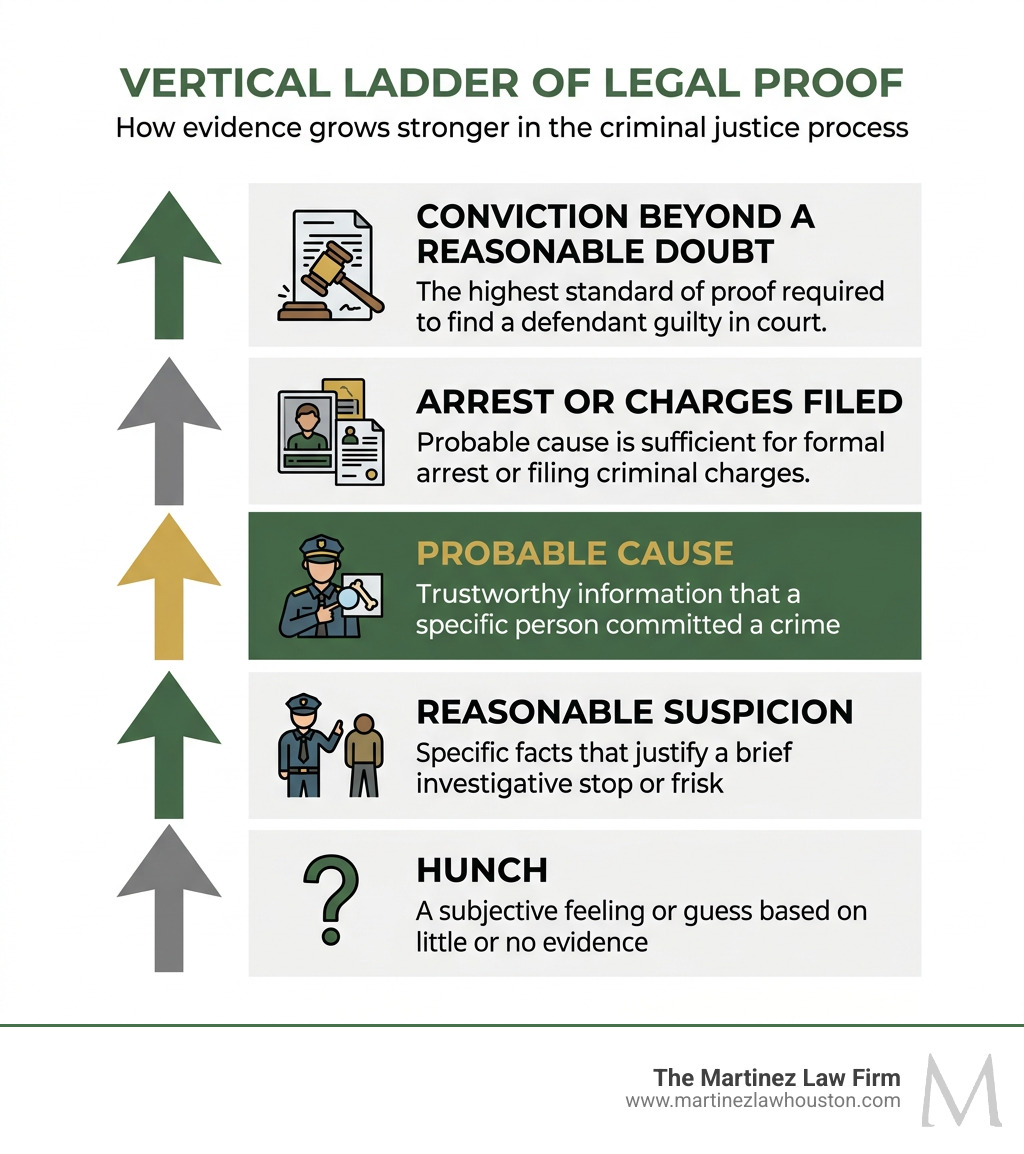
Reasonable Suspicion: The “Terry Stop” Standard

If you’ve ever been walking down a street in Harris County and had a patrol car pull up alongside you, you’ve likely encountered the concept of reasonable-suspicion.
In the eyes of the law, reasonable suspicion is a step above a “hunch” but several steps below “proof.” It requires what lawyers call “specific and articulable facts.” This means an officer can’t just say, “He looked like he was up to no good.” They have to be able to point to something specific—like someone matching the description of a suspect who just robbed a nearby convenience store or someone pacing back and forth in front of a closed business at 3:00 AM while clutching a crowbar.
This standard comes from a landmark 1968 Supreme Court case, Terry v. Ohio, 392 U.S. 1 (1968). In that case, an officer watched three men pacing and peering into a store window multiple times. Suspecting they were “casing” the joint for a robbery, he stopped them and patted them down for weapons. The Court ruled that this was legal because the officer had a reasonable suspicion that a crime was about to happen and that the men might be armed.
Today, we call these “Terry Stops.” They are brief, investigative detentions. The police can ask for your ID, ask what you’re doing, and—if they reasonably believe you are armed and dangerous—conduct a quick pat-down of your outer clothing (a “frisk”).
Crucially, reasonable suspicion does not give them the right to dig through your pockets for drugs or search the trunk of your car. It is strictly limited in scope and duration. If the officer doesn’t find evidence of a crime during that brief window, they are supposed to let you go.
Real-World Examples of Probable Cause vs Reasonable Suspicion
The line between a “hunch” and “reasonable suspicion” is often where we win cases in the Houston courts. Let’s look at some scenarios:
- The Anonymous Tip: In Florida v. J.L., 529 U.S. 266 (2000), the Supreme Court ruled that an anonymous tip saying a young man in a plaid shirt at a bus stop had a gun was not enough for reasonable suspicion. Why? Because the tip didn’t provide any way to test the informant’s credibility or predict future behavior. It was just a description.
- Nervous Behavior: Simply being nervous when a Houston cop pulls you over isn’t usually enough for a search. However, if you’re in a “high-crime area” (a term police love to use) and you suddenly bolt the moment you see a cruiser, the courts have often said that unprovoked flight plus the location can equal reasonable suspicion.
- Loitering: Standing on a corner isn’t a crime. But if an officer sees you passing small glassine baggies to people in exchange for cash, that moves past suspicion and straight into the next category.
Probable Cause: When the Cuffs Come Out
If reasonable suspicion is the “yellow light” of police work, what-is-probable-cause is the “green light.” This is the standard required by the Fourth Amendment for an officer to make an arrest, conduct a full search of your person or property, or ask a judge to sign a warrant.
Probable cause exists when the facts and circumstances would lead a “reasonable person” to believe that a crime has been committed and that the person being arrested is the one who did it. It’s about a “fair probability.”
The Supreme Court clarified this in Illinois v. Gates. They moved away from a rigid, two-part test and instead told courts to look at the “totality of the circumstances.” Basically, they want judges to use common sense. If all the pieces of the puzzle point toward criminal activity, then probable cause is likely met.
In Houston, we see this most often in drug and DWI cases. If an officer pulls you over for swerving (reasonable suspicion) and then smells a strong odor of alcohol on your breath, sees empty beer cans on the floorboard, and watches you stumble out of the car, they now have the “totality” needed for probable cause to arrest you for DWI.
Why the Distinction Between Probable Cause vs Reasonable Suspicion Matters
Why do we care so much about these definitions? Because they are the only things standing between you and a “police state” environment.
- Arrest Authority: Without probable cause, an arrest is illegal. If you are hauled into the Harris County Jail without it, your lawyer can fight to have the charges dropped immediately.
- Search Scope: Reasonable suspicion allows a “pat-down” for weapons. Probable cause allows a “search” for evidence. If an officer reaches into your pocket and pulls out a bag of cocaine based only on reasonable suspicion, that evidence shouldn’t be allowed in court.
- Constitutional Protection: The Fourth Amendment protects you from “unreasonable” searches and seizures. The courts define “reasonable” based on these two standards.
In Harris County courts, judges take these distinctions seriously. If we can prove that a Houston police officer jumped the gun—meaning they made an arrest when they only had suspicion—the entire case can fall apart like a house of cards.
Probable Cause vs Reasonable Suspicion: Key Differences
When we are in the middle of a trial, we often have to break these down for a jury. It helps to look at them side-by-side to see how the officer’s power grows as the evidence increases.
| Feature | Reasonable Suspicion | Probable Cause |
|---|---|---|
| Evidence Level | “Articulable facts” (more than a hunch) | “Fair probability” (more likely than not) |
| Primary Goal | Investigation / Safety | Prosecution / Arrest |
| Authorized Action | Stop, Question, Frisk | Arrest, Search, Warrant |
| Court Case | Terry v. Ohio | Illinois v. Gates |
| Constitutional Basis | 4th Amendment (Reasonableness) | 4th Amendment (Warrants Clause) |
It’s also important to note Florida v. Bostick, 501 U.S. 429 (1991). This case reminds us that a “seizure” happens the moment a reasonable person feels they are not free to leave. If a Houston cop corners you in a way that makes you feel trapped, they better have at least reasonable suspicion to justify it.
How a Houston Traffic Stop Escalates
Traffic stops are the most common way these two standards interact in real life. Let’s walk through a typical night on the 610 Loop or I-10.
Step 1: The Stop (Reasonable Suspicion) An officer sees you change lanes without signaling. That is a traffic violation. In Texas, a traffic violation is enough reasonable suspicion to pull you over. At this point, you are “detained,” but not “arrested.”
Step 2: The Interaction The officer walks up to your window. This is where you need to know your dwi-traffic-stop-what-are-my-rights. You are required to show your license and insurance. You are not required to answer questions like “Where are you coming from?” or “Have you been drinking?”
Step 3: The Observation (Plain View) If the officer sees a baggie of marijuana sitting on your passenger seat, they can seize it under the plain-view-doctrine-an-essential-guide. That visual evidence immediately upgrades their “reasonable suspicion” to “probable cause” to search the rest of the car.
Step 4: The Escalation Maybe there’s no marijuana, but the officer says they smell alcohol. They ask you to step out for field sobriety tests. If you perform poorly on these tests, the officer now has enough evidence to form a “reasonable belief” that you are intoxicated.
Step 5: The Arrest (Probable Cause) Once they have that belief, the cuffs come out. They now have probable cause for a DWI arrest. This is also when they might try to do-the-police-have-the-right-to-search-your-car. Generally, if you are arrested, they can search the area within your immediate control.
Fighting Back: When Police Overstep in Harris County
Police officers are humans. They get tired, they get frustrated, and sometimes, they get overzealous. In Houston, we see cases every week where an officer made an arrest because they “just knew” someone was guilty, even though they didn’t have the legal evidence to back it up.
This is where the Exclusionary Rule comes in.
Established by the Supreme Court in Mapp v. Ohio, the exclusionary rule says that if evidence is obtained in violation of your Fourth Amendment rights, it cannot be used against you in court. This is often called the “Fruit of the Poisonous Tree” doctrine. If the “tree” (the initial stop or arrest) is “poisoned” (illegal), then the “fruit” (the drugs or BAC results found afterward) is also poisoned.
As defense attorneys, one of our strongest tools is the Motion to Suppress. We ask the judge to hold a hearing, cross-examine the officer, and look at the dashcam and bodycam footage.
- Did the officer actually see you swerve, or was that a unlawful-traffic-stops?
- Did they really smell marijuana, or was that just an excuse to search a car they found “suspicious”?
- Did they wait 45 minutes for a K-9 unit to arrive for a simple speeding stop? (The Supreme Court says they can’t extend a stop longer than necessary to handle the initial reason for the stop).
If the judge agrees that the officer lacked probable cause vs reasonable suspicion, they can suppress the evidence. When the evidence is suppressed, the prosecution usually has no choice but to dismiss the charges.
Frequently Asked Questions about Police Encounters
We get a lot of questions from folks in Harris County about their rights. Here are the big three:
Can an officer search my car based only on reasonable suspicion?
No. Reasonable suspicion only allows for a brief detention and, if they fear for their safety, a “frisk” of the passenger compartment for weapons. To do a full search for drugs or other contraband, they generally need your consent, a warrant, or probable cause (like the smell of marijuana or seeing something in plain view).
What happens if I am arrested without probable cause?
If your arrest lacked probable cause, it is a violation of your constitutional rights. Any evidence found after that arrest (like a confession or items found in your pockets) can be suppressed. In many cases, this leads to a complete dismissal of the charges. You may also have grounds for a civil rights lawsuit, though that is a separate legal matter.
Is a “hunch” enough for a police officer to stop me in Texas?
Absolutely not. A hunch is a feeling; reasonable suspicion is a fact. An officer must be able to point to specific behavior or circumstances that suggest a crime is afoot. If an officer pulls you over just because you “looked suspicious” while driving through a certain neighborhood, that stop is likely illegal.
Know Your Rights When a Stop Turns Serious
Understanding the nuances of probable cause vs reasonable suspicion is the first step in protecting your freedom. These standards aren’t just for lawyers to argue about in dusty courtrooms; they are the rules that govern every interaction you have with law enforcement in Houston.
If you or a loved one has been arrested in Harris County, the most important question you can ask is: “Did the police have the legal right to do what they did?”
At The Martinez Law Firm, we don’t just take the police’s word for it. As a former prosecutor and judge, I know how to look at a case from the other side. We meticulously review every detail of the stop and the arrest to ensure your rights weren’t trampled. If the police overstepped, we are prepared to fight aggressively to have that evidence thrown out and your case dismissed.
Don’t leave your future to chance. If you’re facing charges in Houston, you need a defense that is as personalized as it is aggressive. Give us a call today, and let’s start building your defense.
The True Cost of a DWI in Houston

How much is a DWI fine in Texas? If you’re facing a DWI charge in Houston, the financial consequences extend far beyond the initial court-imposed penalty. Here’s what you need to know:
| Offense Level | Court Fine | State Surcharge | Estimated Total Cost |
|---|---|---|---|
| First DWI | Up to $2,000 | $3,000-$6,000 | $5,000-$24,000 |
| Second DWI | Up to $4,000 | $4,500 | $6,000-$25,000+ |
| Third DWI (Felony) | Up to $10,000 | $6,000 | $10,000-$30,000+ |
A DWI conviction in Texas carries an unexpectedly heavy financial burden. While court-imposed fines range from $2,000 to $10,000, these are just the tip of the iceberg. Factoring in state surcharges, ignition interlock fees, insurance hikes, and more, the Texas Department of Transportation estimates the total cost of a first-time DWI can range from $5,000 to $24,000 or more.
Beyond the financial hit, a Houston DWI conviction impacts your life in other ways. Your license may be suspended for up to two years, complicating work and family life. It can also affect child custody, employment, and firearm rights. Penalties escalate with aggravating factors like a high BAC (over 0.15%), a child passenger, or causing an accident, pushing fines and jail time higher.
Understanding the full scope of how much is a DWI fine requires looking beyond direct penalties to the hidden costs. I’m Herman Martinez, founder of The Martinez Law Firm, with over 25 years of experience as a Chief Prosecutor and City of Houston Judge, and I’ve seen the devastating impact of a DWI. The right defense strategy is crucial. My background as a former prosecutor provides unique insight into the State’s case, revealing vulnerabilities we can use to protect your rights and finances.
Key Takeaways
- A DWI fine in Texas ranges from $2,000 to $10,000, depending on the offense: First offenses carry up to $2,000, second up to $4,000, and third (felony) up to $10,000 in court fines alone.
- The real cost goes far beyond the court fine: State surcharges, ignition interlock fees, insurance increases, probation costs, and reinstatement fees can push a first DWI to $5,000–$24,000 or more.
- Repeat or aggravated DWIs sharply increase penalties: A high BAC (0.15%+), a child passenger, or causing injury or death can elevate charges to higher misdemeanors or felonies with larger fines and prison time.
- License suspension and long-term consequences add to the burden: A conviction can suspend your license for up to two years and affect employment, custody, and professional opportunities.
- Strong legal defense can reduce financial and long-term damage: Charge reductions, evidence challenges, or negotiated outcomes may significantly limit fines and collateral consequences.
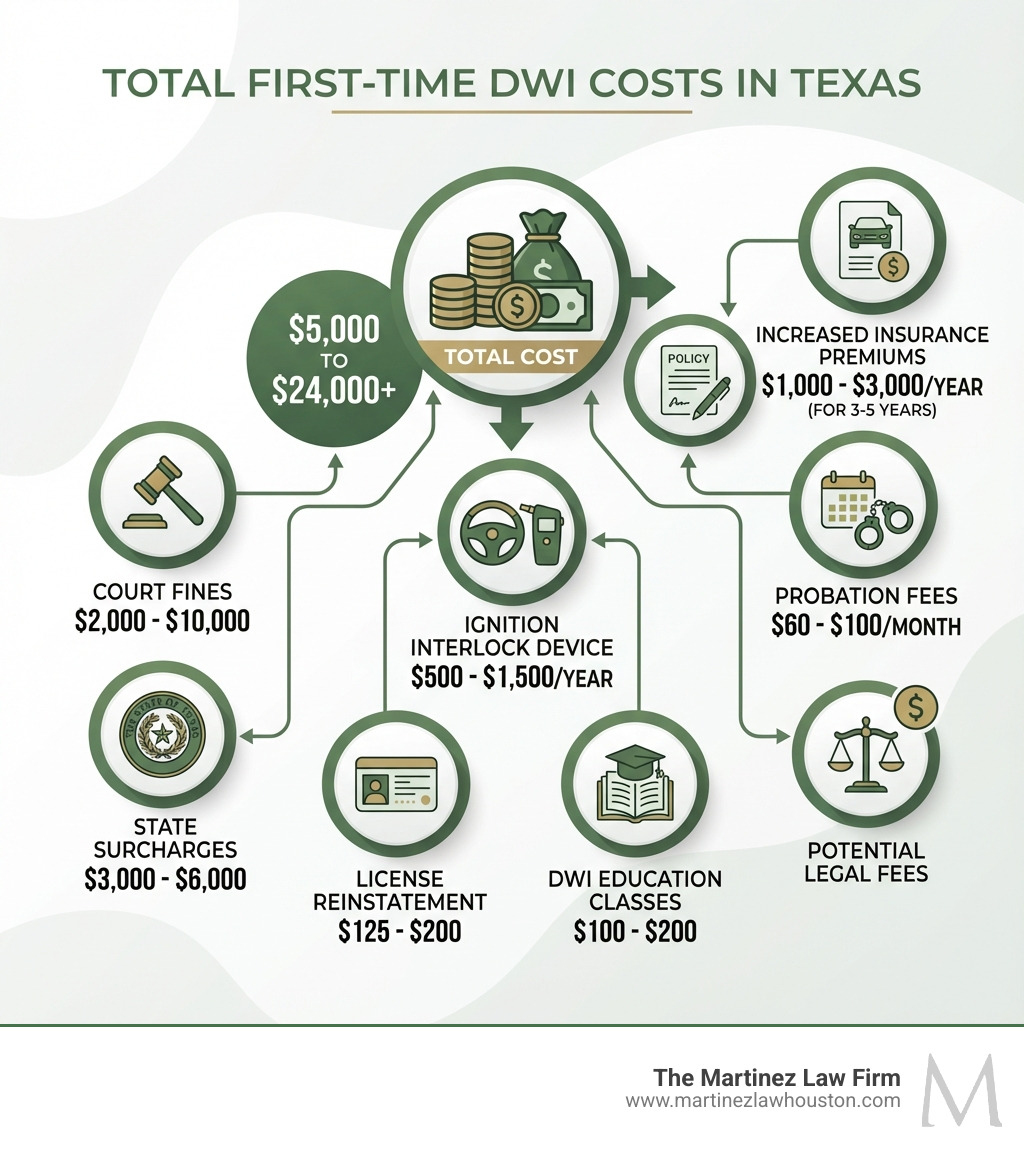
Breaking Down Court-Imposed DWI Fines in Texas
To understand how much is a DWI fine in Texas, start with the court-imposed penalties defined by the Texas Penal Code. The severity of these fines and sentences depends on the offense classification (misdemeanor or felony) and your prior DWI record. While judges have some discretion, mandatory minimums often apply.
Texas uses a tiered penalty system, where fines and other penalties increase with each conviction. A misdemeanor with a manageable fine can quickly escalate to a felony with substantial fines and prison time.

How much is a DWI fine for a first offense?
A first-time DWI in Texas is typically a Class B Misdemeanor, carrying the lightest penalties. The court-imposed fine is up to $2,000, but this is just the base penalty. In addition, a first conviction can lead to:
- Jail time: 3 to 180 days in county jail.
- License suspension: Up to one year.
- Probation: Often imposed with its own conditions and fees.
These are just the criminal penalties; other financial burdens will add up. For more details, refer to the Texas DWI penalties explained.
What are the fines for a second DWI?
A second DWI within 10 years significantly escalates penalties. Texas classifies this repeat offense as a Class A Misdemeanor. The court fine increases to up to $4,000, and a second conviction also brings:
- Mandatory jail time: A minimum of one month and up to one year in county jail.
- Increased license suspension: Up to two years.
- Mandatory Ignition Interlock Device (IID): A judge will likely order an IID installation.
The legal system views a second DWI as a clear sign that previous penalties were insufficient, leading to a much stricter response.
What are the fines for a third (or subsequent) DWI?
A third or subsequent DWI is a Third-Degree Felony in Texas. This life-altering event carries severe penalties. The court fine is up to $10,000, but this is often overshadowed by other potential consequences:
- Prison sentence: 2 to 10 years in a state penitentiary.
- Lengthy license suspension: Up to two years, with additional reinstatement requirements.
- Permanent criminal record: A felony conviction impacts your life indefinitely.
The state’s message is clear: repeat DWI offenses bring severe consequences, making the fine secondary to the loss of freedom and long-term impacts.
How Much is a DWI Fine? Understanding Additional Costs and Surcharges
When asking how much is a DWI fine, many only consider the court penalty. The true financial burden of a Houston DWI conviction is much higher. Texas imposes mandatory state administrative fines (surcharges) and other costs that can dwarf the court fine, pushing the total cost into the tens of thousands of dollars.

Mandatory State Administrative Fines
Separate from court fines, the Texas Department of Public Safety (DPS) levies mandatory civil penalties called surcharges. You must pay these annually for three years to keep your driver’s license.
- First offense surcharge: An annual surcharge of $1,000 for three years ($3,000 total). This increases to $2,000 annually ($6,000 total) if your BAC was 0.15% or higher.
- Second offense surcharge: For a second DWI within 36 months, the annual surcharge is $1,500 for three years ($4,500 total).
- High BAC surcharge: A BAC of 0.15% or higher on a first offense lifts the surcharge to $2,000 annually for three years ($6,000 total).
These non-negotiable surcharges are a major part of the total cost. Failure to pay results in automatic license suspension.
The “Hidden” Costs of a DWI Conviction
Beyond fines and surcharges, a DWI conviction triggers other substantial, often overlooked “hidden” costs:
- Ignition Interlock Device (IID) costs: If court-ordered, you’ll pay for installation and monthly maintenance, adding $500 to $1,500 per year.
- Probation fees: Probation includes monthly supervision fees of $60 to $100 per month.
- DWI education classes (DWI-E): Mandatory DWI education classes cost $100 to $200 or more.
- Increased car insurance rates: As a high-risk driver, your premiums can increase by $1,000 to $3,000 annually for three to five years. Some insurers may drop your coverage.
- License reinstatement fees: Reinstating your license with the DPS costs $125 to $200 after your suspension.
- Legal fees: Hiring an experienced DWI attorney is a necessary expense to protect your rights.
- Bail bond fees: A non-refundable cost if you were arrested.
- Vehicle towing and impoundment fees: Expect these fees after a DWI arrest.
Adding up these fines, surcharges, and hidden costs shows why a first-offense DWI in Houston can total $5,000 to $24,000 or more, not including lost wages or emotional distress.
Aggravating Factors That Can Dramatically Increase Your DWI Fine
Beyond standard penalties, Texas law includes aggravating factors that dramatically increase how much is a DWI fine and other penalties. These factors can lift a misdemeanor to a felony, resulting in higher fines, longer sentences, and severe long-term consequences. Houston-area enforcement is particularly vigilant in these cases.
DWI with a High Blood Alcohol Concentration (BAC)
Texas law imposes harsher penalties for a high BAC. A BAC of 0.15% or higher automatically lifts a first-offense DWI charge.
- Classification: A first DWI with a BAC of 0.15% or higher becomes a Class A Misdemeanor.
- Increased Fines: The maximum court fine increases to $4,000, and the mandatory state surcharge doubles to $6,000 over three years.
- Harsher Penalties: A high BAC often leads to longer probation, mandatory IID installation, and a higher likelihood of jail time.
The higher your BAC, the more severe the penalties.
DWI with a Child Passenger
Driving while intoxicated with a child passenger is a separate, more serious charge in Texas, not just an aggravating factor.
- Charge: This is charged as child endangerment, a State Jail Felony.
- Fines: The charge carries an additional fine of up to $10,000.
- Additional Jail Time: A conviction can result in a prison sentence of up to two years, on top of any DWI penalties.
- License Suspension: Your license could be suspended for an additional 180 days.
The state considers this a direct threat to a child’s safety, resulting in severe penalties.
DWI Causing an Accident, Injury, or Death
The most severe DWI offenses involve accidents causing injury or death. These are serious felonies with life-altering consequences.
- Intoxication Assault: Causing serious bodily injury while intoxicated is a Third-Degree Felony.
- Fines: Up to $10,000.
- Prison: 2 to 10 years in state prison.
- Restitution: You will likely be ordered to pay restitution to the victim.
- Intoxication Manslaughter: Causing a death while intoxicated is a Second-Degree Felony.
- Fines: Up to $10,000.
- Prison: 2 to 20 years in state prison.
- Life-altering consequences: A conviction leads to a permanent felony record, civil lawsuits, and the devastation of causing a fatality.
In these cases, the fine is secondary to lengthy prison sentences and other profound ramifications.
How Texas Law Defines “Intoxicated” and Why It Matters for Your Case
Understanding the Texas legal definition of “intoxicated” is key to a DWI defense. It’s not just about a BAC number; it’s about safe vehicle operation. Prosecutors in Harris County use two primary methods to prove intoxication.
The .08 BAC Per Se Rule
The most common definition is the “per se” rule: you are legally intoxicated if your Blood Alcohol Concentration (BAC) is 0.08 percent or higher. This is measured by breath or blood tests.
- Legal Presumption: A BAC of 0.08% or higher creates a legal presumption of intoxication, regardless of whether you felt impaired, simplifying the prosecution’s case.
- Lower Limits: The limit is lower for commercial drivers (0.04%), and Texas has a “zero tolerance” policy for drivers under 21 (any detectable amount of alcohol).
Impairment by “Loss of Normal Use”
You can be charged with DWI even with a BAC below 0.08% if the prosecution proves you lost the normal use of your mental or physical faculties due to alcohol or drugs. This subjective standard is equally valid under Texas law and focuses on your ability to drive safely.
- Field Sobriety Tests (FSTs): Police use standardized tools and tests to detect impaired drivers, like the Walk-and-Turn and One-Leg Stand, to assess impairment. An officer’s observations of your performance and demeanor can be used as evidence.
- Officer Testimony: The officer’s testimony about your driving, appearance, and FST performance is crucial evidence in these cases.
- Impairment by Drugs or Alcohol: This definition includes impairment from illegal drugs, prescription medications, or over-the-counter drugs. Specially trained Drug Recognition Experts (DREs) may be called to assess suspected drug impairment.
Because these charges rely on subjective observations, a skilled attorney can challenge the FST administration and the officer’s interpretation.
Frequently Asked Questions about DWI Costs in Houston
Understanding how much is a DWI fine and its related costs is complex. Here are FAQs about DWI costs in Houston and Harris County.
What are the fines for refusing a breathalyzer in Texas?
There is no direct criminal fine for refusing a breathalyzer, but the administrative consequences are severe. Under Texas’s implied consent law, refusal triggers an automatic Administrative License Revocation (ALR).
- License Suspension: A first refusal results in a 180-day license suspension. A second refusal leads to a two-year suspension.
- Civil Process: The ALR is a civil process. If you lose the hearing, your license is suspended, and you’ll later pay a reinstatement fee.
- Search Warrant: Refusing may not prevent a BAC test, as officers can seek a warrant for a blood draw. You will still face the ALR suspension.
How do fines for drug-impaired driving compare to alcohol-impaired driving?
Texas law does not distinguish between alcohol and drug impairment regarding DWI fines and penalties. The Texas Penal Code’s definition of “intoxicated” covers both, meaning the same court fines, state surcharges, and jail time apply regardless of the substance.
Proving drug impairment is more complex, often relying on field sobriety tests, Drug Recognition Expert (DRE) observations, and blood tests. However, a conviction carries the same severe financial and legal penalties.
Can a DWI charge be reduced to a lesser offense in Harris County?
Yes, reducing a DWI charge to a lesser offense like Obstruction of a Highway or Reckless Driving is possible in Harris County through plea bargaining. This is a key strategy our firm uses, leveraging our experience as former prosecutors.
- Negotiation: If the state’s case has weaknesses (e.g., issues with the stop, FSTs, or evidence handling), we can negotiate for a reduced charge.
- Deferred Adjudication: For some first-time offenders, deferred adjudication may be an option. Completing probation leads to a dismissal, not a conviction.
- Why It Matters: Achieving a reduction depends on your case, criminal history, and the prosecutor. A lawyer familiar with Harris County prosecutors is invaluable. Reducing a DWI charge mitigates financial and long-term consequences, highlighting the need for skilled legal help.
How a Former Prosecutor Can Protect Your Future and Finances
A Houston DWI charge is daunting, with the question of how much is a DWI fine being just one threat to your freedom and future. The unique perspective of a former prosecutor like Herman Martinez is invaluable in these situations.
At The Martinez Law Firm, our experience on both sides of the courtroom provides a distinct advantage. As a former Chief Prosecutor and City of Houston Judge, Herman Martinez knows how the state builds its case and where to find vulnerabilities. This insider knowledge allows us to:
- Develop a Strong Legal Strategy: We scrutinize every detail of your arrest to find procedural errors and constitutional violations to challenge.
- Seek Evidence Suppression: We fight to suppress illegally obtained evidence, which can weaken the state’s case or lead to dismissal.
- Negotiate Effectively: Our familiarity with Harris County courts and prosecutors helps us negotiate from a position of strength for reduced charges and minimized penalties.
- Provide Aggressive Trial Defense: If a plea bargain isn’t favorable, we are prepared to defend you at trial with a compelling, fact-based case.
A Houston DWI conviction has far-reaching consequences, affecting your job, travel, professional licenses, and personal life. We are dedicated to protecting your rights, your license, and your future.
Don’t face the complexities of a DWI charge alone. Let our proven track record and unique insights work for you. Protect your rights with an experienced DWI lawyer from The Martinez Law Firm. Contact us today for a free consultation, and let us help you steer this challenging time and work towards the best possible outcome for your case.
Why Understanding Horse-Related DWI Laws Matters in Texas

Can you get a DWI on a horse in Texas? This question might sound like something out of a western movie, but it’s a genuine legal concern—especially after viral videos showed people claiming they couldn’t be charged with drunk driving on horseback. Here’s what you need to know:
Quick Answer: DWI on a Horse in Texas
- Legally uncertain: Texas law doesn’t explicitly address horses, creating a gray area
- Unlikely but possible: The statute’s broad definition of “motor vehicle” could theoretically include a horse, though this is not common
- Alternative charges more likely: Public intoxication, reckless endangerment, or animal cruelty are typical charges instead
- Horse-drawn vehicles different: Operating a buggy or wagon while intoxicated can result in DWI charges
- State laws vary drastically: North Carolina explicitly exempts horses; Kentucky explicitly includes them
A viral TikTok from the Charlotte area received nearly 3 million likes when a man confidently stated, “You cannot get a DUI on a horse in the State of North Carolina.” While he was technically correct for his state, the answer for Texas is far less clear-cut—and the consequences of getting it wrong can be serious.
The confusion stems from how different states define “vehicle” in their impaired driving statutes. In Texas, the legal definition is deliberately broad, referring to “a device in, on, or by which a person or property is or may be transported or drawn on a highway.” This vague language has led to DWI charges for everything from riding lawnmowers to operating motorized coolers. But what about a 1,200-pound animal with a mind of its own?
Why This Question Matters in Houston
In Houston and across Harris County, this is more than a theoretical issue. Texas has strong ranching and rodeo traditions, and horseback riding is still part of everyday life in many areas. Whether you are riding home from a neighborhood bar or joining a large trail ride, knowing your legal risk matters. While an actual DWI charge on horseback is uncommon in Texas, officers have other options—most often public intoxication and animal-related charges—that can still lead to significant fines, a record, and even jail time.
With over 25 years navigating Texas criminal law from both sides of the courtroom, first as a Chief Prosecutor and later as a City of Houston Judge, Herman Martinez brings a unique perspective to these issues. When clients ask can you get a DWI on a horse, he draws on this background to explain the legal nuances and real-world outcomes they might face in Houston’s courts.
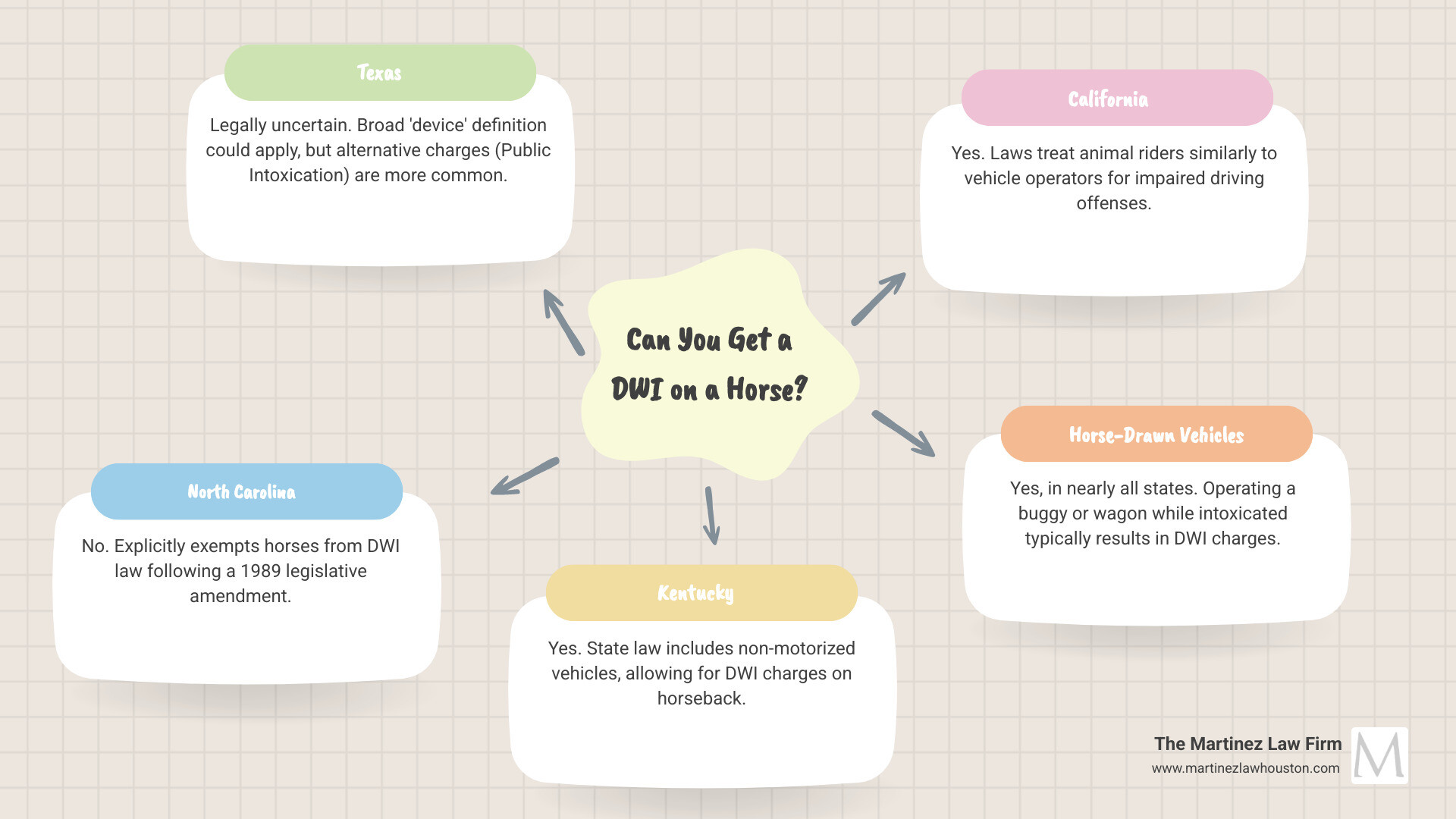
The Core of the Issue: What is a ‘Vehicle’ in Texas DWI Law?
When we talk about Driving While Intoxicated (DWI) laws, the crucial element is always the definition of a “vehicle.” Our Texas Penal Code, like many others, sets out what constitutes a vehicle for the purposes of impaired driving. This is where the ambiguity surrounding can you get a DWI on a horse really begins.
The legal definition of a “motor vehicle” in Texas is quite broad. It’s not just about cars and trucks; it refers to “a device in, on, or by which a person or property is or may be transported or drawn on a highway, except a device used exclusively on stationary rails or tracks.” This definition is key because it doesn’t explicitly require the device to be motorized. This lack of a motor requirement is what opens the door to potential DWI charges for all sorts of unconventional conveyances, and it’s why prosecutors might try to argue that a horse fits this description.
We understand that the legislative intent behind DWI laws was primarily to regulate the operation of motor vehicles, given their inherent danger. However, the broad language leaves room for interpretation. This is where our experience at The Martinez Law Firm becomes invaluable, helping clients steer these legal gray areas.
How Texas Defines “Motor Vehicle”
Let’s dive a little deeper into the specific wording. Texas Penal Code Section 32.34(a) defines a motor vehicle as a “device in, on, or by which a person or property is or may be transported or drawn on a highway.” Notice what’s missing? The word “motor.” This means that, unlike some states, Texas doesn’t limit its DWI statute to only self-propelled vehicles.
This is a critical distinction. If the law explicitly stated “motor vehicle,” then a horse would clearly be exempt. But because it uses the broader term “device,” a prosecutor could attempt to argue that a horse, when ridden or used for transport on a public roadway, acts as a “device” for conveyance. We’ve seen prosecutors try to stretch definitions in the past, and while it might sound far-fetched, it’s a possibility we must consider.
Why a Horse is Likely Not a “Motor Vehicle”
Despite the broad definition, we believe that a horse is likely not a “motor vehicle” under current Texas DWI law for several reasons. Primarily, a horse is an animal, a living being, not a manufactured “device.” The common understanding of a “device” implies a mechanical or man-made object. While a horse can transport a person, its mode of operation—guided by an animal’s will and instincts—differs fundamentally from a car or even a bicycle.

Furthermore, there’s a significant lack of direct precedent in Texas case law where a horse has been successfully prosecuted as a “motor vehicle” for DWI purposes. While some prosecutors might attempt such an argument, the legal odds are strong that it wouldn’t hold up in court. Our role at The Martinez Law Firm is to highlight these distinctions and advocate for our clients, ensuring that the spirit of the law, not just its broadest interpretation, is applied. We fight to preserve the western heritage and Texas traditions that many of our clients value, where riding a horse is a part of life, not an invitation for an absurd DWI charge.
Can You Get a DWI on a Horse in Texas vs. Other States?
The question of can you get a DWI on a horse is truly a tale of varying state laws. What’s perfectly legal in one state might land you in hot water in another. This highlights the importance of understanding your local jurisdiction, especially if you’re riding in Houston or Harris County.
State Breakdown
| State | Can You Get a DWI on a Horse? | Legal Basis / Precedent |
|---|---|---|
| Texas | Unlikely, but possible | Texas law defines “motor vehicle” broadly as a “device” for transport, but a horse is generally not considered a manufactured device. More likely to face alternative charges like public intoxication. |
| North Carolina | No | Explicitly exempted horses from DWI laws in 1989 after an earlier court ruling (State v. Dellinger) had considered a horse a vehicle. However, horses are still considered vehicles for reckless driving. |
| Kentucky | Yes | Kentucky law explicitly prohibits operating a “vehicle that is not a motor vehicle” while impaired. Horses are considered vehicles “propelled by muscular power” under KRS 189.010, meaning you can get a DUI on a horse. |
| California | Yes | California grants the same rights and duties to any person riding or driving an animal on a roadway as to other drivers. Authorities interpret their DUI statute broadly enough to encompass horses, and the California Highway Patrol has arrested people on horseback for DUI. |
| Pennsylvania | No | Pennsylvania’s Supreme Court ruled in Commonwealth v. Bartman that animals are not “vehicles” under the state’s DUI law, reasoning that “device” implies a mechanical or man-made object. |
| Florida | Yes | Authorities interpret their DUI statute broadly enough to encompass horses on public roadways, leading to arrests for DUI while riding. A Florida woman was charged with DUI and animal neglect for riding a horse while drunk on a highway. |
| Montana | No | Montana’s state law criteria for a vehicle in a DUI explicitly excludes devices moved by “animal power,” preventing DUI arrests for horseback riding. |
| Utah | No | The Supreme Court decision in State v. Blowers overturned DUI convictions for horse riders, ruling horses were not vehicles under the state’s DUI law. |
| Michigan/Minnesota | No | DUI statutes in these states typically limit charges to “motor vehicles” only, thus excluding horses. |
| Alabama, Arkansas, Georgia, Kansas, Nevada, New Mexico, Oklahoma, Vermont | Possible | These states may allow charges due to broad definitions of ‘vehicle’ or specific statutes for non-motor vehicles, similar to Kentucky or Florida. Enforcement depends on specific circumstances and local prosecutor discretion. |
So, can you get a DWI on a horse in Texas?
As we’ve discussed, the answer for Texas is nuanced. While the broad definition of “device” in the Texas Penal Code leaves a theoretical opening, it’s highly unlikely that a DWI charge for riding a horse alone would stick in court. We haven’t seen a strong legal precedent for this in Houston or Harris County.
Instead, when law enforcement encounters an intoxicated person on horseback, they are far more likely to pursue alternative charges. These charges, such as public intoxication or reckless endangerment, are often easier for prosecutors to prove and still address the public safety concerns. We’ve seen cases in Texas where individuals arrested for DWI on horseback had their charges reduced to public intoxication, which carries different, though still serious, consequences.
The North Carolina Exception: A Legislative Story
North Carolina provides a fascinating counterpoint to the Texas situation, showing how legislative action can explicitly shape these laws. Initially, in 1985, the North Carolina Court of Appeals ruled in State v. Dellinger that a horse could be considered a vehicle for DWI purposes. This meant that, for a brief period, you could indeed get a DWI on a horse in North Carolina. The defendant in that case had a blood alcohol concentration of 0.18, significantly over the legal limit at the time.
However, the legislature later stepped in. In 1989, lawmakers amended the statute to explicitly exempt horses from their impaired driving laws. This was a unique legal path, potentially influenced by a chaotic Christmas parade incident and a “wily lawmaker” named Senator Bob Swain. While the law was later changed again in 2006 to remove exemptions for bicycles and lawnmowers (meaning you can now get a DWI on a riding lawnmower or bicycle in NC), the horse provision remained. So, the viral TikTok claim that you cannot get a DUI on a horse in North Carolina is, surprisingly, correct. Even though horses are considered vehicles for other purposes, like reckless driving, they are explicitly excluded from DWI.
States Where You Can Get a “Horse DUI”
While Texas and North Carolina offer different perspectives, some states are quite clear: can you get a DWI on a horse? Yes, you can.
Kentucky is a prime example. Their law explicitly prohibits operating a “vehicle that is not a motor vehicle” while impaired. Under KRS 189.010, horses are considered vehicles “propelled by muscular power,” not motors. This means if you’re riding a horse intoxicated in Kentucky, you’re likely facing a DUI. We’ve seen real-world examples, like a Jessamine County man charged with DUI after his blood alcohol level was twice the legal limit while riding a horse. Penalties for these non-motor vehicle DUIs can range from $20 to $100 fines, plus mandatory alcohol treatment programs.
Florida also takes a broad approach. Authorities there interpret their DUI statute widely enough to encompass horses on public roadways, leading to arrests. A Florida woman was famously charged with DUI and animal neglect after riding her horse drunk down a busy highway.
And then there’s California. The Golden State grants the same rights and duties to any person riding or driving an animal on a roadway as to other drivers. This means the California Highway Patrol has arrested people on horseback for DUI, such as a man charged after riding his horse down a freeway while intoxicated. While often these cases might be reduced to public intoxication, the initial DUI charge is a very real possibility.
These examples from other states highlight the critical differences in legal interpretations. What might be a non-issue (for DWI purposes) in Houston could be a serious criminal charge just a state or two away.
Beyond DWI: Other Charges for Intoxicated Riding in Houston
Even if a direct DWI charge on horseback is unlikely in Houston and Harris County, that doesn’t mean you’re in the clear if you choose to ride while intoxicated. Law enforcement takes public safety seriously, and an impaired rider can pose significant risks to themselves, their horse, and others. This means that while we may not be facing a DWI, other criminal charges can and often do apply, along with potential civil liability.
Public Intoxication and Disorderly Conduct
These are the most common charges we see when someone is found intoxicated on horseback in Texas. Public intoxication laws generally target individuals who are visibly intoxicated in public to a degree that they may endanger themselves or others, or cause a public disturbance. An intoxicated person struggling to control a horse on a public street in Houston would certainly fit this description.
Disorderly conduct is another charge that can be brought. This typically covers behavior that is offensive, alarming, or creates a public nuisance. An out-of-control horse, or a rider causing a scene, could easily lead to such a charge. While these aren’t DWI charges, they still carry fines, potential jail time, and a criminal record, which can have long-lasting consequences.
Animal Cruelty and Reckless Endangerment
Beyond public order offenses, we also consider charges related to the animal itself or the general public’s safety. If a rider is too intoxicated to properly care for or control their horse, it could lead to charges of animal cruelty or neglect. This is especially true if the horse is put in danger, such as being ridden into traffic or left unattended in a hazardous situation. The American Association of Equine Practitioners defines neglect as failing to provide necessary care, which an intoxicated rider might certainly do.
Reckless endangerment is another serious charge. This applies when an individual’s conduct creates a substantial risk of serious physical injury to others. An intoxicated rider on a large, powerful animal like a horse, especially on or near public roadways, could easily be deemed to be creating such a risk. This charge could arise if the horse spooks, causes an accident, or otherwise endangers pedestrians or motorists.
Furthermore, if an intoxicated rider causes an accident resulting in property damage or personal injury, they could face significant civil liability. This means being sued for damages, which can be financially devastating.
Horse vs. Horse-Drawn Vehicle: A Critical Legal Distinction
This is where the law draws a very clear line, even in Texas. While riding a horse might be a gray area for DWI, operating a horse-drawn vehicle is almost universally treated differently.
Here’s a breakdown of the key differences:
- Riding a Horse: The “vehicle” is the animal itself, a living being.
- Operating a Horse-Drawn Vehicle: The “vehicle” is a manufactured device (buggy, wagon, carriage) that the horse pulls.
The distinction lies in the manufactured nature of the conveyance. Most states, including Texas, consider horse-drawn buggies, wagons, and carriages to be “vehicles” in the traditional sense, even if they are pulled by an animal. They are devices designed for transport, and their operation, even if animal-powered, falls under traffic laws, including those pertaining to impaired driving.
We’ve seen this play out in various courts. Cases involving Amish buggies in states like Ohio have affirmed that operating such conveyances while intoxicated can lead to impaired driving convictions. In Kentucky, for instance, a Smiths Grove man was charged with a DUI in 2019 while driving a horse-drawn carriage after he sideswiped a vehicle and showed signs of intoxication. Because the horse-drawn carriage is a manufactured “vehicle,” the DUI charge was straightforward.
So, while can you get a DWI on a horse is a complex question in Texas, if you’re operating a buggy or wagon pulled by a horse while intoxicated in Houston or Harris County, you can almost certainly expect to face DWI charges.
What to Do If You’re Facing Charges in Houston
The legal landscape surrounding intoxication and horseback riding in Houston and Harris County is, as we’ve seen, quite complex and often unpredictable. While a direct DWI charge for riding a horse is unlikely, the possibility exists due to the vague wording of Texas law, and other serious charges are very probable.
If you find yourself or a loved one facing charges related to riding a horse while intoxicated—whether it’s public intoxication, reckless endangerment, animal cruelty, or even an attempted DWI charge—it is absolutely critical to seek legal counsel immediately. The nuances of these laws, the potential for prosecutors to stretch definitions, and the severe consequences of any conviction demand an experienced defense.
At The Martinez Law Firm, we understand the intricacies of Texas criminal law. As a former Chief Prosecutor and City of Houston Judge, Herman Martinez brings over 25 years of experience from both sides of the courtroom to every case. We leverage this unique insight to provide an aggressive, personalized defense for our clients in Houston and Harris County. We know how prosecutors think, and we know how to challenge inappropriate charges and protect your rights.
Don’t let an unusual situation lead to a devastating criminal record. If you’re asking can you get a DWI on a horse because you’re facing charges, contact us today for a consultation. We’re here to help you steer these challenging legal waters and fight for the best possible outcome.
Get help from an experienced Houston DWI lawyer
Understanding Your Options for Clearing a DWI in Texas

Can a DWI be expunged in Texas? The answer depends on your specific situation:
Quick Answer:
- DWI Conviction: Cannot be expunged, but may be sealed through an Order of Nondisclosure if it’s a first offense and you meet specific requirements
- DWI Arrest (no conviction): May be eligible for expungement if charges were dismissed, you were acquitted, or charges were never filed
- Location: Texas law differs significantly from other states—convictions stay on your record permanently unless sealed
Key Differences:
| Record Clearing Option | What It Does | When Available |
|---|---|---|
| Expungement | Completely destroys the record as if it never happened | DWI arrests only (no conviction) |
| Nondisclosure (Sealing) | Hides record from public view but remains accessible to law enforcement | First-time DWI convictions meeting specific criteria |
Why Your Texas DWI Record Matters More Than You Think
If you’ve been arrested or convicted of a DWI in Houston or anywhere in Texas, you’re likely worried about how this will affect your future. A DWI on your record can impact everything from job opportunities to housing applications, and in Texas, over a million drivers are arrested for driving under the influence every year. The good news is that Texas law does provide pathways to clear your record—but the process is complex and depends heavily on whether you were convicted or simply arrested.
The distinction between expungement and nondisclosure is critical. While many people use these terms interchangeably, they represent very different legal remedies under Texas law. Recent changes, including House Bill 3016 (often called the “Second Chance Law”), have expanded opportunities for first-time offenders to seal their records, though true expungement remains limited to non-conviction cases.
I’m Herman Martinez, founder of The Martinez Law Firm in Houston, and with over 25 years of experience—including serving as a Chief Prosecutor for the Harris County District Attorney’s Office—I’ve helped countless clients steer the question of can a DWI be expunged and understand their options for clearing their records. Whether you’re dealing with a recent arrest or a conviction from years ago, understanding the legal pathways available in Texas is the first step toward protecting your future.
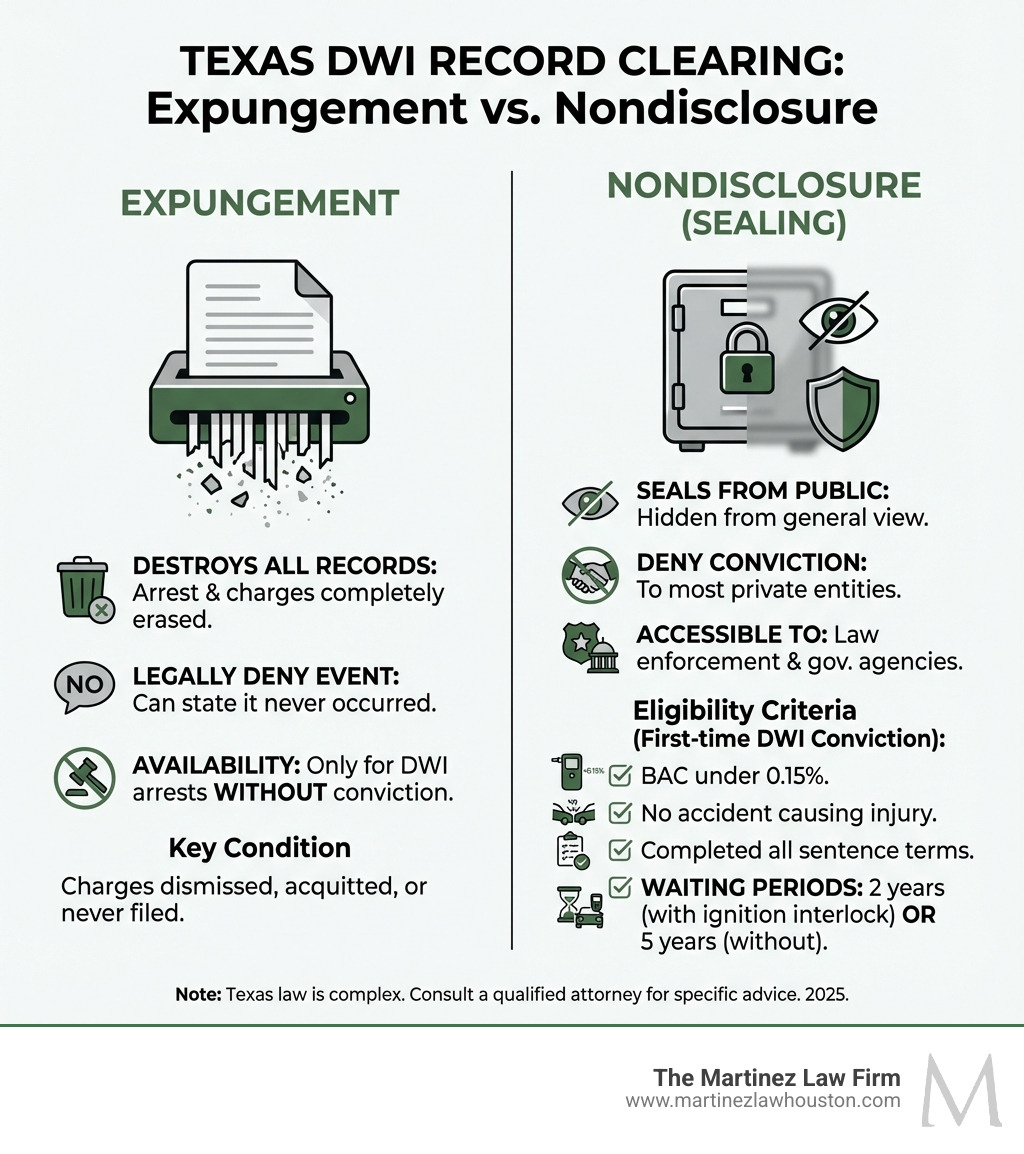
Understanding DWI in Texas and Its Lasting Impact

A Driving While Intoxicated (DWI) charge can feel like a dark cloud hanging over your head. It’s not just a momentary inconvenience; it’s a serious criminal offense with far-reaching consequences that can ripple through every aspect of your life for years to come. In Texas, we take these charges very seriously, and understanding their definition and potential impact is crucial for anyone facing such an accusation.
What is a DWI in Texas?
In Texas, a DWI (Driving While Intoxicated) refers to operating a motor vehicle in a public place while intoxicated. Unlike some other states that might differentiate between DUI (Driving Under the Influence) and DWI, in Texas, these terms refer to the same charge. There is no legal distinction between them; we use DWI.
Intoxication, according to the Texas Penal Code, means:
- Not having the normal use of mental or physical faculties by reason of alcohol, a controlled substance, a drug, a dangerous drug, or a combination of two or more of those substances.
- Having an alcohol concentration of 0.08 or more. This is commonly known as your Blood Alcohol Content (BAC). While 0.08% is the general legal limit, you can still be considered “intoxicated” if your faculties are impaired, even if your BAC is below 0.08%.
How a DWI Conviction Affects Your Life
The immediate penalties for a DWI conviction in Texas—fines, jail time, license suspension, and mandatory education programs—are severe enough. However, the long-term consequences are often what truly haunt individuals, impacting their lives for years, even decades. A DWI conviction can significantly restrict your opportunities and make simple aspects of life much more challenging.
How a DWI conviction can affect your life long-term:
- Employment Background Checks: Many employers conduct criminal background checks, especially for jobs requiring driving, handling sensitive information, or working with vulnerable populations. A DWI conviction can make it incredibly difficult to secure employment, impacting your career trajectory and earning potential. You might find yourself unable to pursue certain professions or even pass basic screenings for entry-level positions.
- Professional Licensing Issues: If you hold or aspire to hold a professional license (e.g., nursing, teaching, law, real estate), a DWI conviction can jeopardize your license or prevent you from obtaining one. Licensing boards often view DWI offenses as indicators of poor judgment or character.
- Increased Insurance Rates: Insurers consider individuals with DWI convictions to be high-risk drivers. You’ll likely face significantly higher insurance premiums for years, and you may even be required to obtain an SR-22 certificate, further increasing costs.
- Housing Application Denial: Landlords often run background checks, and a criminal record, including a DWI, can lead to denials for rental housing, making it harder to find a place to live.
- Financial Aid Difficulties: Some federal and state financial aid programs may have restrictions for individuals with drug or alcohol-related convictions, potentially affecting your ability to pursue higher education.
- Social Stigma: Beyond the legal and financial ramifications, a DWI can carry a social stigma, affecting your personal relationships and reputation within the community.
These consequences underscore why it’s so vital to understand your options and aggressively fight a DWI charge from the outset.
How Long Does a DWI Stay on Your Record in Texas?
This is a question we hear frequently, and the answer is often surprising and disheartening for many. In Texas, if you are found guilty and convicted of a DWI, it will remain on your criminal record for your entire lifetime. Unlike some other states that might have a “washout period” after which a conviction is automatically removed or becomes less visible, Texas does not have such a provision for DWI convictions.
This means that a DWI conviction will appear on most criminal background checks indefinitely.
It’s important to distinguish between your criminal record and your driving record. While a DWI conviction stays permanently on your criminal record, its impact on your driving record, maintained by the Texas Department of Public Safety (DPS), can also be long-lasting:
- Driving Record Impact: A DWI conviction will result in points being added to your driving record and can lead to surcharges from the DPS for a period of several years, in addition to fines imposed by the court.
- Criminal vs. Driving Records: Expunging or sealing a criminal record (which we’ll discuss next) does not automatically remove the incident from your driving record. These are separate records maintained by different agencies, and each has its own rules for removal or concealment.
The permanent nature of a DWI conviction on your criminal record in Texas is precisely why exploring every available legal avenue to mitigate its impact is so critical.
Can a DWI Be Expunged in Texas? The Reality of Expunction vs. Nondisclosure

Given the lasting impact of a DWI, the question of can a DWI be expunged is paramount for many of our clients in Houston and Harris County. The simple truth in Texas is that a DWI conviction generally cannot be expunged. However, there are crucial distinctions and pathways available for clearing your record, depending on the outcome of your case. These pathways involve either “expunction” or “nondisclosure.”
Recent legislative changes, notably House Bill 3016 (often referred to as the “Second Chance Law”), have significantly impacted how first-time DWI convictions can be managed, offering an alternative to traditional expungement. This law, further amended by HB 3582, created a path for sealing certain first-time DWI convictions, which was a major development in Texas law.
The Difference Between Expungement and Sealing a Record
To steer your options, it’s crucial to understand the precise legal definitions of expungement and sealing (nondisclosure) in Texas:
- Expungement (Expunction): This is the most complete form of record clearing. When a record is expunged, all official records of your arrest, charges, and detention related to a specific incident are legally destroyed. It’s as if the event never happened. Once your record is expunged, you can legally deny under oath that the arrest or charge ever occurred, and it will not appear on background checks.
- Nondisclosure (Sealing): This is a different remedy. An Order of Nondisclosure seals your criminal record from public view. While it hides the record from most private entities like employers, landlords, and the general public, it does not destroy the record. Law enforcement agencies, state licensing boards, and certain government agencies can still access sealed records. You can legally deny the existence of the conviction in most private inquiries, but you may still have to disclose it for specific governmental or licensing purposes. For Texas, this means the record is concealed from the public, but not erased entirely.
The Process for Expunction: When a DWI Arrest Can Be Expunged
Because a DWI conviction cannot be expunged in Texas, expunction is typically reserved for DWI arrests that did not result in a final conviction. This means we can often pursue expungement if your case falls into one of these categories:
- Case Dismissed: If your DWI case was dismissed, either by the prosecutor or the judge, you may be eligible for expunction. Even a dismissal leaves an arrest record, which can still appear on background checks unless expunged.
- Acquittal (Found Not Guilty): If you fought your DWI charges and were found “not guilty” by a jury or judge, you are eligible to have the arrest and charges expunged.
- Charges Never Filed: Sometimes, after an arrest, the prosecutor may decide not to file formal charges. Even in this scenario, an arrest record exists and can be expunged.
- Class C Misdemeanor Deferred Disposition: For certain minor offenses (like public intoxication) that are sometimes reduced from a DWI, if you successfully complete a deferred disposition, you may be eligible for expunction.
- Arrested as a Minor: If your first and only DWI offense occurred when you were a minor (under 18) and you fulfilled all court orders, you may be eligible to expunge the arrest and conviction.
The key takeaway here is that expunction is generally available when the legal system has determined that there was insufficient evidence, a procedural error, or you were not ultimately responsible for the alleged offense.
Nondisclosure Requirements: The Alternative When a DWI Conviction Cannot Be Expunged
For first-time DWI convictions, an Order of Nondisclosure is the primary pathway to clearing your record from public view. This option became available thanks to House Bill 3016 (HB 3016) in 2017, and it applies retroactively, meaning convictions prior to 2017 may also be eligible.
How to Qualify
To qualify for nondisclosure of a first-time DWI conviction in Houston or Harris County, you must meet specific criteria:
- First-Time DWI Conviction: This remedy is only available for your first DWI offense. If you have prior convictions or deferred adjudication for other offenses (excluding certain minor traffic violations), you may be ineligible.
- Misdemeanor Offense: The DWI must have been a misdemeanor offense. Felony DWIs are not eligible for nondisclosure.
- BAC Below 0.15%: Your Blood Alcohol Content (BAC) at the time of the offense must have been less than 0.15%. If your BAC was 0.15% or higher, you are typically not eligible.
- No Accident Involved: The incident cannot have involved an accident with another person where injuries occurred.
- Completion of Sentence: You must have successfully completed all terms of your sentence, including any probation, fines, community service, and required alcohol education programs.
- Waiting Periods: Once you’ve completed your sentence, a mandatory waiting period must pass before you can petition for nondisclosure.
- Two-Year Waiting Period: If an ignition interlock device (IID) was required as part of your sentence and you used it for at least six months, you may be eligible to petition after two years from the completion of your sentence.
- Five-Year Waiting Period: If an IID was not required as part of your sentence, you must wait five years from the completion of your sentence.
These requirements are strict, but for eligible individuals, an Order of Nondisclosure can provide significant relief, allowing them to move forward with their lives without the constant burden of a publicly visible DWI conviction.
Steps to Clear Your DWI Record in Houston
Clearing your DWI record in Houston, whether through expunction or nondisclosure, is a detailed legal process that requires careful attention to detail and adherence to specific court procedures. It’s not a do-it-yourself project; navigating the complexities of the Texas legal system often necessitates the guidance of an experienced attorney.
Petitioning for Expunction in Texas
If your DWI case qualifies for expunction (meaning it was an arrest without a conviction, such as a dismissal or acquittal), the process generally involves these steps:
- Filing a Petition for Expunction: We will file a formal Petition for Expunction with the appropriate District Court in Harris County. This petition legally requests that your arrest and related records be destroyed.
- Necessary Documentation: The petition must include specific details about your arrest, the charges, and the outcome of your case. We will gather all required documents, including court orders, dismissal papers, and any other evidence to support your eligibility.
- Notice to Agencies: All agencies involved in your arrest and prosecution (e.g., the arresting police department, the District Attorney’s office, the Harris County Sheriff’s Office, DPS) must be notified of your petition. They have an opportunity to object to the expunction.
- Court Hearing Process: A hearing will be scheduled before a judge. During this hearing, we will present arguments for why your record should be expunged, demonstrating that you meet all statutory requirements.
- What Happens if the State Objects: If an agency objects to your expunction petition, we will need to address their concerns in court. Common reasons for objection might include issues with eligibility or incomplete information. This is where our legal expertise becomes invaluable, as we can counter these objections and advocate fiercely on your behalf.
- Legal Representation: While filing fees for expunction can range from $200 to $400, the true cost lies in the legal expertise required to successfully steer this process. Attempting to handle this on your own is extremely challenging, as you will be up against seasoned legal professionals who are well-versed in these procedures and may object to your petition.
Petitioning for Nondisclosure in Texas
If you have a first-time DWI conviction that meets the eligibility criteria for nondisclosure, the process will follow a similar, yet distinct, path:
- Filing a Petition for Nondisclosure: We will file a Petition for Nondisclosure with the appropriate court in Harris County. This petition formally asks the court to seal your conviction record from public view.
- Waiting Period Calculation: Accurately calculating the mandatory waiting period (two or five years from the completion of your sentence) is crucial. Filing too early will result in denial.
- Community Supervision Completion: We will ensure that you have fully completed all aspects of your community supervision (probation), including payment of all fines, restitution, and completion of any required programs.
- Ignition Interlock Device (IID) Requirement: If an IID was part of your sentence, demonstrating its proper use for the required period is essential for the two-year waiting period eligibility.
- Court Fees: Similar to expunction, there will be court fees associated with filing a Petition for Nondisclosure, typically ranging from $200 to $400.
- Hearing and Order: The court will review your petition, and a hearing may be held. If the judge finds that you meet all statutory requirements, an Order of Nondisclosure will be issued.
How DWI Expungement Laws Vary by State
Texas’s laws regarding DWI expungement and nondisclosure are specific to our state. The legal landscape for clearing DWI records varies dramatically across the United States. What’s possible in one state might be impossible in another, highlighting why local legal counsel is so vital.
For example, while Texas does not allow expungement of DWI convictions, some states are more lenient:
- Missouri: Missouri is one of the exceptions where a DWI can be expunged. If a person meets statutory requirements for a first offense, the court must grant the expungement. However, Missouri only allows expungement for a first offense DWI conviction, and a person can only have one expungement under the statute throughout their lifetime.
- Arizona: In Arizona, courts can “set aside” and eventually discharge a DUI, which is a form of record relief.
- Mississippi: Like Texas, Mississippi generally does not allow DUI convictions to be removed from your record, although other offenses may be expungable.
- Other States: Some states, like Arkansas, may allow records for a first-time misdemeanor DUI to be sealed after probation is completed. California allows expungement once all sentence requirements are met.
Our comprehensive resource, DUI Expungement Laws by State, provides a state-by-state breakdown, but this merely underscores the complexity. These differences emphasize that general advice found online may not apply to your specific situation in Houston, Texas.
Frequently Asked Questions about Clearing a DWI Record
Navigating the aftermath of a DWI in Houston can bring up many questions about your record and future. We’ve compiled answers to some of the most common inquiries our clients have regarding expungement and nondisclosure.
What happens to my record after a DWI is sealed?
When your DWI record is sealed through an Order of Nondisclosure in Texas, it means it is removed from public view. This has several key implications:
- Removed from Public View: The record will generally not appear on standard background checks conducted by private employers, landlords, or educational institutions. This means you can often avoid the stigma and discrimination associated with a visible criminal record.
- Not Visible on Most Background Checks: For most private inquiries, you can legally deny that the conviction occurred. This is a significant relief for job applications, housing, and other private sector opportunities.
- Law Enforcement Access: Sealed records are still accessible to law enforcement agencies and certain government entities.
- Can Be Used for Future Sentencing Improvement: If you were to face future legal proceedings, a sealed DWI conviction could still be used by the prosecution to improve sentencing or for other legal purposes. It’s not completely erased from the legal system’s memory.
Can a sealed DWI be used to deny past convictions?
Yes, for most purposes, you can legally deny the existence of a sealed DWI conviction. This is one of the primary benefits of an Order of Nondisclosure.
- Legally Deny on Applications: You can legally state on job applications, rental agreements, and other private sector forms that you have not been convicted of the DWI offense.
- Cannot Commit Perjury: Because the record is sealed, you are not committing perjury by denying its existence to most private entities. The law specifically grants you this right.
- Exceptions for Government/Licensing Agencies: However, there are exceptions. You may still be required to disclose the sealed conviction to certain governmental agencies, state licensing boards, or for specific types of employment (e.g., law enforcement, childcare, positions requiring a security clearance).
- Restoration of Status: While not as complete as expungement, nondisclosure aims to restore your status in the eyes of the public, allowing you to move forward without the constant burden of your past mistake being visible.
Is there a limit to how many DWIs can be sealed in Texas?
Yes, there is a significant limit: nondisclosure is typically a one-time opportunity and is limited to a first-time DWI conviction in Texas.
- One-Time Opportunity: The “Second Chance Law” (HB 3016) was designed to provide relief for individuals who made a single mistake.
- Nondisclosure Limited to First Offense: If you have a prior DWI conviction or have received deferred adjudication for another offense, you generally will not be eligible to seal a subsequent DWI.
- Subsequent DWIs are Ineligible: This means that if you are convicted of a second DWI after having your first one sealed, the second offense (and likely the first, if the sealing is revoked) will remain permanently on your public record.
- Importance of a Clean Record: This underscores the critical importance of maintaining a clean record after receiving any form of record relief. The opportunity for nondisclosure is a valuable one, but it comes with the expectation of future responsible conduct.
Get Help from an Experienced Houston DWI Attorney
Understanding whether can a DWI be expunged or sealed in Texas is far from straightforward. The nuanced distinctions between expunction for arrests and nondisclosure for convictions, coupled with strict eligibility requirements and complex legal procedures, make it a daunting task to tackle alone.
At The Martinez Law Firm in Houston, we understand the immense pressure and uncertainty you face when dealing with a DWI charge or conviction. Our team, led by Herman Martinez, leverages over 25 years of experience, including invaluable insights gained as a former Chief Prosecutor for the Harris County District Attorney’s Office. This unique background allows us to anticipate prosecutorial strategies and build aggressive, personalized defenses for our clients.
Whether you’re exploring options for expunging an old arrest, seeking nondisclosure for a first-time conviction, or fighting a current DWI charge in Harris County, we are here to guide you. We’ll carefully review your case, explain your legal options in clear, simple language, and champion your right to a fresh start.
Don’t let a DWI define your future. Take the proactive step to protect your record and your opportunities. Contact a Houston DWI Lawyer at The Martinez Law Firm today for a confidential consultation. Let us put our experience to work for you.