

Understanding the Signs That Could Save a Life

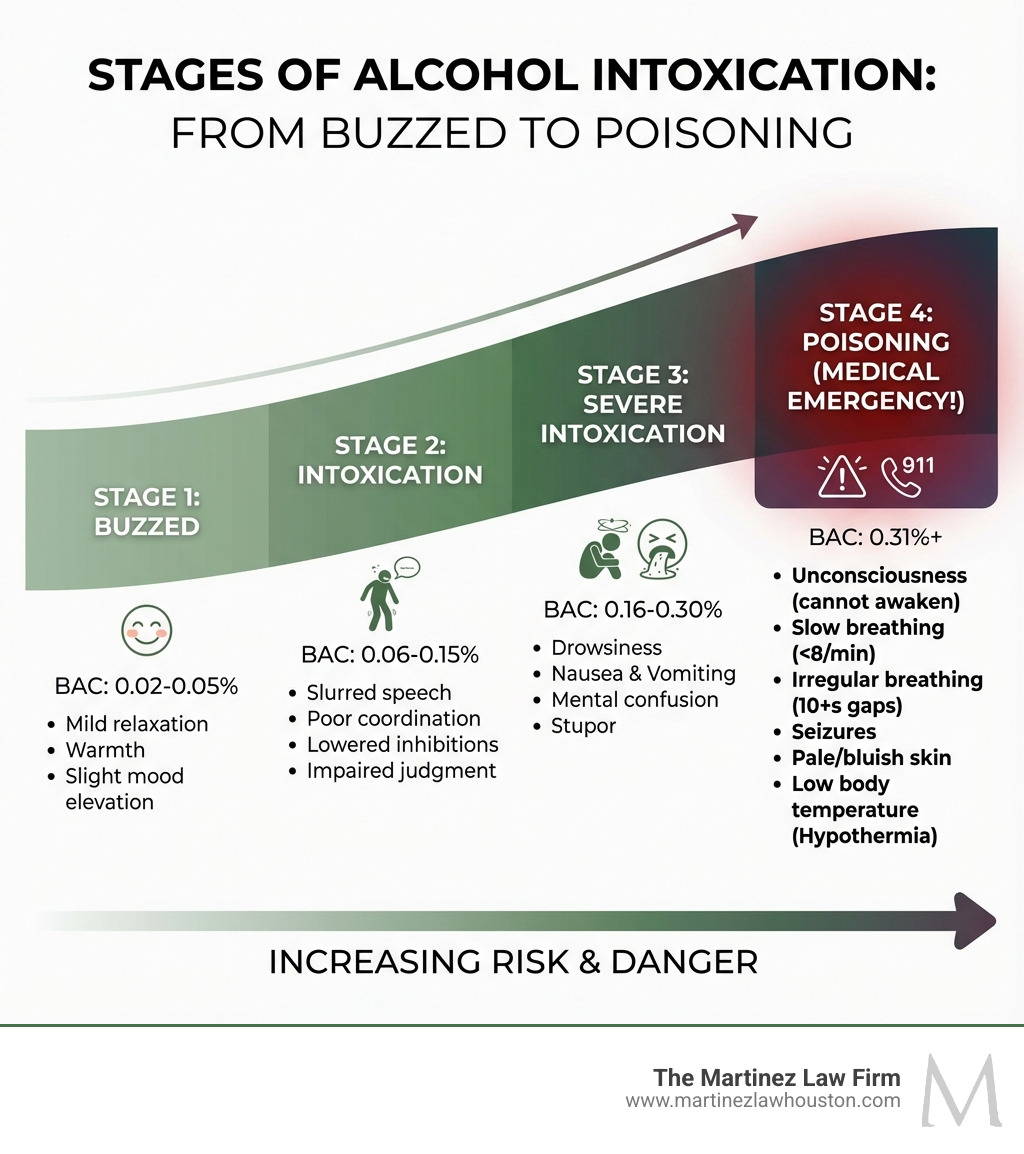
Alcohol intoxication symptoms can range from slurred speech and poor coordination to life-threatening conditions like slow breathing, unconsciousness, and seizures. Recognizing these signs early—and knowing when they cross from typical intoxication into dangerous alcohol poisoning territory—can literally mean the difference between life and death.
Common alcohol intoxication symptoms include:
- Slurred speech and impaired coordination
- Lowered inhibitions and impaired judgment
- Drowsiness, nausea, and vomiting
Critical alcohol poisoning symptoms requiring immediate 911 call:
- Mental confusion or stupor
- Unconsciousness or inability to be awakened
- Slow breathing (fewer than 8 breaths per minute)
- Irregular breathing (10+ seconds between breaths)
- Seizures
- Pale, clammy, or bluish skin
- Low body temperature (hypothermia)
The stakes are genuinely serious. In the United States, acute alcohol intoxication directly causes an average of 2,221 deaths per year, with indirect alcohol-related fatalities adding more than 30,000 additional deaths annually. What starts as a celebration at a party or gathering can quickly turn deadly when alcohol consumption outpaces the body’s ability to process it.
Why Recognizing These Symptoms Matters in Texas
Whether you are worried about a loved one’s behavior, dealing with the fallout from a night of heavy drinking, or already facing legal trouble in Houston, understanding alcohol intoxication symptoms is essential. In Texas, intoxication is more than a health concern—it can lead to serious criminal charges, including public intoxication and DWI, with harsh consequences like fines, possible jail time, and suspension of your driver’s license.
I’m Herman Martinez, founder of The Martinez Law Firm in Houston, and after 25+ years prosecuting and defending criminal cases—including serving as a Chief Prosecutor and City of Houston Judge—I’ve seen how quickly alcohol intoxication symptoms can escalate into both medical emergencies and legal crises. My experience on both sides of the courtroom gives me unique insight into how these situations unfold and how to protect your rights when alcohol-related charges arise in Houston and Harris County.
Recognizing the Danger Zone: Intoxication vs. Alcohol Poisoning
When we talk about drinking, the terms “intoxication” and “alcohol poisoning” often get used interchangeably, but there’s a crucial difference. Understanding this distinction is the first step in recognizing when to act.
Alcohol intoxication occurs when the amount of alcohol we consume leads to behavioral or physical changes, causing our mental and physical abilities to become impaired. It’s the state we enter after having a few drinks, leading to the familiar “buzzed” feeling or even stumbling and slurring words. Think of it as the body’s initial reaction to alcohol, where our judgment and coordination start to go a bit wonky.
Alcohol poisoning, on the other hand, is a much more severe condition. It’s an overdose, a truly serious—and potentially deadly—result of drinking far too much alcohol in a short period. This happens when there’s so much alcohol in our bloodstream that it begins to shut down the brain functions essential for basic life support, like breathing, heart rate, and temperature control. It can affect our gag reflex, potentially leading to coma and even death. It’s a medical emergency that demands immediate attention.
When to Call 911
If you suspect someone in Houston or Harris County has alcohol poisoning, don’t hesitate. Call 911 immediately. Every second counts. Don’t wait for all the critical symptoms to appear; if even one is present, it’s time to get professional medical help.
Here’s a quick comparison to help us distinguish between common intoxication and the critical signs of alcohol poisoning:
| Symptom Category | Mild/Moderate Alcohol Intoxication | Critical Alcohol Poisoning – Call 911 Immediately |
|---|---|---|
| Mental state | Relaxed, lowered inhibitions, impaired judgment, mood swings, trouble focusing. | Mental confusion, stupor, inability to respond normally, or seeming “out of it.” |
| Coordination | Clumsiness, poor balance, stumbling or staggering, slowed reactions. | Unconsciousness or cannot be awakened, even with shaking, shouting, or painful stimulation. |
| Speech | Slurred or slowed speech, difficulty finding words. | May be completely unresponsive or only make groaning sounds; cannot hold a coherent conversation. |
| Breathing | Typically normal breathing, though slightly slower than usual. | Slow breathing (fewer than 8 breaths per minute) or irregular breathing (10 seconds or more between breaths). |
| Skin & temperature | Warm or flushed skin, sweating is possible. | Pale, cold, clammy, or bluish skin, especially lips or fingernails; low body temperature (hypothermia). |
| Other symptoms | Drowsiness, nausea, vomiting, headache, temporary memory gaps (blackouts possible at higher BAC). | Repeated vomiting, seizures, choking risk, or no response after vomiting; signs of shock or very weak pulse. |
For a comprehensive list of symptoms and causes, you can refer to the Mayo Clinic’s guide on alcohol poisoning.
The Aftermath: Medical and Legal Consequences in Houston
When alcohol consumption leads to medical emergencies, the short-term consequences can be severe and life-threatening. These include:
- Choking: A depressed gag reflex due to alcohol poisoning significantly increases the risk of choking on vomit.
- Severe Dehydration: Intense vomiting can lead to dangerous fluid loss, causing extremely low blood pressure and a fast heart rate.
- Seizures: Alcohol poisoning can trigger seizures, especially as the body tries to process the excessive alcohol.
- Hypothermia: Alcohol can lower body temperature to dangerously cold levels, leading to hypothermia.
- Brain Damage or Death: In its most severe forms, alcohol poisoning can lead to permanent brain damage or even death due to respiratory arrest or cardiac arrest. The brain’s vital life-support functions can simply shut down.
Beyond the immediate crisis, repeated incidents of alcohol intoxication symptoms and poisoning can contribute to serious long-term health problems. Chronic alcohol use can lead to liver diseases like alcoholic hepatitis and cirrhosis, as well as heart problems, including an increased risk of heart failure and arrhythmias like “holiday heart syndrome.” Neurological issues such as dementia, cerebellar degeneration, and peripheral neuropathy are also potential long-term complications.
If someone experiences alcohol poisoning, medical treatment in a hospital setting is crucial. This typically involves:
- Continuous Monitoring: Medical staff will closely watch vital signs like breathing, heart rate, and body temperature.
- Intravenous (IV) Fluids: These help combat dehydration and stabilize blood sugar levels. Often, B vitamins are administered to prevent serious neurological complications like Wernicke encephalopathy.
- Breathing Support: In severe cases, a person may need intubation to protect their airway and ensure adequate breathing until the alcohol’s effects subside.
Navigating Texas Law: From Public Intoxication to DWI
Here in Houston and Harris County, we understand that alcohol intoxication symptoms don’t just lead to medical concerns; they can also lead to significant legal consequences. What might start as a fun night out can quickly turn into a legal mess if you or a loved one are deemed “intoxicated” under Texas law.
One common charge we see is Public Intoxication (PI). Under Texas Penal Code § 49.02, it is against the law for any person to be in public under the influence of alcohol and/or drugs to the extent that they may endanger themselves or others. This means that if you’re out in a public place in Houston and your alcohol intoxication symptoms are severe enough that you can’t care for your own safety, or you pose a risk to others, you could face a PI charge. This can happen regardless of your specific Blood Alcohol Concentration (BAC) level.
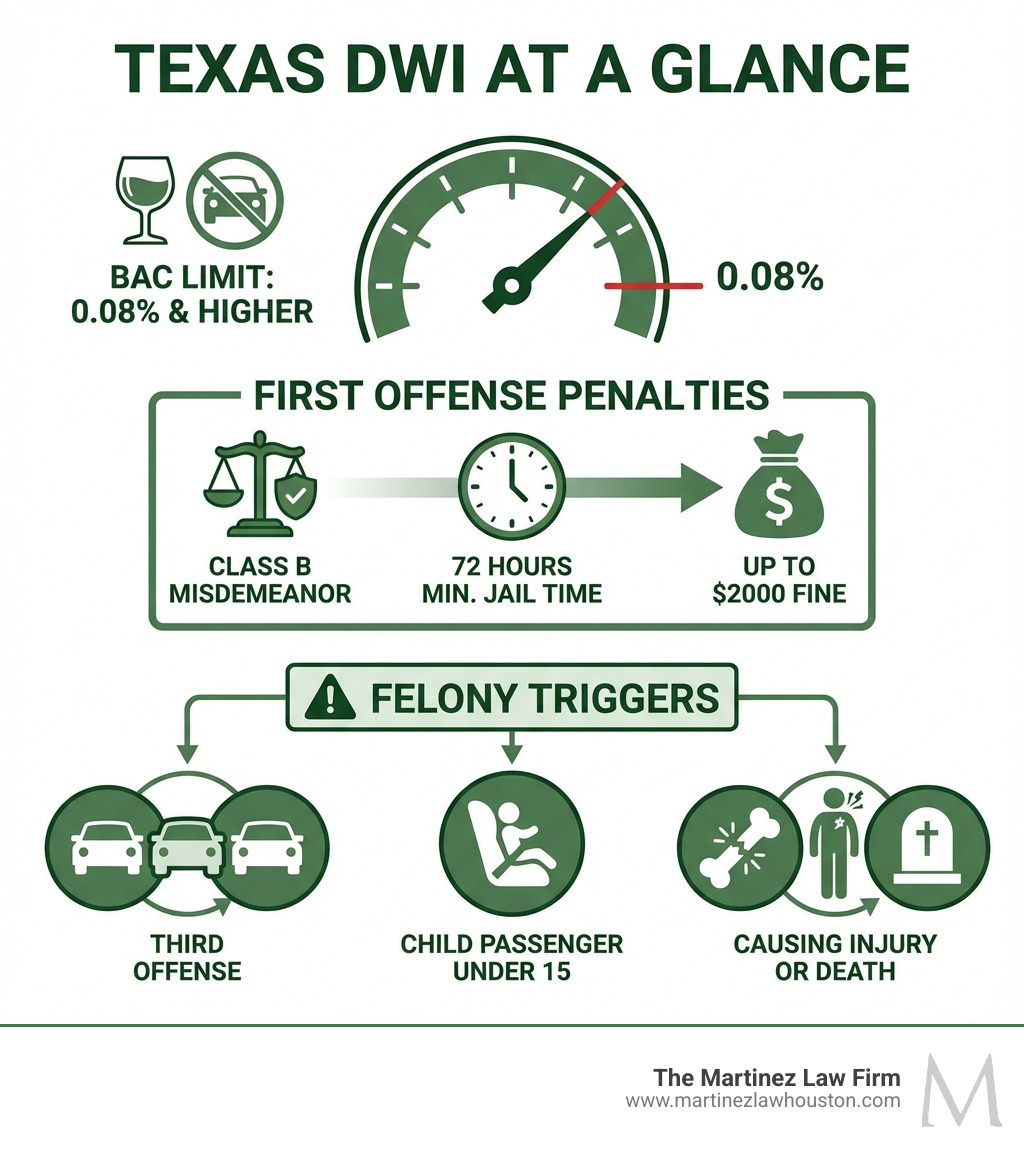
Even more serious are Texas DWI laws. DWI stands for Driving While Intoxicated, and it’s a charge we take very seriously at The Martinez Law Firm. In Texas, you are legally “intoxicated” if you have an alcohol concentration of 0.08 percent or more in your blood, or if you don’t have the normal use of your mental or physical faculties because of alcohol or other substances. It’s important to know that for commercial drivers in Texas, the BAC limit is even lower at 0.04%, and for drivers under 21, it’s a strict 0.01% with a “zero tolerance” policy.
Legal Penalties in Texas
The potential legal penalties for DWI in Houston and Harris County can be severe:
- First DWI Offense: Typically a Class B misdemeanor, carrying penalties such as up to 180 days in jail, fines up to $2,000, and a driver’s license suspension for 90 days to one year. You may also face annual fees to retain your license.
- Second DWI Offense: Usually a Class A misdemeanor, with penalties that can include 30 days to one year in jail, fines up to $4,000, and a driver’s license suspension for up to two years.
- Third or Subsequent DWI Offenses: These are often charged as felonies, with penalties escalating to 2 to 10 years in prison and fines up to $10,000, along with lengthy license suspensions.
Additionally, aggravating factors, such as having a child passenger under 15, or a BAC of 0.15% or higher, can lift a DWI charge and its associated penalties.
Given these serious consequences, the critical role of experienced legal counsel cannot be overstated. If you’re facing a public intoxication charge or a DWI in Houston or Harris County, having a knowledgeable attorney by your side is essential. We can help you understand your rights, steer the complexities of the legal system, and fight for the best possible outcome.
More info about DWI lawyer services
Frequently Asked Questions about Alcohol Intoxication Symptoms
We hear a lot of questions about alcohol and its effects, especially when people are trying to understand the line between having a good time and facing a serious health or legal crisis. Here are some common questions we encounter:
How long do alcohol intoxication symptoms last?
The duration of alcohol intoxication symptoms depends largely on how quickly our body can metabolize, or process, the alcohol. On average, our body breaks down alcohol at a rate of roughly 0.015% BAC per hour. This means it takes time for alcohol to leave our system, and there’s no quick fix to speed up the process.
Factors affecting how long symptoms last include:
- Amount and Type of Alcohol Consumed: More drinks, especially higher proof alcohol, mean a longer duration.
- Body Weight and Sex: Generally, people with less body weight and women tend to reach higher BACs and experience symptoms for longer, even after consuming the same amount of alcohol as a heavier person or a man. This is due to differences in body water content and metabolism.
- Food Intake: Drinking on an empty stomach allows alcohol to be absorbed much faster, leading to quicker onset and potentially longer-lasting symptoms. Eating before or while drinking slows absorption.
- Liver Function: Our liver does most of the heavy lifting when it comes to processing alcohol. Liver health can impact how efficiently alcohol is cleared.
- Age, Medications, and Health Conditions: Older individuals, those on certain medications, or people with pre-existing health issues may metabolize alcohol more slowly.
Even after the acute alcohol intoxication symptoms subside, lingering effects like a headache, nausea, and fatigue (the classic “hangover”) can persist for up to 24 hours or more.
Can you have alcohol poisoning without being unconscious?
Yes, absolutely. While unconsciousness is one of the most alarming and critical signs of alcohol poisoning, it is not the only one. A person can be experiencing severe alcohol intoxication symptoms that qualify as alcohol poisoning even if they are still conscious.
For example, someone might be conscious but severely confused, unable to communicate coherently, vomiting uncontrollably, or exhibiting extremely slow and irregular breathing. These are all critical signs that demand immediate medical attention, even if the person can still be roused or is technically awake. Unconsciousness is often a late-stage indicator, meaning the body’s vital functions are already severely compromised.
What is the difference between a hangover and alcohol poisoning?
This is a really important distinction, and one that often gets confused.
A hangover is the unpleasant collection of alcohol intoxication symptoms that typically occurs hours after drinking, once the BAC has dropped significantly, often to zero. These symptoms include headache, nausea, fatigue, sensitivity to light and sound, and general malaise. While uncomfortable, hangovers are generally not life-threatening. They’re a sign your body is recovering from excessive alcohol consumption.
Alcohol poisoning, as we’ve discussed, is a life-threatening medical emergency. It occurs when a person’s BAC is dangerously high, actively shutting down vital bodily functions. The key differentiators are the severity of the symptoms and the active danger to life:
- Breathing: With alcohol poisoning, breathing can become dangerously slow (fewer than 8 breaths per minute) or irregular (10 seconds or more between breaths). A hangover doesn’t typically affect breathing this way.
- Consciousness: While you might feel drowsy with a hangover, alcohol poisoning can lead to stupor, inability to be awakened, or complete unconsciousness.
- Body Temperature: Alcohol poisoning can cause a dangerous drop in body temperature (hypothermia), leading to pale, clammy, or bluish skin. Hangovers don’t typically cause these severe physiological changes.
- Gag Reflex: Alcohol poisoning can suppress the gag reflex, increasing the risk of choking on vomit, a risk not present with a typical hangover.
If you’re ever in doubt, always err on the side of caution and seek medical help. A hangover will eventually pass, but alcohol poisoning requires immediate intervention.
Prevention and Getting Help
Preventing alcohol intoxication symptoms from escalating into a dangerous situation starts with responsible choices. We encourage everyone to:
- Pace Yourself: Drink slowly. Your body can only process about one standard drink per hour. Don’t try to outpace your liver!
- Eat Food: Never drink on an empty stomach. Food slows down alcohol absorption, giving your body more time to process it.
- Stay Hydrated: Alternate alcoholic beverages with water or non-alcoholic drinks. This helps prevent dehydration, which can worsen alcohol intoxication symptoms.
- Know Your Limits: Understand how much alcohol your body can handle. A “standard drink” is 12 fluid ounces of regular beer (5% alcohol), 5 fluid ounces of wine (12% alcohol), or 1.5 fluid ounces of 80-proof distilled spirits (40% alcohol). These amounts can vary, so always check labels!
- Talk to Teens: Open communication with teenagers about the dangers of binge drinking and alcohol intoxication symptoms is crucial. Educate them about the risks and how to get help. The National Institute on Alcohol Abuse and Alcoholism (NIAAA) provides valuable resources on this topic.
- Avoid Mixing: Never combine alcohol with other drugs, especially those that depress the central nervous system, like opioids, sedatives, or even some antihistamines. This combination can be deadly.
- Safe Storage: Keep all alcohol-containing products, including non-beverage items like rubbing alcohol or mouthwash, safely stored and out of reach of children or vulnerable individuals.
When Alcohol Intoxication Leads to Legal Trouble in Houston
Sometimes, despite our best intentions, things go wrong. If a situation involving alcohol intoxication symptoms results in legal issues in Houston or Harris County, having skilled legal representation is critical. Whether you are facing a public intoxication accusation or a DWI charge, The Martinez Law Firm is ready to stand by your side.
At The Martinez Law Firm, we understand the complexities of these cases. We’re here to provide an aggressive, personalized defense, leveraging our extensive experience to protect your rights and future. Don’t face the legal system alone.
Contact a Houston DWI lawyer for a consultation
Understanding Texas DWI Law: What You Need to Know

Texas penal code driving while intoxicated is defined under Section 49.04 of the Texas Penal Code. If you’ve been arrested for DWI in Houston or anywhere in Texas, you’re likely facing serious legal consequences that can affect your freedom, your finances, and your future.
Quick Answer: Texas DWI Law Overview
- Legal Definition: Operating a motor vehicle in a public place while intoxicated
- Two Ways to Be “Intoxicated”:
- Loss of normal mental or physical faculties due to alcohol, drugs, or other substances
- Blood Alcohol Concentration (BAC) of 0.08% or higher
- First Offense: Class B Misdemeanor (72 hours to 180 days jail, up to $2,000 fine)
- BAC 0.15+: Class A Misdemeanor (up to 1 year jail, up to $4,000 fine)
- Third Offense: Third-Degree Felony (2-10 years prison, up to $10,000 fine)
- With Child Under 15: State Jail Felony (regardless of prior offenses)
You don’t have to feel “drunk” to be charged—any level of impairment counts under Texas law. The charges can apply on private property accessible to the public, and you can be arrested for operating vehicles beyond cars, including boats, golf carts, and ATVs.
What You’ll Learn About Texas DWI Law in 2026
This comprehensive guide breaks down everything you need to know about the Texas Penal Code’s DWI provisions. We’ll explain the legal definitions, walk through the penalties for first-time and repeat offenders, clarify confusing scenarios (like DWI on private property or in non-traditional vehicles), and outline the defense strategies that can make a difference in your case.
Whether you’re facing your first charge or dealing with a more complex situation in Harris County, understanding the law is your first step toward protecting your rights.
I’m Herman Martinez, founder of The Martinez Law Firm in Houston, and I’ve spent over 25 years working both sides of the courtroom—as a former Chief Prosecutor for the Harris County District Attorney’s Office and as a City of Houston Judge—before dedicating my practice to defending clients against charges under the Texas penal code driving while intoxicated. This unique perspective allows me to anticipate prosecution strategies and build aggressive defenses custom to the specific circumstances of each DWI case in the greater Houston area.
Defining Intoxication Under Texas Law
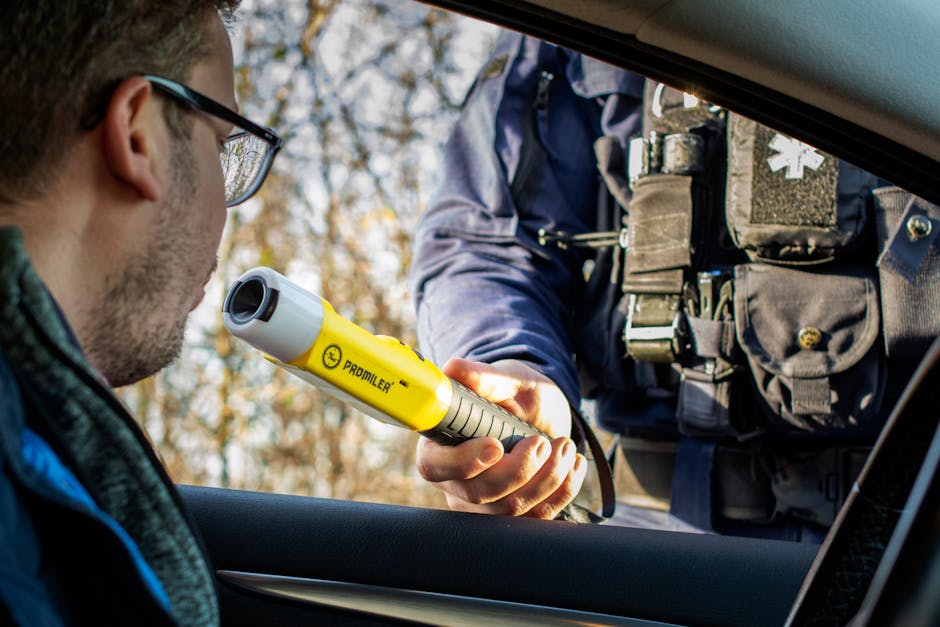
Before we dive into the specifics of charges and penalties, it’s crucial to understand how Texas law defines “intoxicated.” This isn’t just about feeling “drunk” – the legal definition is much broader and often catches people by surprise.
The Texas penal code driving while intoxicated laws are primarily found in Chapter 49 of the Texas Penal Code, which deals with Intoxication and Alcoholic Beverage Offenses. This chapter lays out the legal framework for what constitutes intoxication and the various offenses related to it.
2 Types of Intoxication
Under Texas law, there are two distinct ways a person can be considered “intoxicated”:
- Loss of Normal Faculties: This prong defines intoxication as “not having the normal use of mental or physical faculties by reason of the introduction of alcohol, a controlled substance, a drug, a dangerous drug, a combination of two or more of those substances, or any other substance into the body.” This means if alcohol, drugs (legal or illegal), or even a combination of substances impairs your ability to think, react, or move normally while operating a vehicle, you can be charged with DWI. This subjective standard allows law enforcement to make an arrest even if your blood alcohol concentration (BAC) is below the legal limit. It’s about how the substance affects you.
- Per Se Intoxication (BAC of 0.08% or More): The second prong establishes a clear, objective standard. You are legally intoxicated in Texas when your blood alcohol concentration (BAC) reaches 0.08 percent or more. This is often referred to as a “per se” law, meaning that if your BAC is at or above this level, you are legally intoxicated, regardless of whether you feel impaired or if an officer observes any loss of normal faculties. The law measures “alcohol concentration” as the number of grams of alcohol per 210 liters of breath, 100 milliliters of blood, or 67 milliliters of urine.
Impairment vs. “Drunk”: Don’t Be Fooled
A common misconception is that you have to be visibly “drunk” or feel completely out of control to be guilty of DWI. This is simply not true under Texas law. As our research shows, you are breaking the law as soon as drugs or alcohol affect your driving ability, even if your BAC is below 0.08 percent. You might feel fine, capable, and confident behind the wheel, but if your faculties are even slightly impaired, you could still be charged.
The law focuses on “impaired driving,” meaning any condition where your mental or physical faculties are affected. This condition can arise from drinking alcohol, using controlled substances, prescription drugs, or a combination of these. So, while you might not think you’re drunk, you could still be found guilty under the current definition of the law. Any level of impaired driving is illegal and dangerous.
The Core Offense: Texas Penal Code Driving While Intoxicated
The heart of Texas’s DWI law is found in Texas Penal Code – PENAL § 49.04. Driving While Intoxicated. This section clearly defines the offense and sets the baseline penalties.
A person commits an offense if they are intoxicated while operating a motor vehicle in a public place. Let’s break down those key elements:
- Intoxicated: As we just discussed, this means either a loss of normal faculties or a BAC of 0.08% or more.
- Operating a Motor Vehicle: This refers to having actual physical control over the vehicle. You don’t necessarily have to be driving down the road; sitting in the driver’s seat with the keys in the ignition could be enough.
- In a Public Place: This generally includes any street, highway, alley, or other place that is open to the public, such as public parking lots.
First Offense Penalties
For a first-time DWI offense without any aggravating factors, the charge is typically a Class B Misdemeanor. While this might sound less severe than a felony, the consequences are still significant:
- Fines: You could face a fine of up to $2,000. That this doesn’t include additional state fees and surcharges, which can add thousands more to the total cost.
- Jail Time: A first-offense DWI carries a minimum term of confinement of 72 hours, but can extend up to 180 days (six months) in jail upon conviction.
- Driver’s License Suspension: Your driver’s license could be suspended for up to a year. Reinstating your license often involves paying annual fees ranging from $1,000 to $2,000 for up to three years.
- Probation and Community Service: In many cases, a judge in Houston or Harris County might impose probation, which can include mandatory community service, DWI education courses, and regular check-ins.
These penalties are just the start. A DWI conviction in Harris County can also affect your auto insurance rates, employment opportunities, and even professional licenses.
Aggravating Factors: Open Container
Texas law takes a particularly dim view of having an open container of alcohol in your vehicle while driving intoxicated. This isn’t just about consuming alcohol while driving; it’s about having any open alcoholic beverage in the passenger area of a motor vehicle that is on a public highway.
If it’s shown during the trial that you had an open container of alcohol in your immediate possession at the time of the offense, the penalties for your Class B Misdemeanor DWI are automatically improved. Specifically, the minimum term of confinement increases from 72 hours to a mandatory six days in jail. This stricter minimum jail time reflects the legislature’s intent to discourage drivers from having readily accessible alcohol while operating a vehicle.
Aggravating Factors: High BAC
The level of alcohol concentration in your system can also significantly impact the severity of your DWI charge. If an analysis of your blood, breath, or urine shows an alcohol concentration level of 0.15 or more at the time the analysis was performed, your offense is liftd from a Class B Misdemeanor to a Class A Misdemeanor.
This higher classification comes with substantially increased penalties:
- Increased Fines: The potential fine doubles, going up to $4,000.
- Longer Jail Time: You could face up to one year in jail.
- Extended License Suspension: Your driver’s license suspension could be extended for as long as 18 months, which is six months longer than the maximum for a Class B misdemeanor.
- Ignition Interlock Device (IID): A judge may also require you to install an ignition interlock device (IID) on your vehicle, even for a first offense with a high BAC. This device prevents your car from starting if it detects alcohol on your breath.
These improved penalties highlight that the state of Texas is serious about deterring high-level intoxication while driving, and Houston courts reflect this stern approach.
Common DWI Scenarios and Questions

The complexities of Texas penal code driving while intoxicated extend beyond the obvious. Many people are surprised to learn that a DWI charge can arise in situations they might not expect. Let’s clear up some common but confusing scenarios, especially relevant in and around the Houston area.
Can I get a DWI on Private Property in Houston?
This is a question we hear often, and the answer, perhaps surprisingly, is yes – under certain circumstances. While the Texas Penal Code specifies that a DWI offense occurs when operating a motor vehicle “in a public place,” the definition of “public place” can be broader than you might think.
The key is whether the private property is generally accessible to the public. For example, you can absolutely be charged with DWI in a grocery store parking lot, an apartment complex parking garage, or even a shopping mall lot in Harris County. These are all considered “public places” because they are open to the public for use, even though they are privately owned.
Our research confirms that private property can include parking lots, ranches, homes, parks, or businesses, but if they are accessible to the public, a DWI charge can apply. So, if you’re leaving a friend’s party and decide to move your car in their apartment complex parking lot while intoxicated, you could still face a DWI charge. The general rule of thumb is: if the public is invited or has access, it’s treated like a public place for DWI purposes.
Can I Get a DWI if I’m Not Driving a Car?
Another common misconception is that DWI only applies to traditional passenger cars. Not so fast! The definition of a “motor vehicle” under Texas law is quite broad. According to Texas Penal Code Section 32.34(a), a motor vehicle is “a device in, on, or by which a person or property is or may be transported or drawn on a highway.”
This expansive definition means you could be charged with DWI for operating a wide variety of vehicles, including:
- Boats (BWI – Boating While Intoxicated): Operating a watercraft while intoxicated carries similar penalties to DWI. Houston, with its proximity to Galveston Bay and numerous lakes, sees many BWI cases.
- Golf Carts: Many communities in Houston and surrounding areas allow golf carts on public roads. If you operate one while intoxicated, you can be charged with DWI.
- ATVs and Dirt Bikes: These recreational vehicles are often used on public land or roads, making them subject to DWI laws.
- Scooters and Mopeds: Even smaller motorized vehicles fall under the DWI umbrella.
What about bicycles or horses? While you likely wouldn’t face a DWI charge for operating these while intoxicated, you could still be charged with public intoxication if you are a danger to yourself or others. The key distinction lies in whether the mode of transportation is legally defined as a “motor vehicle.” So, if you’re enjoying a Sunday afternoon on a golf course in Houston and decide to have a few too many, it’s best to walk that cart back to the clubhouse.
Escalating Penalties: Subsequent Offenses and Felony DWIs
Texas takes a very strict stance on repeat DWI offenders. The penalties escalate significantly with each subsequent offense, often moving from misdemeanors to serious felonies. This is a crucial aspect of the Texas penal code driving while intoxicated that everyone needs to understand.
Understanding Subsequent Offenses Under the Texas Penal Code Driving While Intoxicated
Our research clearly shows that Texas has robust improvement provisions within its penal code to address repeat DWI offenses.
| Offense Level | Classification | Fines | Jail/Prison Time | Driver’s License Suspension |
|---|---|---|---|---|
| First Offense | Class B Misdemeanor | Up to $2,000 | 72 hours – 180 days | Up to 1 year |
| Second Offense | Class A Misdemeanor | Up to $4,000 | 30 days – 1 year | Up to 2 years |
| Third (or more) Offense | Third-Degree Felony | Up to $10,000 | 2 – 10 years | Up to 2 years |
- Second DWI Offense: If you are convicted of a second DWI, the charge is automatically liftd to a Class A Misdemeanor, even if your BAC was below 0.15%. The penalties become much harsher:
- Fines: You could face fines of up to $4,000.
- Jail Time: The minimum jail time increases significantly, ranging from 30 days to a full year in jail.
- License Suspension: Your driver’s license could be suspended for up to two years.
- Third (or More) DWI Offense: This is where the consequences become truly severe. A third DWI offense in Texas is charged as a Third-Degree Felony.
- Fines: You could be hit with a substantial fine of up to $10,000.
- Prison Time: Instead of jail, you face prison time, ranging from two to 10 years in a state prison.
- License Suspension: Your driver’s license could again be suspended for up to two years.
These escalating penalties underscore Texas’s commitment to removing repeat intoxicated drivers from our roads, and Harris County courts are no exception to this rigorous enforcement.
Felony DWI: Driving While Intoxicated with a Child Passenger
Among the most serious charges under the Texas penal code driving while intoxicated is DWI with a child passenger. This particular offense reflects the state’s strong desire to protect vulnerable individuals.
If you are found to be intoxicated while operating a motor vehicle in a public place, and the vehicle is occupied by a passenger younger than 15 years of age, you will be charged with a State Jail Felony. This is a felony charge, regardless of whether it’s your first DWI offense or if your BAC was below 0.15%. The penalties are severe:
- Fines: Up to $10,000.
- Jail Time: Instead of county jail, you face confinement in a state jail facility for a term of 180 days to two years.
- Additional License Suspension: Your driver’s license could be suspended for an additional 180 days.
This charge is often coupled with child endangerment charges, adding another layer of legal complexity and potential penalties.
Beyond DWI with a child passenger, other felony DWI charges exist for situations involving serious harm:
- Intoxication Assault: If, as a result of your intoxication while operating a vehicle, you cause serious bodily injury to another person, you could be charged with Intoxication Assault, a Third-Degree Felony.
- Intoxication Manslaughter: If your intoxication while operating a vehicle causes the death of another person, you could be charged with Intoxication Manslaughter, a Second-Degree Felony. These charges carry extremely long prison sentences and significant fines.
These felony DWI provisions demonstrate that Texas law imposes increasingly severe penalties when intoxicated driving results in greater risk or harm to others.
Building a Defense Against a Houston DWI Charge
Facing a DWI charge in Houston or Harris County can feel overwhelming, but it’s crucial to remember that an arrest is not a conviction. Many avenues exist to challenge the charges and protect your future. This is where the importance of skilled legal counsel, particularly from a firm like ours, truly comes into play.
At The Martinez Law Firm, we leverage my experience as a former Chief Prosecutor for the Harris County District Attorney’s Office to your advantage. Having worked on both sides, I understand how prosecutors build their cases, what evidence they rely on, and, crucially, where their weaknesses often lie. This “former prosecutor advantage” allows us to anticipate their strategies and craft aggressive, personalized defenses.
How an Attorney Can Help
Here are some key areas where a DWI defense attorney can help someone facing DWI charges in Texas:
Challenging the Traffic Stop:
Law enforcement officers, whether HPD or Harris County Sheriff’s deputies, must have a valid legal reason (reasonable suspicion) to stop your vehicle. If the stop was unlawful, any evidence gathered afterward could be inadmissible in court. We carefully review police reports, dashcam, and bodycam footage to identify any procedural errors or lack of probable cause.
Contesting the Evidence of Intoxication:
Field Sobriety Tests (FSTs): These tests are often subjective and prone to error. Factors like medical conditions, fatigue, weather, or even the type of shoes you’re wearing can affect performance. We can challenge the administration of these tests, your physical ability to perform them, and the officer’s interpretation of your performance.
Breathalyzer Inaccuracies: While breathalyzer results can seem definitive, they are not infallible. Equipment can be improperly calibrated or maintained, operators can be poorly trained, and even environmental factors or substances in your mouth can lead to inaccurate readings. Our research indicates that many BAC tests can be unreliable due to factors like poorly trained officers, unmaintained equipment, expired seals, less accurate semiconductor sensors, and interference from substances in the mouth or environment. We can investigate the device’s calibration records and the officer’s certification.
Blood Test Procedures: Blood tests are generally considered more accurate, but errors can still occur during collection, storage, or analysis. Contamination, improper handling, or chain of custody issues can all lead to flawed results.
Negotiating with Prosecutors:
Our goal is always to achieve the best possible outcome, which might involve getting charges dismissed or reduced. With my background as a prosecutor, we can often negotiate plea bargains for a more minor charge, such as Obstruction of a Highway or reckless driving, which carry less severe penalties than a DWI conviction.
Protecting Your Rights and Driver’s License:
Beyond the criminal case, a DWI arrest triggers an administrative process to suspend your driver’s license. You have only 15 days from the date of your arrest to request an Administrative License Revocation (ALR) hearing. Failing to do so results in an automatic license suspension. We can represent you at this critical hearing, helping to preserve your driving privileges.
A strong defense in a Texas penal code driving while intoxicated case requires a thorough understanding of the law, meticulous investigation, and aggressive advocacy. We are here to ensure your rights are protected every step of the way.
Moving Forward After a Texas DWI Charge
Understanding the Texas penal code driving while intoxicated is not just about knowing the rules; it’s about safeguarding your future. As we’ve explored, a DWI in Texas is a serious offense with definitions that extend beyond common understanding. Whether it’s the two prongs of intoxication, the escalating penalties for repeat offenses, or the surprising scenarios where a DWI can occur (like on private property or in a golf cart), the legal landscape is complex.
The penalties for DWI in Houston and across Texas are severe, ranging from hefty fines and jail time for a first offense to state prison sentences and felony convictions for subsequent offenses or aggravating factors like having a child passenger. These consequences can ripple through every aspect of your life, affecting your employment, finances, and personal freedom.
Key takeaways from this guide are clear: understanding what constitutes intoxication, knowing your rights during a stop or arrest, and acting swiftly to secure legal representation are absolutely crucial. Don’t underestimate the gravity of a DWI charge or the complexities of the Texas legal system.
If you’re facing a DWI charge in Houston, protecting your future requires experienced, aggressive legal defense. At The Martinez Law Firm, we bring our unique “former prosecutor advantage” to every case, leveraging decades of experience to challenge evidence, negotiate effectively, and fight for the best possible outcome for our clients.
Don’t steer the intricacies of the Texas penal code driving while intoxicated alone. Contact an experienced Houston DWI lawyer today to discuss your case and build a strong defense.
More Than Just a Standard DWI in Texas

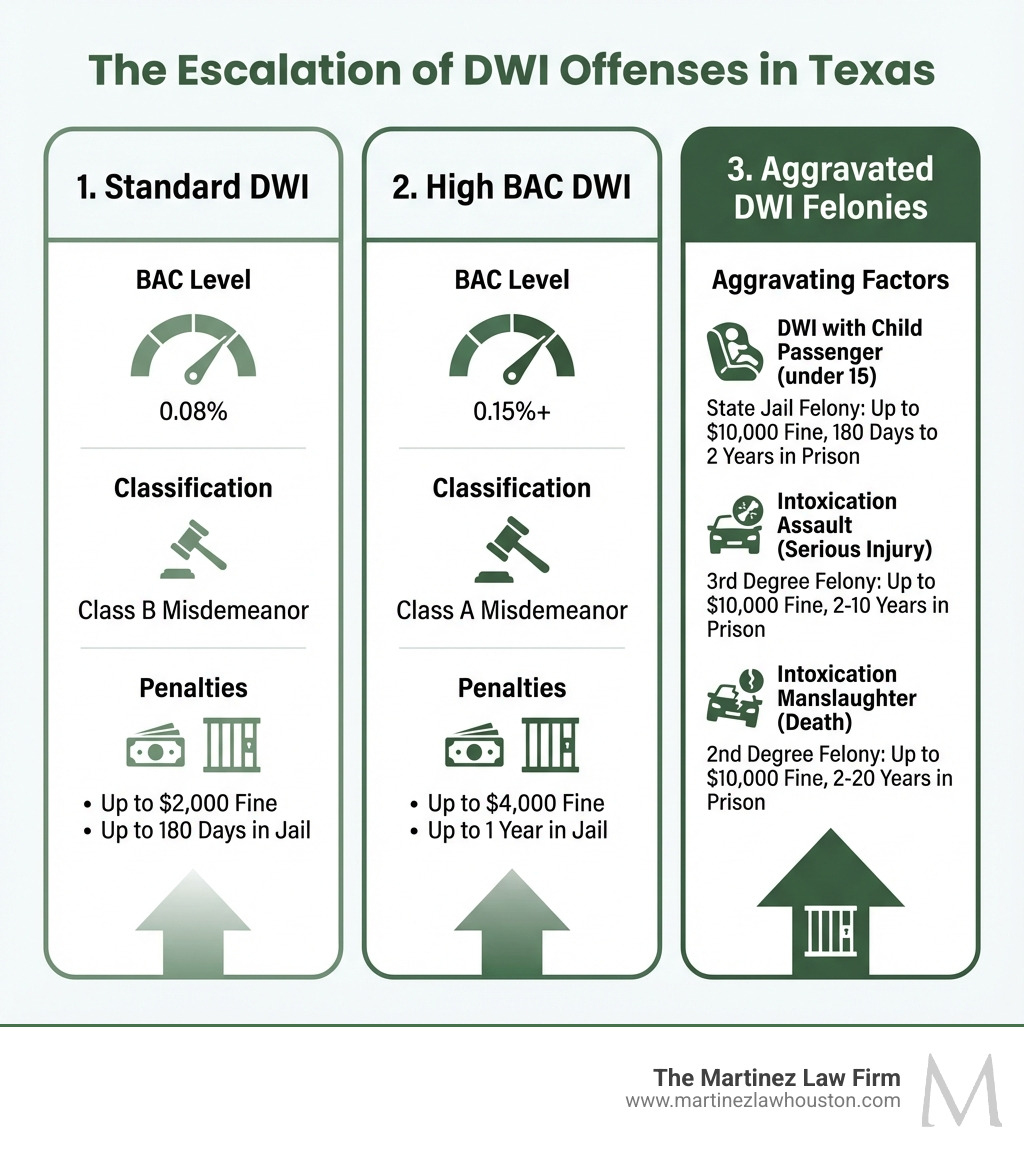
Aggravated DWI is a far more serious charge than a standard driving while intoxicated offense in Texas, carrying severe penalties like felony convictions, prison time, and substantial fines. While a typical first-offense DWI (BAC of 0.08%+) is a Class B misdemeanor, certain aggravating factors can lift the charge to a Class A misdemeanor or even a felony.
Key Differences Between Standard DWI and Aggravated DWI in Texas:
- Standard DWI: BAC of 0.08% or higher, Class B misdemeanor, up to $2,000 fine, up to 180 days in jail
- High BAC (0.15%+): Class A misdemeanor, up to $4,000 fine, up to 1 year in jail
- DWI with Child Passenger (under 15): State jail felony, up to $10,000 fine, 180 days to 2 years in prison
- Intoxication Assault: Third-degree felony, up to $10,000 fine, 2-10 years in prison
- Intoxication Manslaughter: Second-degree felony, up to $10,000 fine, 2-20 years in prison
In Houston and Harris County, prosecutors aggressively pursue these cases. The stakes are incredibly high—an aggravated DWI conviction means more than jail and fines; it can result in a permanent felony record affecting your job, professional licenses, housing, and immigration status.
I’m Herman Martinez, founder of The Martinez Law Firm in Houston, and I’ve spent over 25 years on both sides of the courtroom—as a former Chief Prosecutor for the Harris County District Attorney’s Office and as a defense attorney fighting aggravated DWI charges. My experience as a former prosecutor gives me unique insight into how the state builds its case against you, and how to dismantle it piece by piece.
Easy aggravated DWI glossary:
What Makes a DWI “Aggravated” in Texas?
In Texas, a standard DWI becomes an aggravated DWI when specific factors, defined in Chapter 49 of the Texas Penal Code, escalate its severity. These factors can transform a misdemeanor into a felony with much harsher consequences. For Houston and Harris County residents, understanding this is critical, as local prosecutors aggressively pursue these improved charges. A felony conviction can be life-altering, impacting your freedom and future.

High Blood Alcohol Content (BAC)
A common aggravating factor is a high Blood Alcohol Content (BAC). While the legal limit is 0.08%, a BAC of 0.15% or higher automatically improves a first-time DWI from a Class B to a Class A misdemeanor. This carries substantially increased penalties, including:
- Improved Fines: Up to $4,000, double the maximum for a standard DWI.
- Mandatory Jail Time: A conviction often leads to a mandatory minimum of 30 days in jail, with a maximum of one year.
- Ignition Interlock Device (IID): You will likely be required to install an IID on your vehicle at your own expense.
Prosecutors in Harris County are particularly aggressive in pursuing high BAC cases, arguing it shows a greater disregard for public safety.
DWI with a Child Passenger
One of the most serious aggravating factors is driving while intoxicated with a child passenger younger than 15. This automatically lifts the charge to a State Jail Felony, even for a first offense with no accident. The penalties for this type of aggravated DWI are severe:
- State Jail Felony: Incarceration in a state jail for 180 days to two years.
- Significant Fines: Fines can reach up to $10,000.
- Child Protective Services (CPS) Involvement: A conviction almost always triggers a CPS investigation, which can lead to the removal of children from your custody.
DWI Causing Injury or Death
The most severe forms of aggravated DWI are distinct felony offenses that occur when intoxication leads to serious bodily injury or death.
- Intoxication Assault: This Third-Degree Felony is charged when an intoxicated driver causes “serious bodily injury” to another person. It carries 2 to 10 years in prison and fines up to $10,000.
- Intoxication Manslaughter: This Second-Degree Felony is charged when an intoxicated driver causes the death of another person. It is punishable by 2 to 20 years in prison and fines up to $10,000.
The Steep Consequences of an Aggravated DWI Conviction
The consequences of an aggravated DWI conviction in Texas are designed to be severe, fundamentally altering your life. The legal system in Houston and Harris County imposes significant punishments for these improved offenses.
| Offense Type | Charge Level | Jail/Prison Time | Fines | License Suspension |
|---|---|---|---|---|
| Standard DWI | Class B Misdemeanor | 72 hours – 180 days | Up to $2,000 | 90 days – 1 year |
| High BAC (0.15%+) | Class A Misdemeanor | 30 days – 1 year | Up to $4,000 | 180 days – 2 years |
| DWI w/ Child Passenger | State Jail Felony | 180 days – 2 years (state jail) | Up to $10,000 | Up to 180 days |
| Intoxication Assault | Third-Degree Felony | 2 – 10 years (state prison) | Up to $10,000 | 180 days – 2 years |
| Intoxication Manslaughter | Second-Degree Felony | 2 – 20 years (state prison) | Up to $10,000 | 180 days – 2 years |
Criminal Penalties in Houston
- Jail vs. Prison Time: Misdemeanor aggravated DWI (e.g., high BAC) can lead to a year in county jail. Felony charges (e.g., with a child passenger, Intoxication Assault/Manslaughter) result in state prison time, ranging from 180 days to 20 years.
- Fines up to $10,000: Felony charges consistently carry fines up to $10,000.
- Mandatory Minimums: Texas law includes mandatory minimum sentences for many aggravated DWI offenses, limiting a judge’s discretion.
- Repeat Offender Improvements: Prior DWI convictions will lead to even more severe penalties for a new aggravated charge. A third DWI is automatically a Third-Degree Felony.
- Felony Conviction Consequences: A permanent felony conviction can strip you of fundamental rights, including the right to vote, hold public office, or own a firearm.
Beyond Legal Penalties: The Lasting Impact of an Aggravated DWI
The consequences extend far beyond the courtroom:
- License Suspension: You face mandatory license suspension periods from 90 days to two years. You only have 15 days from your arrest to request an Administrative License Revocation (ALR) hearing to fight an automatic suspension.
- Insurance Rate Hikes: Your auto insurance premiums will skyrocket, and you may be required to obtain more expensive SR-22 insurance.
- Employment Background Checks: A felony conviction can severely limit your job opportunities, especially in professions that require driving or involve children.
- Professional License Jeopardy: An aggravated DWI conviction can put professional licenses (e.g., for doctors, nurses, lawyers) at risk of suspension or revocation.
- Immigration Consequences: For non-citizens, a felony conviction can lead to severe immigration consequences, including deportation.
The Impact of Refusing a Chemical Test
Texas’s “implied consent” law means that by driving, you consent to a breath or blood test if lawfully arrested for DWI.
- Automatic License Suspension: Refusing a test results in an automatic license suspension of 180 days for a first refusal.
- Use of Refusal as Evidence: The prosecution can use your refusal against you in court as evidence of guilt.
- No Refusal Weekends in Houston: Harris County often implements “No Refusal” weekends, where officers get warrants to compel blood draws from drivers who refuse a breath test.
Building a Defense Against an Aggravated DWI Charge
Facing an aggravated DWI charge in Houston is overwhelming, but an arrest is not a conviction. A strong, immediate defense is crucial. Our firm’s unique perspective as former prosecutors gives us an edge in challenging the state’s case against you.

Key Defense Strategies for an Aggravated DWI Charge
Our defense involves a meticulous examination of every detail of your case.
- Challenging the Traffic Stop: Was the stop legal? Police need “reasonable suspicion” to pull you over. If not, evidence gathered afterward could be inadmissible.
- Questioning Field Sobriety Test Administration: Field Sobriety Tests (FSTs) are subjective and often administered incorrectly. We scrutinize the test administration, instructions, and the officer’s interpretation for bias and errors.
- Attacking Breathalyzer Maintenance and Results: Breathalyzers require proper maintenance, calibration, and operation. We investigate machine logs and officer certification to find errors that could invalidate the results.
- Disputing Blood Test Procedures and Contamination: Blood tests are also prone to error. We examine the chain of custody and lab procedures to challenge the sample’s integrity and the accuracy of the analysis.
The Role of an Experienced DWI Lawyer
An experienced lawyer is essential when facing an aggravated DWI in Harris County.
- Navigating the Harris County Court System: Our familiarity with local judges, prosecutors, and procedures allows us to steer the system efficiently on your behalf.
- Negotiating with Prosecutors: As former prosecutors, we understand how the other side thinks, which allows for more effective negotiations to reduce charges or minimize penalties.
- Identifying Procedural Errors: We review all reports and footage to find police errors or constitutional violations that could lead to evidence suppression or case dismissal.
- Preparing for Trial: If a trial is your best option, our extensive trial experience as both prosecutors and defense attorneys means we are prepared to aggressively fight for you before a jury.
- Protecting Your Rights: Our primary role is to be your unwavering advocate, protecting your rights at every stage of the legal process.
How Texas DWI Laws Compare to Other States
While our focus at The Martinez Law Firm is exclusively on Texas law, it can be helpful to briefly understand how other states approach aggravated DWI to appreciate the nuances of our own system.
New York’s Approach
New York defines an aggravated DWI with a BAC of 0.18% or higher. Its “Leandra’s Law” makes a DWI with a child passenger under 16 a felony, similar to Texas law.
Missouri’s Offender Status System
Missouri uses an offender status system based on prior convictions. “Prior,” “persistent,” and “aggravated” offender classifications lead to escalating penalties. We can see this detailed in Missouri’s DWI statute.
New Hampshire’s Unique Factors
New Hampshire considers unique factors like speeding over 30 mph while intoxicated as an aggravating circumstance. A BAC of .16% or higher also triggers an aggravated DWI charge. You can learn more about New Hampshire “Aggravated” DWI law.
While these examples show some similarities, they also highlight how each state tailors its DWI laws. In Texas, our laws are particularly stringent, especially concerning factors like high BAC, child endangerment, and causing harm.
Frequently Asked Questions about Aggravated DWI in Houston
We understand that facing an aggravated DWI charge can bring a flood of questions. Here, we address some of the most common inquiries we receive from clients in Houston and Harris County.
Can an Aggravated DWI be reduced to a regular DWI in Texas?
Yes, reducing an aggravated DWI to a regular DWI is possible, though challenging. The strategy involves attacking the “aggravating factor” itself—for example, by disputing a high BAC result or other key evidence. Harris County prosecutors are reluctant to reduce these charges, but a skilled defense attorney can negotiate by identifying procedural errors or weaknesses in the state’s case. Our experience as former prosecutors provides unique insight into these negotiations, aiming for a charge reduction or a more favorable plea.
Is an Aggravated DWI always a felony in Texas?
No, but it often is. The classification depends on the aggravating factor.
- Class A Misdemeanor: A first-offense DWI with a high Blood Alcohol Content (BAC) of 0.15% or higher is improved to a Class A misdemeanor.
- Felony: The charge becomes a felony if it involves a child passenger under 15 (State Jail Felony), causes serious bodily injury (Intoxication Assault), or results in death (Intoxication Manslaughter). A third DWI offense is also automatically a felony.
While not always a felony, an aggravated DWI always carries harsher penalties than a standard DWI.
How long does an Aggravated DWI stay on your record in Houston?
An aggravated DWI conviction stays on your Texas criminal record permanently and will appear on background checks. There are limited options to seal the record:
- Expungement: This is generally only available if your case was dismissed, you were acquitted, or you received a pardon. It is not an option for convictions.
- Order of Nondisclosure: You may be eligible to seal the record for certain first-offense misdemeanor aggravated DWI convictions after meeting strict requirements, such as completing probation. This makes the record unavailable to the general public, but not to law enforcement. Felony DWI convictions are generally not eligible.
Given the permanent nature of a conviction, an aggressive defense from the start is the best strategy to protect your record.
Protecting Your Future After an Arrest
An aggravated DWI charge in Houston is a serious accusation with life-altering consequences, including prison time, steep fines, and a permanent criminal record. A felony conviction can strip you of fundamental rights and close doors to future opportunities.
Navigating the complexities of Texas DWI law and aggressive Harris County prosecution on your own is a significant risk. You need a strategic defense custom to your case.
At The Martinez Law Firm, we understand the stakes. Our team, led by Herman Martinez, brings over 25 years of experience, including invaluable insights gained from his time as a former Chief Prosecutor for the Harris County District Attorney’s Office. This dual perspective allows us to anticipate the prosecution’s strategies, expose weaknesses in their evidence, and build a robust defense designed to protect your rights and your future.
Don’t let an aggravated DWI charge define your life. The time to act is now.
Contact an experienced Houston DWI lawyer today for a confidential consultation. Let us put our experience to work for you.
Understanding the Confusing Terminology of Impaired Driving Offenses

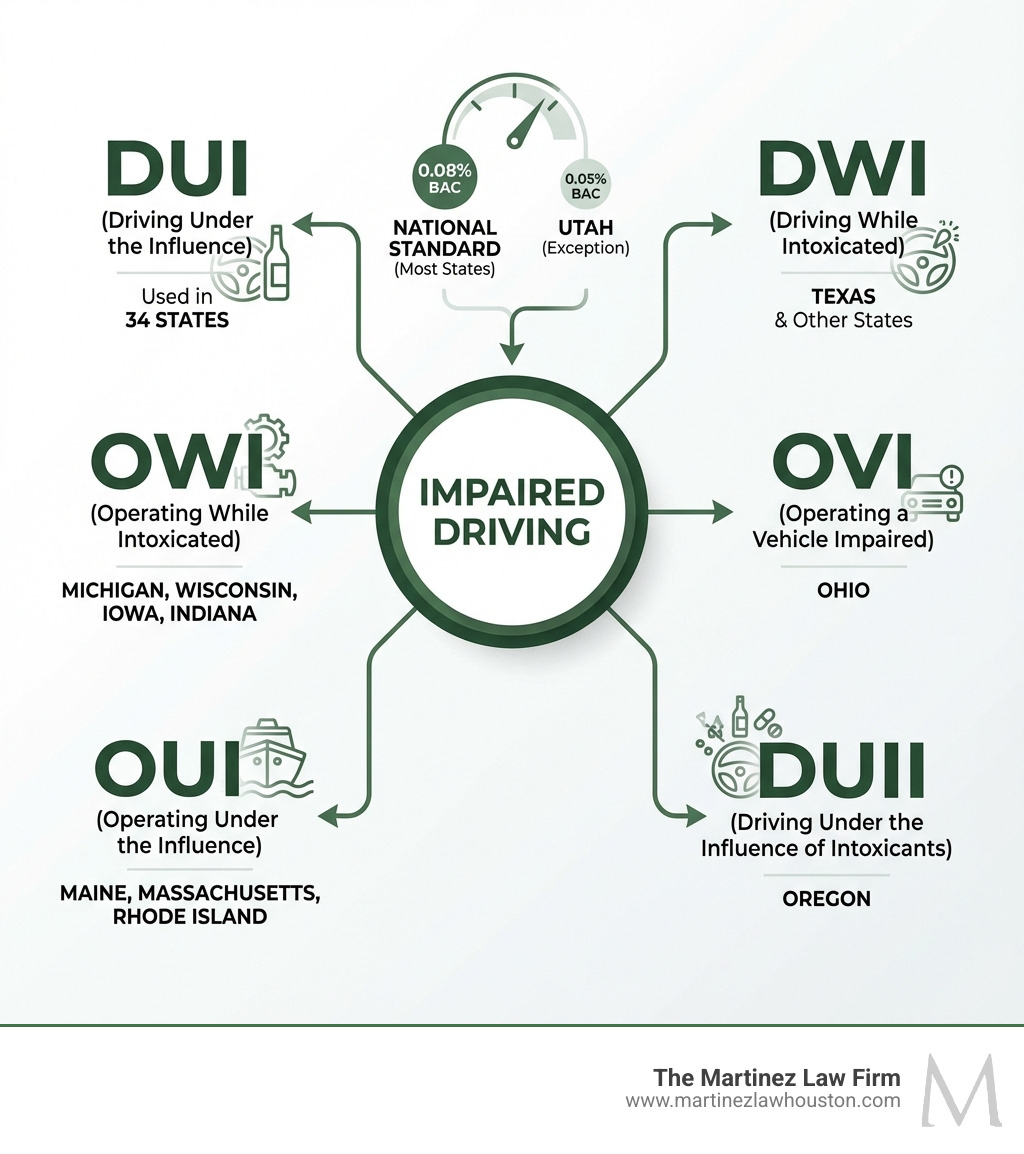
The difference between OWI vs DWI lies in state-specific terminology. DWI (Driving While Intoxicated) is the term used in Texas, while OWI (Operating While Intoxicated) is used in states like Michigan and Wisconsin. The distinction often hinges on “operating” having a broader legal definition than “driving,” potentially including non-moving vehicles. In Texas, only the term DWI is legally relevant.
If you’re facing an impaired driving charge, you’ll encounter a confusing array of acronyms like DUI, DWI, and OWI. While about 44 states use DUI or DWI, others use OWI, OVI, or OUI. This inconsistency stems from each state’s authority to define its own criminal laws.
For anyone in Houston or Harris County, the only term that matters is DWI, as defined in Texas Penal Code § 49.04. Understanding other states’ terms is useful for context, but Texas law does not use OWI. Regardless of the acronym, a conviction carries severe penalties: fines, jail time, license suspension, and increased insurance rates. The legal blood alcohol content (BAC) limit is 0.08% in Texas.
Herman Martinez, founder of The Martinez Law Firm and a former Chief Prosecutor for the Harris County District Attorney’s Office, has over 25 years of experience with DWI cases. This background provides a unique insight into prosecutorial strategies and how to build a strong defense for clients facing DWI charges in Houston.
This guide clarifies the terminology, explains the legal differences, and outlines what to do if you’re facing a DWI charge in Houston or Harris County.
OWI vs DWI glossary:
Decoding the Alphabet Soup: What Do DUI, DWI, and OWI Mean?

The core offense of impaired driving is the same nationwide, but the acronyms—DUI, DWI, OWI—vary by state. These terms refer to the illegal act of controlling a vehicle while your faculties are compromised by alcohol or drugs. Let’s define the most common ones.
Defining the Core Offenses
- DUI (Driving Under the Influence): A widely used term referring to driving while impaired by alcohol or drugs to any degree that affects safe operation.
- DWI (Driving While Intoxicated): The official term in Texas. It refers to operating a vehicle with a blood alcohol content (BAC) of 0.08% or higher, or while one’s normal faculties are impaired by alcohol or drugs. A charge of Driving While Intoxicated (DWI) doesn’t require complete intoxication, only that your ability to operate a vehicle safely is compromised.
- OWI (Operating While Intoxicated): Used in states like Wisconsin and Michigan, this term often has a broader definition than “driving,” covering physical control of a vehicle, even if it’s not moving.
The Critical Difference: ‘Driving’ vs. ‘Operating’
The key legal distinction is “driving” versus “operating.” “Driving” typically implies the vehicle is in motion. “Operating,” however, is a broader term that can mean being in actual physical control of a vehicle, even if it’s parked with the engine running.
For example, Michigan’s OWI law was changed to emphasize “operating,” meaning you could be charged for being intoxicated in the driver’s seat of a running car. Texas law also uses the term “operating” for a DWI charge under Texas Penal Code § 49.04, meaning you don’t have to be actively driving to be arrested.
A Look at Other Impaired Driving Acronyms
Beyond DUI, DWI, and OWI, other states use different labels:
- OVI (Operating a Vehicle Impaired): Used in Ohio.
- OUI (Operating Under the Influence): Used in Maine and Massachusetts.
- DUII (Driving Under the Influence of Intoxicants): Used in Oregon.
- DWAI (Driving While Ability Impaired): A lesser charge in states like New York and Colorado for lower impairment levels.
- DWUI (Driving While Under the Influence): Used in Wyoming.
No matter the acronym, impaired driving is a serious offense. If you have Common DWI Questions about your case in Houston, we can provide answers.
OWI vs DWI: Is There a Real Difference in Texas?

In Houston and Harris County, the OWI vs DWI debate is simple: Texas law only recognizes the term DWI (Driving While Intoxicated).
The Interchangeable Nature of Impaired Driving Terms
While terms like DUI, DWI, and OWI are often used interchangeably and refer to the same serious offense, the specific legal definitions and penalties are determined by state law. The wording of a state’s statute can affect what constitutes “operation” and the exact thresholds for impairment. Understanding Texas’s specific statute is paramount. For a full breakdown, see our DWI DUI Texas Complete Guide.
Why States Use Different Acronyms
The variety of acronyms exists for several reasons:
- States’ Rights: The U.S. legal system, with roots in English Common Law, allows each state to create its own criminal laws, leading to different terminology.
- Legislative Updates: States sometimes update terms to broaden the scope of their laws. For instance, Michigan adopted OWI to emphasize “operating” over “driving” and include more intoxicating substances.
- Distinguishing Offenses: Some states use different acronyms for different levels of impairment, though Texas does not.
The Bottom Line on OWI vs DWI in Houston
For Houston residents, the bottom line is that Texas uses DWI exclusively.
- Texas Penal Code § 49.04 defines the offense as operating a motor vehicle in a public place while intoxicated.
- The term OWI is not used in Texas statutes and has no legal standing in our courts.
- To secure a DWI conviction, a prosecutor must prove you were: (1) operating a motor vehicle, (2) in a public place, (3) while intoxicated. “Intoxicated” means having a BAC of 0.08 or more, or lacking normal use of your faculties due to a substance.
Understanding the specific DWI Laws in Texas is the first step in building a defense.
State-by-State Breakdown of Impaired Driving Laws
While Texas law focuses on DWI, understanding the national landscape of impaired driving laws provides useful context. The U.S. Department of Transportation offers an Impaired Driving Laws overview that highlights the national effort to combat this issue.
A National Overview of Acronyms
DUI and DWI are the most common terms, used in about 44 states. A minority use other acronyms, which can confuse those crossing state lines. Here’s a brief overview:
| Acronym | Stands For | States Using It (Examples) |
|---|---|---|
| DUI | Driving Under the Influence | California, Florida, Illinois, New York (often alongside DWAI) |
| DWI | Driving While Intoxicated | Texas, New Jersey, North Carolina, Virginia |
| OWI | Operating While Intoxicated | Michigan, Wisconsin, Iowa, Indiana |
| OVI | Operating a Vehicle Impaired | Ohio (exclusively) |
| OUI | Operating Under the Influence | Maine, Massachusetts, Rhode Island |
| DUII | Driving Under the Influence of Intoxicants | Oregon |
| DWUI | Driving While Under the Influence | Wyoming |
How Impairment is Defined and Charged
Regardless of the acronym, states charge impaired driving in two main ways:
- Blood Alcohol Content (BAC) – Per Se Laws: Every state has a “per se” law, meaning you are automatically considered impaired if your BAC is at or above the legal limit. The nationwide standard is 0.08% (except for Utah at 0.05%). Law enforcement uses chemical tests like Breath Blood Tests to determine BAC.
- Impairment by Drugs or Combined Substances: Laws also prohibit driving while impaired by illegal, prescription, or over-the-counter drugs. A Controlled Substance DWI What Is It charge can be based on observed impairment, even without a specific drug concentration limit. Texas DWI law covers impairment from alcohol, drugs, or a combination, broadly defining “intoxicated” to include any substance that impairs normal faculties.
The Consequences: Penalties for a DWI Conviction in Texas
A DWI conviction in Houston carries severe, life-altering consequences designed to punish offenders and deter impaired driving. These penalties escalate with each offense and can be increased by aggravating factors.
Understanding Texas DWI Penalties
Texas DWI penalties become more severe with subsequent offenses:
- First Offense: A Class B misdemeanor with up to a $2,000 fine and 3 to 180 days in jail.
- Second Offense: A Class A misdemeanor with up to a $4,000 fine and 180 days to 2 years in jail.
- Third Offense: A third-degree felony with up to a $10,000 fine and 2 to 10 years in prison.
In addition to fines, you face state surcharges of $1,000 to $2,000 annually for three years, mandatory community service, and DWI education programs. These are just some of the 7 DWI Consequences A Houston DWI Lawyer Needs You to Know.
Aggravating Factors That Increase Penalties
Certain circumstances, or aggravating factors, significantly increase penalties for an Aggravated DWI in Texas:
- High BAC: A BAC of 0.15% or higher lifts a first offense to a Class A misdemeanor.
- DWI with a Child Passenger: Driving intoxicated with a child under 15 is a state jail felony, punishable by up to 2 years in jail and a $10,000 fine. Defending a DWI with a Child Passenger charge requires specialized legal knowledge.
- Intoxication Assault: Causing serious bodily injury is a third-degree felony (2-10 years in prison).
- Intoxication Manslaughter: Causing a death is a second-degree felony (2-20 years in prison).
Long-Term Impact of a Conviction
The consequences of a conviction are long-lasting and affect your finances, career, and freedom:
- Driver’s License Suspension: A conviction leads to license suspension. You may also face an administrative DWI License Suspension Houston for refusing or failing a chemical test.
- Ignition Interlock Device (IID): Often required, this device prevents your car from starting if it detects alcohol.
- Increased Insurance Rates: Expect your premiums to skyrocket and potentially require an SR-22 certificate.
- Employment Issues: A criminal record can jeopardize job opportunities, especially those requiring driving or professional licenses. Understanding How Long a DWI Stays on Your Record in Texas is crucial.
- CDL Consequences: A DWI can be career-ending for commercial drivers, with a first offense leading to a one-year disqualification and a second leading to a lifetime ban.
Frequently Asked Questions about OWI vs DWI
Here are answers to common questions about impaired driving charges in Texas, especially regarding the OWI vs DWI debate.
In Texas, is a DUI the same as a DWI?
No. In Texas, the terms are not the same and are distinguished by age:
- DUI (Driving Under the Influence): This is a charge for minors (under 21) who operate a vehicle with any detectable amount of alcohol. Texas has a zero-tolerance policy for underage drinking and driving.
- DWI (Driving While Intoxicated): This applies to adults (21 and over) with a BAC of 0.08% or higher, or whose faculties are impaired. A Minor DWI in Texas Can Minors Get a DWI if their BAC is 0.08% or more, resulting in this more serious charge.
Can you get an OWI for being asleep in your car?
While Texas uses DWI, not OWI, you can still get a DWI for being asleep in your car. The law prohibits “operating” a vehicle while intoxicated, which courts can interpret as having “actual physical control.” Factors include whether the engine is running, where the keys are, and if you’re in the driver’s seat. Trying to “sleep it off” in your car can lead to a DWI charge if the circumstances suggest you were operating the vehicle. Depending on the facts, you could face a Public Intoxication Texas charge instead, which is a lesser offense.
What should I do if I’m charged with a DWI in Houston?
If you are arrested for a DWI in Houston, take these steps immediately:
- Remain Silent: You have the right to remain silent. Only provide your identification.
- Contact an Attorney Immediately: This is the most critical step. An experienced DWI lawyer can protect your rights and start building your defense.
- Request an ALR Hearing: You have only 15 days to request an Administrative License Revocation (ALR) hearing to fight for your driving privileges. Your attorney can handle this for you.
Knowing What to Do After a DWI Arrest in Houston TX is your first line of defense.
Why You Need an Experienced DWI Lawyer on Your Side
Whether the charge is OWI vs DWI, the legal definition in your state and the severe consequences of a conviction are what truly matter. In Houston and Harris County, that charge is DWI, and defending against it is critical.
A DWI conviction is a criminal offense with life-altering repercussions, including fines, jail time, license suspension, and damage to your career and reputation. The stakes are incredibly high.
An experienced DWI lawyer is your most valuable asset. At The Martinez Law Firm, founder Herman Martinez uses his 25 years of experience, including his time as a Chief Prosecutor for the Harris County District Attorney’s Office, to your advantage. This unique perspective allows us to anticipate the prosecution’s strategy and build an aggressive, personalized defense.
We fight to protect our clients’ rights, freedom, and future. If you are facing a DWI charge in Houston, do not face it alone. The time to act is now.
Contact an experienced DWI Lawyer in Houston today for a consultation. Let us put our experience to work for you.
The Staggering Reality of Impaired Driving in the U.S.

DWI statistics reveal a persistent and deadly crisis on American roads. The numbers are staggering:
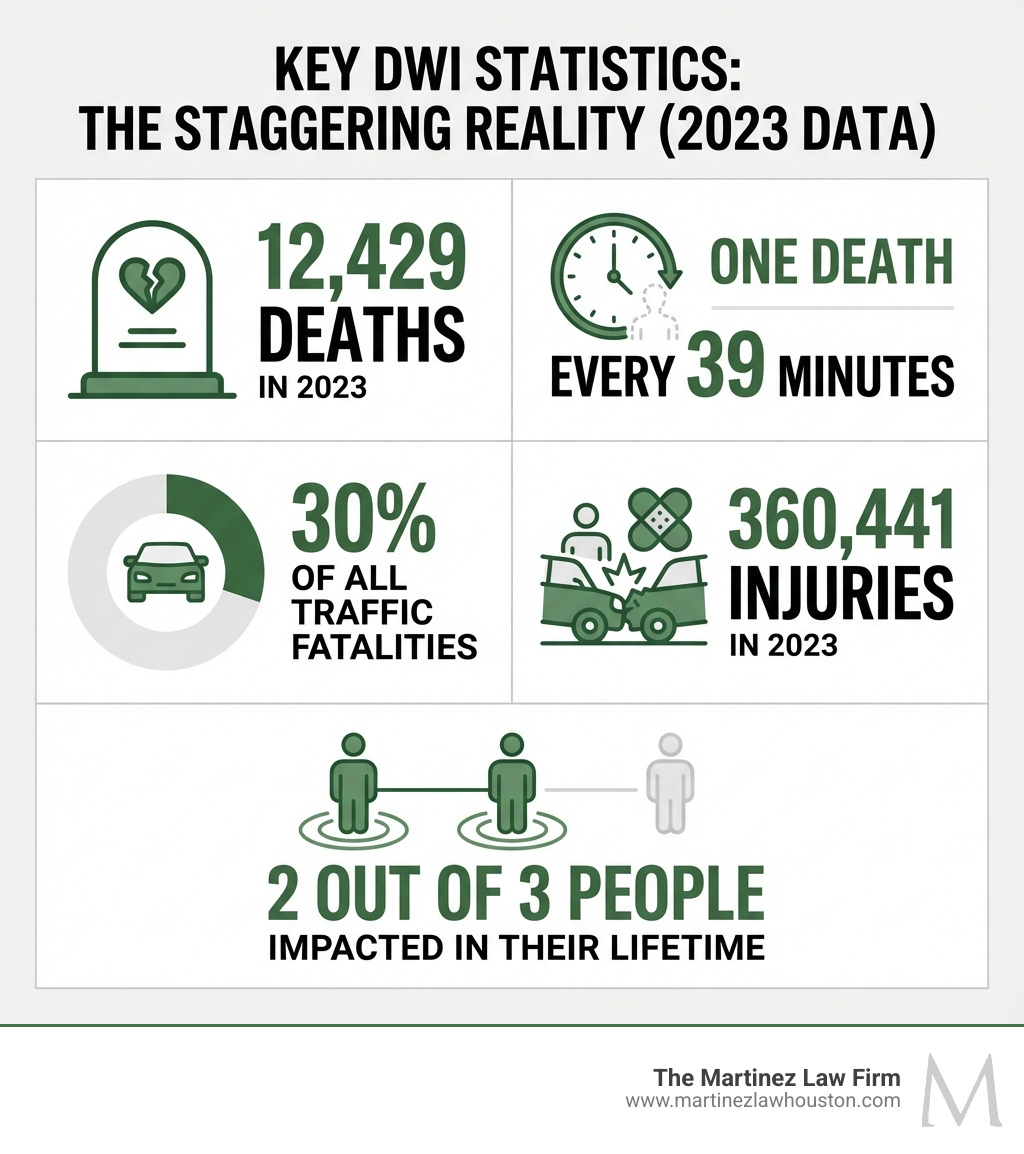
- In 2023, 12,429 people were killed and 360,441 were injured in drunk driving crashes.
- These incidents represent 30% of all traffic fatalities, with one person dying every 39 minutes.
- 2 out of 3 people will be impacted by drunk driving in their lifetime.
- The annual economic cost of these crashes totals approximately $123.3 billion.
- Texas is a major contributor, with 1,699 alcohol-impaired driving deaths in 2023.
DWI (Driving While Intoxicated) is the legal term used in Texas. It refers to operating a vehicle with a Blood Alcohol Concentration (BAC) of .08 g/dL or higher, or while impaired by alcohol or drugs to the point of losing normal faculties.
While national drunk driving fatalities have decreased 41% since 1982, they still account for nearly one-third of all traffic deaths. In 2023, someone was killed or injured in a drunk driving crash every 85 seconds. The victims aren’t just the drivers; 38% of fatalities are passengers, occupants of other vehicles, or pedestrians, including 253 children aged 14 and younger.
For Houston and Harris County, the numbers are particularly alarming. Texas had one of the highest percentages of alcohol-impaired driving fatalities in the nation in 2023 (40%), and Harris County consistently leads the state in alcohol-related crashes. This is a local crisis affecting our community daily.
At The Martinez Law Firm, we see every day how these statistics translate into real lives. From experience from the Harris County District Attorney’s Office, our team understands how these cases are prosecuted and how to build strong defenses for individuals facing DWI charges in our community.
Related content about DWI statistics:
National DWI Statistics: A Sobering Look at the Numbers
The data from the National Highway Traffic Safety Administration (NHTSA) paints a stark picture of alcohol-impaired driving’s impact. While long-term trends show a 41% decrease in drunk driving deaths since 1982, recent years have seen a concerning 22% increase since 2019.
Key DWI Statistics and Trends
- Fatalities: In 2023, an estimated 12,429 people were killed in drunk driving crashes, down from 13,524 in 2022. Despite this slight decrease, these deaths consistently account for 30-32% of all traffic fatalities.
- Daily Toll: Every day, approximately 37 people in the United States die in drunk-driving crashes—one preventable tragedy every 39 minutes.
- Injuries: In 2023, an estimated 360,441 people were injured in drunk driving crashes, causing life-altering physical, emotional, and financial burdens.
- Pervasiveness: Self-reported data suggests there are an estimated 127 million episodes of alcohol-impaired driving annually among U.S. adults, averaging 347,000 incidents each day.
The Staggering Economic and Societal Cost

The impact of impaired driving extends far beyond the crash scene. The annual economic cost of alcohol-related crash deaths is an estimated $123.3 billion, covering medical expenses, lost productivity, property damage, and legal costs.
When factoring in societal harm, which includes the value of lost quality of life, the total cost reached an estimated $296 billion in 2019. These figures represent the immense financial and emotional devastation that DWI-related incidents inflict on individuals and society.
Texas DWI Statistics: A Closer Look at Houston and Harris County
When we examine DWI statistics, Texas consistently ranks among the highest in the nation for alcohol-related fatalities. The Texas Penal Code 49 defines intoxication not just by BAC, but also by the loss of normal faculties, allowing for broad enforcement.
How Texas Compares to the Nation
In 2023, Texas recorded 1,699 alcohol-impaired driving fatalities, the highest number of any state. Furthermore, 40% of all traffic fatalities in Texas were attributed to impaired driving, tying for the highest percentage nationwide. A significant portion of these crashes (27%) involved a driver with a BAC of .15 g/dL or higher—nearly twice the legal limit. This underscores the disproportionate impact of “hardcore drunk drivers” in our state.
While DWI arrest rates in Texas have declined, the high fatality rate suggests many impaired drivers go undetected. For more state-level data, visit the Impaired Driving – Texas Open Data Portal.
Local Impact: DWI in Harris County

For residents of Houston, these statistics are a local crisis. Harris County consistently leads the state in alcohol-related crashes and fatalities. For example, in 2018, Harris County reported 3,229 DUI crashes and 113 fatalities, far surpassing other major counties.
The legal consequences are also severe. In 2013, over 71,000 of nearly 100,000 drunk driving arrests in Texas resulted in convictions. This high conviction rate highlights the aggressive prosecution of DWI cases in Harris County. At The Martinez Law Firm, our experience as former prosecutors provides invaluable insight into local enforcement and prosecution strategies, which is essential for anyone navigating a DWI charge in our community.
Who is Affected? The Demographics of Impaired Driving
DWI statistics show that impaired driving is an indiscriminate killer, affecting drivers, passengers, and innocent bystanders alike.
The Victims: Who Dies in Alcohol-Impaired Crashes?
While impaired drivers themselves account for the majority of deaths (around 60%), a significant portion of victims are other people. The 2022 breakdown shows the tragic ripple effect:
- Impaired Drivers: 59% of fatalities.
- Passengers of Impaired Drivers: 12% of fatalities.
- Occupants of Other Vehicles: 16% of fatalities.
- Nonoccupants (Pedestrians, etc.): 12% of fatalities.
Most tragically, 253 children aged 14 and younger were killed in alcohol-impaired crashes in 2023, accounting for 25% of all child traffic fatalities that year. Over half of these children were passengers in a vehicle with an impaired driver.
Driver Demographics: Age, Gender, and Repeat Offenses
Understanding who is most often behind the wheel in these incidents is key to prevention.
- Age: The 21- to 24-year-old age group consistently has the highest percentage (28-29%) of alcohol-impaired drivers in fatal crashes.
- Gender: Males are far more likely to be involved. In 2022, there were approximately four male alcohol-impaired drivers for every one female driver in fatal crashes.
- Repeat Offenses: “Hardcore drunk drivers” with prior DWI convictions are a major concern. They account for nearly 67% of drunk driving fatalities and are 3 to 4 times more likely to have a prior DWI conviction than sober drivers in fatal crashes. The average drunk driver operates a vehicle 80 times while impaired before their first arrest, highlighting the immense danger they pose.
The Science and Legality of Impaired Driving
Understanding DWI statistics requires knowing the science and laws behind impaired driving. Alcohol is a central nervous system depressant that impairs brain function, thinking, reasoning, and muscle coordination—all essential for safe driving.
Understanding Blood Alcohol Concentration (BAC)
Blood Alcohol Concentration (BAC) is the legal standard for measuring intoxication. In Texas and most of the U.S., the legal limit is .08 g/dL. For commercial drivers, it’s .04 g/dL.
However, impairment begins at much lower levels. A BAC of just .02% can affect judgment and visual function, while at .05%, steering and emergency response are reduced. By the legal limit of .08%, crash risk increases exponentially due to poor coordination, impaired judgment, and memory loss. In Texas, a driver can be charged with DWI even below .08% if they have lost the normal use of their mental or physical faculties.
BAC is measured with a breathalyzer or blood test. While generally reliable, these tests can be challenged based on improper procedure, faulty equipment, or medical conditions.
Here’s a summary of BAC levels, their effects, and typical Texas penalties for a first offense:
| BAC Level | Effects on Body (General) | Typical Texas Penalties (First Offense) |
|---|---|---|
| .02 – .05% | Decline in visual function, inability to multitask, some loss of judgment. | Possible charge if faculties lost. Under 21: illegal consumption (.02% to <.08%) |
| .05 – .07% | Reduced ability to track moving objects, difficulty steering, reduced response to emergencies. | Possible charge if faculties lost. |
| .08% (Legal Limit) | Poor muscle coordination, difficulty detecting danger, impaired judgment, self-control, reasoning, and memory. | Class B Misdemeanor: 3-180 days jail, up to $2,000 fine, 90 days-1 year license suspension, annual fee to retain license. |
| .15% or higher | Significant impairment of vehicle control, attention to driving tasks, and information processing. | Class A Misdemeanor: Up to 1 year jail, up to $4,000 fine, up to 18 months license suspension. |
Note: Penalties can vary based on specific circumstances, prior offenses, and other factors, and are subject to change.
Understanding Drug-Impaired Driving vs. Alcohol DWI Statistics
Drug-impaired driving is a growing concern. In 2020, an estimated 11.7 million people drove under the influence of marijuana, and 2.4 million drove under the influence of other illicit drugs. You can find more data in the National Survey on Drug Use and Health (NSDUH).
However, collecting accurate DWI statistics for drugs is more complex than for alcohol. Key challenges include:
- Difficult Detection: There is no simple, universal roadside test for drug impairment like a breathalyzer.
- Variable Effects: Different drugs affect driving ability in vastly different ways, making a single “legal limit” impractical.
- Testing Limitations: A positive drug test confirms presence but doesn’t always prove impairment at the time of driving, as some drugs remain in the system long after their effects wear off.
Despite these challenges, data shows drugs are a major factor in serious crashes, highlighting the need for continued research and awareness.
Frequently Asked Questions about DWI Statistics
We understand that DWI statistics can be complex. Here are answers to some common questions.
How many people die from drunk driving every day?
Approximately 37 people die each day in the United States in drunk-driving crashes. This means that, on average, one person loses their life every 39 minutes due to impaired driving.
What percentage of car accidents are caused by alcohol?
In recent years, DWI statistics show that alcohol impairment has been a factor in approximately 30-32% of all traffic-related deaths in the U.S. This means nearly one-third of all fatal car accidents involve a drunk driver.
What are the penalties for a first-time DWI in Texas?
A first-time DWI conviction in Texas is a serious offense with significant penalties:
- Fines: Up to $2,000.
- Jail Time: From 3 to 180 days.
- License Suspension: From 90 days up to one year.
- Annual Surcharge: A fee of $1,000-$2,000 for three years to keep your license.
Penalties increase significantly for aggravating factors like a high BAC (.15% or higher) or having a child passenger, which lifts the charge to a felony. At The Martinez Law Firm, we help clients in Houston and Harris County understand these consequences and build a strong defense.
Facing a DWI Charge in Houston?
When you look at DWI statistics, it’s easy to see only numbers. But at The Martinez Law Firm, we know that behind every statistic is a person whose life has been dramatically altered. A DWI charge in Houston and Harris County, where incidents are high, can have profound and lasting consequences on your job, family, and freedom.
Navigating the legal system alone is overwhelming. The complexities of Texas DWI laws and aggressive prosecution tactics demand a strong, knowledgeable defense. This is where our experience becomes your greatest asset.
Herman Martinez, founder of The Martinez Law Firm, brings over 25 years of criminal defense experience, including crucial time as a former Chief Prosecutor for the Harris County District Attorney’s Office. This background gives us a unique understanding of how the prosecution builds its cases, allowing us to craft aggressive defense strategies aimed at achieving the best possible outcome for you.
We carefully examine every detail of your case—from the traffic stop to the test results—to challenge faulty evidence and protect your rights. If you or a loved one are facing a DWI charge in the Houston area, don’t become another statistic. Take control of your future by seeking expert legal representation.
Get expert legal help for your DWI case today.
Why a DWI Charge in Texas Demands Your Immediate Attention

A DWI in Texas is a serious criminal offense for operating a motor vehicle while intoxicated. Intoxication is defined as having a blood alcohol concentration (BAC) of 0.08% or higher, or lacking normal mental or physical faculties due to substances. The consequences are severe, impacting your license, finances, and freedom through two simultaneous legal processes: a criminal case and an administrative license hearing.
Quick Facts About DWI in Texas:
- First offense: Class B misdemeanor; 72 hours to 180 days in jail, fines up to $2,000, license suspension up to 1 year.
- High BAC (0.15%+): Upgraded to a Class A misdemeanor; up to 1 year in jail, fines up to $4,000.
- Second offense: Class A misdemeanor; 30 days to 1 year in jail, fines up to $4,000.
- Third offense: Third-degree felony; 2-10 years in prison, fines up to $10,000.
- Minors (Under 21): Zero tolerance for any detectable amount of alcohol.
- Crucial Deadline: You have only 15 days after arrest to request an Administrative License Revocation (ALR) hearing.
A DWI charge triggers two parallel legal battles. The criminal case involves potential jail time and a permanent record, while the administrative process through the Texas Department of Public Safety threatens your driving privileges immediately.
In Houston and Harris County, navigating one of the state’s busiest court systems can be overwhelming. A DWI conviction can derail your career, spike insurance rates, restrict international travel, and create a permanent criminal record. Many people miss the 15-day ALR hearing deadline, leading to automatic license suspension. Understanding the full scope of penalties is critical to avoid accepting a plea deal with hidden long-term costs.
I’m Herman Martinez, founder of The Martinez Law Firm in Houston. With over 25 years of experience as a Chief Prosecutor and City of Houston Judge, I understand how DWI in Texas cases are built. This unique perspective allows me to develop effective defense strategies to protect your rights, license, and future.
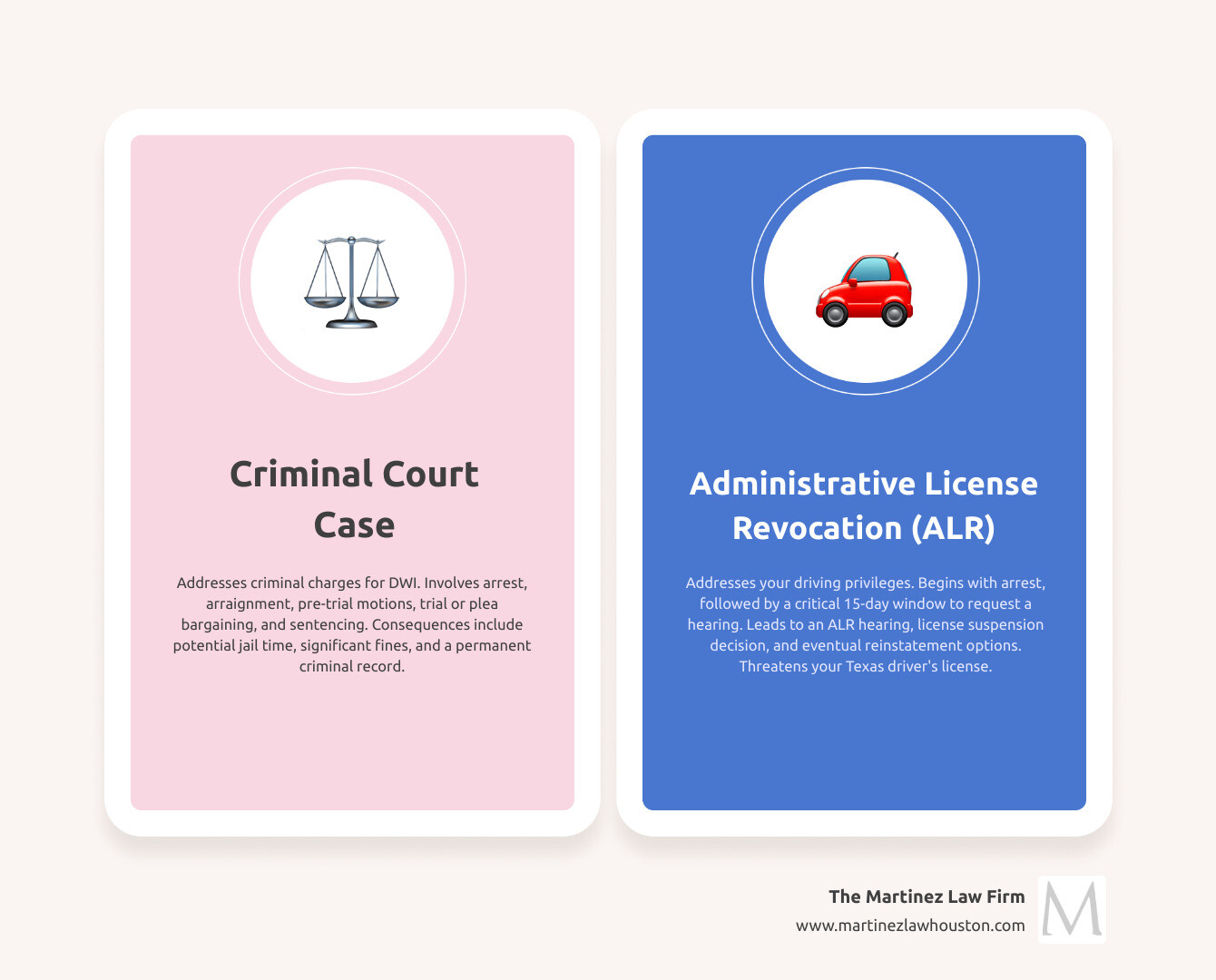
Understanding What Constitutes a DWI in the Lone Star State
What exactly is a DWI in Texas? According to Texas Penal Code § 49.04, you commit an offense if you are intoxicated while operating a motor vehicle in a public place. The legal definition of “intoxicated” is specific and has two primary criteria:
- Per se intoxication: Having a blood alcohol concentration (BAC) of 0.08% or more. If your BAC meets or exceeds this level, you are legally intoxicated, regardless of how you feel.
- Loss of normal faculties: Lacking the normal use of your mental or physical faculties due to alcohol, drugs, or any other substance. This allows an arrest based on an officer’s observations, such as slurred speech or poor coordination, even if your BAC is below 0.08%.
The term “operating a motor vehicle” is also interpreted broadly. It can mean being in physical control of a vehicle with the potential to put it in motion, so you could be charged even while sleeping in a parked car with the keys in the ignition. Understanding these definitions is the foundation of any DWI defense. For the full statute, review the official text: What it means to be legally intoxicated in Texas.
Legal BAC Limits in Texas
BAC limits vary based on age and license type.

- For drivers over 21: The legal BAC limit is 0.08%.
- For commercial drivers: The limit is much lower at 0.04%.
- For drivers under 21: Texas has a “Zero Tolerance” policy, meaning any detectable amount of alcohol is illegal.
DWI vs. DUI: Clarifying the Terminology for a DWI in Texas
In Texas, “DWI” and “DUI” are not interchangeable and refer to distinct offenses.
- DWI (Driving While Intoxicated): This is the primary charge for adults (21+) who operate a vehicle with a BAC of 0.08% or more, or who have lost their normal faculties. This is the standard charge for an adult DWI in Texas.
- DUI (Driving Under the Influence): This charge specifically applies to minors (under 21) who have any detectable amount of alcohol in their system. A first-offense DUI is typically a Class C Misdemeanor, involving fines and license suspension but usually no jail time.
However, a minor with a BAC of 0.08% or higher can be charged with an adult-level DWI in Texas, facing the same severe penalties. This distinction is critical for both adults and minors navigating the legal system in Houston.
The Escalating Penalties for a DWI in Texas
The penalties for a DWI in Texas are severe and escalate with each offense or aggravating factor. These consequences include criminal penalties like fines and jail time, as well as administrative actions against your driving privileges. The Harris County court system takes these offenses very seriously.

First-Time DWI Offense
A first-time DWI in Texas with a BAC below 0.15% is a Class B Misdemeanor. The penalties are significant:
- Jail Time: 72 hours to 180 days (minimum of six days if an open container is present).
- Fines: Up to $2,000, plus potential state fines of $3,000 to $6,000 assessed upon sentencing.
- License Suspension: 90 days to 1 year.
- Mandatory DWI Education: Completion of a 12-hour DWI education program.
Subsequent DWI Offenses (Second, Third, and Beyond)
Texas law imposes increasingly harsh penalties for repeat DWI in Texas offenses.
- Second Offense (Class A Misdemeanor):
- Jail Time: 30 days to 1 year.
- Fines: Up to $4,000.
- License Suspension: 180 days to 2 years.
- Annual Surcharge: Up to $2,000 for three years to retain your license.
- Third Offense (Third-Degree Felony):
- Prison Time: 2 to 10 years in state prison.
- Fines: Up to $10,000.
- License Suspension: 180 days to 2 years.
- Fourth Offense and Beyond: Can be improved to a Second-Degree Felony, with up to 20 years in prison.
Aggravating Factors That Increase Penalties
Certain circumstances can lift a DWI in Texas charge and its penalties.
- High BAC (0.15% or more): A first offense is upgraded to a Class A Misdemeanor, with up to one year in jail and a $4,000 fine.
- Open Container: Increases the minimum jail time for a first offense to six days.
- DWI with a Child Passenger: Driving intoxicated with a child under 15 is a State Jail Felony, carrying 180 days to two years in state jail, fines up to $10,000, and a 180-day license suspension. This often triggers a CPS investigation.
- Intoxication Assault: Causing serious bodily injury to another person is a Third-Degree Felony, with 2 to 10 years in prison and fines up to $10,000.
- Intoxication Manslaughter: Causing the death of another person is a Second-Degree Felony, with 2 to 20 years in prison and fines up to $10,000.
Penalties can be further improved if the victim is a first responder. For a full overview, see the Texas DWI penalties overview.
The Administrative Process: Protecting Your Driving Privileges
Beyond criminal charges, a DWI in Texas arrest initiates a separate civil process called Administrative License Revocation (ALR) through the Texas Department of Public Safety (DPS). This process, which runs parallel to your criminal case, directly threatens your driving privileges based on the state’s Implied Consent Law.
By driving in Texas, you have legally consented to provide a breath or blood sample if lawfully arrested for a DWI in Texas. Refusing this test has immediate and automatic consequences for your license, regardless of the criminal case’s outcome.
The Consequences of Refusing a Breathalyzer or Blood Test
Refusing to provide a breath or blood sample after a lawful DWI arrest triggers an automatic license suspension:
- First Refusal: 180-day license suspension.
- Second or Subsequent Refusal: 2-year license suspension.
Even with a refusal, officers can often obtain a warrant to draw your blood. Therefore, refusing a test does not prevent a BAC reading but does guarantee an immediate license suspension, making the ALR hearing critical.
The ALR Hearing: Your 15-Day Window to Act
After a DWI in Texas arrest, you have only 15 days to request an ALR hearing to challenge the administrative suspension of your license. If you miss this deadline, your license will be automatically suspended on the 40th day after your arrest.
The ALR hearing is your opportunity to fight the suspension and can also be a valuable chance to gather evidence for your criminal case, as the arresting officer may testify. To learn more about this process, review the DPS guidelines: Learn about the ALR Program. Acting quickly is essential to protect your ability to drive in Houston.
Life After a DWI: Navigating the Long-Term Consequences
A DWI in Texas conviction leaves a permanent criminal record that affects nearly every aspect of life, from employment to personal freedoms.
- Criminal Record: A DWI conviction is permanent and appears on background checks for jobs, housing, and education.
- Employment & Professional Licenses: A DWI can hinder job prospects, especially for roles requiring driving or professional licenses (medical, legal, teaching), which may be jeopardized.
- Auto Insurance Rates: Expect a significant premium increase. Insurers may raise rates by 87% or more, costing thousands extra per year.
- International Travel: Countries like Canada and Mexico may deny entry to individuals with a DWI conviction.
- Civil Rights: A felony DWI can lead to the temporary loss of voting rights or the right to own a firearm and can impact child custody cases.
These consequences highlight the importance of a strong defense against any DWI in Texas charge.
Ignition Interlock Devices (IID) and SR-22 Insurance
Two common post-conviction requirements are IIDs and SR-22 insurance.
- Ignition Interlock Device (IID): This device is wired into your vehicle and requires a breath sample to start the engine. It prevents the car from starting if it detects alcohol. IIDs are often mandatory for repeat offenders, those with a high BAC (0.15%+), or as a condition of probation or an occupational license. Costs include installation ($70-$100) and monthly monitoring ($60-$90).
- SR-22 Insurance: This is a Certificate of Financial Responsibility filed with the DPS to prove you have minimum liability coverage. It’s typically required for at least two years after a DWI in Texas conviction and leads to much higher insurance premiums.
Can I Still Drive? Occupational and Reinstated Licenses
Even with a suspended license from a DWI in Texas, there are options for legal driving.
- Occupational License (Essential Need License): You may petition the court for an occupational license, which allows restricted driving for essential needs like work, school, or household duties. Obtaining one requires proving essential need, filing an SR-22, and often installing an IID.
- Reinstating Your License: After the suspension period ends, you must complete several steps for full reinstatement: pay all fines and fees (including a $125 reinstatement fee and annual surcharges), complete required DWI education programs, file an SR-22, and install an IID if required.
How a Houston DWI in Texas Stays on Your Record
A DWI in Texas conviction is permanent and does not automatically disappear from your criminal record. This can create lifelong challenges for employment and other opportunities.
While a conviction is permanent, some limited legal remedies exist:
- Charge Reduction: A skilled defense may negotiate a reduction to a lesser offense like reckless driving, which may carry less stigma.
- Expunction: This legal erasure of records is extremely rare for DWI cases and generally only available if the case was dismissed or you were found not guilty.
- Nondisclosure: This court order can “seal” the record from public view, but not from law enforcement. Eligibility for a DWI in Texas is strict, requiring completion of probation and a multi-year waiting period.
Given the permanence of a conviction, an aggressive defense from the start is the best strategy.
Frequently Asked Questions about DWI in Texas
Facing a DWI in Texas charge in Houston raises many questions. Here are answers to some common inquiries.
Can a first-time DWI be dismissed in Texas?
Yes, dismissing a first-time DWI in Texas is possible but requires a strong defense strategy that exposes weaknesses in the prosecution’s case. A dismissal is not guaranteed. Our legal team examines every detail, including:
- Police procedure errors: Was the traffic stop illegal? Were field sobriety tests administered improperly?
- Faulty chemical tests: Breathalyzers can be unreliable, and blood tests can be challenged on collection and analysis procedures.
- Lack of evidence: If the prosecution cannot prove intoxication beyond a reasonable doubt, a dismissal or acquittal is possible.
An experienced attorney is needed to aggressively challenge the evidence.
How long does a DWI stay on your record in Texas?
A DWI in Texas conviction is permanent. It remains on your criminal record forever and will not automatically be removed. This means it will appear on background checks for the rest of your life.
While the conviction is permanent, an Order of Nondisclosure may be an option in limited cases. This order seals the record from public view but does not erase it, and eligibility requirements are very strict.
What are the total hidden costs of a DWI, beyond the fines?
The financial impact of a DWI in Texas goes far beyond court fines, often totaling tens of thousands of dollars. These “hidden” costs can include:
- Bail, Towing, and Impound Fees: Costs to get out of jail and retrieve your vehicle.
- Legal Fees: An essential investment in your defense.
- License-Related Fees: ALR hearing requests, license reinstatement fees ($125), and annual surcharges ($1,000-$2,000 for three years).
- Court and Probation Costs: Court fees, monthly probation supervision fees, and mandatory drug testing.
- Device Fees: Ignition Interlock Device (IID) installation and monthly monitoring ($60-$90/month) or SCRAM device costs.
- Mandatory Classes: DWI education or intervention program tuition.
- Insurance Increases: A dramatic spike in auto insurance premiums for several years after filing an SR-22.
- Lost Wages: Time away from work for court, jail, or due to license suspension.
These costs combined illustrate the true financial toll of a DWI in Texas.
Navigating Your Charge with an Experienced Advocate
A DWI in Texas is a serious battle on two fronts: criminal court and administrative license proceedings. Understanding the consequences is the first step, but taking immediate action with a knowledgeable guide is crucial. The Martinez Law Firm leverages former prosecutor experience to build an aggressive defense for clients in Houston. By understanding how the other side builds its case, we can effectively protect your rights and fight for the best possible outcome for your future.
Contact a Houston DWI Lawyer for a consultation
Understanding Your Legal Requirements After a DWI Arrest in Houston

DWI ignition interlock devices are breath-test devices connected to a vehicle’s ignition system that prevent the engine from starting if the driver’s blood alcohol concentration (BAC) exceeds a preset limit, typically 0.02 g/dL. Here’s what you need to know:
Quick Facts:
- What it is: A breathalyzer wired to your car that requires a clean breath sample to start the engine
- When it’s required in Texas: Mandatory for second DWI offenses, first offenses with BAC ≥ .15%, or at a judge’s discretion
- How long you need it: Minimum 365 days for first offense; up to 2+ years for repeat offenses
- What it costs: $70-$150 installation + $60-$90/month for monitoring and calibration
- Effectiveness: Reduces repeat DWI offenses by approximately 70% while installed
If you’re facing a DWI charge in Houston or Harris County, understanding Texas’s ignition interlock requirements is essential to regaining your driving privileges. The reality is that most DWI convictions now come with mandatory interlock requirements—especially for cases involving high BAC levels or repeat offenses.
The Day-to-Day Reality
While advocacy groups like Mothers Against Drunk Driving (MADD) and the CDC have successfully pushed for expanded interlock laws across all 50 states, the day-to-day reality of living with one of these devices can be challenging. You’ll face monthly calibration appointments, random rolling retests while driving, detailed data monitoring, and significant costs. On average, the drunk driver has driven impaired 80 times before their first arrest, which is why Texas courts take these cases seriously and frequently impose interlock requirements even for first-time offenders.
The stakes are high. Beyond the device itself, a DWI conviction in Texas carries substantial penalties: fines up to $2,000 for a first offense, jail time ranging from 3 days to 6 months, license suspension, and long-term consequences affecting employment, professional licenses, and even housing. For second offenses, penalties increase to fines up to $4,000 and up to a year in jail. Third offenses become third-degree felonies with potential prison sentences of 2-10 years.
Why Experience on Both Sides of the Courtroom Matters
At The Martinez Law Firm in Houston, your DWI ignition interlock case is guided by more than 25 years of hands-on courtroom experience—first in the Harris County District Attorney’s Office as a Chief Prosecutor, then as a City of Houston Judge, and now as a defense attorney focused on DWI and ignition interlock matters. This background on both sides of the aisle provides practical insight into how interlock programs really operate, what judges and prosecutors look for in terms of compliance, and how to craft defense strategies that can help you avoid a conviction when possible or reduce the burden of ignition interlock requirements on your daily life.
This guide will walk you through everything you need to know about complying with Texas’s DWI ignition interlock laws—from understanding how the devices work to navigating the installation process, managing costs, and avoiding common compliance pitfalls that could extend your requirement or result in additional penalties.
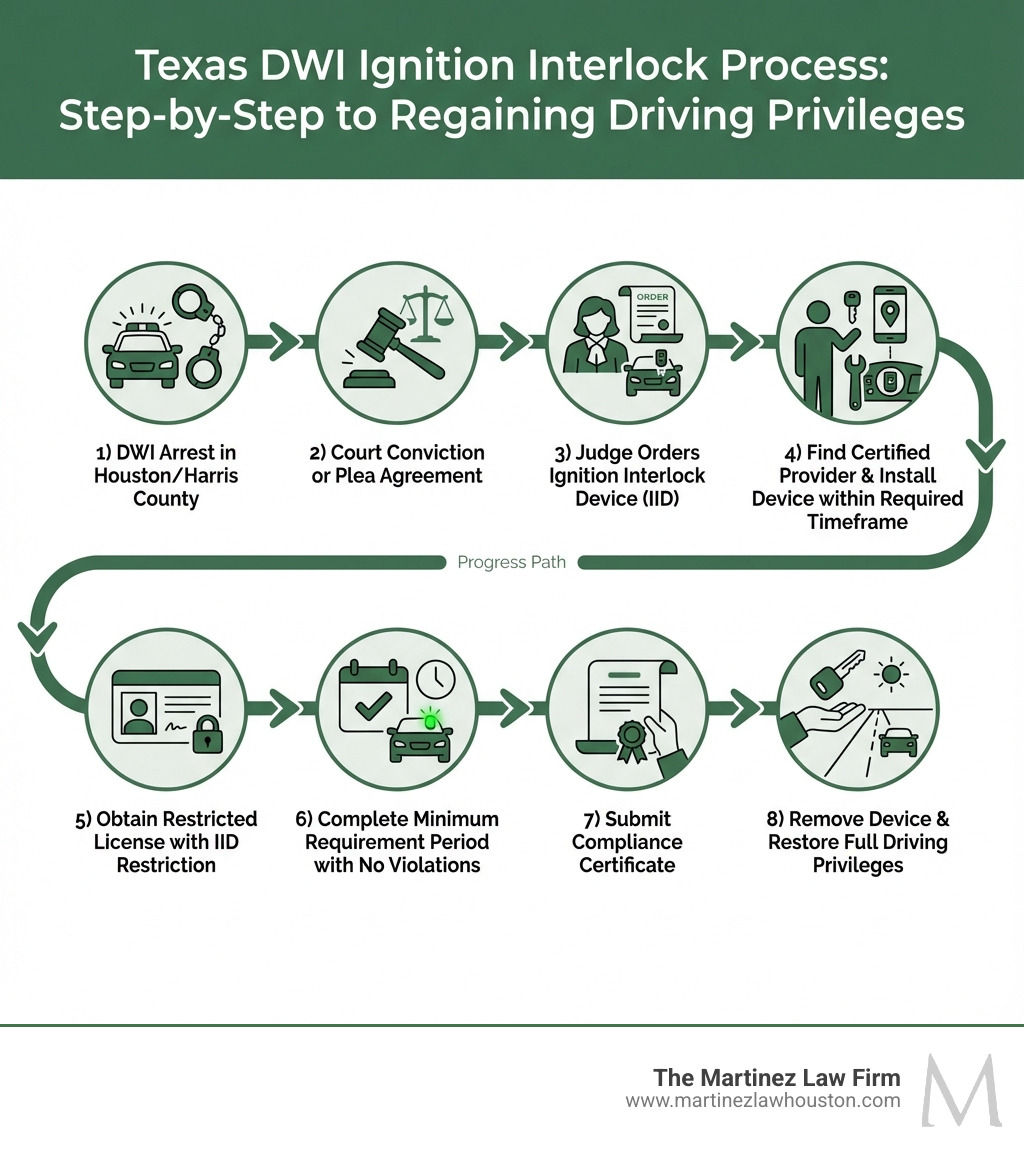
What is a DWI Ignition Interlock Device and How Does It Work?
At its core, a DWI ignition interlock device (IID), sometimes called a Breath Alcohol Ignition Interlock Device (BAIID), is a miniature breathalyzer installed directly into your vehicle. Its primary function is simple: it prevents your car from starting if it detects alcohol on your breath. Think of it as a gatekeeper for your engine, ensuring sobriety before you hit the road.
Here’s how it typically works: before you can start your vehicle, you’ll need to blow into a handheld unit connected to the car’s ignition system. An alcohol-specific sensor within the device analyzes your breath sample. If your Blood Alcohol Concentration (BAC) is below a pre-set limit—usually a very low 0.02 g/dL in most jurisdictions—the car will start. If alcohol is detected above this limit, the engine simply won’t turn over.
But the device isn’t just about starting your car. To ensure you remain sober while driving, IIDs also require what are known as “rolling retests.” These are random breath samples requested at various intervals once the vehicle is in motion. If you fail a rolling retest or fail to provide one when prompted, the device won’t shut off your engine (that would be unsafe!), but it will log the event and typically trigger an alarm, such as flashing lights or honking the horn, to alert authorities.
IIDs Today
Modern IIDs are quite sophisticated. They carefully log every attempt to start the vehicle, every breath sample taken (including BAC levels), and any instances of failed tests or suspected tampering. Many newer models even come equipped with GPS tracking and cameras to verify the identity of the driver providing the breath sample, ensuring that no one else is blowing into the device for you. This comprehensive data collection is crucial, as it’s regularly downloaded and reported to the monitoring authorities, usually the courts or the Department of Public Safety.
The Technology Behind the Device
The reliability and accuracy of ignition interlock devices are paramount, which is why they must meet stringent standards set by organizations like the National Highway Traffic Safety Administration (NHTSA). The core of most modern IIDs lies in their use of fuel cell sensors. These electrochemical sensors are highly sensitive to alcohol and provide accurate BAC readings. While not as precise as the infrared spectroscopy used in some laboratory-grade breathalyzers, they are cost-effective and sufficiently accurate for their purpose.
Preventing circumvention is a constant focus for IID manufacturers. Early devices might have been easier to trick, but today’s technology makes it incredibly difficult. Features like random rolling retests, anti-tampering mechanisms, and the aforementioned cameras and GPS work together to ensure the device is being used correctly by the intended driver. Any attempts to bypass or tamper with the device are logged as violations and can lead to severe penalties, including license revocation, extended interlock periods, or even criminal charges.
For the system to function correctly, regular calibration is essential. IIDs typically require periodic service appointments, often every 30 to 60 days, where a certified technician downloads the stored data, inspects the device for any signs of tampering, and recalibrates it to maintain accuracy. This data, which includes a detailed record of every breath test, failed attempt, and violation, is then submitted to the court or monitoring authority.
Navigating Texas’s DWI Ignition Interlock Program
For individuals facing DWI charges in Houston and Harris County, understanding the specifics of Texas’s DWI ignition interlock program is critical. While the general principles of IIDs are universal, the legal requirements, conditions for mandatory installation, and compliance protocols are dictated by state law and local court orders.
In Texas, an IID is typically a condition of bond, probation, or a requirement for regaining a restricted driver’s license after a DWI conviction. The courts in Harris County, like others across the state, actively use IIDs to improve public safety and monitor offenders. The goal is to ensure that anyone with a history of impaired driving cannot operate a vehicle while under the influence.
When an IID is mandated, you’ll be operating under a restricted license. This means you can only drive vehicles equipped with the device. Monitoring authorities, such as the Texas Department of Public Safety (DPS) and the courts, receive regular reports from your IID service provider. These reports detail your compliance, including successful starts, failed tests, rolling retest adherence, and any detected violations. Successful completion of the program, often referred to as compliance-based removal, relies heavily on these consistent, clean reports.
When is a DWI Ignition Interlock Mandatory in Texas?
The requirements for a DWI ignition interlock device in Texas vary depending on your case. A judge in Houston or Harris County has significant discretion in ordering an IID, even for first-time offenders. However, certain situations make it mandatory:
- First DWI with a High BAC: If you are a first-time DWI offender and your Blood Alcohol Concentration (BAC) was 0.15% or higher, Texas law typically mandates an IID.
- Repeat DWI Offenses: For a second or any subsequent DWI conviction in Texas, an IID is mandatory. This includes second-offense misdemeanors and felony DWI charges. The penalties for repeat offenses are severe, and the IID requirement is a cornerstone of the state’s efforts to prevent recidivism.
- Intoxication Assault or Manslaughter: While not always explicitly stated as an IID trigger, convictions for these severe felony offenses, which involve serious injury or death due to impaired driving, almost invariably include an IID requirement as part of a lengthy probation or parole period.
- Refusing a Breath or Blood Test: While refusing a chemical test can lead to an automatic license suspension, it often results in improved penalties upon conviction. These improved penalties can increase the likelihood of a judge ordering an IID, or it may become a condition of a restricted license.
- Judge’s Discretion: Even for a first-time DWI offense with a BAC below 0.15%, a judge can, at their discretion, order an IID as a condition of probation or bond. This often happens if there are other aggravating factors in your case.
It’s crucial to understand these legal requirements, as compliance is not optional. For a broader overview of state laws regarding ignition interlocks, you can refer to the State Ignition Interlock Laws compiled by the National Conference of State Legislatures. However, always remember that local Texas statutes and court orders take precedence in your specific case.
The Installation and Monitoring Process
Once a DWI ignition interlock is mandated for your Houston DWI case, the next step is to get the device installed. This process begins with finding a certified IID provider in the Houston area. Several companies offer these services, and it’s wise to research reputable providers that are approved by the Texas Department of Public Safety.
You’ll schedule an installation appointment where a trained technician will wire the device into your vehicle’s electrical system, typically near the dashboard and ignition. Rest assured, these installers are certified specialists, and the process is designed not to damage your vehicle’s wiring. After installation, the technician will provide you with a Verification of Installation form (often similar to a DL 920, though specific forms vary by state). This document is essential for proving compliance to the court and the DPS, and for obtaining your restricted license.
The monitoring aspect is ongoing. IIDs require regular calibration and inspection appointments, typically every 60 days. During these appointments, the technician will download all the data logged by the device since your last visit. This data includes every start attempt, every breath sample, any failed tests, and any instances of suspected tampering. These data downloads are then compiled into violation reports, which are forwarded to the court and your monitoring authority. Consistent compliance with these appointments and maintaining a clean record on the device are critical for successfully completing your IID program.
The Proven Effectiveness and Road Safety Impact
The widespread adoption of DWI ignition interlock programs across the United States, including here in Texas, is largely due to their proven effectiveness in enhancing road safety. These devices are more than just a deterrent; they are a proactive measure that physically prevents impaired driving.

One of the most compelling statistics supporting IIDs is their ability to reduce repeat offenses. Studies show that ignition interlocks reduce driving while impaired (DWI) repeat offenses by approximately 70% while they are installed in a vehicle. This significant reduction highlights the immediate impact of the device in keeping convicted offenders from driving drunk again.
Beyond individual recidivism, IIDs contribute substantially to overall road safety and the reduction of alcohol-related crashes and fatalities. Laws that require an ignition interlock for all DWI offenders have been associated with a 26% reduction in alcohol-impaired drivers involved in fatal crashes, compared to states without such laws. Even laws targeting repeat and high-BAC offenders have shown a 20% reduction in alcohol-impaired drivers in fatal crashes. Imagine the impact: experts estimate that 2,600 lives could be saved each year if every state mandated interlocks for all DWI offenders.
Public Support and Advocacy for Ignition Interlocks
Public support for ignition interlocks is also strong. National surveys show that about 80% of people favor requiring interlocks for all DWI offenders, even first-time offenders. Advocacy organizations such as Mothers Against Drunk Driving (MADD) have led efforts like the “Sober to Start” campaign, highlighting the life-saving benefits of IIDs.
Our firm aligns with the spirit of these efforts. We believe in safe roads for Houston, and while we aggressively defend our clients’ rights, we also recognize the importance of effective measures to prevent impaired driving. The data speaks for itself: IIDs, when properly implemented and monitored, are a powerful tool in the fight against drunk driving. For more in-depth analysis on this topic, you can review comprehensive Effectiveness of Ignition Interlocks research.
Understanding the Costs and Common Challenges
While highly effective, complying with a DWI ignition interlock requirement in Houston does come with its own set of financial obligations and potential challenges. It’s important to be prepared for these so you can steer the program smoothly.
The costs associated with an IID are typically the responsibility of the offender. Here’s a general breakdown of what you can expect in Texas:
- Installation Fees: This is the initial cost to have the device professionally wired into your vehicle. In Texas, installation can range from approximately $100 to $200.
- Monthly Monitoring and Calibration Fees: This is a recurring fee for the lease of the device, data monitoring, and mandatory calibration appointments. You can expect to pay between $50 to $100 per month for these services. This might seem like a lot, but when you break it down, it often amounts to less than three dollars a day.
- Removal Fees: Once your required period of use is complete, there will be a fee to have the device professionally removed from your vehicle, typically around $50.
These costs can add up, and they are in addition to any fines, court costs, or legal fees associated with your DWI conviction.
Financial Assistance and Common User Issues
Recognizing that these costs can be a burden, many states, including Texas, offer financial assistance programs for indigent offenders. If you are found to be indigent by the court, you may be eligible for reduced fees or state assistance to cover some or all of the IID expenses. It’s important to inquire about these options through your probation officer or the court system in Harris County. However, it’s worth noting that while two-thirds of states offer such support, less than 10% of eligible offenders actually use these funds, perhaps due to a lack of awareness or the application process.
Day-to-Day Problems
Beyond the financial aspect, living with an IID can present several day-to-day challenges:
- False Positives: Certain foods, mouthwash, or even some medications can contain trace amounts of alcohol and lead to a failed test, even if you haven’t consumed alcohol. It’s wise to rinse your mouth with water before taking a test.
- Vehicle Repairs: If your vehicle breaks down or needs repairs, you’ll need to coordinate with your IID provider. Many providers offer a “toll” or “pause” period, but you’ll need to follow specific procedures and provide documentation. For major repairs, you might need a service code to allow a mechanic to start the vehicle without a breath sample.
- Sharing a Vehicle: If family members or other authorized drivers use your IID-equipped vehicle, they must also blow into the device and pass the breath test. While this can be an inconvenience, it ensures that only sober individuals operate the car. Modern IIDs with cameras prevent anyone other than the driver from taking the test.
- Device Malfunctions: Like any electronic device, IIDs can occasionally malfunction. Regular calibration appointments help prevent this, but if a problem arises, contact your provider immediately.
- Stigma: Some individuals feel a sense of stigma from having an IID, viewing it as a public mark of their DWI conviction. This can be a significant psychological barrier, especially when an IID is an optional alternative to other sanctions.
- Rolling Retest Distraction: As highlighted by some critics, the requirement to perform rolling retests while driving can be a point of concern. The need to focus on providing a breath sample at random intervals could potentially distract a driver, creating a momentary hazard. However, devices are designed to give you time to pull over safely if needed, and the engine will not shut off.
While these challenges exist, understanding them and preparing for them can significantly ease your compliance journey.
Frequently Asked Questions about DWI Ignition Interlock Devices
Navigating DWI ignition interlock devices can bring up many questions. Here are some of the most common ones we hear from clients in Houston:
Can someone else drive my IID-equipped vehicle?
Yes, someone else can drive your vehicle even with an IID installed. However, they must follow the exact same procedures as you would. This means they must blow into the device and provide a clean breath sample for the car to start. They will also be subject to any rolling retests while driving. All tests, successful or not, are recorded by the device. If another driver fails a test or attempts to tamper with the device, those violations will be attributed to your record. Since modern IIDs often include cameras, any attempt by someone other than the designated driver to provide a breath sample will be logged as a violation. Therefore, while others can drive your car, you remain responsible for all activity recorded by the device.
Will the device shut my car off while driving?
This is a common concern, but for safety reasons, no, the DWI ignition interlock device will not shut off your car’s engine while you are driving. Imagine the danger if your vehicle suddenly stalled on a busy Houston freeway! Instead, if you fail a rolling retest or fail to provide a sample when prompted, the device will log the violation and typically activate an alarm sequence. This usually involves honking your horn and/or flashing your lights until you pull over and turn off the ignition, or provide a clean sample. This alarm serves to alert law enforcement to a potential violation without creating a dangerous situation on the road.
What happens if I miss a service appointment?
Missing a routine service or calibration appointment for your IID is a serious matter and can lead to significant consequences. Your device will typically provide reminder warnings as your appointment date approaches. If you miss your scheduled appointment, most providers offer a short grace period, usually around 5-7 days. However, if you fail to bring your vehicle in for service within that grace period, the device will eventually enter a “lockout” mode. When in lockout, your vehicle will not start, and you will be unable to drive it. You would then need to have your car towed to the service center to have the device reset, incurring towing costs and potentially additional reset fees. More importantly, missing appointments is a violation of your IID program requirements and can result in extended interlock periods, additional fines, or even a suspended license. Always prioritize these appointments!
Get Expert Legal Guidance for Your Houston DWI
Navigating the requirements of a DWI ignition interlock device in Houston and Harris County is a complex process that demands strict compliance. From understanding when an IID is mandatory to managing costs, adhering to calibration schedules, and avoiding common pitfalls, every step is critical to successfully completing your program and regaining full driving privileges.
At The Martinez Law Firm, we understand the profound impact a DWI charge can have on your life. My experience as a former Chief Prosecutor for the Harris County District Attorney’s Office and as a City of Houston Judge has given us a unique perspective on how the legal system handles these cases. We leverage this insight to provide aggressive, personalized defense strategies for our clients facing DWI charges in Houston.
Whether you’re fighting to avoid a conviction that could lead to an IID requirement, or you need guidance on navigating an existing interlock program, our team is here to help. We believe in achieving proven results for our clients, and that starts with understanding your rights and building a strong defense. Don’t face the complexities of Texas DWI law alone.
Contact a Houston DWI Lawyer for a consultation today, and let us put our experience to work for you.
Understanding the Legal Stakes: What DUI and DWI Charges Mean in Texas

DUI and DWI charges represent serious criminal offenses in Texas, but they are not the same thing. Here’s what you need to know:
Key Differences:
- DWI (Driving While Intoxicated): Applies to adults 21+ with a BAC of 0.08% or higher, or when alcohol/drugs impair normal mental or physical faculties
- DUI (Driving Under the Influence): Applies exclusively to minors under 21 with any detectable amount of alcohol in their system (zero-tolerance policy)
- Penalties: Range from Class B misdemeanors (first offense) to third-degree felonies (third offense or causing injury), with fines up to $10,000 and prison sentences up to 10 years
- License Suspension: From 90 days to lifetime, depending on offense severity
- Hidden Costs: Criminal record, increased insurance rates, employment challenges, and professional license risks
If you’ve been arrested for an intoxication offense in Houston or Harris County, you’re facing penalties that could fundamentally alter your life. According to Texas law, simply having a BAC of 0.08% or higher—or losing your normal faculties due to alcohol or drugs—constitutes a criminal offense under Section 49.04 of the Texas Penal Code. For those under 21, Texas enforces a strict zero-tolerance policy: even a trace amount of alcohol can lead to criminal charges.
The consequences extend far beyond fines and jail time. A conviction creates a permanent criminal record that can impact employment opportunities, professional licensing, insurance rates, and even immigration status. In Harris County specifically, police reported thousands of impaired driving incidents annually, and prosecutors aggressively pursue these cases.
Understanding the Timeline
What makes these charges particularly complex is the tight timeline for action. You have only 15 days from your arrest to request an Administrative License Revocation (ALR) hearing to fight your license suspension—a deadline many people miss simply because they don’t know it exists. Additionally, the evidence used against you—breathalyzer readings, blood tests, field sobriety tests—can often be challenged if law enforcement failed to follow proper procedures.
I’m Herman Martinez, founder of The Martinez Law Firm, and I’ve spent over 25 years on both sides of DUI and DWI charges—first as a Chief Prosecutor for the Harris County District Attorney’s Office, and now as a defense attorney who uses that insider knowledge to protect my clients’ rights and futures. This comprehensive guide will walk you through everything you need to know about Texas intoxication laws, the penalties you’re facing, and the defense strategies that can make the difference between a conviction and a dismissal.
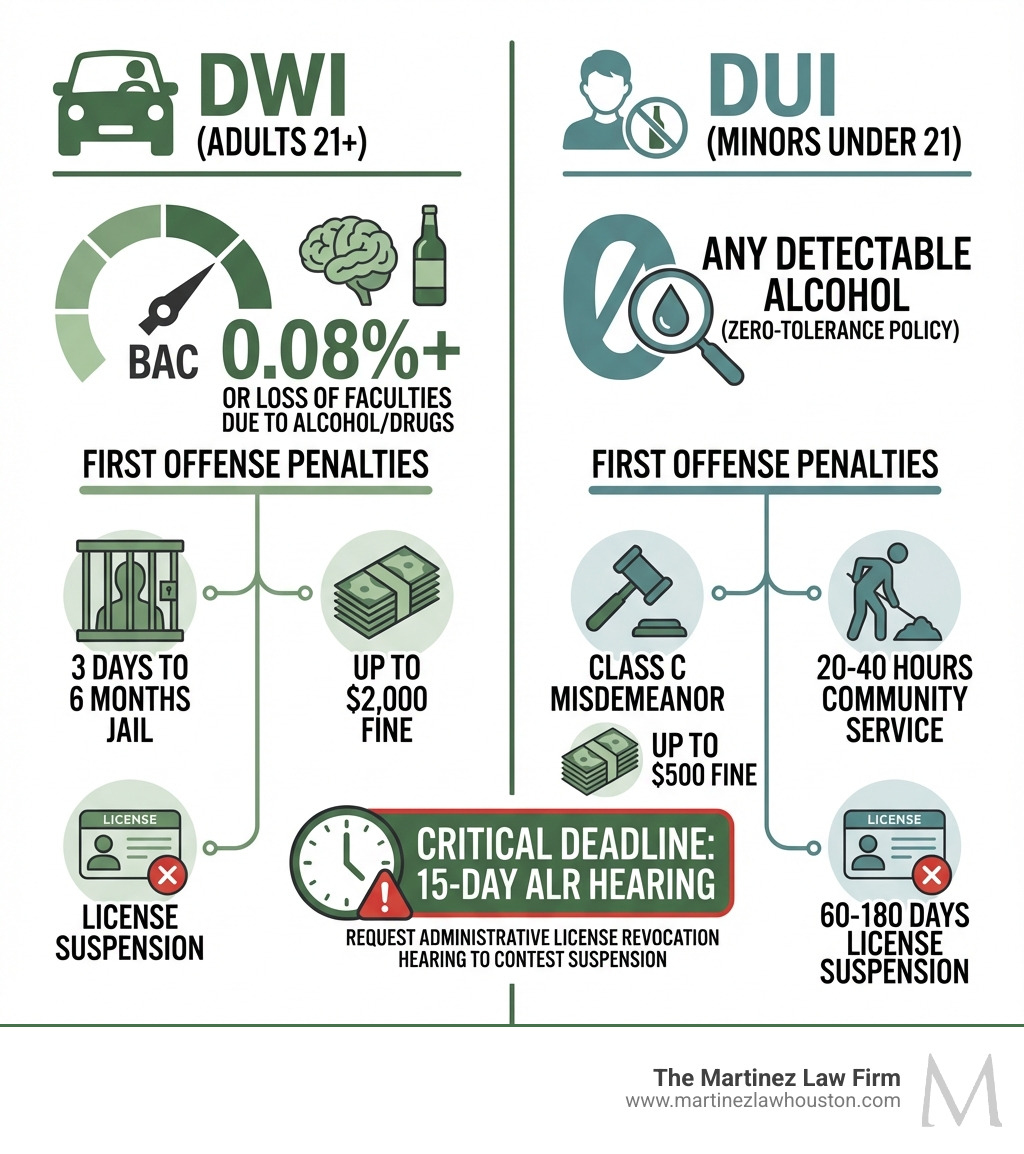
DWI vs. DUI: Decoding Texas Intoxication Laws
In Texas, the terms DWI and DUI are often used interchangeably in casual conversation, but legally, they refer to distinct charges. Understanding this difference is crucial if you or a loved one are facing DUI and DWI charges in Houston or Harris County. We need to look to the Texas Penal Code for precise definitions.
Driving While Intoxicated (DWI): The Charge for Adults
When we talk about Driving While Intoxicated (DWI) in Texas, we’re primarily referring to the charge for individuals aged 21 and older. According to the Texas Penal Code Section 49.04, you are considered “intoxicated” if:
- You do not have the normal use of mental or physical faculties by reason of the introduction of alcohol, a controlled substance, a drug, a dangerous drug, a combination of two or more of those substances, or any other substance into the body; OR
- You have an alcohol concentration of 0.08 or more.
This means that even if your blood alcohol concentration (BAC) is below 0.08%, you can still be charged with DWI if law enforcement believes your mental or physical faculties are impaired to any degree. This definition applies to impairment caused by alcohol, illegal drugs, prescription medications, or any combination thereof. It’s a broad definition, allowing prosecutors to pursue charges even without a definitive BAC reading, relying instead on observations of your driving, performance on field sobriety tests, and other indicators.
For more details on the precise legal definition, you can refer to the legal definition of DWI in Texas.
Driving Under the Influence (DUI): The Charge for Minors
In Texas, the term Driving Under the Influence (DUI) is specifically reserved for minors—drivers under the age of 21. This distinction is critical because Texas operates under a “zero-tolerance” policy for underage drinking and driving.
Under the Texas Alcoholic Beverage Code Section 106.041, if a minor operates a motor vehicle with any detectable amount of alcohol in their system, they can be charged with DUI. This is often referred to as DUIA (Driving Under the Influence of Alcohol) to emphasize the distinction. Unlike adults, minors do not need to reach a 0.08% BAC or show signs of impairment to be charged; even a trace amount of alcohol is enough. This strict policy aims to deter underage drinking and driving, recognizing the increased risks associated with young, inexperienced drivers consuming alcohol.
How Texas Laws Compare Nationally and Internationally
Texas’s age-based distinction between DWI and DUI is a significant characteristic that sets it apart from many other states in the U.S. In some states, DUI and DWI are used interchangeably, or one might be a lesser charge than the other, without the specific age differentiation we see in Texas. For instance, the Legal Information Institute at Cornell Law explains that while DUI commonly means driving under the influence and DWI means driving while intoxicated, some states use them synonymously, while others differentiate, with DUI sometimes being the lesser charge.
However, in Texas, it’s clear: DWI is for adults, DUI is for minors.
Beyond the age distinction, Texas, like all other states, has specific BAC limits. The federal standard for impairment is 0.08% BAC, which Texas adheres to for adult drivers. For commercial drivers, the legal limit is even stricter, at 0.04% BAC, reflecting the higher standard of safety required for professional operation.
If we look internationally, for example, to Canada, the terminology differs entirely. There, the legal term is “impaired driving,” which covers both alcohol and drug impairment, without using “DUI” or “DWI” as legal terms. While Canadians might colloquially use “DUI,” it holds no legal weight in their system. This highlights how distinct legal frameworks can be across jurisdictions. However, our focus remains firmly on Texas, where the specific definitions of DWI and DUI are paramount for anyone facing DUI and DWI charges in Houston.
You can gain a broader perspective on international laws by looking at an overview of impaired driving laws in Canada, but these are distinct from Texas statutes.
The Severe Penalties for DUI and DWI Charges in Harris County
Facing DUI and DWI charges in Houston means confronting a legal system designed to impose significant penalties. These aren’t just minor traffic infractions; they are criminal offenses that can lead to life-altering consequences. Here in Harris County, prosecutors are known for their rigorous approach to these cases, and the penalties escalate sharply based on prior offenses and aggravating factors.

Misdemeanor DWI Penalties: First and Second Offenses
For most adults, a first or second DWI charge will be classified as a misdemeanor, but don’t let the term “misdemeanor” fool you—the penalties are still severe.
- First DWI Offense (Class B Misdemeanor):
- Jail Time: Minimum of 3 days (72 hours) up to 6 months (180 days). If an open container was found in your vehicle, the minimum jail time increases to 6 days.
- Fines: Up to $2,000.
- License Suspension: 90 days to 1 year.
- Annual Surcharge: $1,000 to $2,000 for three years to retain your license.
- Other Requirements: Potential probation, community service, and mandatory alcohol education programs.
- Second DWI Offense (Class A Misdemeanor):
- Jail Time: Minimum of 1 month (30 days) up to 1 year.
- Fines: Up to $4,000.
- License Suspension: Up to 2 years.
- Annual Surcharge: $1,000 to $2,000 for three years.
- Other Requirements: Mandatory alcohol education programs, and potentially an Ignition Interlock Device (IID).
It’s also important to note that if your BAC was 0.15% or higher on your first DWI offense, the charge can be liftd to a Class A Misdemeanor, carrying penalties similar to a second DWI, even if it’s your first time being charged.
In Harris County, eligible first-time offenders with a BAC of 0.15% or below might have the opportunity to participate in the DIVERT program. This pre-trial diversion program, if successfully completed, can lead to the dismissal of your DWI charge, offering a pathway to avoid a permanent criminal record. However, not everyone qualifies, and judges may prefer probation over “time served” pleas, as they view probation as a more active form of rehabilitation.
Felony DWI Penalties: Third Offense and Aggravating Factors
The penalties become significantly more severe if you’re facing a third DWI charge or if aggravating factors are present. These escalate to felony level, carrying prison sentences and much higher fines.
- Third DWI Offense (Third-Degree Felony):
- Prison Time: 2 to 10 years in state prison.
- Fines: Up to $10,000.
- License Suspension: 180 days to 2 years.
- DWI with a Child Passenger (Under 15 years old):
- This is a State Jail Felony, regardless of whether it’s your first offense.
- Jail Time: 6 months to 2 years in a state jail facility.
- Fines: Up to $10,000.
- License Suspension: Minimum 6 months.
- Intoxication Assault:
- If you cause serious bodily injury to another person while driving while intoxicated, it’s a Third-Degree Felony.
- Prison Time: 2 to 10 years in state prison.
- Fines: Up to $10,000.
- Intoxication Manslaughter:
- If your intoxicated driving results in the death of another person, it’s a Second-Degree Felony.
- Prison Time: 2 to 20 years in state prison.
- Fines: Up to $10,000.
These felony DUI and DWI charges represent the most serious outcomes and underscore the critical need for an aggressive and experienced legal defense.
Beyond Fines and Jail: The Hidden Costs of a Conviction
While fines and jail time are immediate concerns, a conviction for DUI and DWI charges in Texas carries a host of “hidden costs” that can impact your life for years, if not permanently.
- Criminal Record: A DWI conviction is a permanent mark on your criminal record. This can show up on background checks for employment, housing, and even volunteer opportunities.
- SR-22 Insurance Requirements: After a DWI conviction, you will likely be required to obtain SR-22 insurance, which is proof of financial responsibility. This type of insurance is significantly more expensive and must be maintained for a minimum of three years, often longer.
- Employment Background Checks: Many employers conduct background checks, and a DWI conviction can severely limit job prospects, especially in fields requiring driving, professional licenses, or positions of trust.
- Professional License Risks: Doctors, nurses, lawyers, real estate agents, commercial drivers, and other licensed professionals can face suspension or revocation of their licenses, jeopardizing their careers.
- Immigration Consequences: For non-U.S. citizens, a DWI conviction can have severe immigration consequences, including denial of visas, green cards, or even deportation.
These long-term consequences highlight why fighting DUI and DWI charges is so important. We understand the full scope of what’s at stake and are committed to helping you steer these complex challenges.
Building a Strong Defense Against Your DWI Charge
When facing DUI and DWI charges in Houston, many people feel overwhelmed and believe a conviction is inevitable. However, that’s simply not true. Every case has unique circumstances, and with an experienced legal team, we can build a strong defense. Our approach involves carefully examining every detail of your arrest and the evidence against you.
The First 15 Days: Fighting Your License Suspension
One of the most immediate and often overlooked aspects of a DWI arrest is the potential for an administrative license suspension. In Texas, under the implied consent law, by simply holding a driver’s license, you’ve implicitly agreed to chemical testing (breath, blood, or urine) if suspected of DWI. Refusing these tests or failing them (e.g., a BAC of 0.08% or higher) can trigger an automatic license suspension.
Critically, you have only 15 days from the date of your arrest to request an Administrative License Revocation (ALR) hearing. If you miss this deadline, your license will be automatically suspended, regardless of the outcome of your criminal case. During this hearing, we can challenge the grounds for your arrest and the validity of the officer’s actions, potentially preventing or shortening your license suspension. If your license is suspended, obtaining an occupational license can be a complex process that we can help you steer.
Refusal to provide a breath or blood sample has its own set of consequences. While you have the right to refuse, doing so typically results in a longer automatic license suspension (180 days for a first refusal), and in most states, you’d be barred from obtaining a conditional, restricted, or hardship license during that refusal suspension period. This is why immediate legal advice is paramount.
Common Defenses for DUI and DWI Charges
We explore every possible avenue for defense, challenging the prosecution’s case on multiple fronts. Some common defenses we employ include:
- Illegal Traffic Stop: Police must have “reasonable suspicion” to pull you over. If the stop was unlawful, any evidence gathered afterward might be inadmissible in court. We scrutinize the initial reason for the stop.
- No Probable Cause for Arrest: Even if the stop was legal, officers must have “probable cause” to arrest you for DWI. This usually comes from observations of your driving, your demeanor, and your performance on Field Sobriety Tests (FSTs).
- Improperly Administered Field Sobriety Tests: FSTs are subjective and often administered incorrectly. Factors like weather conditions, physical limitations, or even footwear can affect performance. We can challenge the officer’s training, the test conditions, and your performance.
- Inaccurate Breathalyzer Results: Breathalyzers are not infallible. We can challenge their accuracy based on:
- Faulty Equipment or Calibration: Breathalyzers require regular maintenance and calibration.
- Operator Error: Officers must follow strict protocols for administering the test.
- Environmental Factors: Substances in the mouth (like mouthwash), medical conditions (like GERD or acid reflux), or even certain foods can lead to false high readings.
- Lack of Observation Period: Officers must observe you for 15 minutes prior to the test to ensure no foreign substances enter your mouth.
- Blood Test Errors: While often considered more reliable, blood tests can also be challenged. Issues can arise with:
- Chain of Custody: Ensuring the blood sample was properly handled and accounted for from collection to analysis.
- Contamination or Improper Storage: Compromising the integrity of the sample.
- Lab Errors: Mistakes in the analysis process.
- Challenging the Definition of Intoxication: We can argue that even if your BAC was at or above 0.08%, your normal mental and physical faculties were not impaired, or that observations of impairment were due to other factors (e.g., fatigue, medical condition, allergies).
Our experience tells us that many people arrested for DWI are not guilty, and a thorough examination of the evidence can reveal weaknesses in the prosecution’s case.
Why a Former Prosecutor Offers a Unique Advantage
When it comes to defending against DUI and DWI charges, having an attorney who has worked as a prosecutor offers an unparalleled advantage. My 25+ years as a Chief Prosecutor for the Harris County District Attorney’s Office means we approach your case with an insider’s perspective.
We know how the prosecution thinks. We understand their strategies, their priorities, and the common pitfalls in their cases. This unique insight allows us to:
- Identify Weaknesses: We can spot procedural errors, evidentiary issues, and inconsistencies in police reports that might be overlooked by others. We’ve trained police officers and understand their protocols, allowing us to effectively challenge their testimony and methods.
- Anticipate Moves: We can predict the prosecution’s next steps and prepare counter-arguments, putting you in a stronger position during negotiations and trial.
- Negotiate Effectively: Our established relationships and understanding of the system allow for more effective negotiations, often leading to reduced charges or alternative resolutions like the Harris County DIVERT program.
- Trial Experience: Having handled countless cases from both sides, we are formidable in the courtroom, skilled at cross-examination and presenting a compelling defense.
This insider knowledge is a powerful tool in protecting your rights and securing the best possible outcome for your DUI and DWI charges in Houston.
Frequently Asked Questions about Houston DWI Cases
Navigating DUI and DWI charges can bring up a lot of questions. Here, we address some of the most common inquiries we receive from individuals in Houston and Harris County.
Can a DWI be dismissed in Texas?
Yes, a DWI charge in Texas can absolutely be dismissed. While it’s a challenging process, dismissals are achievable through various legal strategies. We might pursue:
- Pre-Trial Motions: These motions can seek to suppress evidence (like breathalyzer results or FSTs) that was illegally obtained or is unreliable. If key evidence is suppressed, the prosecution may have no choice but to dismiss the case.
- Challenging Probable Cause: If we can demonstrate that the police lacked reasonable suspicion for the traffic stop or probable cause for the arrest, the case could be dismissed.
- Plea Bargains to Lesser Charges: In some instances, we can negotiate with the prosecutor for a plea to a lesser offense, such as Obstruction of a Highway or Reckless Driving, which carries less severe penalties and may not result in a DWI conviction on your record.
- Successful Completion of Programs: For eligible first-time offenders in Harris County, the DIVERT program offers a path to dismissal upon successful completion of its requirements. This pre-trial diversion program can be an excellent option for avoiding a conviction.
- Acquittal at Trial: If we proceed to trial and the prosecution cannot prove guilt beyond a reasonable doubt, the judge or jury can issue an acquittal, leading to a dismissal.
Many people arrested for DWI are not guilty, and an experienced DWI lawyer can often find avenues for dismissal where others might not.
What are the first steps when facing DUI and DWI Charges in Houston?
The moments immediately following a DWI arrest are critical. Your actions (or inactions) can significantly impact your case. Here’s what we advise:
- Remain Silent: You have the right to remain silent. Beyond providing your identification, vehicle registration, and insurance, do not answer questions about where you’ve been, what you’ve had to drink, or how much you’ve slept. Do not admit guilt or offer explanations.
- Do Not Resist: While you can refuse certain tests (like FSTs or breath tests at the scene), do not physically resist arrest.
- Contact a Lawyer Immediately: This is perhaps the most crucial step. As soon as you are able, contact an experienced Houston DWI lawyer. We can advise you on your rights, guide you through the process, and begin building your defense.
- Request Your ALR Hearing Within 15 Days: As discussed, this deadline is non-negotiable. Instruct your lawyer to immediately request an Administrative License Revocation (ALR) hearing to challenge your license suspension.
- Write Down Every Detail: As soon as you can, document everything you remember about the stop and arrest: the time, location, officer’s name, their demeanor, what they said, what you said, the conditions (weather, road), your physical state, and any tests performed. This information can be invaluable for your defense.
Do I need an ignition interlock device after a DWI?
An Ignition Interlock Device (IID) is a breath alcohol analyzer that prevents a vehicle from starting if it detects alcohol on the driver’s breath. Whether you’ll need one depends on the specifics of your DUI and DWI charges and conviction:
- Mandatory for Repeat Offenses: In Texas, an IID is typically mandatory for repeat DWI offenders. If you are convicted of a second or subsequent DWI, you will likely be required to install an IID as a condition of your probation or to regain your driving privileges.
- Condition of Bond or Probation: Even for a first offense, a judge may order an IID as a condition of your bond, allowing you to drive while your case is pending, or as a condition of your probation after a conviction.
- High BAC Cases: If your BAC was 0.15% or higher, an IID may be required even for a first offense.
The IID requires you to blow into it before starting your vehicle and often at random intervals while driving. It’s a significant inconvenience and an added expense, further highlighting the severe consequences of a DWI conviction. We can advise you on whether an IID is likely in your specific situation and help you understand the requirements.
Secure Your Future with an Experienced DWI Attorney
Facing DUI and DWI charges in Houston or Harris County is undoubtedly one of the most stressful experiences a person can endure. The potential for heavy fines, jail time, license suspension, and a permanent criminal record can feel overwhelming. However, it is crucial to remember that a charge is not a conviction, and you have legal rights that must be protected.
Acting quickly and decisively is critical. The legal process for DWI cases is complex, with strict deadlines and intricate rules of evidence. Attempting to steer this system alone can lead to missed opportunities for defense and harsher penalties.
At The Martinez Law Firm, we understand the immense pressure you’re under. We leverage attorney Herman Martinez’s 25+ years of experience as a former Chief Prosecutor for the Harris County District Attorney’s Office to provide an aggressive, personalized defense. Our insider knowledge of how the prosecution builds its cases, combined with our proven track record in DWI, drug, and violent crime cases, gives our clients a distinct advantage. We carefully examine every detail, challenge every piece of evidence, and fight tirelessly to achieve the best possible outcome for your future.
Don’t let DUI and DWI charges define your life. Your future and your freedom are too important. Contact a Houston DWI Lawyer for a Free Consultation today, and let us put our experience to work for you.
Understanding DWI Charges in Texas: What You Need to Know
4th degree DWI is a term that often causes confusion for individuals facing drunk driving charges in Texas—and for good reason. This classification doesn’t actually exist under Texas law. The term originates from Minnesota’s legal system, where DWI offenses are categorized into four degrees, with a 4th degree DWI representing the least severe charge: a misdemeanor for first-time offenders with no aggravating factors.
If you’re searching for information on “4th degree DWI” in Texas, here’s what you need to know:
- Texas does not use “degree” classifications for DWI offenses
- The Texas equivalent is typically a first-offense DWI, classified as a Class B Misdemeanor
- A first-offense DWI in Texas applies when there are no aggravating factors (such as a BAC of 0.15% or higher, a child passenger, or prior convictions)
- Penalties include up to 180 days in jail, fines up to $2,000, and license suspension for 90 days to 1 year
- Repeat offenses or aggravating factors can lift charges to Class A Misdemeanors or felonies
What to Know After a DWI Arrest in Texas
If you’ve been arrested for DWI in Houston or anywhere in Harris County, understanding how Texas actually classifies these offenses is critical to building an effective defense. Unlike Minnesota’s degree system, Texas categorizes DWI charges based on factors like prior convictions, blood alcohol concentration (BAC), and whether the offense caused injury or death. A first-time DWI with no aggravating circumstances is treated as a Class B Misdemeanor under Texas Penal Code § 49.04, but the consequences can still be severe and life-altering.
The Martinez Law Firm in Houston brings more than 25 years of experience on both sides of the courtroom—first in the Harris County District Attorney’s Office and now as a dedicated DWI defense practice focused on 4th degree DWI equivalents (first-offense DWIs). This combination of prosecutorial and defense insight helps the firm challenge questionable evidence, spot procedural errors, and protect your rights at every stage of the criminal justice process.
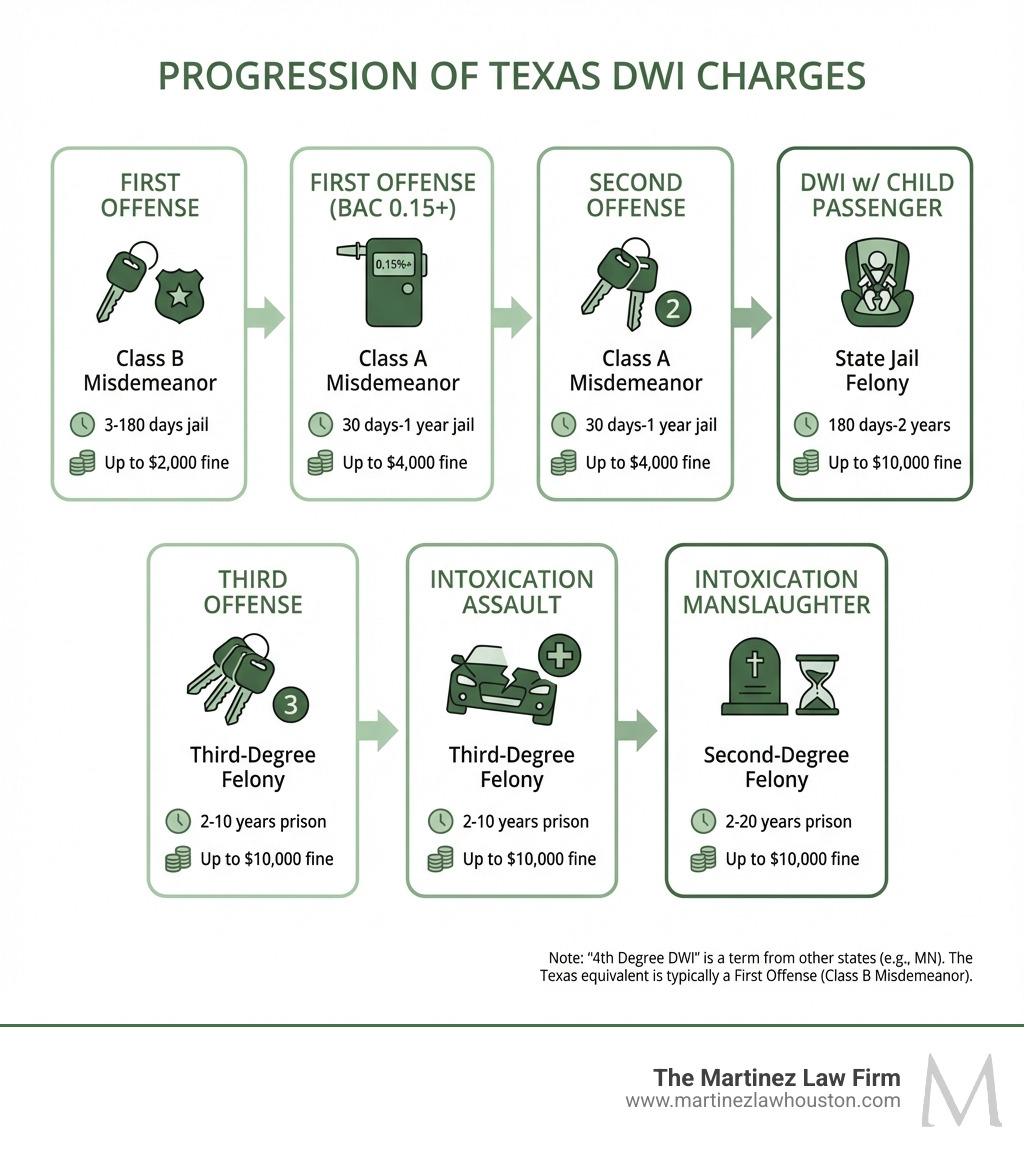
What is a 4th Degree DWI in the Context of Texas Law?
When people ask about a 4th degree DWI, they’re often referring to the least severe type of DWI charge they could face. In Minnesota, this term specifically applies to a misdemeanor offense, typically for a first-time offender with a blood alcohol concentration (BAC) below .16% and no other aggravating factors. It’s a foundational charge that can escalate based on various circumstances.
However, here in Houston and throughout Texas, our legal system operates differently. We don’t use a “degree” classification system for DWI offenses like Minnesota does. Instead, Texas categorizes DWI charges primarily based on the number of prior offenses, the driver’s BAC, and the presence of aggravating factors. This means that while the concept of a “least severe” DWI exists, it’s not called a 4th degree DWI.
For us in Texas, the closest equivalent to what Minnesota calls a 4th degree DWI would be a first-offense Driving While Intoxicated (DWI) charge, which is typically classified as a Class B Misdemeanor under Texas law. This charge applies when it’s your first DWI, your BAC is below 0.15%, and there are no other aggravating factors involved.
Here’s a quick comparison to highlight the differences:
| Feature | Minnesota 4th Degree DWI | Texas First Offense DWI (Class B Misdemeanor) |
|---|---|---|
| Classification | Misdemeanor | Class B Misdemeanor |
| Severity | Least severe DWI charge | Least severe DWI charge |
| Prior Offenses | First-time offense | First-time offense |
| Aggravating Factors | None | None |
| Typical BAC Range | .08 to .16 | .08 to .149 |
| Jail Time (Max) | 90 days | 180 days |
| Fines (Max) | $1,000 | $2,000 |
The Texas Equivalent of a 4th Degree DWI
In Texas, a first-offense DWI is defined by Texas Penal Code § 49.04. This statute outlines that a person commits an offense if they are intoxicated while operating a motor vehicle in a public place. The term “intoxicated” is further defined in two ways:
- Not having the normal use of mental or physical faculties by reason of the introduction of alcohol, a controlled substance, a drug, a dangerous drug, a combination of two or more of those substances, or any other substance into the body.
- Having an alcohol concentration of 0.08 or more within two hours of driving.
So, for a first-time DWI in Houston, if your BAC is below 0.15% and there are no other enhancing circumstances, you’re looking at a Class B Misdemeanor. This is our equivalent to what Minnesota refers to as a 4th degree DWI. It’s still a serious criminal charge, but it’s the baseline from which all other, more severe DWI charges escalate.
Why This Distinction Matters for Your Houston Case
Understanding these jurisdictional differences is absolutely vital, especially if you’re facing a DWI charge in Houston or anywhere in Harris County. Relying on information about “4th degree DWI” from other states, like Minnesota, can lead to serious misinformation. Texas laws, penalties, and defense strategies are unique.
Our Harris County court system has its own procedures, and the judges and prosecutors here operate under Texas statutes. What might be a common plea deal or a specific administrative penalty in Minnesota might not apply here at all. For example, some states have specific DWI courts or diversion programs that differ significantly from what’s available in Harris County.
This is why local legal knowledge is not just helpful, it’s essential. An attorney who understands the nuances of Texas DWI law and has experience navigating the Houston legal landscape can make all the difference in your case. Misinformation risks are high when you’re dealing with different state laws, and getting accurate, localized advice is your best defense.
Penalties for a First-Time DWI in Houston
Even though a first-time DWI (our equivalent of a 4th degree DWI) is considered the least severe DWI offense in Texas, it is still a serious criminal charge with significant consequences. These penalties fall into two main categories: criminal and administrative. Both can have immediate and long-term impacts on your life, your wallet, and your future.

Criminal Penalties for a First-Offense DWI
If you are convicted of a first-offense DWI in Houston, you face a Class B Misdemeanor. The criminal penalties can include:
- Jail Time: You could face anywhere from 3 days to 180 days in jail. Texas law mandates a minimum of 72 hours of confinement, even for a first offense.
- Fines: You may be required to pay fines up to $2,000. This doesn’t include court costs, surcharges, or other fees that can add up quickly.
- Probation: Instead of maximum jail time, a judge might impose probation (community supervision), which can last for 1 to 2 years. Probation often comes with strict conditions, such as:
- Regular check-ins with a probation officer.
- Maintaining employment.
- Avoiding alcohol and drugs, often with random testing.
- Installation of an ignition interlock device (IID) on your vehicle, even for a first offense, especially if ordered by the judge.
- DWI Education Programs: You will likely be required to complete a DWI education program, which is typically 12 hours long.
- Community Service: Judges often order community service hours as part of the sentence or probation conditions.
These criminal penalties are just the beginning. A conviction leaves a permanent mark on your criminal record, which can affect future employment, housing, and educational opportunities.
Administrative Penalties & License Suspension
Separate from the criminal court process, the Texas Department of Public Safety (DPS) will initiate an Administrative License Revocation (ALR) process. This is an administrative action against your driving privileges.
- 15-Day Deadline: After a DWI arrest in Houston, you have only 15 days to request an ALR hearing to contest your license suspension. If you miss this deadline, your license will be automatically suspended. We always advise our clients to contact us immediately after an arrest to ensure this critical deadline is met.
- License Suspension Periods: For a first-time DWI, your license can be suspended for 90 days to 1 year. If you refused a chemical test (breath or blood), the suspension period can be longer, typically 180 days.
- Annual Surcharges: After your license is reinstated, you may face annual surcharges from DPS for three years. These surcharges can be $1,000 or $2,000 per year, depending on the specifics of your case, on top of any court-imposed fines.
- Ignition Interlock Device (IID): While not always mandatory for a first offense without aggravating factors, an IID may be required as a condition of bond, probation, or to obtain an occupational license (restricted driving privileges). This device prevents your vehicle from starting if it detects alcohol on your breath.
The complexities of the ALR process alone highlight the need for experienced legal counsel. Our team can help you steer this administrative maze, fight for your driving privileges, and explore options like occupational licenses. You can learn more about how we defend against these charges on our DWI defense page.
Understanding a Texas 4th Degree DWI Equivalent
To reiterate, a first-offense DWI in Texas is what many might mistakenly refer to as a 4th degree DWI. This charge applies to individuals who:
- Have no prior DWI convictions or alcohol-related license revocations within the past 10 years.
- Had a BAC of less than 0.15% (but still 0.08% or higher).
- Were not involved in an accident causing injury or death.
- Did not have a child passenger under 15 years old in the vehicle.
- Did not have an open container of alcohol in the vehicle.
While it carries lighter penalties compared to aggravated or repeat DWI offenses, it is still a serious criminal charge that can have significant consequences on an individual’s record and future.
How a DWI Charge Escalates in Texas
The Texas legal system is designed to impose increasingly severe penalties for repeat DWI offenders or for those whose impaired driving involves aggravating circumstances. What starts as a basic first-offense DWI (the equivalent of a 4th degree DWI) can quickly escalate to a gross misdemeanor or even a felony, carrying much harsher consequences.
What Are Aggravating Factors in Texas?
Aggravating factors are specific circumstances that increase the severity of a DWI charge, elevating it beyond a simple Class B Misdemeanor. These factors demonstrate a higher level of recklessness or danger, leading to more significant penalties.
Here are the primary aggravating factors in Texas:
- High BAC (0.15% or more): If your blood alcohol concentration is 0.15% or higher at the time of the offense, your first DWI charge will automatically be liftd to a Class A Misdemeanor. This significantly increases potential jail time and fines.
- Open Container: If you were operating a motor vehicle with an open container of alcohol in your immediate possession (not in the trunk or a locked glove compartment), your DWI charge will carry a mandatory minimum jail term of 6 days, even for a first offense.
- Child Passenger Under 15: Driving while intoxicated with a child under 15 years old in the vehicle is a serious offense. This immediately lifts the charge to a State Jail Felony, even if it’s your first DWI.
- Intoxication Assault: If your impaired driving causes serious bodily injury to another person, you will be charged with Intoxication Assault. This is a Third-Degree Felony, carrying a potential prison sentence of 2 to 10 years and fines up to $10,000.
- Intoxication Manslaughter: The most severe DWI charge, Intoxication Manslaughter, occurs when your impaired driving causes the death of another person. This is a Second-Degree Felony, punishable by 2 to 20 years in prison and fines up to $10,000. These cases are particularly heartbreaking and prosecuted with extreme vigor in Harris County.
From First Offense to Felony: Repeat DWI Charges
Texas law takes a very dim view of repeat DWI offenses, with penalties escalating sharply with each subsequent conviction within a 10-year period.
- Second DWI Offense: If you are arrested for a second DWI, it will be classified as a Class A Misdemeanor. This carries a potential jail sentence of 30 days to 1 year and fines up to $4,000. Your license suspension period will also typically be longer, ranging from 180 days to 2 years.
- Third DWI Offense: A third DWI offense is a major jump in severity. It is classified as a Third-Degree Felony. The penalties include a prison sentence of 2 to 10 years and fines up to $10,000. Probation for a third DWI is highly unlikely, as the courts consider these individuals habitual offenders.
- Fourth and Subsequent DWI Offenses: While Texas law classifies a third DWI as a felony, any subsequent DWI (a fourth, fifth, etc.) will also be treated as a Third-Degree Felony, with potential prison sentences ranging from 2 to 20 years, depending on the specifics and the judge’s discretion. The chances of probation are virtually nonexistent at this level.
The progression from a misdemeanor to a felony DWI has profound implications, including the potential loss of civil rights like voting and possessing firearms.
DWI and Controlled Substances
DWI charges in Texas aren’t limited to alcohol. You can also be charged with DWI if you are impaired by drugs, including illegal substances, prescription medications, or even over-the-counter drugs if they affect your ability to drive safely. This falls under the “not having the normal use of mental or physical faculties” part of the intoxication definition.
Furthermore, driving with any amount of a Schedule I or II controlled substance or its metabolite in your system (except for marijuana or tetrahydrocannabinols, which have different rules) can also lead to a DWI charge, even if you don’t appear outwardly impaired. Proving impairment from drugs can be more complex than alcohol, often relying on Drug Recognition Expert (DRE) evaluations and toxicology reports. Our firm has extensive experience challenging these types of cases in Houston courts.
Building a Defense Against a Houston DWI Charge
Facing a DWI charge in Houston, whether it’s a first offense (our equivalent of a 4th degree DWI) or a more serious felony, can feel overwhelming. However, an arrest is not a conviction. With proactive defense strategies and an experienced legal team, we can challenge the charges and work towards the best possible outcome. Protecting your rights is our top priority.
The Role of an Experienced DWI Defense Attorney
When you’re up against the Harris County legal system, having a skilled DWI defense attorney by your side is invaluable. We leverage our extensive knowledge of Texas DWI laws and our experience in Houston courts to build a robust defense.
Here’s how we help:
- Challenging the Traffic Stop Legality: We carefully review the details of your stop to ensure law enforcement had a legitimate reason (probable cause) to pull you over. If the stop was unlawful, any evidence gathered afterward might be inadmissible in court.
- Scrutinizing Field Sobriety Test Administration: Field Sobriety Tests (FSTs) are often subjective and prone to error. We examine whether these tests were administered correctly, if environmental factors played a role, and if your physical condition might have impacted your performance. We understand how to challenge the reliability of these tests.
- Disputing Breath and Blood Test Results: Breathalyzers and blood tests are not infallible. We investigate the calibration and maintenance records of breath test machines, the chain of custody for blood samples, and the qualifications of the technicians involved. We look for any procedural errors or scientific inconsistencies that could invalidate the results.
- Negotiating with Prosecutors: As a former Chief Prosecutor for the Harris County District Attorney’s Office, Herman Martinez has a unique advantage. He understands how prosecutors build their cases and, more importantly, how to dismantle them. We engage in aggressive negotiations to seek reduced charges, alternative sentencing, or even dismissal when the evidence supports it.
Can a Texas DWI Charge Be Reduced or Dismissed?
Yes, it is possible for a Texas DWI charge, including a first offense, to be reduced or even dismissed. While every case is unique, our strategic defense approach aims for the most favorable outcome.
- Plea Bargains: If a dismissal isn’t possible, we work to negotiate plea bargains that can reduce the severity of the charge (e.g., from DWI to obstruction of a highway or even reckless driving) or minimize the penalties.
- Pre-Trial Diversion Programs in Harris County: For certain first-time offenders, Harris County offers pre-trial diversion programs. These programs allow individuals to complete specific requirements (like counseling, community service, and IID installation) in exchange for the DWI charge being dismissed upon successful completion. This is a fantastic outcome, as it avoids a criminal conviction.
- Identifying Procedural Errors: We are experts at finding procedural errors made by law enforcement, from incorrect Miranda warnings to improper arrest procedures. Such errors can lead to evidence being suppressed or charges being dismissed.
- Insufficient Evidence: If the prosecution’s evidence is weak, inconsistent, or collected improperly, we will argue for dismissal of the charges.
Clearing Your Record: DWI Nondisclosure in Texas
A DWI conviction in Texas can have long-lasting consequences, impacting employment, housing, and even professional licensing. Fortunately, Texas law provides mechanisms to clear or seal your criminal record, known as expunction and orders of nondisclosure.
- Expunction vs. Order of Nondisclosure:
- Expunction: This process completely erases the arrest and related records from your criminal history, as if it never happened. It’s typically available if your DWI charge was dismissed, you were acquitted, or you received a pardon.
- Order of Nondisclosure: This seals your record from public view, meaning most private employers and the general public cannot access it. However, certain government agencies and licensing boards can still see it. Nondisclosure is usually available after successful completion of deferred adjudication probation for a DWI.
- Eligibility Requirements: Both options have strict eligibility criteria, including waiting periods after your case is closed and requirements to remain crime-free. For nondisclosure, you must have completed all terms of your probation, paid all fines, and waited a specific period (usually two years for a Class B misdemeanor DWI).
- Benefits of a Sealed Record: Clearing your record can significantly improve future employment opportunities, housing applications, and overall quality of life by removing the stigma of a criminal past.
We can assess your eligibility and guide you through the process of seeking an expunction or an order of nondisclosure in Harris County. For official guidance on clearing criminal records in Texas, you can refer to TexasLawHelp.org.
Frequently Asked Questions about First-Time DWI Charges in Texas
It’s natural to have many questions when facing a DWI charge in Houston. Here, we address some of the most common inquiries regarding first-time DWI offenses in Texas.
What is the mandatory minimum sentence for a first DWI in Texas?
For a first-offense DWI (a Class B Misdemeanor with no aggravating factors), Texas law requires a mandatory minimum of 72 hours in jail. If the offense involved an open container, this minimum increases to 6 days. While probation is often granted, this mandatory jail time can sometimes be served through alternative programs or credit for time served, depending on the judge and prosecutor’s discretion.
Can I refuse a breathalyzer test in Houston?
Yes, you can refuse a breathalyzer test in Houston or anywhere in Texas. However, Texas has an “implied consent” law. This means that by operating a vehicle on Texas roads, you are deemed to have consented to a chemical test (breath or blood) if arrested for DWI. If you refuse, your driver’s license will be automatically suspended by the Department of Public Safety (DPS) for a longer period – typically 180 days for a first refusal. While refusing a test avoids providing direct evidence of your BAC, it can still be used against you in court, and prosecutors may argue that your refusal indicates guilt. It’s a complex decision that’s best discussed with an attorney immediately after your arrest.
How long will a first-time DWI stay on my record in Texas?
A first-time DWI conviction in Texas will remain on your criminal record permanently unless specific legal action is taken to have it sealed or expunged. Unlike some other states, Texas does not automatically remove DWI convictions from your record after a certain period. If your case resulted in a dismissal or acquittal, you might be eligible for an expunction, which completely erases the record. If you successfully completed deferred adjudication probation, you might be eligible for an order of nondisclosure, which seals the record from public view. Without these actions, the DWI conviction will appear on background checks, potentially affecting employment, housing, and other opportunities for years to come.
Protecting Your Future After a DWI Arrest
While the term 4th degree DWI doesn’t apply in Texas, we understand that you’re likely searching for information about a first-time DWI offense in Houston. As we’ve seen, even a first-offense DWI, classified as a Class B Misdemeanor, is a serious criminal charge with a range of significant penalties—from jail time and hefty fines to license suspension and a lasting criminal record. The consequences only grow more severe with aggravating factors or repeat offenses, quickly escalating to felony charges.
The complexities of Texas DWI law, combined with the unique procedures of the Harris County court system, demand skilled legal counsel. At The Martinez Law Firm, we believe that an arrest should not define your future. Our team, led by Herman Martinez, brings a unique perspective to every case, leveraging decades of experience as both a prosecutor and a defense attorney. This dual insight allows us to anticipate the prosecution’s strategies, identify weaknesses in their case, and build the strongest possible defense for you.
If you or a loved one is facing a DWI charge in Houston, don’t steer this challenging legal landscape alone. We are here to protect your rights, challenge the evidence, and fight for the best possible outcome.
Contact our Houston DWI defense team today for a confidential consultation. We’re ready to put our aggressive, personalized defense strategy to work for you.
Understanding RICO: A Federal Law That Goes Beyond Traditional Crime

What is RICO law? RICO, the Racketeer Influenced and Corrupt Organizations Act, is a federal law enacted in 1970 that targets organized criminal activity by allowing prosecutors to charge individuals or groups who engage in an ongoing pattern of illegal conduct through an enterprise. The law creates both criminal and civil liability for racketeering activities.
Key Components of RICO:
- Enterprise – Any individual, partnership, corporation, association, or group of individuals associated in fact
- Predicate Acts – At least two qualifying crimes (from a list of over 35 federal and state offenses) committed within a 10-year period
- Pattern of Racketeering Activity – The predicate acts must be related and demonstrate continuity or threat of continued criminal activity
- Criminal Penalties – Up to 20 years in prison per count, fines up to $250,000 for individuals ($500,000 for organizations), and asset forfeiture
- Civil Remedies – Private parties can sue for treble damages (triple the actual damages) plus attorney’s fees
While RICO was originally designed to combat Mafia syndicates, federal prosecutors in Houston and across Texas now use it to target a wide range of criminal enterprises—from drug trafficking organizations and street gangs to corrupt business operations and white-collar fraud schemes. The law’s broad reach makes it one of the most powerful prosecutorial tools in the federal criminal justice system, but also one of the most complex to defend against.
RICO in Texas
RICO cases in the Southern District of Texas often involve multi-defendant conspiracies where the government alleges a pattern of criminal activity spanning years. The stakes are extraordinarily high: a RICO conviction can mean decades in federal prison, the loss of business assets, and lifelong consequences that extend far beyond the courtroom.
At The Martinez Law Firm, founder Herman Martinez draws on decades of experience—including service as a Chief Prosecutor for the Harris County District Attorney’s Office—to show why understanding what RICO law is is critical to building an effective defense in complex federal cases. His work on both sides of the courtroom, as well as his time as a City of Houston Judge, provides unique insight into how prosecutors construct RICO charges and how those theories can be strategically challenged.
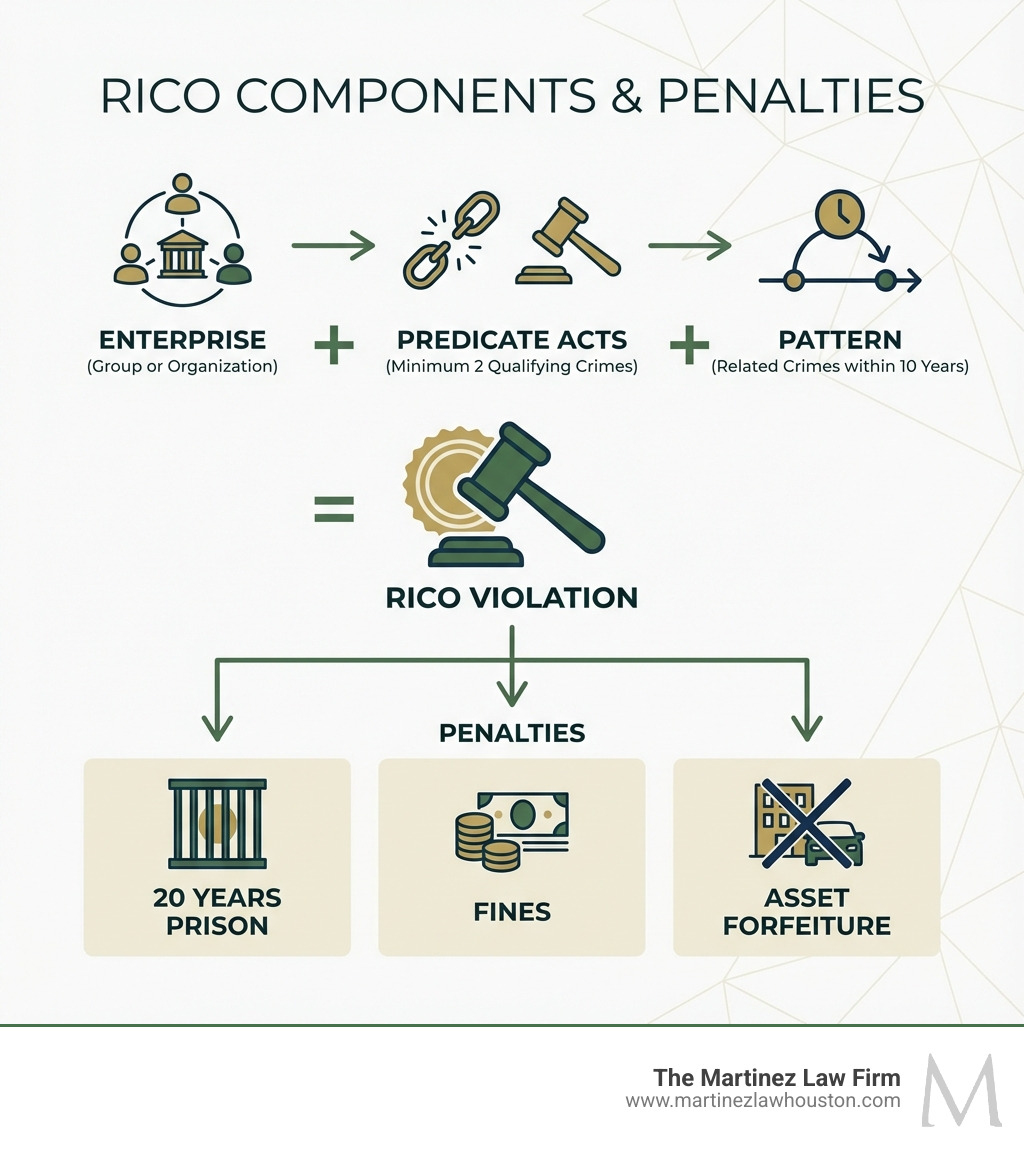
The Origins and Evolution of the RICO Act
The Racketeer Influenced and Corrupt Organizations Act, or RICO, didn’t just appear out of thin air. It was born from a specific need and has since grown far beyond its original scope.
RICO was enacted on October 15, 1970, as Title IX of the Organized Crime Control Act of 1970. Its primary purpose was clear: to strengthen legal tools for evidence gathering, establish new penal prohibitions, and provide improved sanctions and remedies for dealing with the unlawful activities of organized crime. At the time, law enforcement faced immense challenges in prosecuting high-ranking Mafia members whose disconnected structures made direct conviction difficult. RICO was Congress’s answer to this problem, aiming to dismantle these criminal syndicates from the top down.
Initially, the mention of RICO immediately brought to mind notorious figures like the “five Mafia families” convicted in New York City in 1986. This was precisely what the law was designed for – targeting traditional organized crime. However, even at its inception, legal scholars like G. Robert Blakey, one of the law’s drafters, asserted that Congress never intended RICO to be exclusively for the Mafia. Instead, the goal was a uniform set of rules applicable to criminal enterprises regardless of their background or public image.
And evolve it did.
What RICO Covers
Over the decades, the application of RICO dramatically expanded. Prosecutors recognized its immense power to target any ongoing criminal enterprise, not just the stereotypical mob. This led to its use against a wide range of actors, including:
- White-collar criminals: Cases involving large-scale fraud, securities violations, and money laundering. A notable early example was the prosecution of Wall Street executive Michael Milken.
- Corrupt public officials: RICO became a formidable weapon against corruption in government, targeting officials who used their positions for personal gain through patterns of illicit activities.
- Nonprofits and protest movements: Controversially, RICO’s broad provisions have even been applied to groups like anti-abortion activists and environmental protest organizations, though judicial guardrails have often intervened to protect First Amendment rights.
- Street gangs and music labels: More recently, RICO has been used in cases against modern criminal organizations, such as the indictment of rapper Young Thug and his YSL Records label in Georgia, alleging it was a street gang involved in violent activity.
- Political figures: The law’s reach was highlighted in 2023 with the Georgia state RICO charges against former President Donald Trump and his allies.
This evolution showcases RICO’s adaptability and sheer prosecutorial might. It began as a tool to fight the Mafia and became a broad statute used to combat any organized group engaged in a pattern of profit-driven criminal activity, dramatically changing the landscape of federal criminal law.
What is RICO Law and How Does It Work?
What is RICO law at its core? It’s a federal statute, codified at 18 U.S.C. §§ 1961-1968, that creates both criminal and civil liability for engaging in racketeering activities that are connected to an “enterprise.” Unlike many criminal laws that target individual acts, RICO focuses on the pattern of criminal behavior and the organization behind it.

For a prosecutor in the U.S. Attorney’s Office in the Southern District of Texas to prove a RICO violation, they must establish four key elements: (1) conduct (2) of an enterprise (3) through a pattern (4) of racketeering activity. This framework allows federal authorities to target entire criminal structures, rather than just individual offenders or isolated incidents.
The Three Core Elements of a RICO Violation
Let’s break down the essential components that make up a RICO charge:
Predicate Acts:
These are the specific, underlying criminal offenses that form the basis of a RICO charge. RICO doesn’t define “racketeering activity” itself but rather provides an extensive list of state and federal crimes that can serve as predicate acts. This list is incredibly broad and includes:
State felony crimes involving acts or threats of murder, kidnapping, gambling, arson, robbery, bribery, extortion, dealing in obscene matter, or dealing in controlled substances.
Over one hundred federal offenses, such as mail fraud, wire fraud, bribery, money laundering, counterfeiting, witness tampering, securities violations, and even human trafficking.
For a comprehensive list, you can refer to 18 U.S.C. § 1961.
Pattern of Racketeering Activity:
Simply committing a few predicate acts isn’t enough. The law requires a “pattern.” This means at least two predicate offenses must have been committed within a ten-year period. However, the Supreme Court, in H.J. Inc. v. Northwestern Bell Tel. Co., clarified that these acts must also be “related” and demonstrate “continuity” or the “threat of continuity.” This is often referred to as the “continuity plus relationship” test:
Relatedness:
The predicate acts must share similar purposes, results, participants, victims, or methods of commission, or otherwise be interrelated by distinguishing characteristics and not be isolated events.
Continuity:
This can be shown by a closed period of repeated conduct over a substantial period of time, or by demonstrating that the past conduct projects into the future with a threat of repetition, indicating an ongoing association or a regular way of conducting criminal activity. It’s not just about two crimes; it’s about a persistent course of criminal conduct.
Enterprise:
This is perhaps one of the most expansive and crucial elements of RICO. An “enterprise” is broadly defined to include “any individual, partnership, corporation, association, or other legal entity, and any union or group of individuals associated in fact although not a legal entity.” This means an enterprise can be a legitimate business, a government agency, a labor union, or even an informal “association-in-fact” – a group of people working together for a common, albeit illegal, purpose. The enterprise must affect interstate or foreign commerce in some way, which is often a low bar to meet. Critically, the enterprise must have:
- A shared purpose.
- Relationships among its members.
- A duration sufficient to pursue its shared purpose.
- And, importantly, the enterprise must be distinct from the pattern of racketeering activity itself. You can’t just be a collection of crimes; there must be an organized structure that the crimes operate through.
Understanding RICO Conspiracy Charges
Beyond the substantive RICO offenses, there’s also the powerful RICO conspiracy provision, found at 18 U.S.C. § 1962(d). This provision makes it unlawful to conspire to commit any of the prohibited activities under RICO.
What makes RICO conspiracy particularly potent is its breadth compared to traditional conspiracy laws. As the Supreme Court clarified in Salinas v. United States, the sole requirement for a RICO conspiracy is an agreement between two or more individuals or entities to engage in conduct that would, if completed, constitute a substantive RICO offense. This means:
- No Overt Act Required: Unlike many other conspiracy statutes, a RICO conspiracy charge typically does not require proof of an overt act in furtherance of the conspiracy. The agreement itself is the crime.
- Broader Liability: An individual can be liable for RICO conspiracy even if they didn’t personally commit or agree to commit two predicate acts. If you agree to facilitate the overall criminal scheme of the enterprise, knowing its general scope and that it extends beyond your individual role, you could be charged. You don’t even need to know all the co-conspirators or every detail of the scheme.
This broad reach means that if you’re involved in any way with an organization that’s conducting its affairs through a pattern of racketeering, even if your role seems minor, you could face serious conspiracy charges.
Penalties and Remedies: The Consequences of a RICO Conviction
Being charged under RICO is no laughing matter. Whether it’s a criminal prosecution brought by the federal government or a civil lawsuit initiated by a private party, the consequences are severe and far-reaching.

A RICO conviction can lead to staggering prison sentences, massive financial penalties, and the forfeiture of assets. For businesses and individuals in Houston, this could mean the complete dismantling of an organization, financial ruin, and a profound impact on one’s life and reputation.
Criminal Penalties for RICO Violations
The criminal penalties associated with RICO violations are designed to be punitive and to strip criminal enterprises of their ill-gotten gains. For those found guilty of racketeering, the stakes are incredibly high:
- Imprisonment: Individuals can face up to 20 years in federal prison per racketeering count. If any of the underlying predicate acts carry a maximum penalty of life imprisonment (such as murder), the RICO sentence can also extend to life.
- Fines: Significant financial penalties are imposed. Individuals can be fined up to $250,000, while organizations can face fines of up to $500,000. These fines are in addition to the sentences for any underlying predicate acts a defendant is convicted of.
- Asset Forfeiture: This is one of RICO’s most powerful deterrents. Convicted defendants must forfeit any interest in the enterprise, any property derived from or used in the racketeering activity, and any proceeds obtained through their illegal conduct. This can include homes, cars, bank accounts, and entire businesses.
- Dissolution: In some cases, the government can seek injunctive relief, including the dissolution or reorganization of the criminal enterprise itself, effectively shutting down its operations.
These penalties, outlined in 18 U.S.C. § 1963, underscore the federal government’s commitment to eradicating organized criminal activity.
Civil RICO: Lawsuits and Treble Damages
Beyond criminal prosecution, RICO also provides a powerful tool for victims: the civil lawsuit. Any person “injured in his business or property” by a violation of RICO can bring a civil action in federal court. This private right of action offers victims a chance to recover damages and hold perpetrators accountable.
The most compelling aspect of civil RICO is the provision for treble damages. This means that if a plaintiff successfully proves they were harmed by a RICO violation, they can recover triple the amount of actual damages they sustained, plus the costs of the lawsuit and reasonable attorney’s fees. This makes civil RICO an attractive option for victims, particularly in complex business disputes or cases of widespread fraud.
While the burden of proof in a civil RICO case is lower than in a criminal case (requiring a “preponderance of the evidence” rather than “beyond a reasonable doubt”), it’s still a high bar to meet, requiring plaintiffs to establish all the complex elements of a RICO violation. However, if a criminal RICO conviction has already occurred, it can simplify matters for civil plaintiffs, as the defendant may be “estopped” from denying the allegations in the civil court.
Defenses and Limitations in RICO Cases
Given the severe penalties and broad scope of RICO, mounting an effective defense is paramount. RICO cases are notoriously complex, often involving vast amounts of evidence, multiple defendants, and intricate legal arguments. However, several constitutional protections and judicial guardrails exist to prevent the overbroad or abusive application of this powerful statute.
Navigating these complexities requires specialized legal knowledge and a deep understanding of federal criminal law. As former prosecutors, we understand how the government builds these cases and, crucially, where their weaknesses lie.
What is the required knowledge and intent for a RICO law violation?
For an individual to be held liable under RICO, the government must prove a specific mental state, or mens rea. It’s not enough to simply be associated with an enterprise that commits crimes; there must be a level of knowledge and intent.
RICO liability extends only to individuals who have some level of knowledge of and intent to engage in or facilitate unlawful activity. For a substantive RICO violation (e.g., conducting the enterprise’s affairs through racketeering), the government must establish that the defendant:
- Knew of the general nature of the enterprise’s activities.
- Willfully participated in the affairs of the enterprise.
- Knew that their actions were part of a pattern of racketeering activity.
- Had the requisite intent for each underlying predicate act they committed or agreed to commit.
For a RICO conspiracy, the intent requirement is slightly different. As per DOJ guidance on proving intent, the government must establish an agreement between individuals to commit the substantive RICO offense. This means proving that the defendant agreed to participate in the enterprise’s affairs with knowledge of the conspiracy’s general scope and that it extended beyond their individual role, and with the intent that others would commit predicate acts. Without this critical element of knowledge and intent, a RICO charge cannot stand.
Constitutional and Judicial Guardrails
While powerful, RICO is not without its checks and balances. The courts, particularly the Supreme Court, have established significant guardrails to protect individual liberties and prevent the law’s overreach:
- First Amendment Protections: The Supreme Court has repeatedly affirmed that “guilt by association is a philosophy alien to the traditions of a free society.” In cases like NAACP v. Clairborne Hardware Co., the Court emphasized that the First Amendment protects against RICO liability based solely on association or protected speech, even in extreme circumstances. This is crucial for activists, protestors, and organizations whose activities might be misconstrued as part of a criminal enterprise.
- Strict Proof of Elements: Courts demand rigorous proof of each RICO element. The “enterprise” must be distinct from the “pattern of racketeering activity.” The “pattern” itself must meet the demanding “continuity plus relationship” test. This prevents prosecutors from simply aggregating disparate criminal acts into a RICO charge without demonstrating a coherent, organized criminal structure.
- Scheidler v. National Organization for Women, Inc.: This landmark case saw the Supreme Court reverse a RICO conviction against anti-abortion groups, finding that their actions, while potentially unlawful, did not constitute “extortion” (the predicate act alleged) under the Hobbs Act. This ruling reinforced that predicate acts must fit their legal definitions precisely and cannot be stretched to fit the facts.
These guardrails are vital in ensuring that RICO remains a tool against genuine criminal enterprises and does not become an instrument to suppress legitimate, if unpopular, activities.
How does Texas’s RICO law compare to the federal statute?
While the federal RICO Act is certainly the most well-known, many states, including Texas, have their own versions of anti-racketeering statutes. In Texas, the primary law targeting organized criminal activity is found in Texas Penal Code Chapter 71: Organized Criminal Activity.
Texas’s statute shares the federal law’s core philosophy of targeting groups engaged in a pattern of criminal conduct. However, there are some key differences:
- “Combination” vs. “Enterprise”: Instead of “enterprise,” Texas law refers to a “criminal combination.” While similar in concept, the definition and proof requirements for a “combination” can differ from the federal “enterprise” element.
- Predicate Offenses: Texas’s list of predicate offenses, while comprehensive, is specific to state law. It includes many offenses similar to federal RICO (like murder, robbery, theft, fraud, drug offenses), but there might be nuances or different thresholds. Our internal article, Texas Crimes: Racketeering, provides more detail on how these crimes are approached at the state level.
- Jurisdiction: Federal RICO charges are prosecuted by the U.S. Attorney’s Office (for us, in the Southern District of Texas). State Organized Criminal Activity charges are handled by the local District Attorney’s Office, such as the Harris County District Attorney’s Office.
- Penalties: While both carry severe penalties, the specific sentencing guidelines, fines, and forfeiture procedures will adhere to state law for Texas Organized Criminal Activity charges.
Understanding these distinctions is crucial, especially in Houston, where individuals or groups might face concurrent federal and state investigations or charges for similar conduct. Our firm regularly handles cases in both federal and Harris County courts, giving us a unique perspective on the interplay between these complex statutes.
Frequently Asked Questions about RICO Law in Houston
Can I be charged with RICO if I didn’t personally commit the main crimes?
Yes, absolutely. This is one of the most surprising and powerful aspects of RICO, particularly its conspiracy provision (18 U.S.C. § 1962(d)). You can be charged with RICO conspiracy if you merely agree to facilitate the enterprise’s criminal activities, even if you never personally committed a single predicate act. The key is your agreement to participate in the overall scheme, knowing its general criminal purpose. This broad liability is why even individuals with seemingly minor roles in a larger organization can find themselves facing devastating RICO charges.
Is the RICO Act only used against mobsters and gangs?
No, that’s a common misconception! While RICO was indeed originally designed to combat the Mafia and has been effectively used against traditional organized crime groups and street gangs, its application has expanded dramatically. Today, federal prosecutors in Houston and across the country use RICO against a wide array of enterprises, including:
- Legitimate businesses engaged in a pattern of fraud or other illegal activities.
- Corrupt political organizations or public officials.
- Drug trafficking networks.
- White-collar criminals involved in elaborate financial schemes.
- Even groups involved in human trafficking or other illicit operations.
The law’s flexibility means it can target any group of individuals associated in fact that engages in a pattern of racketeering activity.
What is the difference between a criminal and civil RICO case?
The distinction between criminal and civil RICO cases is significant:
- Criminal RICO: These cases are brought by the government (e.g., the U.S. Attorney’s Office). The standard of proof is “beyond a reasonable doubt,” meaning the government must convince a jury that there is no other logical explanation for the facts except that the defendant committed the crime. Penalties include severe prison sentences (up to 20 years per count, or even life), substantial fines, and mandatory forfeiture of assets.
- Civil RICO: These cases are brought by private parties (individuals or businesses) who have been “injured in their business or property” by a RICO violation. The standard of proof is lower, requiring only a “preponderance of the evidence” – meaning it’s more likely than not that the defendant engaged in the racketeering activity. The primary remedy in civil RICO is financial: the plaintiff can recover “treble damages” (triple their actual losses), plus attorney’s fees.
Both types of cases are complex and carry profound consequences, but they serve different purposes and operate under different legal frameworks.
Moving Forward When Facing RICO Allegations
What is RICO law? It is a formidable piece of federal legislation designed to dismantle organized criminal enterprises by targeting their patterns of illegal activity. From its origins combating the Mafia to its modern application against white-collar criminals, corrupt officials, and contemporary gangs, RICO remains a powerful and evolving force in federal criminal law.
The stakes in a RICO case are extraordinarily high, involving severe criminal penalties like decades in prison, massive fines, and asset forfeiture, as well as the potential for crippling civil lawsuits with treble damages. Navigating these complex legal waters requires specialized knowledge, meticulous preparation, and an aggressive defense strategy.
At The Martinez Law Firm, we understand the unique challenges posed by RICO charges. Our lead attorney, Herman Martinez, brings invaluable insights from his years as a former Chief Prosecutor for the Harris County District Attorney’s Office and a City of Houston Judge. This experience on both sides of the courtroom allows us to anticipate prosecutorial strategies and craft robust defenses for our clients facing federal charges in Houston and throughout Texas.
If you or someone you know is facing a RICO investigation or charges, don’t hesitate. The time to build a strong defense is now. Contact a Houston federal criminal defense attorney for a consultation at The Martinez Law Firm. We are here to protect your rights and fight for your future.