

What “Failure to Render Aid” Really Means — and Why It Matters in Texas
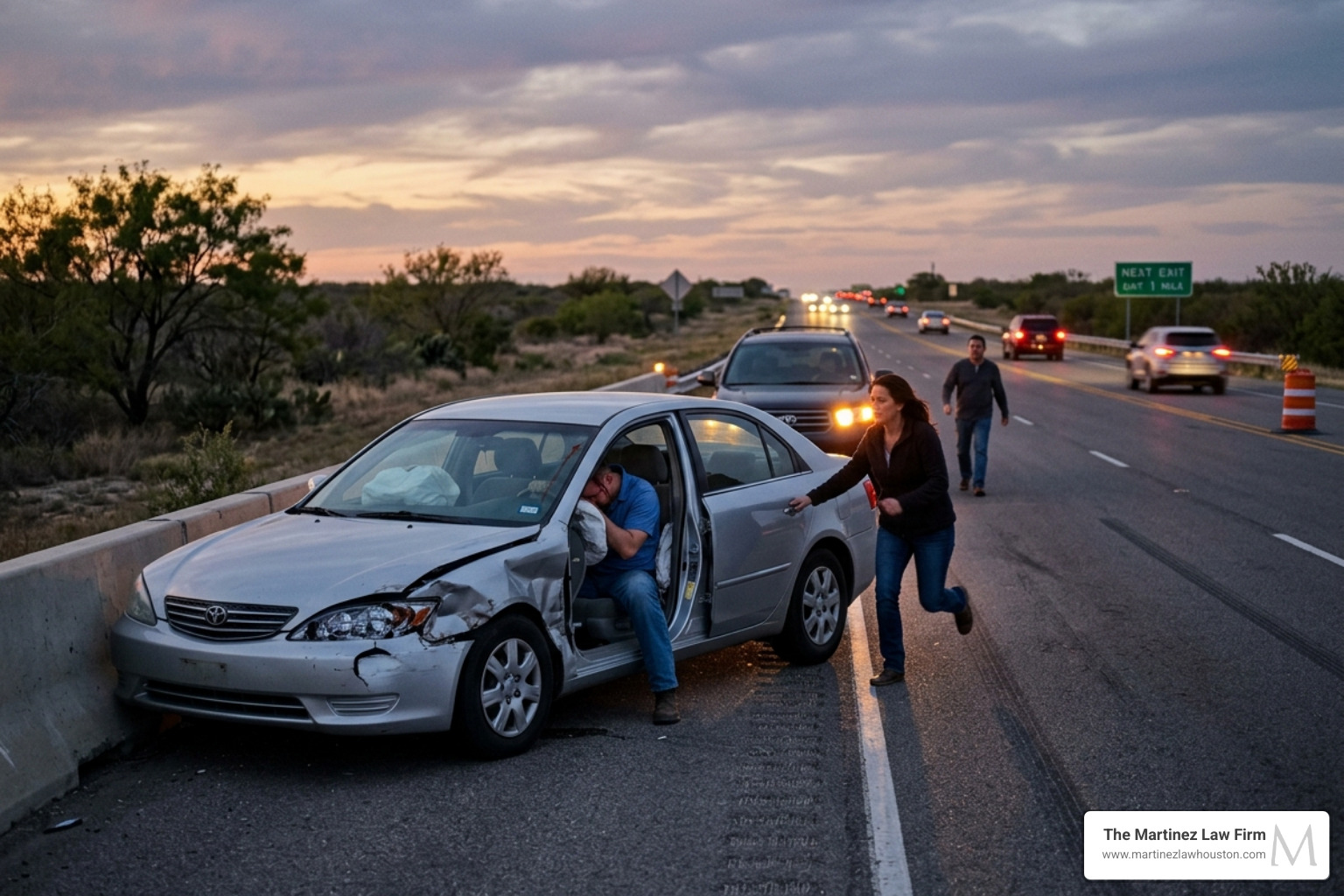
Failure to render aid is a serious criminal offense in Texas that occurs when a driver involved in a vehicle collision leaves the scene without stopping, checking on injured parties, or providing reasonable assistance. Here’s what you need to know at a glance:
- What it is: Leaving the scene of an accident without helping injured people or exchanging required information
- Who it applies to: Any driver involved in a collision — even if they didn’t cause it
- Where it’s governed in Texas: Texas Transportation Code Chapter 550, specifically Sections 550.021 and 550.023
- Potential charges: Ranges from a Class C misdemeanor (property damage only) up to a second-degree felony (if someone dies)
- Key penalties: Fines, jail or prison time, license suspension, and serious civil liability
Most people assume this law only applies to drivers who cause accidents. It doesn’t. In Texas, every driver involved in a collision has a legal duty to stop, check for injuries, and provide help — regardless of fault.
That distinction matters enormously, especially in a city like Houston, where high-traffic corridors like I-10, the 610 Loop, and US-59 see hundreds of accidents every year. A split-second decision to drive away — even in a moment of panic — can turn a car crash into a felony charge.
The consequences aren’t just criminal, either. Failing to stop can trigger insurance coverage denial, civil lawsuits, and mandatory license revocation. And if someone dies, you’re looking at a potential second-degree felony carrying up to 20 years in prison.
Key Takeaways: Failure to Render Aid in Texas
- Leaving the scene is a crime—regardless of fault. In Texas, any driver involved in a crash must stop, check for injuries, and provide information, even if they did not cause the accident.
- Penalties escalate quickly based on injury severity. Charges range from a minor misdemeanor (property damage) to a second-degree felony with up to 20 years in prison if someone dies.
- “Failure to render aid” goes beyond just stopping. You must provide reasonable assistance, such as calling 911 or helping arrange medical care—doing nothing can still lead to criminal charges.
- A single mistake can trigger long-term consequences. Convictions may lead to license suspension, insurance denial, civil lawsuits, and permanent criminal records, even if the initial crash was minor.
- Action step: stop, document, and get help immediately. After any collision, stay at the scene, exchange information, call emergency services, and seek legal guidance before speaking with investigators to protect your rights.
I’m Herman Martinez, founder of The Martinez Law Firm and a former Chief Prosecutor for the Harris County District Attorney’s Office — experience that gives me a rare, inside view of exactly how failure to render aid cases are built and prosecuted. Over more than 25 years of criminal defense work in Houston, I’ve seen how these charges escalate fast and why having the right defense strategy from day one makes all the difference.
The Legal Duty: What is Failure to Render Aid?
When we talk about the Duty to rescue, we are looking at a concept that varies wildly depending on where you are in the world. In many European “civil law” systems, a bystander who sees someone in trouble might actually be legally required to help. However, in the United States and other “common law” systems, you generally don’t have a legal obligation to save a stranger unless you have a “special relationship” with them—like a parent with a child or an employer with an employee.
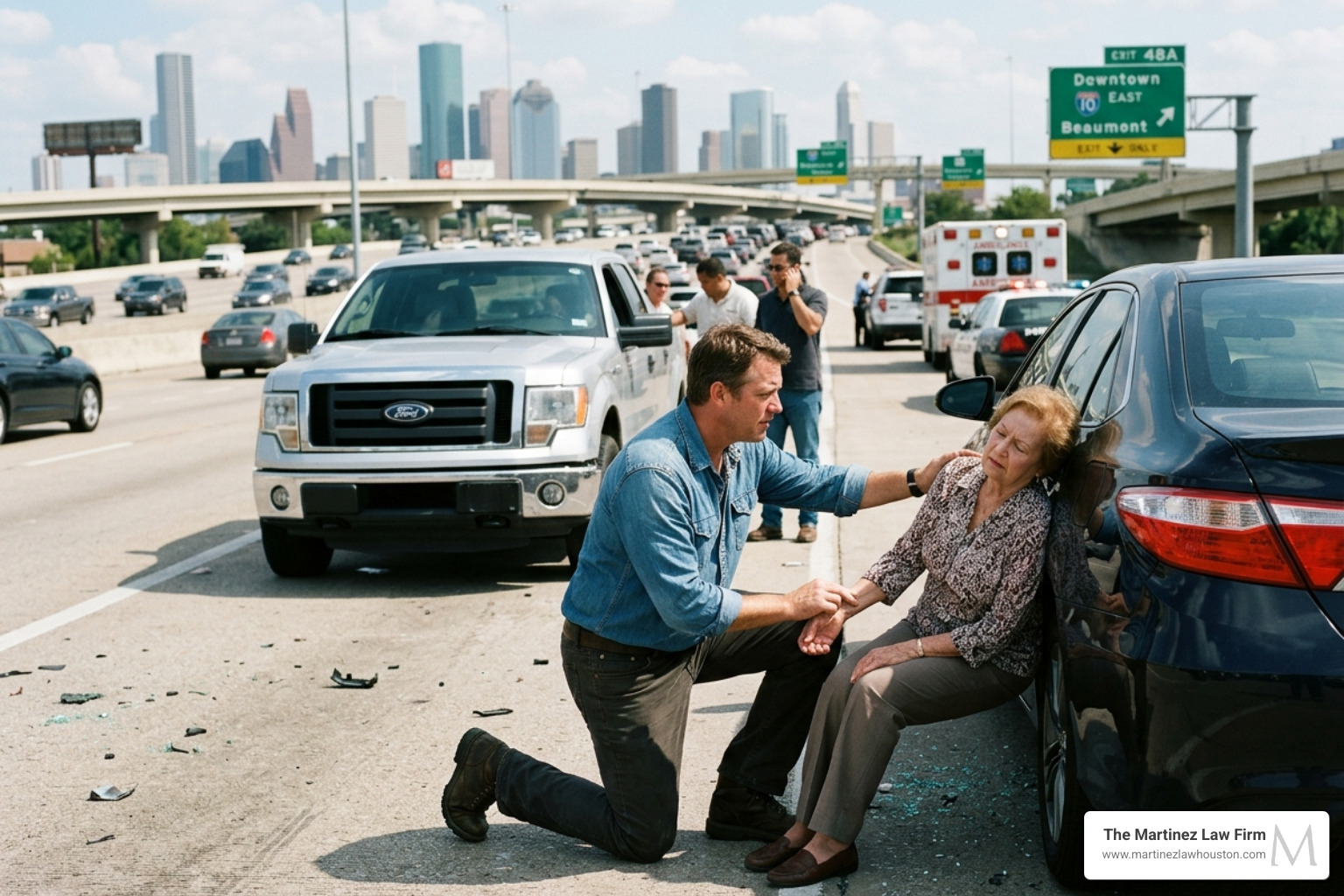
But here is where it gets tricky for Houston drivers: the moment you are involved in a vehicle collision, that “no duty” rule goes out the window. By being part of the incident, you have entered into a statutory obligation. You aren’t just a bystander anymore; you are a participant.
Failure to render aid happens when you fail to provide “reasonable assistance.” This doesn’t mean you have to perform open-heart surgery on the shoulder of I-45. It means you must do what a sensible person would do: call 911, check for a pulse, or arrange for the injured person to get to a hospital if it’s obvious they need medical transport.
A DWI crash can make this issue much worse. If a drunk driver leaves the scene or fails to help an injured person, prosecutors may pursue both intoxication-related charges and failure to render aid. And newer vehicle technology does not erase that duty. Whether you were driving, using advanced driver-assist features, or relying on automation, the legal obligation to stop, report the crash, and make sure help arrives still matters.
Texas Laws and the Houston Driver’s Responsibility
In Texas, we don’t mess around with hit-and-runs. The state recently moved away from the word “accident” in its legal code, replacing it with “collision” to reflect that these events often involve human choice or negligence.
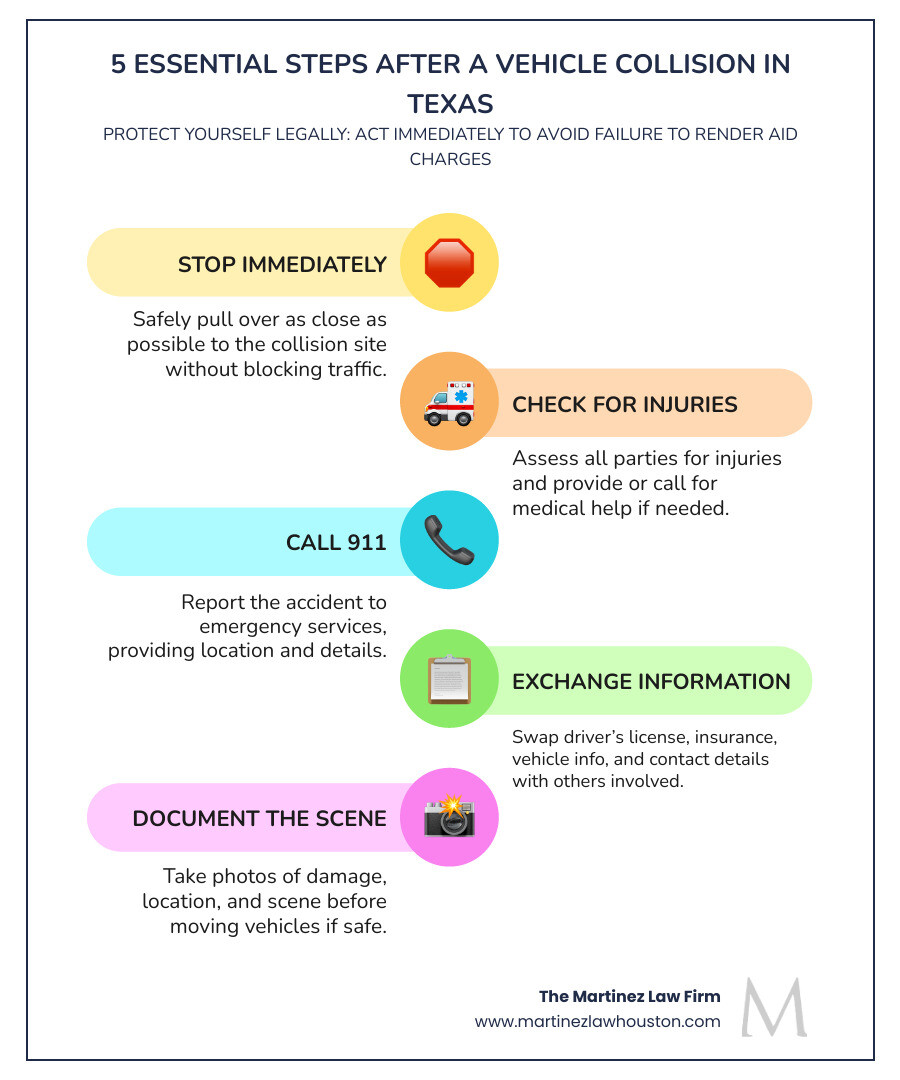
The heavy hitters in the Texas Transportation Code are Sections 550.021 and 550.023. Under Section 550.021, if you are in a collision that results in injury or death, you must:
- Immediately stop your vehicle at the scene (or as close as possible).
- Return to the scene if you didn’t stop initially.
- Determine if anyone needs aid.
- Remain there until you have exchanged information.
Section 550.023 lists exactly what you need to hand over. In Houston, if you don’t provide these items, you’re breaking the law:
- Your name and address.
- The registration number of your vehicle.
- The name of your insurance liability provider.
- Your driver’s license (if requested).
The stakes have never been higher. A New Texas Law Heightens Hit And Run Sentences recently, making the penalties for leaving the scene of a fatal crash just as severe as Intoxicated Manslaughter. This was done specifically to stop people from fleeing a scene to “sober up” before the police arrive. If the collision leads to a fatality, you could face Vehicular Homicide Charges In Texas.
Harris County law enforcement is particularly aggressive about investigating these cases. With the abundance of toll road cameras, dash cams, and doorbell cameras in Houston neighborhoods, the “blind spot” for hit-and-runs is shrinking every day.
Proving Guilt and Navigating Defenses
To convict someone of failure to render aid, a prosecutor has to prove more than just “you weren’t there when the cops arrived.” They have to prove that you knew a collision occurred and that you knew (or should have known) that someone was likely injured.
This is where “willful ignorance” comes in. You can’t just crank up the radio, ignore the loud “thud,” and claim you didn’t know you hit someone. If the circumstances suggest a reasonable person would have known there was an injury, the court will likely find you had the “requisite knowledge.”
However, there are legitimate defenses we use in Houston courts every day. It isn’t always a cut-and-dry case of someone being a “bad person.” Sometimes, things are much more complicated.
Common defenses include:
- Lack of Knowledge: If it was dark, raining heavily, or the impact was so slight that you genuinely didn’t realize a person was involved, this can be a valid defense.
- Self-Preservation/Safety: If you stop in a dangerous area of Houston at 2:00 AM and a crowd begins to act aggressively toward you, leaving the scene to call the police from a safe location might be justified.
- Emergency Situations: If you were rushing someone to the hospital for a life-threatening emergency and had a minor collision, the “necessity” of the situation might play into your defense.
- Identity Defense: Just because your car was involved doesn’t mean you were driving. The prosecution must prove beyond a reasonable doubt that you were the one behind the wheel.
- Involuntary Intoxication: While rare, if you were drugged without your knowledge and were not in control of your faculties, it could impact the “intentional” nature of the crime.
According to research on Failure to Stop and Render Aid: Legal Consequences and Penalties, the prosecution’s easiest path to a conviction is often the defendant’s own statement. This is why we tell our clients: Don’t talk to the police without a lawyer.
The Ripple Effect: Penalties and Civil Liability
If you’re convicted of failure to render aid in Texas, the floor is going to drop out from under you pretty quickly. The law treats these offenses with increasing severity based on how badly the other person was hurt.
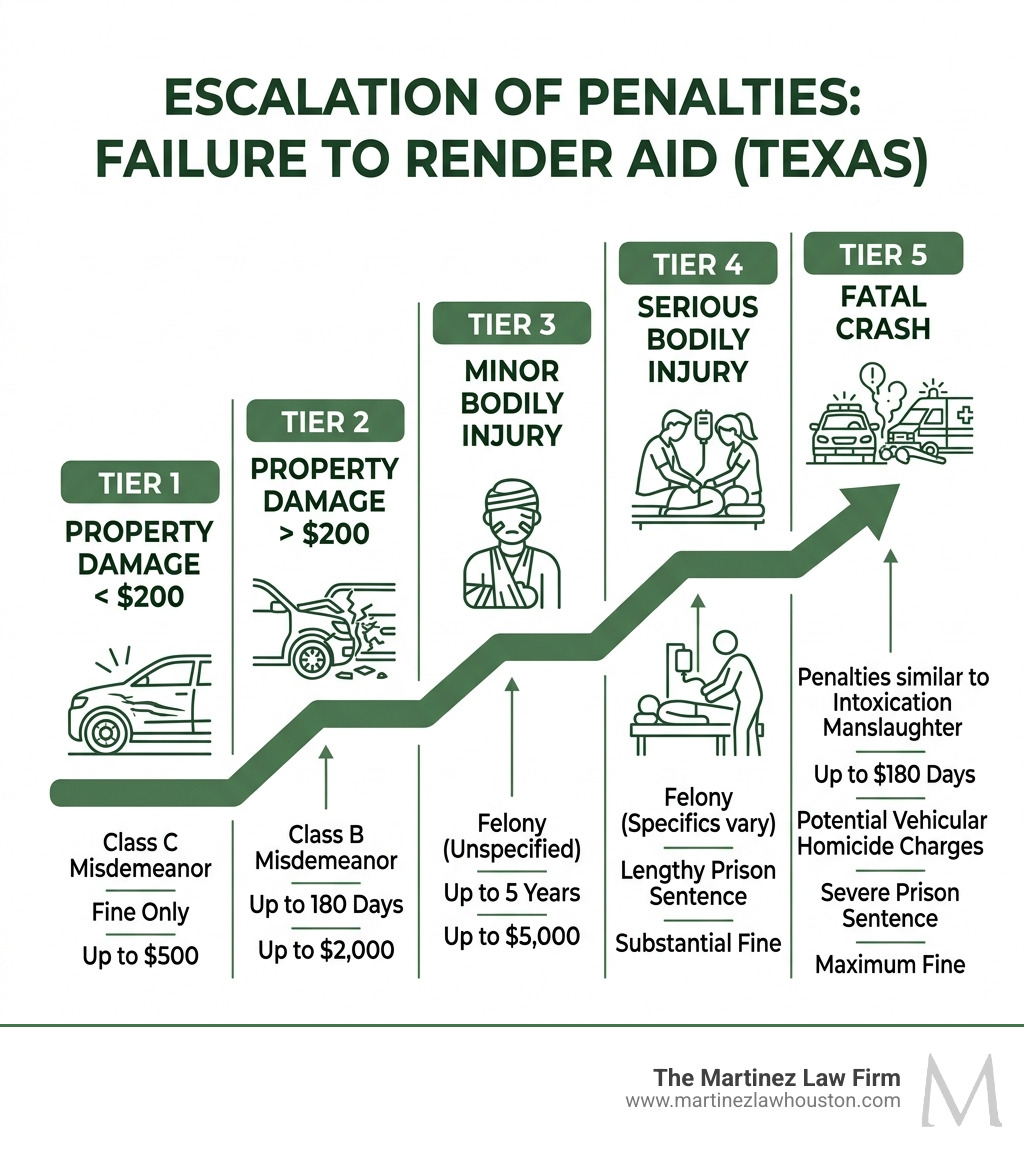
| Severity of Incident | Texas Charge Level | Potential Prison/Jail Time | Max Fine |
|---|---|---|---|
| Property Damage < $200 | Class C Misdemeanor | Fine Only | $500 |
| Property Damage > $200 | Class B Misdemeanor | Up to 180 Days | $2,000 |
| Minor Bodily Injury | Felony (Unspecified) | Up to 5 Years | $5,000 |
| Serious Bodily Injury | 3rd Degree Felony | 2 to 10 Years | $10,000 |
| Death | 2nd Degree Felony | 2 to 20 Years | $10,000 |
One of the most brutal parts of Texas law involves probation. If a judge grants you probation for a collision involving death, there is a mandatory minimum of 120 days in jail that you must serve as a condition of that probation. There is no getting around it.
Beyond the jail cell, you have to worry about the administrative and civil fallout. Your license will likely be suspended or revoked. Insurance companies often use a hit-and-run as a reason to deny coverage or cancel your policy entirely.
Then there are the civil lawsuits. If you flee, a personal injury lawyer will argue that your delay in calling for help made the victim’s injuries worse. This can lead to massive “exemplary damages” meant to punish you. If the collision involved alcohol, you might also be facing Intoxication Assault or Leaving The Scene charges, which carry their own heavy weight.
Frequently Asked Questions about Failure to Render Aid
Is failure to render aid a felony in Texas?
Yes, it very often is. While hitting a mailbox and driving off is a misdemeanor, any collision involving a person’s injury is elevated to a felony. If the injury is “serious bodily injury” (meaning it creates a substantial risk of death or causes permanent disfigurement), it is a third-degree felony. If the person dies, it jumps to a second-degree felony. Even if the injury seems minor at the scene, if you leave, you are risking a felony charge that can follow you for the rest of your life.
How does failure to render aid affect my driver’s license?
Texas is strict about driving privileges. A conviction for failure to render aid typically results in an automatic suspension or revocation of your license. To get it back, you’ll likely have to attend administrative hearings, pay reinstatement fees, and provide proof of “SR-22” high-risk insurance, which is significantly more expensive than standard coverage. In many cases, the suspension lasts for at least one year, but it can be longer depending on your prior driving record.
What counts as “reasonable assistance” at an accident scene?
The law doesn’t expect you to be a doctor, but it does expect you to be helpful. “Reasonable assistance” includes calling 911 immediately. If the injured person is conscious and asks to go to a specific hospital, you are legally required to arrange that transport if it’s safe to do so. If they are unconscious, the “apparent necessity” of the situation dictates that you call for an ambulance. You should not move someone unless they are in immediate danger (like a car fire), as you could make their injuries worse. Simply standing by and waiting for the police is usually the best way to fulfill this duty.
What to Do Next if You’re Facing Failure to Render Aid
Navigating the aftermath of a Houston car crash is overwhelming. Between the adrenaline, the fear, and the confusion of the law, it is easy to make a mistake that changes your life forever. But a mistake at the scene doesn’t have to mean the end of your future.
At The Martinez Law Firm, we believe that everyone deserves a defense that is as aggressive as the prosecution. We leverage Herman Martinez’s experience as a former Chief Prosecutor to anticipate the state’s moves before they make them. We know how Harris County builds these cases, and we know where the cracks in those cases usually hide.
Whether you are facing a misdemeanor for property damage or a serious felony charge, you need a team that understands the local courts and the high stakes involved. We have spent decades achieving proven results for people in Houston, Harris County, and the surrounding areas.
If you’re worried about a failure to render aid charge, don’t wait for the police to knock on your door. Take control of your situation now.