
Understanding DWI Charges in Texas: What You Need to Know

4th degree DWI is a term that often causes confusion for individuals facing drunk driving charges in Texas—and for good reason. This classification doesn’t actually exist under Texas law. The term originates from Minnesota’s legal system, where DWI offenses are categorized into four degrees, with a 4th degree DWI representing the least severe charge: a misdemeanor for first-time offenders with no aggravating factors.
If you’re searching for information on “4th degree DWI” in Texas, here’s what you need to know:
- Texas does not use “degree” classifications for DWI offenses
- The Texas equivalent is typically a first-offense DWI, classified as a Class B Misdemeanor
- A first-offense DWI in Texas applies when there are no aggravating factors (such as a BAC of 0.15% or higher, a child passenger, or prior convictions)
- Penalties include up to 180 days in jail, fines up to $2,000, and license suspension for 90 days to 1 year
- Repeat offenses or aggravating factors can lift charges to Class A Misdemeanors or felonies
What to Know After a DWI Arrest in Texas
If you’ve been arrested for DWI in Houston or anywhere in Harris County, understanding how Texas actually classifies these offenses is critical to building an effective defense. Unlike Minnesota’s degree system, Texas categorizes DWI charges based on factors like prior convictions, blood alcohol concentration (BAC), and whether the offense caused injury or death. A first-time DWI with no aggravating circumstances is treated as a Class B Misdemeanor under Texas Penal Code § 49.04, but the consequences can still be severe and life-altering.
The Martinez Law Firm in Houston brings more than 25 years of experience on both sides of the courtroom—first in the Harris County District Attorney’s Office and now as a dedicated DWI defense practice focused on 4th degree DWI equivalents (first-offense DWIs). This combination of prosecutorial and defense insight helps the firm challenge questionable evidence, spot procedural errors, and protect your rights at every stage of the criminal justice process.
What is a 4th Degree DWI in the Context of Texas Law?
When people ask about a 4th degree DWI, they’re often referring to the least severe type of DWI charge they could face. In Minnesota, this term specifically applies to a misdemeanor offense, typically for a first-time offender with a blood alcohol concentration (BAC) below .16% and no other aggravating factors. It’s a foundational charge that can escalate based on various circumstances.
However, here in Houston and throughout Texas, our legal system operates differently. We don’t use a “degree” classification system for DWI offenses like Minnesota does. Instead, Texas categorizes DWI charges primarily based on the number of prior offenses, the driver’s BAC, and the presence of aggravating factors. This means that while the concept of a “least severe” DWI exists, it’s not called a 4th degree DWI.
For us in Texas, the closest equivalent to what Minnesota calls a 4th degree DWI would be a first-offense Driving While Intoxicated (DWI) charge, which is typically classified as a Class B Misdemeanor under Texas law. This charge applies when it’s your first DWI, your BAC is below 0.15%, and there are no other aggravating factors involved.
Here’s a quick comparison to highlight the differences:
| Feature | Minnesota 4th Degree DWI | Texas First Offense DWI (Class B Misdemeanor) |
|---|---|---|
| Classification | Misdemeanor | Class B Misdemeanor |
| Severity | Least severe DWI charge | Least severe DWI charge |
| Prior Offenses | First-time offense | First-time offense |
| Aggravating Factors | None | None |
| Typical BAC Range | .08 to .16 | .08 to .149 |
| Jail Time (Max) | 90 days | 180 days |
| Fines (Max) | $1,000 | $2,000 |
The Texas Equivalent of a 4th Degree DWI
In Texas, a first-offense DWI is defined by Texas Penal Code § 49.04. This statute outlines that a person commits an offense if they are intoxicated while operating a motor vehicle in a public place. The term “intoxicated” is further defined in two ways:
- Not having the normal use of mental or physical faculties by reason of the introduction of alcohol, a controlled substance, a drug, a dangerous drug, a combination of two or more of those substances, or any other substance into the body.
- Having an alcohol concentration of 0.08 or more within two hours of driving.
So, for a first-time DWI in Houston, if your BAC is below 0.15% and there are no other enhancing circumstances, you’re looking at a Class B Misdemeanor. This is our equivalent to what Minnesota refers to as a 4th degree DWI. It’s still a serious criminal charge, but it’s the baseline from which all other, more severe DWI charges escalate.
Why This Distinction Matters for Your Houston Case
Understanding these jurisdictional differences is absolutely vital, especially if you’re facing a DWI charge in Houston or anywhere in Harris County. Relying on information about “4th degree DWI” from other states, like Minnesota, can lead to serious misinformation. Texas laws, penalties, and defense strategies are unique.
Our Harris County court system has its own procedures, and the judges and prosecutors here operate under Texas statutes. What might be a common plea deal or a specific administrative penalty in Minnesota might not apply here at all. For example, some states have specific DWI courts or diversion programs that differ significantly from what’s available in Harris County.
This is why local legal knowledge is not just helpful, it’s essential. An attorney who understands the nuances of Texas DWI law and has experience navigating the Houston legal landscape can make all the difference in your case. Misinformation risks are high when you’re dealing with different state laws, and getting accurate, localized advice is your best defense.
Penalties for a First-Time DWI in Houston
Even though a first-time DWI (our equivalent of a 4th degree DWI) is considered the least severe DWI offense in Texas, it is still a serious criminal charge with significant consequences. These penalties fall into two main categories: criminal and administrative. Both can have immediate and long-term impacts on your life, your wallet, and your future.

Criminal Penalties for a First-Offense DWI
If you are convicted of a first-offense DWI in Houston, you face a Class B Misdemeanor. The criminal penalties can include:
- Jail Time: You could face anywhere from 3 days to 180 days in jail. Texas law mandates a minimum of 72 hours of confinement, even for a first offense.
- Fines: You may be required to pay fines up to $2,000. This doesn’t include court costs, surcharges, or other fees that can add up quickly.
- Probation: Instead of maximum jail time, a judge might impose probation (community supervision), which can last for 1 to 2 years. Probation often comes with strict conditions, such as:
- Regular check-ins with a probation officer.
- Maintaining employment.
- Avoiding alcohol and drugs, often with random testing.
- Installation of an ignition interlock device (IID) on your vehicle, even for a first offense, especially if ordered by the judge.
- DWI Education Programs: You will likely be required to complete a DWI education program, which is typically 12 hours long.
- Community Service: Judges often order community service hours as part of the sentence or probation conditions.
These criminal penalties are just the beginning. A conviction leaves a permanent mark on your criminal record, which can affect future employment, housing, and educational opportunities.
Administrative Penalties & License Suspension
Separate from the criminal court process, the Texas Department of Public Safety (DPS) will initiate an Administrative License Revocation (ALR) process. This is an administrative action against your driving privileges.
- 15-Day Deadline: After a DWI arrest in Houston, you have only 15 days to request an ALR hearing to contest your license suspension. If you miss this deadline, your license will be automatically suspended. We always advise our clients to contact us immediately after an arrest to ensure this critical deadline is met.
- License Suspension Periods: For a first-time DWI, your license can be suspended for 90 days to 1 year. If you refused a chemical test (breath or blood), the suspension period can be longer, typically 180 days.
- Annual Surcharges: After your license is reinstated, you may face annual surcharges from DPS for three years. These surcharges can be $1,000 or $2,000 per year, depending on the specifics of your case, on top of any court-imposed fines.
- Ignition Interlock Device (IID): While not always mandatory for a first offense without aggravating factors, an IID may be required as a condition of bond, probation, or to obtain an occupational license (restricted driving privileges). This device prevents your vehicle from starting if it detects alcohol on your breath.
The complexities of the ALR process alone highlight the need for experienced legal counsel. Our team can help you steer this administrative maze, fight for your driving privileges, and explore options like occupational licenses. You can learn more about how we defend against these charges on our DWI defense page.
Understanding a Texas 4th Degree DWI Equivalent
To reiterate, a first-offense DWI in Texas is what many might mistakenly refer to as a 4th degree DWI. This charge applies to individuals who:
- Have no prior DWI convictions or alcohol-related license revocations within the past 10 years.
- Had a BAC of less than 0.15% (but still 0.08% or higher).
- Were not involved in an accident causing injury or death.
- Did not have a child passenger under 15 years old in the vehicle.
- Did not have an open container of alcohol in the vehicle.
While it carries lighter penalties compared to aggravated or repeat DWI offenses, it is still a serious criminal charge that can have significant consequences on an individual’s record and future.
How a DWI Charge Escalates in Texas
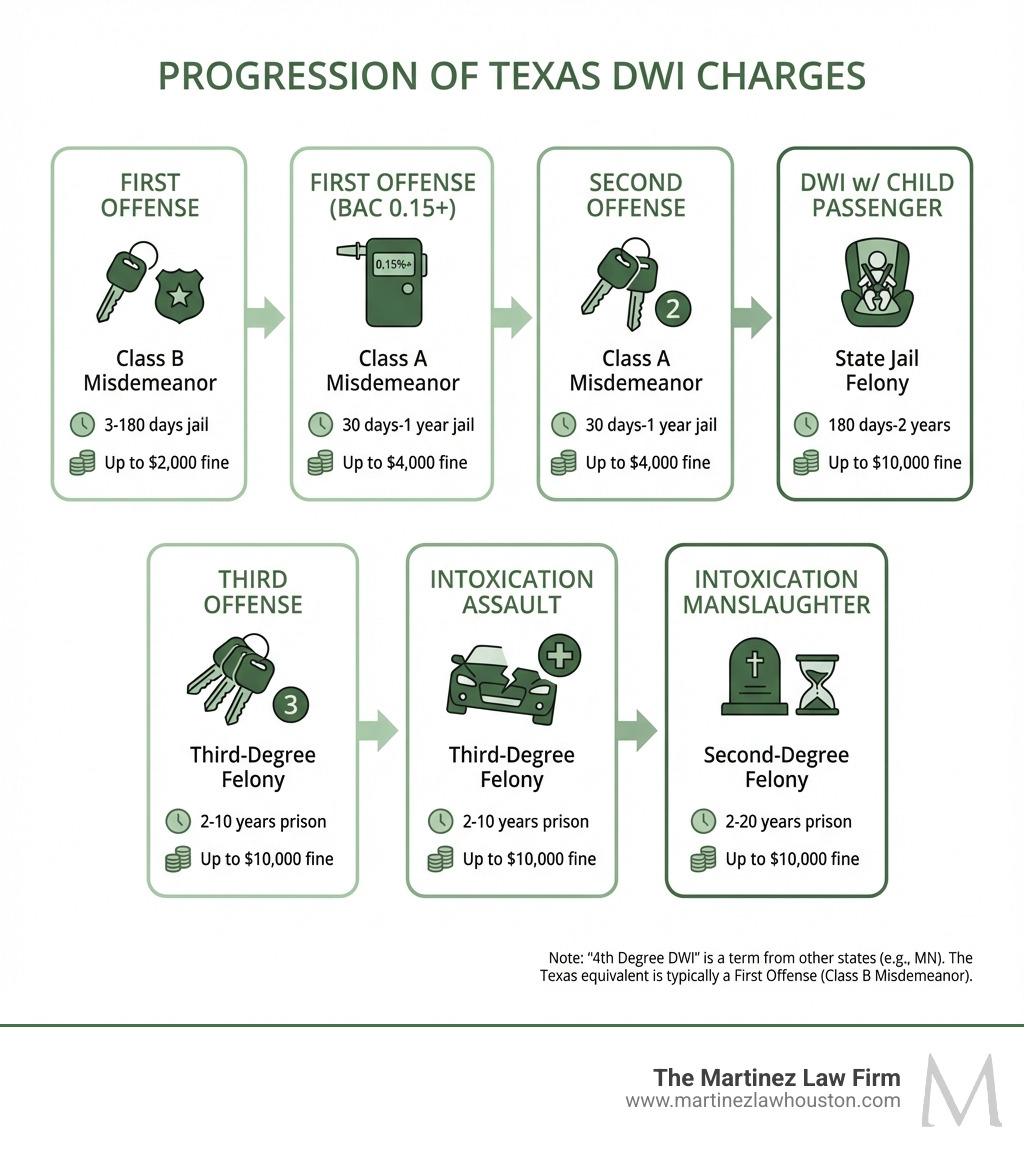
The Texas legal system is designed to impose increasingly severe penalties for repeat DWI offenders or for those whose impaired driving involves aggravating circumstances. What starts as a basic first-offense DWI (the equivalent of a 4th degree DWI) can quickly escalate to a gross misdemeanor or even a felony, carrying much harsher consequences.
What Are Aggravating Factors in Texas?
Aggravating factors are specific circumstances that increase the severity of a DWI charge, elevating it beyond a simple Class B Misdemeanor. These factors demonstrate a higher level of recklessness or danger, leading to more significant penalties.
Here are the primary aggravating factors in Texas:
- High BAC (0.15% or more): If your blood alcohol concentration is 0.15% or higher at the time of the offense, your first DWI charge will automatically be liftd to a Class A Misdemeanor. This significantly increases potential jail time and fines.
- Open Container: If you were operating a motor vehicle with an open container of alcohol in your immediate possession (not in the trunk or a locked glove compartment), your DWI charge will carry a mandatory minimum jail term of 6 days, even for a first offense.
- Child Passenger Under 15: Driving while intoxicated with a child under 15 years old in the vehicle is a serious offense. This immediately lifts the charge to a State Jail Felony, even if it’s your first DWI.
- Intoxication Assault: If your impaired driving causes serious bodily injury to another person, you will be charged with Intoxication Assault. This is a Third-Degree Felony, carrying a potential prison sentence of 2 to 10 years and fines up to $10,000.
- Intoxication Manslaughter: The most severe DWI charge, Intoxication Manslaughter, occurs when your impaired driving causes the death of another person. This is a Second-Degree Felony, punishable by 2 to 20 years in prison and fines up to $10,000. These cases are particularly heartbreaking and prosecuted with extreme vigor in Harris County.
From First Offense to Felony: Repeat DWI Charges
Texas law takes a very dim view of repeat DWI offenses, with penalties escalating sharply with each subsequent conviction within a 10-year period.
- Second DWI Offense: If you are arrested for a second DWI, it will be classified as a Class A Misdemeanor. This carries a potential jail sentence of 30 days to 1 year and fines up to $4,000. Your license suspension period will also typically be longer, ranging from 180 days to 2 years.
- Third DWI Offense: A third DWI offense is a major jump in severity. It is classified as a Third-Degree Felony. The penalties include a prison sentence of 2 to 10 years and fines up to $10,000. Probation for a third DWI is highly unlikely, as the courts consider these individuals habitual offenders.
- Fourth and Subsequent DWI Offenses: While Texas law classifies a third DWI as a felony, any subsequent DWI (a fourth, fifth, etc.) will also be treated as a Third-Degree Felony, with potential prison sentences ranging from 2 to 20 years, depending on the specifics and the judge’s discretion. The chances of probation are virtually nonexistent at this level.
The progression from a misdemeanor to a felony DWI has profound implications, including the potential loss of civil rights like voting and possessing firearms.
DWI and Controlled Substances
DWI charges in Texas aren’t limited to alcohol. You can also be charged with DWI if you are impaired by drugs, including illegal substances, prescription medications, or even over-the-counter drugs if they affect your ability to drive safely. This falls under the “not having the normal use of mental or physical faculties” part of the intoxication definition.
Furthermore, driving with any amount of a Schedule I or II controlled substance or its metabolite in your system (except for marijuana or tetrahydrocannabinols, which have different rules) can also lead to a DWI charge, even if you don’t appear outwardly impaired. Proving impairment from drugs can be more complex than alcohol, often relying on Drug Recognition Expert (DRE) evaluations and toxicology reports. Our firm has extensive experience challenging these types of cases in Houston courts.
Building a Defense Against a Houston DWI Charge
Facing a DWI charge in Houston, whether it’s a first offense (our equivalent of a 4th degree DWI) or a more serious felony, can feel overwhelming. However, an arrest is not a conviction. With proactive defense strategies and an experienced legal team, we can challenge the charges and work towards the best possible outcome. Protecting your rights is our top priority.
The Role of an Experienced DWI Defense Attorney
When you’re up against the Harris County legal system, having a skilled DWI defense attorney by your side is invaluable. We leverage our extensive knowledge of Texas DWI laws and our experience in Houston courts to build a robust defense.
Here’s how we help:
- Challenging the Traffic Stop Legality: We carefully review the details of your stop to ensure law enforcement had a legitimate reason (probable cause) to pull you over. If the stop was unlawful, any evidence gathered afterward might be inadmissible in court.
- Scrutinizing Field Sobriety Test Administration: Field Sobriety Tests (FSTs) are often subjective and prone to error. We examine whether these tests were administered correctly, if environmental factors played a role, and if your physical condition might have impacted your performance. We understand how to challenge the reliability of these tests.
- Disputing Breath and Blood Test Results: Breathalyzers and blood tests are not infallible. We investigate the calibration and maintenance records of breath test machines, the chain of custody for blood samples, and the qualifications of the technicians involved. We look for any procedural errors or scientific inconsistencies that could invalidate the results.
- Negotiating with Prosecutors: As a former Chief Prosecutor for the Harris County District Attorney’s Office, Herman Martinez has a unique advantage. He understands how prosecutors build their cases and, more importantly, how to dismantle them. We engage in aggressive negotiations to seek reduced charges, alternative sentencing, or even dismissal when the evidence supports it.
Can a Texas DWI Charge Be Reduced or Dismissed?
Yes, it is possible for a Texas DWI charge, including a first offense, to be reduced or even dismissed. While every case is unique, our strategic defense approach aims for the most favorable outcome.
- Plea Bargains: If a dismissal isn’t possible, we work to negotiate plea bargains that can reduce the severity of the charge (e.g., from DWI to obstruction of a highway or even reckless driving) or minimize the penalties.
- Pre-Trial Diversion Programs in Harris County: For certain first-time offenders, Harris County offers pre-trial diversion programs. These programs allow individuals to complete specific requirements (like counseling, community service, and IID installation) in exchange for the DWI charge being dismissed upon successful completion. This is a fantastic outcome, as it avoids a criminal conviction.
- Identifying Procedural Errors: We are experts at finding procedural errors made by law enforcement, from incorrect Miranda warnings to improper arrest procedures. Such errors can lead to evidence being suppressed or charges being dismissed.
- Insufficient Evidence: If the prosecution’s evidence is weak, inconsistent, or collected improperly, we will argue for dismissal of the charges.
Clearing Your Record: DWI Nondisclosure in Texas
A DWI conviction in Texas can have long-lasting consequences, impacting employment, housing, and even professional licensing. Fortunately, Texas law provides mechanisms to clear or seal your criminal record, known as expunction and orders of nondisclosure.
- Expunction vs. Order of Nondisclosure:
- Expunction: This process completely erases the arrest and related records from your criminal history, as if it never happened. It’s typically available if your DWI charge was dismissed, you were acquitted, or you received a pardon.
- Order of Nondisclosure: This seals your record from public view, meaning most private employers and the general public cannot access it. However, certain government agencies and licensing boards can still see it. Nondisclosure is usually available after successful completion of deferred adjudication probation for a DWI.
- Eligibility Requirements: Both options have strict eligibility criteria, including waiting periods after your case is closed and requirements to remain crime-free. For nondisclosure, you must have completed all terms of your probation, paid all fines, and waited a specific period (usually two years for a Class B misdemeanor DWI).
- Benefits of a Sealed Record: Clearing your record can significantly improve future employment opportunities, housing applications, and overall quality of life by removing the stigma of a criminal past.
We can assess your eligibility and guide you through the process of seeking an expunction or an order of nondisclosure in Harris County. For official guidance on clearing criminal records in Texas, you can refer to TexasLawHelp.org.
Frequently Asked Questions about First-Time DWI Charges in Texas
It’s natural to have many questions when facing a DWI charge in Houston. Here, we address some of the most common inquiries regarding first-time DWI offenses in Texas.
What is the mandatory minimum sentence for a first DWI in Texas?
For a first-offense DWI (a Class B Misdemeanor with no aggravating factors), Texas law requires a mandatory minimum of 72 hours in jail. If the offense involved an open container, this minimum increases to 6 days. While probation is often granted, this mandatory jail time can sometimes be served through alternative programs or credit for time served, depending on the judge and prosecutor’s discretion.
Can I refuse a breathalyzer test in Houston?
Yes, you can refuse a breathalyzer test in Houston or anywhere in Texas. However, Texas has an “implied consent” law. This means that by operating a vehicle on Texas roads, you are deemed to have consented to a chemical test (breath or blood) if arrested for DWI. If you refuse, your driver’s license will be automatically suspended by the Department of Public Safety (DPS) for a longer period – typically 180 days for a first refusal. While refusing a test avoids providing direct evidence of your BAC, it can still be used against you in court, and prosecutors may argue that your refusal indicates guilt. It’s a complex decision that’s best discussed with an attorney immediately after your arrest.
How long will a first-time DWI stay on my record in Texas?
A first-time DWI conviction in Texas will remain on your criminal record permanently unless specific legal action is taken to have it sealed or expunged. Unlike some other states, Texas does not automatically remove DWI convictions from your record after a certain period. If your case resulted in a dismissal or acquittal, you might be eligible for an expunction, which completely erases the record. If you successfully completed deferred adjudication probation, you might be eligible for an order of nondisclosure, which seals the record from public view. Without these actions, the DWI conviction will appear on background checks, potentially affecting employment, housing, and other opportunities for years to come.
Protecting Your Future After a DWI Arrest
While the term 4th degree DWI doesn’t apply in Texas, we understand that you’re likely searching for information about a first-time DWI offense in Houston. As we’ve seen, even a first-offense DWI, classified as a Class B Misdemeanor, is a serious criminal charge with a range of significant penalties—from jail time and hefty fines to license suspension and a lasting criminal record. The consequences only grow more severe with aggravating factors or repeat offenses, quickly escalating to felony charges.
The complexities of Texas DWI law, combined with the unique procedures of the Harris County court system, demand skilled legal counsel. At The Martinez Law Firm, we believe that an arrest should not define your future. Our team, led by Herman Martinez, brings a unique perspective to every case, leveraging decades of experience as both a prosecutor and a defense attorney. This dual insight allows us to anticipate the prosecution’s strategies, identify weaknesses in their case, and build the strongest possible defense for you.
If you or a loved one is facing a DWI charge in Houston, don’t steer this challenging legal landscape alone. We are here to protect your rights, challenge the evidence, and fight for the best possible outcome.
Contact our Houston DWI defense team today for a confidential consultation. We’re ready to put our aggressive, personalized defense strategy to work for you.