

Can a DWI Be Expunged? How to Get Rid of a DWI
Understanding Your Options for Clearing a DWI in Texas

Can a DWI be expunged in Texas? The answer depends on your specific situation:
Quick Answer:
- DWI Conviction: Cannot be expunged, but may be sealed through an Order of Nondisclosure if it’s a first offense and you meet specific requirements
- DWI Arrest (no conviction): May be eligible for expungement if charges were dismissed, you were acquitted, or charges were never filed
- Location: Texas law differs significantly from other states—convictions stay on your record permanently unless sealed
Key Differences:
| Record Clearing Option | What It Does | When Available |
|---|---|---|
| Expungement | Completely destroys the record as if it never happened | DWI arrests only (no conviction) |
| Nondisclosure (Sealing) | Hides record from public view but remains accessible to law enforcement | First-time DWI convictions meeting specific criteria |
Why Your Texas DWI Record Matters More Than You Think
If you’ve been arrested or convicted of a DWI in Houston or anywhere in Texas, you’re likely worried about how this will affect your future. A DWI on your record can impact everything from job opportunities to housing applications, and in Texas, over a million drivers are arrested for driving under the influence every year. The good news is that Texas law does provide pathways to clear your record—but the process is complex and depends heavily on whether you were convicted or simply arrested.
The distinction between expungement and nondisclosure is critical. While many people use these terms interchangeably, they represent very different legal remedies under Texas law. Recent changes, including House Bill 3016 (often called the “Second Chance Law”), have expanded opportunities for first-time offenders to seal their records, though true expungement remains limited to non-conviction cases.
I’m Herman Martinez, founder of The Martinez Law Firm in Houston, and with over 25 years of experience—including serving as a Chief Prosecutor for the Harris County District Attorney’s Office—I’ve helped countless clients steer the question of can a DWI be expunged and understand their options for clearing their records. Whether you’re dealing with a recent arrest or a conviction from years ago, understanding the legal pathways available in Texas is the first step toward protecting your future.
Understanding DWI in Texas and Its Lasting Impact

A Driving While Intoxicated (DWI) charge can feel like a dark cloud hanging over your head. It’s not just a momentary inconvenience; it’s a serious criminal offense with far-reaching consequences that can ripple through every aspect of your life for years to come. In Texas, we take these charges very seriously, and understanding their definition and potential impact is crucial for anyone facing such an accusation.
What is a DWI in Texas?
In Texas, a DWI (Driving While Intoxicated) refers to operating a motor vehicle in a public place while intoxicated. Unlike some other states that might differentiate between DUI (Driving Under the Influence) and DWI, in Texas, these terms refer to the same charge. There is no legal distinction between them; we use DWI.
Intoxication, according to the Texas Penal Code, means:
- Not having the normal use of mental or physical faculties by reason of alcohol, a controlled substance, a drug, a dangerous drug, or a combination of two or more of those substances.
- Having an alcohol concentration of 0.08 or more. This is commonly known as your Blood Alcohol Content (BAC). While 0.08% is the general legal limit, you can still be considered “intoxicated” if your faculties are impaired, even if your BAC is below 0.08%.
How a DWI Conviction Affects Your Life
The immediate penalties for a DWI conviction in Texas—fines, jail time, license suspension, and mandatory education programs—are severe enough. However, the long-term consequences are often what truly haunt individuals, impacting their lives for years, even decades. A DWI conviction can significantly restrict your opportunities and make simple aspects of life much more challenging.
How a DWI conviction can affect your life long-term:
- Employment Background Checks: Many employers conduct criminal background checks, especially for jobs requiring driving, handling sensitive information, or working with vulnerable populations. A DWI conviction can make it incredibly difficult to secure employment, impacting your career trajectory and earning potential. You might find yourself unable to pursue certain professions or even pass basic screenings for entry-level positions.
- Professional Licensing Issues: If you hold or aspire to hold a professional license (e.g., nursing, teaching, law, real estate), a DWI conviction can jeopardize your license or prevent you from obtaining one. Licensing boards often view DWI offenses as indicators of poor judgment or character.
- Increased Insurance Rates: Insurers consider individuals with DWI convictions to be high-risk drivers. You’ll likely face significantly higher insurance premiums for years, and you may even be required to obtain an SR-22 certificate, further increasing costs.
- Housing Application Denial: Landlords often run background checks, and a criminal record, including a DWI, can lead to denials for rental housing, making it harder to find a place to live.
- Financial Aid Difficulties: Some federal and state financial aid programs may have restrictions for individuals with drug or alcohol-related convictions, potentially affecting your ability to pursue higher education.
- Social Stigma: Beyond the legal and financial ramifications, a DWI can carry a social stigma, affecting your personal relationships and reputation within the community.
These consequences underscore why it’s so vital to understand your options and aggressively fight a DWI charge from the outset.
How Long Does a DWI Stay on Your Record in Texas?
This is a question we hear frequently, and the answer is often surprising and disheartening for many. In Texas, if you are found guilty and convicted of a DWI, it will remain on your criminal record for your entire lifetime. Unlike some other states that might have a “washout period” after which a conviction is automatically removed or becomes less visible, Texas does not have such a provision for DWI convictions.
This means that a DWI conviction will appear on most criminal background checks indefinitely.
It’s important to distinguish between your criminal record and your driving record. While a DWI conviction stays permanently on your criminal record, its impact on your driving record, maintained by the Texas Department of Public Safety (DPS), can also be long-lasting:
- Driving Record Impact: A DWI conviction will result in points being added to your driving record and can lead to surcharges from the DPS for a period of several years, in addition to fines imposed by the court.
- Criminal vs. Driving Records: Expunging or sealing a criminal record (which we’ll discuss next) does not automatically remove the incident from your driving record. These are separate records maintained by different agencies, and each has its own rules for removal or concealment.
The permanent nature of a DWI conviction on your criminal record in Texas is precisely why exploring every available legal avenue to mitigate its impact is so critical.
Can a DWI Be Expunged in Texas? The Reality of Expunction vs. Nondisclosure

Given the lasting impact of a DWI, the question of can a DWI be expunged is paramount for many of our clients in Houston and Harris County. The simple truth in Texas is that a DWI conviction generally cannot be expunged. However, there are crucial distinctions and pathways available for clearing your record, depending on the outcome of your case. These pathways involve either “expunction” or “nondisclosure.”
Recent legislative changes, notably House Bill 3016 (often referred to as the “Second Chance Law”), have significantly impacted how first-time DWI convictions can be managed, offering an alternative to traditional expungement. This law, further amended by HB 3582, created a path for sealing certain first-time DWI convictions, which was a major development in Texas law.
The Difference Between Expungement and Sealing a Record
To steer your options, it’s crucial to understand the precise legal definitions of expungement and sealing (nondisclosure) in Texas:
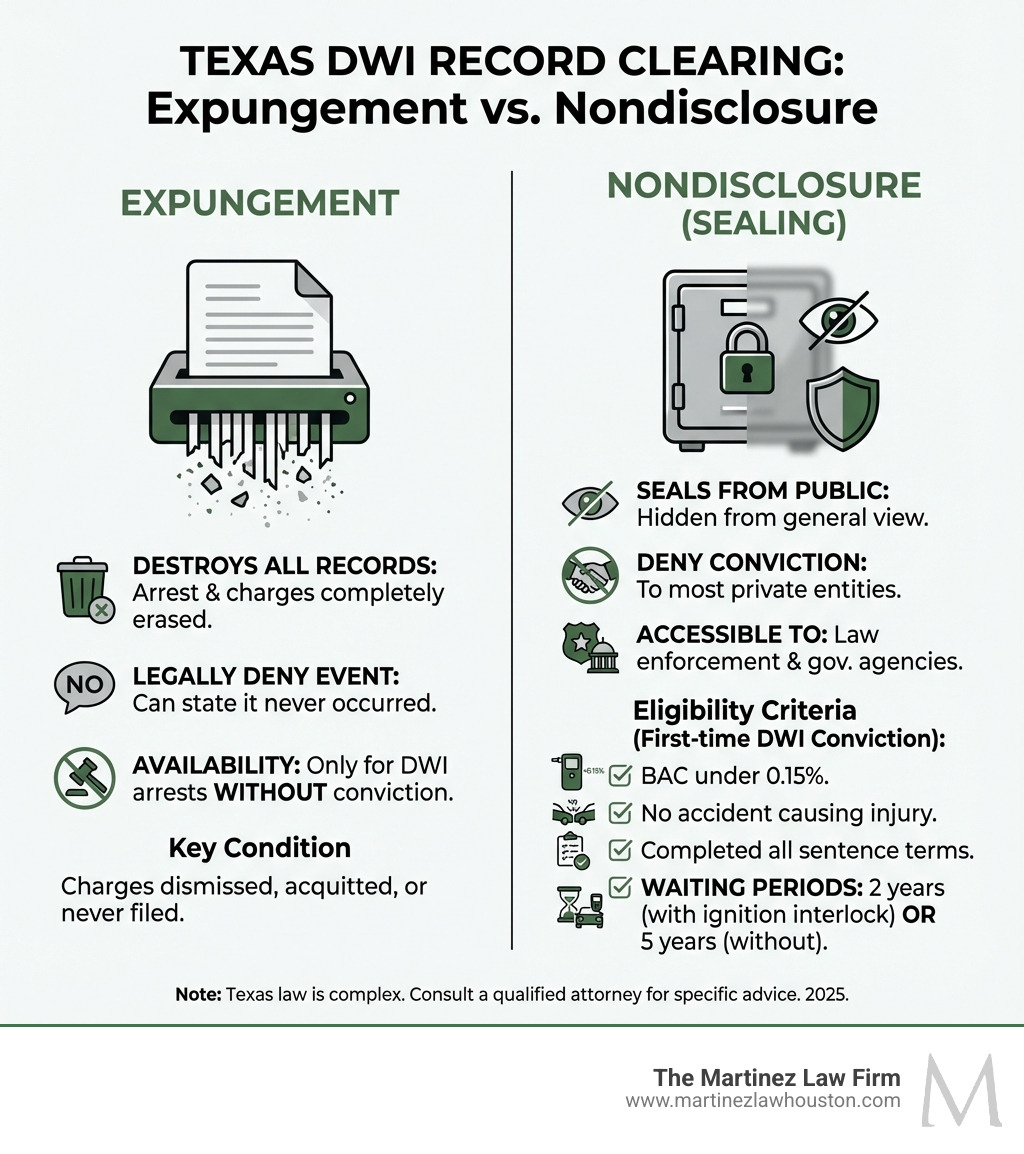
- Expungement (Expunction): This is the most complete form of record clearing. When a record is expunged, all official records of your arrest, charges, and detention related to a specific incident are legally destroyed. It’s as if the event never happened. Once your record is expunged, you can legally deny under oath that the arrest or charge ever occurred, and it will not appear on background checks.
- Nondisclosure (Sealing): This is a different remedy. An Order of Nondisclosure seals your criminal record from public view. While it hides the record from most private entities like employers, landlords, and the general public, it does not destroy the record. Law enforcement agencies, state licensing boards, and certain government agencies can still access sealed records. You can legally deny the existence of the conviction in most private inquiries, but you may still have to disclose it for specific governmental or licensing purposes. For Texas, this means the record is concealed from the public, but not erased entirely.
The Process for Expunction: When a DWI Arrest Can Be Expunged
Because a DWI conviction cannot be expunged in Texas, expunction is typically reserved for DWI arrests that did not result in a final conviction. This means we can often pursue expungement if your case falls into one of these categories:
- Case Dismissed: If your DWI case was dismissed, either by the prosecutor or the judge, you may be eligible for expunction. Even a dismissal leaves an arrest record, which can still appear on background checks unless expunged.
- Acquittal (Found Not Guilty): If you fought your DWI charges and were found “not guilty” by a jury or judge, you are eligible to have the arrest and charges expunged.
- Charges Never Filed: Sometimes, after an arrest, the prosecutor may decide not to file formal charges. Even in this scenario, an arrest record exists and can be expunged.
- Class C Misdemeanor Deferred Disposition: For certain minor offenses (like public intoxication) that are sometimes reduced from a DWI, if you successfully complete a deferred disposition, you may be eligible for expunction.
- Arrested as a Minor: If your first and only DWI offense occurred when you were a minor (under 18) and you fulfilled all court orders, you may be eligible to expunge the arrest and conviction.
The key takeaway here is that expunction is generally available when the legal system has determined that there was insufficient evidence, a procedural error, or you were not ultimately responsible for the alleged offense.
Nondisclosure Requirements: The Alternative When a DWI Conviction Cannot Be Expunged
For first-time DWI convictions, an Order of Nondisclosure is the primary pathway to clearing your record from public view. This option became available thanks to House Bill 3016 (HB 3016) in 2017, and it applies retroactively, meaning convictions prior to 2017 may also be eligible.
How to Qualify
To qualify for nondisclosure of a first-time DWI conviction in Houston or Harris County, you must meet specific criteria:
- First-Time DWI Conviction: This remedy is only available for your first DWI offense. If you have prior convictions or deferred adjudication for other offenses (excluding certain minor traffic violations), you may be ineligible.
- Misdemeanor Offense: The DWI must have been a misdemeanor offense. Felony DWIs are not eligible for nondisclosure.
- BAC Below 0.15%: Your Blood Alcohol Content (BAC) at the time of the offense must have been less than 0.15%. If your BAC was 0.15% or higher, you are typically not eligible.
- No Accident Involved: The incident cannot have involved an accident with another person where injuries occurred.
- Completion of Sentence: You must have successfully completed all terms of your sentence, including any probation, fines, community service, and required alcohol education programs.
- Waiting Periods: Once you’ve completed your sentence, a mandatory waiting period must pass before you can petition for nondisclosure.
- Two-Year Waiting Period: If an ignition interlock device (IID) was required as part of your sentence and you used it for at least six months, you may be eligible to petition after two years from the completion of your sentence.
- Five-Year Waiting Period: If an IID was not required as part of your sentence, you must wait five years from the completion of your sentence.
These requirements are strict, but for eligible individuals, an Order of Nondisclosure can provide significant relief, allowing them to move forward with their lives without the constant burden of a publicly visible DWI conviction.
Steps to Clear Your DWI Record in Houston
Clearing your DWI record in Houston, whether through expunction or nondisclosure, is a detailed legal process that requires careful attention to detail and adherence to specific court procedures. It’s not a do-it-yourself project; navigating the complexities of the Texas legal system often necessitates the guidance of an experienced attorney.
Petitioning for Expunction in Texas
If your DWI case qualifies for expunction (meaning it was an arrest without a conviction, such as a dismissal or acquittal), the process generally involves these steps:
- Filing a Petition for Expunction: We will file a formal Petition for Expunction with the appropriate District Court in Harris County. This petition legally requests that your arrest and related records be destroyed.
- Necessary Documentation: The petition must include specific details about your arrest, the charges, and the outcome of your case. We will gather all required documents, including court orders, dismissal papers, and any other evidence to support your eligibility.
- Notice to Agencies: All agencies involved in your arrest and prosecution (e.g., the arresting police department, the District Attorney’s office, the Harris County Sheriff’s Office, DPS) must be notified of your petition. They have an opportunity to object to the expunction.
- Court Hearing Process: A hearing will be scheduled before a judge. During this hearing, we will present arguments for why your record should be expunged, demonstrating that you meet all statutory requirements.
- What Happens if the State Objects: If an agency objects to your expunction petition, we will need to address their concerns in court. Common reasons for objection might include issues with eligibility or incomplete information. This is where our legal expertise becomes invaluable, as we can counter these objections and advocate fiercely on your behalf.
- Legal Representation: While filing fees for expunction can range from $200 to $400, the true cost lies in the legal expertise required to successfully steer this process. Attempting to handle this on your own is extremely challenging, as you will be up against seasoned legal professionals who are well-versed in these procedures and may object to your petition.
Petitioning for Nondisclosure in Texas
If you have a first-time DWI conviction that meets the eligibility criteria for nondisclosure, the process will follow a similar, yet distinct, path:
- Filing a Petition for Nondisclosure: We will file a Petition for Nondisclosure with the appropriate court in Harris County. This petition formally asks the court to seal your conviction record from public view.
- Waiting Period Calculation: Accurately calculating the mandatory waiting period (two or five years from the completion of your sentence) is crucial. Filing too early will result in denial.
- Community Supervision Completion: We will ensure that you have fully completed all aspects of your community supervision (probation), including payment of all fines, restitution, and completion of any required programs.
- Ignition Interlock Device (IID) Requirement: If an IID was part of your sentence, demonstrating its proper use for the required period is essential for the two-year waiting period eligibility.
- Court Fees: Similar to expunction, there will be court fees associated with filing a Petition for Nondisclosure, typically ranging from $200 to $400.
- Hearing and Order: The court will review your petition, and a hearing may be held. If the judge finds that you meet all statutory requirements, an Order of Nondisclosure will be issued.
How DWI Expungement Laws Vary by State
Texas’s laws regarding DWI expungement and nondisclosure are specific to our state. The legal landscape for clearing DWI records varies dramatically across the United States. What’s possible in one state might be impossible in another, highlighting why local legal counsel is so vital.
For example, while Texas does not allow expungement of DWI convictions, some states are more lenient:
- Missouri: Missouri is one of the exceptions where a DWI can be expunged. If a person meets statutory requirements for a first offense, the court must grant the expungement. However, Missouri only allows expungement for a first offense DWI conviction, and a person can only have one expungement under the statute throughout their lifetime.
- Arizona: In Arizona, courts can “set aside” and eventually discharge a DUI, which is a form of record relief.
- Mississippi: Like Texas, Mississippi generally does not allow DUI convictions to be removed from your record, although other offenses may be expungable.
- Other States: Some states, like Arkansas, may allow records for a first-time misdemeanor DUI to be sealed after probation is completed. California allows expungement once all sentence requirements are met.
Our comprehensive resource, DUI Expungement Laws by State, provides a state-by-state breakdown, but this merely underscores the complexity. These differences emphasize that general advice found online may not apply to your specific situation in Houston, Texas.
Frequently Asked Questions about Clearing a DWI Record
Navigating the aftermath of a DWI in Houston can bring up many questions about your record and future. We’ve compiled answers to some of the most common inquiries our clients have regarding expungement and nondisclosure.
What happens to my record after a DWI is sealed?
When your DWI record is sealed through an Order of Nondisclosure in Texas, it means it is removed from public view. This has several key implications:
- Removed from Public View: The record will generally not appear on standard background checks conducted by private employers, landlords, or educational institutions. This means you can often avoid the stigma and discrimination associated with a visible criminal record.
- Not Visible on Most Background Checks: For most private inquiries, you can legally deny that the conviction occurred. This is a significant relief for job applications, housing, and other private sector opportunities.
- Law Enforcement Access: Sealed records are still accessible to law enforcement agencies and certain government entities.
- Can Be Used for Future Sentencing Improvement: If you were to face future legal proceedings, a sealed DWI conviction could still be used by the prosecution to improve sentencing or for other legal purposes. It’s not completely erased from the legal system’s memory.
Can a sealed DWI be used to deny past convictions?
Yes, for most purposes, you can legally deny the existence of a sealed DWI conviction. This is one of the primary benefits of an Order of Nondisclosure.
- Legally Deny on Applications: You can legally state on job applications, rental agreements, and other private sector forms that you have not been convicted of the DWI offense.
- Cannot Commit Perjury: Because the record is sealed, you are not committing perjury by denying its existence to most private entities. The law specifically grants you this right.
- Exceptions for Government/Licensing Agencies: However, there are exceptions. You may still be required to disclose the sealed conviction to certain governmental agencies, state licensing boards, or for specific types of employment (e.g., law enforcement, childcare, positions requiring a security clearance).
- Restoration of Status: While not as complete as expungement, nondisclosure aims to restore your status in the eyes of the public, allowing you to move forward without the constant burden of your past mistake being visible.
Is there a limit to how many DWIs can be sealed in Texas?
Yes, there is a significant limit: nondisclosure is typically a one-time opportunity and is limited to a first-time DWI conviction in Texas.
- One-Time Opportunity: The “Second Chance Law” (HB 3016) was designed to provide relief for individuals who made a single mistake.
- Nondisclosure Limited to First Offense: If you have a prior DWI conviction or have received deferred adjudication for another offense, you generally will not be eligible to seal a subsequent DWI.
- Subsequent DWIs are Ineligible: This means that if you are convicted of a second DWI after having your first one sealed, the second offense (and likely the first, if the sealing is revoked) will remain permanently on your public record.
- Importance of a Clean Record: This underscores the critical importance of maintaining a clean record after receiving any form of record relief. The opportunity for nondisclosure is a valuable one, but it comes with the expectation of future responsible conduct.
Get Help from an Experienced Houston DWI Attorney
Understanding whether can a DWI be expunged or sealed in Texas is far from straightforward. The nuanced distinctions between expunction for arrests and nondisclosure for convictions, coupled with strict eligibility requirements and complex legal procedures, make it a daunting task to tackle alone.
At The Martinez Law Firm in Houston, we understand the immense pressure and uncertainty you face when dealing with a DWI charge or conviction. Our team, led by Herman Martinez, leverages over 25 years of experience, including invaluable insights gained as a former Chief Prosecutor for the Harris County District Attorney’s Office. This unique background allows us to anticipate prosecutorial strategies and build aggressive, personalized defenses for our clients.
Whether you’re exploring options for expunging an old arrest, seeking nondisclosure for a first-time conviction, or fighting a current DWI charge in Harris County, we are here to guide you. We’ll carefully review your case, explain your legal options in clear, simple language, and champion your right to a fresh start.
Don’t let a DWI define your future. Take the proactive step to protect your record and your opportunities. Contact a Houston DWI Lawyer at The Martinez Law Firm today for a confidential consultation. Let us put our experience to work for you.
About the author
