
Understanding the Legal Stakes: What DUI and DWI Charges Mean in Texas

DUI and DWI charges represent serious criminal offenses in Texas, but they are not the same thing. Here’s what you need to know:
Key Differences:
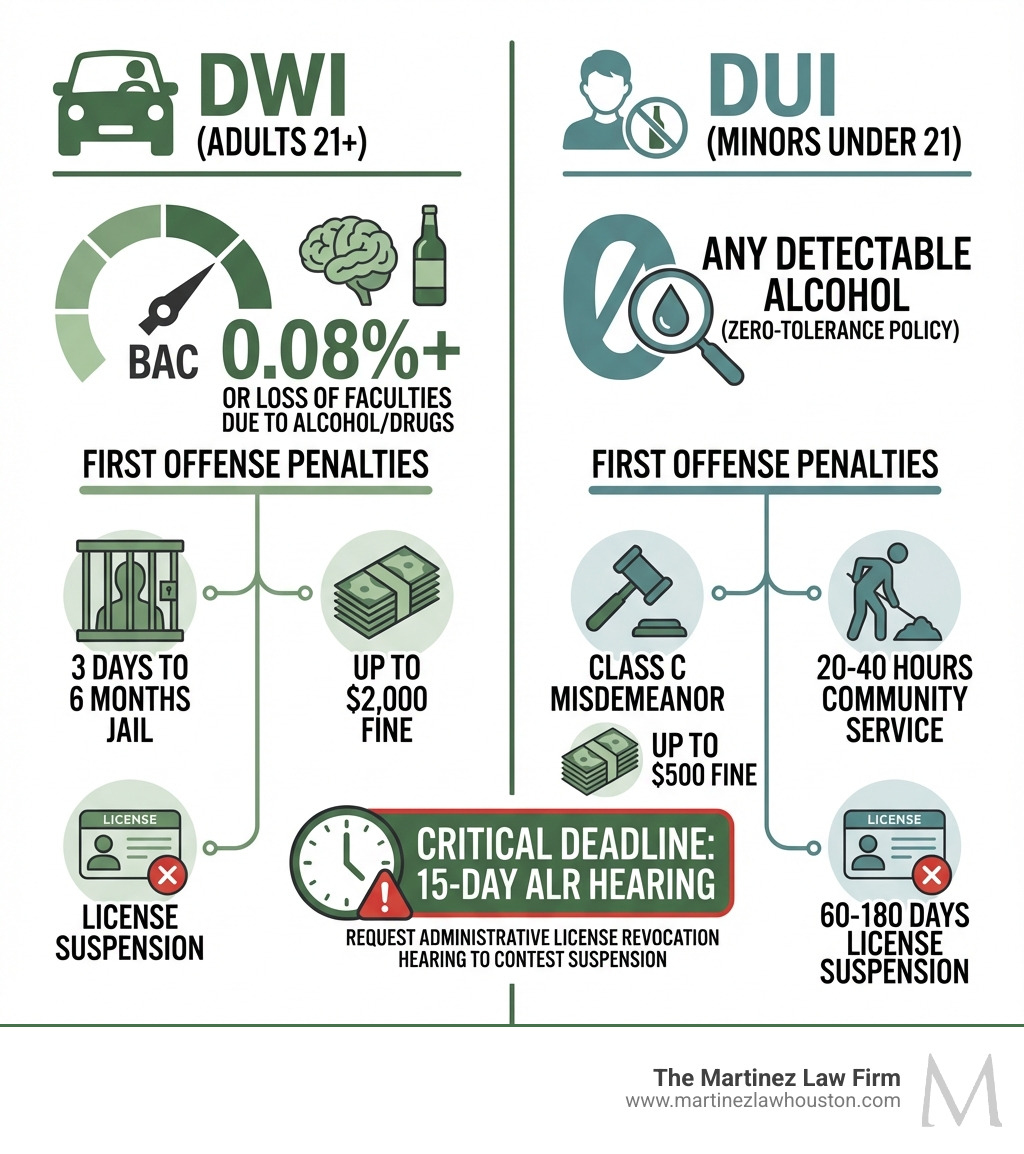
- DWI (Driving While Intoxicated): Applies to adults 21+ with a BAC of 0.08% or higher, or when alcohol/drugs impair normal mental or physical faculties
- DUI (Driving Under the Influence): Applies exclusively to minors under 21 with any detectable amount of alcohol in their system (zero-tolerance policy)
- Penalties: Range from Class B misdemeanors (first offense) to third-degree felonies (third offense or causing injury), with fines up to $10,000 and prison sentences up to 10 years
- License Suspension: From 90 days to lifetime, depending on offense severity
- Hidden Costs: Criminal record, increased insurance rates, employment challenges, and professional license risks
If you’ve been arrested for an intoxication offense in Houston or Harris County, you’re facing penalties that could fundamentally alter your life. According to Texas law, simply having a BAC of 0.08% or higher—or losing your normal faculties due to alcohol or drugs—constitutes a criminal offense under Section 49.04 of the Texas Penal Code. For those under 21, Texas enforces a strict zero-tolerance policy: even a trace amount of alcohol can lead to criminal charges.
The consequences extend far beyond fines and jail time. A conviction creates a permanent criminal record that can impact employment opportunities, professional licensing, insurance rates, and even immigration status. In Harris County specifically, police reported thousands of impaired driving incidents annually, and prosecutors aggressively pursue these cases.
Understanding the Timeline
What makes these charges particularly complex is the tight timeline for action. You have only 15 days from your arrest to request an Administrative License Revocation (ALR) hearing to fight your license suspension—a deadline many people miss simply because they don’t know it exists. Additionally, the evidence used against you—breathalyzer readings, blood tests, field sobriety tests—can often be challenged if law enforcement failed to follow proper procedures.
I’m Herman Martinez, founder of The Martinez Law Firm, and I’ve spent over 25 years on both sides of DUI and DWI charges—first as a Chief Prosecutor for the Harris County District Attorney’s Office, and now as a defense attorney who uses that insider knowledge to protect my clients’ rights and futures. This comprehensive guide will walk you through everything you need to know about Texas intoxication laws, the penalties you’re facing, and the defense strategies that can make the difference between a conviction and a dismissal.
DWI vs. DUI: Decoding Texas Intoxication Laws
In Texas, the terms DWI and DUI are often used interchangeably in casual conversation, but legally, they refer to distinct charges. Understanding this difference is crucial if you or a loved one are facing DUI and DWI charges in Houston or Harris County. We need to look to the Texas Penal Code for precise definitions.
Driving While Intoxicated (DWI): The Charge for Adults
When we talk about Driving While Intoxicated (DWI) in Texas, we’re primarily referring to the charge for individuals aged 21 and older. According to the Texas Penal Code Section 49.04, you are considered “intoxicated” if:
- You do not have the normal use of mental or physical faculties by reason of the introduction of alcohol, a controlled substance, a drug, a dangerous drug, a combination of two or more of those substances, or any other substance into the body; OR
- You have an alcohol concentration of 0.08 or more.
This means that even if your blood alcohol concentration (BAC) is below 0.08%, you can still be charged with DWI if law enforcement believes your mental or physical faculties are impaired to any degree. This definition applies to impairment caused by alcohol, illegal drugs, prescription medications, or any combination thereof. It’s a broad definition, allowing prosecutors to pursue charges even without a definitive BAC reading, relying instead on observations of your driving, performance on field sobriety tests, and other indicators.
For more details on the precise legal definition, you can refer to the legal definition of DWI in Texas.
Driving Under the Influence (DUI): The Charge for Minors
In Texas, the term Driving Under the Influence (DUI) is specifically reserved for minors—drivers under the age of 21. This distinction is critical because Texas operates under a “zero-tolerance” policy for underage drinking and driving.
Under the Texas Alcoholic Beverage Code Section 106.041, if a minor operates a motor vehicle with any detectable amount of alcohol in their system, they can be charged with DUI. This is often referred to as DUIA (Driving Under the Influence of Alcohol) to emphasize the distinction. Unlike adults, minors do not need to reach a 0.08% BAC or show signs of impairment to be charged; even a trace amount of alcohol is enough. This strict policy aims to deter underage drinking and driving, recognizing the increased risks associated with young, inexperienced drivers consuming alcohol.
How Texas Laws Compare Nationally and Internationally
Texas’s age-based distinction between DWI and DUI is a significant characteristic that sets it apart from many other states in the U.S. In some states, DUI and DWI are used interchangeably, or one might be a lesser charge than the other, without the specific age differentiation we see in Texas. For instance, the Legal Information Institute at Cornell Law explains that while DUI commonly means driving under the influence and DWI means driving while intoxicated, some states use them synonymously, while others differentiate, with DUI sometimes being the lesser charge.
However, in Texas, it’s clear: DWI is for adults, DUI is for minors.
Beyond the age distinction, Texas, like all other states, has specific BAC limits. The federal standard for impairment is 0.08% BAC, which Texas adheres to for adult drivers. For commercial drivers, the legal limit is even stricter, at 0.04% BAC, reflecting the higher standard of safety required for professional operation.
If we look internationally, for example, to Canada, the terminology differs entirely. There, the legal term is “impaired driving,” which covers both alcohol and drug impairment, without using “DUI” or “DWI” as legal terms. While Canadians might colloquially use “DUI,” it holds no legal weight in their system. This highlights how distinct legal frameworks can be across jurisdictions. However, our focus remains firmly on Texas, where the specific definitions of DWI and DUI are paramount for anyone facing DUI and DWI charges in Houston.
You can gain a broader perspective on international laws by looking at an overview of impaired driving laws in Canada, but these are distinct from Texas statutes.
The Severe Penalties for DUI and DWI Charges in Harris County
Facing DUI and DWI charges in Houston means confronting a legal system designed to impose significant penalties. These aren’t just minor traffic infractions; they are criminal offenses that can lead to life-altering consequences. Here in Harris County, prosecutors are known for their rigorous approach to these cases, and the penalties escalate sharply based on prior offenses and aggravating factors.

Misdemeanor DWI Penalties: First and Second Offenses
For most adults, a first or second DWI charge will be classified as a misdemeanor, but don’t let the term “misdemeanor” fool you—the penalties are still severe.
- First DWI Offense (Class B Misdemeanor):
- Jail Time: Minimum of 3 days (72 hours) up to 6 months (180 days). If an open container was found in your vehicle, the minimum jail time increases to 6 days.
- Fines: Up to $2,000.
- License Suspension: 90 days to 1 year.
- Annual Surcharge: $1,000 to $2,000 for three years to retain your license.
- Other Requirements: Potential probation, community service, and mandatory alcohol education programs.
- Second DWI Offense (Class A Misdemeanor):
- Jail Time: Minimum of 1 month (30 days) up to 1 year.
- Fines: Up to $4,000.
- License Suspension: Up to 2 years.
- Annual Surcharge: $1,000 to $2,000 for three years.
- Other Requirements: Mandatory alcohol education programs, and potentially an Ignition Interlock Device (IID).
It’s also important to note that if your BAC was 0.15% or higher on your first DWI offense, the charge can be liftd to a Class A Misdemeanor, carrying penalties similar to a second DWI, even if it’s your first time being charged.
In Harris County, eligible first-time offenders with a BAC of 0.15% or below might have the opportunity to participate in the DIVERT program. This pre-trial diversion program, if successfully completed, can lead to the dismissal of your DWI charge, offering a pathway to avoid a permanent criminal record. However, not everyone qualifies, and judges may prefer probation over “time served” pleas, as they view probation as a more active form of rehabilitation.
Felony DWI Penalties: Third Offense and Aggravating Factors
The penalties become significantly more severe if you’re facing a third DWI charge or if aggravating factors are present. These escalate to felony level, carrying prison sentences and much higher fines.
- Third DWI Offense (Third-Degree Felony):
- Prison Time: 2 to 10 years in state prison.
- Fines: Up to $10,000.
- License Suspension: 180 days to 2 years.
- DWI with a Child Passenger (Under 15 years old):
- This is a State Jail Felony, regardless of whether it’s your first offense.
- Jail Time: 6 months to 2 years in a state jail facility.
- Fines: Up to $10,000.
- License Suspension: Minimum 6 months.
- Intoxication Assault:
- If you cause serious bodily injury to another person while driving while intoxicated, it’s a Third-Degree Felony.
- Prison Time: 2 to 10 years in state prison.
- Fines: Up to $10,000.
- Intoxication Manslaughter:
- If your intoxicated driving results in the death of another person, it’s a Second-Degree Felony.
- Prison Time: 2 to 20 years in state prison.
- Fines: Up to $10,000.
These felony DUI and DWI charges represent the most serious outcomes and underscore the critical need for an aggressive and experienced legal defense.
Beyond Fines and Jail: The Hidden Costs of a Conviction
While fines and jail time are immediate concerns, a conviction for DUI and DWI charges in Texas carries a host of “hidden costs” that can impact your life for years, if not permanently.
- Criminal Record: A DWI conviction is a permanent mark on your criminal record. This can show up on background checks for employment, housing, and even volunteer opportunities.
- SR-22 Insurance Requirements: After a DWI conviction, you will likely be required to obtain SR-22 insurance, which is proof of financial responsibility. This type of insurance is significantly more expensive and must be maintained for a minimum of three years, often longer.
- Employment Background Checks: Many employers conduct background checks, and a DWI conviction can severely limit job prospects, especially in fields requiring driving, professional licenses, or positions of trust.
- Professional License Risks: Doctors, nurses, lawyers, real estate agents, commercial drivers, and other licensed professionals can face suspension or revocation of their licenses, jeopardizing their careers.
- Immigration Consequences: For non-U.S. citizens, a DWI conviction can have severe immigration consequences, including denial of visas, green cards, or even deportation.
These long-term consequences highlight why fighting DUI and DWI charges is so important. We understand the full scope of what’s at stake and are committed to helping you steer these complex challenges.
Building a Strong Defense Against Your DWI Charge
When facing DUI and DWI charges in Houston, many people feel overwhelmed and believe a conviction is inevitable. However, that’s simply not true. Every case has unique circumstances, and with an experienced legal team, we can build a strong defense. Our approach involves carefully examining every detail of your arrest and the evidence against you.
The First 15 Days: Fighting Your License Suspension
One of the most immediate and often overlooked aspects of a DWI arrest is the potential for an administrative license suspension. In Texas, under the implied consent law, by simply holding a driver’s license, you’ve implicitly agreed to chemical testing (breath, blood, or urine) if suspected of DWI. Refusing these tests or failing them (e.g., a BAC of 0.08% or higher) can trigger an automatic license suspension.
Critically, you have only 15 days from the date of your arrest to request an Administrative License Revocation (ALR) hearing. If you miss this deadline, your license will be automatically suspended, regardless of the outcome of your criminal case. During this hearing, we can challenge the grounds for your arrest and the validity of the officer’s actions, potentially preventing or shortening your license suspension. If your license is suspended, obtaining an occupational license can be a complex process that we can help you steer.
Refusal to provide a breath or blood sample has its own set of consequences. While you have the right to refuse, doing so typically results in a longer automatic license suspension (180 days for a first refusal), and in most states, you’d be barred from obtaining a conditional, restricted, or hardship license during that refusal suspension period. This is why immediate legal advice is paramount.
Common Defenses for DUI and DWI Charges
We explore every possible avenue for defense, challenging the prosecution’s case on multiple fronts. Some common defenses we employ include:
- Illegal Traffic Stop: Police must have “reasonable suspicion” to pull you over. If the stop was unlawful, any evidence gathered afterward might be inadmissible in court. We scrutinize the initial reason for the stop.
- No Probable Cause for Arrest: Even if the stop was legal, officers must have “probable cause” to arrest you for DWI. This usually comes from observations of your driving, your demeanor, and your performance on Field Sobriety Tests (FSTs).
- Improperly Administered Field Sobriety Tests: FSTs are subjective and often administered incorrectly. Factors like weather conditions, physical limitations, or even footwear can affect performance. We can challenge the officer’s training, the test conditions, and your performance.
- Inaccurate Breathalyzer Results: Breathalyzers are not infallible. We can challenge their accuracy based on:
- Faulty Equipment or Calibration: Breathalyzers require regular maintenance and calibration.
- Operator Error: Officers must follow strict protocols for administering the test.
- Environmental Factors: Substances in the mouth (like mouthwash), medical conditions (like GERD or acid reflux), or even certain foods can lead to false high readings.
- Lack of Observation Period: Officers must observe you for 15 minutes prior to the test to ensure no foreign substances enter your mouth.
- Blood Test Errors: While often considered more reliable, blood tests can also be challenged. Issues can arise with:
- Chain of Custody: Ensuring the blood sample was properly handled and accounted for from collection to analysis.
- Contamination or Improper Storage: Compromising the integrity of the sample.
- Lab Errors: Mistakes in the analysis process.
- Challenging the Definition of Intoxication: We can argue that even if your BAC was at or above 0.08%, your normal mental and physical faculties were not impaired, or that observations of impairment were due to other factors (e.g., fatigue, medical condition, allergies).
Our experience tells us that many people arrested for DWI are not guilty, and a thorough examination of the evidence can reveal weaknesses in the prosecution’s case.
Why a Former Prosecutor Offers a Unique Advantage
When it comes to defending against DUI and DWI charges, having an attorney who has worked as a prosecutor offers an unparalleled advantage. My 25+ years as a Chief Prosecutor for the Harris County District Attorney’s Office means we approach your case with an insider’s perspective.
We know how the prosecution thinks. We understand their strategies, their priorities, and the common pitfalls in their cases. This unique insight allows us to:
- Identify Weaknesses: We can spot procedural errors, evidentiary issues, and inconsistencies in police reports that might be overlooked by others. We’ve trained police officers and understand their protocols, allowing us to effectively challenge their testimony and methods.
- Anticipate Moves: We can predict the prosecution’s next steps and prepare counter-arguments, putting you in a stronger position during negotiations and trial.
- Negotiate Effectively: Our established relationships and understanding of the system allow for more effective negotiations, often leading to reduced charges or alternative resolutions like the Harris County DIVERT program.
- Trial Experience: Having handled countless cases from both sides, we are formidable in the courtroom, skilled at cross-examination and presenting a compelling defense.
This insider knowledge is a powerful tool in protecting your rights and securing the best possible outcome for your DUI and DWI charges in Houston.
Frequently Asked Questions about Houston DWI Cases
Navigating DUI and DWI charges can bring up a lot of questions. Here, we address some of the most common inquiries we receive from individuals in Houston and Harris County.
Can a DWI be dismissed in Texas?
Yes, a DWI charge in Texas can absolutely be dismissed. While it’s a challenging process, dismissals are achievable through various legal strategies. We might pursue:
- Pre-Trial Motions: These motions can seek to suppress evidence (like breathalyzer results or FSTs) that was illegally obtained or is unreliable. If key evidence is suppressed, the prosecution may have no choice but to dismiss the case.
- Challenging Probable Cause: If we can demonstrate that the police lacked reasonable suspicion for the traffic stop or probable cause for the arrest, the case could be dismissed.
- Plea Bargains to Lesser Charges: In some instances, we can negotiate with the prosecutor for a plea to a lesser offense, such as Obstruction of a Highway or Reckless Driving, which carries less severe penalties and may not result in a DWI conviction on your record.
- Successful Completion of Programs: For eligible first-time offenders in Harris County, the DIVERT program offers a path to dismissal upon successful completion of its requirements. This pre-trial diversion program can be an excellent option for avoiding a conviction.
- Acquittal at Trial: If we proceed to trial and the prosecution cannot prove guilt beyond a reasonable doubt, the judge or jury can issue an acquittal, leading to a dismissal.
Many people arrested for DWI are not guilty, and an experienced DWI lawyer can often find avenues for dismissal where others might not.
What are the first steps when facing DUI and DWI Charges in Houston?
The moments immediately following a DWI arrest are critical. Your actions (or inactions) can significantly impact your case. Here’s what we advise:
- Remain Silent: You have the right to remain silent. Beyond providing your identification, vehicle registration, and insurance, do not answer questions about where you’ve been, what you’ve had to drink, or how much you’ve slept. Do not admit guilt or offer explanations.
- Do Not Resist: While you can refuse certain tests (like FSTs or breath tests at the scene), do not physically resist arrest.
- Contact a Lawyer Immediately: This is perhaps the most crucial step. As soon as you are able, contact an experienced Houston DWI lawyer. We can advise you on your rights, guide you through the process, and begin building your defense.
- Request Your ALR Hearing Within 15 Days: As discussed, this deadline is non-negotiable. Instruct your lawyer to immediately request an Administrative License Revocation (ALR) hearing to challenge your license suspension.
- Write Down Every Detail: As soon as you can, document everything you remember about the stop and arrest: the time, location, officer’s name, their demeanor, what they said, what you said, the conditions (weather, road), your physical state, and any tests performed. This information can be invaluable for your defense.
Do I need an ignition interlock device after a DWI?
An Ignition Interlock Device (IID) is a breath alcohol analyzer that prevents a vehicle from starting if it detects alcohol on the driver’s breath. Whether you’ll need one depends on the specifics of your DUI and DWI charges and conviction:
- Mandatory for Repeat Offenses: In Texas, an IID is typically mandatory for repeat DWI offenders. If you are convicted of a second or subsequent DWI, you will likely be required to install an IID as a condition of your probation or to regain your driving privileges.
- Condition of Bond or Probation: Even for a first offense, a judge may order an IID as a condition of your bond, allowing you to drive while your case is pending, or as a condition of your probation after a conviction.
- High BAC Cases: If your BAC was 0.15% or higher, an IID may be required even for a first offense.
The IID requires you to blow into it before starting your vehicle and often at random intervals while driving. It’s a significant inconvenience and an added expense, further highlighting the severe consequences of a DWI conviction. We can advise you on whether an IID is likely in your specific situation and help you understand the requirements.
Secure Your Future with an Experienced DWI Attorney
Facing DUI and DWI charges in Houston or Harris County is undoubtedly one of the most stressful experiences a person can endure. The potential for heavy fines, jail time, license suspension, and a permanent criminal record can feel overwhelming. However, it is crucial to remember that a charge is not a conviction, and you have legal rights that must be protected.
Acting quickly and decisively is critical. The legal process for DWI cases is complex, with strict deadlines and intricate rules of evidence. Attempting to steer this system alone can lead to missed opportunities for defense and harsher penalties.
At The Martinez Law Firm, we understand the immense pressure you’re under. We leverage attorney Herman Martinez’s 25+ years of experience as a former Chief Prosecutor for the Harris County District Attorney’s Office to provide an aggressive, personalized defense. Our insider knowledge of how the prosecution builds its cases, combined with our proven track record in DWI, drug, and violent crime cases, gives our clients a distinct advantage. We carefully examine every detail, challenge every piece of evidence, and fight tirelessly to achieve the best possible outcome for your future.
Don’t let DUI and DWI charges define your life. Your future and your freedom are too important. Contact a Houston DWI Lawyer for a Free Consultation today, and let us put our experience to work for you.