
More Than Just a Standard DWI in Texas

Aggravated DWI is a far more serious charge than a standard driving while intoxicated offense in Texas, carrying severe penalties like felony convictions, prison time, and substantial fines. While a typical first-offense DWI (BAC of 0.08%+) is a Class B misdemeanor, certain aggravating factors can lift the charge to a Class A misdemeanor or even a felony.
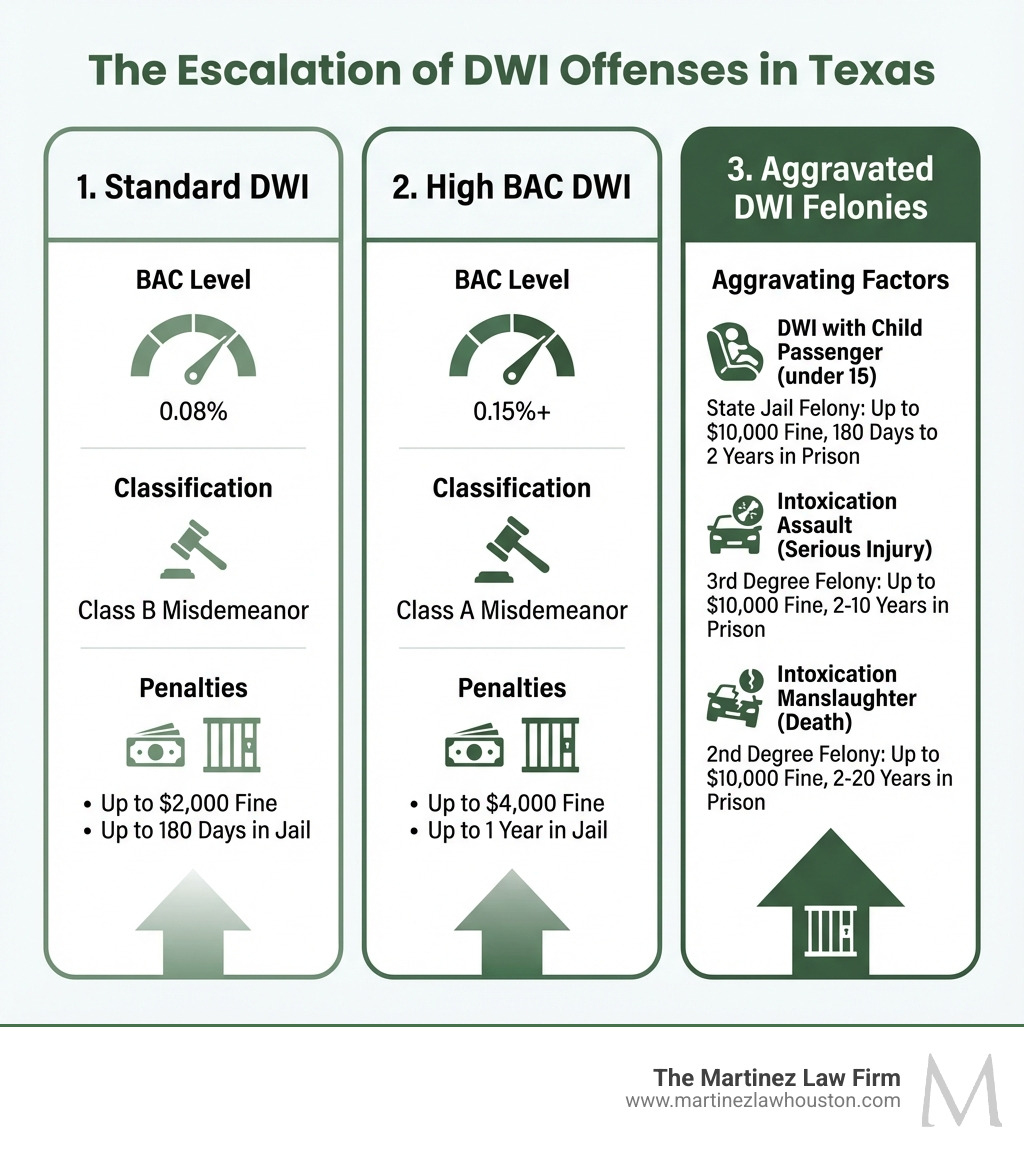
Key Differences Between Standard DWI and Aggravated DWI in Texas:
- Standard DWI: BAC of 0.08% or higher, Class B misdemeanor, up to $2,000 fine, up to 180 days in jail
- High BAC (0.15%+): Class A misdemeanor, up to $4,000 fine, up to 1 year in jail
- DWI with Child Passenger (under 15): State jail felony, up to $10,000 fine, 180 days to 2 years in prison
- Intoxication Assault: Third-degree felony, up to $10,000 fine, 2-10 years in prison
- Intoxication Manslaughter: Second-degree felony, up to $10,000 fine, 2-20 years in prison
In Houston and Harris County, prosecutors aggressively pursue these cases. The stakes are incredibly high—an aggravated DWI conviction means more than jail and fines; it can result in a permanent felony record affecting your job, professional licenses, housing, and immigration status.
I’m Herman Martinez, founder of The Martinez Law Firm in Houston, and I’ve spent over 25 years on both sides of the courtroom—as a former Chief Prosecutor for the Harris County District Attorney’s Office and as a defense attorney fighting aggravated DWI charges. My experience as a former prosecutor gives me unique insight into how the state builds its case against you, and how to dismantle it piece by piece.
Easy aggravated DWI glossary:
What Makes a DWI “Aggravated” in Texas?
In Texas, a standard DWI becomes an aggravated DWI when specific factors, defined in Chapter 49 of the Texas Penal Code, escalate its severity. These factors can transform a misdemeanor into a felony with much harsher consequences. For Houston and Harris County residents, understanding this is critical, as local prosecutors aggressively pursue these improved charges. A felony conviction can be life-altering, impacting your freedom and future.

High Blood Alcohol Content (BAC)
A common aggravating factor is a high Blood Alcohol Content (BAC). While the legal limit is 0.08%, a BAC of 0.15% or higher automatically improves a first-time DWI from a Class B to a Class A misdemeanor. This carries substantially increased penalties, including:
- Improved Fines: Up to $4,000, double the maximum for a standard DWI.
- Mandatory Jail Time: A conviction often leads to a mandatory minimum of 30 days in jail, with a maximum of one year.
- Ignition Interlock Device (IID): You will likely be required to install an IID on your vehicle at your own expense.
Prosecutors in Harris County are particularly aggressive in pursuing high BAC cases, arguing it shows a greater disregard for public safety.
DWI with a Child Passenger
One of the most serious aggravating factors is driving while intoxicated with a child passenger younger than 15. This automatically lifts the charge to a State Jail Felony, even for a first offense with no accident. The penalties for this type of aggravated DWI are severe:
- State Jail Felony: Incarceration in a state jail for 180 days to two years.
- Significant Fines: Fines can reach up to $10,000.
- Child Protective Services (CPS) Involvement: A conviction almost always triggers a CPS investigation, which can lead to the removal of children from your custody.
DWI Causing Injury or Death
The most severe forms of aggravated DWI are distinct felony offenses that occur when intoxication leads to serious bodily injury or death.
- Intoxication Assault: This Third-Degree Felony is charged when an intoxicated driver causes “serious bodily injury” to another person. It carries 2 to 10 years in prison and fines up to $10,000.
- Intoxication Manslaughter: This Second-Degree Felony is charged when an intoxicated driver causes the death of another person. It is punishable by 2 to 20 years in prison and fines up to $10,000.
The Steep Consequences of an Aggravated DWI Conviction
The consequences of an aggravated DWI conviction in Texas are designed to be severe, fundamentally altering your life. The legal system in Houston and Harris County imposes significant punishments for these improved offenses.
| Offense Type | Charge Level | Jail/Prison Time | Fines | License Suspension |
|---|---|---|---|---|
| Standard DWI | Class B Misdemeanor | 72 hours – 180 days | Up to $2,000 | 90 days – 1 year |
| High BAC (0.15%+) | Class A Misdemeanor | 30 days – 1 year | Up to $4,000 | 180 days – 2 years |
| DWI w/ Child Passenger | State Jail Felony | 180 days – 2 years (state jail) | Up to $10,000 | Up to 180 days |
| Intoxication Assault | Third-Degree Felony | 2 – 10 years (state prison) | Up to $10,000 | 180 days – 2 years |
| Intoxication Manslaughter | Second-Degree Felony | 2 – 20 years (state prison) | Up to $10,000 | 180 days – 2 years |
Criminal Penalties in Houston
- Jail vs. Prison Time: Misdemeanor aggravated DWI (e.g., high BAC) can lead to a year in county jail. Felony charges (e.g., with a child passenger, Intoxication Assault/Manslaughter) result in state prison time, ranging from 180 days to 20 years.
- Fines up to $10,000: Felony charges consistently carry fines up to $10,000.
- Mandatory Minimums: Texas law includes mandatory minimum sentences for many aggravated DWI offenses, limiting a judge’s discretion.
- Repeat Offender Improvements: Prior DWI convictions will lead to even more severe penalties for a new aggravated charge. A third DWI is automatically a Third-Degree Felony.
- Felony Conviction Consequences: A permanent felony conviction can strip you of fundamental rights, including the right to vote, hold public office, or own a firearm.
Beyond Legal Penalties: The Lasting Impact of an Aggravated DWI
The consequences extend far beyond the courtroom:
- License Suspension: You face mandatory license suspension periods from 90 days to two years. You only have 15 days from your arrest to request an Administrative License Revocation (ALR) hearing to fight an automatic suspension.
- Insurance Rate Hikes: Your auto insurance premiums will skyrocket, and you may be required to obtain more expensive SR-22 insurance.
- Employment Background Checks: A felony conviction can severely limit your job opportunities, especially in professions that require driving or involve children.
- Professional License Jeopardy: An aggravated DWI conviction can put professional licenses (e.g., for doctors, nurses, lawyers) at risk of suspension or revocation.
- Immigration Consequences: For non-citizens, a felony conviction can lead to severe immigration consequences, including deportation.
The Impact of Refusing a Chemical Test
Texas’s “implied consent” law means that by driving, you consent to a breath or blood test if lawfully arrested for DWI.
- Automatic License Suspension: Refusing a test results in an automatic license suspension of 180 days for a first refusal.
- Use of Refusal as Evidence: The prosecution can use your refusal against you in court as evidence of guilt.
- No Refusal Weekends in Houston: Harris County often implements “No Refusal” weekends, where officers get warrants to compel blood draws from drivers who refuse a breath test.
Building a Defense Against an Aggravated DWI Charge
Facing an aggravated DWI charge in Houston is overwhelming, but an arrest is not a conviction. A strong, immediate defense is crucial. Our firm’s unique perspective as former prosecutors gives us an edge in challenging the state’s case against you.

Key Defense Strategies for an Aggravated DWI Charge
Our defense involves a meticulous examination of every detail of your case.
- Challenging the Traffic Stop: Was the stop legal? Police need “reasonable suspicion” to pull you over. If not, evidence gathered afterward could be inadmissible.
- Questioning Field Sobriety Test Administration: Field Sobriety Tests (FSTs) are subjective and often administered incorrectly. We scrutinize the test administration, instructions, and the officer’s interpretation for bias and errors.
- Attacking Breathalyzer Maintenance and Results: Breathalyzers require proper maintenance, calibration, and operation. We investigate machine logs and officer certification to find errors that could invalidate the results.
- Disputing Blood Test Procedures and Contamination: Blood tests are also prone to error. We examine the chain of custody and lab procedures to challenge the sample’s integrity and the accuracy of the analysis.
The Role of an Experienced DWI Lawyer
An experienced lawyer is essential when facing an aggravated DWI in Harris County.
- Navigating the Harris County Court System: Our familiarity with local judges, prosecutors, and procedures allows us to steer the system efficiently on your behalf.
- Negotiating with Prosecutors: As former prosecutors, we understand how the other side thinks, which allows for more effective negotiations to reduce charges or minimize penalties.
- Identifying Procedural Errors: We review all reports and footage to find police errors or constitutional violations that could lead to evidence suppression or case dismissal.
- Preparing for Trial: If a trial is your best option, our extensive trial experience as both prosecutors and defense attorneys means we are prepared to aggressively fight for you before a jury.
- Protecting Your Rights: Our primary role is to be your unwavering advocate, protecting your rights at every stage of the legal process.
How Texas DWI Laws Compare to Other States
While our focus at The Martinez Law Firm is exclusively on Texas law, it can be helpful to briefly understand how other states approach aggravated DWI to appreciate the nuances of our own system.
New York’s Approach
New York defines an aggravated DWI with a BAC of 0.18% or higher. Its “Leandra’s Law” makes a DWI with a child passenger under 16 a felony, similar to Texas law.
Missouri’s Offender Status System
Missouri uses an offender status system based on prior convictions. “Prior,” “persistent,” and “aggravated” offender classifications lead to escalating penalties. We can see this detailed in Missouri’s DWI statute.
New Hampshire’s Unique Factors
New Hampshire considers unique factors like speeding over 30 mph while intoxicated as an aggravating circumstance. A BAC of .16% or higher also triggers an aggravated DWI charge. You can learn more about New Hampshire “Aggravated” DWI law.
While these examples show some similarities, they also highlight how each state tailors its DWI laws. In Texas, our laws are particularly stringent, especially concerning factors like high BAC, child endangerment, and causing harm.
Frequently Asked Questions about Aggravated DWI in Houston
We understand that facing an aggravated DWI charge can bring a flood of questions. Here, we address some of the most common inquiries we receive from clients in Houston and Harris County.
Can an Aggravated DWI be reduced to a regular DWI in Texas?
Yes, reducing an aggravated DWI to a regular DWI is possible, though challenging. The strategy involves attacking the “aggravating factor” itself—for example, by disputing a high BAC result or other key evidence. Harris County prosecutors are reluctant to reduce these charges, but a skilled defense attorney can negotiate by identifying procedural errors or weaknesses in the state’s case. Our experience as former prosecutors provides unique insight into these negotiations, aiming for a charge reduction or a more favorable plea.
Is an Aggravated DWI always a felony in Texas?
No, but it often is. The classification depends on the aggravating factor.
- Class A Misdemeanor: A first-offense DWI with a high Blood Alcohol Content (BAC) of 0.15% or higher is improved to a Class A misdemeanor.
- Felony: The charge becomes a felony if it involves a child passenger under 15 (State Jail Felony), causes serious bodily injury (Intoxication Assault), or results in death (Intoxication Manslaughter). A third DWI offense is also automatically a felony.
While not always a felony, an aggravated DWI always carries harsher penalties than a standard DWI.
How long does an Aggravated DWI stay on your record in Houston?
An aggravated DWI conviction stays on your Texas criminal record permanently and will appear on background checks. There are limited options to seal the record:
- Expungement: This is generally only available if your case was dismissed, you were acquitted, or you received a pardon. It is not an option for convictions.
- Order of Nondisclosure: You may be eligible to seal the record for certain first-offense misdemeanor aggravated DWI convictions after meeting strict requirements, such as completing probation. This makes the record unavailable to the general public, but not to law enforcement. Felony DWI convictions are generally not eligible.
Given the permanent nature of a conviction, an aggressive defense from the start is the best strategy to protect your record.
Protecting Your Future After an Arrest
An aggravated DWI charge in Houston is a serious accusation with life-altering consequences, including prison time, steep fines, and a permanent criminal record. A felony conviction can strip you of fundamental rights and close doors to future opportunities.
Navigating the complexities of Texas DWI law and aggressive Harris County prosecution on your own is a significant risk. You need a strategic defense custom to your case.
At The Martinez Law Firm, we understand the stakes. Our team, led by Herman Martinez, brings over 25 years of experience, including invaluable insights gained from his time as a former Chief Prosecutor for the Harris County District Attorney’s Office. This dual perspective allows us to anticipate the prosecution’s strategies, expose weaknesses in their evidence, and build a robust defense designed to protect your rights and your future.
Don’t let an aggravated DWI charge define your life. The time to act is now.
Contact an experienced Houston DWI lawyer today for a confidential consultation. Let us put our experience to work for you.