
When a Tragedy Becomes a Criminal Charge: What You Need to Know

Negligent homicide vs manslaughter are two of the most commonly confused criminal charges — and the difference between them could mean years, sometimes decades, of your life.
Here’s the short version:
| Negligent Homicide | Manslaughter | |
|---|---|---|
| Mental state | Failed to perceive a risk | Consciously ignored a known risk |
| Legal term | Criminal negligence | Recklessness |
| Texas classification | State jail felony | Second-degree felony |
| Texas sentence | 180 days – 2 years | 2 – 20 years |
| Example | Left a loaded gun where a child found it | Drove 90 mph through a school zone |
Both charges involve an unintentional death. Neither requires proof that you meant to kill anyone. But the law treats them very differently — because the question isn’t just what happened, it’s what you were thinking when it happened.
That single distinction — whether you were aware of the risk and ignored it, or simply failed to notice a risk a reasonable person would have caught — is what separates a state jail felony from a second-degree felony in Texas.
In Harris County and courtrooms across Houston, prosecutors make this call every day. And the charge they land on shapes everything: the sentence, the bond amount, even whether probation is on the table.
Key Takeaways
- The key difference is mental state. Manslaughter involves recklessness (you knew the risk and ignored it), while negligent homicide involves criminal negligence (you failed to recognize a risk you should have seen).
- Penalties differ significantly in Texas. Manslaughter is a second-degree felony (2–20 years), while negligent homicide is a state jail felony (180 days–2 years).
- Both charges involve unintentional death. The law does not require intent to kill, but it closely examines your awareness and behavior leading up to the incident.
- Real-world situations determine the charge. Actions like extreme speeding or unsafe gun handling often lead to manslaughter, while failure to notice obvious dangers may lead to negligent homicide.
- Charges can be challenged or reduced. A strong defense may argue lack of recklessness, break the chain of causation, or reduce manslaughter to negligent homicide, which can significantly lower penalties.
I’m Herman Martinez, founder of The Martinez Law Firm and a former Chief Prosecutor for the Harris County District Attorney’s Office and City of Houston Judge — experience that gives me an understanding of exactly how these negligent homicide vs manslaughter distinctions play out on both sides of the courtroom. If you or someone you love is facing either of these charges, understanding the legal landscape is the critical first step.
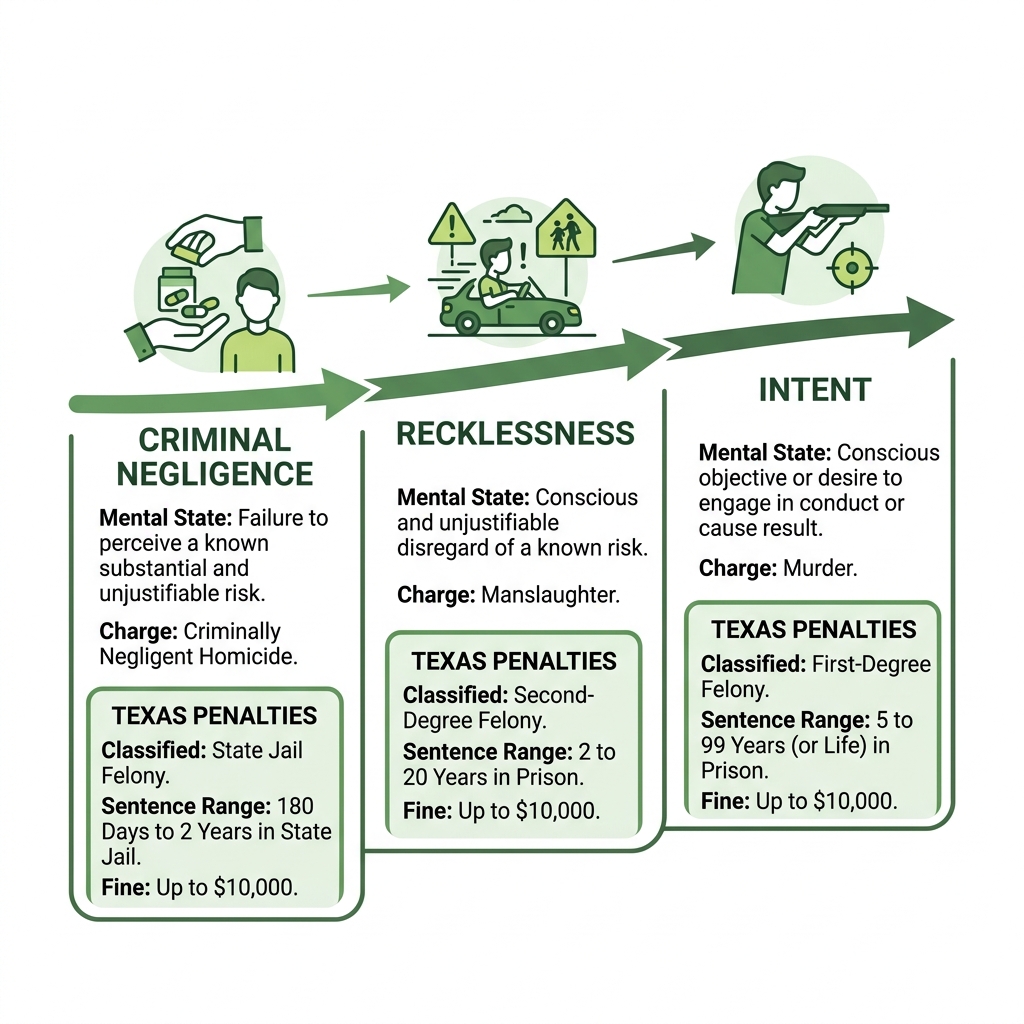
The Core Difference: Negligent Homicide vs Manslaughter
When we walk into a Houston courtroom to defend a client, the battle often isn’t about whether a death occurred. That part is tragically clear. The real fight is over the “mens rea”—a fancy Latin term lawyers use for your “guilty mind” or mental state at the time of the incident.
In Texas, the law doesn’t just look at the result; it looks at your level of awareness. Under Texas Penal Code Chapter 19, criminal homicide is broken down into four categories: capital murder, murder, manslaughter, and criminally negligent homicide.
The primary legal distinction between negligent homicide vs manslaughter is the difference between recklessness and criminal negligence.

Think of it like a ladder of culpability. At the bottom, you have a “gross deviation” from the standard of care that any reasonable person in Houston would follow. This is where we find negligent homicide. You didn’t see the danger, but the law says you should have. One rung up is manslaughter, where you actually saw the danger, recognized it was a bad idea, and decided to do it anyway.
| Charge | Culpable Mental State | Texas Felony Level | Punishment Range |
|---|---|---|---|
| Manslaughter | Reckless | Second-Degree | 2 to 20 years in prison |
| Criminally Negligent Homicide | Criminal Negligence | State Jail Felony | 180 days to 2 years in state jail |
In the Harris County court system, the difference between these two rungs is massive. A second-degree felony carries a prison sentence up to 20 years, while a state jail felony tops out at two years.
Understanding Recklessness in Manslaughter
What does it actually mean to be “reckless”? According to Texas Penal Code § 19.04, a person commits manslaughter if they recklessly cause the death of another.
Recklessness is a conscious disregard of a substantial and unjustifiable risk. It’s that moment where a little voice in your head says, “This is dangerous,” and you keep going. You aren’t trying to kill anyone—if you were, you’d be facing murder charges—but you are being extremely irresponsible with human life.
Common scenarios we see in our criminal defense for manslaughter practice include:
- Extreme Speeding: We aren’t talking 10 mph over the limit on I-610. We mean weaving through heavy Houston traffic at 100 mph. You know someone could die; you just assume you’re a good enough driver to avoid it.
- Handling Firearms: Pointing a “cleared” gun at a friend and pulling the trigger. You know guns are dangerous, but you disregarded the risk that a round was still chambered.
- Heat of Passion: Sometimes, a sudden quarrel leads to a reckless act that results in death, though Texas law has specific nuances for how “sudden passion” can mitigate punishment.
The key is awareness. If the prosecutor can prove you knew there was a risk and you blew past it anyway, they’re going for manslaughter.
Defining Criminal Negligence in Negligent Homicide
Now, let’s look at the other side of the negligent homicide vs manslaughter coin. Criminally negligent homicide occurs when a person ought to be aware of a substantial and unjustifiable risk, but they fail to perceive it.
This is more than just a simple “accident” or “oops” moment. It’s not civil negligence (the kind you see in car insurance commercials). It is a “gross deviation” from the standard of care. ome states define this under statutes like ARS Section 13-1102, but in Texas, we look at criminally negligent homicide details through the lens of the “reasonable person.”
Would a reasonable person in Houston have seen the danger? If the answer is yes, and you didn’t, you could be facing a state jail felony.
The legal definition of negligence here involves unintentional harm. You didn’t think anyone would get hurt. You weren’t even considering the possibility. But because you should have been considering it, the state holds you criminally liable.
A classic example is a parent leaving a loaded, unsecured firearm on a nightstand where a curious toddler finds it. The parent didn’t “disregard” the risk in the moment—they likely weren’t thinking about it at all—but they should have perceived the danger of leaving a weapon accessible to a child.
Penalties and Classifications in Texas and Beyond
If you’re standing in a Texas courtroom, the label on your case file changes your entire future.
Texas Penalties
In Texas, manslaughter is a second-degree felony. That means if you’re convicted, you’re looking at 2 to 20 years in a state prison and a fine of up to $10,000. Because it’s a higher-level felony, the stakes for your “normal” life—jobs, housing, voting rights—are devastating.
Criminally negligent homicide is a state jail felony. This is the least serious homicide charge in Texas, but don’t let that fool you. You can still spend up to two years in a state jail facility.
One bit of “good” news for defendants in these cases is that both manslaughter and negligent homicide are generally eligible for probation (community supervision), unlike murder convictions where a jury cannot grant probation.
Looking Across State Lines
It’s interesting to see how other states handle these same tragedies. In Arizona, under Arizona Revised Statutes Section 13-1103, manslaughter is a Class 2 felony with a presumptive 5-year sentence. Their negligent homicide is a Class 4 felony, which is much lighter.
In New York, they use a “Class” system. Criminally negligent homicide is a Class E felony (up to 4 years), while second-degree manslaughter is a Class C felony (up to 15 years).
The Financial Toll: Bond Stats
We often get asked about bail immediately after an arrest. In nearby Tarrant County, data shows a massive spread in bond amounts. While a murder bond might sit at $100,000, manslaughter typically lands around $50,000. Interestingly, intoxication manslaughter—which involves a death caused by a DUI—often sees higher bonds, around $75,000, because the state views drunk driving as an ongoing threat to the community.
Real-World Scenarios: From Roadways to Work Sites
To truly understand negligent homicide vs manslaughter, you have to look at how these laws apply to real life in Houston.
The Dangers of the Road
Vehicular homicide in Texas is one of the most common ways these charges arise. If you are driving sober but being incredibly reckless—racing another car on Westheimer, for instance—and you kill someone, that’s manslaughter.
However, if you are intoxicated, Texas has a specific charge: intoxication manslaughter. This is a second-degree felony, just like regular manslaughter. The law assumes that by choosing to drink and drive, you have created a reckless risk to everyone on the road.
Case Study: Saunders v. State
The Saunders v. State case is a landmark for Texas lawyers. It helped clarify when a defendant is entitled to a “lesser included offense” jury instruction. In that case, the court looked at whether a defendant’s actions were merely negligent or truly reckless. These high-level court battles are exactly why having a former prosecutor on your side matters—we know how the state builds these cases and where the cracks are.
Workplace and Everyday Tragedies
- Construction Sites: If a foreman forgets to double-check a safety harness and a worker falls, that might be negligent homicide. If the foreman knows the harness is frayed, tells the worker to use it anyway, and the worker dies? That’s manslaughter.
- Medical Errors: Most medical mistakes are handled in civil court (malpractice). But if a doctor or nurse is under the influence or skips a standard check that they know is life-critical, it can cross into criminal territory.
- Firearm Mishaps: We see many cases involving “accidental” discharges. The difference usually comes down to whether the person was playing with the gun (reckless) or simply handled it improperly without realizing it was loaded (negligent).
Common Defenses and Reducing Charges
Just because you’ve been charged doesn’t mean the case is closed. Our job is to dig into the evidence and find the truth.
One of the most powerful tools in a defense attorney’s kit is challenging proximate cause. To convict you, the state has to prove that your specific action was the direct cause of the death. If there was an intervening factor—like a mechanical failure in a car or a medical professional’s error at the hospital—it can break the chain of legal responsibility.
When dealing with an intoxication manslaughter defense, we often challenge the validity of the blood or breath tests. If the police didn’t follow the rules, that evidence might get tossed out.
Other common strategies include:
- Lack of Awareness: Proving that you truly had no reason to perceive the risk. If the danger was hidden or unforeseeable, you shouldn’t be held criminally negligent.
- Constitutional Violations: Did the police search your car without a warrant? Did they fail to read you your rights? We look for any “procedural foul” that could lead to a dismissal.
- Factual Innocence: Sometimes, the police simply have the wrong person. Mistaken identity happens more often than people think in chaotic accident scenes.
- Reducing Felony Levels: If the state is overcharging you with manslaughter, we work to provide evidence that your actions were, at worst, negligent. Moving from a second-degree felony to a state jail felony can save you 18 years of your life.
Frequently Asked Questions about Homicide Charges
Can a manslaughter charge be reduced to negligent homicide?
Yes, absolutely. This is one of the most common outcomes in successful defense cases. It often happens through plea bargaining, where the prosecutor realizes their evidence for “recklessness” is weak. It can also happen at trial. If the judge allows a “lesser included offense” instruction, the jury can decide that while you weren’t reckless, you were negligent. This is where “mitigating evidence”—like your clean record or your character—becomes vital.
How do these crimes differ from murder in terms of intent?
The jump from manslaughter to murder is all about intent. Under Texas Penal Code § 19.02, murder requires that you “intentionally or knowingly” caused the death.
- Murder: You meant to kill them, or you knew with near-certainty your actions would kill them.
- Manslaughter: You didn’t mean to kill them, but you were being reckless.
- Negligent Homicide: You didn’t mean to kill them, and you didn’t even realize you were being dangerous (though you should have).
There is no “malice” or premeditation in manslaughter or negligent homicide. They are, in the eyes of the law, tragic accidents where someone is still legally to blame.
What are the typical bond amounts for these crimes in Texas?
While every judge is different, Harris County typically follows a bail schedule. For manslaughter, you might see a bond of $50,000. For intoxication manslaughter, that often jumps to $75,000. Murder bonds are rarely less than $100,000. These amounts are meant to ensure you show up to court, but they can be a massive financial burden. We often file motions for bond reduction to get our clients home while their case is pending.
What This Means for Your Defense
The line between negligent homicide vs manslaughter is thin, but the consequences of crossing it are life-altering. Whether you’re in downtown Houston or the outskirts of Harris County, the legal system is a maze of complex statutes and aggressive prosecutors.
At The Martinez Law Firm, we don’t just see a case number; we see a person whose future is on the line. I’ve spent years on the other side of the aisle as a prosecutor, and I know the tactics the state will use to try and secure a conviction. We use that inside knowledge to build an aggressive, personalized defense for every client.
If you are facing a homicide charge, don’t wait. The earlier we can get involved—reviewing the scene, talking to witnesses, and challenging the state’s narrative—the better your chances of a favorable outcome.
More info about criminal defense services is just a click away. Let us put our experience to work for you. Reach out to us today for a consultation, and let’s start fighting for your freedom.