
Understanding Texas DWI Law: What You Need to Know
Texas penal code driving while intoxicated is defined under Section 49.04 of the Texas Penal Code. If you’ve been arrested for DWI in Houston or anywhere in Texas, you’re likely facing serious legal consequences that can affect your freedom, your finances, and your future.
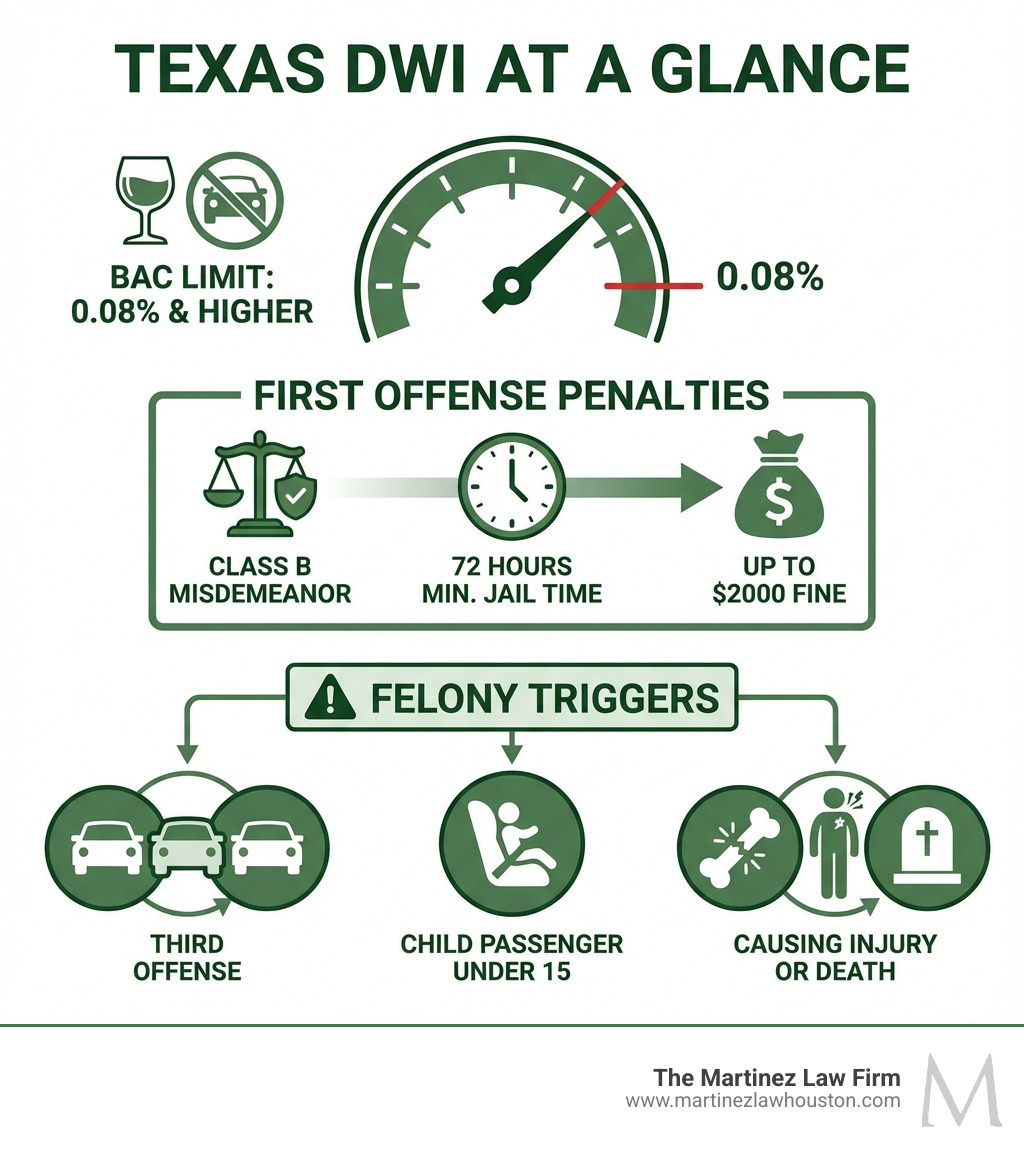
Quick Answer: Texas DWI Law Overview
- Legal Definition: Operating a motor vehicle in a public place while intoxicated
- Two Ways to Be “Intoxicated”:
- Loss of normal mental or physical faculties due to alcohol, drugs, or other substances
- Blood Alcohol Concentration (BAC) of 0.08% or higher
- First Offense: Class B Misdemeanor (72 hours to 180 days jail, up to $2,000 fine)
- BAC 0.15+: Class A Misdemeanor (up to 1 year jail, up to $4,000 fine)
- Third Offense: Third-Degree Felony (2-10 years prison, up to $10,000 fine)
- With Child Under 15: State Jail Felony (regardless of prior offenses)
You don’t have to feel “drunk” to be charged—any level of impairment counts under Texas law. The charges can apply on private property accessible to the public, and you can be arrested for operating vehicles beyond cars, including boats, golf carts, and ATVs.
What You’ll Learn About Texas DWI Law in 2026
This comprehensive guide breaks down everything you need to know about the Texas Penal Code’s DWI provisions. We’ll explain the legal definitions, walk through the penalties for first-time and repeat offenders, clarify confusing scenarios (like DWI on private property or in non-traditional vehicles), and outline the defense strategies that can make a difference in your case.
Whether you’re facing your first charge or dealing with a more complex situation in Harris County, understanding the law is your first step toward protecting your rights.
I’m Herman Martinez, founder of The Martinez Law Firm in Houston, and I’ve spent over 25 years working both sides of the courtroom—as a former Chief Prosecutor for the Harris County District Attorney’s Office and as a City of Houston Judge—before dedicating my practice to defending clients against charges under the Texas penal code driving while intoxicated. This unique perspective allows me to anticipate prosecution strategies and build aggressive defenses custom to the specific circumstances of each DWI case in the greater Houston area.
Defining Intoxication Under Texas Law
Before we dive into the specifics of charges and penalties, it’s crucial to understand how Texas law defines “intoxicated.” This isn’t just about feeling “drunk” – the legal definition is much broader and often catches people by surprise.
The Texas penal code driving while intoxicated laws are primarily found in Chapter 49 of the Texas Penal Code, which deals with Intoxication and Alcoholic Beverage Offenses. This chapter lays out the legal framework for what constitutes intoxication and the various offenses related to it.
2 Types of Intoxication
Under Texas law, there are two distinct ways a person can be considered “intoxicated”:
- Loss of Normal Faculties: This prong defines intoxication as “not having the normal use of mental or physical faculties by reason of the introduction of alcohol, a controlled substance, a drug, a dangerous drug, a combination of two or more of those substances, or any other substance into the body.” This means if alcohol, drugs (legal or illegal), or even a combination of substances impairs your ability to think, react, or move normally while operating a vehicle, you can be charged with DWI. This subjective standard allows law enforcement to make an arrest even if your blood alcohol concentration (BAC) is below the legal limit. It’s about how the substance affects you.
- Per Se Intoxication (BAC of 0.08% or More): The second prong establishes a clear, objective standard. You are legally intoxicated in Texas when your blood alcohol concentration (BAC) reaches 0.08 percent or more. This is often referred to as a “per se” law, meaning that if your BAC is at or above this level, you are legally intoxicated, regardless of whether you feel impaired or if an officer observes any loss of normal faculties. The law measures “alcohol concentration” as the number of grams of alcohol per 210 liters of breath, 100 milliliters of blood, or 67 milliliters of urine.
Impairment vs. “Drunk”: Don’t Be Fooled
A common misconception is that you have to be visibly “drunk” or feel completely out of control to be guilty of DWI. This is simply not true under Texas law. As our research shows, you are breaking the law as soon as drugs or alcohol affect your driving ability, even if your BAC is below 0.08 percent. You might feel fine, capable, and confident behind the wheel, but if your faculties are even slightly impaired, you could still be charged.
The law focuses on “impaired driving,” meaning any condition where your mental or physical faculties are affected. This condition can arise from drinking alcohol, using controlled substances, prescription drugs, or a combination of these. So, while you might not think you’re drunk, you could still be found guilty under the current definition of the law. Any level of impaired driving is illegal and dangerous.
The Core Offense: Texas Penal Code Driving While Intoxicated
The heart of Texas’s DWI law is found in Texas Penal Code – PENAL § 49.04. Driving While Intoxicated. This section clearly defines the offense and sets the baseline penalties.
A person commits an offense if they are intoxicated while operating a motor vehicle in a public place. Let’s break down those key elements:
- Intoxicated: As we just discussed, this means either a loss of normal faculties or a BAC of 0.08% or more.
- Operating a Motor Vehicle: This refers to having actual physical control over the vehicle. You don’t necessarily have to be driving down the road; sitting in the driver’s seat with the keys in the ignition could be enough.
- In a Public Place: This generally includes any street, highway, alley, or other place that is open to the public, such as public parking lots.
First Offense Penalties
For a first-time DWI offense without any aggravating factors, the charge is typically a Class B Misdemeanor. While this might sound less severe than a felony, the consequences are still significant:
- Fines: You could face a fine of up to $2,000. That this doesn’t include additional state fees and surcharges, which can add thousands more to the total cost.
- Jail Time: A first-offense DWI carries a minimum term of confinement of 72 hours, but can extend up to 180 days (six months) in jail upon conviction.
- Driver’s License Suspension: Your driver’s license could be suspended for up to a year. Reinstating your license often involves paying annual fees ranging from $1,000 to $2,000 for up to three years.
- Probation and Community Service: In many cases, a judge in Houston or Harris County might impose probation, which can include mandatory community service, DWI education courses, and regular check-ins.
These penalties are just the start. A DWI conviction in Harris County can also affect your auto insurance rates, employment opportunities, and even professional licenses.
Aggravating Factors: Open Container
Texas law takes a particularly dim view of having an open container of alcohol in your vehicle while driving intoxicated. This isn’t just about consuming alcohol while driving; it’s about having any open alcoholic beverage in the passenger area of a motor vehicle that is on a public highway.
If it’s shown during the trial that you had an open container of alcohol in your immediate possession at the time of the offense, the penalties for your Class B Misdemeanor DWI are automatically improved. Specifically, the minimum term of confinement increases from 72 hours to a mandatory six days in jail. This stricter minimum jail time reflects the legislature’s intent to discourage drivers from having readily accessible alcohol while operating a vehicle.
Aggravating Factors: High BAC
The level of alcohol concentration in your system can also significantly impact the severity of your DWI charge. If an analysis of your blood, breath, or urine shows an alcohol concentration level of 0.15 or more at the time the analysis was performed, your offense is liftd from a Class B Misdemeanor to a Class A Misdemeanor.
This higher classification comes with substantially increased penalties:
- Increased Fines: The potential fine doubles, going up to $4,000.
- Longer Jail Time: You could face up to one year in jail.
- Extended License Suspension: Your driver’s license suspension could be extended for as long as 18 months, which is six months longer than the maximum for a Class B misdemeanor.
- Ignition Interlock Device (IID): A judge may also require you to install an ignition interlock device (IID) on your vehicle, even for a first offense with a high BAC. This device prevents your car from starting if it detects alcohol on your breath.
These improved penalties highlight that the state of Texas is serious about deterring high-level intoxication while driving, and Houston courts reflect this stern approach.
Common DWI Scenarios and Questions

The complexities of Texas penal code driving while intoxicated extend beyond the obvious. Many people are surprised to learn that a DWI charge can arise in situations they might not expect. Let’s clear up some common but confusing scenarios, especially relevant in and around the Houston area.
Can I get a DWI on Private Property in Houston?
This is a question we hear often, and the answer, perhaps surprisingly, is yes – under certain circumstances. While the Texas Penal Code specifies that a DWI offense occurs when operating a motor vehicle “in a public place,” the definition of “public place” can be broader than you might think.
The key is whether the private property is generally accessible to the public. For example, you can absolutely be charged with DWI in a grocery store parking lot, an apartment complex parking garage, or even a shopping mall lot in Harris County. These are all considered “public places” because they are open to the public for use, even though they are privately owned.
Our research confirms that private property can include parking lots, ranches, homes, parks, or businesses, but if they are accessible to the public, a DWI charge can apply. So, if you’re leaving a friend’s party and decide to move your car in their apartment complex parking lot while intoxicated, you could still face a DWI charge. The general rule of thumb is: if the public is invited or has access, it’s treated like a public place for DWI purposes.
Can I Get a DWI if I’m Not Driving a Car?
Another common misconception is that DWI only applies to traditional passenger cars. Not so fast! The definition of a “motor vehicle” under Texas law is quite broad. According to Texas Penal Code Section 32.34(a), a motor vehicle is “a device in, on, or by which a person or property is or may be transported or drawn on a highway.”
This expansive definition means you could be charged with DWI for operating a wide variety of vehicles, including:
- Boats (BWI – Boating While Intoxicated): Operating a watercraft while intoxicated carries similar penalties to DWI. Houston, with its proximity to Galveston Bay and numerous lakes, sees many BWI cases.
- Golf Carts: Many communities in Houston and surrounding areas allow golf carts on public roads. If you operate one while intoxicated, you can be charged with DWI.
- ATVs and Dirt Bikes: These recreational vehicles are often used on public land or roads, making them subject to DWI laws.
- Scooters and Mopeds: Even smaller motorized vehicles fall under the DWI umbrella.
What about bicycles or horses? While you likely wouldn’t face a DWI charge for operating these while intoxicated, you could still be charged with public intoxication if you are a danger to yourself or others. The key distinction lies in whether the mode of transportation is legally defined as a “motor vehicle.” So, if you’re enjoying a Sunday afternoon on a golf course in Houston and decide to have a few too many, it’s best to walk that cart back to the clubhouse.
Escalating Penalties: Subsequent Offenses and Felony DWIs
Texas takes a very strict stance on repeat DWI offenders. The penalties escalate significantly with each subsequent offense, often moving from misdemeanors to serious felonies. This is a crucial aspect of the Texas penal code driving while intoxicated that everyone needs to understand.
Understanding Subsequent Offenses Under the Texas Penal Code Driving While Intoxicated
Our research clearly shows that Texas has robust improvement provisions within its penal code to address repeat DWI offenses.
| Offense Level | Classification | Fines | Jail/Prison Time | Driver’s License Suspension |
|---|---|---|---|---|
| First Offense | Class B Misdemeanor | Up to $2,000 | 72 hours – 180 days | Up to 1 year |
| Second Offense | Class A Misdemeanor | Up to $4,000 | 30 days – 1 year | Up to 2 years |
| Third (or more) Offense | Third-Degree Felony | Up to $10,000 | 2 – 10 years | Up to 2 years |
- Second DWI Offense: If you are convicted of a second DWI, the charge is automatically liftd to a Class A Misdemeanor, even if your BAC was below 0.15%. The penalties become much harsher:
- Fines: You could face fines of up to $4,000.
- Jail Time: The minimum jail time increases significantly, ranging from 30 days to a full year in jail.
- License Suspension: Your driver’s license could be suspended for up to two years.
- Third (or More) DWI Offense: This is where the consequences become truly severe. A third DWI offense in Texas is charged as a Third-Degree Felony.
- Fines: You could be hit with a substantial fine of up to $10,000.
- Prison Time: Instead of jail, you face prison time, ranging from two to 10 years in a state prison.
- License Suspension: Your driver’s license could again be suspended for up to two years.
These escalating penalties underscore Texas’s commitment to removing repeat intoxicated drivers from our roads, and Harris County courts are no exception to this rigorous enforcement.
Felony DWI: Driving While Intoxicated with a Child Passenger
Among the most serious charges under the Texas penal code driving while intoxicated is DWI with a child passenger. This particular offense reflects the state’s strong desire to protect vulnerable individuals.
If you are found to be intoxicated while operating a motor vehicle in a public place, and the vehicle is occupied by a passenger younger than 15 years of age, you will be charged with a State Jail Felony. This is a felony charge, regardless of whether it’s your first DWI offense or if your BAC was below 0.15%. The penalties are severe:
- Fines: Up to $10,000.
- Jail Time: Instead of county jail, you face confinement in a state jail facility for a term of 180 days to two years.
- Additional License Suspension: Your driver’s license could be suspended for an additional 180 days.
This charge is often coupled with child endangerment charges, adding another layer of legal complexity and potential penalties.
Beyond DWI with a child passenger, other felony DWI charges exist for situations involving serious harm:
- Intoxication Assault: If, as a result of your intoxication while operating a vehicle, you cause serious bodily injury to another person, you could be charged with Intoxication Assault, a Third-Degree Felony.
- Intoxication Manslaughter: If your intoxication while operating a vehicle causes the death of another person, you could be charged with Intoxication Manslaughter, a Second-Degree Felony. These charges carry extremely long prison sentences and significant fines.
These felony DWI provisions demonstrate that Texas law imposes increasingly severe penalties when intoxicated driving results in greater risk or harm to others.
Building a Defense Against a Houston DWI Charge
Facing a DWI charge in Houston or Harris County can feel overwhelming, but it’s crucial to remember that an arrest is not a conviction. Many avenues exist to challenge the charges and protect your future. This is where the importance of skilled legal counsel, particularly from a firm like ours, truly comes into play.
At The Martinez Law Firm, we leverage my experience as a former Chief Prosecutor for the Harris County District Attorney’s Office to your advantage. Having worked on both sides, I understand how prosecutors build their cases, what evidence they rely on, and, crucially, where their weaknesses often lie. This “former prosecutor advantage” allows us to anticipate their strategies and craft aggressive, personalized defenses.
How an Attorney Can Help
Here are some key areas where a DWI defense attorney can help someone facing DWI charges in Texas:
Challenging the Traffic Stop:
Law enforcement officers, whether HPD or Harris County Sheriff’s deputies, must have a valid legal reason (reasonable suspicion) to stop your vehicle. If the stop was unlawful, any evidence gathered afterward could be inadmissible in court. We carefully review police reports, dashcam, and bodycam footage to identify any procedural errors or lack of probable cause.
Contesting the Evidence of Intoxication:
Field Sobriety Tests (FSTs): These tests are often subjective and prone to error. Factors like medical conditions, fatigue, weather, or even the type of shoes you’re wearing can affect performance. We can challenge the administration of these tests, your physical ability to perform them, and the officer’s interpretation of your performance.
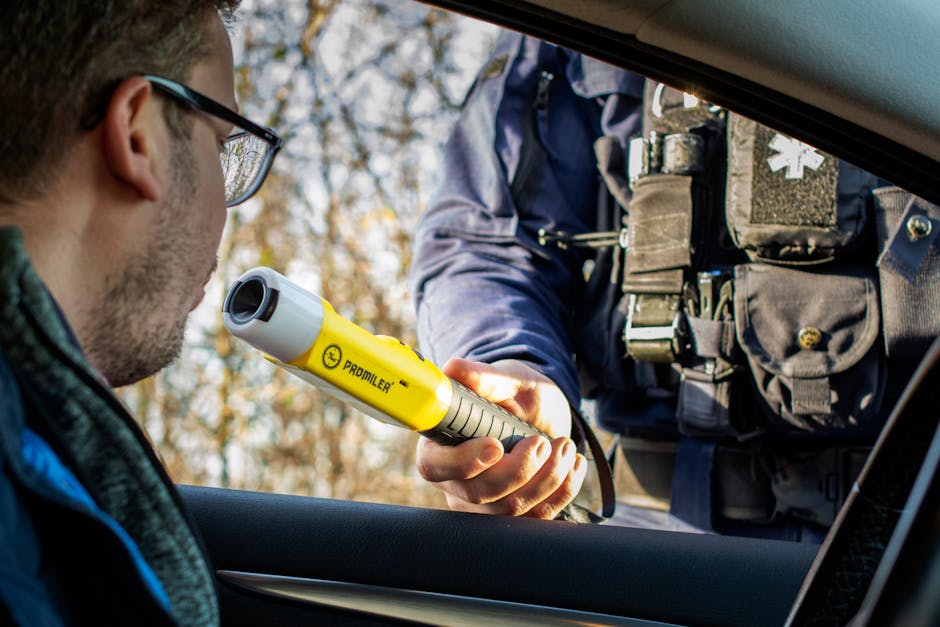
Breathalyzer Inaccuracies: While breathalyzer results can seem definitive, they are not infallible. Equipment can be improperly calibrated or maintained, operators can be poorly trained, and even environmental factors or substances in your mouth can lead to inaccurate readings. Our research indicates that many BAC tests can be unreliable due to factors like poorly trained officers, unmaintained equipment, expired seals, less accurate semiconductor sensors, and interference from substances in the mouth or environment. We can investigate the device’s calibration records and the officer’s certification.
Blood Test Procedures: Blood tests are generally considered more accurate, but errors can still occur during collection, storage, or analysis. Contamination, improper handling, or chain of custody issues can all lead to flawed results.
Negotiating with Prosecutors:
Our goal is always to achieve the best possible outcome, which might involve getting charges dismissed or reduced. With my background as a prosecutor, we can often negotiate plea bargains for a more minor charge, such as Obstruction of a Highway or reckless driving, which carry less severe penalties than a DWI conviction.
Protecting Your Rights and Driver’s License:
Beyond the criminal case, a DWI arrest triggers an administrative process to suspend your driver’s license. You have only 15 days from the date of your arrest to request an Administrative License Revocation (ALR) hearing. Failing to do so results in an automatic license suspension. We can represent you at this critical hearing, helping to preserve your driving privileges.
A strong defense in a Texas penal code driving while intoxicated case requires a thorough understanding of the law, meticulous investigation, and aggressive advocacy. We are here to ensure your rights are protected every step of the way.
Moving Forward After a Texas DWI Charge
Understanding the Texas penal code driving while intoxicated is not just about knowing the rules; it’s about safeguarding your future. As we’ve explored, a DWI in Texas is a serious offense with definitions that extend beyond common understanding. Whether it’s the two prongs of intoxication, the escalating penalties for repeat offenses, or the surprising scenarios where a DWI can occur (like on private property or in a golf cart), the legal landscape is complex.
The penalties for DWI in Houston and across Texas are severe, ranging from hefty fines and jail time for a first offense to state prison sentences and felony convictions for subsequent offenses or aggravating factors like having a child passenger. These consequences can ripple through every aspect of your life, affecting your employment, finances, and personal freedom.
Key takeaways from this guide are clear: understanding what constitutes intoxication, knowing your rights during a stop or arrest, and acting swiftly to secure legal representation are absolutely crucial. Don’t underestimate the gravity of a DWI charge or the complexities of the Texas legal system.
If you’re facing a DWI charge in Houston, protecting your future requires experienced, aggressive legal defense. At The Martinez Law Firm, we bring our unique “former prosecutor advantage” to every case, leveraging decades of experience to challenge evidence, negotiate effectively, and fight for the best possible outcome for our clients.
Don’t steer the intricacies of the Texas penal code driving while intoxicated alone. Contact an experienced Houston DWI lawyer today to discuss your case and build a strong defense.