
The Surprising Legal Risk of Riding a Bike After Drinking in Texas

Can you get a DUI on a bike is one of those questions that sounds almost too simple — like the answer should be obvious. But the honest answer is: it depends, and in Texas, the details matter more than you’d think.
Here’s a quick breakdown for anyone who needs a fast answer:
| Scenario | Likely Charge in Texas |
|---|---|
| Riding a regular pedal bike while drunk | Usually not a DWI, but Public Intoxication is possible |
| Riding an e-bike or motorized scooter while drunk | Potentially a full DWI depending on classification |
| Riding any bike while drunk under age 21 | Higher risk — zero tolerance rules apply |
| Riding a Class 3 e-bike (28 mph, motor-assisted) while drunk | Very likely treated as a motor vehicle DWI |
The common assumption in Houston — especially on nights when the patios on Washington Ave are packed — is that hopping on a bike instead of driving is the “responsible” choice. And from a pure safety standpoint, sure, you’re probably not going to hurt someone else as badly. But legally? It’s not the get-out-of-jail-free card most people think it is.
Texas DWI law is built around the concept of a motor vehicle, which is actually good news for traditional cyclists. But that doesn’t mean you’re untouchable. Public Intoxication charges, reckless endangerment, and the very real risk of an accident on a busy road like Westheimer mean that riding drunk still carries serious consequences — legal and otherwise.
One in three fatal bicycle crashes involves alcohol, according to safety data from the National Highway Traffic Safety Administration. That’s not a small number, and Houston police know it.
Key Takeaways
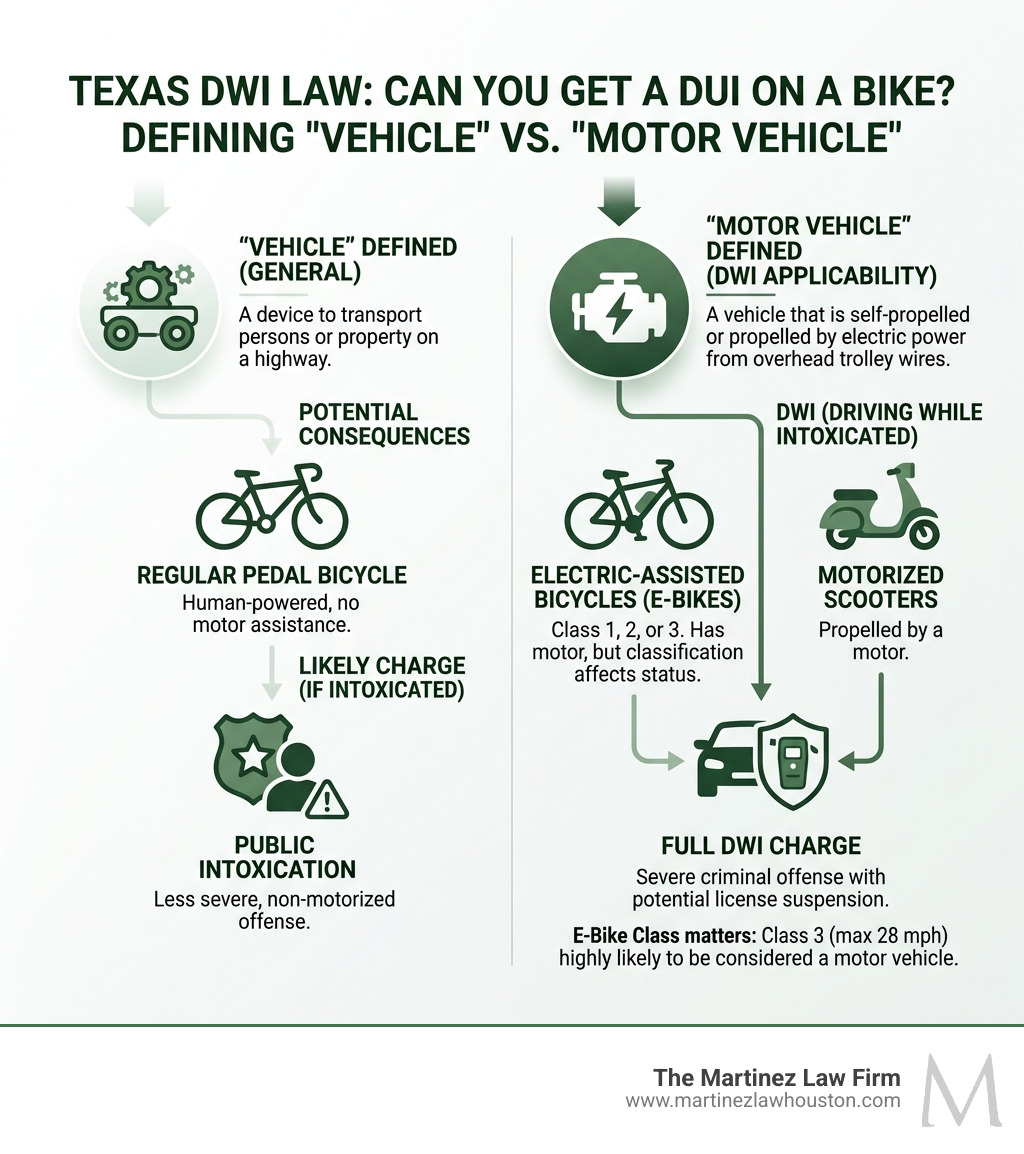
- You usually cannot get a DWI on a regular bicycle in Texas. The law applies to motor vehicles, so pedal bikes typically fall outside DWI charges—but other charges still apply.
- Public Intoxication is the most common risk. If you appear impaired and pose a danger to yourself or others, police can charge you even without a motor vehicle.
- Motorized bikes and scooters change the legal outcome. E-bikes, scooters, and high-speed motor-assisted devices may qualify as motor vehicles, increasing the risk of a full DWI.
- Legal consequences can still be serious. Charges may include fines, possible jail time, and for minors, driver’s license suspension under zero-tolerance rules.
- Safety risks are high even without legal penalties. Alcohol reduces reaction time and control, increasing crash risk—making riding impaired dangerous both legally and physically.
I’m Herman Martinez, founder of The Martinez Law Firm and a former Chief Prosecutor for the Harris County District Attorney’s Office with over 25 years of experience in DWI and criminal defense — and I’ve seen how charges related to can you get a DUI on a bike situations can spiral quickly when people assume they’re in the clear. Whether you’re facing a DWI, a Public Intoxication charge, or something in between, understanding exactly where Texas law draws the line is the first step to protecting yourself.
The Legal Reality: Can You Get a DUI on a Bike?
When we talk about the law in Houston, we have to look at the specific phrasing of the Texas Penal Code. In many states, like Florida or California, the law uses the word “vehicle.” In those places, a bicycle is often legally considered a vehicle, meaning you can absolutely get a standard DUI while pedaling.
However, in Texas, the statute specifically targets the operation of a motor vehicle. This nuance is where things get interesting for Houston cyclists. If you are on a traditional, human-powered bicycle, you generally cannot be charged with a DWI (Driving While Intoxicated) because a bike lacks a motor.
But don’t start celebrating with another round just yet. While a DWI might be off the table for a pedal bike, Texas law is broad. We often see cases where the “human power” factor is debated, especially as the line between bikes and motorized transport blurs. For a detailed look at how these charges are structured, you can check out our A Z Guide To DUI And DWI Charges Legal Options.
Location also plays a role in how a patrol officer might perceive your behavior. If you’re wobbling along a dedicated trail like Buffalo Bayou, you’re less likely to draw heat than if you’re swerving down Westheimer Road or Montrose Boulevard. In the eyes of a judge, being intoxicated on a public roadway where you pose a danger to others is a much bigger deal than being tipsy on a secluded dirt path.
Texas Specifics: DWI vs. Public Intoxication

In the Harris County Criminal Justice Center, we see a lot of “creative” charging. Even if the law says you need a motor for a DWI, a Houston cop who sees you falling off your bike in Midtown isn’t just going to wave you home.
If they can’t pin a DWI on you, they will almost certainly pivot to Public Intoxication (PI). Under Texas law, PI occurs when an individual is in a public place while intoxicated to the degree that they may endanger themselves or another person. Since a bicycle offers zero protection and puts you right in the path of Houston traffic, it’s very easy for an officer to argue that you were a danger to yourself.
You can read more about these specific distinctions in our article on Bicycle DWI. The reality of prosecutorial discretion here in Harris County is that they want to keep the roads safe. If you’re creating a hazard, they will find a charge that sticks, even if it’s not the one you expected.
Why the definition of a motor vehicle matters for a DUI on a bike
In Texas, the definition of a motor vehicle is “a device in, on, or by which a person or property is or may be transported or drawn on a highway, except a device used exclusively on stationary rails or tracks.” While that sounds broad enough to include a bicycle, courts have traditionally held that it implies a self-propelled mechanism (an engine).
Our Comprehesive Guide explains that the Texas Transportation Code separates your beach cruiser from your F-150. However, the “operating” part of the law is extremely loose. You don’t necessarily have to be moving to be “operating” a vehicle in the eyes of some overzealous prosecutors.
Penalties and license impacts of a DUI on a bike
One of the biggest fears people have is: “Can they take my driver’s license for a bike ride?”
In Texas, if you are convicted of a standard DWI, your driver’s license is usually suspended. If you are riding a traditional pedal bike and get charged with Public Intoxication, your driver’s license is generally safe. However, there is a major exception: minors.
Texas has a “Zero Tolerance” policy for anyone under 21. If a minor is caught cycling under the influence, they can face a 180-day license suspension, even if they weren’t in a car.
| Charge | Typical Fine | Potential Jail Time | License Impact (Adult) |
|---|---|---|---|
| Public Intoxication | Up to $500 | None (Class C Misdemeanor) | None |
| DWI (1st Offense) | Up to $2,000 | 3 to 180 days | 90 days to 1 year suspension |
| Reckless Endangerment | Up to $4,000 | Up to 1 year | Possible suspension |
E-Bikes, Scooters, and Other “Weird” Vehicles
This is where the “simple” answer gets messy. Houston has seen an explosion of electric rental scooters and e-bikes. If your bike has a motor, can you get a DUI on a bike becomes a much more dangerous “yes.”
Texas law is currently grappling with how to classify these. Generally, if the motor is powerful enough to propel the bike without you pedaling, or if it exceeds certain speed thresholds (like Class 3 e-bikes that hit 28 mph), it starts looking a lot more like a “motor vehicle” to a prosecutor.
And it’s not just bikes. We’ve seen people charged for all sorts of things. If you’re curious about the more “rural” side of Texas law, read our guide on Horse-Based DWIs. Believe it or not, people have been arrested for DWI on riding lawnmowers and even motorized “Cruzin Coolers.”
How e-bike classifications change the rules for a DUI on a bike
E-bikes are categorized into three classes:
- Class 1: Pedal-assist only, stops at 20 mph.
- Class 2: Throttle-assisted, stops at 20 mph.
- Class 3: Pedal-assist only, but goes up to 28 mph.
Because Class 2 and Class 3 bikes rely more heavily on a motor, they occupy a legal gray area. If you are zipping through Downtown Houston on a throttle-powered scooter or a high-speed e-bike while intoxicated, a DWI Lawyer will tell you that the state has a much stronger argument for a full DWI charge than if you were on a 10-speed.
Safety Risks and Common Defenses
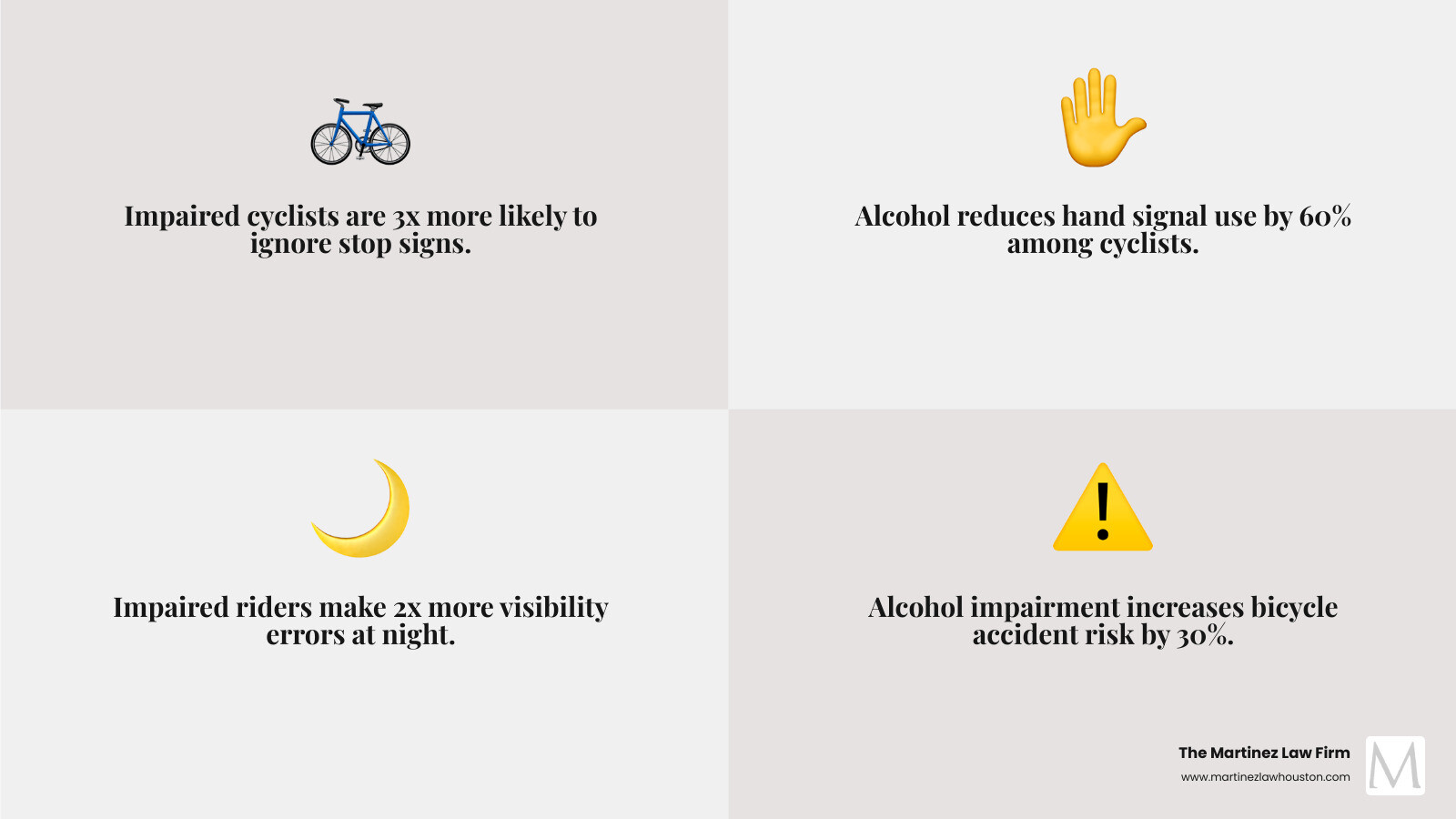
Even if you avoid a DWI, riding drunk in Houston is a safety nightmare. Alcohol slows your neural processing by 10% to 30%. That split-second decision to swerve around a pothole or a car door opening on Washington Ave becomes much harder when you’ve had a few.
Statistics from the Texas Department of Transportation show that impaired cyclists are:
- 3x more likely to ignore stop signs.
- 60% less likely to use hand signals.
- 2x more likely to make visibility errors at night.
If you are stopped, there are defenses available. Officers often use “Standardized Field Sobriety Tests” (SFSTs) on cyclists. But here’s the catch: those tests were designed for people getting out of cars, not people who just finished a grueling 20-mile ride. Physical exhaustion, leg fatigue, and even the type of shoes you wear for cycling can make you fail a balance test even if you’re stone-cold sober.
Furthermore, breathalyzers can be wonky. Heavy physical exertion causes heavy breathing, which some studies suggest can inflate breath alcohol readings by up to 15%. As your DWI Lawyer, we look at challenging the “probable cause” for the stop. Did the officer pull you over because you were actually impaired, or just because you were a cyclist in a “party” neighborhood at 2:00 AM?
Frequently Asked Questions about Biking and Alcohol
Can I get a DWI on a bicycle in Houston?
The short answer is usually no, provided it’s a standard pedal bike. However, you are almost certain to face a Public Intoxication charge if you are visibly impaired. If the bike is motorized (e-bike or scooter), the risk of a full DWI increases significantly.
This is a huge concern for our clients who drive for a living. In Texas, any alcohol-related conviction can threaten a Commercial Driver’s License (CDL). While a PI might not trigger an automatic suspension like a DWI would, your employer may have their own policies, and “any” alcohol-related arrest on your record is bad news for a professional driver.
What are common signs of impairment that lead to a bicycle stop?
Houston police look for:
- Swerving or inability to maintain a straight line.
- Riding against traffic or on sidewalks where prohibited.
- “Blowing” through stop signs or red lights (common on Washington Ave).
- Riding at night without a white front light and a red rear reflector/light (required by Texas law).
The Bottom Line for Texas Cyclists
At The Martinez Law Firm, we know that a “simple” bike ride can turn into a legal nightmare faster than you can say “last call.” Houston is a great city for cycling, but the intersection of alcohol and two wheels is a favorite target for local law enforcement.
Having a former prosecutor like Herman Martinez in your corner is a game-changer. We understand how the Harris County DA’s office thinks, and we know how to spot when a police officer has overstepped their bounds—whether you were in a truck or on a Trek. We provide aggressive, personalized defense for all “weird” vehicle charges to ensure one mistake doesn’t ruin your future.
If you’ve been stopped while riding, don’t wait for the system to decide your fate. Contact an experienced DWI Lawyer today and let us start fighting for you.