

Understanding the Immediate Impact of a DWI Arrest on Your Driving Privileges
A DWI license suspension in Houston isn’t a distant threat—it begins the moment you are arrested. Understanding the immediate consequences is critical.
Key Facts About DWI License Suspension in Houston:
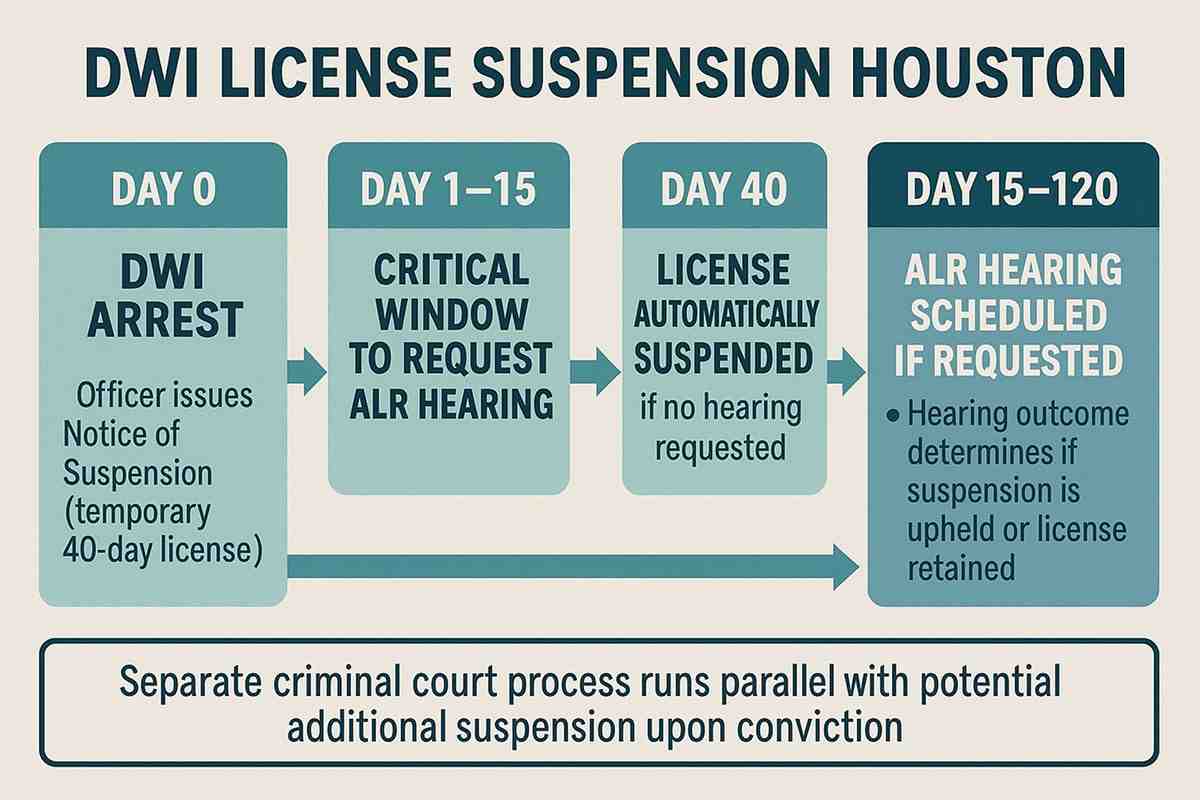
- You have only 15 days from your arrest to request an Administrative License Revocation (ALR) hearing.
- Your license will be automatically suspended on the 40th day after arrest if you fail to request a hearing.
- Two separate processes can suspend your license: the civil ALR process and a criminal court conviction.
- Refusing a breath/blood test leads to a 180-day suspension for a first offense; failing the test results in a 90-day suspension.
- The ALR suspension is independent of your criminal DWI case; you can lose your license even if criminal charges are later dismissed.
If you’ve been arrested for DWI in Houston, the administrative process moves fast. Missing the 15-day window to challenge the suspension means you lose your right to fight it before it takes effect. This is a separate battle from any criminal penalties you might face, meaning you must fight on two fronts simultaneously.
Losing your license impacts your ability to work, care for your family, and manage daily life. For commercial drivers, the consequences are even more severe and can be career-ending.
I’m Herman Martinez, founder of The Martinez Law Firm. I’ve handled DWI license suspension cases from both sides. As a former Chief Prosecutor and now as a defense attorney. With 25+ years in Harris County courts, I bring practical, proven insight.
The Immediate Threat: Administrative License Revocation (ALR)
When you’re arrested for a suspected DWI in Houston, a civil process called Administrative License Revocation (ALR) begins immediately. This process is handled by the Texas Department of Public Safety (DPS), not the criminal courts, and runs on a separate track from your criminal DWI case. You can lose your license through the ALR process even if your criminal charges are eventually dismissed.

The ALR program is triggered automatically if an officer believes you were driving while intoxicated and you either refused a breath or blood test or your blood alcohol concentration (BAC) was 0.08% or higher. This is based on Texas’s implied consent law, which states that by driving on Texas roads, you have agreed to chemical testing if suspected of DWI. The official details are on the state’s Administrative License Revocation (ALR) Program page, but the most important takeaway is that you must act fast.
The Critical 15-Day Deadline You Cannot Miss
You have exactly 15 days from the date of your arrest notice to request an ALR hearing. This is the single most important deadline in the process. When you are arrested, the officer confiscates your license and gives you a temporary paper permit, which is your Notice of Suspension. This permit is valid for 40 days, but the deadline to act is only 15 days.
If you miss this deadline, your license will be automatically suspended on the 40th day after your arrest. There are no exceptions or grace periods. To request a hearing, you must contact DPS, a task best handled by an experienced attorney to ensure it is done correctly and on time.
ALR Suspension Periods: Refusal vs. Failure
The length of your ALR suspension depends on whether you refused or failed the chemical test and if you have prior DWI-related incidents in the last 10 years. Refusing a test results in a longer suspension than failing one.
For a first offense, refusing a test triggers a 180-day suspension, while failing a test (BAC ≥ 0.08%) results in a 90-day suspension. With a prior DWI-related incident, the penalties increase to a 2-year suspension for refusal and a 1-year suspension for failure.
| Offense Type (Adult 21+) | First Offense (No Prior Suspensions/Convictions in 10 years) | Repeat Offense (Prior Suspension/Conviction in 10 years) |
|---|---|---|
| Refusing Breath/Blood Test | 180 days | 2 years |
| Failing Breath/Blood Test (BAC ≥ 0.08) | 90 days | 1 year |
For drivers under 21, Texas has a zero-tolerance policy. Any detectable amount of alcohol can lead to a 60-day suspension for a first offense. These suspensions are automatic if you don’t request an ALR hearing or if you lose the hearing, which is why swift action is essential.
Fighting Back: The ALR Hearing Process for a DWI License Suspension in Houston
Requesting an ALR hearing within the 15-day window gives you a fighting chance to keep your license. This formal proceeding is a real opportunity to challenge the state’s attempt to suspend your driving privileges.
The ALR hearing is overseen by an Administrative Law Judge (ALJ), and the burden of proof is on the Department of Public Safety (DPS), not you. To suspend your license, DPS must prove:
- The officer had reasonable suspicion for the initial traffic stop.
- The officer had probable cause to arrest you for DWI.
- You were properly informed of the consequences of refusing or failing a chemical test.
- You either refused the test or your test results showed a BAC of 0.08% or higher.
If DPS fails to prove even one of these points, you win the hearing, and the suspension is denied.
How to Challenge Your DWI License Suspension in Houston
The ALR hearing allows us to scrutinize every detail of your arrest. We look for procedural errors and inconsistencies to prevent DPS from meeting its burden of proof.
Common challenges include:
- Illegal Stop: If the officer lacked reasonable suspicion for the traffic stop, any evidence gathered afterward may be invalid.
- Lack of Probable Cause: We can challenge the officer’s justification for the arrest, such as improperly administered field sobriety tests or failure to account for physical limitations.
- Inaccurate Test Results: Breathalyzers require strict calibration and maintenance protocols. We can challenge the breathalyzer’s accuracy if procedures weren’t followed. Similarly, blood tests can be contested due to improper collection, chain of custody issues, or lab errors.
- Officer Fails to Appear: We subpoena the arresting officer. If they fail to appear at the hearing, you typically win by default, and the suspension is dismissed.
Using the ALR Hearing as a Strategic Advantage
The ALR hearing is more than just a fight for your license; it’s a critical tool for your criminal DWI defense. It is often the first opportunity to question the arresting officer under oath, and their testimony is recorded.
This allows us to lock in their testimony. If the officer’s story changes later in criminal court, we can use the ALR transcript to challenge their credibility. This hearing also helps us identify weaknesses in the prosecution’s case early on, such as an officer admitting to a procedural error. A successful ALR hearing provides significant leverage in plea negotiations, as prosecutors know their criminal case has been weakened. As a former Chief Prosecutor, I know how to use these hearings to gain a strategic advantage for my clients in both the administrative and criminal proceedings.
Understanding the Two Types of Suspensions: ALR vs. Court-Ordered
Many people facing a DWI in Houston are confused by the two separate legal battles that can suspend their license. You can win one and still lose the other.

The first is the Administrative License Revocation (ALR) suspension. This is a civil action by the Texas DPS that begins right after your arrest if you refused a test or your BAC was over the limit. It happens before your criminal case is resolved.
The second is a court-ordered suspension. This is a criminal penalty imposed by a judge only after a DWI conviction in Harris County Criminal Court. It is part of your sentence.
The good news is that these suspensions can overlap. If your license is suspended through the ALR process, Houston courts will typically credit that time toward any court-ordered suspension you receive later.
How a DWI Conviction Impacts Your License
A DWI conviction under Texas Penal Code § 49.04 brings serious penalties, including fines, potential jail time, and a mandatory license suspension.
- First DWI Offense: Suspension of 90 days to one year.
- Second DWI Offense: Suspension of up to two years.
- Third or Subsequent DWI: Suspension of 180 days to two years.
A DWI conviction also creates a permanent mark on your driving record, leading to drastically higher insurance rates and the requirement to obtain an SR-22 certificate to prove you have coverage.
Special Rules for CDL Holders and Drivers Under 21
Texas law is stricter for commercial drivers and those under 21.
For CDL holders, your livelihood is at risk. The legal BAC limit is just 0.04%, even in a personal vehicle. A first DWI offense results in a one-year CDL disqualification (three years if transporting hazardous materials). A second offense typically means a lifetime disqualification.
For drivers under 21, Texas has a zero-tolerance policy. Any detectable amount of alcohol can lead to a charge. Under Texas Transportation Code 521.342, a minor’s first offense can result in a 60-day ALR suspension and a criminal conviction suspension of up to one year. These consequences can derail a young person’s education and career.
Navigating a Suspension: Occupational Licenses and Reinstatement
If you are facing a DWI license suspension in Houston, you may still have options to drive legally for essential needs and a clear path to get your full license back.
Can I Still Drive? Obtaining an Occupational Driver’s License (ODL)
An Occupational Driver’s License (ODL), or hardship license, allows you to drive for essential needs like work, school, and necessary household duties. To get an ODL, you must petition a Harris County court, proving a genuine need to drive.
If the judge grants your petition, they will issue a court order that you take to the Texas DPS. Key requirements and restrictions for an ODL include:
- Ignition Interlock Device (IID): You will almost certainly need an IID installed in your vehicle. This device prevents the car from starting if it detects alcohol on your breath.
- SR-22 Insurance: You must obtain an SR-22 certificate from your insurance company, which proves you carry state-mandated liability coverage.
- Driving Restrictions: Your driving will be limited to specific hours (usually a 12-hour window) and for court-approved purposes only.
Violating any ODL restriction is a serious offense that can lead to additional criminal charges and a longer suspension.
The Road to Reinstatement: Getting Your Full License Back
Once your suspension period ends, your license is not automatically restored. You must complete several steps with the Texas DPS to get it back.
- Complete the Suspension Period: You must serve the entire suspension term.
- Pay Reinstatement Fees: A $125 reinstatement fee for DWI-related suspensions must be paid, along with any other outstanding fines.
- Complete DWI Education: You will need to complete a state-approved DWI education program. This is typically a 12-hour course for a first offense or a 32-hour DWI Repeat Offender Program for subsequent offenses.
- Maintain SR-22 Insurance: You must maintain SR-22 insurance for two years from your conviction date. A lapse in coverage will trigger another suspension.
- Satisfy All Court Orders: You must complete all other requirements of your sentence, such as probation or community service.
The Texas DPS License Eligibility webpage allows you to check your status, view outstanding fees, and see what requirements you still need to meet. Checking this site can save you time and frustration.
Frequently Asked Questions About Houston DWI License Suspensions
Facing a DWI license suspension in Houston brings up many urgent questions. With over 25 years of experience in Harris County, I’ve addressed the most common concerns from clients in your situation.
Can my license be suspended even if my DWI case is dismissed?
Yes. This is a frustrating but crucial point to understand. The Administrative License Revocation (ALR) process is a civil matter that is completely separate from your criminal DWI case. The ALR hearing only decides if the officer had proper grounds for the stop and arrest and whether you refused or failed a chemical test.
Because they are separate proceedings, you can win your criminal case (by dismissal or a “not guilty” verdict) but still have to serve an administrative license suspension. This is why it is vital to fight both battles, starting with requesting an ALR hearing within 15 days.
What happens if I refuse the breath or blood test in Houston?
Refusing a chemical test triggers an automatic ALR suspension that is longer than if you had failed the test. For a first-time refusal, the suspension is 180 days. For a repeat offender, it is 2 years.
The trade-off is that by refusing, you deny the prosecution key scientific evidence of your Blood Alcohol Concentration (BAC). While they can still use the officer’s observations and field sobriety test results, the lack of a BAC number can sometimes make their criminal case harder to prove. It’s a complex decision with significant consequences for both your license and your criminal case.
How do I check the status of my Texas driver’s license?
Texas makes it easy to stay informed about your license status. You can check your eligibility and any outstanding requirements online at any time through the official Texas DPS License Eligibility webpage.
This tool will show your current license status (e.g., eligible, suspended), list any reinstatement fees you owe, and detail the compliance requirements you still need to meet, such as completing a DWI education course or filing an SR-22. Regularly checking this page helps ensure a smooth path to reinstatement.
Why You Need an Experienced Houston DWI Attorney
If you’re facing a DWI license suspension in Houston, you’re up against a complex legal system with two separate tracks: the fast-moving civil ALR process and the criminal court case. Trying to steer this alone puts your driving privileges, your job, and your future at immediate risk.

At The Martinez Law Firm, we have over 25 years of experience in the Harris County legal system. As a former Chief Prosecutor, Herman Martinez understands DWI cases from both sides, giving our clients an invaluable advantage.
Here’s how we protect you:
- We Meet the 15-Day Deadline: We immediately file your ALR hearing request to prevent the automatic suspension of your license.
- We Fight at the ALR Hearing: We treat the ALR hearing as a strategic opportunity to challenge the state’s case. We subpoena the arresting officer, question them under oath, and lock in their testimony. This is often where we find the weaknesses that can help win not only your license hearing but also your criminal case.
- We Build a Strong Criminal Defense: Our insider knowledge of how the Harris County District Attorney’s office operates allows us to build a powerful defense. We scrutinize every detail, from the legality of the traffic stop to the accuracy of the chemical tests.
Our goal is to protect your driving privileges and your future. Whether that means winning the ALR hearing, securing an Occupational Driver’s License, negotiating a reduction of charges, or fighting for a not-guilty verdict at trial, we are prepared to fight for you.
We know you’re worried. We take the time to explain your options and keep you informed. Don’t wait to get help. Every day counts.
Contact our Houston DWI lawyers for a free consultation today. Let’s discuss your case and build a strategy to fight for the best possible outcome.
What You Need to Know About Reasonable Suspicion in Texas
Reasonable suspicion is a legal standard allowing police to briefly stop and question you based on specific, articulable facts suggesting criminal activity. It’s a critical concept that can determine the outcome of a police encounter in Houston.
Quick Facts About Reasonable Suspicion:
- What it is: More than a hunch, but less than probable cause
- What it allows: Brief stops (Terry stops), questioning, and friscks for weapons
- What it requires: Specific, observable facts—not assumptions or stereotypes
- What it doesn’t allow: Full searches, arrests, or extended detentions
- Key difference: Reasonable suspicion justifies a stop; probable cause justifies an arrest
If you’ve been stopped by police in Houston, understanding this standard is key to protecting your rights. Officers must base their suspicion on objective facts like erratic driving or matching a suspect’s description, not on your race or a “gut feeling.” When they overstep, evidence they find may be thrown out of court.
I’m Herman Martinez, founder of The Martinez Law Firm. As a former Chief Prosecutor and City of Houston Judge, I’ve seen this standard from all sides. Now, as a defense attorney, I use that experience to challenge unlawful stops and protect my clients. This guide will break down what you need to know.
Related content about reasonable suspicion:
Reasonable Suspicion vs. Probable Cause: Understanding the Key Differences
Reasonable suspicion and probable cause are two distinct legal standards that define what police can do during an encounter. While they sound similar, the difference can mean a brief stop versus an arrest.
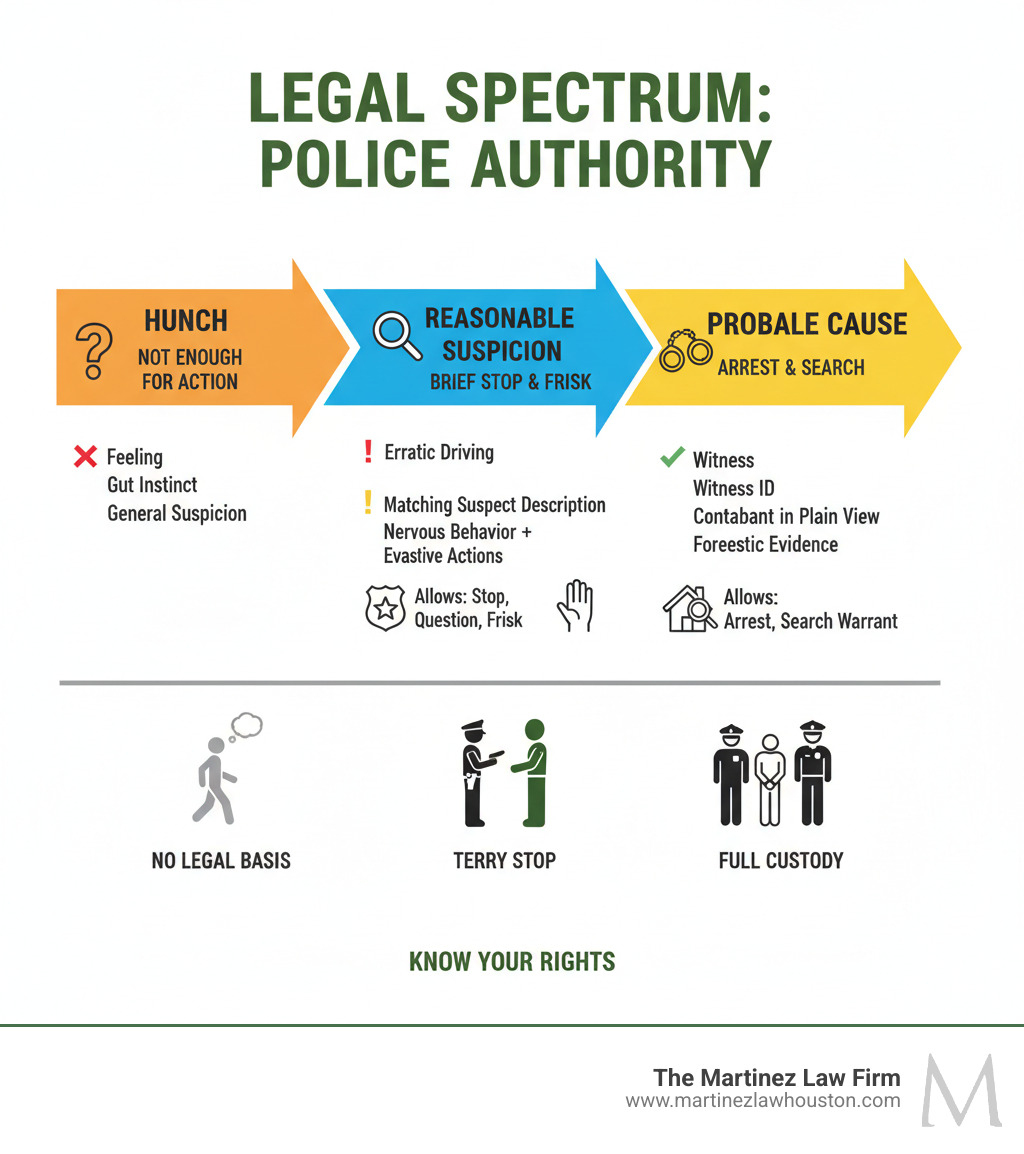
Think of it as a ladder of proof: a hunch is at the bottom (not enough for police action), reasonable suspicion is in the middle (allowing a brief stop), and probable cause is at the top (allowing an arrest or search). Each step requires more concrete evidence. The Supreme Court defines reasonable suspicion as a common-sense conclusion based on observable behavior, more than a gut feeling but less than probable cause.
Probable cause is a higher standard, requiring a reasonable belief that a crime has been, is being, or will be committed.
Here’s how they compare side by side:
| Feature | Reasonable Suspicion | Probable Cause |
|---|---|---|
| What it is | An objectively justifiable suspicion based on specific, articulable facts. | A reasonable belief that a crime has been, is being, or will be committed, supported by trustworthy information. |
| Level of Proof | More than a hunch (a crime might have occurred). | More than reasonable suspicion (a crime most likely has occurred). |
| What it Allows | Brief investigative stops, questioning, limited pat-downs (frisks) for weapons. | Arrests, full searches, obtaining warrants. |
Understanding this distinction is crucial. If Houston police conduct a full search with only reasonable suspicion, any evidence found could be suppressed. I’ve seen cases dismissed because officers confused these standards. For more on the higher standard, see our guide on What is Probable Cause?
What Constitutes Probable Cause in Texas?
In Texas, probable cause is the standard for an arrest or search warrant. It means officers have reasonably trustworthy information to believe a person has committed a crime, based on the “totality of the circumstances.”
For example, in a Houston DWI case, an officer might pull a driver over for swerving (reasonable suspicion). If the officer then smells alcohol, sees bloodshot eyes, and observes slurred speech, these facts can build to probable cause for a DWI arrest. Field sobriety tests or a breathalyzer result can solidify this. In Texas, even the smell of marijuana can contribute to probable cause for a search, as it remains illegal. After an arrest, knowing your Miranda Rights in Texas is vital.
Defining the Lower Standard of Reasonable Suspicion
Reasonable suspicion is the threshold for a brief investigative stop. It requires “specific, articulable facts” that an officer can explain to a judge—not just a hunch.
With reasonable suspicion, police can:
- Briefly detain you to investigate.
- Ask you questions about their suspicions.
- Conduct a limited pat-down (frisk) of your outer clothing for weapons if they also reasonably suspect you are armed and dangerous.
This standard balances public safety with your Fourth Amendment right to be free from unreasonable searches and seizures.
What Are the “Specific, Articulable Facts” That Justify a Stop?
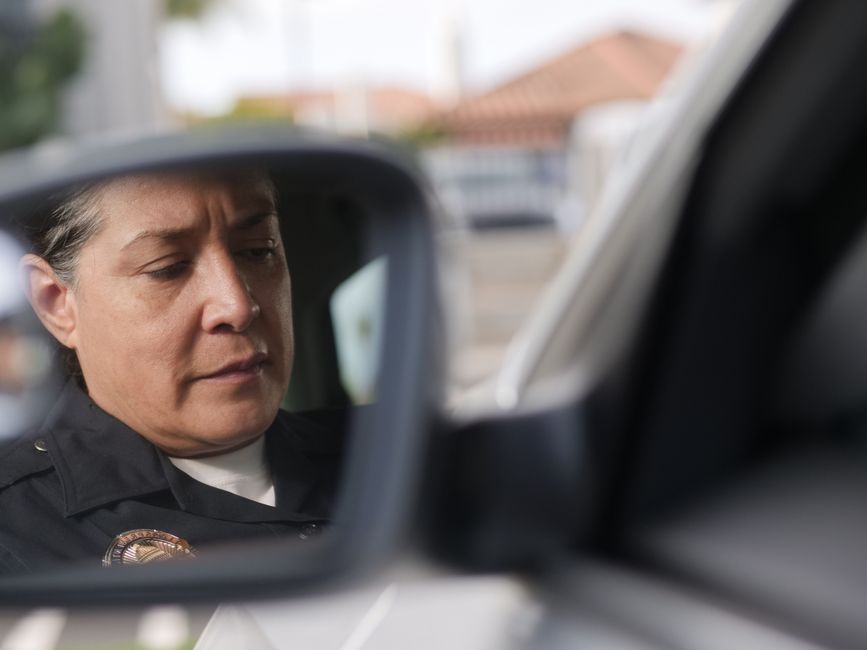
The legal standard of reasonable suspicion hinges on “specific, articulable facts.” This means an officer must be able to point to concrete, observable details to justify a stop, not just rely on a hunch or gut feeling.
Courts use a “totality of the circumstances” test, looking at the whole picture rather than isolated facts. An officer’s training can help interpret observations—for example, recognizing behavior that suggests drug activity—but it cannot replace the need for objective facts.
Facts that can contribute to reasonable suspicion include:
- Behavioral Cues: Furtive movements, appearing to hide something, or extreme nervousness.
- Informant Tips: Reliable and detailed tips can provide a basis for a stop.
- Context: The time of day, location in a high-crime area (when combined with other factors), or proximity to a recent crime.
- Evasive Behavior: Unprovoked flight from police in a high-crime area can be a factor. However, exercising your right to remain silent or refuse a search is not evasive behavior.
Examples of Valid Reasonable Suspicion in Houston
Here are some real-world examples of what Houston courts often consider valid reasonable suspicion:
- Erratic Driving: Swerving, weaving, driving far below the speed limit, or nearly hitting a curb can suggest a DWI. This is a common reason for a DWI Traffic Stop: What Are My Rights?.
- Matching a Suspect’s Description: If an officer spots someone who closely matches a detailed description of a suspect from a recent crime, they can initiate a stop.
- Suspicious Activity in a High-Crime Area: Someone repeatedly peering into a closed business late at night and testing door handles could be reasonably suspected of planning a burglary.
- Fleeing from Police: Unprovoked flight upon seeing a patrol car in an area known for drug sales can justify an investigatory stop.
It’s almost always a combination of factors, not a single observation, that creates valid reasonable suspicion.
What Does NOT Count as Reasonable Suspicion
It’s just as important to know what officers cannot use to justify a stop. A stop based on these factors is likely illegal:
- Race or Ethnicity: This is racial profiling and is unconstitutional.
- Time of Day: Simply driving late at night is not suspicious.
- Bumper Stickers or Personal Expression: Your protected speech cannot be the reason for a stop.
- Refusing a Consensual Search: Exercising your Fourth Amendment right is not an admission of guilt.
- Presence in a High-Crime Area: Being in a particular neighborhood, without more, is not enough.
- Anonymous, Vague Tips: A call with no specific, verifiable details is generally insufficient.
- An Officer’s ‘Hunch’: The law requires facts, not feelings.
If you were stopped for one of these reasons, the stop was likely illegal, and any resulting evidence could be suppressed.
How Reasonable Suspicion Impacts Your Rights in Texas
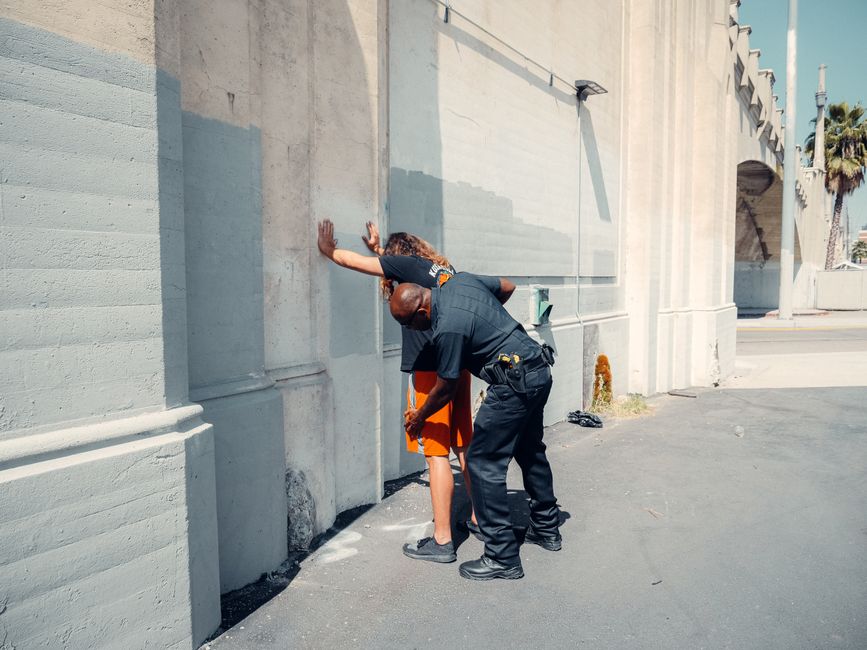
Your Fourth Amendment right against unreasonable searches and seizures hinges on reasonable suspicion. This legal standard dictates what police can and cannot do during an encounter.
The concept was established in the 1968 Supreme Court case Terry v. Ohio. The court ruled that police can conduct brief investigative detentions (“Terry stops”) based on reasonable suspicion, a lower standard than probable cause. The ruling also allows for a limited pat-down, or “frisk,” for weapons if an officer reasonably believes the person is armed and dangerous.
This created a balance: police can investigate suspicious activity, but citizens are protected from arbitrary stops. A Terry stop must be brief and focused. The frisk is strictly a safety measure to detect weapons, not a search for other contraband.
While reasonable suspicion is enough for a stop, it is generally not enough for a full vehicle search, which requires probable cause or your consent. Learn more about When Can Police Search My Vehicle?.
The “Terry Stop” and Frisk
A “Terry Stop” is a brief, temporary detention based on reasonable suspicion of criminal activity. During the stop, an officer can ask questions to confirm or dispel their suspicion.
A frisk is not automatic. To conduct a frisk, the officer needs a separate reasonable suspicion that you are armed and dangerous. This might be based on seeing a bulge in your clothing or your furtive movements toward a pocket.
- The Stop: Must be brief and investigative. It is not an arrest.
- The Frisk: A pat-down of outer clothing to feel for weapons. It is not a full search of your pockets or belongings.
An officer who goes beyond these limits, such as emptying your pockets during a frisk, has likely conducted an illegal search.
Reasonable Suspicion During a Houston DWI Stop
For a DWI stop in Houston, an officer must first have reasonable suspicion of a traffic violation or criminal activity. Without it, the entire stop is illegal.
- Initial Justification: Speeding, running a red light, or even a broken taillight can justify a stop.
- Developing Suspicion: Erratic driving, such as swerving or weaving, provides reasonable suspicion for a DWI investigation.
Once stopped, the officer looks for more evidence. The smell of alcohol, slurred speech, or bloodshot eyes can lift reasonable suspicion to probable cause for an arrest. The officer may then request Field Sobriety Tests.
Crucially, a traffic stop cannot be prolonged indefinitely. The Supreme Court has ruled that the stop must not last longer than necessary to address the initial reason for it, unless new suspicion arises. If an officer illegally extends a stop, any evidence found can be challenged. We have successfully defended many clients by identifying these unlawful traffic stops.
Frequently Asked Questions about Police Stops
We hear these questions all the time from Houston residents who’ve had unexpected encounters with law enforcement. Here are answers to common concerns about reasonable suspicion and what it means for you.
What should I do if I believe I was stopped without reasonable suspicion?
If you feel you were stopped unfairly, stay calm and protect your rights. Do not argue with the officer on the street—that’s a battle for the courtroom.
- Remain Silent: State clearly, “Officer, I am choosing to remain silent.” Learn more about this right in our guide on After an Arrest: Remaining Silent.
- Do Not Consent to Searches: If asked, state firmly, “I do not consent to any searches.”
- Ask if You Are Free to Leave: Ask, “Am I being detained, or am I free to go?” If you are free to go, leave calmly.
- Document Everything: As soon as you can, write down every detail: the officer’s name/badge number, location, time, and what was said.
- Contact an Attorney: Call our firm immediately. If the stop was illegal, we can file a motion to suppress any evidence found.
Can police search my car based only on reasonable suspicion?
No. In general, reasonable suspicion alone is not enough for a full vehicle search. To conduct a search, police need either:
- Probable Cause: A reasonable belief that your car contains evidence of a crime.
- Your Consent: Which you should not give.
There is one key exception: if an officer has reasonable suspicion that you’re armed and dangerous, they may conduct a limited protective ‘frisk’ of the passenger compartment where a weapon could be hidden. This is not a full search for contraband. For more details, read our guide: Do the Police Have the Right to Search Your Car?.
Do I have to identify myself to police in Texas?
It depends.
- Consensual Encounter: If an officer just starts a conversation and you are free to leave, you are not required to identify yourself.
- Lawful Detention or Arrest: If you have been lawfully detained based on reasonable suspicion or arrested, Texas law requires you to provide your name, address, and date of birth.
Refusing to identify yourself in this situation can lead to a separate charge. However, providing identification is not the same as answering questions. You can identify yourself and then state that you are exercising your right to remain silent. Learn More on your rights after an arrest.
What to Do If Your Rights Were Violated

If a police officer stops you without reasonable suspicion, it’s a violation of your constitutional rights. Crucially, any evidence gathered from an illegal stop can be thrown out of court through a legal tool called a motion to suppress.
Challenging an unlawful stop is a key defense strategy. We scrutinize every detail of the police encounter: Did the officer have specific facts, or just a hunch? Was the detention too long? Was the stop based on impermissible factors like your race? A successful challenge can lead to evidence being excluded and charges being dismissed.
This is where my experience as a former Chief Prosecutor and City of Houston Judge provides a distinct advantage. I know how prosecutors build cases and, more importantly, how to find their weaknesses. I understand what judges in Houston and Harris County look for when evaluating reasonable suspicion and use that knowledge to protect your rights.
At The Martinez Law Firm, we fight to hold law enforcement accountable. If you believe your rights were violated during a police stop, don’t wait. The sooner we review your case, the stronger your defense can be.
Your future shouldn’t be jeopardized by an illegal stop. Contact us today for a consultation to protect your rights and your freedom.
Why Understanding THC Laws in Texas Can Protect Your Freedom
Is THC legal in Texas? The answer is complicated and creates a legal minefield for residents. Here’s a quick overview:
- Recreational marijuana is illegal. Penalties include jail time and significant fines.
- Medical cannabis is legal but highly restricted. The Texas Compassionate Use Program (TCUP) allows low-THC products (up to 1% THC) for specific medical conditions.
- Hemp-derived THC products are legal if they contain less than 0.3% Delta-9 THC by dry weight, creating a confusing gray area.
- Possession of illegal marijuana (under 2 oz) is a Class B misdemeanor, punishable by up to 180 days in jail and a $2,000 fine.
Texas has some of the strictest cannabis laws in the U.S. While you can legally buy Delta-8 gummies in Houston, possessing marijuana flower can lead to arrest. The legal distinction hinges on technical definitions most people don’t understand, putting well-meaning citizens at risk of criminal charges.
The confusion is amplified by the open sale of some THC products in gas stations and smoke shops, while others are strictly illegal. In Harris County, diversion programs like the First Chance Intervention Program offer some leniency for minor offenses, but they don’t eliminate the underlying crime. Meanwhile, cities like Austin face state-level legal challenges for passing local decriminalization measures.
Thousands of Texans are arrested for marijuana possession annually, facing long-term consequences for employment, housing, and professional licenses. I’m Herman Martinez, founder of The Martinez Law Firm. With over 25 years of experience, including as a Chief Prosecutor for the Harris County District Attorney’s Office, I’ve seen how this confusion leads to serious charges. Understanding these laws is critical to protecting your freedom.
The Core Question: Is THC Legal in Texas?
The legality of THC in Texas depends entirely on its source, concentration, and intended use. The law treats THC from marijuana differently than THC from hemp, and medical use differently than recreational use. This creates a complex system that can easily confuse Houston residents. Let’s break down the three main categories.
Is recreational THC legal in Texas? A Firm No
Recreational marijuana is strictly illegal in Texas. Possessing, selling, or growing it is a criminal offense under Texas state law. There is no exception for \”personal use.\”
The penalties are harsh. Possessing less than two ounces is a Class B misdemeanor, carrying penalties of up to 180 days in county jail and fines up to $2,000. A conviction can impact your job, professional licenses, and housing applications. In Houston, thousands of residents face these consequences for amounts that are legal in neighboring states.
Medical Marijuana: A Limited Yes
Texas offers a narrow path for medical cannabis through the Texas Compassionate Use Program (TCUP). This program allows patients with qualifying conditions to use low-THC cannabis with a doctor’s prescription. These products must be obtained from state-licensed dispensaries.
As of June 2025, the program expanded, increasing the THC cap to 1% THC and adding more qualifying conditions. While this is progress, it remains far more restrictive than medical programs in states like California or Colorado. For those with serious medical conditions, TCUP provides a legal pathway, but it is heavily regulated.
Hemp-Derived THC: The Gray Area
This is the source of most confusion. The 2018 Farm Bill federally legalized hemp, defined as cannabis with less than 0.3% Delta-9 THC by dry weight. Texas adopted this standard in 2019 with House Bill 1325, legalizing hemp and its derivatives.
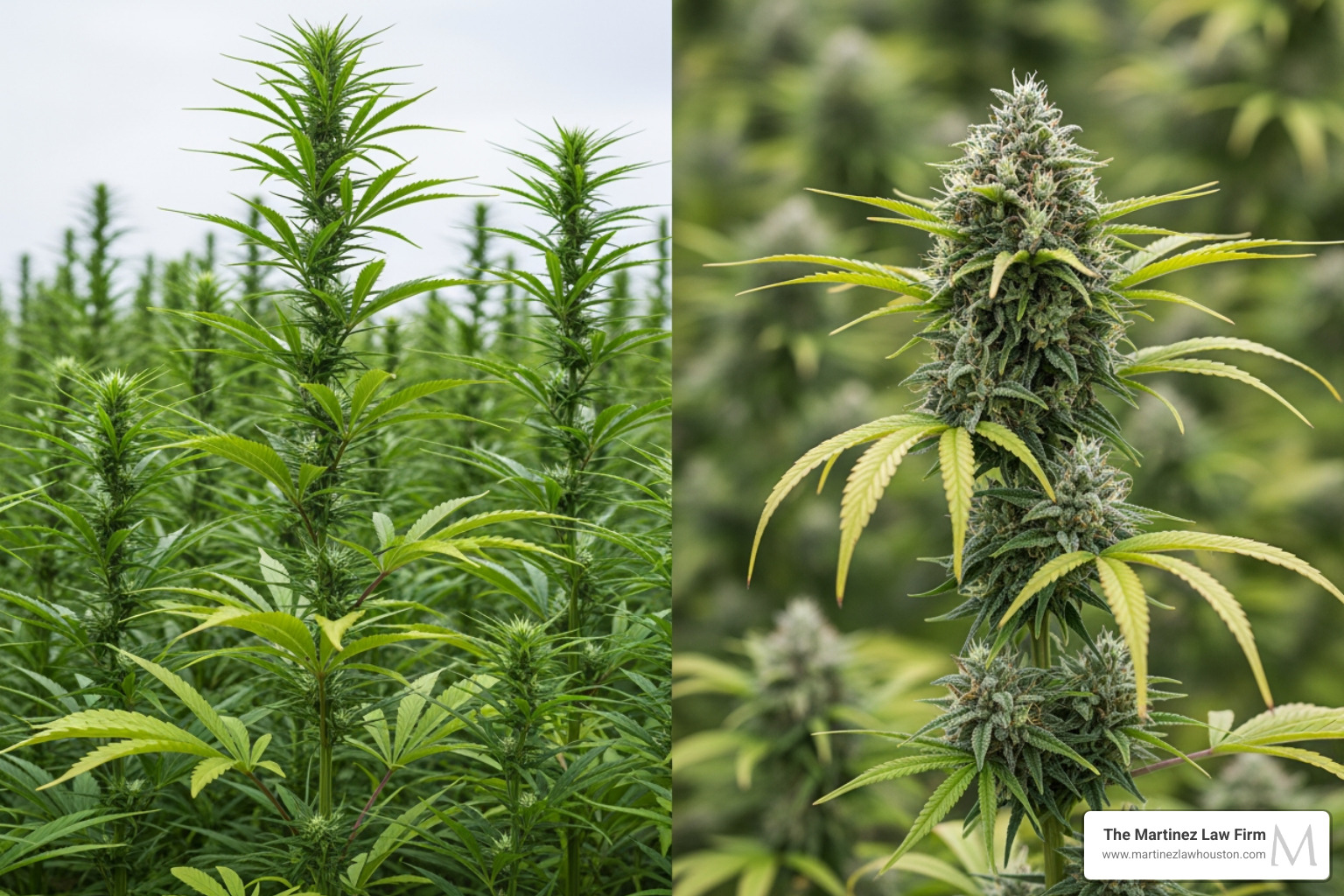
This law opened the door for products containing Delta-8 THC, Delta-10 THC, and even Delta-9 THC, as long as they meet the 0.3% concentration limit. As a result, THC gummies, vapes, and drinks are now sold openly in Houston stores.
The legal status of these products, particularly Delta-8, remains contested. While the industry argues they are legal under the hemp law, some state regulators and legal experts disagree. This creates a risky situation for consumers, as the market is completely unregulated for quality and safety. If arrested with one of these products, you may have to defend its technical legality in court.
If you face charges related to any THC product, you need an experienced lawyer. Our firm has handled countless drug crimes cases in Houston and understands these complex legal distinctions.
Understanding the Difference: Marijuana, Hemp, CBD, and Deltas
To understand if THC is legal in Texas, you must first know the difference between various cannabis products. All come from the Cannabis sativa plant, but their legal status depends on their chemical makeup, specifically their THC concentration.
- Marijuana: Cannabis with more than 0.3% Delta-9 THC by dry weight. It is illegal for recreational use in Texas.
- Hemp: Cannabis with 0.3% or less Delta-9 THC by dry weight. It is legal to grow and process in Texas under House Bill 1325.
- Cannabidiol (CBD): A non-psychoactive compound. CBD products derived from legal hemp are allowed in Texas.
- Delta-8 THC: A psychoactive cannabinoid, usually made by converting CBD. It produces a milder high than Delta-9. Its legality is currently protected by a court injunction, but this could change.
- Delta-9 THC: The main psychoactive compound in marijuana. It is illegal if from marijuana but legal if derived from hemp and under the 0.3% concentration limit. This loophole allows for the sale of \”legal\” Delta-9 gummies that can still be potent.

| Product | Legality in Texas (Recreational) | THC Content | Primary Use |
|---|---|---|---|
| Marijuana | Illegal | > 0.3% Delta-9 THC | Psychoactive/Recreational/Medical (illegal form) |
| Hemp | Legal | <= 0.3% Delta-9 THC | Industrial, CBD, other cannabinoids |
| CBD | Legal | Non-psychoactive, <= 0.3% Delta-9 THC | Wellness, non-intoxicating |
| Delta-8 THC | Legal (currently due to injunction) | Psychoactive, derived from hemp, <= 0.3% Delta-9 THC | Psychoactive/Recreational (milder high) |
| Delta-9 THC | Illegal (from marijuana); Legal (from hemp if <= 0.3%) | Psychoactive, variable | Psychoactive/Recreational |
Is hemp-derived THC legal in Texas?
Yes, hemp-derived THC products are legal in Texas if they meet the 0.3% Delta-9 THC limit. However, this market is a “Wild West\” with no regulation for product safety, purity, or labeling accuracy. A product labeled \”legal\” could contain illegal THC levels or harmful contaminants. Furthermore, Texas lawmakers have expressed intent to ban these products, meaning their legal status is unstable. If you are facing legal issues related to these products, it is vital to seek legal help for drug crimes.
What about THCa and other cannabinoids?
The legal landscape is further complicated by other cannabinoids.
- THCa (Tetrahydrocannabinolic acid): A non-psychoactive compound in raw cannabis that converts to psychoactive Delta-9 THC when heated. THCa products exist in a legal gray area, as Texas law has not clarified whether THCa counts toward the 0.3% THC limit.
- Synthetic Cannabinoids (THC-O, HHC): These are lab-created or heavily modified compounds. The DEA has stated that THC-O is an illegal controlled substance because it does not occur naturally in hemp. The legal status of HHC is also murky. These substances often carry greater potency and significant legal risks.
What seems like a legal purchase at a Houston smoke shop could become evidence in a criminal case if the law changes or the product is non-compliant.
Medical Cannabis: The Texas Compassionate Use Program (TCUP)
For those with serious medical conditions, the answer to is THC legal in Texas is a qualified yes, through the Texas Compassionate Use Program (TCUP). This program allows physicians to prescribe low-THC cannabis to patients with specific conditions.
\”Low-THC\” in Texas now means up to 10 milligrams of THC per dose, a shift from the previous percentage-based cap. This change, part of the HB 46 expansion in 2025, makes dosing more practical for patients. To participate, patients must be registered in the Compassionate Use Registry of Texas (CURT) by a qualified physician. You can find official information on the Texas Compassionate Use Program website.
What are the qualifying conditions for TCUP?
The list of qualifying conditions has expanded over the years. It now includes:
- Epilepsy and other seizure disorders
- Multiple sclerosis
- Spasticity
- Amyotrophic lateral sclerosis (ALS)
- Autism
- Terminal cancer
- Incurable neurodegenerative diseases
- Post-traumatic stress disorder (PTSD)
- Chronic pain
- Crohn’s disease
- Traumatic brain injury
This expansion has significantly increased the number of Texans who can legally access low-THC cannabis for therapeutic purposes.
How does medical cannabis impact my gun rights in Texas?
This is a critical and complex issue. While Texas permits medical cannabis through TCUP, federal law still classifies marijuana as an illegal Schedule I controlled substance. This creates a direct conflict affecting Second Amendment rights.
When purchasing a firearm, you must fill out ATF Form 4473, which asks if you are an \”unlawful user of…marijuana.\” Because marijuana is federally illegal, any cannabis use—even state-legal medical use—can classify you as an \”unlawful user.\” Lying on this form is a felony, and possessing a firearm as an unlawful user is a federal crime.
The Texas Department of Public Safety’s Compassionate Use Program FAQ states they do not believe TCUP participation disqualifies a person from possessing a firearm. However, this state interpretation does not override federal law. The ATF maintains that medical marijuana users are prohibited from possessing firearms.
This puts TCUP patients in an impossible position. If you are a patient considering firearm ownership or have been arrested for drug possession in Houston and are concerned about your gun rights, you need expert legal advice. The intersection of state and federal law is treacherous, and the stakes are incredibly high.
The Risks: Penalties for Illegal Marijuana Possession in Texas
While some forms of THC are legal, possessing illegal marijuana in Texas carries severe penalties under the Texas Controlled Substances Act. The confusion around is THC legal in Texas offers no defense when you are caught with a substance classified as illegal. Law enforcement in Houston and across the state actively enforces these laws, and penalties escalate quickly based on weight.

A conviction can affect your job, housing, and future. The difference between a misdemeanor and a felony can be just a few ounces. For a detailed look at sentences, see our guide on How Many Years in Jail for Drug Possession in Texas?
What are the penalties for possessing marijuana?
Texas uses a tiered system for marijuana possession penalties:
- 2 ounces or less: Class B Misdemeanor, up to 180 days in jail and a $2,000 fine.
- 2 to 4 ounces: Class A Misdemeanor, up to one year in jail and a $4,000 fine.
- 4 ounces to 5 pounds: State Jail Felony, 180 days to two years in a state jail and a $10,000 fine.
- 5 to 50 pounds: Third-Degree Felony, two to 10 years in prison and a $10,000 fine.
- 50 to 2,000 pounds: Second-Degree Felony, five to 99 years in prison and a $10,000 fine.
- Over 2,000 pounds: First-Degree Felony, five to 99 years in prison and a $50,000 fine.
A felony conviction has lifelong consequences, affecting your right to vote, own a firearm, and secure employment. If you’re facing felony drug charges in Houston, you need an aggressive defense from a lawyer who understands how prosecutors operate.
What is the stance on decriminalization in Houston and other Texas cities?
While state law is strict, some Texas cities, including Houston, have tried to reduce penalties for minor marijuana offenses. In Harris County, the First Chance Intervention Program and the Misdemeanor Marijuana Diversion Program allow some individuals caught with small amounts to avoid formal charges by completing an educational program.
These programs are a positive step but do not change the law; possession remains illegal. They are discretionary and typically only apply to first-time offenders with small amounts.
Other cities like Austin, Denton, and San Marcos passed ordinances to decriminalize small amounts, but Texas Attorney General Ken Paxton has filed lawsuits against them, arguing that local rules cannot override state law. This legal battle creates uncertainty. For Houston residents, diversion programs offer a chance to avoid a conviction, but they are not a get-out-of-jail-free card. The legal landscape is a patchwork of conflicting rules, making experienced legal counsel essential if you are facing charges.
Frequently Asked Questions about Texas THC Laws
The complex nature of Texas THC laws leads to many questions. Here are answers to some of the most common concerns we hear at The Martinez Law Firm.
Is it legal to buy Delta-9 gummies in Houston?
Yes, it is legal to buy Delta-9 gummies in Houston, provided they are derived from hemp and contain less than 0.3% Delta-9 THC by dry weight. This \”by dry weight\” rule is key. A single gummy can be heavy enough to contain a significant dose of THC (e.g., 15-30 mg) while remaining technically legal. This is how these products can produce strong psychoactive effects.
However, \”legal\” does not mean risk-free. The market is unregulated, so product quality and labeling are unreliable. Driving while impaired by these products can lead to a DWI. Furthermore, state lawmakers have indicated a desire to ban such products, so their legality may be temporary.
What happens if I’m caught with a THC vape pen in Texas?
This is a critical point where many are caught off guard: possessing a THC vape cartridge is a felony in Texas, regardless of the amount. While possessing a small amount of marijuana flower is a misdemeanor, Texas law treats THC concentrates—like vape oils, waxes, and dabs—much more harshly.
Under the Texas Health and Safety Code, even a cartridge with less than one gram of THC oil is classified under a higher penalty group. This results in a State Jail Felony charge, punishable by 180 days to two years in state jail and a fine of up to $10,000. Many people in Houston face felony charges for what they assumed was a minor offense. If you are facing charges for drug possession involving concentrates, you need an aggressive defense immediately.
Does having a TCUP prescription protect me from a DWI charge?
No. A valid prescription through the Texas Compassionate Use Program (TCUP) is not a defense against a DWI charge. Texas law prohibits driving while intoxicated by any substance, including legally prescribed medication.
If a police officer determines that your use of low-THC cannabis has impaired your ability to drive safely, you can be arrested and charged with DWI. The legal standard is impairment, not the legality of the substance. A Controlled Substance DWI carries severe penalties, including fines, license suspension, and potential jail time. Your TCUP prescription only proves you had legal access to the substance; it does not excuse impaired driving. The safest approach is to never drive after using your medication.
Navigating the Hazy Laws with a Clear Defense
So, is THC legal in Texas? The answer is a patchwork of rules, exceptions, and legal gray areas. Recreational marijuana is illegal and harshly penalized. Medical cannabis is legal only through the restrictive TCUP program. And hemp-derived products are sold openly in Houston but exist in a precarious legal state that could change at any moment.
This legal chaos creates a minefield for ordinary citizens. You can legally buy a potent Delta-8 vape at a gas station, but possessing a small amount of marijuana flower can land you in jail. A tiny THC cartridge is treated as a felony, while a package of \”legal\” gummies might contain more total THC than an illegal product. These contradictions are confusing and dangerous.
If you are facing charges related to marijuana or any THC product in Houston, you cannot afford to steer this complexity alone. The penalties are severe, and your future is at stake. At The Martinez Law Firm, we provide the clear, aggressive defense you need. Herman Martinez’s experience as a former Chief Prosecutor for Harris County gives us a unique insight into how the other side works—and how to build a powerful defense against their tactics.
Whether you’re dealing with a misdemeanor drug possession charge or a complex felony case involving THC concentrates, we are here to fight for you. Texas cannabis laws may be hazy, but your defense shouldn’t be. Contact The Martinez Law Firm today for a consultation to protect your rights and your freedom.
What You Need to Know About a Third DWI Offense in Texas
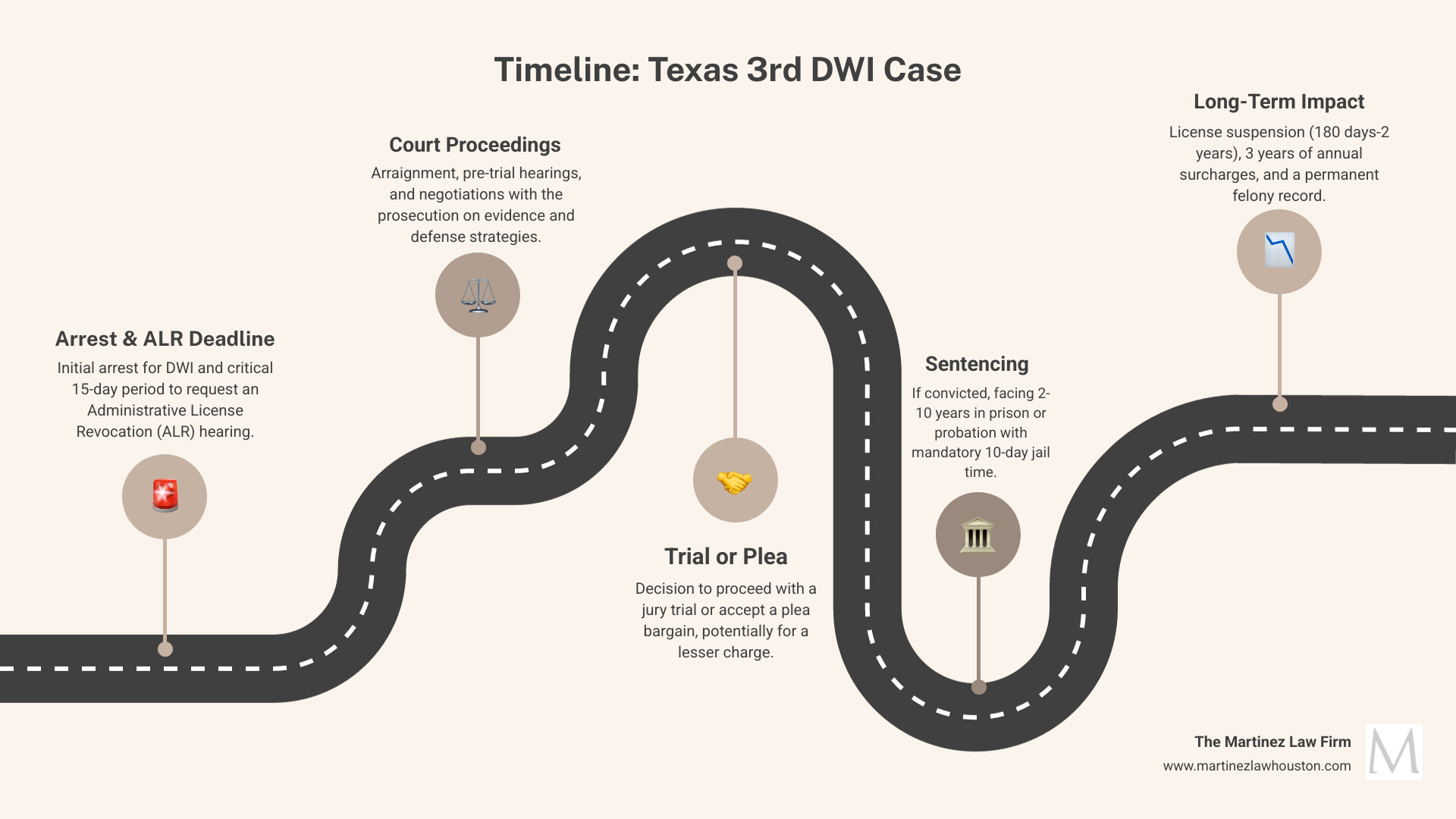
A DWI third offense Texas is a third-degree felony with severe, life-altering penalties. Unlike misdemeanor first and second offenses, a third conviction means facing state prison, substantial fines, a lengthy license suspension, and a permanent felony record.
Quick Facts: Third DWI Offense in Texas
- Classification: Third-degree felony under Texas Penal Code §49.09
- Prison Time: 2 to 10 years in Texas Department of Criminal Justice (TDCJ)
- Fines: Up to $10,000 (plus state surcharges of $1,500-$2,000 annually for 3 years)
- License Suspension: 180 days to 2 years
- Mandatory Jail Time: Minimum 10 days even with probation
- Community Service: 160 to 600 hours required
- No Lookback Period: All prior DWI convictions count, regardless of how long ago they occurred
- Permanent Record: Cannot be expunged or sealed in Texas
Texas has no lookback period, meaning a DWI from 20 years ago counts the same as one from last year. With two prior DWI convictions from anywhere in the U.S., a third arrest is automatically a felony. This is especially true in Houston and Harris County, where prosecutors aggressively seek harsh penalties for repeat offenders. A felony conviction can destroy employment opportunities, housing prospects, professional licenses, and firearm rights. The stakes are not just about jail time; they are about your entire future.
I’m Herman Martinez, founder of The Martinez Law Firm. As a former Chief Prosecutor for the Harris County District Attorney’s Office, I have over 25 years of experience on both sides of the courtroom. This unique perspective on Texas DWI third offense cases gives me insight into how prosecutors build their cases and, more importantly, how to dismantle them to protect my clients’ freedom.
The Felony Hammer Falls: Criminal Penalties for a DWI Third Offense Texas
When you’re arrested for a DWI third offense, the charge is elevated from a misdemeanor to a felony. That single word carries immense weight in Houston and Harris County courtrooms, where judges view repeat offenders as a significant public safety risk.

The difference is stark: county jail for misdemeanors versus state prison for felonies. A felony conviction follows you permanently, affecting job applications, housing, professional licenses, and even your right to own a firearm. The situation can worsen with aggravating factors, such as having a child passenger under 15, a high blood alcohol concentration (BAC), or causing an accident. These factors often push prosecutors to seek the harshest penalties available.
Third-Degree Felony Prison Time and Fines
A DWI third offense Texas is a third-degree felony, punishable by two to ten years in the Texas Department of Criminal Justice (TDCJ). This is state prison time, not a stay in a county facility. The financial penalties are also severe, with fines reaching up to $10,000, not including thousands more in state surcharges and other costs.
Penalties can be improved further. If you have a prior felony conviction with a prison sentence, a third DWI can be upgraded to a second-degree felony, carrying two to 20 years in prison. With two prior prison trips, you could face 25 years to life under Texas’s habitual offender laws. Texas Penal Code §49.04 details these severe penalties, showing how seriously the state treats repeat offenses.
Driver’s License Suspension and ALR Hearings
Beyond criminal court, a DWI third offense Texas arrest triggers an immediate administrative process to suspend your driver’s license for 180 days to two years. This is handled by the Texas Department of Public Safety (DPS), not the criminal court.
From the moment of your arrest, you have only 15 days to request an Administrative License Revocation (ALR) hearing. If you miss this critical deadline, your license is automatically suspended. The ALR hearing is your chance to challenge the suspension by cross-examining the arresting officer and questioning the evidence. Information on these hearings is available from the Texas Department of Transportation (TxDOT). If your license is suspended, you might qualify for an occupational license for essential driving, but it will come with strict restrictions and likely require an ignition interlock device.
State Surcharges and Financial Burdens
The financial impact of a third DWI extends far beyond court fines. Texas imposes annual surcharges of $1,500 to $2,000 for three years to maintain your driver’s license after a conviction. That’s up to $6,000 in surcharges alone.
Additional costs include court fees, mandatory DWI education programs, substance abuse evaluations, and ignition interlock device installation and maintenance. Your auto insurance rates will also skyrocket, and you’ll be required to carry expensive SR-22 insurance for high-risk drivers for at least three years. The total financial cost of a DWI third offense in Texas can easily exceed $50,000, not counting lost income from a potential prison sentence or felony record.
Navigating Probation and Mandatory Requirements
Receiving probation, or community supervision, for a DWI third offense Texas is not a lenient outcome. The conditions are demanding and strictly enforced, especially in Harris County. Any violation can result in the revocation of your probation and activation of your original prison sentence.

Probation means serving your sentence in the community, but it requires strict adherence to a long list of rules designed to ensure accountability and public safety.
Strict Conditions of Community Supervision
Even with probation for a DWI third offense, you must serve a mandatory minimum of 10 days in county jail. This is non-negotiable. Other conditions include:
- Community Service: 160 to 600 hours of unpaid service.
- DWI Intervention Program: A specialized course for repeat offenders.
- Substance Abuse Evaluation: A mandatory assessment that may lead to required counseling or treatment programs.
- Regular Testing: Frequent and random drug and alcohol tests. A single failed test can lead to probation revocation.
Failing to meet any of these conditions, such as missing an appointment with your probation officer or failing a drug test, can have swift and severe consequences, often resulting in a motion to revoke your probation and send you to prison.
The Ignition Interlock Device (IID) Mandate
An Ignition Interlock Device (IID) is a near-certain requirement. This device is a breathalyzer connected to your car’s ignition, which prevents the vehicle from starting if it detects alcohol on your breath. The IID also requires random “rolling retests” while you are driving.
An IID is typically mandatory as a condition of bond while your case is pending, as a condition of probation, and often as a requirement to restore your driving privileges after your sentence is complete. The Texas Department of Transportation (TxDOT) may require it before you can legally drive again.
You are responsible for all costs, including installation ($70-$150) and monthly monitoring fees ($60-$80). While inconvenient and expensive, an IID may be the only way to retain limited driving privileges for essential needs like work and medical appointments, which can be crucial for maintaining stability while facing charges in the Houston area.
Life After Conviction: The Lasting Consequences of a Felony DWI
A DWI third offense Texas conviction creates a permanent felony record that brings lifelong obstacles. These collateral consequences—the secondary punishments not part of the official sentence—are often more challenging than the prison time or fines. In Houston’s competitive job and housing markets, the stigma of being a “convicted felon” can be devastating.
Impact on Employment, Housing, and Professional Licenses
With a felony DWI on your record, finding a job becomes incredibly difficult. Most employers conduct background checks, and a felony is an immediate red flag. Jobs involving driving, handling money, or requiring security clearances are often out of reach. Texas is an “at-will” employment state, so even your current job may be at risk.
For licensed professionals like nurses, teachers, and real estate agents, a felony conviction can trigger disciplinary action from state licensing boards, potentially leading to license suspension or revocation. This can be a career-ending event.
Housing is another major hurdle. Landlords frequently run background checks and may automatically reject applicants with felony convictions, limiting your options and creating housing insecurity. These barriers to employment and housing can create a difficult cycle to escape.
Loss of Civil Rights: Firearm and Voting Rights
A felony conviction for a DWI third offense Texas also results in the loss of fundamental civil rights. Under federal law, a convicted felon is permanently banned from owning or possessing firearms. This lifetime ban on firearm ownership rights can only be reversed through a pardon, which is extremely difficult to obtain.
Your right to vote is also suspended in Texas while you are serving your sentence, which includes time in prison, on parole, or on probation. Once you have fully completed all terms of your sentence, your voting rights are automatically restored. However, this period of disenfranchisement can last for many years, serving as another constant reminder of your felon status.
Building a Defense Against a Third DWI Charge
Facing a DWI third offense Texas charge is daunting, but an arrest is not a conviction. A strong defense is possible. At The Martinez Law Firm, my experience as a former Chief Prosecutor for Harris County provides a critical advantage. I know how prosecutors build these cases, which means I know how to find the weak spots and dismantle their arguments.

In Houston, you need a defense attorney who understands the system from the inside out. We scrutinize every detail of your case to challenge the prosecution’s evidence and protect your constitutional rights.
Common Defense Strategies for a dwi third offense texas
Every DWI case has potential vulnerabilities. Our defense strategies often focus on:
- Illegal Traffic Stop: Police need reasonable suspicion to pull you over. If the stop was unlawful, all evidence gathered afterward may be suppressed.
- Field Sobriety Test Errors: These tests are subjective and often administered incorrectly. Factors like medical conditions, fatigue, or poor conditions can render the results unreliable.
- Inaccurate Breath or Blood Tests: Breathalyzers require proper calibration, and blood samples must follow a strict chain of custody. We investigate maintenance logs, technician qualifications, and handling procedures for errors that could invalidate the results.
- Challenging Prior Convictions: The prosecution must prove your two prior DWIs. We examine the records of these convictions, especially those from out-of-state, for procedural flaws that could prevent them from being used to improve your charge to a felony.
- Procedural Errors: We review the entire arrest for violations of your rights, such as an improper reading of Miranda rights or mishandling of evidence.
Can a Texas DWI third offense charge be reduced or dismissed?
Yes, it is possible to achieve a reduction or dismissal, though it is challenging. By exposing weaknesses in the state’s case—such as a questionable stop or unreliable tests—we can create leverage for plea negotiations. This can lead to reduced charges or more favorable sentencing recommendations.
While uncommon, reducing a felony DWI to a misdemeanor is possible if there are significant legal flaws in the case. Case dismissal is the ultimate goal, which we pursue when the state cannot prove its case beyond a reasonable doubt or when critical evidence is suppressed due to constitutional violations.
My background as a former Harris County prosecutor gives me an insider’s perspective on how to counter the state’s arguments. This experience is invaluable when your freedom and future are on the line.
Frequently Asked Questions about a Third DWI in Texas
If you’re facing a DWI third offense charge in the Houston area, you likely have urgent questions. Here are straightforward answers to some of the most common concerns we hear at The Martinez Law Firm.
Can a third DWI conviction be expunged or sealed in Texas?
No. Under Texas law, DWI convictions cannot be expunged. Furthermore, a felony conviction like a dwi third offense texas is ineligible for an order of non-disclosure (record sealing). This means a conviction will remain on your criminal record permanently, visible to anyone who runs a background check. This is why fighting the charge from the outset is so critical.
What is the difference between a 3rd DWI and other felony DWI charges?
A third DWI is a felony based on your history of prior offenses. However, you can face a felony DWI charge even on a first offense if aggravating factors are present:
- Intoxication Assault: Causing serious bodily injury to another person while driving intoxicated. This is a third-degree felony, with penalties similar to a third DWI.
- Intoxication Manslaughter: Causing the death of another person due to intoxication. This is a second-degree felony, carrying a prison sentence of two to 20 years.
The key difference is the reason for the felony charge: a third DWI is based on repeat offenses, while the others are based on the harm caused in a single incident.
Do prior DWI convictions from other states count in Texas?
Yes, they almost always do. Texas is part of the Interstate Driver’s License Compact, an agreement among states to share information on traffic violations, including DWIs. Prosecutors in Harris County will use this system to pull records from other states to prove your prior convictions.
However, proving an out-of-state conviction is not always simple. The prosecution must show that the offense in the other state is legally equivalent to a Texas DWI. An experienced defense attorney can scrutinize these records for procedural errors, documentation issues, or legal differences that could disqualify the prior conviction from being used to improve your charge. Challenging these priors can sometimes mean the difference between a felony and a misdemeanor.
Facing a 3rd DWI in Houston? Take Action Now
A DWI third offense Texas charge is a direct threat to your freedom and future. In Houston and Harris County, prosecutors seek maximum penalties, including years in state prison and a permanent felony record that can cost you tens of thousands of dollars and follow you for life.
This feels overwhelming, but remember: a charge is not a conviction. You have options, but you need an attorney with the right experience to fight for you.
As a former Chief Prosecutor in the Harris County District Attorney’s Office, I know the strategies the other side will use because I used them myself. At The Martinez Law Firm, we use that insider knowledge to dismantle the prosecution’s case, challenge the evidence, and protect our clients’ rights.
The stakes are too high to wait. Critical deadlines, like the 15-day window to save your driver’s license, are passing. Evidence can be lost and witnesses’ memories fade. Your defense must start now.
Don’t let a DWI conviction define your life. You need a proven fighter in your corner. Contact The Martinez Law Firm today for a comprehensive case evaluation, and let’s start building your defense together.
Get help from an experienced Houston DWI lawyer
Understanding the Complex Legal Status of Delta 9 in Texas
Is delta 9 legal in Texas? The answer is complicated, depending on the THC’s source and concentration:
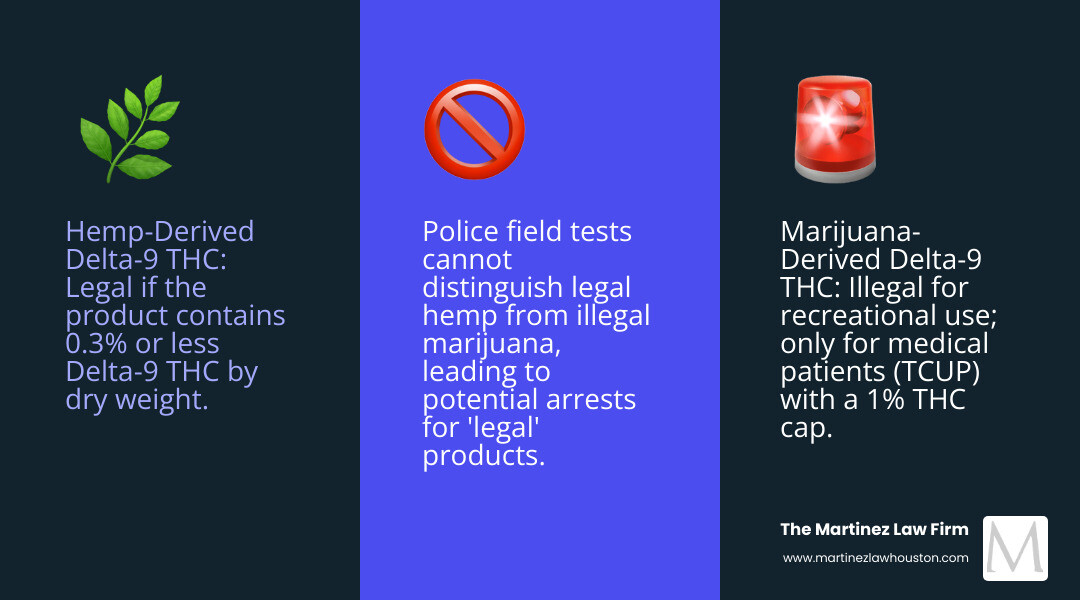
- Hemp-Derived Delta-9 THC: Legal if the product contains 0.3% or less Delta-9 THC by dry weight.
- Marijuana-Derived Delta-9 THC: Illegal for recreational use; only allowed for registered medical patients under the Texas Compassionate Use Program (TCUP) with a 1% THC cap.
- The Catch: Even “legal” hemp products can lead to arrest because police field tests cannot distinguish between legal and illegal THC or measure its exact percentage.
Shelves in Houston’s gas stations, smoke shops, and CBD stores are stocked with products containing Delta-9 THC, creating widespread confusion. While these hemp-derived products are marketed as legal under federal and state law, Texans are still being arrested and facing felony charges for possessing them.
This legal gray area stems from the 2018 Farm Bill and Texas House Bill 1325, which legalized hemp products containing less than 0.3% Delta-9 THC. What many consumers don’t realize is that this small percentage can still be psychoactive, and more importantly, that law enforcement often cannot distinguish legal hemp from illegal marijuana during a traffic stop.
The stakes are high. In 2022, thousands of Texans were arrested for marijuana possession, many believing they carried legal hemp. Penalties can range from misdemeanors to state jail felonies with up to two years in prison and $10,000 in fines.
Key Takeaways
-
Delta-9 THC is legal in Texas only under strict limits — Hemp-derived Delta-9 is legal if the product contains ≤0.3% Delta-9 THC by dry weight, while marijuana-derived Delta-9 remains illegal except for registered patients under the Texas Compassionate Use Program (TCUP).
-
The “0.3% rule” creates a legal loophole — Because the limit is based on percentage by dry weight, products like gummies can legally contain around 10 mg of THC per serving and still remain compliant.
-
Legal products can still lead to arrest — Police field tests detect THC but cannot measure THC percentage, meaning officers often cannot distinguish legal hemp products from illegal marijuana, which can lead to charges.
-
Possession penalties can be severe — If a product exceeds the legal THC limit, it may be charged as Possession of a Controlled Substance (POCS) with penalties ranging from 180 days to life in prison depending on the amount.
-
Consumers must exercise caution when buying THC products — Choosing licensed vendors, verifying third-party lab reports (COAs), and keeping packaging and receipts can help reduce legal risk in Texas’s evolving cannabis laws.
I’m Herman Martinez, founder of The Martinez Law Firm in Houston, and I’ve seen how this confusion leads to wrongful arrests. With over 25 years in criminal defense and a background as a former Chief Prosecutor and City of Houston Judge, I have critical insight into how these cases are handled—and how to defend them effectively.
The Legal Labyrinth: Is Delta 9 Legal in Texas?
Trying to determine is delta 9 legal in Texas is one of the most confusing questions in cannabis law. The answer hinges on a 0.3% threshold that creates a legal distinction between two chemically identical products. Both hemp and marijuana come from the Cannabis sativa L. plant, but one is sold legally in Houston gas stations while the other can land you in jail.
This 0.3% limit came from the federal 2018 Farm Bill, which Texas adopted with House Bill 1325. Lawmakers likely didn’t foresee the “gummy loophole” this would create, turning convenience stores across Harris County into unlikely cannabis retailers.
How Texas Law Defines Hemp
Texas law is very specific. The Texas Agriculture Code, Section 121.001 defines hemp as “the plant Cannabis sativa L. and any part of that plant…with a delta-9 tetrahydrocannabinol concentration of not more than 0.3 percent on a dry weight basis.”
In simple terms, any part of the cannabis plant—flowers, extracts, and other derivatives—is legal hemp as long as its Delta-9 THC content is at or below 0.3%. If it crosses that line, it becomes illegal marijuana under Texas law (except for limited medical use).
This definition covers everything from CBD oils to the hemp-derived Delta-9 gummies now common in Houston. The key is that manufacturers can extract and concentrate cannabinoids, including Delta-9 THC, as long as the final product adheres to the 0.3% limit.

The “Gummy Loophole”: How a Little THC Becomes Potent
Here’s where the law creates unintended consequences. The 0.3% limit is based on the product’s total dry weight, not the dose per serving. This allows manufacturers to create intoxicating products that are technically legal.
For example, a heavy gummy can legally contain 10 milligrams of Delta-9 THC and still fall below the 0.3% threshold. For many people, 10mg is a standard dose capable of producing significant psychoactive effects.
This is the “gummy loophole.” The percentage of THC is tiny, but the total amount can be potent. Texas law only regulates the former. As a result, Houston’s smoke shops and CBD stores are filled with legal, intoxicating products like gummies, chocolates, and beverages.
But there’s a critical catch: this has created massive confusion. New users may not understand the potency of a “legal” 10mg gummy. More importantly, law enforcement officers cannot distinguish between legal hemp-derived THC and illegal marijuana-derived THC. They look, smell, and produce the same effects.
This gap between the law and practical enforcement has led to arrests and serious first-time drug offense charges across Harris County. People who made legal purchases are facing life-altering consequences because a police field test can’t measure the difference between 0.29% and 0.31% THC.
Navigating Different THC Products in Texas
Walk into any Houston smoke shop, and you’ll see that Delta-9 isn’t the only cannabinoid for sale. The market is flooded with Delta-8, Delta-10, and THCA products, each with a confusing and precarious legal status. Understanding these differences is key to avoiding potential criminal charges.
- Delta-9 THC: The most psychoactive. Legal only if hemp-derived and under 0.3% by dry weight.
- Delta-8 THC: Offers a milder high, but its legality is in question due to ongoing court battles.
- Delta-10 THC: Even less potent and generally considered legal if the product meets the 0.3% Delta-9 limit.
- THCA: Non-psychoactive until heated, when it converts to illegal Delta-9 THC, creating a major legal risk.
Hemp-Derived Delta-9 vs. Marijuana-Derived Delta-9
The Delta-9 THC molecule is the same whether it comes from hemp or marijuana. Your body can’t tell the difference, and neither can most police tests. The law, however, cares deeply about its origin.
Hemp-derived Delta-9 products are sold openly in Houston stores and online. As long as they contain no more than 0.3% Delta-9 THC by dry weight, they are legal under Texas law.
Marijuana-derived Delta-9, however, is illegal for recreational use. The state’s Texas Compassionate Use Program (TCUP) is a narrow exception, allowing patients with specific conditions like epilepsy, PTSD, or cancer to access products with up to 1% THC through a registered physician. For most Texans, marijuana remains off-limits.
The Murky Waters of Delta-8, Delta-10, and THCA
Delta-8 THC exists in a legal limbo. A court injunction currently prevents the state from classifying it as a Schedule I controlled substance, but pending litigation means its status is uncertain and users still face prosecution risks.
THCA is even more precarious. It’s non-psychoactive and legal in its raw form. However, heating it (by smoking, vaping, or cooking) converts it into illegal Delta-9 THC. This is dangerous because police field tests may involve heating, inadvertently turning your legal product into an illegal one and leading to felony charges.
Delta-10 THC is the mildest of these cannabinoids and is generally considered legal as long as the final product respects the 0.3% Delta-9 THC limit.
What are Consumable Hemp Products (CHPs)?
Texas regulates these items as Consumable Hemp Products (CHPs), which includes any edible, tincture, or beverage containing hemp. The Texas Department of State Health Services (DSHS) requires manufacturers and sellers to obtain a license, creating a system to ensure compliance with the 0.3% THC limit.
Reputable vendors provide QR codes on packaging that link to lab reports (Certificates of Analysis, or COAs) verifying the cannabinoid content. However, the system isn’t foolproof, and mislabeled products that exceed the legal limit are common. This creates serious legal problems for consumers, as Texas maintains strict controlled substances laws.
The Risks: Law Enforcement and Penalties in Houston
Even if you buy a Delta-9 THC product you believe is legal, you can still be arrested in Houston. In my 25 years as a criminal defense lawyer in Harris County, I’ve seen this happen repeatedly. The law on paper doesn’t match the dangerous reality on the streets for consumers.

Why You Can Still Be Arrested
Imagine being pulled over in Houston for a minor traffic issue. An officer sees your legally purchased hemp gummies, runs a field test, and it comes back positive for THC. You are now under arrest.
The problem is that police field tests only detect the presence of THC—they cannot measure the percentage. They can’t tell the difference between a legal 0.29% THC gummy and an illegal one. To the test, THC is THC.
After an arrest, the product is sent to a lab, but this can take months. In the meantime, you face serious charges. The situation is worsened by widespread product mislabeling. A Texas Monthly investigation found that every sample from eight Texas dispensaries exceeded the legal 0.3% THC limit.
Crucially, possessing THC concentrates or edibles over the limit isn’t a simple marijuana charge; it’s a felony Possession of a Controlled Substance (POCS). Houston’s program to decriminalize small amounts of marijuana flower does not apply to these products. At The Martinez Law Firm, we frequently defend clients facing drug possession charges for items they thought were legal.
Penalties for THC Possession in Texas
As a former Chief Prosecutor for Harris County, I know how devastating THC charges can be. Products with over 0.3% Delta-9 THC fall under Penalty Group 2 of the Texas Controlled Substances Act, which carries severe penalties:
- Less than 1 gram: A state jail felony, with 180 days to 2 years in jail and a fine up to $10,000.
- 1 to 4 grams: A third-degree felony, with 2 to 10 years in prison and a $10,000 fine.
- 4 to 400 grams: A second-degree felony, with 2 to 20 years in prison.
- Over 400 grams: A first-degree felony, with 5 to 99 years or life in prison.
A felony conviction has lifelong consequences, including the loss of firearm rights, difficulty obtaining professional licenses, and barriers to employment and housing. I’ve represented clients who bought a gummy from a Houston shop and faced years in prison because it was mislabeled. If you’re facing drug crime charges in Harris County, you need immediate legal help.
The Future of THC in Texas: A Volatile Political Climate
The answer to is delta 9 legal in Texas could change tomorrow. The legal landscape is caught between legislative battles and powerful economic and political forces.
Lt. Gov. Dan Patrick has been a vocal opponent, pushing for a total ban on hemp-derived cannabinoids over concerns about unregulated products and access by minors. Despite his efforts, legislation like Senate Bill 3 has repeatedly failed to pass, partly due to the industry’s significant economic footprint.
The Texas hemp industry generates an estimated $8 billion annually and supports over 50,000 jobs. A fiscal analysis predicted a ban would cost the state millions in revenue. This tension—pitting public safety concerns against economic benefits—has led to legislative gridlock. While some advocate for common-sense regulations like age limits and better labeling, the all-or-nothing political debate has stalled progress.
For Houston residents, this means the future is uncertain. The products on shelves today could be illegal tomorrow.
Where to Buy and What Precautions to Take
Given the political volatility and legal risks, extreme caution is essential when purchasing or possessing Delta-9 products in Houston. I’ve seen too many clients face charges over a product they assumed was safe.
- Buy from reputable vendors. Choose businesses that are transparent and provide product documentation.
- Demand third-party lab reports (COAs). This is essential. A COA from an independent lab should verify the Delta-9 THC concentration is below 0.3%. Many products have a QR code on the package linking to these results.
- Read product labels carefully. Understand the total THC content per serving and package. A product can be legally compliant but still highly intoxicating.
- Avoid products marketed to children. Packaging with cartoons or candy-like designs are major red flags for law enforcement.
- Keep receipts and original packaging. This can help demonstrate your intent to buy a legal product if questioned.
- Store products safely. When transporting, keep items sealed and out of sight, such as in the trunk, to avoid any appearance of an open container violation.
- Stay informed. Texas cannabis laws are evolving. Follow legal updates to stay current.
Even with these precautions, you operate in a legal gray area. Possessing any THC product in Texas carries inherent risks.
Frequently Asked Questions about Delta 9 in Texas
What is the current legal status of Delta-9 THC in Texas?
Hemp-derived Delta-9 is legal in Texas only if the product contains 0.3% or less Delta-9 THC by dry weight. Marijuana-derived Delta-9 is illegal for recreational use. However, this distinction creates a dangerous gray area. Police field tests can’t measure THC percentage, so you can be arrested in Houston for possessing a technically legal product. Proving its legality during a traffic stop is nearly impossible, creating serious legal risks.
Can I get a DWI for driving after consuming legal Delta 9 products in Houston?
Yes, absolutely. Texas law prohibits driving while impaired by any substance, including legally purchased hemp-derived THC. If a Delta-9 product impairs you, an officer can charge you with a DWI based on signs of intoxication. The penalties are severe, including jail time, fines, and license suspension. It’s critical to understand how long a DWI stays on your record in Texas before deciding to drive after consuming any THC product. Treat Delta-9 products like alcohol: if you consume them, do not drive.
What should I do if I’m arrested for possessing a Delta 9 product in Texas?
If you are arrested for possessing a Delta-9 product in Harris County, your first step is to protect your rights. Remain silent. You are not required to answer questions about where you bought the product or what you knew about it. Politely state that you want to speak with an attorney. Do not consent to any searches.
Immediately contact an experienced criminal defense attorney who understands Texas’s complex drug laws. The confusion over is delta 9 legal in Texas leads to many wrongful arrests. An attorney who knows how to challenge field tests and negotiate with prosecutors is essential.
At The Martinez Law Firm, we have handled countless cases involving hemp products. With Herman Martinez’s background as a former Chief Prosecutor and Judge, we know how these cases are prosecuted and how to build a strong defense. Contact us immediately for a confidential consultation.
How to Safely Steer Delta 9 Legality in Texas
The answer to is delta 9 legal in Texas is dangerously complex. While products with less than 0.3% Delta-9 THC are technically legal, this offers no real protection from arrest. Police field tests can’t distinguish legal hemp from illegal marijuana, and with mislabeled products being common, a seemingly legal purchase can lead to a felony Possession of a Controlled Substance (POCS) charge.
The stakes are incredibly high for Houston residents. A conviction carries penalties including years in prison, thousands in fines, and a permanent criminal record. The political climate remains volatile, so what is legal today could be banned tomorrow. And never forget: driving while intoxicated by legally purchased THC is still a DWI, a crime with devastating consequences. You can learn more about how long a DWI stays on your record in Texas on our site.
The legal landscape is a minefield. If you or a loved one is facing THC-related charges in the Houston area, you need an advocate who understands the system from the inside.
At The Martinez Law Firm, we bring over 25 years of criminal defense experience. My background as a former Chief Prosecutor for the Harris County District Attorney’s Office and a former City of Houston Judge provides a unique advantage in defending these complex drug cases. We’ve seen how confusion over Texas’s THC laws has ruined lives, and we fight aggressively to protect our clients’ futures.
Don’t let a questionable THC charge derail your life. Contact us today for a confidential consultation to protect your rights and explore your defense options. Learn more about defending against drug possession charges.
Why a Harris County DWI Arrest Demands Immediate Action
A Harris County DWI attorney can be the difference between a dismissal and a life-altering conviction. If you’ve been arrested for DWI in Harris County, you must act fast. Key facts to know:
- You have only 15 days from your arrest to request an Administrative License Revocation (ALR) hearing to fight for your driver’s license.
- A first-time DWI is a Class B misdemeanor (up to 180 days in jail, $2,000 fine), but it becomes a Class A misdemeanor if your BAC was .15 or higher (up to 1 year in jail, $4,000 fine).
- An arrest is not a conviction. Prosecutors must prove guilt beyond a reasonable doubt, and skilled defense attorneys know how to challenge the evidence.
- Collateral consequences include license suspension, ignition interlock devices, insurance hikes, and employment issues.
Facing a first DWI is overwhelming. With 23,075 DWI arrests in Harris County in 2022, it’s a common but serious charge. Texas law enforcement and prosecutors are aggressive, and they begin building their case against you immediately. The clock is ticking on critical deadlines, especially the 15-day window to save your license.
I’m Herman Martinez, founder of The Martinez Law Firm. As a former Chief Prosecutor for the Harris County District Attorney’s Office with over 25 years of experience, I’ve handled DWI cases from both sides. This perspective as a Harris County DWI attorney allows me to anticipate prosecution strategies and build aggressive defenses to protect my clients’ futures.
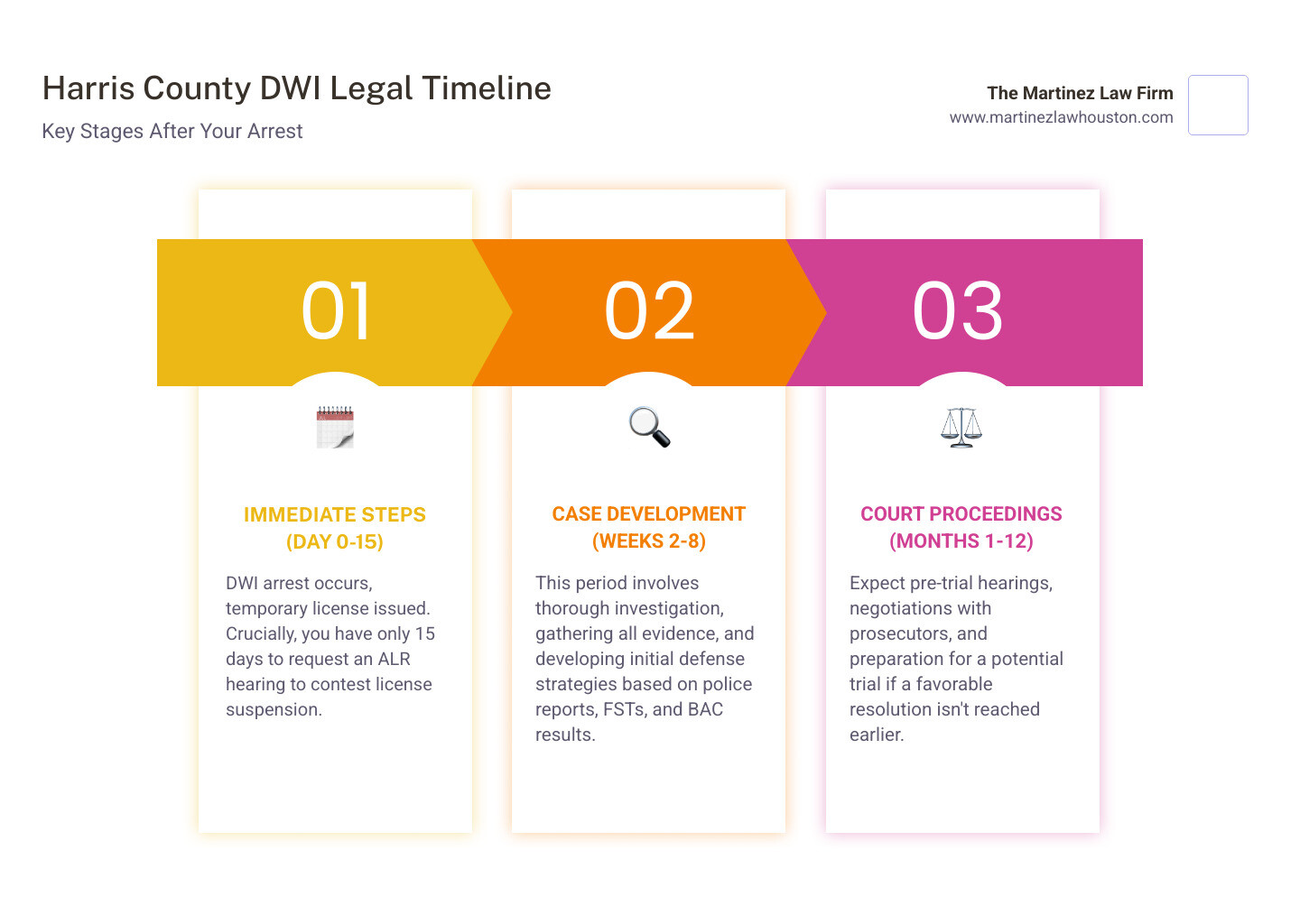
Understanding Your DWI Charge in Harris County
If you’re facing a DWI charge in Harris County, understanding the law is the first step toward protecting yourself. Let me break down what Texas law says about DWI charges.
Under Texas Penal Code § 49.04(a), a DWI occurs when you are intoxicated while operating a motor vehicle in a public place. But “intoxicated” has two legal definitions under Texas Penal Code § 49.01(2): not having the normal use of your mental or physical faculties, or having a Blood Alcohol Concentration (BAC) of 0.08 or higher.
This means you can be charged even if your BAC is below 0.08, based on an officer’s subjective opinion that you’ve lost the normal use of your faculties. As a Harris County DWI attorney who has prosecuted and defended these cases, I know this subjective element is often a key area to challenge.
Furthermore, “operating” can mean just being in physical control of the vehicle, not necessarily driving down the road. I’ve seen cases where someone sleeping in a parked car with the keys in the ignition faced DWI charges. The most important thing to remember is that an arrest is not a conviction. The state must prove its case beyond a reasonable doubt.
What are the Penalties for a First-Time DWI?
A first DWI arrest is a serious matter with significant penalties. A first-time offense is typically a Class B misdemeanor, but certain circumstances can lift it to a Class A misdemeanor with much harsher consequences.
| Offense Classification | Maximum Jail Time | Maximum Fine | Minimum Driver’s License Suspension | Other Penalties |
|---|---|---|---|---|
| Class B Misdemeanor | 180 days | $2,000 | 90 days – 1 year | Annual DPS Surcharges ($1,000 for 3 years), Ignition Interlock Device (IID) possible, community service, DWI education programs |
| Class A Misdemeanor | 1 year (365 days) | $4,000 | 90 days – 2 years | Annual DPS Surcharges ($1,500-$2,000 for 3 years), Mandatory IID, community service, DWI education programs, more extensive probation |
The jail time and fines are just the start. A conviction triggers an automatic driver’s license suspension and costly annual DPS Driver Responsibility Surcharges for three years. In Houston, where a car is essential, losing your license can disrupt your entire life. That’s why we fight so hard to protect your driving privileges.
How Your BAC Level Impacts the Charge
Your BAC reading significantly impacts the charge. While 0.08 is the legal threshold, where your BAC falls above that line matters.
If your BAC is between 0.08 and 0.14, a first offense is typically a Class B misdemeanor. This is the most common scenario I see in Harris County.
But if your BAC is 0.15 or higher, the charge is automatically improved to a Class A misdemeanor. This means you face up to a full year in jail and a $4,000 fine. The difference between 0.14 and 0.15 might seem small, but it doubles your potential penalties. It’s also worth noting the ongoing national debate on lowering BAC limits to 0.05, showing that DWI laws remain a focus of strict enforcement.
What if There Was an Open Container?
Imagine being pulled over and an officer sees an open beer can in your car. That open container just made your situation much worse.
Under Texas’s open container law, a first-time DWI with an open alcoholic beverage in your immediate possession increases the minimum jail sentence from 72 hours to six days. While still a Class B misdemeanor, this mandatory minimum jail time limits a judge’s discretion and presents new challenges for your Harris County DWI attorney.
Why You Need an Experienced Harris County DWI Attorney Immediately
If you’ve been arrested for DWI in Harris County, waiting to act is a costly mistake. The clock on your case started the moment of your arrest.

The most urgent deadline is the 15-day window to request an Administrative License Revocation (ALR) hearing. If you miss it, your driver’s license will be automatically suspended 40 days after your arrest, regardless of your criminal case’s outcome. In a city like Houston, losing your license can mean losing your job.
Beyond the deadline, evidence disappears, witness memories fade, and surveillance footage is erased. The sooner an experienced Harris County DWI attorney is involved, the better we can preserve evidence and protect your rights. Police and prosecutors are already building their case. You need an advocate who can challenge their evidence and procedures.
At The Martinez Law Firm, we bring a unique advantage to your defense. As a former Chief Prosecutor for the Harris County District Attorney’s Office, I know their strategies and weak points. This insider perspective allows us to build a defense that’s several steps ahead.
An Arrest is Not a Conviction: How a Lawyer Can Fight for You
Let me be clear: an arrest is not a conviction. Many people assume a charge means their fate is sealed, but that’s not true. The prosecutor must prove every element of the case beyond a reasonable doubt—the highest legal standard.
Our job is to create that doubt. Every DWI case has potential vulnerabilities. Was the traffic stop legal? Were field sobriety tests administered incorrectly? Was the breathalyzer calibrated? We scrutinize every detail—police reports, video footage, lab results—to find inconsistencies, procedural errors, and constitutional violations.
These findings are how we win cases. In Harris County, public records show many DWI cases end in not guilty verdicts or dismissals when a defense attorney successfully challenges the evidence. We negotiate aggressively with prosecutors for dismissals or reduced charges, and we are always prepared to go to trial if it’s your best option.
What a Top Harris County DWI Attorney Investigates
Building a strong defense means a thorough investigation. Here are critical areas where errors often occur:
The traffic stop itself is the first place we look. Police need reasonable suspicion for a stop. If their reason is invalid, any evidence gathered afterward could be thrown out.
Field sobriety tests are notoriously unreliable and have strict administration guidelines. We examine every factor—from the road surface to your health—that could invalidate the results.
Breathalyzer machines aren’t infallible. These devices require proper calibration and operation. We investigate maintenance records and potential errors, as medical conditions or even mouthwash can cause false high readings.
When it comes to blood draws, the rules are even stricter. We verify if a warrant was obtained, if the phlebotomist was qualified, and if proper sterilization procedures were followed.
Chain of custody is crucial for all samples. We demand a complete, unbroken chain of custody to ensure the evidence wasn’t contaminated or tampered with.
Finally, we compare police reports against video evidence. Discrepancies between the officer’s report and the video can undermine the officer’s credibility and the prosecution’s case.
This level of investigation is why hiring an experienced Harris County DWI attorney from day one is so critical. The sooner we start, the stronger your defense becomes.
Beyond the Courtroom: Collateral Consequences of a DWI
The penalties for a DWI conviction extend far beyond the courtroom. These collateral consequences can reshape your life long after your case is closed, as detailed by TxDOT’s overview of criminal and administrative penalties.
One of the first is the Ignition Interlock Device (IID). You may be ordered to install this device in your car at your own expense, requiring you to provide a breath sample before the vehicle will start. This is a constant financial and personal burden.
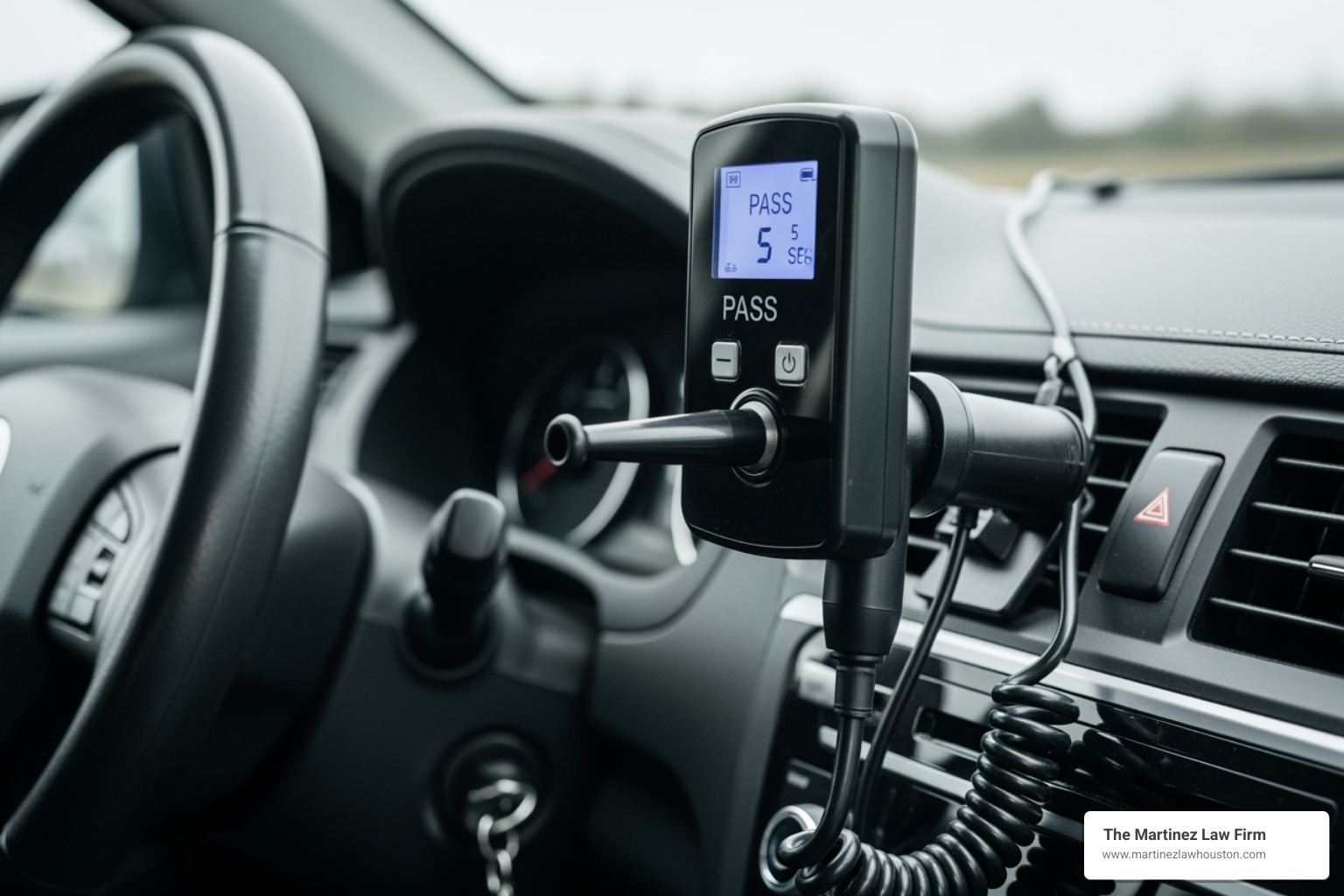
Your insurance rates will skyrocket. A DWI conviction labels you a high-risk driver, often doubling or tripling your premiums for years. Some insurers in the Houston area may drop you completely.
A DWI can threaten your career, especially if you hold a professional license. Professional license risks are serious for nurses, teachers, and others who face disciplinary action, including suspension or revocation of their license.
Employment background checks are now standard. A DWI conviction on your permanent record can limit job opportunities, as many companies are hesitant to hire individuals with a criminal history.
For parents, a DWI can have devastating child custody implications. A conviction can be used in Harris County family courts to argue for reduced custody or supervised visitation.
Finally, a DWI can lead to travel restrictions, as countries like Canada may deny entry to individuals with a criminal record.
These consequences can be more damaging than the initial penalties. As your Harris County DWI attorney, we fight to protect your entire future from these far-reaching effects.
Frequently Asked Questions about Harris County DWI Cases
If you’re facing a DWI charge in Harris County, you likely have many questions. Let’s walk through some of the most common concerns we hear from clients in Houston.
What is an ALR Hearing and Why is it So Urgent?
Your driver’s license is at risk immediately after a DWI arrest, completely separate from your criminal case. This is where the Administrative License Revocation (ALR) hearing is crucial.
You have exactly 15 days from your arrest date to request an ALR hearing. If you miss this deadline, your license is automatically suspended on the 40th day after your arrest—even if your criminal case is later dismissed. The ALR process is independent of the criminal court.
The ALR hearing is your chance to contest your license suspension. Your Harris County DWI attorney can challenge whether the officer had probable cause to stop and arrest you and question the validity of any tests. This 15-day deadline is a primary reason to contact an attorney immediately after an arrest.
Can I Refuse a Breathalyzer or Blood Test in Texas?
Yes, you can refuse a breath or blood test, but Texas’s “implied consent” law means there are automatic consequences. When you get a Texas driver’s license, you agree to provide a sample if lawfully arrested for DWI.
Refusing results in an automatic license suspension—180 days for a first refusal—which is longer than for a failed test. This suspension happens regardless of the DWI case outcome.
Furthermore, Harris County officers can—and often do—obtain a search warrant to compel a blood draw. So, you could face the automatic suspension and have blood evidence used against you. While refusal can sometimes be strategic, it’s a complex decision with immediate penalties. If you’ve already refused, don’t panic—we can still build a strong defense.
How can a Harris County DWI attorney help if I’m a first-time offender?
If this is your first offense, you may have more options available to you. The Harris County District Attorney’s office offers diversion programs for some first-time DWI offenders. Successful completion can lead to a case dismissal, leaving you with no conviction on your record.
An experienced attorney can also work to negotiate reduced charges or favorable probation terms that fit your life. As a former prosecutor, I understand how the Harris County DA’s office operates, which is a significant advantage in these negotiations.
Most importantly, we work to protect your future. A DWI conviction creates a permanent criminal record that affects jobs, housing, and insurance for years. Our goal is to minimize these long-term consequences through dismissal, acquittal, or strategic sentencing. We also guide you through the confusing legal process, ensuring you understand your options at every step.
Secure Your Defense and Protect Your Future
A DWI charge in Harris County is overwhelming, with serious penalties and consequences that can affect your job, family, and future. But remember this critical fact: an arrest is not a conviction. You have rights that deserve a powerful defense.
A strong defense is about protecting the life you’ve built. The decisions you make in the hours and days after your arrest are critical, which is why having an experienced Harris County DWI attorney is essential.
At The Martinez Law Firm in Houston, we understand what’s at stake. Herman Martinez’s experience as a former Chief Prosecutor for the Harris County District Attorney’s Office gives us unique insight into how the prosecution works—and where their cases fail. This is a powerful advantage for our clients.
Our approach is aggressive, strategic, and personalized. We challenge the evidence, scrutinize procedures, and fight for your rights. Don’t steer the Harris County legal system alone. Take the first step in your defense by contacting us today for a free, confidential consultation. We are ready to fight for you.
Please keep in mind that the DWI reinstatement fee only needs to be paid
if you lose your license. The main reasons a person loses their driver’s license in Texas for a DWI is because they lost their ALR hearing, they were sentenced to jail time instead of probation, or they have more than one DWI conviction. Regardless, a person does not have to pay a reinstatement fee if their driver’s license is not suspended. As experienced Houston Lawyers, we frequently save a person’s license by winning their ALR hearing regardless of the fact if they blew over the legal limit or a blood test was performed.