

What You Need to Know About Probation Duration in Texas
In Texas, how long is probation depends on whether you’re facing a criminal sentence or an employment trial period. For criminal cases, probation (officially “community supervision”) can last from 6 months to 10 years. Here’s a quick overview:
- Misdemeanor Probation: Maximum of 2 years for Class A or B misdemeanors.
- Felony Probation: Up to 10 years for most felonies (5 years for some third-degree felonies).
- Sex Offenses with Minor Victims: Minimum of 5 years.
- Employment Probation: Typically 90 days, based on the employment contract.
In Houston and Harris County, the exact duration is influenced by the offense’s severity, your criminal history, the type of probation, and the judge’s discretion.
Probation is a court-ordered alternative to incarceration with strict rules, not a “get out of jail free” card. Violating any condition can lead to revocation, meaning you could be sent to jail or prison to serve the original sentence without credit for the time you spent on probation.
If you’re facing criminal charges in Houston, understanding how probation works is critical. At The Martinez Law Firm—led by Herman Martinez, a former Chief Prosecutor for the Harris County District Attorney’s Office with over 25 years of experience—we know how probation length is set and why decisive, custom defense can shape your outcome.
How Long is Probation in Texas?
When people in Houston ask “how long is probation?” they’re usually referring to what Texas law calls “community supervision.” It’s a criminal sentence served in the community under court supervision, rather than in jail or prison. You must report to a probation officer and follow specific court-ordered rules. If you break those rules, you risk serving the original jail or prison time.
There is no single answer to how long is probation in Texas. The duration depends on the type of crime, your criminal history, and the judge’s discretion. In my 25 years in Harris County courtrooms, I’ve seen judges consider the full picture: the offense, the circumstances, and the defendant’s character. Texas sentencing guidelines provide a framework, but judges have significant leeway, which is why experienced representation is so important.
For DWI-specific probation rules, see our guide on DWI Probation in Texas: What You Need to Know.
How long is probation for misdemeanors vs. felonies?
The biggest factor determining how long is probation is whether the charge is a misdemeanor or a felony.
For misdemeanor probation in Texas (Class A or B), the maximum term is two years. Judges have flexibility as there is typically no minimum term.
Felony probation involves higher stakes and longer terms:
- Most felonies carry a maximum community supervision period of 10 years.
- Some third-degree felonies have a shorter maximum of 5 years.
- Sex offenses involving victims under 17 have a mandatory minimum of five years of probation.
For all felonies, the minimum probation term usually matches the minimum imprisonment term for that offense. The final length depends on your case, the judge, and negotiations between your defense attorney and the prosecutor.

Deferred Adjudication vs. Straight Probation
There are two main types of probation in Texas, and the difference can determine whether you end up with a permanent criminal conviction.
Deferred adjudication is often the best possible outcome. You plead guilty or no contest, but the judge defers a finding of guilt. If you successfully complete probation, the case is dismissed. This means no conviction, and you may be able to have the record sealed later. Learn more about dismissals in our article on Getting Your DWI Dismissed in Texas. The maximum term for deferred adjudication is 10 years for felonies and 2 years for misdemeanors.
Straight probation (or regular probation) is different. The judge finds you guilty and sentences you, but suspends the jail or prison time in favor of community supervision. The critical difference is that you have a conviction on your record. While it may be eligible for an order of nondisclosure later, the conviction remains.
| Feature | Deferred Adjudication | Straight Probation (Conviction Probation) |
|---|---|---|
| Conviction Status | No formal conviction entered if successfully completed | Formal conviction entered |
| Criminal Record Impact | Case dismissed, potentially eligible for expunction | Conviction remains, potentially eligible for nondisclosure |
| Purpose | Avoids conviction, offers a clean slate upon completion | Alternative to immediate jail/prison sentence |
| Eligibility | Depends on offense type, prior record, and prosecutor/judge discretion | Depends on offense type, prior record, and judge’s discretion |
| Violation Consequences | Judge can impose full range of punishment for original offense | Judge can impose original suspended sentence |
Negotiating for deferred adjudication is often a top priority in a defense strategy.
Factors That Influence Probation Duration
Judges in Houston and Harris County consider several factors when deciding how long is probation will be:
- The severity of the crime: A first-degree felony will result in a longer term than a misdemeanor.
- Your prior criminal history: First-time offenders are often viewed more favorably than those with a record.
- Plea bargain negotiations: A skilled defense attorney can often negotiate for a shorter probation term or better conditions.
- The judge’s assessment: Judges have discretion and consider pre-sentence reports, arguments from both sides, and your remorse.
- Your assessed risk level: The probation department uses risk assessment tools. A high-risk score may lead to a longer, stricter term.
- Recommendations from the prosecution: The prosecutor’s stance can significantly sway a judge’s decision.
In some cases, programs like pretrial diversion can help you avoid probation altogether. Learn more in our article: What do I need to do to get a Pretrial Diversion in Houston, Harris County, Texas?
The Rules of Probation and Consequences of Violations
Being granted probation in Houston is a serious second chance that comes with a detailed set of rules. You are entering an agreement with the court, and breaking it can land you back before a judge.
Your probation officer is a key figure who ensures you follow the rules and reports your progress to the court. You will have regular check-ins, which may be weekly or monthly. In Harris County, the Harris County Community Supervision & Corrections Department (CSCD) oversees probation cases. Their Fields Services division works with probationers to ensure compliance and provide support.

Common Probation Conditions in Harris County
While every case is different, most probation orders in Houston include similar conditions. Being prepared for these expectations is key to success.
- Regular reporting to your probation officer is mandatory.
- Staying out of trouble by following all laws is the most important rule. No new offenses.
- Financial obligations, including court costs, supervision fees, and victim restitution, must be paid.
- Community service hours are often required.
- Drug and alcohol testing is frequent and often random. Any marijuana use is typically prohibited.
- Counseling or classes custom to your offense, such as substance abuse treatment or anger management, are common.
- An ignition interlock device is often mandatory for DWI cases, as discussed in our article How Long is DUI Probation?
- Restrictions on where you can go and who you can associate with may apply.
- Maintaining steady employment and notifying your officer of any changes in your job or address is usually required.
- Prohibition from possessing firearms or other weapons.
These conditions are designed to protect public safety and help you rebuild your life. Taking every rule seriously is crucial.
What Happens if You Violate Probation?
Violating your probation terms can undo all your progress. Violations fall into two categories: technical violations (breaking a rule, like missing a meeting or failing a drug test) and new law violations (getting arrested for a new crime).
When a violation is alleged, your probation officer can file a Motion to Revoke Probation (MTR). This leads to a probation violation hearing, where the rules differ from a criminal trial. The prosecutor only needs to prove “by a preponderance of the evidence” (more likely than not) that you violated a term. This lower standard makes having an experienced attorney essential. Our guide on Probation Violation Hearing: What to Do explains this process.
If the judge finds you violated probation, the most severe consequence is serving the original suspended sentence in jail or prison. Crucially, you typically get no credit for the time you already spent on probation. The judge might also extend your probation, add more conditions, or order a short period of jail time. Getting a DUI while on probation is an especially serious scenario, which we cover in What Happens if You Get a DUI While on Probation?
If you are accused of a violation, contact a Houston criminal defense attorney immediately. Early intervention provides the best chance to avoid the worst outcomes.
Understanding Employment Probation Periods
The term “probation” is also used in the workplace, but it means something entirely different from a criminal sentence. An employment probation period is a trial run for a new job, allowing both you and the employer to assess the fit.
This is a contractual agreement, not a legal sentence. In Texas, an “at-will employment” state, either party can end the relationship at any time for nearly any non-discriminatory reason. An employment probation period is defined by your contract or employee handbook, not by state law, and often gives employers more flexibility to terminate a new hire.

How long is probation for employment in Texas?
There is no Texas law setting a specific timeframe, but the most common duration for employment probation is 90 days. This industry standard gives employers time to evaluate your performance and fit. These terms should be outlined in your offer letter or contract.
During this period, termination rights are often more straightforward for employers, and severance pay is typically not offered unless specified in your contract. However, you are still protected by anti-discrimination laws. Your employee handbook should detail the company’s policies on probation, performance expectations, and termination procedures.
Can an Employer Extend a Probation Period?
Yes, an employer in Texas can extend a probation period, but this should be done with a clear written agreement and your employee consent. Extensions are often used when an employer sees potential in an employee who needs more time to meet expectations, sometimes in conjunction with a performance improvement plan.
Legally, an extension continues the employer’s right to terminate with less formality. It’s best practice for both parties to have everything in writing to avoid disputes. If you’re facing an extended probation period, ensure you understand the new expectations and timeline.
Frequently Asked Questions about Probation
Here are answers to the most common questions I hear from clients in Houston and Harris County about how long is probation and what it entails.
Can I shorten my time on probation in Texas?
Yes, it’s possible to get off probation early through a process called early termination, but it is entirely at the judge’s discretion. To be considered, you generally must have completed at least one-third of your probation term or a minimum of two years, whichever is less. You must also have fulfilled all court-ordered conditions, paid all fines and fees, and maintained a record of good behavior with no new violations.
To request early release, your attorney must file a formal motion with the court, presenting evidence of your compliance and rehabilitation. An experienced attorney who knows the local courts can make a significant difference.
What is the difference between probation and parole?
People often confuse probation and parole, but they are fundamentally different.
- Probation is a sentence given instead of jail or prison time. It’s an alternative to incarceration, overseen by the sentencing court and a county probation officer.
- Parole is an early release from prison after an inmate has already served part of their sentence. It is granted and supervised by the Texas Board of Pardons and Paroles, not a judge.
Violating probation sends you back before the original judge, while a parole violation is handled by the parole board. For more definitions, the federal courts offer a Glossary of Legal Terms.
What happens if my probation is revoked?
Probation revocation is a serious outcome where the court finds you violated your supervision terms. The process begins with a revocation hearing, where the prosecutor must prove the violation by a “preponderance of the evidence”—a lower standard than in a criminal trial. You have the right to an attorney, which is critical at this stage, as explained in our article I Have Been Accused of Violating My Probation. What’s Next?.
If the judge finds you in violation, the most severe consequence is serving your original suspended sentence in jail or prison. You typically receive no credit for “street time”—the time you successfully spent on probation. The judge may also impose additional conditions, such as extending your probation, adding community service, or requiring a short jail stay followed by continued probation.
The stakes are incredibly high. If you are facing a potential revocation, contact an experienced criminal defense attorney immediately.
Navigating Your Probation in Houston
Knowing how long is probation is just the first step; successfully completing it in Harris County requires strict compliance. A minor mistake—a missed appointment, a failed drug test, or a traffic ticket—can escalate quickly and put your freedom at risk. What starts as a second chance can turn into jail time if you’re not careful.
Throughout this process, you have legal rights. If you’re accused of a violation, you are entitled to a hearing and to have an attorney fight for you.
At The Martinez Law Firm, we protect people facing these exact challenges. Herman Martinez’s 25+ years of experience, including as a Chief Prosecutor for the Harris County District Attorney’s Office, provides an edge most defense attorneys don’t have. We know how prosecutors build their cases and what judges look for, allowing us to create a personalized defense strategy for you.
Whether you’re just starting the process, worried about a violation, or facing a motion to revoke, you don’t have to face it alone. Your future matters, and the decision to get experienced legal help can determine the outcome.
If you’re dealing with a probation issue in Houston, we are here to help. Contact a Houston DWI Lawyer for Help today to discuss your situation. We’ll explain your options and start building a defense to protect your rights and your freedom.
What You Need to Know About Criminally Negligent Homicide in Texas
Criminally negligent homicide occurs when a person causes another’s death through criminal negligence—meaning they failed to perceive a substantial and unjustifiable risk that a reasonable person would have recognized. In Texas, this charge is the lowest level of culpable homicide, but it still carries serious felony consequences that can change your life forever.
Key Facts About Criminally Negligent Homicide:
- Legal Classification: State jail felony under Texas Penal Code § 19.05
- Prison Sentence: 180 days to 2 years in state jail
- Maximum Fine: Up to $10,000
- Mental State Required: Criminal negligence (failure to perceive risk), not intent to kill
- Key Difference from Manslaughter: Manslaughter requires recklessness (consciously disregarding a known risk), while criminally negligent homicide involves failing to perceive a risk.
- Common Examples: Fatal DWI accidents, leaving a child in a hot car, discharging a firearm negligently, driving with known dangerous vehicle defects
The line between a tragic accident and a crime is at the heart of every criminally negligent homicide case. The outcome depends on whether your actions were a “gross deviation” from what an ordinary person would do—a vague standard when you’re facing charges in Houston or Harris County.
These cases are emotionally profound because they typically involve no intent to harm. They arise from human error or a failure to appreciate danger that leads to the worst possible outcome. The legal system must decide if that failure rises to the level of criminal negligence, which is far more serious than ordinary carelessness.
I’m Herman Martinez, founder of The Martinez Law Firm in Houston. I’ve spent over 25 years on both sides of these cases—first as a Chief Prosecutor for the Harris County District Attorney’s Office and now as a defense attorney. This unique perspective shows me that winning often depends on how effectively your attorney challenges the prosecution’s claims about what you “should have known.”
Understanding Criminally Negligent Homicide in Texas
When someone dies because of another’s actions, Texas law must determine culpability. Criminally negligent homicide is the least severe homicide charge, but it’s a state jail felony with life-altering consequences.
What makes this charge unique is the lack of intent. The accused didn’t mean for anyone to die or even consciously take a known risk. Instead, they failed to see a danger that a reasonable person would have spotted. It is this failure—this blind spot—that the law deems criminal.
But how is this different from ordinary carelessness that might lead to a lawsuit? The answer is “gross deviation from the standard of care.” Texas law doesn’t punish every mistake. Criminal negligence requires a profound failure to recognize an obvious, substantial danger.
What is the legal definition of criminally negligent homicide?
Under Texas Penal Code § 19.05, a person commits this offense by causing a death through criminal negligence. The key is defining “criminal negligence.”
Texas Penal Code § 6.03(d) states you act with criminal negligence when you ought to be aware of a substantial and unjustifiable risk but fail to perceive it. This failure must be a gross deviation from the standard of care an ordinary person would exercise.
In plain English, this means:
- A substantial and unjustifiable risk existed.
- A reasonable person would have recognized this danger.
- The accused failed to perceive the risk.
- This failure was a gross deviation from reasonable behavior, not a simple oversight.
Criminally negligent homicide involves the inadvertent creation of risk. The person wasn’t thinking about the danger. In my years defending clients in Houston, I’ve seen how this element of “should have known” becomes the central battleground of the case.
How It Differs from Murder and Manslaughter
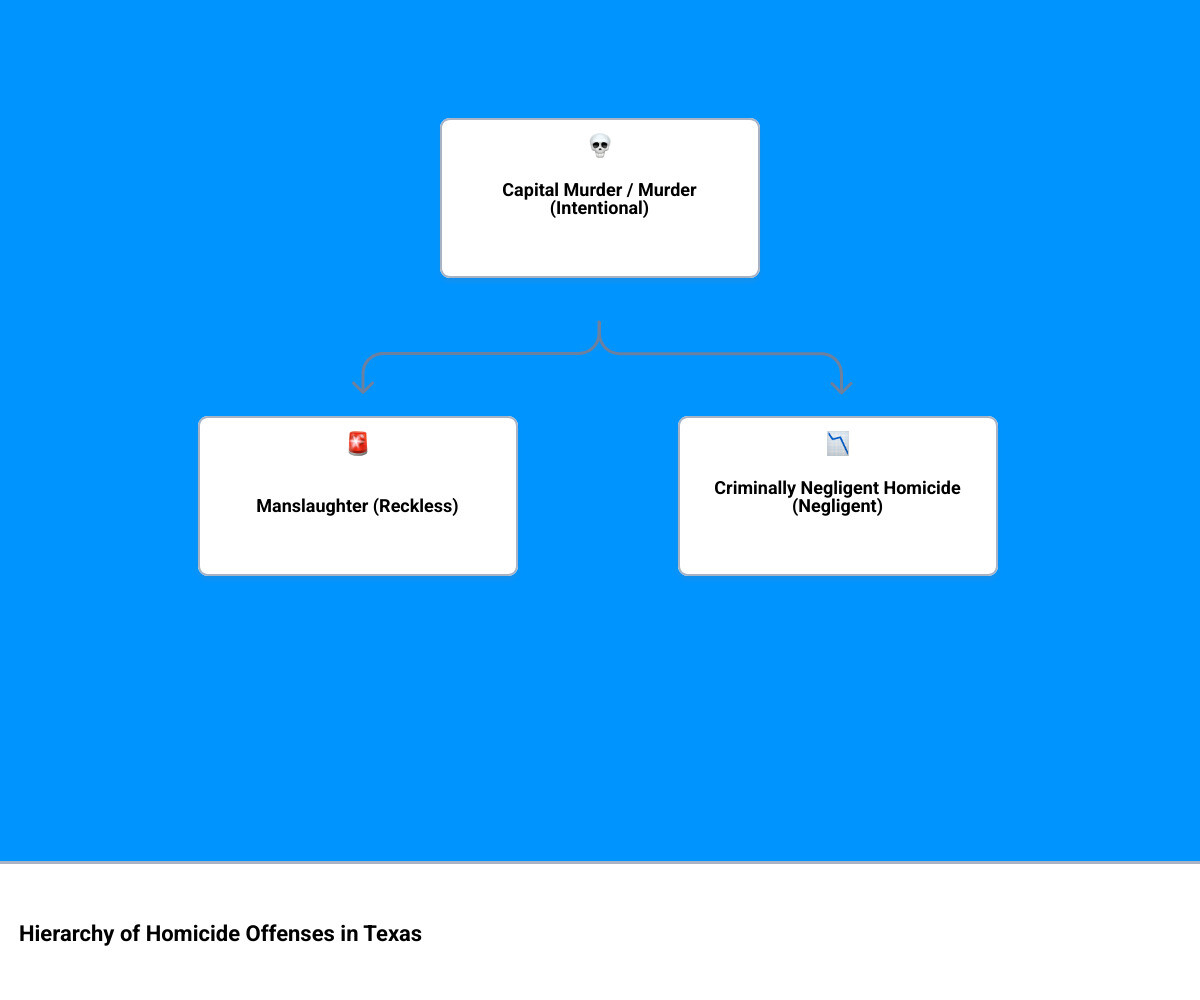
The Texas Penal Code has four culpable mental states: intentional, knowing, reckless, and criminally negligent. Understanding this hierarchy is essential.
- Murder (§ 19.02) is a first-degree felony (5-99 years or life) where a person intentionally or knowingly caused a death.
- Manslaughter (§ 19.04) is a second-degree felony (2-20 years) involving recklessness. The person was aware of a substantial risk of death but consciously disregarded it.
- Criminally negligent homicide (§ 19.05) is a state jail felony (180 days to 2 years). There is no intent and no conscious disregard of risk, only a failure to perceive a danger they should have seen.
| Offense | Mental State (Mens Rea) | Texas Penal Code Section | Punishment Range |
|---|---|---|---|
| Murder | Intentional/Knowing: Intentionally or knowingly causes death; or intends serious bodily injury and commits dangerous act causing death; or commits felony and dangerous act causes death. | § 19.02 | First-degree felony: 5 to 99 years or life imprisonment, up to $10,000 fine. |
| Manslaughter | Reckless: Consciously disregards a substantial and unjustifiable risk that death will occur. Aware of the risk, but proceeds anyway. | § 19.04 | Second-degree felony: 2 to 20 years imprisonment, up to $10,000 fine. |
| Criminally Negligent Homicide | Criminally Negligent: Ought to be aware of a substantial and unjustifiable risk, but fails to perceive it. Gross deviation from reasonable care. | § 19.05 | State jail felony: 180 days to 2 years in state jail, up to $10,000 fine. |
The mental state is everything. Prosecutors in Harris County may initially charge manslaughter, only for it to be reduced to criminally negligent homicide when evidence shows no conscious awareness of the risk. The case of Saunders v. State, 840 SW 2d 390 (Tex.Crim.App.1992), provides a detailed legal analysis of these distinctions.
International Perspectives: A Brief Comparison
Other legal systems grapple with similar issues. The UK’s “gross negligence manslaughter” requires a breach of a duty of care so severe it is considered criminal, as detailed by the Crown Prosecution Service. Canada’s “causing death by criminal negligence” can carry a life sentence and focuses on a “wanton or reckless disregard for the lives or safety of other persons.” These comparisons show the universal challenge of distinguishing a terrible accident from a criminal act.
Common Scenarios That Can Lead to Charges

The tragic reality of criminally negligent homicide is that it often arises from everyday situations where someone fails to recognize a deadly risk. In Houston and Harris County, a moment of inattention can quickly escalate into criminal charges.
The key question is always foreseeability: would a reasonable person have predicted that their actions—or inaction—might lead to someone’s death? This is the standard prosecutors use and the battleground where these cases are won or lost.
Vehicular Incidents
Many criminally negligent homicide charges in Houston stem from our busy roads, where the line between a tragic accident and criminal negligence can be thin.
- Driving under the influence: Even if not legally intoxicated, impairment can affect a driver’s ability to perceive risks that a sober person would see.
- Texting while driving: With the dangers of distracted driving well-known, looking at a phone instead of the road is often argued as a gross deviation from reasonable care.
- Street racing: The choice to race on public roads creates substantial and unjustifiable risks, making it difficult to argue a fatal crash was unforeseeable.
- Driving with known faulty equipment: Postponing repairs on critical parts like brakes or tires can lead to charges if those failures cause a fatal accident. Prosecutors will argue the driver should have been aware of the risk.
Public frustration over traffic fatalities, as noted in reports like “Vehicular homicide sentences not harsh enough, say victims’ families,” can lead to aggressive prosecution, making an experienced defense crucial.
Child Endangerment and Neglect
Cases involving children are among the most heartbreaking. The law expects a higher standard of care around children, and any breach can lead to criminally negligent homicide charges.
- Leaving a child in a hot car: A tragic mistake, but the law expects a reasonable person to be aware of the extreme danger of heatstroke in Houston’s climate.
- Unsafe storage of firearms: If a child accesses a loaded gun and an accident occurs, the adult who failed to secure it faces serious charges.
- Failure to provide necessary medical care: If a guardian fails to get medical help for a child with a condition a reasonable person would see as severe, charges may be filed.
- Manufacturing drugs in a home with children: This exposes children to chemicals and fire risks, which prosecutors view as a profound failure to perceive danger.
Other Negligent Acts

Beyond vehicles and child safety, charges can arise from various other situations.
- Improperly handling a loaded firearm: Waving a gun around or failing to follow basic safety rules can lead to charges if it accidentally discharges and kills someone.
- Workplace safety violations: In Houston’s industrial sectors, if a death occurs from a blatant safety hazard a supervisor should have recognized, criminal charges can follow.
- Negligent medical treatment: Though rare and typically a civil matter, criminal charges are possible in egregious cases where a medical professional’s actions are a gross deviation from the standard of care.
These situations are complex and rarely involve malicious intent. My job at The Martinez Law Firm is to challenge the prosecution’s narrative about what you “should have known” and ensure your actions are judged fairly.
Penalties and Legal Defenses in a Houston Courtroom
Facing a criminally negligent homicide charge in Houston is terrifying. The Harris County criminal justice system moves fast, and these cases carry a unique emotional burden. While there’s no alleged intent to harm, a life has been lost, and you are being held accountable. A strategic, aggressive defense is everything.
Penalties for a Conviction in Texas
A criminally negligent homicide conviction is a state jail felony with severe, life-changing consequences.
- Prison: The sentence is 180 days to two years in a state jail. Critically, you are generally not eligible for parole and must serve the full time, minus any good time credit.
- Fines: You can be fined up to $10,000.
Beyond the sentence, the collateral consequences of a felony conviction are devastating. Your future can be impacted by:
- Loss of employment and professional licenses.
- Difficulty finding housing due to background checks.
- Loss of civil rights, including the right to vote (while incarcerated), serve on a jury, or own a firearm.
- Social stigma that affects you and your family.
This is why we fight to prevent a charge from becoming a conviction that follows you forever.
Potential defenses for a criminally negligent homicide charge
The prosecution must prove every element of the charge beyond a reasonable doubt. My experience as a prosecutor taught me where these cases are vulnerable.
- Lack of Causation: We investigate whether an intervening event broke the chain of causation. For example, did a medical error, not the initial injury, cause the death? If so, your actions were not the legal cause.
- The Risk Was Not Substantial or Unjustifiable: The prosecution will portray the danger as obvious. We challenge this by showing that the risk was not as clear as it seems in hindsight. We may argue that similar actions are common and rarely result in tragedy.
- No Gross Deviation from the Standard of Care: This defense argues that what happened was a true accident, not a crime. We work to show that your actions were not a “gross deviation” from what an ordinary, prudent person might have done in the same circumstances.
- Insufficient Evidence: We scrutinize every piece of the State’s evidence—police reports, witness statements, forensics—for weaknesses, inconsistencies, and gaps. If the prosecution cannot meet its high burden of proof, we push for a dismissal or acquittal.
Every case is unique, and your defense strategy will be custom to the facts. Our commitment is to challenge the State’s narrative and protect your future.
Frequently Asked Questions about Criminally Negligent Homicide

When facing a potential homicide charge, you will have urgent questions. The legal terms are confusing, and the stakes are incredibly high. Here are straight answers to common questions we hear in our Houston office.
Is criminally negligent homicide the same as involuntary manslaughter in Texas?
No. This is a common point of confusion. Texas law does not use the term “involuntary manslaughter.” Instead, Texas has two distinct charges:
- Manslaughter requires recklessness. This means you were consciously aware of a substantial risk of death but chose to disregard it. You knew better but did it anyway.
- Criminally negligent homicide involves criminal negligence. This means you failed to perceive a risk that a reasonable person would have recognized. You should have known better but didn’t realize the danger.
This distinction is critical. Recklessness is about consciously ignoring a known risk, while negligence is about a profound failure of awareness. They require entirely different defense strategies.
Can I go to jail for a car accident that wasn’t my fault?
No. A tragic accident alone is not a crime. You cannot be convicted simply because you were the driver in a fatal accident.
The Harris County prosecutor must prove you acted with criminal negligence, a very high legal standard. They must show your actions were a gross deviation from what a reasonable person would do. Simple carelessness or a momentary lapse of attention is not enough.
If you were driving lawfully and an unforeseeable event occurred—like another driver running a red light—it is a tragedy, not a crime. However, if your conduct fell far below a reasonable standard (e.g., texting extensively, driving a car you knew was unsafe), the situation is more serious. Even then, the prosecution has a high burden of proof, and we can build a strong defense.
What is the first thing I should do if I’m investigated for criminally negligent homicide?
If law enforcement contacts you about a fatal incident, you must do two things immediately: exercise your right to remain silent and contact an experienced criminal defense attorney.
Do not speak to the police without a lawyer. It’s natural to want to explain yourself, but this is dangerous. As a former Chief Prosecutor in Harris County, I saw countless people talk their way into charges. Innocent statements can be twisted and used against you. You may think you are helping, but you could be building the prosecution’s case.
Exercising your right to remain silent is not an admission of guilt; it is smart. Once you have an attorney, we can assess the situation and protect your rights. The first hours are critical for preserving evidence and building your defense. The sooner you call, the better your chances of a favorable outcome.
Protect Your Future: Why You Need an Experienced Defense
When you’re facing charges after a tragic death, understanding the difference between an accident and criminally negligent homicide is critical. A conviction is a felony that carries jail time, fines, and a permanent criminal record that can ruin your future.
The entire case hinges on what you should have known. The prosecution will argue that any reasonable person would have seen the risk and that your actions were a “gross deviation” from common sense. Challenging this narrative requires an attorney who understands how to dismantle it.
At The Martinez Law Firm, we bring a crucial advantage to your defense: intimate knowledge of how Harris County prosecutors build their cases. As a former Chief Prosecutor for the Harris County District Attorney’s Office, Herman Martinez prosecuted these very charges. We know the playbook, we see the weaknesses in the State’s case, and we know what it takes to win in a Houston courtroom.
Too many people try to explain their way out of trouble, only to have their words used against them. Don’t make that mistake. Behind every charge is a human story, often a tragedy with no malicious intent. We are here to tell that story and fight for you.
If you are under investigation or have been charged, time is not on your side. Contact a Houston criminal defense attorney for a consultation and let us start protecting your future today.
Understanding the Legal Status of Escorts in Texas
Are escorts legal? The answer is complicated. In Texas, paying someone for their time and companionship is generally legal, but paying for sexual services is not. This legal gray area has led to countless arrests and felony charges across Houston and Harris County, ruining lives over simple misunderstandings.
Quick Answer: Are Escorts Legal in Texas?
- Legal: Hiring an escort for companionship at social events or public activities where no sexual services are exchanged.
- Illegal: Agreeing to exchange money (or anything of value) for sexual conduct, which is prostitution under Texas Penal Code § 43.02.
- The Critical Distinction: Legality hinges on the intent and agreement—not just what actually happens.
- Solicitation Charges: In Texas, even offering or agreeing to pay for sex is a state jail felony, punishable by up to 2 years in jail and a $10,000 fine.
- High Risk: Houston law enforcement actively conducts sting operations, and a simple text message can become evidence of solicitation.
The line between legal escort services and illegal prostitution is razor-thin, and crossing it carries severe criminal penalties. Many people arrested for solicitation believed they were acting legally, only to find themselves facing felony prosecution.
I’m Herman Martinez, founder of The Martinez Law Firm, and I’ve spent over 25 years in Texas criminal law, including serving as a Chief Prosecutor for the Harris County District Attorney’s Office. He has seen how easily misunderstandings about whether escorts are legal can lead to life-changing criminal charges. That experience on both sides of the courtroom provides uncommon insight into how these cases are prosecuted and how to build a strong defense.

The Legal Line: Escorting vs. Prostitution in Texas
If you’re wondering are escorts legal, the answer hinges on what is being exchanged for money. In Texas, this distinction is the difference between a legal business transaction and a felony charge that could land you in jail.
Paying for time and companionship is legal. This includes hiring someone to attend a social event, a business dinner, or simply for conversation. A legal escort service operates as a companionship business, where the payment is strictly for the person’s time and presence, not for sexual acts. Clear boundaries and terms of service are essential.
Paying for sex is illegal. The moment money is exchanged with an agreement or understanding that sexual acts will occur, you have crossed into illegal prostitution. The intent and the agreement matter more than the act itself. Law enforcement doesn’t need to catch anyone in the act; they only need evidence of an agreement, which can be a text message, a recorded call, or an exchange with an undercover officer.
What is the Legal Definition of Prostitution in Texas?
Under Texas Penal Code § 43.02, prostitution occurs when someone knowingly offers or agrees to engage in sexual conduct for a fee. The crime is complete the moment the agreement is made.
- “Knowingly” means you understood what you were agreeing to.
- “Offer or agree to engage” is the key element. The act does not need to happen. This is why sting operations are so effective.
- “Sexual conduct” is broadly defined to include intercourse, oral sex, and other forms of sexual contact.
- “For a fee” includes cash, gifts, services, or anything of value exchanged for the promise of sexual conduct.
Both the person offering sex (prostitution) and the person offering to pay (solicitation) are breaking the law in Texas and face serious charges.
Are Escorts Legal in Houston, TX?
While Texas law applies statewide, the question are escorts legal in Houston comes with a warning: enforcement here is notoriously aggressive. The Houston Police Department and Harris County Sheriff’s Office actively hunt for violations, making the city a high-risk area for anyone involved in escort services.

Sophisticated sting operations are a constant threat. Officers pose as both clients and escorts, monitoring the websites, apps, and social media platforms where these services are advertised. They look for red flags like suggestive language, coded phrases (“GFE” or “full service”), or explicit photos.
Online communication is the primary evidence. What you believe is a private conversation could be a documented exchange with an undercover officer. Every text message, email, and chat log can be used to prove an illegal agreement was made. A simple “yes” to a leading question can be enough to lead to a felony charge, even if you never meet the person or exchange money.
The core of these investigations is to prove an agreement for sex in exchange for a fee. Undercover officers are trained to guide conversations toward this line. They may ask, “What does your rate include?” or “For an extra fee, can we make the night more memorable?” Agreeing to such a proposal, even vaguely, can be interpreted as committing the crime of solicitation. Your true intention of seeking non-sexual companionship becomes irrelevant if your words suggest otherwise. In Houston, you must assume every conversation with an escort service is being recorded by law enforcement.
Penalties for Solicitation and Prostitution in Houston
The consequences for crossing the line from legal escorting to illegal prostitution in Houston are severe. Texas law takes a particularly tough stance on those who buy sex. While offering sex (prostitution) may start as a misdemeanor, solicitation of prostitution—the act of buying sex—is a felony from the very first offense.

Under Texas Penal Code § 43.021, merely offering or agreeing to pay for sexual conduct can result in a felony charge. This reflects a deliberate policy to punish the demand side of prostitution, and Houston law enforcement enforces these laws aggressively.
What are the penalties for buying sex in Texas?
In 2021, Texas law (HB1540) made buying sex a felony, even for a first-time violation. If you are charged with solicitation of prostitution for the first time, you face a state jail felony, which includes:
- 180 days to 2 years in a state jail
- A fine of up to $10,000
- A permanent felony criminal record
Penalties escalate for subsequent offenses or if a minor is involved. The table below shows the stark difference in how Texas penalizes the seller versus the buyer.
| Offense Type | Charge Level | Jail Time | Maximum Fine |
|---|---|---|---|
| Prostitution (Offering/Agreeing to sell sex) | |||
| First Offense | Class B Misdemeanor | 3 – 180 days | $2,000 |
| Second Offense | Class A Misdemeanor | Up to 1 year | $4,000 |
| Third or Subsequent Offense | State Jail Felony | 180 days – 2 years | $10,000 |
| Soliciting Prostitution (Buying sex) | |||
| First Offense | State Jail Felony | 180 days – 2 years | $10,000 |
| Second Offense | Third-Degree Felony | 2 – 10 years | $10,000 |
| From someone under 18 | Second-Degree Felony | 2 – 20 years | $10,000 |
| Promoting Prostitution | |||
| General | Third-Degree Felony | 2 – 10 years | $10,000 |
| Of someone under 18 | First-Degree Felony | 5 – 99 years | $10,000 |
| Online Promotion of Prostitution | |||
| General | Third-Degree Felony | 2 – 10 years | $10,000 |
| Of someone under 18 | Second-Degree Felony | 2 – 20 years | $10,000 |
What are the potential legal consequences if an interaction crosses into prostitution?
Beyond jail time and fines, a solicitation conviction carries devastating lifelong consequences that can destroy your career, family, and future. These include:
- Public Arrest Record: Your name and mugshot become public, appearing in background checks and online searches.
- Reputational Damage: The stigma can ruin your standing in the community and strain personal relationships.
- Employment Consequences: A felony conviction can lead to immediate job termination and make it nearly impossible to find new work. It can also result in the loss of professional licenses (for doctors, lawyers, teachers, etc.).
- Vehicle Seizure: Law enforcement can seize any vehicle used to commit or facilitate the offense.
- Immigration Issues: Non-citizens may face deportation or denial of visas and citizenship applications.
- Financial Ruin: The combination of fines, legal fees, lost income, and court-mandated programs can be financially crippling.
Defending Against Solicitation Charges in Texas
Facing a solicitation charge in Houston is overwhelming, but an accusation is not a conviction. With the right legal strategy, it is possible to fight these charges and protect your future. The first and most critical step is to exercise your right to remain silent and ask for a lawyer. Do not try to explain the situation to the police; anything you say can be used against you.

As former prosecutors, we know how to find the weak points in the state’s case. A strong defense requires a meticulous review of all evidence, including police reports, recordings, and text logs. Common defense strategies include:
- Entrapment: This applies if law enforcement induced you to commit a crime you otherwise would not have. If an undercover officer used excessive pressure or coercion to get you to agree to sex for a fee, we can argue you were entrapped.
- Lack of Intent: The prosecution must prove you knowingly agreed to exchange a fee for sexual conduct. If your communication was ambiguous or genuinely focused on legal companionship, we can argue the required criminal intent was absent.
- Insufficient Evidence: We challenge the prosecution’s evidence at every turn. If text messages are vague, recordings are inaudible, or the state simply cannot prove its case beyond a reasonable doubt, the charges may be dismissed.
- Illegal Evidence Collection: If your constitutional rights were violated during the investigation or arrest, we can file a motion to suppress the illegally obtained evidence, potentially causing the prosecution’s case to collapse.
What legal advice should someone seek if facing charges?
If you are facing solicitation charges in Houston, contact an experienced criminal defense attorney immediately. The sooner we get involved, the more we can do to protect you. At The Martinez Law Firm, our unique advantage is Herman Martinez’s background as a Chief Prosecutor for the Harris County District Attorney’s Office. We know the prosecution’s playbook because we helped write it.
Our firm will:
- Immediately evaluate your case to find holes in the prosecution’s argument.
- Protect your rights and ensure you are not pressured into a bad plea deal.
- Develop a custom defense strategy aimed at the best possible outcome, whether that’s a dismissal, a favorable negotiation, or a trial.
- Steer the Harris County court system using our deep local knowledge of the judges and prosecutors.
Don’t face this alone. Let us put our insider experience to work for you.
Can an escort be charged with prostitution?
Yes. The term “escort” offers no legal protection. If a person offers or agrees to engage in sexual conduct for a fee, they can be charged with prostitution under Texas law. They face the same risks of misdemeanor and felony charges, a permanent criminal record, and the devastating collateral consequences that follow.
Furthermore, individuals involved in prostitution are often vulnerable to exploitation, violence, and human trafficking. Many are coerced or forced into this life. If you or someone you know is a victim of human trafficking, confidential help is available 24/7. Contact the National Human Trafficking Hotline at 1-888-373-7888.
Texas Escort Takeaways
The question are escorts legal in Texas has a dangerously complex answer. A thin line separates legal paid companionship from illegal prostitution, and crossing it—even through a single text message or misunderstood conversation—can lead to a felony charge.
We’ve seen it happen too many times: good people who thought they were acting legally suddenly face handcuffs and a ruined future. The consequences of a solicitation conviction in Houston are devastating: a permanent criminal record, jail time, massive fines, and destroyed careers and relationships. These charges can follow you for life.
Houston and Harris County law enforcement agencies are aggressive, using online surveillance and sting operations to build cases. The system is designed to get convictions, and navigating it without expert legal help is nearly impossible.
At The Martinez Law Firm, we leverage Herman Martinez’s experience as a former Chief Prosecutor for the Harris County District Attorney’s Office to our clients’ advantage. We know how these cases are built and, more importantly, how to take them apart. We use that insider knowledge to craft aggressive, personalized defenses that give our clients the best possible chance to protect their future.
If you are facing solicitation or prostitution charges, your next move is critical. Do not talk to the police. Your freedom, reputation, and future are on the line.
We are here to fight for you. For immediate, confidential help, Contact a Houston criminal defense attorney at The Martinez Law Firm today. Don’t face this alone—let us put our experience to work for you.
Why Understanding How to Beat a Domestic Assault Charge is Critical for Your Future
Understanding how to beat a domestic assault charge in Houston requires a strategic defense. The consequences of a conviction are severe, affecting your firearm rights, employment, child custody, and immigration status. Harris County prosecutors pursue these cases aggressively, often even when the alleged victim wants to drop the charges.
Key strategies for your defense include:
- Challenging the Evidence: Finding inconsistencies in statements and a lack of physical proof.
- Asserting Legal Defenses: Arguing self-defense, false allegations, or lack of intent.
- Negotiating with Prosecutors: Using weak evidence to seek a dismissal or reduced charge.
- Taking Proactive Steps: Enrolling in counseling or BIPP to show initiative.
- Hiring an Experienced Attorney: A former prosecutor knows how to dismantle the state’s case.
A charge is not a conviction. The prosecution has the burden of proof, and a skilled defense attorney can expose weaknesses in their case. There are multiple paths to a successful outcome, from proving self-defense to showing that the allegations were fabricated.
I’m Herman Martinez, founder of The Martinez Law Firm. With over 25 years of experience, including time as a Chief Prosecutor for the Harris County District Attorney’s Office, I have a unique insider’s perspective. My background as a former prosecutor and judge allows me to identify and exploit vulnerabilities in the state’s strategy, giving you a critical advantage.

Understanding Domestic Assault Charges in Houston
If you’ve been arrested for domestic assault in Houston, it’s crucial to understand the charge. In Texas, it’s officially Assault Family Violence under Texas Penal Code Section 22.01. The key distinction is your relationship with the alleged victim, which triggers mandatory arrest policies, harsh penalties, and lasting consequences.
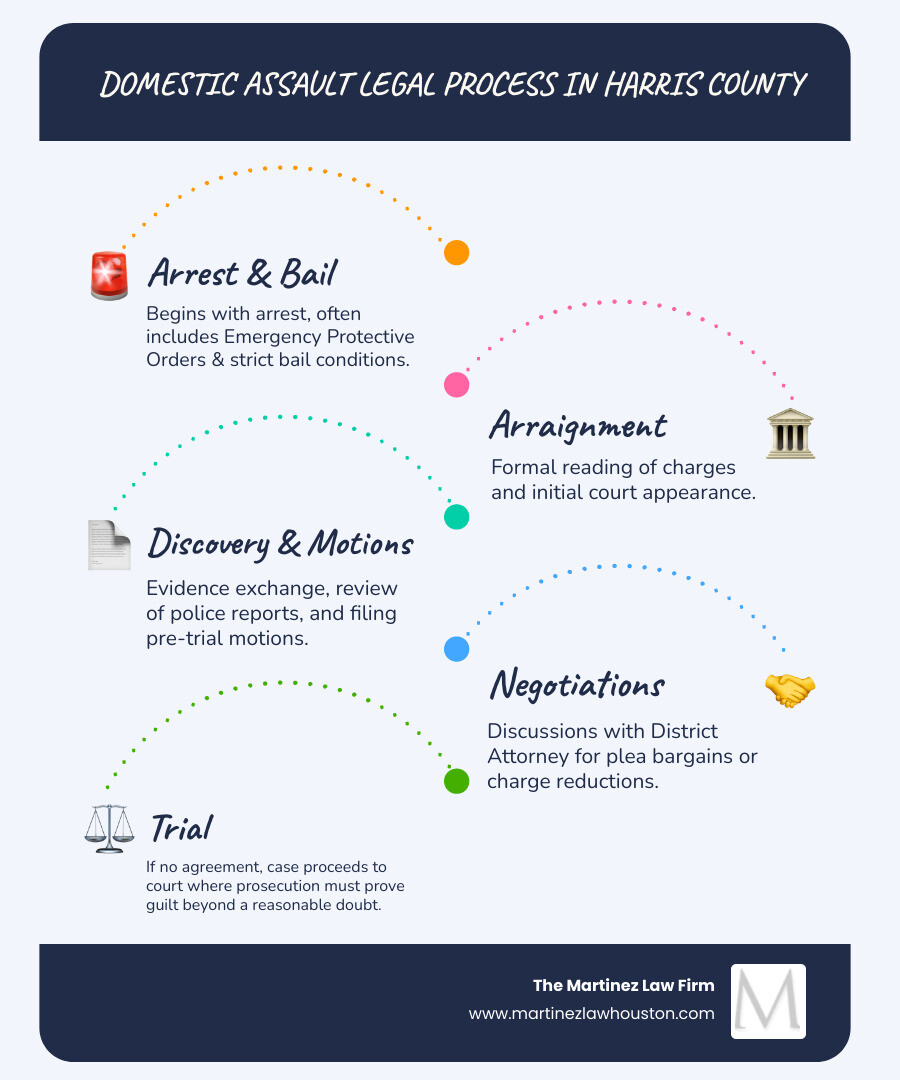
Once arrested in Harris County, you’ll likely face an Emergency Protective Order (EPO) and strict bail conditions. The case then moves through arraignment and negotiations with the District Attorney’s office. The prosecution must prove guilt beyond a reasonable doubt, which is where a strong defense strategy becomes essential.
Aggravating factors can lift a misdemeanor to a felony. An allegation of strangulation or choking results in an automatic felony charge. A prior family violence conviction also improves the charge to a felony, even if the new incident is minor. Furthermore, Continuous Violence Against the Family—two or more incidents in a 12-month period—can lead to a mandatory prison sentence, even without prior convictions.
What Constitutes Domestic Assault in Texas?
Under Texas law, domestic assault occurs if you:
- Intentionally, knowingly, or recklessly cause bodily injury to a family member, household member, or dating partner. “Bodily injury” can be as minor as pain or redness.
- Intentionally or knowingly threaten someone with imminent bodily injury. No physical contact is required.
- Intentionally or knowingly cause physical contact that the other person would find offensive, such as unwanted touching or shoving.
The relationship is what lifts a simple assault to Assault Family Violence. This includes blood relatives, spouses, household members, and individuals in a continuing romantic or intimate relationship.
Potential Penalties for a Conviction
The consequences of a domestic assault conviction in Houston are life-altering. A first-time offense is typically a Class A Misdemeanor, punishable by up to one year in jail and a $4,000 fine. With aggravating factors like strangulation or a prior conviction, it becomes a Third-Degree Felony, carrying 2 to 10 years in prison and a $10,000 fine.
Beyond jail time, a conviction leads to:
- Protective Orders: Long-term orders restricting contact and access to your home.
- Loss of Firearm Rights: A lifetime federal ban on owning guns, even for a misdemeanor conviction.
- Child Custody Issues: A conviction can lead to supervised visitation or loss of custody.
- Immigration Problems: Non-citizens face deportation and inadmissibility for green cards or citizenship.
- Employment and Housing Barriers: The conviction appears on background checks, making it difficult to find jobs and housing.
These are not just possibilities; they are common outcomes. Building a strong defense from day one is critical to protecting your future.
How to Beat a Domestic Assault Charge in Texas
If you’re wondering how to beat a domestic assault charge, know this: the alleged victim does not control the case. The Harris County District Attorney’s Office has the final say and often operates under a “no-drop” policy, pursuing charges even if the victim recants.
However, prosecutors must have a strong case to secure a conviction. An experienced defense attorney can expose weaknesses and negotiate for a dismissal. Prosecutors may drop charges if:
- The evidence is weak from the start (e.g., no visible injuries, no independent witnesses).
- The alleged victim’s statements are inconsistent.
- There is no corroborating physical evidence.
- The alleged victim provides an Affidavit of Non-Prosecution, stating they do not wish to proceed.
- The alleged victim refuses to cooperate, leaving the state without its key witness.
As a former Chief Prosecutor, I know how the DA’s office evaluates cases and what arguments persuade them to dismiss or reduce charges.
Common Legal Defenses to Beat a Domestic Assault Charge
The right defense depends on the facts of your case. Common strategies include:
- Self-Defense: Texas law allows you to use reasonable force to protect yourself, another person, or your property from imminent harm. We must show you had a reasonable belief that force was necessary. The Texas Rules of Evidence guide how we present this defense.
- False Allegations: Accusations are sometimes fabricated out of revenge or to gain leverage in a divorce or custody battle. We investigate the accuser’s motives, search for inconsistencies, and examine texts, emails, and social media for proof.
- Lack of Intent: The contact was accidental. Since assault requires an intentional, knowing, or reckless act, an accident is a complete defense.
- Mistaken Identity / Alibi: You were not there. We use surveillance footage, receipts, and witness testimony to prove you were elsewhere.
Proactive Steps to Help Beat a Domestic Assault Charge

Taking proactive steps while your case is pending can significantly influence the outcome. These actions show prosecutors and judges that you are taking the situation seriously.
- Enroll in Counseling: Voluntarily starting a Batterer’s Intervention and Prevention Program (BIPP), anger management, or substance abuse counseling demonstrates responsibility and a commitment to change.
- Consider Pre-Trial Intervention: For some first-time offenders, these programs offer a path to dismissal upon successful completion.
- Gather Your Evidence: Save all relevant text messages, emails, and social media posts. Get contact information for any witnesses who can support your side of the story.
When presented strategically by your attorney, these proactive measures become powerful negotiating tools that can lead to a more favorable resolution.
Immediate Steps to Take After an Arrest
Getting arrested for domestic assault in Houston can feel like your world is crashing down. The actions you take in those first hours can make or break your ability to beat a domestic assault charge.
Your right to remain silent is your lifeline. Police are building a case against you. Anything you say can be twisted and used in court. The only words you should say are, “I wish to remain silent and I want to speak to my lawyer.” Then, say nothing more.
Do not resist arrest, even if the charges are false. Resisting leads to a separate criminal charge that complicates your defense. Cooperate physically while remaining silent.
After release, you must strictly follow all bail conditions, including any Emergency Protective Order (EPO). Violating these orders will lead to re-arrest and make your case much harder to defend.
Finally, begin preserving evidence. Write down everything you remember, photograph any injuries you sustained, and save all relevant texts, emails, and call logs. This information is vital for building your defense.
Navigating Bail Conditions and No-Contact Orders

Bail conditions and no-contact orders in Houston domestic assault cases are strict, and violations have severe consequences. You must understand and follow them perfectly.
“Any contact” means exactly that. No calls, texts, emails, social media messages, or showing up at the alleged victim’s home or work. You cannot use children or third parties to pass messages. Indirect contact, like asking a friend to deliver a letter, is a violation.
If you share a home, you must move out immediately. Violating a protective order is a new crime. You will be re-arrested, your bond will be revoked, and you will likely remain in jail until your trial. Prosecutors use violations as proof that you are a continuing threat, which destroys any chance of a favorable negotiation.
Review every condition with your attorney. If you have any questions about what is and isn’t allowed, call your lawyer before you act. A five-minute call can prevent a mistake that could ruin your defense.
The Crucial Role of an Experienced Defense Lawyer
When you’re facing a domestic assault charge in Houston, hiring an experienced criminal defense lawyer is essential. The legal system is complicated, and the consequences of a conviction are too severe to face alone.
At The Martinez Law Firm, we offer a unique advantage: Herman Martinez’s 25+ years of experience, including his time as a Chief Prosecutor for the Harris County District Attorney’s Office. This insider’s perspective means we know the prosecution’s playbook—how they build cases and where their arguments are weakest. We use this knowledge to anticipate their strategy and build a defense designed to counter it.
Our work starts with a deep dive into the state’s evidence. We scrutinize police reports, witness statements, 911 calls, and bodycam footage, searching for inconsistencies and constitutional violations. We analyze all evidence to find weaknesses that can help us beat a domestic assault charge.
Armed with this information, we negotiate with the District Attorney’s office. Our former prosecutor experience allows us to speak their language and present compelling legal arguments for why charges should be dismissed or reduced. Our goal is always to avoid a conviction. If a trial is necessary, we are fully prepared to fight for you in court.
How a Lawyer Challenges the Prosecution’s Case
A skilled defense attorney uses multiple tools to dismantle the state’s case and create reasonable doubt.
- Filing Pre-Trial Motions: We file motions to suppress evidence obtained through illegal searches or coerced statements. Getting key evidence thrown out can cripple the prosecution’s case.
- Challenging Witness Credibility: During cross-examination, we expose inconsistencies in testimony and highlight potential biases or motives for the accuser to lie, such as a pending custody battle.
- Presenting Defense Evidence: We don’t just poke holes in the state’s case; we build our own. We present texts, emails, alibi witnesses, and other evidence that supports your side of the story and contradicts the allegations.
- Arguing Legal Defenses: We persuasively argue defenses like self-defense, false allegations, or lack of intent, using Texas law and case precedent to support our position.
By aggressively challenging every aspect of the prosecution’s case, we provide the best possible chance of a successful outcome.
Long-Term Consequences of a Domestic Assault Conviction
A domestic assault conviction has consequences that last a lifetime, affecting far more than just your freedom.

Your criminal record becomes a permanent barrier. In Texas, this conviction appears on background checks indefinitely, creating significant problems in many areas of your life.
- Employment and Professional Licenses: Many employers in Houston will not hire someone with a domestic violence conviction. Professional licenses for careers in medicine, law, and education can be suspended or revoked.
- Housing: Landlords often deny rental applications based on a conviction for a violent crime, making it difficult to find a place to live.
- Firearm Rights: Under federal law, a conviction—even for a misdemeanor—results in a lifetime ban on owning or possessing firearms.
- Family and Immigration: A conviction can be used against you in child custody battles, potentially leading to supervised visitation or loss of parental rights. For non-citizens, it can trigger deportation and prevent you from obtaining a green card or citizenship.
These are not minor inconveniences; they are life-altering consequences. This is why understanding how to beat a domestic assault charge is so critical. Our goal is not just to keep you out of jail but to protect your entire future.
Frequently Asked Questions about Beating a Domestic Assault Charge
When you’re facing a domestic assault charge in Houston, you likely have urgent questions. We’ve been helping people in your situation for over 25 years, and we know the concerns that keep you up at night. Here are answers to the most common questions we hear from clients.
Can domestic assault charges be dropped if the victim doesn’t want to press charges?
No, not automatically. The decision to drop charges belongs to the prosecutor (District Attorney), not the alleged victim. The Harris County DA’s office often pursues these cases under a “no-drop” policy, even if the victim recants.
However, the victim’s wishes are still influential. An Affidavit of Non-Prosecution, a sworn statement from the victim explaining their desire not to pursue the case, can be a powerful negotiating tool for your attorney. If the state’s case is weak without the victim’s testimony, a skilled lawyer can often leverage this to get the charges dismissed or reduced.
What is a protective order and how does it work?
A protective order is a civil court order designed to prevent future family violence. A judge can issue one for up to two years if they find that violence has occurred and is likely to happen again.
These orders typically prohibit you from contacting, harassing, or going near the victim, their home, or their workplace. They also require you to surrender any firearms for the duration of the order. Violating a protective order is a separate criminal offense. It does not matter if the victim initiated contact. Any violation can lead to your immediate arrest, new charges, and revocation of your bond, severely damaging your defense in the original case.
Is it possible to get a domestic assault charge expunged from my record in Texas?
This is very difficult. In Texas, a conviction for domestic assault generally cannot be expunged or sealed, even if you receive deferred adjudication. The law treats these offenses with unique severity.
The only reliable way to be eligible for an expunction—which completely erases the arrest record—is if your case is dismissed by the prosecutor or you are acquitted at trial (found not guilty). This is why fighting the charge from the beginning is so crucial. A conviction creates a permanent record that will affect jobs, housing, and your right to own a firearm. Our primary goal is to avoid that conviction to keep your record clear.
Secure Your Future with a Strong Defense
A domestic assault charge in Houston threatens your career, family, and freedom. While the situation is serious, a charge is not a conviction. The prosecution must prove its case beyond a reasonable doubt, and a strong defense can make all the difference.
Understanding how to beat a domestic assault charge starts with hiring the right legal team. At The Martinez Law Firm, Herman Martinez’s experience as a former Chief Prosecutor for Harris County gives us an unparalleled insider’s perspective. We know how to find the weaknesses in the state’s case and fight for the best possible outcome.
Don’t let this charge define your future. The sooner you act, the more we can do to protect your rights. With an aggressive, knowledgeable defense, you can fight back and work toward securing your freedom.
Contact a Houston domestic violence lawyer to build your defense strategy and take the first step toward protecting your future.
Why Legal Fees Are an Investment, Not Just an Expense

When facing serious accusations, “how much will sex crime defense cost me” is often the first question. The financial burden adds immense stress, but a robust legal defense is a vital investment in your future and freedom, not just an expense.
Here’s a quick overview of typical ranges:
| Case Type | Typical Cost Range |
|---|---|
| Misdemeanor Sex Crime | $3,000 – $10,000 |
| Felony Sex Crime | $10,000 – $70,000+ |
| Complex/Serious Felony | $40,000 – $200,000+ |
| Attorney Hourly Rate | $200 – $750 per hour |
Sex crime accusations can be more life-shattering than murder charges, impacting your job, home, and relationships. Understanding the costs is a crucial first step in building your defense. This guide will help you steer the financial side of securing top-tier representation.
As the founder of The Martinez Law Firm, I’ve seen the critical importance of a strong defense. With over 25 years of experience, including time as a Chief Prosecutor and City Judge, I bring a unique understanding of the justice system to every case.
The Key Factors That Drive Sex Crime Defense Costs

When we evaluate “how much will sex crime defense cost,” several factors influence the price. These figures reflect the case’s complexity, required resources, and the expertise needed for the best outcome. The primary drivers are the charge’s severity, case complexity, attorney experience, and whether the case goes to trial or settles.
Each element impacts the final cost. For a comprehensive look at our approach, explore our insights on Defending a Sexual Assault Case in Houston.
The Seriousness of the Charge
The nature of the accusation is the most significant factor in determining legal costs. Misdemeanor sex crimes, while serious, generally involve less extensive legal work than felony charges. For instance, a Class A Misdemeanor in Texas carries up to one year in jail and a $4,000 fine, while a Class B Misdemeanor has a maximum of 180 days and a $2,000 fine. Legal fees for these can range from $2,500 to $8,000 for Class A and $2,500 to $6,000 for Class B.
Felony sex crimes carry far graver consequences, including lengthy prison sentences and mandatory sex offender registration. First-Degree Felonies, such as aggravated sexual assault, can lead to 5 to 99 years or life in prison.
Second-Degree Felonies might result in 2 to 20 years. Defending these charges is inherently more complex, demanding extensive investigation and meticulous legal strategy. This increased complexity means higher legal fees, with felony cases typically ranging from $7,000 to $70,000, and serious felonies often exceeding $50,000.
Some offenses are “wobblers,” meaning they can be charged as either a misdemeanor or a felony. Our legal strategy in such cases often involves fighting to reduce the charge, which can significantly reduce potential penalties and defense costs. Understanding the legal burden of proof is critical in these cases; learn more about The Burden of Proof in Sex Crimes: What to Know.
The Attorney’s Experience and Reputation
An attorney’s experience and reputation are pivotal. Lawyers with decades of experience, a proven track record, and specific expertise in sex crime defense command higher rates for the value they bring. An experienced criminal defense attorney can cost anywhere from $5,000 to $200,000+, with hourly rates from $200 to $750.
Our firm leverages Herman Martinez’s unique advantage as a former prosecutor. This insider knowledge of how the prosecution builds its case allows us to craft a more effective defense. We’ve been on both sides of the courtroom, and that perspective is invaluable.
When choosing an attorney, peer reviews, board certifications, and attorney ratings (like those on platforms such as Avvo) offer insights into their standing. While ratings are helpful, always verify a lawyer’s disciplinary status with their state bar association before hiring them.
Additional Case Expenses
Beyond attorney fees, other costs are crucial for a strong defense:
- Private Investigators: Essential for gathering evidence and interviewing witnesses.
- Forensic Analysts: For examining digital evidence (computers, phones), DNA, or other scientific data.
- DNA Testing: Independent DNA testing may be necessary if biological evidence is central to the case.
- Psychological Evaluations: If the mental state or credibility of witnesses is an issue, an expert may be needed.
- Court Filing Fees: Administrative costs for filing motions and other legal documents.
- Deposition Costs: Fees for taking sworn testimony from witnesses outside of court.
- Travel Expenses: If the case requires attorneys or investigators to travel, these costs will be factored in.
These expenses are not always predictable, but we discuss them transparently as they become necessary. They are critical investments in strengthening your defense.
Understanding Attorney Fee Structures: Flat Fees vs. Hourly Rates
When you’re asking “how much will sex crime defense cost,” it’s also important to understand how attorneys charge. The two main structures are flat fees and hourly rates, often requiring an initial retainer payment. Each has pros and cons depending on your case.
| Feature | Flat Fee | Hourly Rate |
|---|---|---|
| Predictability | High – fixed total cost | Low – cost varies with time spent |
| Transparency | Clear upfront cost for defined scope | Detailed billing for specific tasks |
| Best For | Cases with defined scope (e.g., plea agreement) | Cases with uncertain duration/complexity |
| Control | Client knows total cost, less worry about hours | Client pays only for work done, but costs can escalate |
| Complexity | Good for cases where outcome is somewhat predictable | Better for highly complex, unpredictable cases |
| Retainer | Often a single upfront payment or phased | Initial deposit, replenished as hours are used |
We believe in clear, honest conversations about costs from the start. Sometimes, attorneys might offer hybrid models or payment plans to make legal help more accessible. Our goal is for you to understand exactly what you’re paying for. You can learn more about how lawyers typically charge for their services on Nolo.com.
What is a Flat Fee?
A flat fee is a single, set amount for an attorney’s services, regardless of the hours spent. This provides cost certainty, which helps with budgeting during a stressful time.
For a misdemeanor charge, a flat fee might range from $1,500 to $3,500. If that same case goes to trial, the fee could increase to $3,000 to $5,000. For felony charges, a flat fee for a favorable settlement might be $3,000 to $6,000. If a felony case heads to trial, the flat fee could range from $10,000 to $20,000. For the most serious felonies, flat fees can go upwards of $40,000.
Sometimes, flat fees are broken down into phases, such as one fee for the pre-trial phase (investigations, motions, negotiations) and a separate fee if the case goes to trial. This “phased billing” helps keep things clear and allows you to plan your finances.
How Do Hourly Rates Work?
With hourly rates, you pay for the exact time the attorney and their team work on your case. For criminal defense attorneys, these rates typically fall between $150 and $750 per hour. Highly experienced lawyers might charge between $250 and $750 per hour.
Attorneys track their time in small increments, like 6 or 15 minutes, so every task is recorded and billed. If your case resolves quickly, you may pay less. However, if a case becomes complex or lengthy, costs can escalate, with monthly bills sometimes reaching $10,000 to $15,000.
Most attorneys will ask for an initial retainer when you hire them. This is an upfront deposit. As the attorney works, their hourly fees are deducted from this retainer. When the balance gets low, you’ll be asked to “replenish” it. For example, a lawyer charging $200 per hour might ask for a $2,000 retainer to cover the first 10 hours of work.
How Much Will Sex Crime Defense Cost? A Look at Average Ranges

When you’re asking “how much will sex crime defense cost,” there is no single, fixed price. The cost depends on factors like the charge’s severity, case complexity, and attorney experience. The numbers we share are average ranges to provide a general idea.
While national averages for a criminal defense lawyer might sit around $8,000 (often ranging from $1,000 to $15,000), costs here in Texas can vary even more, depending on your specific county like Houston, Harris County, or Fort Bend County.
How much will sex crime defense cost for Misdemeanor Charges?
For misdemeanor sex crime accusations, the average defense cost typically ranges from $3,000 to $10,000. These cases, while still very serious, usually don’t require as much deep investigation or as many long court battles as felony cases.
You might be facing charges like Public Lewdness, Indecent Exposure, or Soliciting a Prostitute.
If your case can be resolved quickly through negotiation, your costs might be on the lower end of that range, around $3,000 to $6,000. But if your misdemeanor case needs to go to trial, the costs will naturally climb. A trial means more time and resources spent on preparation, jury selection, and court time. In these situations, you could see costs reaching the higher end, around $8,000 to $10,000.
How much will sex crime defense cost for Felony Charges?
For felony sex crime defense, the costs are significantly higher, generally ranging from $10,000 to $70,000+. For very complex cases, that figure can even go above $200,000. The potential penalties are far more severe, sometimes including decades in prison and mandatory sex offender registration, which demands an incredibly thorough and aggressive defense.
Common felony sex offenses include Sexual Assault, Sexual Assault of a Child, and Child Pornography Charges, which often involve complex digital forensics. We have experience in defending against false allegations in these sensitive cases.
These higher costs reflect the immense work involved, such as analyzing extensive evidence, hiring expert witnesses, and navigating a lengthy court process. Cases where a life sentence is possible can easily exceed $50,000, and for top-tier lawyers, may surpass $100,000. This is an investment in your freedom, future, and reputation.
The True Cost of Inadequate Defense

When asking, “how much will sex crime defense cost,” it’s natural to consider saving money. However, the true cost of an inadequate defense far outweighs any initial savings. Seeking the cheapest option or representing yourself in a complex sex crime case is a gamble with devastating odds. You should never face the legal system without an experienced guide.
While public defenders are a vital resource, they are often stretched thin with massive caseloads, which can limit the individual attention they can dedicate to each case. Representing yourself, while a constitutional right, is a perilous path in sex crime cases where the legal rules are incredibly complex. Trying to save money by delaying or skipping a skilled criminal defense attorney can backfire, potentially leaving you with much graver consequences.
The Lifelong Impact of a Conviction
The impact of a sex crime conviction reaches far beyond legal fees, prison time, or fines. It casts a long shadow over your life, leading to challenges that can last a lifetime. These are the “beyond legal fees” costs that underscore the importance of a strong defense:
- Sex Offender Registration: This public record follows you for life, creating immense problems. You can learn more about what this means for your future here: Sex Offender Registration.
- Employment Challenges: A conviction can make it incredibly difficult to find or keep a job, especially in certain fields.
- Housing Restrictions: The sex offender registry can severely limit where you’re allowed to live, often prohibiting residence near schools, parks, or daycares.
- Professional License Revocation: A conviction can lead to the suspension or permanent revocation of a professional license, ending your career.
- Reputational Damage: The stigma surrounding sex crime accusations is immense and can severely damage your reputation within your community and family.
- Strained Relationships: The emotional toll on your personal relationships is profound and can lead to isolation and breakdowns within families.
It’s also important to remember that false accusations can lead to job loss, child custody battles, and professional license issues, even if charges are never filed. These hidden costs highlight why investing in a robust defense from the start is a crucial investment in protecting your future.
Frequently Asked Questions about Sex Crime Defense Costs
We know that figuring out the money side of a sex crime defense can feel like a maze. It’s completely normal to have lots of questions! Here are some common ones we hear, along with clear answers to help you understand your options.
Is a more expensive lawyer always the best choice?
It’s not simply about picking the most expensive option, but there is a strong link between cost and quality. While a higher fee doesn’t guarantee a specific outcome, it usually reflects an attorney’s experience, a strong reputation, specialized knowledge, and the resources they can dedicate to your case.
For example, an attorney like Herman Martinez, with his background as a former prosecutor, brings a unique advantage. He knows how the other side thinks and builds their case, leading to a more aggressive and personalized defense strategy. Conversely, a “cheap” attorney for a serious sex crime case might lack the experience, time, or resources to properly investigate and challenge evidence. This can lead to a horrible result that costs you far more in the long run. It’s about finding the best value for your investment by looking for an attorney with proven results and a smart approach. For more insights, see our page where a Sexual Assault Attorney in Houston Answers Frequently Asked Questions.
What are the “hidden fees” I should ask about in a consultation?
We believe in being upfront about costs and encourage clients to ask about all potential fees. Beyond the main attorney fee, additional expenses are often necessary to build the strongest defense.
These can include:
- Expert Witness Fees: For specialists like forensic analysts or psychologists.
- Investigator Fees: For private investigators to gather evidence and find witnesses.
- Court Costs and Filing Fees: Administrative fees for filing motions and other documents.
- Deposition Costs: Costs for court reporters and transcripts for sworn testimony.
- Travel Expenses: If your case requires our team or experts to travel.
- Document Duplication and Processing Fees: For copying and organizing large amounts of evidence.
The most important thing is to receive a clear, written fee agreement that spells out all potential costs so there are no surprises.
Can I get a refund if my case is dismissed quickly?
Whether you can get a refund depends on your fee agreement.
If you have a retainer agreement (hourly billing), you pay an initial deposit. If your case is dismissed quickly, any unused portion of that retainer should be refunded to you, after accounting for work performed and expenses. However, some retainers might be listed as “non-refundable” or “earned upon receipt,” so clarify this at the start.
If you agreed to a flat fee, you paid a fixed amount for the attorney’s services, regardless of the time spent. In these situations, a refund is generally unlikely, even if the case is dismissed quickly, because the attorney’s expertise was committed to your case. Some agreements might include rare conditions for partial refunds.
It’s essential to discuss refund policies, how “earned” versus “unearned” fees are handled, and all specifics of your agreement before you sign. This ensures everyone is on the same page.
Protecting Your Future: The Most Important Investment You Can Make
When asking “how much will sex crime defense cost,” it’s easy to feel overwhelmed. Instead of a burden, view these fees as a crucial investment in your future, freedom, and reputation. The factors we’ve discussed—charge severity, case complexity, expert resources, and attorney’s experience—are the building blocks of a robust defense strategy designed to protect what matters most.
At The Martinez Law Firm, we believe everyone deserves an aggressive, personalized defense, especially when facing life-altering accusations. Our unique strength comes from Herman Martinez’s background as a former prosecutor, which gives us an insider’s view of how the other side thinks.
This allows us to craft powerful, effective strategies. We’ve seen proven results in challenging cases across Houston, Harris County, Fort Bend County, Montgomery County, Galveston County, Sugar Land, Pasadena, Missouri City, and Pearland.
The lifelong consequences of a conviction—such as mandatory sex offender registration, employment challenges, and housing restrictions—are the hidden, long-term costs that make investing in a strong defense invaluable.
Don’t let cost concerns prevent you from seeking the best legal help. Scheduling a confidential consultation is a critical first step. Your future, freedom, and reputation are too important to leave to chance.
Ready to take action? Let’s start building your aggressive sex crime defense today. Schedule a confidential consultation with us. We are here to stand by you and fight tirelessly on your behalf.
The Texas Department of Public Safety wants to keep the roads as safe as possible. Part of these efforts is to remove “unfit drivers” before someone gets hurt. Unfortunately, if you live in a commuter city like Houston, TX, you need a car.
There are several reasons the state might suspend someone’s license. For example, someone’s physical or mental health might deteriorate to the point they cannot operate a vehicle safely. However, it is far more common to lose your license due to a moving violation or arrest, such as Driving While Intoxicated (DWI). Then, it’s in the hands of law enforcement and the courts whether they suspend or revoke your license – and for how long.
How Do I Find Out If My License Is Suspended?
You have a few options here. However, if the police pull you over for drunk driving, the suspension is automatic. There’s still a way to save your driver’s license with an ALR hearing, though. You just need a solid attorney on your side.
If the TxDPS upholds the suspension, they send a notice through the mail. In the event you don’t receive this notice or want to check on the status of a suspension, you can also check online, over the phone, by email, or in person.
Checking Your Texas License Suspension Online
The DPS in Texas has an online database that allows you to see whether you have an active suspension on your license. To access your file, you need the following information:
- Date of Birth
- License or ID Number
- The last four digits of your Social Security Number
Additionally, it will show the requirements for reinstatement along with any fees.
By Phone, By Email, Or in Person
The Texas DPS also offers ways to contact the customer service department by phone or email. You can reach the department by calling (512) 424-2000. Alternatively, you can submit an inquiry to the form on this page to contact them by email.
Finally, you can find a DPS office near you and head over there to inquire in person. However, you should be careful if you have warrants out against you.
Texas License Suspension After a Drunk Driving Arrest
If the court convicts you for a DWI, there are two license suspensions to deal with:
- Administrative License Revocation – an ALR hearing
- The legal penalty that accompanies the conviction
You have to deal with the ALR following your arrest, conviction or no. You have 15 days to save your license after your arrest. Work with an attorney to schedule a hearing and appeal your license revocation.
Unless you win your appeal, the suspension starts on the 40th day after your arrest.
How to Fight a Texas License Suspension
If the police arrest you for drunk driving, you need an attorney to help you save your license. Herman Martinez is a practiced attorney with over two decades of experience helping people save their driver’s licenses.
Our legal team can fight the criminal suspension of your license. If the suspension is in place, we can help you apply for a restricted license. However, this may require the installation of an interlock device.
To learn more about your options, call 713.242.1455 today.

The burden of proof in sex crimes cases is an essential factor in how a lawyer builds their defense. When you face a charge, claim, or allegation for a sexual offense in Texas, it’s common to wonder how the evidence works. If you need concise advice, consult a Houston criminal lawyer for guidance on your specific case.
For now, our firm is here to offer a general overview that shows that standards courts follow in most Texas cases.
Burden of Proof in Sex Crimes: “Beyond a Reasonable Doubt”
In a Texas sex crime case, the standard of proof is “beyond a reasonable doubt.” For defendants, this means that the prosecution bears the legal burden of proof. It is on them to establish the defendant’s guilt beyond a reasonable doubt.
When they do so, they have to show that there is no room within the facts for another explanation. The sole resolution must be that the defendant committed the offense. This level of proof must apply to each element of the offense.
However, “beyond a reasonable doubt” does not equate to absolute proof. Instead, it is as close to absolute certainty as possible. Generally speaking, this is the highest legal standard.
As such, this is not solely the burden of proof in sex crimes. In fact, it is the standard of proof across criminal cases throughout the country. It’s part of the “due process” clause in the Fifth Amendment of the Constitution.
Additionally, when the trial begins, it is essential that the jury starts with a presumption of innocence. Then, prosecutors must establish the evidence to show that there is no reasonable doubt of the defendant’s guilt.
As such, it falls to the prosecutors, not a sex crime defense attorney, to shoulder the burden of proof.
Elements of Burden of Proof
When it comes to the burden of proof in sex crimes, the courts have established two aspects of the reasonable doubt standard.
- Burden of production means that the prosecution produced enough evidence to establish every element of an offense as fact.
- Burden of persuasion requires the prosecution to persuade jurors that they applied the standard to every aspect of the offense.
Do Other Standards of Proof Apply?
In Texas sex crimes trials, the prosecution cannot prove guilt by any other standard of proof. Typically, these standards apply solely to civil cases. For example, the standard of “a preponderance of evidence” still allows room for doubt. Additionally, “clear and convincing evidence” only shows that something is probably or likely.
Instead, the burden of proof in sex crimes is for the prosecution to prove guilt beyond a reasonable doubt.
While other standards leave room for interpretation, this remains the highest legal standard for proof. Generally, it applies to criminal trials specifically because the stakes are so high. In some cases, a defendant might face up to 99 years when found guilty of a sex crime.
What Is the Statute of Limitations on Texas Sex Crimes?
In addition to the burden of proof in sex crimes cases, prosecutors who hope to charge someone with a crime have to abide by the Texas statute of limitations for the crimes. These statutes set limits as to how much time may pass before it’s no longer possible to charge someone.
Generally, this varies depending on the severity of the crime.
In Texas, some crimes have no limit on how much time passes. For example, there is no statute of limitations on the following charges.
- Sexual assault of a child
- Indecency with a child
- Aggravated sexual assault of a child
- Continuous sexual abuse of a child
- Sexual assault of an adult (when there is DNA evidence available)
Then, the statute drops to 20 years for the following crimes.
- Burglary with the intent to commit a sex crime
- Aggravated kidnapping with the intent to commit a sex crime
- Sexual performance by a child
From there, the statute lowers to 10 years for the following crimes.
- Sexual assault of an adult (with no DNA evidence)
- Aggravated sexual assault of an adult
So, what does this all mean? The prosecution has to prove the defendant committed the crime within the period of the statute of limitations. However, as mentioned, some crimes have no limitations at all.
Note: It’s important to recognize that “rape” is not a legal term in Texas. Instead, it falls under various forms of “sexual assault.”
A Difficult Standard to Prove
When it comes to rape and sexual assault cases, it is often difficult to prove a case beyond a reasonable doubt. Often, the prosecution cites the definition under the Texas Penal Code as part of the problem. It places an emphasis on the use of coercion, violence, or physical force.
As such, it’s not enough for a potential victim to say “no.” Instead, the burden of proof requires that they show the refusal was overcome by force.
Defenses Against Sex Crime Allegations
With the high burden of proof in sex crimes cases, there are several defenses that offer potential against sexual assault charges.
One option is an “affirmative defense.” In this method, the criminal lawyer proves facts through a preponderance of evidence that shows innocence. Still, the prosecution has to prove each element beyond a reasonable doubt. However, if the defense lawyer convinces the jury that the facts of the affirmative defense are true, they may find the client not guilty.
Do You or a Loved One Need Legal Representation?
If you face allegations of sex crimes in the Greater Houston Area, you need an experienced Houston criminal lawyer to protect your rights and your future.
Contact our criminal defense law firm for a free, confidential consultation. Our legal team is ready to offer guidance and fight for the best possible outcome in your case.

A white-collar crime is a non-violent type of crime. Often, the motivation is financial. Typically, white-coll criminals have a position of power in a company that commands compensation above the average salary.
In the 1930s, criminologist Edwin Sutherland coined the term. He used the phrase to describe crimes that people of high social status committed. Prior to this introduction to the concept, people often believed that upper-class individuals weren’t capable of criminal acts.
Blue Collar or White Collar Crime: What’s the Difference?
Oftentimes the difference between blue-collar and white-collar crime stems from the type of access the person has. For example, blue-collar crimes tend to be more straightforward and direct. This includes robbery, theft, etc. Because they lack access to corporate information, it’s more difficult for them to commit high-level fraud.
On the other hand, a white-collar criminal tends to have more access to this information and the systems involved. For instance, a loan officer at a bank has access to a broad spectrum of records, information, and systems.
With this access, they have the potential to commit widespread, complicated schemes.
Common Types of White Collar Crime
White-collar crime is an umbrella term, As such, it encompasses a broad array of offenses. Let’s look at a few of the more common forms of these crimes.
Insider Trading
When someone commits insider trading, they act with the benefit of knowledge that is not public. This knowledge gives them an advantage in financial markets. For instance, an investment banker knows about a forthcoming acquisition between two companies: A and B.
With this knowledge, they buy stock in Company B because they expect it to rise once this knowledge becomes public. This gives them an unfair advantage over other investors.
Identity Theft and Cyber Crimes
Identity theft and hacking are the top two computer crimes. Across the United States, experts estimate that losses from identity theft totaled almost $2 billion in a single year. With over 73,000 cases, California has the most reported cases of any state in the US.
Fraud
As white-collar crime is an umbrella term, so is fraud. It covers a handful of different schemes people use to defraud others of their assets. One common example of fraud is when someone claims to send another person a lot of money. However, that individual first needs to send a smaller amount.
For instance, they may claim that they have access to an inheritance. However, to gain access, they need $300 to afford some processing fee. When the person sends them money, they never receive what was promised to them.
Ponzi Scheme
This form of white-collar crime gets its name from Charles Ponzi, the original perpetrator. This scam is an investment scheme in which someone offers investors high returns on a project. As the person finds a new client, they pay off the initial investors.
This continues until they no longer have the ability to attract the clients they need to pay off older ones. When this happens, the entire scheme collapses. This leaves many of the investors with massive losses.
Embezzlement
Embezzlement covers theft and larceny. It ranges from an employee who steals a few dollars out of a cash register to complex schemes. In more complicated cases, the employee transfers millions of dollars out of company accounts.
One popular example of this is in the plot of the movie Office Space. A group of employees attempts to set up a program that transfers fractions of cents out of company accounts over time. However, they accidentally set up one massive transfer.
Money Laundering
As far as white-collar crime goes, money laundering is essential for those who deal in large amounts of cash. Through this act, someone funnels cash through different accounts and eventually into a legitimate business.
At that point, it intermingles with genuine revenue, making the illegal source harder to identify.
Counterfeiting
In order to combat counterfeiting efforts, many currencies are now more detailed and colorful. With modern technology, older forms of currency were easy to duplicate. However, the results remain to be seen as technology continues to advance on both sides.
Espionage
When we think of espionage or spying, we often think of James Bond or international spies working to uncover information. Yet, we don’t think of it as a white-collar crime very often.
However, when it involves corporations, it is definitely a white-collar crime. For instance, an agent of a foreign government or competitive company might seek out information or technology from a company.
One tactic is to approach an employee at that company. The “spy” offers to pay them a large sum in exchange for a prototype, copy of a document, etc.
White Collar Crime Classifications
Oftentimes, these crimes fall into two categories.
Corporate Crimes
Some white-collar criminals act at a corporate level, as a group. For instance, a firm may encourage or simply allow employees to engage in insider trading. As they use private information to gain an advantage, it boosts their profits.
Money laundering is another common crime conducted at a corporate level.
Individual Crimes
At the individual level, a person or group acts outside of a corporation. For instance, one person might build out a Ponzi scheme. Alternatively, a group might form to commit cybercrimes collectively.
Other individual crimes commonly include hacking, counterfeiting, and dozens of fraud schemes.
Legal Review for White Collar Crime
When you face charges for a white-collar crime, it’s essential to gain legal representation. With a criminal defense attorney on your side, you have an advocate to protect your rights and freedom.
If you or a loved one currently faces white-collar criminal charges, contact the Martinez Law Firm for a free legal consultation. To build a strong defense, you need an experienced attorney.

A man in Houston robbed a bank inside of a Walmart in Harris County early this morning. According to the FBI, the suspect walked into the store and went up to the teller’s window. He handed the teller a note and demanded finances. He threatened the teller, claiming that he had a gun and was willing to use it.
The teller complied with his wishes, and the suspect walked out of the store with cash in hand. He got into a silver Pontiac Grand Prix and sped from the scene. This is not the only time that a Harris County local has robbed a bank in the area in recent days. Some suspect that the same individual continues to rob banks in the area.
Harris County Sheriffs are now looking into the incident. They are still trying to determine how many suspects were inside the bank for the robbery and how much money they fled with. The getaway vehicle was located in a shopping center and there was cash inside the vehicle. It has been recovered, but police are still looking for the offender.
If you have been accused of robbing a bank, then you are going to want a Houston criminal defense attorney on your side immediately. Bank robbery is a serious crime that can result in life-altering penalties and marks on a person’s record. Texas State Law says that a bank robber can be charged with up to 20 years in prison and a fine of $250,000.
Aggravated robbery is a robbery that occurs when a suspect causes serious bodily injury to another or uses or exhibits a weapon. This means that the robber doesn’t actually have to use the weapon, exhibiting the gun or knife is enough to constitute aggravated robbery. If you have been charged of this crime and want a defense lawyer on your side, don’t hesitate to hire a professional former prosecutor at The Martinez Law Firm. A
Houston criminal defense attorney at this firm will help you to get the assistance that you need today. Contact the firm right away to learn more!

According to recent reports of police crimes, a Harris County sheriff’s deputy was recently indicted after claims that he was coercing women with warrants into pleasuring him sexually. Reports show that he told one woman that if she performed an act with him, he would not turn her in. He has been charged with the police crimes of sexual assault and official oppression as a result. According to investigators, he came across a woman who had an open warrant, and then offered not to arrest her in exchange for physical interactions.
Whenever police are arrested and indicted, it can be very serious. Those who are supposed to be maintaining the law are often held to the highest standard, and when arrested and charged with police crimes officers are at risk to serious punishments and guaranteed job loss. If you want to learn more about police crimes, or if you are an officer who has been charged with a serious crime, then you need to talk with a Martinez Law Firm criminal defense attorney today.
Sadly, many police officers are falsely accused of crimes like the one described above. Sometimes angry criminals want to avoid penalties, and will claim false arrests or accuse a police officer of gross misconduct. If you have been accused of a police misconduct crime, and are not guilty, then you need to talk with a Houston criminal defense lawyer at the firm today and set the record straight. At The Martinez Law Firm, Attorney Martinez and his team are here to help you out with your criminal charges. The firm is focused on working to help you with your case and doing all that they can to prove your innocence. Don’t hesitate to call the firm right away to learn more and get the information that you need!