

Understanding the Jail vs Prison Distinction

Jail vs prison are terms often used interchangeably in everyday conversation, but they represent fundamentally different parts of the criminal justice system. For anyone facing criminal charges in Houston or Harris County, understanding this distinction isn’t just academic—it directly impacts where you’ll be held, for how long, and what your daily life will look like during incarceration.
Quick Answer: The Core Differences
| Aspect | Jail | Prison |
|---|---|---|
| Operated By | Local government (county sheriffs, city police) | State or federal government |
| Typical Sentence Length | Less than 1 year | More than 1 year |
| Who’s Held There | Pre-trial detainees, misdemeanor offenders | Convicted felons |
| Primary Purpose | Temporary holding, awaiting trial/sentencing | Long-term punishment and rehabilitation |
The confusion between these two facilities is understandable. Both involve loss of freedom, both are part of the criminal justice system, and both can dramatically impact your future. However, whether you’re facing time in the Harris County Jail or a Texas Department of Criminal Justice (TDCJ) prison facility depends entirely on the nature and severity of the charges against you.
Jail vs Prison in Texas
In Texas specifically, this distinction matters even more. The state uses determinate sentencing guidelines, and the classification of your offense—misdemeanor versus felony—determines not only where you’ll serve time but also what rights you retain, what programs are available to you, and how your case is prosecuted.
More than 2 million people are incarcerated in the United States at any given time, with about 30% held in local and county jails and roughly half in state prisons. Nearly 11 million people cycle through jails every year, highlighting the high-turnover, short-term nature of these facilities compared to the more stable, long-term prison population.
I’m Herman Martinez, founder of The Martinez Law Firm in Houston, and with over 25 years of experience as both a former Chief Prosecutor for the Harris County District Attorney’s Office and a City of Houston Judge, I’ve seen how the jail vs prison distinction impacts defendants on both sides of the courtroom. My unique perspective from working within both the prosecution and defense sides of the criminal justice system has taught me that understanding where you might be held—and why—is the first step in building an effective defense strategy for charges ranging from DWI to serious felonies.
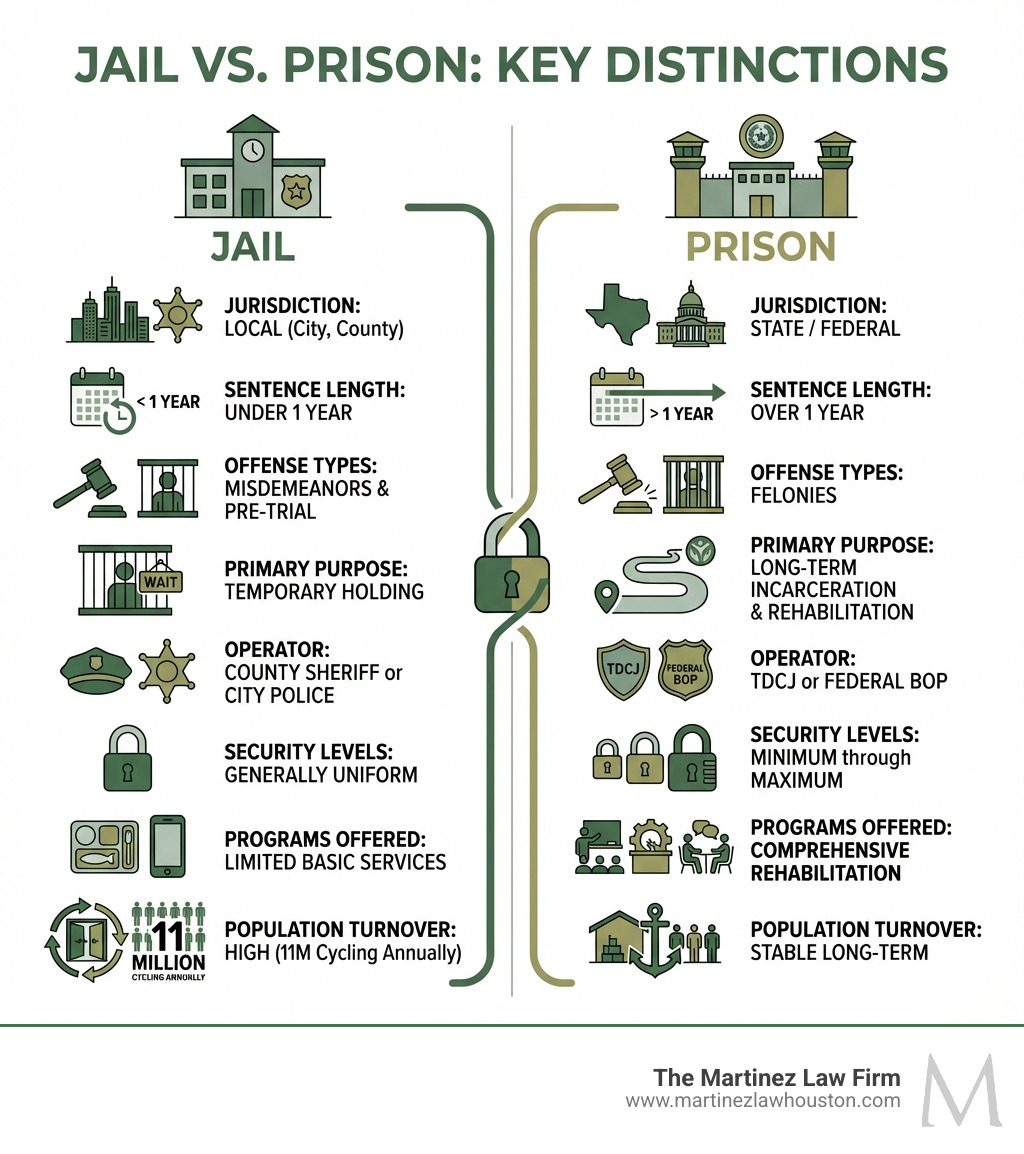
The Core Differences: Jail vs Prison
When we talk about correctional facilities, the terms “jail” and “prison” are often tossed around as if they’re interchangeable. But, as we’ve already hinted, they serve distinct purposes within our criminal justice system. Understanding these differences is absolutely crucial, especially if you or a loved one is navigating the system in Houston or Harris County. Let’s break down the fundamental distinctions that define whether a facility is a jail or a prison, focusing on who runs it, why people are there, and for how long.
| Aspect | Jail | Prison |
|---|---|---|
| Operator | Local government (county sheriffs, city police) | State or federal government |
| Sentence Length | Typically less than 1 year (or pre-trial) | Typically more than 1 year |
| Offense Type | Misdemeanors, awaiting trial/sentencing | Felonies, serious crimes |
| Primary Purpose | Detention, short-term incarceration | Long-term incarceration, rehabilitation |
Who Runs the Facility? Jurisdiction and Operation
The first, and perhaps most defining, difference between a jail and a prison lies in their administration. It’s all about jurisdiction, folks!
Jails are typically local facilities, meaning they are operated by local government entities. In Houston and across Harris County, this primarily falls under the purview of county sheriffs, such as the Harris County Sheriff’s Office, which runs the Harris County Jail. City police departments might also operate smaller municipal jails for very short-term holds. These local facilities are designed to serve the immediate needs of the local justice system, handling arrests made within the city or county limits.
Prisons, on the other hand, are much grander in scale and fall under the authority of either state or federal government agencies. In Texas, our state prisons are managed by the Texas Department of Criminal Justice (TDCJ). These are the facilities that house individuals convicted of serious state crimes. For federal offenses, we look to the federal government, specifically the Federal Bureau of Prisons (BOP), which oversees a network of federal correctional institutions across the country, including those in Texas.
So, if you’re arrested by the Houston Police Department for a state-level misdemeanor, you’re likely headed to the Harris County Jail. If you’re convicted of a serious felony and sentenced to several years, you’ll be transferred to a TDCJ prison. If you’re charged with a federal crime, you’ll be in the federal system from the get-go.
Why Are You There? Offense Type and Legal Status
The reason for an individual’s incarceration is another critical differentiator between jails and prisons. It reflects their legal status and the stage of their criminal justice process.
In a jail, you’ll find a wide mixture of people. Many individuals are there awaiting trial, which we call pre-trial detention. They haven’t been convicted yet, but they’ve been arrested and are being held because they couldn’t make bail or were deemed a flight risk. Jails also house individuals who have been convicted of misdemeanors and are serving shorter sentences, typically less than one year. Additionally, jails may hold people who have violated their probation or parole, or those awaiting transfer to another facility. The Texas Penal Code outlines the various misdemeanor offenses that could lead to jail time in Texas.
Prisons, conversely, are reserved for individuals who have been convicted of serious crimes—felonies—and have been sentenced to long-term incarceration. These are individuals who have gone through the trial process (or pleaded guilty) and have been found guilty of offenses that warrant more than a year behind bars. This includes both state crimes, resulting in placement in a TDCJ facility, and federal crimes, leading to federal prison. The population in prison is largely post-conviction, serving out sentences for crimes like murder, aggravated assault, drug trafficking, or fraud.
How Long is the Stay? Sentence Length
Perhaps the most practical way we distinguish between jails and prisons is by the typical length of stay. This is the “how long” factor, and it’s a pretty clear line in the sand.
Jails are designed for short-term stays. This can mean a few hours for someone arrested and quickly bailed out, or it could mean up to a year for someone convicted of a misdemeanor. Individuals awaiting sentencing, or those held temporarily for other jurisdictions, also contribute to the short-term nature of jail populations. The average length of stay in a jail is significantly shorter than in a prison, primarily because of the dynamic mix of pre-trial detainees and those serving brief sentences.
Prisons, by contrast, are built for long-term incarceration. If you’re sentenced to more than one year, you’re almost certainly headed to prison. This can range from a couple of years for a lower-level felony to decades, life sentences, or even death row for the most severe crimes. The entire infrastructure and operational philosophy of a prison are geared towards managing individuals who will be there for extended periods, often with the goal of rehabilitation and eventual reintegration into society (though the effectiveness of this varies).
A Look Inside: Daily Life and Environment
The day-to-day experience of an incarcerated person varies dramatically between a jail and a prison. It’s not just the length of stay that’s different; it’s the entire environment, from the social dynamics to the opportunities available.

Population and Turnover: The Jail vs Prison Environment
Imagine a busy bus station versus a long-term care facility. That’s a bit like the difference between a jail and a prison in terms of population dynamics.
Jails experience incredibly high turnover. Nearly 11 million people cycle in and out of jails every year across the U.S. This means the population is constantly changing, with new faces arriving and others departing daily, sometimes hourly. This creates a very fluid and often unpredictable environment. Individuals in jail are in various stages of the legal process—some are newly arrested, some are awaiting trial, others are serving short sentences, and some are waiting to be transferred. This constant flux means that jails often focus on immediate needs and basic processing rather than long-term stability or programming.
Prisons, however, have a much more stable population. Inmates are there for the long haul, serving sentences that typically exceed one year. This stability allows for the implementation of more structured routines and a more consistent approach to security and programming. While there are transfers and releases, the core population remains relatively constant, fostering a different kind of social environment and operational focus.
Security Levels and Inmate Classification
While both jails and prisons are secure environments, the complexity and stratification of security measures differ significantly.
Jails generally have a more uniform and typically lower security environment compared to prisons. Because they house a diverse mix of pre-trial detainees and those serving short sentences for less serious crimes, the need for extensive, tiered security classification is less pronounced. Security is certainly a priority, but it’s typically geared towards preventing escapes and maintaining order within a transient population.
Prisons, especially state and federal facilities, operate with a highly sophisticated system of multiple security levels. These range from minimum security, often referred to as Federal Prison Camps, where non-violent offenders with shorter sentences might have more freedom of movement, to medium, and then to maximum security facilities. Maximum security prisons are designed for inmates with a history of violence or those who pose a significant escape risk. There are also administrative segregation units for inmates requiring isolation for disciplinary or safety reasons. This classification system helps manage different levels of risk within a long-term population. For example, federal prisons are classified into five different security levels: Minimum, Low, Medium, Maximum, and Administrative, with facilities like ADX Florence representing the most secure federal prison, housing high-profile inmates in extreme isolation.
Programs and Services: Rehabilitation Opportunities
The availability and scope of programs and services also highlight a significant difference between these two types of facilities.
Due to their short-term nature and high turnover, jail programs are often limited. The focus is primarily on managing the population, ensuring basic needs are met, and facilitating legal processes. While some jails might offer basic educational resources or support groups, comprehensive educational or vocational training programs are rare. The emphasis is on temporary confinement rather than long-term solutions or extensive rehabilitation.
Prison programs, however, are typically much more comprehensive. Given the long sentences, prisons have a greater imperative and opportunity to offer a wider array of services aimed at rehabilitation and preparing inmates for eventual release. This can include General Equivalency Diploma (GED) courses, college-level education programs, vocational training (like welding, carpentry, or culinary arts), and extensive mental health and substance abuse counseling services. The goal is often to equip individuals with skills and support systems that can help them successfully reintegrate into society upon release, reducing recidivism.
Special Considerations in the Justice System
Beyond the basic definitions, other factors like private operation and the distinction between state and federal systems add layers of complexity to our understanding of correctional facilities. It’s not always as simple as local vs. state/federal.

State vs. Federal Systems
The U.S. has a dual court system, meaning we have both state and federal laws, and consequently, state and federal correctional systems. Understanding which system applies to a given crime is critical.
State crimes are violations of laws established by individual states. In Texas, these are outlined in the Texas Penal Code. Most criminal offenses—from simple assault and theft to murder—are state crimes. If you’re convicted of a state felony in Houston, you’ll be sentenced to a state prison managed by the Texas Department of Criminal Justice (TDCJ). These cases are prosecuted by local district attorneys, such as the Harris County District Attorney’s Office.
Federal crimes, conversely, are violations of laws enacted by the U.S. Congress, found in the U.S. Code. These typically involve offenses that cross state lines, impact federal interests, or occur on federal property. Examples include interstate drug trafficking, bank robbery (if the bank is federally insured), mail fraud, wire fraud, or crimes committed in national parks. Investigations for federal crimes are carried out by federal agencies like the FBI or DEA, and prosecutions are handled by U.S. Attorneys. If convicted, individuals serve their time in facilities run by the Federal Bureau of Prisons (BOP). The penalties for federal crimes can often be more severe, with stricter sentencing guidelines and mandatory minimums, and importantly, there is no parole in the federal system.
It’s also worth noting that sometimes, both state and federal authorities can have jurisdiction over the same crime, a concept known as “dual sovereignty.” This means a person could potentially face prosecution in both state and federal court for the same act, a rare exception to the double jeopardy rule.
Private Jails and Prisons
While most jails and prisons are government-operated, a growing number of facilities are run by private companies under contract with state or federal governments.
Private jails and prisons are operated by for-profit corporations. The primary argument for their existence is often cost-saving for governments, as these companies may promise to run facilities more efficiently or at a lower price point than public institutions. In the U.S., there are nearly 100,000 inmates in private prisons, representing a significant portion of the incarcerated population.
While private facilities are still subject to government oversight and regulations, their operational models can differ. Critics often raise concerns about accountability, staff training, and the quality of inmate care and rehabilitation programs in private facilities, arguing that the profit motive can sometimes conflict with the goals of justice and rehabilitation. Some jails, particularly regional ones that serve multiple jurisdictions, can also be privately operated, though prisons are more commonly privatized.
Frequently Asked Questions about Jail vs Prison
We often hear many questions about the differences between jails and prisons. Let’s tackle some of the most common ones we encounter.
Can you be held in jail while awaiting trial?
Absolutely, yes! Holding individuals who are awaiting trial is a primary function of jails. In fact, a significant portion of the jail population in Harris County and across the nation consists of pre-trial detainees. This often applies to people who have not been granted bail, cannot afford the bail set by the court, or are considered a flight risk. It also includes individuals who may have been granted bail but are unable to pay, meaning they remain incarcerated until their court date. This period of pre-trial detention can sometimes be lengthy, depending on the complexity of the case and court schedules.
What’s the difference between a state and federal prison?
The key distinction lies in the jurisdiction of the crime committed. State prisons, like those run by the Texas Department of Criminal Justice (TDCJ) here in Texas, house individuals convicted of breaking state laws. These are the vast majority of criminal offenses you hear about daily—theft, assault, murder, state-level drug offenses, and so on.
Federal prisons, managed by the Federal Bureau of Prisons (BOP), house those convicted of federal crimes. These are specific offenses against federal statutes, such as interstate drug trafficking, bank robbery (especially if a federally insured institution is involved), mail fraud, wire fraud, counterfeiting, or crimes committed on federal property. The federal system generally deals with offenses that have a broader impact or involve federal agencies.
Do jails and prisons have different security levels?
Yes, they do, and this is a notable difference. Prisons typically have a highly complex classification system with distinct security levels. These can range from minimum security (often referred to as “camps” or “low-security facilities”), which house non-violent offenders with shorter sentences, to medium security, and then to maximum (or supermax) security facilities, designed for the most dangerous or high-risk inmates. This tiered system allows prisons to manage diverse populations based on their crime, sentence length, behavior, and potential threat.
Jails, on the other hand, typically have a more uniform security setup. While they maintain strict security to prevent escapes and ensure safety, they don’t usually have the same extensive classification and segregation into distinct security levels as prisons. This is because jails primarily house short-term populations—pre-trial detainees and those serving brief sentences—whose risk profiles can be more transient. The focus is on general security and managing a constantly changing group of individuals.
Navigating the Texas Criminal Justice System
Understanding the jail vs prison distinction is more than just knowing a legal definition; it’s crucial when facing the legal system in Houston or anywhere in Texas. The specific facility where you might be held, the potential length of your sentence, and the types of programs available to you are all directly determined by the nature of the charge—whether it’s a misdemeanor or a felony, and whether it falls under state or federal jurisdiction. This knowledge empowers you to better understand your situation and the path ahead.
Navigating the complexities of the Texas criminal justice system, especially when facing charges that could lead to incarceration, requires expert guidance. An experienced attorney can be critical in clarifying these distinctions, explaining your rights, and building an aggressive defense strategy custom to your unique circumstances.
At The Martinez Law Firm, we leverage Attorney Herman Martinez’s over 25 years of experience, including his time as a former prosecutor and judge, to provide aggressive, personalized defense for our clients in Houston, Harris County, and beyond. We’ve seen both sides of the courtroom, giving us unique insights into how to best protect your future. Whether you’re dealing with DWI charges, drug offenses, or violent crime allegations, we’re here to fight for you.
Don’t leave your freedom to chance. If you’re facing criminal charges and need clarity on the difference between jail and prison, or how your case might proceed in Texas, reach out to us today.
Contact us for a consultation on your case
Understanding Your Constitutional Rights During Police Encounters

The plain view doctrine allows law enforcement to seize evidence of a crime without a warrant if it’s clearly visible during a lawful observation. This exception to the Fourth Amendment is frequently used in criminal cases in Houston and across the U.S., balancing effective police work with constitutional rights.
Key Requirements for the Plain View Doctrine:
- Lawful Presence – The officer must be legally positioned to view the item.
- Lawful Access – The officer must have a legal right to physically access and seize the object.
- Immediately Apparent – The item’s incriminating nature must be obvious without further inspection.
- No “Inadvertence” Required – Since Horton v. California (1990), officers don’t need to find evidence accidentally.
If you’re facing criminal charges in Houston for DWI, drug possession, or another offense, understanding this doctrine is critical. Police must meet all three core requirements for a seizure to be constitutional. If an officer violates even one, any evidence they seized may be suppressed, potentially leading to reduced or dismissed charges.
I’m Herman Martinez, founder of The Martinez Law Firm. With over 25 years of experience as a criminal defense attorney, Chief Prosecutor, and City of Houston Judge, I have seen countless cases where the plain view doctrine was misapplied. My unique perspective from both sides of the courtroom helps me identify Fourth Amendment violations that can make or break a case in Harris County.
This guide explains the plain view doctrine, its application to modern technology, and how to protect your rights when facing criminal charges in Houston.
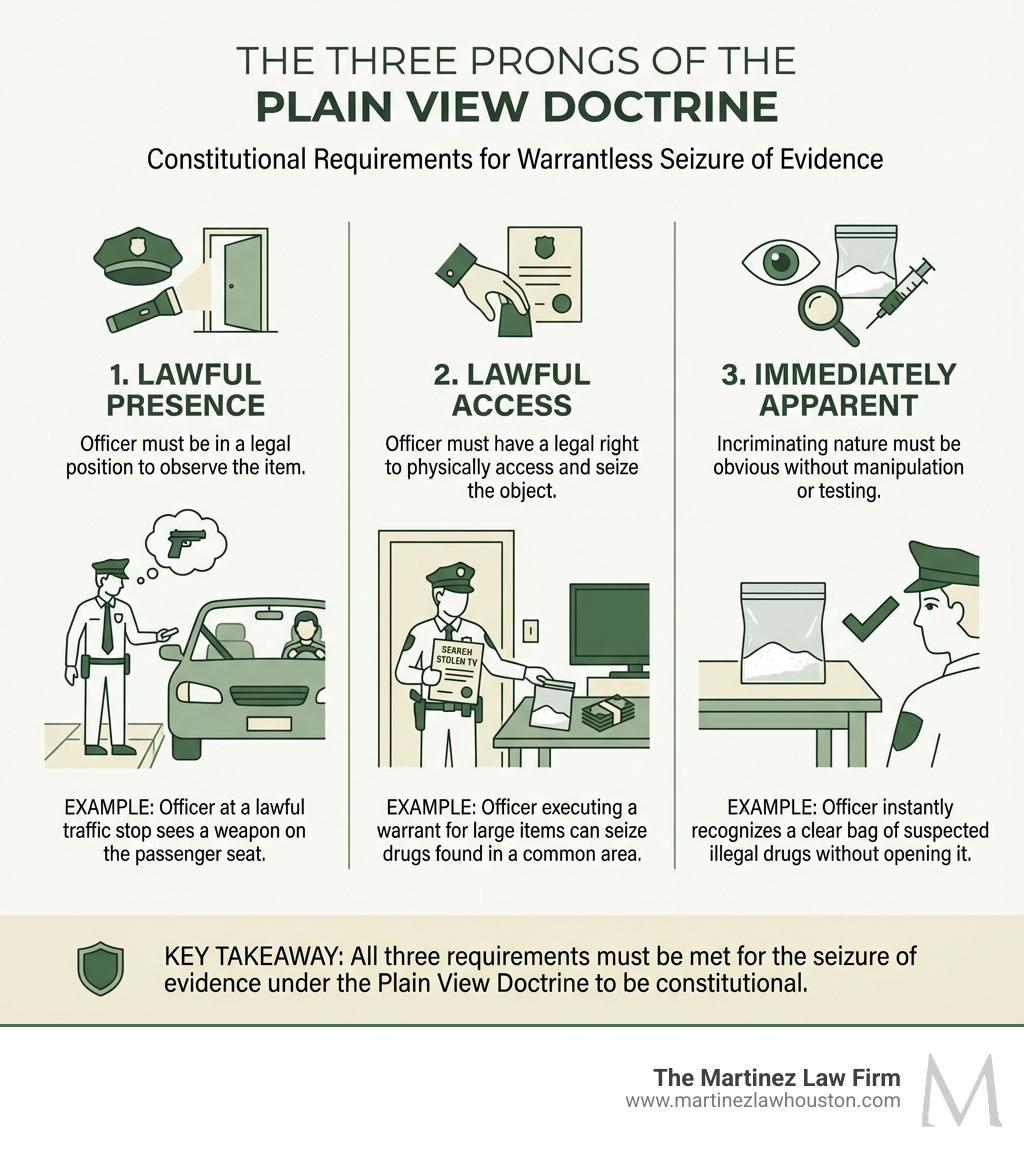
The Core Requirements of the Plain View Doctrine
For law enforcement in Houston to lawfully seize an item without a warrant under the plain view doctrine, they must satisfy a specific three-prong test. This test ensures police can act on obvious criminal activity but cannot use “plain view” as a pretext for a general, exploratory search.

Here’s how these crucial requirements work:
Lawful Presence of the Officer
First, the officer must be lawfully present in the place from which they observe the evidence. They cannot have violated the Fourth Amendment to get to that vantage point. For example, an officer standing on a public sidewalk who sees something illegal in your front yard is lawfully present.
Examples of lawful presence include:
- During a valid traffic stop: An officer who pulls you over on the Sam Houston Tollway and sees illegal drugs on your passenger seat is lawfully present.
- Executing a search warrant: If officers have a warrant to search your home for stolen goods and see illegal firearms in the open, their presence is lawful.
- Responding to an emergency (exigent circumstances): Police entering a home due to screams or smoke are lawfully present.
- With your consent: If you invite officers into your home, they are lawfully present.
The initial intrusion must be justified. As the U.S. Supreme Court noted in Collins v. Virginia, if the officer broke the law to reach the location, the plain view doctrine cannot apply.
Lawful Right of Access to the Object
Seeing something is not the same as being able to seize it. The second prong requires that the officer have a lawful right of access to the object. They must be able to physically take the item without further violating your Fourth Amendment rights. For instance, an officer who sees marijuana on your kitchen table from the street cannot simply break down your door to seize it without a warrant.
A key case is Arizona v. Hicks. Police lawfully entered an apartment after a shooting and saw suspicious, expensive stereo equipment. An officer moved the equipment to read its serial numbers, suspecting it was stolen. The Supreme Court ruled this movement was an unlawful search because the officer lacked probable cause before touching it. This case established that police cannot move or manipulate objects to get a better view without probable cause.
For more detailed information, we recommend checking out The Plain View Doctrine explained by Cornell Law.
Immediately Apparent Incriminating Nature
The third requirement is that the object’s incriminating character must be “immediately apparent.” This means it must be obvious to a reasonable officer that the item is contraband or evidence of a crime, without any further investigation. This is tied to the standard of probable cause. An officer can’t seize an item just because it looks suspicious.
As we’ll discuss next, the Supreme Court in Horton v. California eliminated a previous requirement that the findy of evidence be “inadvertent.” This means an officer can now seize evidence they expected to find in plain sight, as long as they met the other three requirements.
Evolution and Key Cases Shaping the Doctrine
The plain view doctrine has evolved through landmark Supreme Court decisions that shape how police operate in Texas and across the nation. Understanding this history is key to grasping the doctrine’s current application.
The Original Test: Coolidge v. New Hampshire
The Supreme Court’s 1971 decision in Coolidge v. New Hampshire established the initial framework for the doctrine. It included three elements:
- Lawful Presence: The officer must have a lawful right to be where the evidence is viewed.
- Lawful Access: The officer must have a lawful right of access to the object.
- Inadvertent Findy: The findy of the evidence had to be accidental.
The “inadvertence” requirement was intended to prevent police from using the doctrine as a loophole to conduct warrantless searches for evidence they expected to find but didn’t include in a warrant. However, proving an officer’s subjective intent was difficult, making the rule hard to apply consistently.
The Modern Standard: Horton v. California

The doctrine shifted significantly in 1990 with Horton v. California, which eliminated the “inadvertence” requirement. In Horton, an officer with a warrant to search for robbery proceeds also seized weapons he found in plain view, which were not listed in the warrant.
The Court reasoned that the Fourth Amendment was already protected by two key principles:
- Warrants must specifically describe the place to be searched and items to be seized.
- Warrantless searches are already limited by the circumstances that justify them (e.g., emergencies).
The Court concluded that an officer’s subjective expectation of finding an item is irrelevant. The legality of a seizure should be based on objective standards, not the officer’s state of mind.
Implications of the change: This ruling simplified the doctrine for law enforcement. A Houston police officer can now lawfully seize evidence found in plain view during a lawful search, even if they suspected they might find it. The core protections—lawful presence, lawful access, and the item’s immediately apparent incriminating nature—remain essential.
To dig deeper into this pivotal case, you can Read the full Horton v. California decision.
Expanding the “Plain View”: Feel, Smell, and Hearing
The principles of the plain view doctrine aren’t just for our eyes. Our other senses can also lead to the lawful findy and seizure of evidence, provided the same core requirements of lawful presence, lawful access, and immediately apparent incriminating nature are met. These extensions are often referred to as the “plain feel,” “plain smell,” and “plain hearing” doctrines.
The “Plain Feel” Doctrine
The “plain feel” doctrine, sometimes called “plain touch,” was recognized by the Supreme Court in the 1993 case of Minnesota v. Dickerson. This doctrine allows an officer to seize contraband detected through the sense of touch during a lawful pat-down search (a “Terry frisk”).
Here’s how it works: If an officer is conducting a lawful pat-down for weapons—for example, during an investigative detention in downtown Houston based on reasonable suspicion—and they immediately feel an object whose incriminating character as contraband (like drugs) is unmistakable without any further manipulation or squeezing, they can seize it.
The crucial limitation is the “immediately apparent” aspect. The officer cannot manipulate, squeeze, or explore the object to determine if it’s contraband. If the officer feels something that might be a weapon, they can remove it. But if they immediately recognize, by its shape and consistency, that it’s a baggie of crack cocaine, they can seize it. If they have to squeeze or roll it around in the suspect’s pocket to figure out what it is, that goes beyond the scope of a lawful pat-down for weapons and constitutes an unlawful search.
The “Plain Smell” and “Plain Hearing” Doctrines
The senses of smell and hearing can also trigger exceptions to the warrant requirement, though their application can be nuanced.
Plain Smell: This doctrine often comes into play during vehicle stops in Texas. If a Houston police officer lawfully approaches a vehicle—perhaps for a broken taillight or a traffic infraction near Hermann Park—and immediately smells the strong odor of burnt marijuana emanating from the car, that smell can provide the probable cause needed to search the vehicle without a warrant. Our Texas courts have consistently upheld that the odor of marijuana, a controlled substance, can establish probable cause for a search.
However, the smell must be immediately apparent and come from a place where the officer is lawfully present. An officer can’t, for example, trespass onto private property to get a whiff of something suspicious and then claim plain smell.
Plain Hearing: This doctrine applies when officers, while lawfully present in a location, overhear incriminating statements or sounds. For example, if police are lawfully executing a search warrant in one room of a house and, from their position, clearly hear people in an adjacent room discussing a crime or planning illegal activity, those overheard statements could be admissible.
It’s vital to distinguish this from illegal wiretapping. The plain hearing doctrine does not allow officers to use technology to improve their hearing to intrude into private conversations where there’s a reasonable expectation of privacy. It’s about what a person can hear with their unaided ear from a lawful vantage point. For instance, if officers are responding to a noise complaint at an apartment complex and, while standing in the hallway, they clearly hear someone inside confessing to a crime, that could fall under plain hearing.
Modern Challenges: The Plain View Doctrine in the Digital Age
Applying a doctrine created for physical objects to the vast, private data on our electronic devices presents significant Fourth Amendment challenges for courts in Houston and beyond.
Applying the Plain View Doctrine to Digital Evidence
Searching a computer or smartphone is not like searching a room. It involves potentially accessing gigabytes of personal data, which creates tension with the “immediately apparent” requirement of the plain view doctrine.
The Supreme Court addressed digital privacy in the landmark 2014 case Riley v. California. The Court ruled that police generally need a warrant to search the contents of a cell phone, even during a lawful arrest. It recognized that modern phones contain “vast quantities of personal information,” and searching them is a major invasion of privacy.
So, how does plain view fit in? If officers have a warrant to search a computer for specific files (e.g., fraud records) and happen to see a clearly illegal file (e.g., child pornography) while conducting that authorized search, the plain view doctrine might apply. However, courts scrutinize these situations heavily. An officer opening every file on a device is likely an overbroad search, not a legitimate plain view findy.
For a deeper dive into these complexities, you might find this scholarly article on digital searches insightful.
The Scope of Digital Searches in Texas
In Harris County and across Texas, courts are cautious about digital searches. A warrant to search a house does not automatically grant police the right to search every phone and computer inside.
- Specific Warrants Required: Law enforcement needs a warrant that specifically authorizes searching electronic devices and defines the scope of that search.
- No “General Rummaging”: The search must be limited to the types of files and data reasonably related to the warrant’s purpose. Officers cannot conduct a “fishing expedition” through your digital life.
- Protecting Privacy: Due to the immense privacy interests, even if an officer finds “plain view” digital evidence, the safest legal route is often to obtain a new warrant to seize and analyze that data. This helps ensure the evidence is admissible in court.
Contesting evidence from a digital search is a complex area of law where an experienced Houston criminal defense attorney is invaluable. We can scrutinize the warrant and the search method to identify potential Fourth Amendment violations.
A Comparative Look: Plain View in the U.S. vs. Canada
Understanding how similar legal principles are applied in other Western democracies like Canada offers a broader perspective on the balance between state power and individual rights.
The Canadian Plain View Doctrine
In Canada, the plain view doctrine also exists as a common law principle permitting the warrantless seizure of items found during a lawful police presence. The requirements are very similar to the U.S. standard: the officer must be lawfully present, and the item’s incriminating nature must be immediately obvious. While Canadian law once had a strict “inadvertence” requirement (that the findy be accidental), recent cases have adopted a more flexible approach, similar to the U.S. after Horton v. California.
The Canadian doctrine, like the U.S. version, grants a power to seize, not a power to conduct an exploratory search.
For more on Canadian case law regarding plain view, you can explore Canadian case law on plain view.
Interaction with the Canadian Charter
The Canadian legal landscape is shaped by the Canadian Charter of Rights and Freedoms, particularly Section 8, which protects against unreasonable search or seizure—Canada’s equivalent to the U.S. Fourth Amendment. Any warrantless search is presumed unreasonable, and courts must balance the state’s interest in law enforcement against an individual’s right to privacy. This balancing act applies to all plain view seizures, including those involving digital evidence, ensuring that police actions remain reasonable and justified under the law.
Frequently Asked Questions about the Plain View Doctrine
We often encounter questions about the plain view doctrine from our clients in Houston. Here are some of the most common ones, along with our insights.
Can police use binoculars to see into my Houston home and claim plain view?
Generally, no. The Fourth Amendment protects your reasonable expectation of privacy in your home. Using sense-enhancing technology like binoculars or thermal imagers to see details inside a home that aren’t visible to the naked eye is considered a search and requires a warrant, as established in Kyllo v. United States. Anything seen this way would not fall under the plain view doctrine.
What if an officer sees a gun in my car during a traffic stop on the 610 Loop?
This is a common scenario. If a Houston police officer lawfully stops you and sees a firearm in plain view from outside your car, the doctrine may apply. However, simply seeing a gun is not enough for a seizure. In Texas, where many people legally own firearms, the officer must have probable cause to believe a crime is being committed (e.g., you are a felon in possession of a firearm, or the gun is being used illegally). The legality of the seizure depends entirely on the specific facts. For more information, you can read our articles on Do the police have the right to search your car? and When can police search my vehicle?.
If I’m arrested at home, can police search my entire house?
No. If you are lawfully arrested at home, police cannot search your entire house without a warrant. They can only seize incriminating items that are in plain view from their lawful position. Officers may also conduct a limited “protective sweep” of immediately adjoining areas for their safety to ensure no one else is present who could pose a threat. This sweep is not a search for evidence, and a full search of your home requires a separate warrant.
Protecting Your Rights in Houston
The plain view doctrine is a powerful tool for law enforcement but is governed by strict constitutional rules. Understanding the requirements—lawful presence, lawful access, and immediately apparent incriminating nature—is the first step in protecting your Fourth Amendment rights. These cases are complex, especially with the rise of digital evidence. If you believe you have been the victim of an illegal search and seizure in the Houston area, it is crucial to act quickly. The experienced attorneys at The Martinez Law Firm can analyze the details of your case, challenge unlawfully obtained evidence, and build an aggressive defense. Contact us today for a consultation.
Your Right to Self-Defense in Houston, Texas

Texas stand your ground law gives you the right to defend yourself without retreating when faced with an immediate threat. For anyone involved in a self-defense incident in Houston or Harris County, understanding this law is critical to clearing your name and avoiding serious criminal charges.
Here’s what you need to know immediately:
- No Duty to Retreat: Texas law does not require you to flee before using force if you’re lawfully present, haven’t provoked the encounter, and aren’t engaged in criminal activity (beyond a Class C traffic misdemeanor).
- Where It Applies: You can stand your ground in any location where you have a legal right to be—not just your home.
- Legal Standard: You must reasonably believe that force is immediately necessary to protect yourself against another person’s unlawful use of force.
- Deadly Force: You may use deadly force if you reasonably believe it’s immediately necessary to prevent death, serious bodily injury, or certain violent crimes (aggravated kidnapping, murder, sexual assault, aggravated robbery, or robbery).
- Key Statutes: Texas Penal Code §9.31 (use of force) and §9.32 (deadly force in defense of person) form the foundation of these protections.
When you act to protect yourself, the legal system evaluates that split-second decision. In courtrooms across Houston and Harris County, that evaluation determines whether your actions were justified under Texas law.
Texas self-defense law is built on the right to protect yourself, your loved ones, and your property. This principle is codified in Chapter 9 of the Texas Penal Code, which outlines when Texans can use force, including deadly force, without criminal liability.
The law distinguishes between two related but distinct concepts:
- The Castle Doctrine: Removes your duty to retreat when you’re in your home, vehicle, or place of business, and creates a legal presumption that your use of force was reasonable if someone unlawfully and forcefully enters these locations.
- Stand Your Ground: Extends beyond your “castle” to any place you’re lawfully present, eliminating the duty to retreat but requiring you to prove the reasonableness of your actions.
Understanding these distinctions is vital if you’re facing charges. Houston prosecutors scrutinize every detail of a self-defense incident. Even if you believe you acted lawfully, you could be arrested and prosecuted.
Herman Martinez, founder of The Martinez Law Firm in Houston, brings over 25 years of experience to your defense. As a former Chief Prosecutor in Harris County, he understands how the DA’s office handles Texas stand your ground law cases. He now uses that insider knowledge to build aggressive defense strategies for his clients.
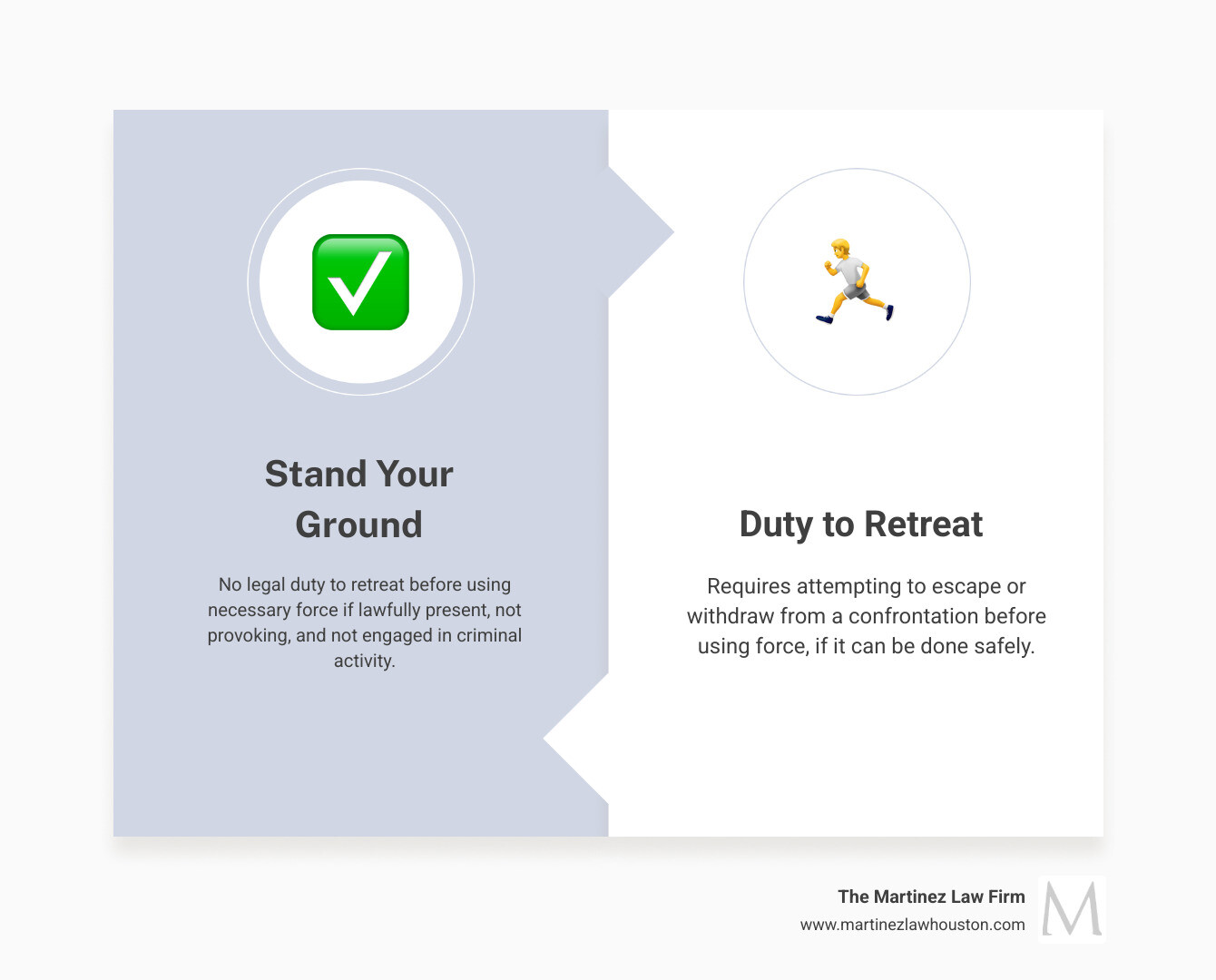
Understanding the Texas Stand Your Ground Law
Texas is a “stand your ground” state, meaning you have no duty to retreat before using deadly force where you are lawfully present. While the phrase isn’t in the statutes, the principle is the core of the Texas stand your ground law, embedded in Chapter 9, Subchapter C of the Texas Penal Code.
Specifically, Texas Penal Code § 9.31 outlines when the use of force is justified, and Texas Penal Code § 9.32 details the justification for using deadly force. The 2007 legislation, Senate Bill 378 (SB 378), was a game-changer. It clarified and expanded these rights by explicitly removing the duty to retreat for individuals who meet certain criteria, codifying the “stand your ground” principle.
For the full legal text, you can always refer to the official source: Texas Penal Code, Chapter 9, Subchapter C.
The Evolution from “Duty to Retreat”
Historically, common law required a “duty to retreat” before using deadly force. If you could safely escape a dangerous situation, you were legally expected to do so to avoid escalating violence. This principle was a cornerstone of self-defense law for centuries.
However, the legal landscape shifted. The pivotal 2007 change in Texas, SB 378, amended the Penal Code to state a person “is not required to retreat before using force or deadly force” if they meet the legal conditions.
This change significantly impacted self-defense cases in Houston, empowering individuals to defend themselves without being prosecuted for not fleeing. While not a free pass to use force, it provides a stronger legal standing for those who act to protect themselves or others while lawfully present.
Key Conditions for the Texas Stand Your Ground Law
The Texas stand your ground law is not a blanket permission to use force. The defense is only valid if these crucial conditions are met:
- Right to be present: You must have a legal right to be at the location where you use force. This means you cannot be trespassing. Texas Penal Code §30.05 defines criminal trespass as entering or remaining on property without effective consent, or after receiving notice to depart. If you are not considered a trespasser, you generally have a legal right to be there.
- No provocation: You must not have provoked the person against whom force is used. If you start the altercation, you generally lose the right to claim self-defense. While verbal provocation alone usually doesn’t justify the other party’s use of force, if you provoke the encounter, you might regain your right to self-defense only if you clearly abandon the encounter and the other party continues to use unlawful force.
- Not committing a crime: You must not be engaged in criminal activity when the force is used. There’s an exception for Class C misdemeanor traffic offenses, but otherwise, breaking the law can negate your self-defense claim.
- Reasonable belief of threat: You must reasonably believe the force (or deadly force) is immediately necessary to protect yourself against the other person’s use or attempted use of unlawful force. This “reasonable belief” is central to all Texas self-defense claims. The standard is not what you subjectively felt, but what an objective, reasonable person in your situation would have believed.
Castle Doctrine vs. Stand Your Ground: Your Home, Car, and Beyond
Both the Castle Doctrine and Texas stand your ground law concern self-defense but have key differences in location and legal presumptions. The Castle Doctrine is a fortified version of self-defense for your personal spaces, while Stand Your Ground applies more broadly.
Here’s a quick comparison:
| Feature | Castle Doctrine | Stand Your Ground (Texas) |
|---|---|---|
| Location | Your habitation (home), occupied vehicle, place of business/employment. | Any place you have a legal right to be (public or private). |
| Presumption of Reasonableness | YES, under specific conditions (unlawful/forceful entry). | NO, you must prove reasonableness. |
| Duty to Retreat | NO, explicitly removed. | NO, explicitly removed. |
| Conditions | Unlawful/forceful entry; no provocation; not committing a crime. | Lawful presence; no provocation; not committing a crime. |

The Castle Doctrine: Fortifying Your Habitation
Rooted in the idea that “a person’s home is their castle,” the Castle Doctrine in Texas Penal Code § 9.32(b) and § 9.31(a) provides special protections when you defend yourself in certain defined spaces.
In Texas, your “castle” extends beyond just your home. The law defines “habitation” (Texas Penal Code §30.01) to include:
- A structure or vehicle adapted for overnight accommodation.
- Each separately secured or occupied portion of the structure or vehicle.
- Structures connected to the structure or vehicle (like a garage or porch).
This means your home, apartment, occupied vehicle, or place of business are locations with improved self-defense rights.
The key benefit is the presumption of reasonableness. If someone unlawfully and forcefully enters your occupied home, vehicle, or business, the law presumes your use of force was reasonable. This shifts the burden of proof, making it harder for prosecutors to challenge your actions, a powerful defense in Harris County courts.
This presumption applies specifically to these “castle” locations. For more detailed statutory language, see Texas Penal Code, Chapter 9, Subchapter D, which covers the protection of property.
How Stand Your Ground Extends Your Rights
While the Castle Doctrine provides a strong defense within your “castle,” the Texas stand your ground law extends the “no duty to retreat” principle to any location where you have a legal right to be. This means you don’t have to back away from a threat in a public park or on a Houston street, as long as you meet the three core conditions: you’re lawfully present, you haven’t provoked the encounter, and you’re not engaged in criminal activity.
Crucially, outside your “castle,” there is generally no presumption of reasonableness. If you use force in public, your attorney must present evidence showing your belief that force was necessary was reasonable. While you must first produce evidence of self-defense, the prosecution then has the burden to disprove your claim beyond a reasonable doubt. This distinction is vital in any Harris County self-defense case.
When is Deadly Force Justified in Texas?
Using deadly force is a grave decision. Texas law defines it as “force that is intended or known by the actor to cause, or in the manner of its use or intended use is capable of causing, death or serious bodily injury” (Texas Penal Code §9.01).

For deadly force to be justified under Texas stand your ground law, these elements must be present:
- Serious Bodily Injury: This means injury creating a substantial risk of death, or causing death, serious permanent disfigurement, or protracted loss or impairment of a bodily function.
- Immediate Necessity: You must reasonably believe that deadly force is immediately necessary to stop a present, unfolding danger.
- Proportionality: The force used must be proportional to the threat. Deadly force against a non-deadly threat is not considered reasonable.
- Reasonable Belief Standard: Your belief that deadly force was necessary must be one that a reasonable person in your exact circumstances would have held.
Defending Yourself or a Third Person
Texas Penal Code § 9.32 permits using deadly force to defend a person if:
- You would be justified in using force under Section 9.31 (you reasonably believe force is immediately necessary); AND
- You reasonably believe deadly force is immediately necessary to protect against another’s use of unlawful deadly force; OR
- To prevent the other’s imminent commission of certain violent crimes, including:
- Aggravated kidnapping
- Murder
- Sexual assault
- Aggravated sexual assault
- Robbery
- Aggravated robbery
This right extends to defending a third person (Texas Penal Code § 9.33). If you would be justified in using force to protect yourself, you can use that same force to protect someone else. If you witness a violent crime in Houston and reasonably believe the victim is in imminent danger, you may be justified in using deadly force to intervene.
These are serious situations with complex legal ramifications. For more information, visit More info about defending against violent crime charges in Houston.
Protecting Your Property with Deadly Force
Uniquely, Texas law (Penal Code § 9.42) allows for deadly force to protect property under specific conditions. You are justified in using deadly force to protect your land or property if:
- You would be justified in using force under Section 9.41; AND
- You reasonably believe deadly force is immediately necessary to prevent the imminent commission of arson, burglary, robbery, aggravated robbery, theft during the nighttime, or criminal mischief during the nighttime; OR
- You reasonably believe deadly force is immediately necessary to prevent someone from fleeing immediately after committing one of those offenses with your property; AND
- You reasonably believe the property cannot be protected or recovered by other means, or that using non-deadly force would expose you or another to a substantial risk of death or serious bodily injury.
The “during the nighttime” clauses are key. For example, you might be justified in using deadly force against someone stealing your car at 2 AM in Houston, but likely not during the day unless other threats are present.
So, can you shoot a fleeing thief? Yes, but only under the strict conditions of PC 9.42—such as fleeing immediately after a nighttime theft where you believe the property is otherwise unrecoverable. It’s a high legal bar that is heavily scrutinized in Harris County courts. You can read more about this complex area at Can You Shoot a Fleeing Thief in Texas?.
Legal Limits and Consequences: When Self-Defense Fails
Even with strong self-defense laws like Texas stand your ground law, using force—especially deadly force—triggers a criminal investigation. In Houston, even a justified act will likely lead to an arrest, questioning, and potential charges.
The Harris County District Attorney’s office investigates all uses of force seriously. Prosecutors examine every detail before a case may go to a grand jury to decide on indictment. This process is lengthy and stressful, even when you’ve acted in self-defense.
Additionally, even if you are acquitted of criminal charges, you can still face a civil lawsuit. Under Texas Penal Code §9.06, the family of the person you used force against can file a wrongful death suit for financial damages.
Actions That Invalidate Your Self-Defense Claim
Several actions can invalidate your self-defense claim, turning a justified act into a crime. Avoid these pitfalls:
- Provoking the difficulty: If you initiated the aggression, your self-defense claim is weakened unless you clearly abandoned the encounter and the other party continued the unlawful force.
- Being the initial aggressor: If you started the physical confrontation, you cannot claim self-defense.
- Involved in criminal activity: Being engaged in a crime (beyond a minor traffic offense) when you used force can invalidate your claim.
- Resisting arrest: You cannot use force to resist a lawful arrest by a police officer unless the officer uses excessive force.
- Verbal provocation alone: Using force in response to only verbal insults is not justified under Texas law.
Understanding these limits is as important as knowing your rights to avoid severe legal consequences in Harris County.
Potential Criminal and Civil Ramifications
If your self-defense claim fails, the consequences are devastating. You could face serious charges, including:
- Murder charges: A first-degree felony with penalties from 5 to 99 years or life in prison.
- Manslaughter charges: A second-degree felony for reckless but unintentional acts.
- Aggravated assault charges: A second-degree felony if serious bodily injury was caused without justification.
Beyond prison, civil lawsuits pose a major threat. A wrongful death suit can lead to financial ruin through damages for medical bills, lost income, and pain and suffering, even if you avoid a criminal conviction.
Navigating these high-stakes situations requires seasoned legal guidance. We have extensive experience handling deadly force cases in Houston. For more insights, visit More on deadly force cases in Houston.
Frequently Asked Questions about the Texas Stand Your Ground Law
The Texas stand your ground law and related self-defense statutes generate many questions. Here are some of the most common ones in Houston.
Can you legally shoot a fleeing thief in Texas?
The answer is “it depends.” Under Texas Penal Code § 9.42, you can use deadly force against a fleeing thief only under very specific circumstances:
- The theft must occur during the nighttime.
- You must reasonably believe deadly force is needed to prevent the thief from escaping with the property.
- You must reasonably believe the property cannot be recovered by other means, or that using less force would create a substantial risk of death or serious bodily injury.
For example, shooting a car thief at 2 PM is likely not justified, but it might be at 2 AM if all other legal conditions are met. These cases are highly fact-specific and face intense scrutiny from Harris County prosecutors.
How does this law apply to road rage incidents in Houston?
Road rage is volatile. While texas stand your ground law and the Castle Doctrine can apply, there are significant caveats.
Your vehicle is a “habitation” under the Castle Doctrine, so you have no duty to retreat from a forceful, unlawful entry. However, most road rage incidents don’t involve this.
If you exit your car, the standard Texas stand your ground law applies. The challenge is proving the threat justified your level of force. Yelling or a minor collision does not justify deadly force, and escalating the conflict can be seen as provocation, which negates a self-defense claim.
Harris County prosecutors are cautious with armed road rage cases. The legal bar for justifying deadly force is very high in these public, dynamic situations. De-escalation is almost always the best option.
What is the first thing I should do after using force in self-defense?
If you use force in self-defense in Houston, your next steps are critical to the legal outcome.
- Ensure Safety: Make sure you and any innocent parties are safe. Secure yourself if the threat is gone.
- Call 911: Immediately call emergency services. Report that you were forced to defend yourself.
- Request Medical Aid: Ask for medical attention for anyone who is injured.
- Remain Silent: When police arrive, state that you were forced to defend yourself and will cooperate fully after speaking with your attorney. Do not discuss details without legal counsel. Anything you say can be used against you.
- Contact a Houston Criminal Defense Attorney: As soon as possible, contact an experienced Houston criminal defense attorney. This is your top priority after ensuring safety and calling 911.
Navigating a Self-Defense Claim in Houston
Understanding your rights under Texas stand your ground law is empowering, but navigating a claim in Houston is complex. The interpretation of “reasonableness,” “imminent threat,” and “provocation” depends on the specific facts and how they are presented.
The summary of key rights is clear:
- You have no duty to retreat if lawfully present, unprovoked, and not engaged in criminal activity.
- Your home, occupied vehicle, and place of business have improved protections.
- Deadly force is justified under specific, severe threats to life or in limited property defense scenarios.
The standard of reasonableness is paramount. Your actions are judged by what a “reasonable person” would have done, making legal expertise indispensable.
The Martinez Law Firm offers a unique advantage. With over 25 years of experience, including as a Chief Prosecutor in Harris County, Herman Martinez understands how the prosecution builds its case. This insider knowledge allows us to craft an aggressive, customized defense strategy to protect your freedom.
If you’ve been involved in a self-defense incident in Houston or Harris County, or have questions about your rights under Texas stand your ground law, do not hesitate. Your immediate actions and legal representation can make all the difference. Contact a Houston criminal defense attorney for a consultation today.
Understanding Xanax and Its Legal Status

Is Xanax a controlled substance? Yes, Xanax is classified as a Schedule IV controlled substance under federal law and is regulated by the Drug Enforcement Administration (DEA). Here’s what you need to know:
- Generic Name: Alprazolam
- Drug Class: Benzodiazepine
- Schedule: Schedule IV (low potential for abuse relative to Schedules I-III)
- Medical Use: Prescribed for anxiety disorders and panic disorders
- Prescription Volume: More than 15 million prescriptions written in 2023
- Legal Status: Possession without a valid prescription is illegal in Texas and carries criminal penalties
Xanax, known generically as alprazolam, is a commonly prescribed medication in the United States for treating anxiety and panic disorders. Despite its medical uses, Xanax carries significant risks when misused, abused, or combined with other substances like alcohol or opioids. As a central nervous system depressant, it slows brain activity and breathing—making it both therapeutically effective and potentially dangerous.
Why Xanax’s Status Matters in Houston Cases
Understanding Xanax’s controlled status is critical if you’re charged with drug possession in Houston or Harris County. Whether you have a valid prescription but were stopped with pills outside the original container, are accused of prescription fraud, or face more serious distribution allegations, the consequences can be severe. Under Texas law, Xanax (alprazolam) is in Penalty Group 3, and penalties can span from a Class A misdemeanor to a first-degree felony, depending on the amount alleged to be in your possession.
As the founder of The Martinez Law Firm in Houston, I’ve spent more than 25 years handling drug cases from both sides of the courtroom—first as a Chief Prosecutor for the Harris County District Attorney’s Office, and later as a defense attorney. My experience with controlled-substance cases, including Xanax, shows many people don’t realize that the answer to ‘is Xanax a controlled substance‘ has serious legal consequences—especially in matters of prescription fraud, unlawful possession, or DUI.
In this guide, we’ll break down everything you need to know about Xanax’s controlled substance classification, the specific penalties you could face in Texas, the dangers of misuse, and what legal options are available if you’re facing charges related to this medication.
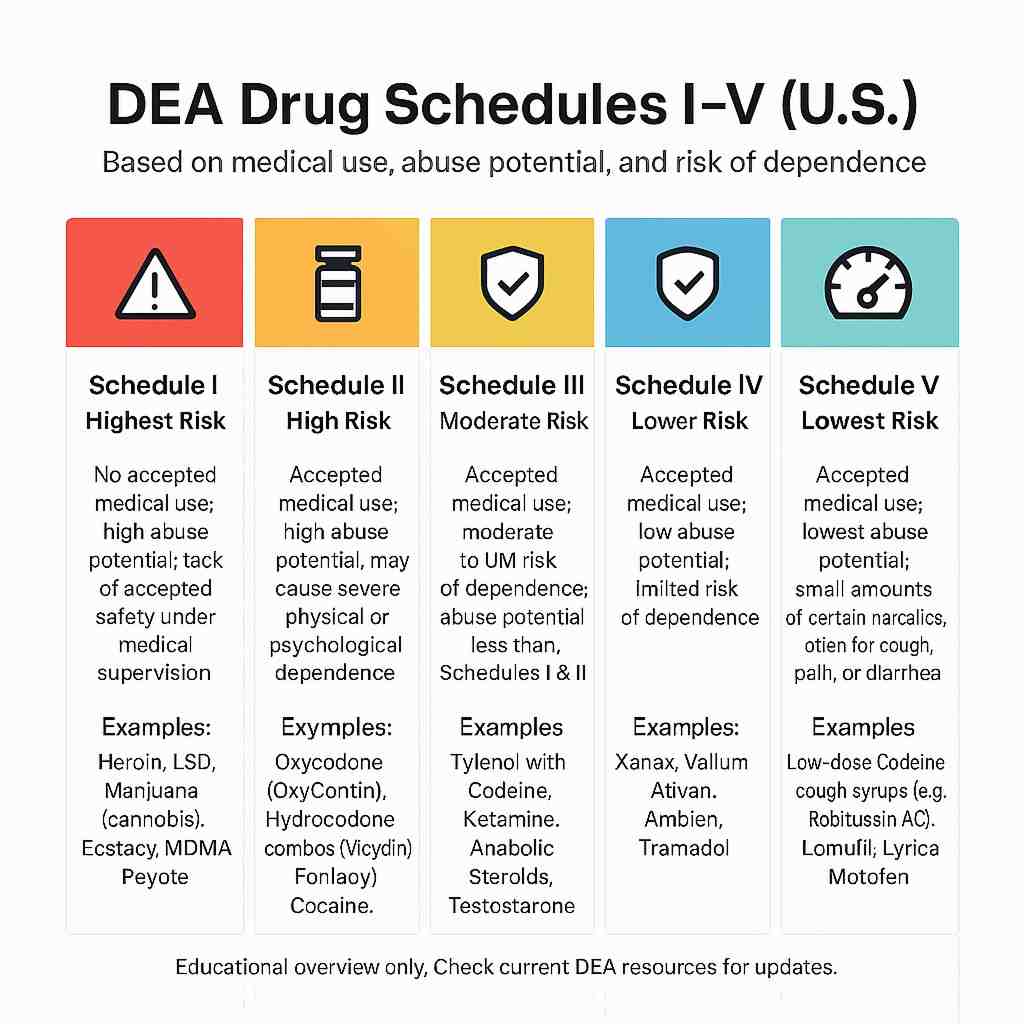
Is Xanax a Controlled Substance? The Official DEA Classification
Is Xanax a controlled substance? Absolutely—and understanding exactly what that means can help you steer both the medical and legal implications of this widely prescribed medication.
In the United States, drugs like Xanax fall under the Controlled Substances Act (CSA), a federal law passed in 1970 that brought together all previous drug regulations into one comprehensive system. The CSA doesn’t just prohibit certain substances—it creates a structured framework for regulating how drugs are manufactured, imported, possessed, used, and distributed across the country.
The Drug Enforcement Administration (DEA) is the federal agency tasked with enforcing the Controlled Substances Act. One of their primary responsibilities is organizing drugs into five distinct categories, or “schedules,” based on three key factors: whether the drug has accepted medical uses, how likely it is to be abused, and whether it can cause physical or psychological dependence. This scheduling system attempts to strike a delicate balance—allowing doctors to prescribe beneficial medications while preventing misuse and keeping dangerous substances off the streets.
You can explore the full details of how the DEA categorizes different substances through their official DEA drug scheduling information page.
What Schedule is Xanax?
Xanax—or alprazolam, if we’re using its generic name—sits in Schedule IV of the Controlled Substances Act. This puts it in the same category as several other prescription medications you’ve probably heard of, including Valium, Ativan, and even Ambien.
So what does Schedule IV actually mean? According to the DEA’s definition, Schedule IV drugs have a low potential for abuse relative to Schedules I through III and an accepted medical use in treatment. Think of it this way: these medications are useful and relatively safe when used as prescribed, but they’re not entirely without risk.
Here’s how Schedule IV compares to the other categories. Schedule I drugs like heroin and LSD have no accepted medical use and high abuse potential. Next, Schedule II substances such as oxycodone, fentanyl, and methamphetamine have legitimate medical applications but carry a high risk of severe dependence. Then, Schedule III drugs like Tylenol with codeine and ketamine fall somewhere in the middle, with moderate potential for dependence.
Schedule IV, where Xanax lives, represents drugs that medical professionals consider relatively safe for prescription use but still require controls. Besides alprazolam, this category includes diazepam (Valium), lorazepam (Ativan), zolpidem (Ambien), and tramadol—all medications commonly prescribed in Houston and across Texas.
The “low potential for abuse” label might sound reassuring, but it’s important not to let that classification lull you into a false sense of security. Just because something is Schedule IV doesn’t mean it’s harmless.
Why is Xanax a controlled substance despite its classification?
If Xanax is only a Schedule IV drug with supposedly “low” abuse potential, why all the concern? Why is it controlled at all?
The reality is more complicated than the scheduling might suggest. While Xanax does have legitimate medical benefits for people struggling with anxiety and panic disorders, it also carries significant risks of physical dependence and addiction—risks that can sneak up on even responsible users.
When you take Xanax regularly, your body begins to adapt. Over time, you might develop tolerance, meaning you need higher doses to get the same relief you once felt with smaller amounts. If you then try to stop taking it suddenly, your body can revolt with severe withdrawal symptoms ranging from rebound anxiety and insomnia to potentially life-threatening seizures. This is why doctors stress the importance of tapering off benzodiazepines slowly under medical supervision rather than quitting cold turkey.
Abuse
Beyond physical dependence, there’s the potential for misuse and addiction. Some people start taking more than prescribed to chase that initial calming effect. Others might crush and snort the pills, or combine Xanax with alcohol or opioids to intensify the high. What might begin as a legitimate prescription for anxiety can spiral into a pattern of compulsive use that damages relationships, careers, and health.
The U.S. Food and Drug Administration takes these risks seriously. In 2020, the FDA began requiring an FDA black box warning on all benzodiazepines, including Xanax. This is the strongest warning the FDA can issue for prescription medications, and it specifically highlights the serious dangers of abuse, misuse, addiction, physical dependence, and withdrawal reactions.
That black box warning tells you something important: even a “low potential for abuse” drug can have a high potential for harm when not used exactly as prescribed. In my years handling drug cases in Houston—first as a prosecutor and now as a defense attorney—I’ve seen countless individuals who never imagined they’d face criminal charges over a prescription medication. They thought because their doctor prescribed it, or because it’s “only” Schedule IV, the legal risks were minimal. Unfortunately, Texas law doesn’t make those distinctions when it comes to unlawful possession or misuse.
Understanding the Risks: From Dependence to Overdose
When we talk about is Xanax a controlled substance, we’re not just discussing legal paperwork and DEA classifications. We’re talking about real people in Houston and across Texas who started with a legitimate prescription and found themselves struggling with something they never expected: addiction.
The truth is, Xanax can be medically beneficial for many people dealing with anxiety and panic disorders. But the risks of dependence, misuse, and overdose are very real, and they don’t discriminate. Whether you’re a college student, a busy professional, or a parent managing stress, anyone can develop a problem with this medication.
Recognizing the signs of Xanax addiction early can make all the difference. Some warning signs are behavioral: you might notice someone doctor shopping (visiting multiple physicians to get extra prescriptions), becoming increasingly secretive or defensive about their medication use, or withdrawing from family and friends. They might stop showing up for work or family obligations, or continue using Xanax even when it’s clearly causing problems in their life.
The physical symptoms can be just as telling. Persistent drowsiness, slurred speech, memory problems or blackouts, and impaired coordination are common red flags. You might notice someone forgetting conversations they had just hours earlier, stumbling when they walk, or seeming “out of it” much of the time.
One of the most dangerous aspects of Xanax misuse isn’t just the drug itself—it’s what happens when people mix it with other substances. This practice, called polysubstance use, dramatically increases the risk of serious harm or death.

The Lethal Combination: Is Xanax a controlled substance that’s dangerous with opioids?
Here’s something that might surprise you: even though is Xanax a controlled substance classified as Schedule IV—meaning it theoretically has a “low potential for abuse”—combining it with opioids creates one of the deadliest drug combinations possible.
Both Xanax and opioids are central nervous system depressants. Think of your nervous system as your body’s control center—it manages everything from your heartbeat to your breathing. When you take a CNS depressant, you’re essentially telling that control center to slow down. Take two different depressants together, and you’re not just doubling the effect—you’re creating what doctors call a synergistic effect, where the combined impact is far more powerful than either drug alone.
This combination leads to severe respiratory depression, a frightening condition where your breathing becomes so slow and shallow that your brain and organs don’t get enough oxygen. This is how most overdose deaths happen—people simply stop breathing.
The statistics are sobering. Research published in Pain Medicine found that overdose death rates were 10 times higher among people taking opioids and benzodiazepines together compared to those taking only opioids. That’s not a small increase—it’s a tenfold jump in risk.
That’s why the CDC strongly recommends against co-prescribing benzodiazepines with opioid pain medication, and why the FDA requires black box warnings on both types of medications. If you’re in Houston and have been prescribed both, please talk to your doctor about safer alternatives. Your life could depend on it.
Xanax and Alcohol: A Dangerous Mix
If you’ve ever been prescribed Xanax, your doctor probably told you not to drink alcohol while taking it. Unfortunately, this warning is often ignored—and the consequences can be fatal.
Like opioids, alcohol is a central nervous system depressant. When you mix it with Xanax, you’re creating the same dangerous synergistic effect. The combination leads to increased sedation that goes far beyond what you’d experience with either substance alone. People can lose consciousness unexpectedly, even from what seems like a small amount of alcohol.
Your judgment and coordination become severely impaired, making you vulnerable to accidents, falls, and dangerous decisions you’d never make sober. Many people in Houston have found themselves facing DUI charges after mixing Xanax and alcohol, genuinely unaware of how impaired they were.
Perhaps most frightening is the memory loss—what’s often called a “blackout.” You might function, walk around, even have conversations, but later have absolutely no memory of what happened. This isn’t just forgetting a few details; it’s complete amnesia for hours of your life.
Most critically, mixing Xanax and alcohol dramatically increases your risk of overdose. The combined depressant effects can slow your breathing to dangerous levels, leading to coma or death. Even a single drink can significantly amplify Xanax’s effects.
If you or someone you care about is struggling with Xanax misuse, especially involving alcohol or other drugs, please reach out for help. As someone who’s handled countless drug cases in Harris County, I’ve seen too many lives lost to combinations that people thought they could handle. The good news is that with proper medical supervision and support, recovery is absolutely possible.
Xanax Possession Laws and Penalties in Houston, TX
Understanding that is Xanax a controlled substance is vital, but equally important, especially if you’re in Houston, Texas, is knowing the legal consequences of possessing it without a valid prescription. Here in Texas, possession of Xanax (alprazolam) without a legitimate prescription from a licensed medical professional is illegal and can lead to serious criminal charges.
Texas law categorizes controlled substances under the Texas Health and Safety Code. Xanax falls under Penalty Group 3, which includes a range of substances with accepted medical uses but also a potential for abuse and dependence. The severity of the charges and penalties depends heavily on the amount of Xanax involved.
Here’s a breakdown of the typical penalties for Xanax possession in Texas, based on the weight of the drug:
| Amount of Xanax (Alprazolam) | Charge | Potential Punishment |
|---|---|---|
| Less than 28 grams | Class A Misdemeanor | Up to 1 year in a county jail and/or a fine of up to $4,000 |
| 28 grams to less than 200 grams | Third-Degree Felony | 2 to 10 years in state prison and a fine of up to $10,000 |
| 200 grams to less than 400 grams | Second-Degree Felony | 2 to 20 years in state prison and a fine of up to $10,000 |
| 400 grams or more | First-Degree Felony | 5 to 99 years or life in state prison and a fine of up to $50,000 |
These penalties are severe and can have a lasting impact on your life, including a permanent criminal record, difficulty finding employment or housing, and loss of certain rights.
Related Charges
Beyond simple possession, other offenses related to Xanax can also lead to significant legal trouble in Houston and Harris County:
- Prescription Fraud: This involves altering a prescription, forging a prescription, or using deceptive means to obtain Xanax. It can be charged as a felony.
- Doctor Shopping: This occurs when an individual visits multiple doctors to obtain numerous prescriptions for controlled substances like Xanax. This is a felony offense.
- Driving Under the Influence (DUI) of Drugs: Operating a vehicle while impaired by Xanax, even if you have a valid prescription, can result in DUI charges. In Texas, this carries penalties similar to drunk driving, including fines, license suspension, and jail time.
Given the complexities of drug laws in Texas and the severe penalties involved, facing Xanax-related charges in Houston or Harris County demands immediate and experienced legal representation. Our firm is well-versed in navigating these intricate legal waters and protecting the rights of our clients.
Frequently Asked Questions About Xanax
Navigating the legal and medical landscape around Xanax can feel overwhelming, especially if you’re facing charges or concerned about a loved one. Over my 25+ years practicing law in Houston, I’ve heard these questions countless times from clients sitting across from me, worried and confused. Let me walk you through some of the most common concerns with straight answers you can actually use.
How long is a Xanax prescription valid in Texas?
This is something many people don’t realize until they’re standing at a pharmacy counter or, worse, stopped by law enforcement. Because is Xanax a controlled substance classified as Schedule IV, both federal and Texas state laws place specific time limits on prescriptions.
In Texas, your Xanax prescription is valid for six months from the date your doctor wrote it. That’s your window. Within those six months, you’re allowed a maximum of five refills. Once you’ve either hit the six-month mark or used up your five refills—whichever comes first—you’ll need to see your doctor again for a new prescription to continue treatment.
This isn’t just bureaucratic red tape. The law requires this regular medical supervision because benzodiazepines like Xanax can be habit-forming. Your doctor needs to periodically reassess whether the medication is still appropriate for you, monitor for signs of dependence, and ensure you’re not developing tolerance that might require dosage adjustments. These Schedule IV rules exist to protect patients from inadvertently sliding into dependence while still allowing access to legitimate medical treatment.
Can I be charged for having pills outside the prescription bottle?
Yes, absolutely, and this catches people off guard more often than you’d think. I’ve represented clients in Houston who had completely legitimate prescriptions but made the mistake of carrying their pills loose in a pocket, a pill organizer, or transferred to another bottle for convenience. They were shocked to find themselves facing criminal charges.
Texas law requires that prescription medications be kept in their original container with the pharmacy label clearly visible. The label shows your name, the prescribing doctor, the pharmacy, the medication name, dosage, and fill date—all crucial information that law enforcement needs to verify the legitimacy of your possession.
When Harris County deputies or Houston police officers find someone with loose pills or pills in an unmarked container, they can’t immediately verify whether that person has a legal right to possess them. The initial presumption may be unlawful possession, even if you legitimately take that medication every day. While having a valid prescription is certainly a defense, you might still face charges for improper storage of a controlled substance—often a misdemeanor offense.
The burden then shifts to you to prove you had a valid prescription for those specific pills, which can mean additional court appearances, legal fees, and stress that could have been avoided. My advice? Always keep your Xanax in its original, labeled container, especially when you’re out and about in Houston or traveling anywhere in Texas.
What are the treatment options for Xanax addiction?
If you or someone you care about is struggling with Xanax dependence or addiction here in Houston, I want you to know something important: seeking help is not a sign of weakness, and effective treatment is available. Over the years, I’ve watched clients successfully reclaim their lives after battling benzodiazepine addiction, but it requires professional help.
Medical supervision is absolutely critical when addressing Xanax dependence. Unlike some substances, abruptly stopping Xanax can be genuinely dangerous. Severe withdrawal symptoms can include life-threatening seizures, along with anxiety, tremors, sweating, and insomnia. This is why attempting to quit “cold turkey” on your own is never recommended.
Detox
The journey to recovery typically begins with medically-assisted detox, where healthcare professionals in Houston’s specialized detox facilities or hospital settings carefully supervise a gradual tapering of your Xanax dosage. This controlled reduction minimizes withdrawal symptoms and significantly reduces the risk of complications like seizures. Think of it as your body needing time to readjust to functioning without the medication it’s become dependent on.
After detox, treatment continues through either inpatient or outpatient programs. Inpatient programs offer a structured residential environment with 24/7 support—ideal for severe addictions or when someone needs to step away from triggering environments. Outpatient programs provide flexibility, allowing people to live at home and maintain work or family responsibilities while attending regular therapy sessions at Houston treatment centers.
CBT
Cognitive-behavioral therapy (CBT) forms the backbone of most effective treatment plans. This evidence-based approach helps you identify the thought patterns and triggers that led to misuse, develop healthier coping strategies for anxiety, and build skills to resist cravings. I’ve seen CBT genuinely transform how people manage stress without relying on medication.
Finally, support groups like Narcotics Anonymous (NA) or local recovery groups throughout Houston provide ongoing community support. There’s something powerful about connecting with others who truly understand what you’re going through—people who’ve walked the same difficult path and come out the other side.
Every person’s situation is unique, so treatment plans should be custom to individual needs, the severity of addiction, and any co-occurring mental health conditions like the anxiety disorder that may have led to the original prescription. The good news? With proper treatment, full recovery is absolutely possible. The sooner someone seeks help, the better their chances of successful, lasting recovery.
Facing Xanax Charges? How a Houston Criminal Defense Attorney Can Help
We’ve walked through quite a journey together in this guide, and if there’s one thing I hope you take away, it’s this: understanding that is Xanax a controlled substance is more than just a legal technicality—it’s knowledge that could protect your future.
Let’s bring it all together. Xanax, known generically as alprazolam, sits in the Schedule IV category of controlled substances. Yes, it has legitimate medical uses for anxiety and panic disorders, and yes, it’s considered to have a lower abuse potential than drugs in Schedules I through III. But that classification doesn’t diminish the very real risks it carries. When misused or combined with other substances like opioids or alcohol, Xanax can be deadly. The statistics on overdose deaths don’t lie, and the FDA’s black box warnings exist for good reason.
Here in Houston and Harris County, the legal stakes are equally serious. Texas law doesn’t take Xanax possession lightly. If you’re caught with this medication without a valid prescription, you’re looking at criminal charges that can range from a Class A misdemeanor for small amounts to a first-degree felony if you’re found with 400 grams or more. We’re talking about potential penalties that include years in state prison and fines reaching tens of thousands of dollars. Beyond simple possession, charges can stem from prescription fraud, doctor shopping, or even driving under the influence of Xanax—each carrying its own set of severe consequences.
Why Choose Our Firm?
If you’re reading this because you or someone you care about is facing Xanax-related charges in Houston, I want you to know something important: you don’t have to face this alone, and acting quickly matters. The criminal justice system can feel overwhelming, especially when you’re staring down the possibility of jail time, hefty fines, and a permanent criminal record that could affect your employment, housing, and personal relationships for years to come.
This is where having the right legal representation makes all the difference.
At The Martinez Law Firm, we’ve spent over 25 years navigating these exact situations. Our founder, Herman Martinez, didn’t just study criminal law from textbooks—he lived it from the other side of the courtroom as a Chief Prosecutor for the Harris County District Attorney’s Office. That experience isn’t just a line on a resume; it’s a strategic advantage. Herman knows how prosecutors think, how they build their cases, and most importantly, where their weaknesses lie.
When you work with our firm, you’re not getting a one-size-fits-all defense. We take the time to understand your specific situation, the circumstances of your arrest, and your personal goals. Maybe you were caught with pills outside their original container but have a valid prescription. Perhaps you’re struggling with addiction and need help navigating treatment options alongside your legal defense. Or maybe there were procedural errors in how evidence was collected. Whatever your situation, we build an aggressive, personalized defense strategy designed specifically for you.
We fight for our clients. We challenge every piece of evidence, question every procedure, and explore every possible avenue for reducing or dismissing charges. Our track record speaks to our commitment—we’ve helped countless Houston residents protect their rights and their futures when facing drug-related charges.
Contact an Attorney Now
The worst thing you can do right now is wait. Evidence can be lost, witnesses’ memories fade, and opportunities for building a strong defense can slip away. The sooner we can get started on your case, the better positioned we are to fight for the best possible outcome.
Don’t let a Xanax charge derail your life. You deserve experienced, dedicated legal representation that understands both the law and the human side of these cases.
Contact our Houston office for a confidential case review regarding your drug possession charges. Let’s sit down, talk through what happened, and map out a path forward together. Your future is worth fighting for, and we’re ready to stand beside you every step of the way.
Why a DWI with a Child Passenger in Houston Changes Everything

DWI with child Houston cases are among the most serious drunk driving offenses in Texas. If you are arrested for driving while intoxicated with a passenger under 15 years old, you face an automatic state jail felony with severe criminal penalties and devastating family consequences.
Here’s what you need to know about DWI with child Houston penalties:
- Charge: Automatic state jail felony
- Jail Time: 180 days to 2 years in a state jail
- Fines: Up to $10,000
- License Suspension: Automatic 180-day suspension
- CPS Involvement: Mandatory investigation and potential custody loss
- Long-Term Impact: A permanent felony record affecting your future
Even if you thought you were fine to drive after dinner, Harris County judges and juries show little sympathy when a child’s safety is involved. The stakes extend far beyond the criminal courtroom and into family law.
I’m Herman Martinez. With over 25 years of experience, including as a Chief Prosecutor for the Harris County District Attorney’s Office, I’ve seen how these cases can devastate families. An aggressive defense from day one is crucial. Understanding the charges is the first step to protecting your freedom and parental rights.
DWI with child Houston terms made easy:
Understanding the Charge: What is a DWI with a Child Passenger in Texas?
A DWI with child Houston charge is not a typical DWI. Under Texas Penal Code Section 49.045, it is a separate and much more serious offense. If you are intoxicated while driving with a passenger under 15, you have committed a state jail felony. This is automatic, even for a first offense.
In Texas, “intoxicated” can be proven in two ways:
- A Blood Alcohol Content (BAC) of 0.08% or higher.
- Not having the normal use of your mental or physical faculties due to alcohol or drugs.
This second definition means you can be charged even if your BAC is below 0.08%, based on an officer’s observations of impairment like slurred speech or failed sobriety tests. The presence of a child under 15 immediately lifts the charge to a felony.
The Legal Definition and Age Requirement
Texas law is strict: a “child” for this offense is anyone younger than 15 years old. A 14-year-old passenger triggers the felony charge just as a toddler does. The law makes no distinction between a baby and a middle schooler, catching many parents by surprise.
How is This Different From a Standard DWI?
The difference is night and day. A standard first-time DWI is a Class B misdemeanor, which is serious but manageable. A DWI with child Houston case is a state jail felony with far harsher consequences.
- Standard 1st DWI (Misdemeanor): 3 to 180 days in jail, fines up to $2,000, and no permanent felony record.
- DWI with Child (Felony): 180 days to 2 years in state jail, fines up to $10,000, and a permanent felony conviction.
What truly sets these cases apart in Houston is the automatic involvement of Child Protective Services (CPS). Law enforcement must notify CPS, triggering a separate investigation that can threaten your custody rights.
This Felony DWI classification also means you’ll face experienced Harris County felony prosecutors who seek maximum penalties when children are involved. Treating this charge like a standard DWI is a mistake that can cost you your freedom, family, and future.
The High Stakes of a DWI with Child in Houston: Penalties & Long-Term Consequences

A conviction for a DWI with child Houston offense is a felony that carries a lifetime of consequences. The state of Texas takes these charges seriously, and the penalties reflect the gravity of risking a child’s safety. Understanding the full scope of these DWI Penalties is essential.
Criminal Penalties: Jail, Fines, and License Suspension
As a state jail felony, the criminal penalties are severe and immediate:
- Jail Time: A mandatory minimum of 180 days and up to two years in a state jail.
- Fines: Up to $10,000, plus court costs, program fees, and other expenses.
- License Suspension: Your driver’s license will be suspended for at least 180 days. This is handled through an Administrative License Revocation (ALR) hearing, which you must request within 15 days of your arrest. To learn more, read about what happens at an ALR hearing.
Courts in Houston also frequently impose lengthy community service, mandatory DWI education classes, and the installation of an Ignition Interlock Device in your vehicle at your own expense.
Collateral Consequences: Beyond the Courtroom
The damage from a felony conviction extends far beyond the courtroom. A permanent criminal record for DWI with child Houston affects nearly every aspect of your life.
- Employment: A felony conviction is a major red flag for Houston employers. It can lead to job loss, especially in fields requiring driving or working with children, and make it difficult to find new employment.
- Professional Licenses: Doctors, nurses, teachers, lawyers, and other licensed professionals can face suspension or revocation of their licenses.
- Housing: Many landlords will not rent to individuals with a felony conviction.
- Civil Rights: In Texas, a felony conviction means losing your right to vote (while incarcerated or on parole), your right to own a firearm, and your right to serve on a jury.
- Immigration: Non-U.S. citizens may face deportation or denial of naturalization.
As we explain in our guide, a DWI will show up on your background check, and a felony conviction is a permanent mark. Fighting these charges from the start is critical, as many of these consequences are irreversible once a conviction is on your record.
The Double Threat: Child Endangerment Charges and CPS Involvement
An arrest for a DWI with child Houston offense creates a two-front battle: one in criminal court and another with the Texas Department of Family and Protective Services (CPS). This “double threat” puts both your freedom and your parental rights at risk.
Understanding the Separate Child Endangerment Charge
Harris County prosecutors can charge you with child endangerment as a separate offense in addition to the DWI charge. Under Texas Penal Code Section 22.041(c), engaging in conduct that places a child under 15 in imminent danger of injury or impairment is a state jail felony.
The act of driving while intoxicated with a child is often considered sufficient to meet this standard, even if no accident occurred. This charge carries the same penalties as the DWI with a child passenger offense: 180 days to two years in jail and a fine up to $10,000. Prosecutors may use the threat of this second felony charge as leverage in plea negotiations.
How CPS Gets Involved in a Houston DWI with Child Case
By law, police must report any DWI with child Houston arrest to CPS. This triggers a mandatory and separate investigation into your child’s safety, which runs parallel to your criminal case.
A CPS caseworker will investigate your family’s situation, which may include interviews with you, your child, and others. The potential outcomes are severe:
- Immediate Removal: If CPS determines the child is in immediate danger, they can be removed from your home and placed with relatives or in foster care.
- Ongoing Supervision: CPS may impose requirements like mandatory counseling, parenting classes, and random drug tests.
- Custody Implications: A DWI conviction and a negative CPS finding can be used against you in family court, potentially leading to loss of custody, supervised visitation, or even termination of parental rights.
Anything you say to a CPS caseworker can be used against you in both the family and criminal courts. It is critical to have an attorney represent you in all communications with CPS to protect your rights.
Building Your Defense: How to Fight a DWI with a Child Charge

An arrest for a DWI with child Houston charge is not a conviction. With an aggressive defense strategy, we can challenge the prosecution’s evidence at every turn. Every case has potential weaknesses, and our job is to find them to protect your freedom and family. A dismissal is always the goal, and you can learn more about Getting Your DWI Dismissed in Texas.
What to Do Immediately After an Arrest
The actions you take immediately after an arrest are critical. For a complete guide, see our article on What to Do After a DWI Arrest in Houston, TX. Key steps include:
- Exercise your right to remain silent. Politely decline to answer questions and ask for a lawyer.
- Do not consent to searches of your vehicle or person.
- You can refuse field sobriety tests. These tests are subjective and often inaccurate. Learn more about DWI Field Sobriety Myths.
- Contact a Houston DWI attorney immediately.
- Request your ALR hearing within 15 days to fight the automatic license suspension. Find out What Happens at an ALR Hearing? on our site.
- Write down every detail you remember about the arrest.
Challenging the Traffic Stop and Sobriety Tests
Our defense often begins with the traffic stop itself. Police need reasonable suspicion of a traffic violation to pull you over. If the stop was unlawful, any evidence gathered afterward may be suppressed. We will scrutinize dash cam video and police reports to challenge the legality of the stop.
We also challenge the field sobriety tests (FSTs). These tests are notoriously unreliable and can be affected by nerves, medical conditions, or poor instructions from the officer. We analyze how the tests were administered to identify errors that can invalidate them as evidence.
Contesting Blood and Breath Test Results
A BAC result over 0.08% does not guarantee a conviction. Both breath and blood tests are prone to error.
- Breath Tests: The Intoxilyzer machines used in Houston require strict maintenance and calibration. We examine logs and operator certifications to find procedural errors that could render the results inaccurate.
- Blood Tests: Blood draws have a strict chain of custody. We investigate for any breaks in this chain, such as improper storage or contamination. We also verify that police obtained a valid warrant for the blood draw, as is generally required.
We explore every technical defense, from questioning the child’s age to challenging whether the vehicle was in a “public place.” A skilled defense can raise reasonable doubt, and you can learn more on our page about Challenging Breath/Blood Tests. The prosecution must prove every element of their case, and our job is to make that as difficult as possible.
Frequently Asked Questions about DWI with a Child in Houston
Facing a DWI with child Houston charge brings many urgent questions. Here are straightforward answers to the most common concerns.
Is a DWI with a child always a felony in Texas?
Yes, without exception. Under Texas Penal Code Section 49.045, driving while intoxicated with a passenger under 15 is automatically a state jail felony. This applies even if it is your first offense and your BAC was just over the limit.
Can I lose custody of my child for a DWI with child passenger charge?
Yes, this is a serious risk. A DWI with child Houston arrest triggers a mandatory report to Child Protective Services (CPS). CPS will launch its own investigation into your child’s safety, which can lead to court-ordered supervision, restricted visitation, or even the removal of your child from your home. In a custody dispute, this charge can be used by the other parent to argue for full custody.
Can a DWI with a child charge be removed from my record in Houston?
It depends on the outcome. If your case is dismissed or you are acquitted at trial, you may be eligible for an expunction, which completely erases the arrest from your record. However, a conviction for a felony DWI with a child is generally permanent and cannot be sealed or removed. This is why an aggressive defense is so vital. Learn more about your options in our guide to DWI Expungement.
Protecting Your Family and Your Future
A DWI with child Houston charge threatens your freedom, your future, and your family. The consequences are severe: a permanent felony record, potential jail time, and a CPS investigation that could impact your parental rights. But an arrest is not a conviction.
From my 25+ years in criminal defense, including my time as a Chief Prosecutor in Harris County, I know that DWI with child Houston cases can be fought and won. We have successfully challenged unlawful stops, discredited faulty chemical tests, and helped parents protect their custody rights.
The key is immediate action. The prosecution is already building its case, and critical deadlines, like the 15-day window for your ALR hearing, are approaching. You cannot afford to wait.
At The Martinez Law Firm, we use our insider knowledge of the Houston courts and prosecutors to build a powerful defense. We understand what is at stake and will fight to protect your legal and parental rights.
Your family deserves a fighter in their corner. Contact an experienced Houston DWI Lawyer for a case evaluation today. Let’s discuss your case and start building your defense right now.
Understanding Houston’s Complex Marijuana Laws

Is weed legal in Houston? No, recreational marijuana is illegal in Houston and throughout Texas. However, the answer is more nuanced due to local policies, medical exceptions, and legal hemp products.
Quick Answer: Legal Status of Cannabis in Houston
- Recreational Marijuana: Illegal under Texas state law
- Medical Cannabis: Legal only through the Texas Compassionate Use Program (low-THC cannabis oil for specific conditions)
- Hemp & CBD: Legal if containing less than 0.3% Delta-9 THC
- Local Policy: Harris County offers a diversion program for possession of less than 4 ounces
- Penalties: Range from Class B misdemeanor (under 2 oz) to felonies for larger amounts
Despite Houston’s more lenient enforcement, Texas state law still criminalizes cannabis. This creates a confusing landscape where local policies like Houston’s “cite and release” program clash with state laws that carry serious penalties—including jail time, hefty fines, and a permanent criminal record. The situation is further complicated by legal hemp products, limited medical cannabis, and legalization in neighboring states, highlighting the tension between current laws and evolving public attitudes.
Key Takeaways
- Recreational marijuana is illegal in Houston and across Texas — Possession remains a criminal offense under the Texas Controlled Substances Act, with penalties ranging from up to 180 days in jail for under 2 ounces to felony charges for larger amounts.
- Harris County offers limited diversion options — For possession of less than 4 ounces, the Misdemeanor Marijuana Diversion Program (MMDP) may allow eligible individuals to complete a class and avoid a permanent criminal record.
- Medical cannabis is legal but highly restricted — The Texas Compassionate Use Program (TCUP) permits low-THC cannabis (≤1.0% THC) only for specific conditions such as epilepsy, PTSD, cancer, and certain neurological disorders.
- Hemp and CBD are legal with strict THC limits — Products derived from hemp must contain less than 0.3% Delta-9 THC to remain legal, while compounds like Delta-8 THC exist in a legal gray area in Texas.
- Marijuana charges can carry serious long-term consequences — Arrests may lead to jail time, fines up to $10,000, and lasting impacts on employment, housing, and criminal records, making early legal guidance critical.
As a former Chief Prosecutor for the Harris County District Attorney’s Office and the founder of The Martinez Law Firm, I’ve seen how marijuana charges can upend lives. With more than 25 years of experience, I bring perspective from both sides of the courtroom to steer these cases with clear strategy, protecting clients’ rights and futures. Understanding the nuances of Is weed legal in Houston? is essential for anyone facing allegations, and having an experienced advocate can make a real difference.
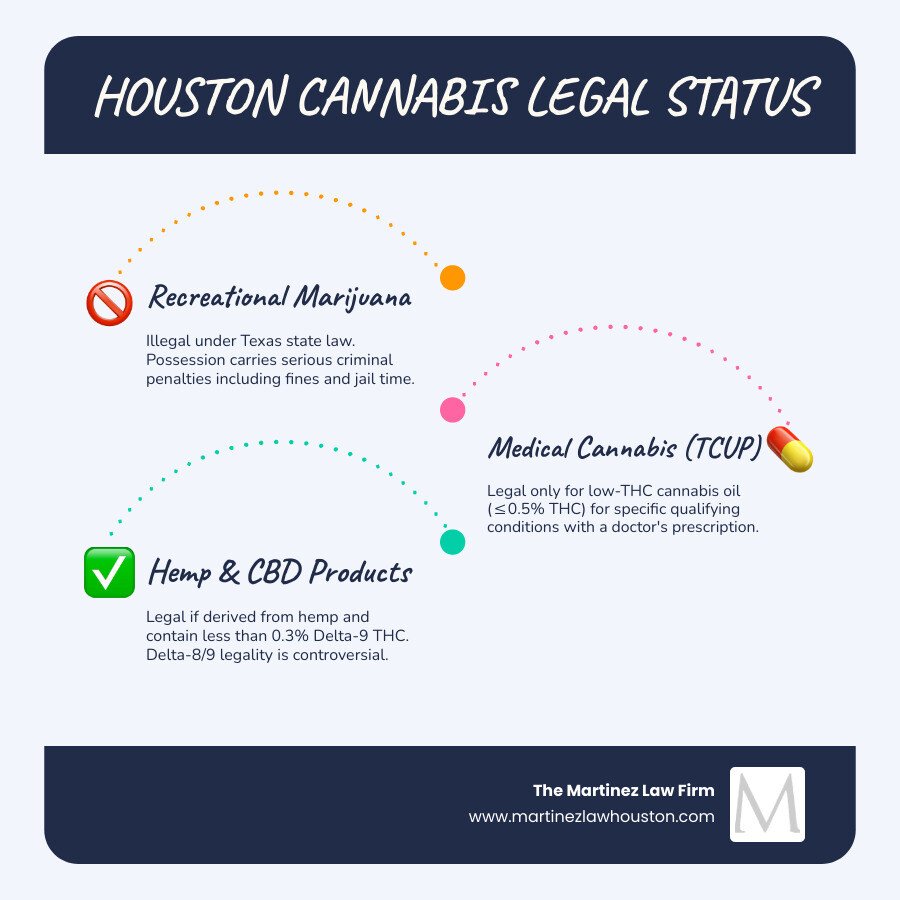
The Legal Landscape: Is Weed Legal in Houston?
Understanding Houston’s marijuana laws can be confusing. You hear about legalization in other states and wonder where Texas fits in. So let’s get straight to the point: is weed legal in Houston?
Recreational Marijuana: The Straight Answer to “Is Weed Legal in Houston?”
No, recreational marijuana is not legal in Houston. The Texas Controlled Substances Act makes it illegal to possess, use, sell, or grow marijuana. However, Houston has implemented policies to ease the burden on the criminal justice system. The city’s ‘cite and release’ policy allows officers to issue a citation for small amounts instead of making an arrest.
Additionally, the Harris County Misdemeanor Marijuana Diversion Program (MMDP) offers a lifeline for many caught with less than four ounces. Eligible individuals can take a drug education class and pay a fee to avoid a criminal record. I’ve seen this program give countless clients a second chance.
However, state law always trumps local policy. These programs don’t change Texas law. If you’re stopped by a state trooper or are in a neighboring county like Montgomery County, you could face the full force of Texas criminal penalties. The Texas State Law Library on Cannabis and the Law confirms that marijuana remains a criminal offense statewide.
For more on how we handle these cases, see our resources on Criminal Defense: Drug Crimes and Arrested for Drug Possession in Houston.
Potential Penalties for Marijuana Possession in Texas
Even with Houston’s lenient approach, Texas state law imposes harsh penalties that escalate with the amount possessed, as detailed in Section 481.121 of the Texas Health and Safety Code.

- Under 2 ounces: Class B misdemeanor (up to 180 days in jail, $2,000 fine).
- 2 to 4 ounces: Class A misdemeanor (up to 1 year in jail, $4,000 fine).
- 4 ounces to 5 pounds: State Jail Felony (180 days to 2 years in state jail, $10,000 fine). A felony record can affect employment, housing, and voting rights.
- 5 to 50 pounds: Third-Degree Felony (2 to 10 years in prison, $10,000 fine).
- 50 to 2,000 pounds: Second-Degree Felony (2 to 20 years in prison, $10,000 fine).
- Over 2,000 pounds: First-Degree Felony (5 to 99 years or life in prison, $50,000 fine).
These penalties are outlined in Chapter 12 of the Texas Penal Code and can have devastating consequences. If you’re facing possession charges, our page on Criminal Defense: Drug Possession explains how we can help.
Laws on Marijuana Sale and Cultivation
Penalties for selling or growing marijuana are significantly more severe than for simple possession.
According to Section 481.120 of the Texas Health and Safety Code, delivering marijuana penalties are as follows:
- Delivering a quarter-ounce or less for free: Class B misdemeanor (up to 180 days in jail, $2,000 fine).
- Delivering a quarter-ounce or less for payment: Class A misdemeanor (up to 1 year in jail, $4,000 fine).
- More than a quarter-ounce to 5 pounds: State Jail Felony (180 days to 2 years, $10,000 fine).
- 5 to 50 pounds: Second-Degree Felony (2 to 20 years in prison, $10,000 fine).
- 50 to 2,000 pounds: First-Degree Felony (5 to 99 years or life, $10,000 fine).
- Over 2,000 pounds: First-Degree Felony (10 years to life, $100,000 fine).
Cultivation charges are based on the total weight of the plants. Selling to a minor is especially serious; under Section 481.122, it is an automatic Second-Degree Felony, regardless of the amount.
If you face charges for sale, delivery, or cultivation, you need an attorney who understands the system. Our firm handles Criminal Defense: Drug Trafficking and Criminal Defense: Drug Cultivation cases with the aggressive defense they demand.
Legal Cannabis in Texas: Medical Use, CBD, and Hemp
While recreational marijuana is illegal in Houston, Texas allows for certain forms of cannabis. Many people are confused about where the lines are drawn regarding medical use and CBD products.
Medical Cannabis: Is Weed Legal in Houston with a Prescription?
Yes, medical marijuana is legal in Houston, but only for patients who qualify under the highly restrictive Texas Compassionate Use Program (TCUP). Originally passed in 2015 for intractable epilepsy, the program has expanded but remains one of the strictest in the nation.
Key features of TCUP include:
- Low-THC Cannabis: Products must contain no more than 1.0% THC by weight.
- Qualifying Conditions: The list includes epilepsy, multiple sclerosis, spasticity, ALS, autism, cancer, PTSD, and incurable neurological diseases.
- Doctor’s Prescription: A prescription is required from a physician registered with the Compassionate Use Registry of Texas (CURT).
- No Smoking: Smoking cannabis flower is illegal, even for medical patients. Products are available as edibles, oils, and topicals.
- No Physical Cards: Verification is handled digitally at licensed dispensaries.
For context on how Texas compares to other states, see the NCSL State Medical Cannabis Laws, but Texas laws are uniquely restrictive.
The Legal Status of Hemp and CBD Products
While marijuana is illegal, industrial hemp and its derivatives like CBD are legal in Texas if they meet specific criteria. This has created a large market in Houston for these products.

In 2019, Texas passed House Bill 1325, aligning state law with the 2018 federal Farm Bill. This bill legalized hemp, defined as cannabis containing less than 0.3% Delta-9 THC by dry weight. Anything above this threshold is considered illegal marijuana. The Brookings explainer on the Farm Bill details the national implications.
CBD (cannabidiol), a non-intoxicating compound from hemp, is legal in Houston as long as the product adheres to the 0.3% Delta-9 THC limit. However, the legality of other hemp-derived cannabinoids, like Delta-8 THC, is a legal gray area. While derived from legal hemp, Delta-8 is psychoactive. Texas has attempted to ban these products, but court injunctions have kept them on the market for now.
This has also led to hemp-derived Delta-9 products that stay under the 0.3% by-weight threshold, creating a loophole for mildly intoxicating but technically legal products.
This legal ambiguity creates a razor-thin line between legal hemp and illegal marijuana. If you face charges related to these products, our experience with Criminal Defense: Drug Crimes can help you steer these complex situations.
Broader Implications of Houston’s Marijuana Laws
Understanding if is weed legal in Houston requires looking at the broader impact on employment, federal law, and the future of reform.
Federal Law vs. Texas Law
At the federal level, marijuana is a Schedule I controlled substance under the Controlled Substances Act, in the same category as heroin. This classification deems it to have a high potential for abuse and no accepted medical use, despite what research and other states’ laws suggest.
This means that even if you comply with Texas’s limited medical program, you are technically violating federal law. However, the federal government has largely taken a hands-off approach to individual users in states with their own cannabis laws. As detailed in a CRS report on Federal Marijuana Status, federal enforcement priorities have shifted away from prosecuting individuals.
Still, federal law creates real problems, such as banking restrictions for cannabis businesses and prohibitions on transporting cannabis across state lines. The good news is that the DEA is considering rescheduling cannabis to Schedule III, which would acknowledge its medical use and be a significant step toward federal reform.
Employment and Drug Testing in Houston
Can you be fired for using medical cannabis in Houston? Unfortunately, yes. Texas is an at-will employment state, meaning employers can fire employees for nearly any reason not explicitly protected by law. Using marijuana, even with a TCUP prescription, is not a protected activity.
Most Houston employers, especially in safety-sensitive industries like oil and gas, maintain zero-tolerance drug policies. Failing a drug test can lead to termination or prevent you from being hired. TCUP patients have no employment protections under Texas law, creating a difficult situation where legal medical treatment could cost you your job.
As explained in this Nolo article on Workplace Drug Testing in Texas, employers can legally test you at various times. Always review your company’s drug policy carefully.
The Future of Marijuana Laws in Texas
Despite its conservative reputation, Texas is seeing a shift in attitudes toward marijuana.

Legislative momentum is building. In 2023, House Bill 218, which would have reduced penalties for possessing one ounce of marijuana, passed the Texas House with bipartisan support before stalling in the Senate. This shows a significant shift in attitude among lawmakers.
Public opinion strongly favors reform. A University of Texas at Austin study found that 60% of Texans support some form of legal possession, while only 13% believe it should remain illegal. This aligns with national trends showing record-high support for legalization, as noted in a recent Gallup poll.
Advocacy groups are influential. Organizations like Texas NORML continue to lobby legislators and educate the public, keeping pressure on lawmakers to act. Houston often plays a leading role in these conversations.
Change will likely be incremental, with expanded medical access and decriminalization probably preceding full recreational legalization. But the trajectory is clear: Texas marijuana laws are evolving, and until they change, having strong legal representation is critical for anyone facing charges in Houston.
What to Do If You’re Facing a Marijuana Charge in Houston
Even with Harris County’s diversion programs, a marijuana charge is a serious matter. What you do after an encounter with law enforcement can make or break your case.
Your Immediate Rights and First Steps
If law enforcement stops you on suspicion of marijuana possession, your first steps are critical. Cooperating by answering questions or consenting to searches often harms your case. Based on my 25 years of experience as both a prosecutor and defense attorney, here is what you must do to protect yourself:
- Exercise your right to remain silent. You are not required to answer questions about where you are going or what you are doing. Politely state, “I prefer not to answer questions.” Anything you say can be used against you.
- Never consent to searches. If an officer asks to search your car or belongings, you have the right to refuse. State clearly, “I do not consent to a search.” Do not physically resist if they search anyway, but your refusal is critical for your defense.
- Ask for a lawyer immediately. As soon as you are detained or arrested, say, “I want to speak with a lawyer,” and then stop talking. Do not try to explain or negotiate.
Once you have legal representation, your attorney will explain the charges, whether it’s simple possession under Section 481.121 or delivery under Section 481.120, and build your defense. For more information, visit our Criminal Defense: Drug Crimes FAQ.
How Houston Compares to Other Cities and States
Texas is significantly stricter than many other states. The consequences for possessing one ounce of marijuana vary drastically by location:
- Denver, CO: Legal for adults 21+. No criminal penalties.
- Austin, TX: While still illegal under state law, a 2022 city proposition made marijuana enforcement the lowest police priority, resulting in fewer arrests.
- Houston, TX: You face a Class B misdemeanor. However, you may be eligible for the Harris County Misdemeanor Marijuana Diversion Program, which allows you to avoid a criminal record by completing a class and paying a fee. This is a second chance, but it is not the same as legality.
This patchwork of laws creates confusion. People visit states with legal cannabis and assume attitudes have changed everywhere. They haven’t. Texas’s reputation for strict drug enforcement is well-earned, and underestimating that can be a costly mistake.
Finding Legal Resources and Support
When facing a marijuana charge in Houston, you don’t have to go it alone. Getting the right legal help early can be the difference between a dismissed case and a lifelong criminal record.
At The Martinez Law Firm, we provide the expert legal support you need. My experience as a former Chief Prosecutor for the Harris County District Attorney’s Office gives our firm a unique advantage. We know how prosecutors build their cases and, more importantly, how to find their weaknesses. We use this insider knowledge to craft strategic, aggressive defenses custom to your situation. For more on our approach, visit our Criminal Defense: Drug Possession page.
If you need other options, the State Bar of Texas Lawyer Referral Service can connect you with qualified attorneys. The most important step is not to wait. The sooner you have experienced legal counsel, the better your chances of a favorable outcome. Don’t let a marijuana charge derail your life. Get the help you need.
Bottom Line: Houston Weed Laws
So, is weed legal in Houston? The answer is complex. Recreational marijuana is illegal under Texas law, with penalties ranging from misdemeanors to felonies. While Harris County’s diversion program offers a safety net for some, it doesn’t change the underlying illegality.
Medical cannabis is available only through the restrictive Texas Compassionate Use Program for patients with specific conditions. Meanwhile, hemp and CBD products are legal if they contain less than 0.3% Delta-9 THC, but the status of related products like Delta-8 remains a legal gray area.
Houston’s marijuana laws are a confusing mix of federal prohibition, strict state criminalization, and lenient local policies. Navigating this legal minefield is difficult, and even a minor charge can have life-altering consequences for your job, freedom, and future.
If you’re facing a marijuana charge in Houston, you need an attorney who understands the system from the inside out. At The Martinez Law Firm, we leverage Herman Martinez’s 25 years of experience, including his time as a Chief Prosecutor for Harris County. This unique perspective allows us to anticipate the prosecution’s moves and build a powerful defense. We fight aggressively and personally for each client’s rights.
Don’t try to steer this maze alone. Get expert help for your drug charge case and let us put our proven track record to work for you. Your future is too important to leave to chance.
Understanding Your Constitutional Right Against Self-Incrimination

“Plead the fifth” is a phrase many know from TV, but its real-world application is a critical legal strategy. It refers to invoking your Fifth Amendment right to refuse to answer questions that could incriminate you. Here’s a quick overview:
- Your Right: The Constitution says you cannot be compelled to testify against yourself in a criminal case.
- When to Use It: This right applies during police questioning, court testimony, or any legal setting where your answers could be used against you.
- Key Point: Invoking this right is not an admission of guilt. It’s a protection for everyone, and juries in criminal cases are forbidden from holding your silence against you.
The Fifth Amendment’s Self-Incrimination Clause states that no person “shall be compelled in any criminal case to be a witness against himself.” This principle was born from the abuses of 17th-century English inquisitorial courts, which forced confessions. The founders included it to ensure no one is bound to accuse themselves.
Why Plead the 5th?
Many wonder why an innocent person would plead the Fifth. The Supreme Court has affirmed this right protects the innocent and guilty alike. You might use it to avoid perjury traps, prevent misremembered facts from being twisted against you, or simply because the Constitution guarantees you don’t have to help the prosecution build its case.
However, exercising this right has become more complex. Recent court decisions mean that in some situations, you must explicitly state you are invoking your rights—silence isn’t enough.
I’m Herman Martinez, founder of The Martinez Law Firm in Houston. With over 25 years of experience as a former Chief Prosecutor and now a criminal defense attorney, I’ve seen how crucial it is to know when and how to plead the Fifth. For anyone facing criminal charges in the Houston area, understanding this right is a cornerstone of a strong defense.
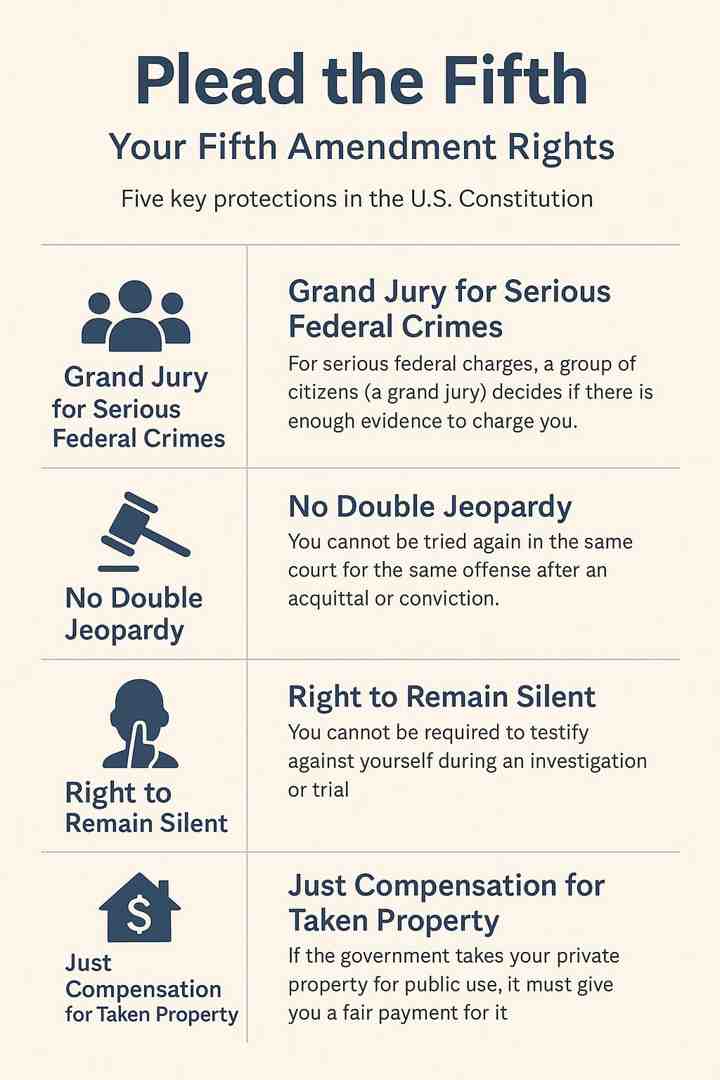
Understanding the Fifth Amendment and Your Right to Remain Silent

The Fifth Amendment is a constitutional shield against government overreach. For anyone in Houston facing the justice system, understanding its protections is vital.
What is the Fifth Amendment?
The Fifth Amendment provides five distinct protections. While most people associate it with the right to remain silent, it also includes:
- The Grand Jury Clause: Requires a grand jury indictment for serious federal crimes, preventing baseless charges. Texas has its own grand jury procedures.
- Double Jeopardy Protection: Prevents the government from trying you twice for the same crime after an acquittal or conviction.
- The Self-Incrimination Clause: This is the basis for the right to plead the fifth. It ensures you cannot be forced to provide testimony against yourself in a criminal case.
- Due Process: Guarantees the government must follow fair legal procedures before depriving anyone of life, liberty, or property.
- The Takings Clause: Requires the government to pay “just compensation” for private property taken for public use.
You can explore the complete text through the Fifth Amendment explained by Cornell Law.
What Does It Mean to ‘Plead the Fifth’?
To plead the fifth is to invoke your constitutional right to refuse to answer questions that could incriminate you. It is not an admission of guilt but a fundamental protection for all. The right applies to any testimonial evidence—communicative statements that could provide a “link in the chain” of evidence needed for prosecution.
This right can be used in various settings in Houston and Harris County:
- Criminal Proceedings: Defendants and witnesses can invoke the right on the stand.
- Police Questioning: You have the right to remain silent, especially during a custodial interrogation (the basis for Miranda rights).
- Civil Cases: You can plead the fifth in a civil suit if your testimony could lead to criminal charges. However, unlike in criminal trials, a civil jury may be allowed to draw a negative inference from your silence.
- Governmental Hearings: Witnesses in congressional hearings and other proceedings can also invoke this right.
Crucially, invoking this right is not an admission of guilt. The Supreme Court has made it clear the privilege protects the innocent just as much as the guilty. At The Martinez Law Firm, we help Houston clients make the strategic decision about when and how to use their Fifth Amendment rights, a choice that requires deep knowledge of constitutional law and Texas criminal courts.
The ‘Why’ and ‘How’ of Invoking Your Rights

Deciding to plead the fifth can be daunting, as many people fear it makes them look guilty. However, understanding the practical reasons for this right shows why it’s a vital protection.
Historical Roots of the Self-Incrimination Clause
The right to remain silent was born from the brutal tactics of 17th-century English courts like the Star Chamber, which forced people to answer questions without even knowing the accusations against them. This led to the principle of nemo tenetur seipsum accusare—no one is bound to accuse himself. The Founding Fathers included this protection in the Bill of Rights to prevent such government overreach. You can learn more from the historical context of the Fifth Amendment.
Why an Innocent Person Might Plead the Fifth
Many of our Houston clients are surprised to learn that innocent people have excellent reasons to plead the fifth. Answering questions, even truthfully, can be risky.
- Avoiding Perjury Traps: Under pressure, it’s easy to misremember facts or give confusing answers. Prosecutors can use any inconsistency to suggest you’re lying.
- Preventing a “Link in the Chain”: In Ohio v. Reiner, the Supreme Court affirmed that the right protects the innocent, as even truthful testimony could provide a “link in the chain” of evidence against them. Prosecutors don’t need a full confession; they just need details that help build their case.
- Protecting Others: You might invoke the right to avoid implicating friends or family.
The bottom line is that pleading the fifth is a right for the innocent and guilty alike. It’s a protection against a system that can sometimes ensnare innocent people.
Pleading the Fifth vs. Pre-Arrest Silence
Knowing how and when to invoke your right is critical. The law treats silence differently depending on the context.
In custodial interrogation (when you’re under arrest), Miranda v. Arizona requires police to inform you of your right to remain silent and right to an attorney.
However, in non-custodial settings (when you’re not under arrest), the rules are different. The 2013 case Salinas v. Texas changed the landscape. A man voluntarily answered police questions but fell silent on a key question. Because he never explicitly invoked his Fifth Amendment right, the Supreme Court allowed his silence to be used as evidence of guilt.
This ruling has major implications in Houston. If you are speaking to police and are not in custody, simply staying quiet is not enough. You must clearly state, “I am invoking my right to remain silent and would like to speak with an attorney.” This removes all ambiguity. You can read more in our article about how the Supreme Court Declares Silence Can Be Held Against You.
Legal Implications When You Plead the Fifth in Texas

In a Houston courtroom, the consequences of invoking your right to plead the fifth differ dramatically between criminal and civil cases.
Can a Jury Infer Guilt from Pleading the Fifth?
The answer depends on the type of case.
- In criminal cases, no. The Supreme Court’s ruling in Griffin v. California established a clear rule: prosecutors cannot comment on a defendant’s refusal to testify, and juries are instructed not to draw any “adverse inference” from it. The prosecution must prove its case without using your silence against you. This protection is absolute in all Texas criminal courts.
- In civil cases, yes. While you can still plead the fifth in a civil lawsuit to avoid criminal self-incrimination, the jury is often allowed to draw a negative conclusion from your silence. They may assume your testimony would have been damaging.
This creates a dilemma if you’re facing both civil and criminal liability. Testifying in the civil case could create evidence for the criminal case, but pleading the fifth could cause you to lose the civil suit. This complex situation requires strategic advice from a Houston attorney.
How the Fifth Amendment Applies in Houston Courts
Your Fifth Amendment rights are just as strong in Texas state courts as they are in federal court. Through the incorporation doctrine of the Fourteenth Amendment, fundamental rights apply to state governments. The Supreme Court confirmed this in Malloy v. Hogan (1964), making the privilege against self-incrimination fully applicable in state proceedings.
This means your right to plead the fifth is the same whether you are in a Harris County district court or a federal court in Houston. The Texas Constitution also provides its own similar protections. An experienced Houston attorney understands how these rights are applied in local courts, which is crucial for an effective defense.
Limitations and the Role of a Criminal Defense Attorney
While the right to plead the fifth is powerful, it is not absolute. Understanding its limitations is key to using it effectively.
Are There Exceptions to the Right to Plead the Fifth?
The Fifth Amendment’s protection has several important exceptions:
- Corporations and Business Records: The privilege is personal and does not apply to collective entities like corporations or partnerships. A custodian of records cannot refuse to produce documents, even if they are incriminating. This is highly relevant for business-related investigations in Houston.
- Non-Testimonial Evidence: The right only protects you from being forced to testify or communicate. It does not protect physical evidence. As established in Schmerber v. California, police can compel you to provide blood or DNA samples, fingerprints, or stand in a lineup.
- Immunity Grants: If a prosecutor grants you immunity, you can no longer claim the right against self-incrimination for that testimony. Use immunity protects your testimony from being used against you, while broader transactional immunity protects you from prosecution for the related offense. Refusing to testify after a grant of immunity can lead to contempt of court charges.
- Waiving the Privilege: If you voluntarily start answering questions on a topic, you may waive your right to remain silent on related follow-up questions. This is known as “opening the door” and is a common trap.
Why You Need a Houston Attorney When Considering to Plead the Fifth
Deciding whether to plead the fifth is a complex legal decision with serious consequences. As a former prosecutor now defending clients in Houston, I know how critical the right legal guidance is. An experienced attorney is essential for several reasons:
- Assessing Risks and Benefits: An attorney can analyze whether speaking or remaining silent is the best strategy, especially when facing both criminal and civil liability. Our experience as a former prosecutor gives us unique insight into how the other side thinks.
- Ensuring Proper Invocation: After Salinas v. Texas, simply staying quiet may not be enough. An attorney ensures you use the correct language, such as, “I am invoking my right to remain silent under the Fifth Amendment, and I would like to speak with an attorney.”
- Avoiding Accidental Waiver: It is easy to inadvertently waive your rights by answering seemingly harmless questions. We guide you to maintain that protective shield.
- Negotiating Immunity: If prosecutors offer immunity, an attorney can negotiate for the best terms, such as transactional immunity over use immunity, to fully protect you.
This is about protecting your future. Whether you face drug offenses or other charges in Houston, using your Fifth Amendment rights effectively is a critical part of your defense. We offer a free consultation to help you make informed decisions.
For more guidance, read our articles on When to Hire a Criminal Defense Attorney and the Role of a Criminal Defense Attorney.
Key Takeaways on Pleading the Fifth
The phrase “I plead the fifth” represents a fundamental constitutional right that shields citizens from government overreach and coerced confessions. This protection is vital whether you are in a Houston police station or a Harris County courtroom.
Crucially, invoking your Fifth Amendment right is not an admission of guilt. It is a right for the innocent and guilty alike, ensuring the burden of proof remains on the prosecution. It acknowledges that anyone can be trapped by confusing questions or misremembered details.
However, knowing when and how to invoke this right is complex. The rules differ for criminal and civil cases, and after Salinas v. Texas, you must often explicitly state your intention to remain silent. With exceptions for non-testimonial evidence, corporate records, and immunity grants, navigating this right is treacherous.
That’s where experienced legal counsel is invaluable. At The Martinez Law Firm, our 25+ years of experience, first as prosecutors and now as defense attorneys, gives us the insight to protect our clients’ rights in the Houston criminal justice system. The decision to plead the fifth is too important to make alone.
If you are under investigation or facing criminal charges in Houston or Harris County, do not steer these waters without a skilled advocate. Contact a Houston criminal defense lawyer at The Martinez Law Firm today for a confidential consultation. Your rights and your future deserve a fierce defender.
Understanding the Immediate Impact of a DWI Arrest on Your Driving Privileges
A DWI license suspension in Houston isn’t a distant threat—it begins the moment you are arrested. Understanding the immediate consequences is critical.
Key Facts About DWI License Suspension in Houston:
- You have only 15 days from your arrest to request an Administrative License Revocation (ALR) hearing.
- Your license will be automatically suspended on the 40th day after arrest if you fail to request a hearing.
- Two separate processes can suspend your license: the civil ALR process and a criminal court conviction.
- Refusing a breath/blood test leads to a 180-day suspension for a first offense; failing the test results in a 90-day suspension.
- The ALR suspension is independent of your criminal DWI case; you can lose your license even if criminal charges are later dismissed.
If you’ve been arrested for DWI in Houston, the administrative process moves fast. Missing the 15-day window to challenge the suspension means you lose your right to fight it before it takes effect. This is a separate battle from any criminal penalties you might face, meaning you must fight on two fronts simultaneously.
Losing your license impacts your ability to work, care for your family, and manage daily life. For commercial drivers, the consequences are even more severe and can be career-ending.
I’m Herman Martinez, founder of The Martinez Law Firm. I’ve handled DWI license suspension cases from both sides. As a former Chief Prosecutor and now as a defense attorney. With 25+ years in Harris County courts, I bring practical, proven insight.
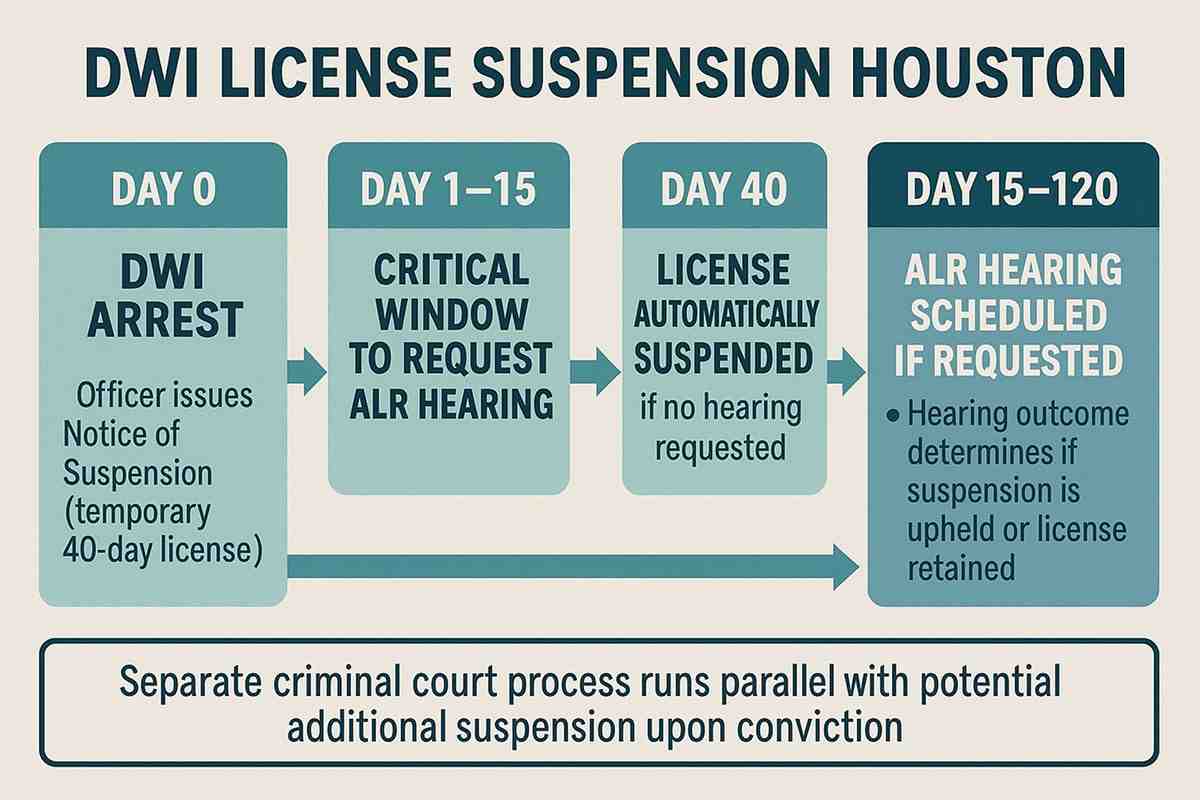
The Immediate Threat: Administrative License Revocation (ALR)
When you’re arrested for a suspected DWI in Houston, a civil process called Administrative License Revocation (ALR) begins immediately. This process is handled by the Texas Department of Public Safety (DPS), not the criminal courts, and runs on a separate track from your criminal DWI case. You can lose your license through the ALR process even if your criminal charges are eventually dismissed.

The ALR program is triggered automatically if an officer believes you were driving while intoxicated and you either refused a breath or blood test or your blood alcohol concentration (BAC) was 0.08% or higher. This is based on Texas’s implied consent law, which states that by driving on Texas roads, you have agreed to chemical testing if suspected of DWI. The official details are on the state’s Administrative License Revocation (ALR) Program page, but the most important takeaway is that you must act fast.
The Critical 15-Day Deadline You Cannot Miss
You have exactly 15 days from the date of your arrest notice to request an ALR hearing. This is the single most important deadline in the process. When you are arrested, the officer confiscates your license and gives you a temporary paper permit, which is your Notice of Suspension. This permit is valid for 40 days, but the deadline to act is only 15 days.
If you miss this deadline, your license will be automatically suspended on the 40th day after your arrest. There are no exceptions or grace periods. To request a hearing, you must contact DPS, a task best handled by an experienced attorney to ensure it is done correctly and on time.
ALR Suspension Periods: Refusal vs. Failure
The length of your ALR suspension depends on whether you refused or failed the chemical test and if you have prior DWI-related incidents in the last 10 years. Refusing a test results in a longer suspension than failing one.
For a first offense, refusing a test triggers a 180-day suspension, while failing a test (BAC ≥ 0.08%) results in a 90-day suspension. With a prior DWI-related incident, the penalties increase to a 2-year suspension for refusal and a 1-year suspension for failure.
| Offense Type (Adult 21+) | First Offense (No Prior Suspensions/Convictions in 10 years) | Repeat Offense (Prior Suspension/Conviction in 10 years) |
|---|---|---|
| Refusing Breath/Blood Test | 180 days | 2 years |
| Failing Breath/Blood Test (BAC ≥ 0.08) | 90 days | 1 year |
For drivers under 21, Texas has a zero-tolerance policy. Any detectable amount of alcohol can lead to a 60-day suspension for a first offense. These suspensions are automatic if you don’t request an ALR hearing or if you lose the hearing, which is why swift action is essential.
Fighting Back: The ALR Hearing Process for a DWI License Suspension in Houston
Requesting an ALR hearing within the 15-day window gives you a fighting chance to keep your license. This formal proceeding is a real opportunity to challenge the state’s attempt to suspend your driving privileges.

The ALR hearing is overseen by an Administrative Law Judge (ALJ), and the burden of proof is on the Department of Public Safety (DPS), not you. To suspend your license, DPS must prove:
- The officer had reasonable suspicion for the initial traffic stop.
- The officer had probable cause to arrest you for DWI.
- You were properly informed of the consequences of refusing or failing a chemical test.
- You either refused the test or your test results showed a BAC of 0.08% or higher.
If DPS fails to prove even one of these points, you win the hearing, and the suspension is denied.
How to Challenge Your DWI License Suspension in Houston
The ALR hearing allows us to scrutinize every detail of your arrest. We look for procedural errors and inconsistencies to prevent DPS from meeting its burden of proof.
Common challenges include:
- Illegal Stop: If the officer lacked reasonable suspicion for the traffic stop, any evidence gathered afterward may be invalid.
- Lack of Probable Cause: We can challenge the officer’s justification for the arrest, such as improperly administered field sobriety tests or failure to account for physical limitations.
- Inaccurate Test Results: Breathalyzers require strict calibration and maintenance protocols. We can challenge the breathalyzer’s accuracy if procedures weren’t followed. Similarly, blood tests can be contested due to improper collection, chain of custody issues, or lab errors.
- Officer Fails to Appear: We subpoena the arresting officer. If they fail to appear at the hearing, you typically win by default, and the suspension is dismissed.
Using the ALR Hearing as a Strategic Advantage
The ALR hearing is more than just a fight for your license; it’s a critical tool for your criminal DWI defense. It is often the first opportunity to question the arresting officer under oath, and their testimony is recorded.
This allows us to lock in their testimony. If the officer’s story changes later in criminal court, we can use the ALR transcript to challenge their credibility. This hearing also helps us identify weaknesses in the prosecution’s case early on, such as an officer admitting to a procedural error. A successful ALR hearing provides significant leverage in plea negotiations, as prosecutors know their criminal case has been weakened. As a former Chief Prosecutor, I know how to use these hearings to gain a strategic advantage for my clients in both the administrative and criminal proceedings.
Understanding the Two Types of Suspensions: ALR vs. Court-Ordered
Many people facing a DWI in Houston are confused by the two separate legal battles that can suspend their license. You can win one and still lose the other.

The first is the Administrative License Revocation (ALR) suspension. This is a civil action by the Texas DPS that begins right after your arrest if you refused a test or your BAC was over the limit. It happens before your criminal case is resolved.
The second is a court-ordered suspension. This is a criminal penalty imposed by a judge only after a DWI conviction in Harris County Criminal Court. It is part of your sentence.
The good news is that these suspensions can overlap. If your license is suspended through the ALR process, Houston courts will typically credit that time toward any court-ordered suspension you receive later.
How a DWI Conviction Impacts Your License
A DWI conviction under Texas Penal Code § 49.04 brings serious penalties, including fines, potential jail time, and a mandatory license suspension.
- First DWI Offense: Suspension of 90 days to one year.
- Second DWI Offense: Suspension of up to two years.
- Third or Subsequent DWI: Suspension of 180 days to two years.
A DWI conviction also creates a permanent mark on your driving record, leading to drastically higher insurance rates and the requirement to obtain an SR-22 certificate to prove you have coverage.
Special Rules for CDL Holders and Drivers Under 21
Texas law is stricter for commercial drivers and those under 21.
For CDL holders, your livelihood is at risk. The legal BAC limit is just 0.04%, even in a personal vehicle. A first DWI offense results in a one-year CDL disqualification (three years if transporting hazardous materials). A second offense typically means a lifetime disqualification.
For drivers under 21, Texas has a zero-tolerance policy. Any detectable amount of alcohol can lead to a charge. Under Texas Transportation Code 521.342, a minor’s first offense can result in a 60-day ALR suspension and a criminal conviction suspension of up to one year. These consequences can derail a young person’s education and career.
Navigating a Suspension: Occupational Licenses and Reinstatement
If you are facing a DWI license suspension in Houston, you may still have options to drive legally for essential needs and a clear path to get your full license back.
Can I Still Drive? Obtaining an Occupational Driver’s License (ODL)
An Occupational Driver’s License (ODL), or hardship license, allows you to drive for essential needs like work, school, and necessary household duties. To get an ODL, you must petition a Harris County court, proving a genuine need to drive.
If the judge grants your petition, they will issue a court order that you take to the Texas DPS. Key requirements and restrictions for an ODL include:
- Ignition Interlock Device (IID): You will almost certainly need an IID installed in your vehicle. This device prevents the car from starting if it detects alcohol on your breath.
- SR-22 Insurance: You must obtain an SR-22 certificate from your insurance company, which proves you carry state-mandated liability coverage.
- Driving Restrictions: Your driving will be limited to specific hours (usually a 12-hour window) and for court-approved purposes only.
Violating any ODL restriction is a serious offense that can lead to additional criminal charges and a longer suspension.
The Road to Reinstatement: Getting Your Full License Back
Once your suspension period ends, your license is not automatically restored. You must complete several steps with the Texas DPS to get it back.
- Complete the Suspension Period: You must serve the entire suspension term.
- Pay Reinstatement Fees: A $125 reinstatement fee for DWI-related suspensions must be paid, along with any other outstanding fines.
- Complete DWI Education: You will need to complete a state-approved DWI education program. This is typically a 12-hour course for a first offense or a 32-hour DWI Repeat Offender Program for subsequent offenses.
- Maintain SR-22 Insurance: You must maintain SR-22 insurance for two years from your conviction date. A lapse in coverage will trigger another suspension.
- Satisfy All Court Orders: You must complete all other requirements of your sentence, such as probation or community service.
The Texas DPS License Eligibility webpage allows you to check your status, view outstanding fees, and see what requirements you still need to meet. Checking this site can save you time and frustration.
Frequently Asked Questions About Houston DWI License Suspensions
Facing a DWI license suspension in Houston brings up many urgent questions. With over 25 years of experience in Harris County, I’ve addressed the most common concerns from clients in your situation.
Can my license be suspended even if my DWI case is dismissed?
Yes. This is a frustrating but crucial point to understand. The Administrative License Revocation (ALR) process is a civil matter that is completely separate from your criminal DWI case. The ALR hearing only decides if the officer had proper grounds for the stop and arrest and whether you refused or failed a chemical test.
Because they are separate proceedings, you can win your criminal case (by dismissal or a “not guilty” verdict) but still have to serve an administrative license suspension. This is why it is vital to fight both battles, starting with requesting an ALR hearing within 15 days.
What happens if I refuse the breath or blood test in Houston?
Refusing a chemical test triggers an automatic ALR suspension that is longer than if you had failed the test. For a first-time refusal, the suspension is 180 days. For a repeat offender, it is 2 years.
The trade-off is that by refusing, you deny the prosecution key scientific evidence of your Blood Alcohol Concentration (BAC). While they can still use the officer’s observations and field sobriety test results, the lack of a BAC number can sometimes make their criminal case harder to prove. It’s a complex decision with significant consequences for both your license and your criminal case.
How do I check the status of my Texas driver’s license?
Texas makes it easy to stay informed about your license status. You can check your eligibility and any outstanding requirements online at any time through the official Texas DPS License Eligibility webpage.
This tool will show your current license status (e.g., eligible, suspended), list any reinstatement fees you owe, and detail the compliance requirements you still need to meet, such as completing a DWI education course or filing an SR-22. Regularly checking this page helps ensure a smooth path to reinstatement.
Why You Need an Experienced Houston DWI Attorney
If you’re facing a DWI license suspension in Houston, you’re up against a complex legal system with two separate tracks: the fast-moving civil ALR process and the criminal court case. Trying to steer this alone puts your driving privileges, your job, and your future at immediate risk.

At The Martinez Law Firm, we have over 25 years of experience in the Harris County legal system. As a former Chief Prosecutor, Herman Martinez understands DWI cases from both sides, giving our clients an invaluable advantage.
Here’s how we protect you:
- We Meet the 15-Day Deadline: We immediately file your ALR hearing request to prevent the automatic suspension of your license.
- We Fight at the ALR Hearing: We treat the ALR hearing as a strategic opportunity to challenge the state’s case. We subpoena the arresting officer, question them under oath, and lock in their testimony. This is often where we find the weaknesses that can help win not only your license hearing but also your criminal case.
- We Build a Strong Criminal Defense: Our insider knowledge of how the Harris County District Attorney’s office operates allows us to build a powerful defense. We scrutinize every detail, from the legality of the traffic stop to the accuracy of the chemical tests.
Our goal is to protect your driving privileges and your future. Whether that means winning the ALR hearing, securing an Occupational Driver’s License, negotiating a reduction of charges, or fighting for a not-guilty verdict at trial, we are prepared to fight for you.
We know you’re worried. We take the time to explain your options and keep you informed. Don’t wait to get help. Every day counts.
Contact our Houston DWI lawyers for a free consultation today. Let’s discuss your case and build a strategy to fight for the best possible outcome.
What You Need to Know About Reasonable Suspicion in Texas
Reasonable suspicion is a legal standard allowing police to briefly stop and question you based on specific, articulable facts suggesting criminal activity. It’s a critical concept that can determine the outcome of a police encounter in Houston.
Quick Facts About Reasonable Suspicion:
- What it is: More than a hunch, but less than probable cause
- What it allows: Brief stops (Terry stops), questioning, and friscks for weapons
- What it requires: Specific, observable facts—not assumptions or stereotypes
- What it doesn’t allow: Full searches, arrests, or extended detentions
- Key difference: Reasonable suspicion justifies a stop; probable cause justifies an arrest
If you’ve been stopped by police in Houston, understanding this standard is key to protecting your rights. Officers must base their suspicion on objective facts like erratic driving or matching a suspect’s description, not on your race or a “gut feeling.” When they overstep, evidence they find may be thrown out of court.
I’m Herman Martinez, founder of The Martinez Law Firm. As a former Chief Prosecutor and City of Houston Judge, I’ve seen this standard from all sides. Now, as a defense attorney, I use that experience to challenge unlawful stops and protect my clients. This guide will break down what you need to know.
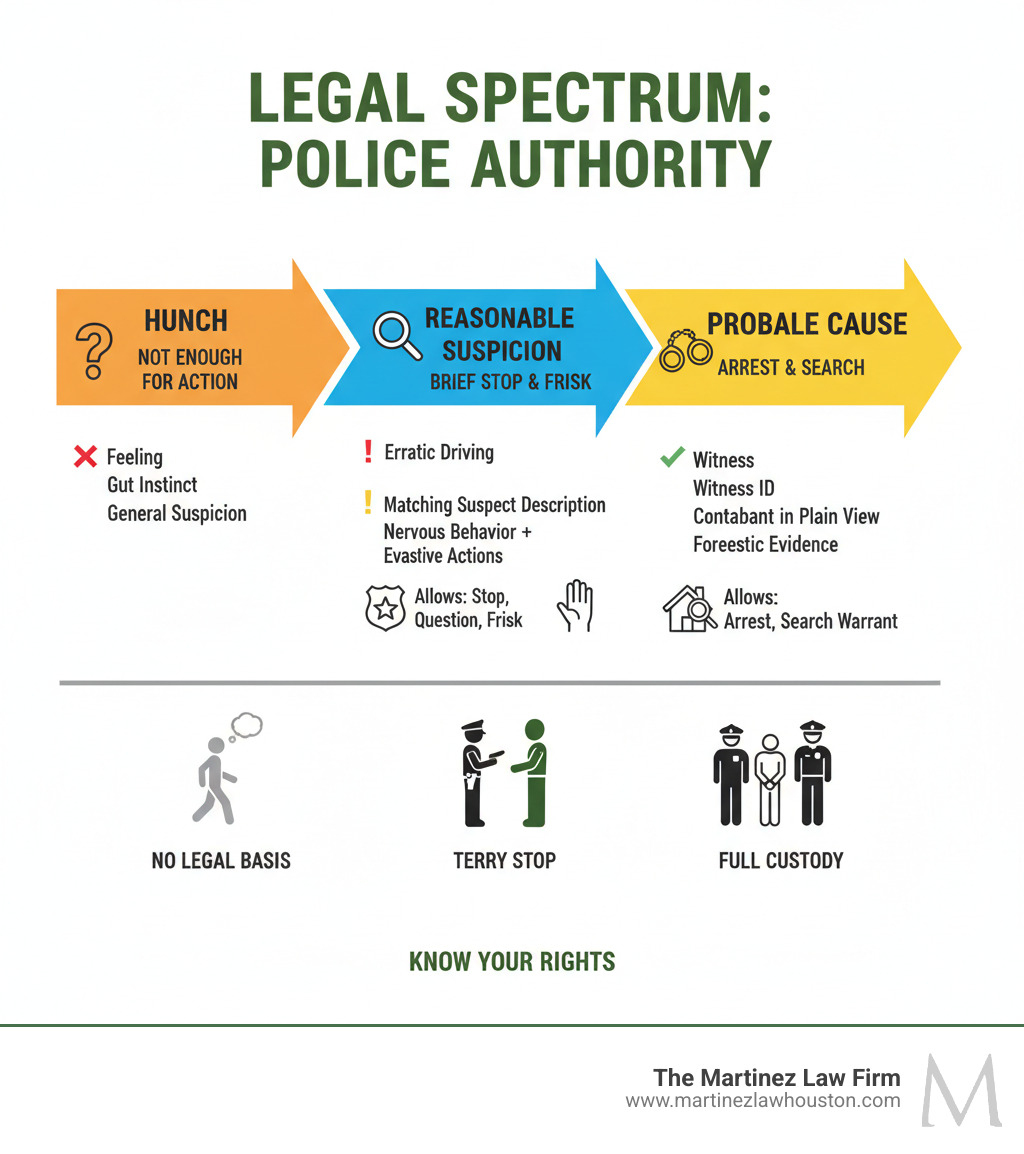
Related content about reasonable suspicion:
Reasonable Suspicion vs. Probable Cause: Understanding the Key Differences
Reasonable suspicion and probable cause are two distinct legal standards that define what police can do during an encounter. While they sound similar, the difference can mean a brief stop versus an arrest.
Think of it as a ladder of proof: a hunch is at the bottom (not enough for police action), reasonable suspicion is in the middle (allowing a brief stop), and probable cause is at the top (allowing an arrest or search). Each step requires more concrete evidence. The Supreme Court defines reasonable suspicion as a common-sense conclusion based on observable behavior, more than a gut feeling but less than probable cause.
Probable cause is a higher standard, requiring a reasonable belief that a crime has been, is being, or will be committed.
Here’s how they compare side by side:
| Feature | Reasonable Suspicion | Probable Cause |
|---|---|---|
| What it is | An objectively justifiable suspicion based on specific, articulable facts. | A reasonable belief that a crime has been, is being, or will be committed, supported by trustworthy information. |
| Level of Proof | More than a hunch (a crime might have occurred). | More than reasonable suspicion (a crime most likely has occurred). |
| What it Allows | Brief investigative stops, questioning, limited pat-downs (frisks) for weapons. | Arrests, full searches, obtaining warrants. |
Understanding this distinction is crucial. If Houston police conduct a full search with only reasonable suspicion, any evidence found could be suppressed. I’ve seen cases dismissed because officers confused these standards. For more on the higher standard, see our guide on What is Probable Cause?
What Constitutes Probable Cause in Texas?
In Texas, probable cause is the standard for an arrest or search warrant. It means officers have reasonably trustworthy information to believe a person has committed a crime, based on the “totality of the circumstances.”
For example, in a Houston DWI case, an officer might pull a driver over for swerving (reasonable suspicion). If the officer then smells alcohol, sees bloodshot eyes, and observes slurred speech, these facts can build to probable cause for a DWI arrest. Field sobriety tests or a breathalyzer result can solidify this. In Texas, even the smell of marijuana can contribute to probable cause for a search, as it remains illegal. After an arrest, knowing your Miranda Rights in Texas is vital.
Defining the Lower Standard of Reasonable Suspicion
Reasonable suspicion is the threshold for a brief investigative stop. It requires “specific, articulable facts” that an officer can explain to a judge—not just a hunch.
With reasonable suspicion, police can:
- Briefly detain you to investigate.
- Ask you questions about their suspicions.
- Conduct a limited pat-down (frisk) of your outer clothing for weapons if they also reasonably suspect you are armed and dangerous.
This standard balances public safety with your Fourth Amendment right to be free from unreasonable searches and seizures.
What Are the “Specific, Articulable Facts” That Justify a Stop?

The legal standard of reasonable suspicion hinges on “specific, articulable facts.” This means an officer must be able to point to concrete, observable details to justify a stop, not just rely on a hunch or gut feeling.
Courts use a “totality of the circumstances” test, looking at the whole picture rather than isolated facts. An officer’s training can help interpret observations—for example, recognizing behavior that suggests drug activity—but it cannot replace the need for objective facts.
Facts that can contribute to reasonable suspicion include:
- Behavioral Cues: Furtive movements, appearing to hide something, or extreme nervousness.
- Informant Tips: Reliable and detailed tips can provide a basis for a stop.
- Context: The time of day, location in a high-crime area (when combined with other factors), or proximity to a recent crime.
- Evasive Behavior: Unprovoked flight from police in a high-crime area can be a factor. However, exercising your right to remain silent or refuse a search is not evasive behavior.
Examples of Valid Reasonable Suspicion in Houston
Here are some real-world examples of what Houston courts often consider valid reasonable suspicion:
- Erratic Driving: Swerving, weaving, driving far below the speed limit, or nearly hitting a curb can suggest a DWI. This is a common reason for a DWI Traffic Stop: What Are My Rights?.
- Matching a Suspect’s Description: If an officer spots someone who closely matches a detailed description of a suspect from a recent crime, they can initiate a stop.
- Suspicious Activity in a High-Crime Area: Someone repeatedly peering into a closed business late at night and testing door handles could be reasonably suspected of planning a burglary.
- Fleeing from Police: Unprovoked flight upon seeing a patrol car in an area known for drug sales can justify an investigatory stop.
It’s almost always a combination of factors, not a single observation, that creates valid reasonable suspicion.
What Does NOT Count as Reasonable Suspicion
It’s just as important to know what officers cannot use to justify a stop. A stop based on these factors is likely illegal:
- Race or Ethnicity: This is racial profiling and is unconstitutional.
- Time of Day: Simply driving late at night is not suspicious.
- Bumper Stickers or Personal Expression: Your protected speech cannot be the reason for a stop.
- Refusing a Consensual Search: Exercising your Fourth Amendment right is not an admission of guilt.
- Presence in a High-Crime Area: Being in a particular neighborhood, without more, is not enough.
- Anonymous, Vague Tips: A call with no specific, verifiable details is generally insufficient.
- An Officer’s ‘Hunch’: The law requires facts, not feelings.
If you were stopped for one of these reasons, the stop was likely illegal, and any resulting evidence could be suppressed.
How Reasonable Suspicion Impacts Your Rights in Texas
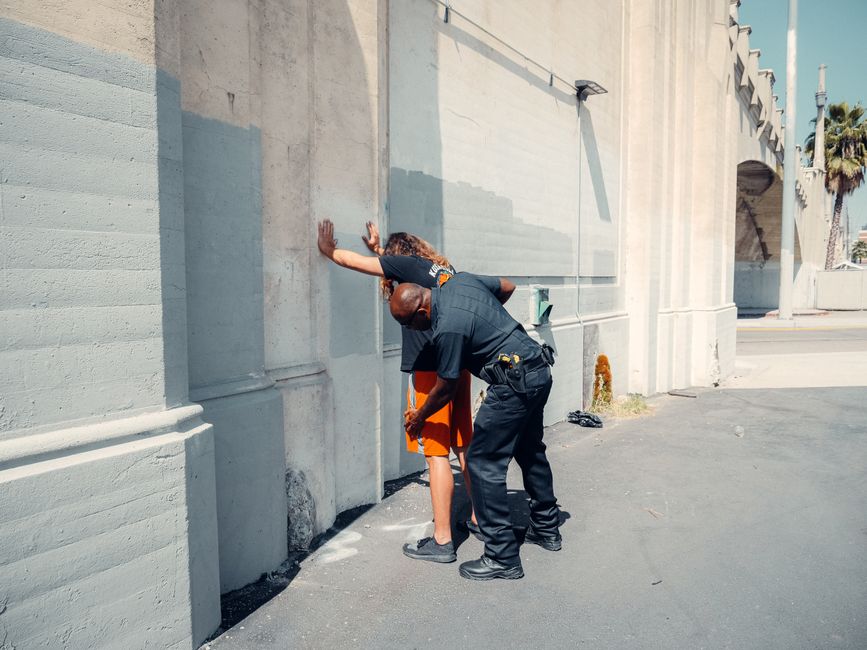
Your Fourth Amendment right against unreasonable searches and seizures hinges on reasonable suspicion. This legal standard dictates what police can and cannot do during an encounter.
The concept was established in the 1968 Supreme Court case Terry v. Ohio. The court ruled that police can conduct brief investigative detentions (“Terry stops”) based on reasonable suspicion, a lower standard than probable cause. The ruling also allows for a limited pat-down, or “frisk,” for weapons if an officer reasonably believes the person is armed and dangerous.
This created a balance: police can investigate suspicious activity, but citizens are protected from arbitrary stops. A Terry stop must be brief and focused. The frisk is strictly a safety measure to detect weapons, not a search for other contraband.
While reasonable suspicion is enough for a stop, it is generally not enough for a full vehicle search, which requires probable cause or your consent. Learn more about When Can Police Search My Vehicle?.
The “Terry Stop” and Frisk
A “Terry Stop” is a brief, temporary detention based on reasonable suspicion of criminal activity. During the stop, an officer can ask questions to confirm or dispel their suspicion.
A frisk is not automatic. To conduct a frisk, the officer needs a separate reasonable suspicion that you are armed and dangerous. This might be based on seeing a bulge in your clothing or your furtive movements toward a pocket.
- The Stop: Must be brief and investigative. It is not an arrest.
- The Frisk: A pat-down of outer clothing to feel for weapons. It is not a full search of your pockets or belongings.
An officer who goes beyond these limits, such as emptying your pockets during a frisk, has likely conducted an illegal search.
Reasonable Suspicion During a Houston DWI Stop
For a DWI stop in Houston, an officer must first have reasonable suspicion of a traffic violation or criminal activity. Without it, the entire stop is illegal.
- Initial Justification: Speeding, running a red light, or even a broken taillight can justify a stop.
- Developing Suspicion: Erratic driving, such as swerving or weaving, provides reasonable suspicion for a DWI investigation.
Once stopped, the officer looks for more evidence. The smell of alcohol, slurred speech, or bloodshot eyes can lift reasonable suspicion to probable cause for an arrest. The officer may then request Field Sobriety Tests.
Crucially, a traffic stop cannot be prolonged indefinitely. The Supreme Court has ruled that the stop must not last longer than necessary to address the initial reason for it, unless new suspicion arises. If an officer illegally extends a stop, any evidence found can be challenged. We have successfully defended many clients by identifying these unlawful traffic stops.
Frequently Asked Questions about Police Stops
We hear these questions all the time from Houston residents who’ve had unexpected encounters with law enforcement. Here are answers to common concerns about reasonable suspicion and what it means for you.
What should I do if I believe I was stopped without reasonable suspicion?
If you feel you were stopped unfairly, stay calm and protect your rights. Do not argue with the officer on the street—that’s a battle for the courtroom.
- Remain Silent: State clearly, “Officer, I am choosing to remain silent.” Learn more about this right in our guide on After an Arrest: Remaining Silent.
- Do Not Consent to Searches: If asked, state firmly, “I do not consent to any searches.”
- Ask if You Are Free to Leave: Ask, “Am I being detained, or am I free to go?” If you are free to go, leave calmly.
- Document Everything: As soon as you can, write down every detail: the officer’s name/badge number, location, time, and what was said.
- Contact an Attorney: Call our firm immediately. If the stop was illegal, we can file a motion to suppress any evidence found.
Can police search my car based only on reasonable suspicion?
No. In general, reasonable suspicion alone is not enough for a full vehicle search. To conduct a search, police need either:
- Probable Cause: A reasonable belief that your car contains evidence of a crime.
- Your Consent: Which you should not give.
There is one key exception: if an officer has reasonable suspicion that you’re armed and dangerous, they may conduct a limited protective ‘frisk’ of the passenger compartment where a weapon could be hidden. This is not a full search for contraband. For more details, read our guide: Do the Police Have the Right to Search Your Car?.
Do I have to identify myself to police in Texas?
It depends.
- Consensual Encounter: If an officer just starts a conversation and you are free to leave, you are not required to identify yourself.
- Lawful Detention or Arrest: If you have been lawfully detained based on reasonable suspicion or arrested, Texas law requires you to provide your name, address, and date of birth.
Refusing to identify yourself in this situation can lead to a separate charge. However, providing identification is not the same as answering questions. You can identify yourself and then state that you are exercising your right to remain silent. Learn More on your rights after an arrest.
What to Do If Your Rights Were Violated

If a police officer stops you without reasonable suspicion, it’s a violation of your constitutional rights. Crucially, any evidence gathered from an illegal stop can be thrown out of court through a legal tool called a motion to suppress.
Challenging an unlawful stop is a key defense strategy. We scrutinize every detail of the police encounter: Did the officer have specific facts, or just a hunch? Was the detention too long? Was the stop based on impermissible factors like your race? A successful challenge can lead to evidence being excluded and charges being dismissed.
This is where my experience as a former Chief Prosecutor and City of Houston Judge provides a distinct advantage. I know how prosecutors build cases and, more importantly, how to find their weaknesses. I understand what judges in Houston and Harris County look for when evaluating reasonable suspicion and use that knowledge to protect your rights.
At The Martinez Law Firm, we fight to hold law enforcement accountable. If you believe your rights were violated during a police stop, don’t wait. The sooner we review your case, the stronger your defense can be.
Your future shouldn’t be jeopardized by an illegal stop. Contact us today for a consultation to protect your rights and your freedom.
Understanding Your Rights and Requirements Under Community Supervision
Texas DWI probation is a form of community supervision that allows individuals convicted of driving while intoxicated to avoid jail time by adhering to strict court-ordered conditions. If you’re facing a DWI in Houston, here’s what you need to know immediately:
Key Facts About DWI Probation in Texas:
- What it is: An alternative to incarceration where you serve your sentence under supervision in the community.
- Duration: Typically 1-2 years for misdemeanors, potentially longer for felonies.
- Cost: $1,000+ in fines, plus monthly probation fees ($60-$100), ignition interlock device costs, and education program fees.
- Main requirements: Regular probation officer check-ins, alcohol education classes, community service, random drug/alcohol testing, complete sobriety, and often an ignition interlock device.
- Early release: Not permitted under Texas law for DWI offenses.
- Violations: Can result in probation revocation and serving your original jail sentence.
After a DWI arrest in Harris County, understanding your options is critical. Probation is not a “get out of jail free” card; it’s a binding legal agreement. Missing a meeting, failing a drug test, or getting arrested for any other offense can trigger a probation violation hearing, where a judge could send you to jail to serve your original sentence.
Texas DWI probation has become increasingly stringent, with mandatory ignition interlock devices for most cases and no possibility of early termination. A DWI conviction can affect your employment, professional licenses, and insurance rates for life. For those on probation, one mistake can mean losing everything.
As a former Chief Prosecutor and City of Houston Judge, Herman Martinez has seen Texas DWI probation cases from every angle. This unique perspective allows The Martinez Law Firm to help Houston-area clients understand what they’re facing and build the strongest possible defense.
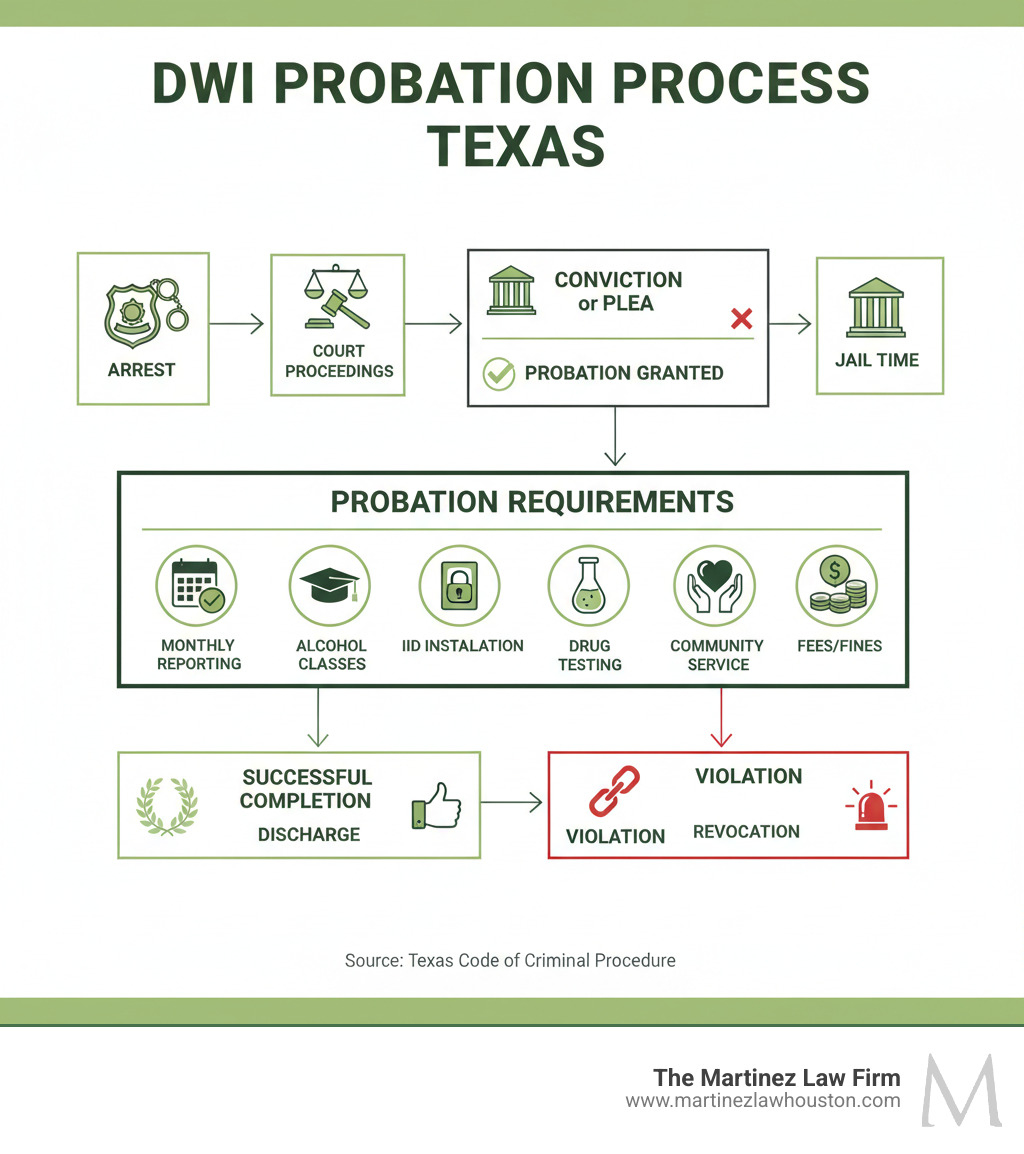
What is DWI Probation and Who is Eligible?
In Texas, “community supervision” is the legal term for what most people call probation. It’s an arrangement that lets you serve a DWI sentence in the community instead of jail, but it requires following strict rules under the supervision of a probation officer. The legal basis for Texas DWI probation is found in Chapter 42A of the Texas Code of Criminal Procedure.
Probation offers a chance to keep your job and stay with your family while participating in rehabilitative programs. However, getting probation isn’t automatic. A judge has significant discretion and will consider factors like your criminal history and the specifics of your arrest. Was your blood alcohol content (BAC) extremely high? Was a child in the car? These details heavily influence a judge’s decision in Houston courts.
An experienced defense attorney can build a compelling case for why you deserve probation, presenting mitigating factors and negotiating with prosecutors to secure a favorable outcome.
Straight Probation vs. Deferred Adjudication
Understanding the two types of Texas DWI probation is crucial for your future.
Straight probation follows a conviction. The judge finds you guilty but suspends the jail sentence, placing you on probation instead. If you complete it successfully, you avoid jail, but the conviction remains permanently on your record, visible on background checks for jobs, housing, and professional licenses.
Deferred adjudication is a more favorable path. The judge defers a finding of guilt while you complete probation. If you succeed, the charges are dismissed. You may then be eligible to file for a non-disclosure order, which seals the DWI charge from most public background checks. This is incredibly valuable for future employment opportunities. However, government agencies and prosecutors can still see the charge if you are arrested again.
Since 2019, deferred adjudication has been an option for some first-time DWI offenders, but with strict limits. To qualify, your BAC must be below 0.15%, you cannot have a commercial driver’s license, and the incident generally cannot involve an accident. Even if you meet these criteria, receiving deferred adjudication depends on the prosecutor’s offer and the judge’s approval.
Eligibility for DWI Probation Texas
Whether you qualify for Texas DWI probation depends on several factors:
-
First-time offenders have the best chance of receiving probation. Houston judges are often willing to grant an opportunity for rehabilitation if it’s a first offense.
-
Repeat offenders face a much tougher road. A second DWI makes probation less certain and its conditions harsher, often including some jail time. A third DWI is a felony, and the chances of avoiding significant prison time are low.
-
Charge Classification is critical. Most first and second DWIs are misdemeanors, offering better probation prospects. However, certain aggravating factors can lift the charge to a felony. These include:
- A third or subsequent DWI (third-degree felony).
- A child passenger under 15 in the vehicle (state jail felony).
- A high BAC of 0.15% or above, which upgrades a first offense to a Class A misdemeanor and typically disqualifies you from deferred adjudication.
- Accident involvement causing injury (Intoxication Assault) or death (Intoxication Manslaughter), which are serious felonies where prison time is the expected outcome.
This is where The Martinez Law Firm’s experience is invaluable. Herman Martinez’s background as a former Chief Prosecutor and City of Houston Judge provides insight into how prosecutors and judges evaluate these cases. We know how to identify weaknesses in the state’s case and build the strongest argument for probation or fight for a dismissal.
The Rules of the Road: Common Conditions of DWI Probation Texas
Being granted DWI probation in Texas means agreeing to a strict contract with the court. Violating any term can have severe consequences. While conditions vary, most people on DWI probation in Houston and Harris County can expect the following.
General requirements include monthly meetings with a probation officer, paying significant fines and monthly supervision fees, completing community service hours (typically 24-100), and maintaining employment. You must also avoid any new criminal offenses and get permission from your probation officer before traveling outside your county and its adjacent areas.
Mandatory Programs and Testing
DWI probation focuses heavily on education and sobriety. You will be required to complete specific programs to prevent re-offending.
- DWI Education: First-time offenders must complete a 12-hour DWI Intervention Program, while repeat offenders face a more intensive 32-hour DWI Repeat Offender Program. You must provide proof of completion to the Texas Department of Licensing and Regulation within 180 days of conviction to avoid driver’s license revocation.
- Victim Impact Panel: You will attend a MADD Victim Impact Panel to hear from those whose lives have been affected by drunk driving.
- Sobriety Testing: Expect frequent, random drug and alcohol testing. This can include urinalysis, breath tests, or continuous monitoring devices like Soberlink or SCRAM bracelets. A failed test is a serious violation.
- Risk Assessment: The court may use the Texas Risk Assessment System (TRAS) to evaluate your risk of re-offense and order additional counseling or treatment.
Driving and Alcohol Restrictions
Your driving privileges will be heavily restricted. The most common requirements include:
- Ignition Interlock Device (IID): This device is installed in your vehicle and requires you to provide a clean breath sample to start the engine and at random intervals while driving. IIDs are now standard for most DWI probation cases, and you are responsible for all installation and monthly fees.
- Occupational Driver License (ODL): If your license is suspended, you may be able to get an ODL to drive for essential needs like work and school, but with strict time and location limits.
- SR-22 Insurance: You must maintain an SR-22 certificate for two years, which proves you have liability insurance and will significantly increase your premiums.
- Absolute Sobriety: This is a non-negotiable rule. You cannot consume any alcohol. It is also wise to avoid places where alcohol is the primary focus, like bars and nightclubs.
The Cost of DWI Probation
While it keeps you out of jail, Texas DWI probation is expensive. The financial burden can be a shock for many in Houston. Be prepared for a wide range of costs that accumulate over the entire probation term.
| Cost Item | Estimated Range (Texas) | Notes |
|---|---|---|
| DWI Probation Duration | 2-3 years, but can be longer for felony DWIs; Early release not permitted. | |
| Probation Fees | $60-$100 per month | Paid directly to the probation department. |
| Alcohol Education Programs | $100-$300 (one-time) | For required 12-hour or 32-hour courses. |
| Ignition Interlock Device | $75-$150 (installation), $60-$100 (monthly maintenance) | Costs for leasing and servicing the device. |
| Court Costs & Fines | $1,000s, up to $10,000 for felonies | Can range significantly based on offense level and judge’s discretion. |
| License Reinstatement Fees | $100+ | Required by DPS to reinstate your driver’s license after suspension. |
| SR-22 Insurance | Higher premiums (varies) | Proof of financial responsibility, mandatory for 2 years, often leads to increased insurance rates. |
| Substance Abuse Evaluation | $50-$200 (one-time) | For TRAS assessment and any recommended counseling. |
| Victim Impact Panel | $25-$50 (one-time) | Fee for attending the MADD panel. |
| Drug/Alcohol Tests | $10-$50 per test (varies) | Can be frequent and add up quickly. |
When all costs are combined, you can expect to pay thousands of dollars over the course of your probation. Understanding these financial and personal commitments is crucial before accepting a plea. At The Martinez Law Firm, we ensure our clients know what to expect and fight to negotiate the most manageable terms possible.
Violating Probation: Consequences and Special Scenarios
When you’re on DWI probation in Texas, even a small mistake can have major consequences. If your probation officer believes you’ve broken a rule—such as missing a meeting, failing a drug test, or getting arrested—they will likely file a Motion to Revoke (MTR) with the court.
Filing an MTR triggers a warrant for your arrest. After being taken into custody, you will face a probation violation hearing. In this hearing, a judge alone decides your fate. The judge can issue a warning, add stricter conditions to your probation, or revoke it entirely and order you to serve your original jail sentence. Critically, time already served on probation often does not count toward that sentence.
What Happens if You Get a DWI While on Probation?
Getting arrested for a new DWI while on probation for any offense creates a serious legal battle on two fronts.
- The New DWI Case: The state must prove you are guilty of the new charge beyond a reasonable doubt, the highest legal standard.
- The Probation Violation Case: The state only needs to prove you violated your probation by a “preponderance of the evidence,” a much lower standard meaning “more likely than not.” An arrest alone can be enough for a judge to find you in violation.
This means your probation can be revoked even if you are ultimately found not guilty of the new DWI charge. You could face penalties for both the original offense (by serving the suspended sentence) and the new DWI charge. Under Texas Penal Code Ch 49.04, a new DWI can also carry improved penalties, turning a third offense into a felony with a potential prison sentence of two to 10 years.
Defending Against a Probation Violation in Houston
If you’re accused of violating your Texas DWI probation, you must act quickly and secure experienced legal help. A defense strategy often begins by challenging the violation allegation itself. Was the drug test administered correctly? Was the new arrest lawful? We investigate for errors or misunderstandings that could invalidate the claim.
Even if a violation occurred, we present mitigating evidence to the judge to argue for a second chance instead of revocation. Proof of voluntary counseling, steady employment, and family support can persuade a judge to modify your probation rather than revoke it.
Herman Martinez’s background as a former Chief Prosecutor and City of Houston Judge provides a crucial advantage in these hearings. We understand how to build a case that resonates with judges and negotiate for outcomes like continued probation with modified terms. The sooner you contact us after a potential violation, the more options we have to protect your freedom.
Frequently Asked Questions about DWI Probation Texas

Facing dwi probation texas brings up many urgent questions. Here are answers to some of the most common concerns we hear from clients in Houston and Harris County.
Can I get early release from DWI probation in Texas?
No. Texas law explicitly prohibits early termination for DWI probation. Under Texas Code of Criminal Procedure 42A § 701, you must serve the full term. However, after completing all active requirements (classes, fines, community service), your attorney may be able to request that you be moved to a “non-reporting status.” This means you would no longer have to check in with your probation officer or submit to random testing for the remainder of your term, offering significant relief.
Can I travel outside of Texas while on probation?
Only with explicit, prior permission from your probation officer. A standard condition of DWI probation in Texas is to remain within your county of residence and sometimes contiguous counties. Traveling outside this approved area without permission is a violation that could lead to your probation being revoked. Always request travel permission in writing well in advance.
What are the penalties for a DWI conviction in Texas?
Understanding the potential penalties shows why probation is often the preferred outcome. Penalties escalate with each offense.
-
First DWI (Class B Misdemeanor):
- Fine: Up to $2,000
- Jail: 3 to 180 days
- License Suspension: Up to 2 years
-
First DWI with BAC ≥ 0.15 (Class A Misdemeanor):
- Fine: Up to $4,000
- Jail: Up to 1 year
-
Second DWI (Class A Misdemeanor):
- Fine: Up to $4,000
- Jail: 1 month to 1 year
- License Suspension: Up to 2 years
-
Third DWI or More (Third-Degree Felony):
- Fine: Up to $10,000
- Prison: 2 to 10 years
-
DWI with Child Passenger <15 (State Jail Felony):
- Fine: Up to $10,000
- State Jail: 180 days to 2 years
-
Intoxication Assault (Third-Degree Felony):
- Fine: Up to $10,000
- Prison: 2 to 10 years
-
Intoxication Manslaughter (Second-Degree Felony):
- Fine: Up to $10,000
- Prison: 2 to 20 years
All convictions also involve additional costs, such as annual license surcharges, SR-22 insurance requirements, and license reinstatement fees. Given these severe potential outcomes, probation allows you to maintain your freedom and livelihood while serving your sentence.
Successfully Completing Your Probation and Moving Forward
Texas DWI probation is a demanding alternative to incarceration that requires strict compliance. From regular check-ins and random testing to mandatory programs and ignition interlock devices, every condition is designed to ensure accountability. A single misstep can lead to a Motion to Revoke Probation and a potential jail sentence.
Successfully completing your probation is about more than just avoiding jail—it’s about reclaiming your life and building a stable future. While the process is challenging, navigating it successfully paves the way for a fresh start.
At The Martinez Law Firm, we understand the complexities of DWI probation in Texas cases in Houston. Herman Martinez’s unique background as a former prosecutor and judge gives us an unparalleled advantage in defending our clients. We provide aggressive, informed defense strategies to protect your rights and fight for the best possible outcome.
If you are facing DWI charges or probation issues in Houston or Harris County, do not face the system alone.
Contact a Houston DWI lawyer for help with your case today. We are here to fight for your freedom.