

Why Understanding THC Laws in Texas Can Protect Your Freedom
Is THC legal in Texas? The answer is complicated and creates a legal minefield for residents. Here’s a quick overview:
- Recreational marijuana is illegal. Penalties include jail time and significant fines.
- Medical cannabis is legal but highly restricted. The Texas Compassionate Use Program (TCUP) allows low-THC products (up to 1% THC) for specific medical conditions.
- Hemp-derived THC products are legal if they contain less than 0.3% Delta-9 THC by dry weight, creating a confusing gray area.
- Possession of illegal marijuana (under 2 oz) is a Class B misdemeanor, punishable by up to 180 days in jail and a $2,000 fine.
Texas has some of the strictest cannabis laws in the U.S. While you can legally buy Delta-8 gummies in Houston, possessing marijuana flower can lead to arrest. The legal distinction hinges on technical definitions most people don’t understand, putting well-meaning citizens at risk of criminal charges.
The confusion is amplified by the open sale of some THC products in gas stations and smoke shops, while others are strictly illegal. In Harris County, diversion programs like the First Chance Intervention Program offer some leniency for minor offenses, but they don’t eliminate the underlying crime. Meanwhile, cities like Austin face state-level legal challenges for passing local decriminalization measures.
Thousands of Texans are arrested for marijuana possession annually, facing long-term consequences for employment, housing, and professional licenses. I’m Herman Martinez, founder of The Martinez Law Firm. With over 25 years of experience, including as a Chief Prosecutor for the Harris County District Attorney’s Office, I’ve seen how this confusion leads to serious charges. Understanding these laws is critical to protecting your freedom.
The Core Question: Is THC Legal in Texas?
The legality of THC in Texas depends entirely on its source, concentration, and intended use. The law treats THC from marijuana differently than THC from hemp, and medical use differently than recreational use. This creates a complex system that can easily confuse Houston residents. Let’s break down the three main categories.
Is recreational THC legal in Texas? A Firm No
Recreational marijuana is strictly illegal in Texas. Possessing, selling, or growing it is a criminal offense under Texas state law. There is no exception for \”personal use.\”
The penalties are harsh. Possessing less than two ounces is a Class B misdemeanor, carrying penalties of up to 180 days in county jail and fines up to $2,000. A conviction can impact your job, professional licenses, and housing applications. In Houston, thousands of residents face these consequences for amounts that are legal in neighboring states.
Medical Marijuana: A Limited Yes
Texas offers a narrow path for medical cannabis through the Texas Compassionate Use Program (TCUP). This program allows patients with qualifying conditions to use low-THC cannabis with a doctor’s prescription. These products must be obtained from state-licensed dispensaries.
As of June 2025, the program expanded, increasing the THC cap to 1% THC and adding more qualifying conditions. While this is progress, it remains far more restrictive than medical programs in states like California or Colorado. For those with serious medical conditions, TCUP provides a legal pathway, but it is heavily regulated.
Hemp-Derived THC: The Gray Area
This is the source of most confusion. The 2018 Farm Bill federally legalized hemp, defined as cannabis with less than 0.3% Delta-9 THC by dry weight. Texas adopted this standard in 2019 with House Bill 1325, legalizing hemp and its derivatives.

This law opened the door for products containing Delta-8 THC, Delta-10 THC, and even Delta-9 THC, as long as they meet the 0.3% concentration limit. As a result, THC gummies, vapes, and drinks are now sold openly in Houston stores.
The legal status of these products, particularly Delta-8, remains contested. While the industry argues they are legal under the hemp law, some state regulators and legal experts disagree. This creates a risky situation for consumers, as the market is completely unregulated for quality and safety. If arrested with one of these products, you may have to defend its technical legality in court.
If you face charges related to any THC product, you need an experienced lawyer. Our firm has handled countless drug crimes cases in Houston and understands these complex legal distinctions.
Understanding the Difference: Marijuana, Hemp, CBD, and Deltas
To understand if THC is legal in Texas, you must first know the difference between various cannabis products. All come from the Cannabis sativa plant, but their legal status depends on their chemical makeup, specifically their THC concentration.
- Marijuana: Cannabis with more than 0.3% Delta-9 THC by dry weight. It is illegal for recreational use in Texas.
- Hemp: Cannabis with 0.3% or less Delta-9 THC by dry weight. It is legal to grow and process in Texas under House Bill 1325.
- Cannabidiol (CBD): A non-psychoactive compound. CBD products derived from legal hemp are allowed in Texas.
- Delta-8 THC: A psychoactive cannabinoid, usually made by converting CBD. It produces a milder high than Delta-9. Its legality is currently protected by a court injunction, but this could change.
- Delta-9 THC: The main psychoactive compound in marijuana. It is illegal if from marijuana but legal if derived from hemp and under the 0.3% concentration limit. This loophole allows for the sale of \”legal\” Delta-9 gummies that can still be potent.

| Product | Legality in Texas (Recreational) | THC Content | Primary Use |
|---|---|---|---|
| Marijuana | Illegal | > 0.3% Delta-9 THC | Psychoactive/Recreational/Medical (illegal form) |
| Hemp | Legal | <= 0.3% Delta-9 THC | Industrial, CBD, other cannabinoids |
| CBD | Legal | Non-psychoactive, <= 0.3% Delta-9 THC | Wellness, non-intoxicating |
| Delta-8 THC | Legal (currently due to injunction) | Psychoactive, derived from hemp, <= 0.3% Delta-9 THC | Psychoactive/Recreational (milder high) |
| Delta-9 THC | Illegal (from marijuana); Legal (from hemp if <= 0.3%) | Psychoactive, variable | Psychoactive/Recreational |
Is hemp-derived THC legal in Texas?
Yes, hemp-derived THC products are legal in Texas if they meet the 0.3% Delta-9 THC limit. However, this market is a “Wild West\” with no regulation for product safety, purity, or labeling accuracy. A product labeled \”legal\” could contain illegal THC levels or harmful contaminants. Furthermore, Texas lawmakers have expressed intent to ban these products, meaning their legal status is unstable. If you are facing legal issues related to these products, it is vital to seek legal help for drug crimes.
What about THCa and other cannabinoids?
The legal landscape is further complicated by other cannabinoids.
- THCa (Tetrahydrocannabinolic acid): A non-psychoactive compound in raw cannabis that converts to psychoactive Delta-9 THC when heated. THCa products exist in a legal gray area, as Texas law has not clarified whether THCa counts toward the 0.3% THC limit.
- Synthetic Cannabinoids (THC-O, HHC): These are lab-created or heavily modified compounds. The DEA has stated that THC-O is an illegal controlled substance because it does not occur naturally in hemp. The legal status of HHC is also murky. These substances often carry greater potency and significant legal risks.
What seems like a legal purchase at a Houston smoke shop could become evidence in a criminal case if the law changes or the product is non-compliant.
Medical Cannabis: The Texas Compassionate Use Program (TCUP)
For those with serious medical conditions, the answer to is THC legal in Texas is a qualified yes, through the Texas Compassionate Use Program (TCUP). This program allows physicians to prescribe low-THC cannabis to patients with specific conditions.
\”Low-THC\” in Texas now means up to 10 milligrams of THC per dose, a shift from the previous percentage-based cap. This change, part of the HB 46 expansion in 2025, makes dosing more practical for patients. To participate, patients must be registered in the Compassionate Use Registry of Texas (CURT) by a qualified physician. You can find official information on the Texas Compassionate Use Program website.
What are the qualifying conditions for TCUP?
The list of qualifying conditions has expanded over the years. It now includes:
- Epilepsy and other seizure disorders
- Multiple sclerosis
- Spasticity
- Amyotrophic lateral sclerosis (ALS)
- Autism
- Terminal cancer
- Incurable neurodegenerative diseases
- Post-traumatic stress disorder (PTSD)
- Chronic pain
- Crohn’s disease
- Traumatic brain injury
This expansion has significantly increased the number of Texans who can legally access low-THC cannabis for therapeutic purposes.
How does medical cannabis impact my gun rights in Texas?
This is a critical and complex issue. While Texas permits medical cannabis through TCUP, federal law still classifies marijuana as an illegal Schedule I controlled substance. This creates a direct conflict affecting Second Amendment rights.
When purchasing a firearm, you must fill out ATF Form 4473, which asks if you are an \”unlawful user of…marijuana.\” Because marijuana is federally illegal, any cannabis use—even state-legal medical use—can classify you as an \”unlawful user.\” Lying on this form is a felony, and possessing a firearm as an unlawful user is a federal crime.
The Texas Department of Public Safety’s Compassionate Use Program FAQ states they do not believe TCUP participation disqualifies a person from possessing a firearm. However, this state interpretation does not override federal law. The ATF maintains that medical marijuana users are prohibited from possessing firearms.
This puts TCUP patients in an impossible position. If you are a patient considering firearm ownership or have been arrested for drug possession in Houston and are concerned about your gun rights, you need expert legal advice. The intersection of state and federal law is treacherous, and the stakes are incredibly high.
The Risks: Penalties for Illegal Marijuana Possession in Texas
While some forms of THC are legal, possessing illegal marijuana in Texas carries severe penalties under the Texas Controlled Substances Act. The confusion around is THC legal in Texas offers no defense when you are caught with a substance classified as illegal. Law enforcement in Houston and across the state actively enforces these laws, and penalties escalate quickly based on weight.

A conviction can affect your job, housing, and future. The difference between a misdemeanor and a felony can be just a few ounces. For a detailed look at sentences, see our guide on How Many Years in Jail for Drug Possession in Texas?
What are the penalties for possessing marijuana?
Texas uses a tiered system for marijuana possession penalties:
- 2 ounces or less: Class B Misdemeanor, up to 180 days in jail and a $2,000 fine.
- 2 to 4 ounces: Class A Misdemeanor, up to one year in jail and a $4,000 fine.
- 4 ounces to 5 pounds: State Jail Felony, 180 days to two years in a state jail and a $10,000 fine.
- 5 to 50 pounds: Third-Degree Felony, two to 10 years in prison and a $10,000 fine.
- 50 to 2,000 pounds: Second-Degree Felony, five to 99 years in prison and a $10,000 fine.
- Over 2,000 pounds: First-Degree Felony, five to 99 years in prison and a $50,000 fine.
A felony conviction has lifelong consequences, affecting your right to vote, own a firearm, and secure employment. If you’re facing felony drug charges in Houston, you need an aggressive defense from a lawyer who understands how prosecutors operate.
What is the stance on decriminalization in Houston and other Texas cities?
While state law is strict, some Texas cities, including Houston, have tried to reduce penalties for minor marijuana offenses. In Harris County, the First Chance Intervention Program and the Misdemeanor Marijuana Diversion Program allow some individuals caught with small amounts to avoid formal charges by completing an educational program.
These programs are a positive step but do not change the law; possession remains illegal. They are discretionary and typically only apply to first-time offenders with small amounts.
Other cities like Austin, Denton, and San Marcos passed ordinances to decriminalize small amounts, but Texas Attorney General Ken Paxton has filed lawsuits against them, arguing that local rules cannot override state law. This legal battle creates uncertainty. For Houston residents, diversion programs offer a chance to avoid a conviction, but they are not a get-out-of-jail-free card. The legal landscape is a patchwork of conflicting rules, making experienced legal counsel essential if you are facing charges.
Frequently Asked Questions about Texas THC Laws
The complex nature of Texas THC laws leads to many questions. Here are answers to some of the most common concerns we hear at The Martinez Law Firm.
Is it legal to buy Delta-9 gummies in Houston?
Yes, it is legal to buy Delta-9 gummies in Houston, provided they are derived from hemp and contain less than 0.3% Delta-9 THC by dry weight. This \”by dry weight\” rule is key. A single gummy can be heavy enough to contain a significant dose of THC (e.g., 15-30 mg) while remaining technically legal. This is how these products can produce strong psychoactive effects.
However, \”legal\” does not mean risk-free. The market is unregulated, so product quality and labeling are unreliable. Driving while impaired by these products can lead to a DWI. Furthermore, state lawmakers have indicated a desire to ban such products, so their legality may be temporary.
What happens if I’m caught with a THC vape pen in Texas?
This is a critical point where many are caught off guard: possessing a THC vape cartridge is a felony in Texas, regardless of the amount. While possessing a small amount of marijuana flower is a misdemeanor, Texas law treats THC concentrates—like vape oils, waxes, and dabs—much more harshly.
Under the Texas Health and Safety Code, even a cartridge with less than one gram of THC oil is classified under a higher penalty group. This results in a State Jail Felony charge, punishable by 180 days to two years in state jail and a fine of up to $10,000. Many people in Houston face felony charges for what they assumed was a minor offense. If you are facing charges for drug possession involving concentrates, you need an aggressive defense immediately.
Does having a TCUP prescription protect me from a DWI charge?
No. A valid prescription through the Texas Compassionate Use Program (TCUP) is not a defense against a DWI charge. Texas law prohibits driving while intoxicated by any substance, including legally prescribed medication.
If a police officer determines that your use of low-THC cannabis has impaired your ability to drive safely, you can be arrested and charged with DWI. The legal standard is impairment, not the legality of the substance. A Controlled Substance DWI carries severe penalties, including fines, license suspension, and potential jail time. Your TCUP prescription only proves you had legal access to the substance; it does not excuse impaired driving. The safest approach is to never drive after using your medication.
Navigating the Hazy Laws with a Clear Defense
So, is THC legal in Texas? The answer is a patchwork of rules, exceptions, and legal gray areas. Recreational marijuana is illegal and harshly penalized. Medical cannabis is legal only through the restrictive TCUP program. And hemp-derived products are sold openly in Houston but exist in a precarious legal state that could change at any moment.
This legal chaos creates a minefield for ordinary citizens. You can legally buy a potent Delta-8 vape at a gas station, but possessing a small amount of marijuana flower can land you in jail. A tiny THC cartridge is treated as a felony, while a package of \”legal\” gummies might contain more total THC than an illegal product. These contradictions are confusing and dangerous.
If you are facing charges related to marijuana or any THC product in Houston, you cannot afford to steer this complexity alone. The penalties are severe, and your future is at stake. At The Martinez Law Firm, we provide the clear, aggressive defense you need. Herman Martinez’s experience as a former Chief Prosecutor for Harris County gives us a unique insight into how the other side works—and how to build a powerful defense against their tactics.
Whether you’re dealing with a misdemeanor drug possession charge or a complex felony case involving THC concentrates, we are here to fight for you. Texas cannabis laws may be hazy, but your defense shouldn’t be. Contact The Martinez Law Firm today for a consultation to protect your rights and your freedom.
When Self-Defense Becomes Your Best Legal Strategy
How to prove self defense in domestic violence requires showing you faced an imminent threat, your belief in that danger was reasonable, and your force was proportionate. Success hinges on compelling evidence—photos, medical records, witness statements, and proof of the accuser’s violent history—presented by an experienced attorney.
Key Steps to Prove Self-Defense:
- Document the Imminent Threat – Show immediate danger with photos of injuries, torn clothing, damaged property, or threatening messages.
- Establish Reasonableness – Demonstrate why a reasonable person would have perceived danger, citing history of abuse, size disparity, or prior incidents.
- Prove Proportionality – Show the force you used matched the threat you faced.
- Gather Witness Testimony – Collect statements from eyewitnesses, neighbors, or experts on trauma responses.
- Challenge the Accuser’s Credibility – Present evidence of their violent history, prior police calls, or false allegations.
Facing a Houston domestic violence charge when you were the one defending yourself is unjust. The system doesn’t automatically see your side; you must prove it. While Texas law allows a self-defense claim, the burden is on you and your attorney to build a case that convinces a prosecutor or jury your actions were justified.
Domestic violence cases are complex, and victims are sometimes wrongly arrested. Without the right evidence and legal strategy, legitimate self-defense claims can fail. In Houston, a conviction carries severe penalties: jail time, fines, a criminal record, and loss of child custody and gun rights. Understanding how to prove self-defense is critical.
I’m Herman Martinez. With over 25 years of experience, including as a Chief Prosecutor for Harris County, I’ve seen how to prove self defense in domestic violence from both sides. I know what it takes to build a winning defense and ensure your story is heard.
Understanding Self-Defense in Texas Domestic Violence Law
When facing Assault charges in Houston after defending yourself, you must understand how Texas law views self-defense. Your actions must fit the legal framework established in Texas Penal Code Chapter 9.
In domestic violence cases, self-defense is an “affirmative defense.” This means you state, “Yes, I used force, but I had a legally justified reason.” The key distinction is between protecting yourself from an immediate threat and retaliating after the danger has passed. Texas law only protects self-defense, not revenge.
What is an “Affirmative Defense”?
An affirmative defense means you admit to the act but provide a legal justification. Once you present evidence supporting your self-defense claim, the burden shifts to the prosecutor. They must then prove beyond a reasonable doubt that you did not act in self-defense. This is a high standard for them to meet, which is why a well-documented self-defense case is so powerful. The prosecutor must convince a jury you weren’t in danger or your response was unreasonable, a much harder task when we present strong evidence.
Self-Defense vs. Retaliation: The Critical Difference
This distinction is crucial. Self-defense is reactive—a response to an immediate, ongoing threat. Retaliation is proactive—striking back after the danger has ended.
Texas law only protects you against an imminent threat, meaning danger that is happening or about to happen in seconds. If your partner attacks you and you defend yourself in that moment, it’s self-defense. If the attack stops, they walk away, and you then use force, it’s illegal retaliation.
Think of it as a “cooling-off period.” Once the immediate threat ends, the justification for using force also ends. Prosecutors in Houston will scrutinize this timeline. Did you act during the attack or after? The answer determines if you have a valid self-defense claim. A history of abuse can support your belief of imminent danger, but it must be presented correctly by an experienced attorney who understands how Harris County prosecutors operate.

The 3 Pillars of a Successful Self-Defense Claim
To prove self-defense in a Houston domestic violence case, we must establish three core elements: imminence, reasonableness, and proportionality. These are the practical standards a jury will use to decide if your actions were justified. While the general principles of self-defense law are a good starting point, applying them to your specific situation is what matters.
Was the Threat of Harm “Imminent”?
“Imminent” means the danger was immediate—happening right then or about to happen. You must have reasonably believed physical harm was about to occur. While an active assault is clearly imminent, so are situations like an abuser screaming threats while advancing aggressively or reaching for a known weapon.
This is where the history of the relationship is critical. A pattern of violence, sometimes related to Battered Woman Syndrome or the cycle of violence, can help explain why you recognized warning signs an outsider wouldn’t. We work to show the jury the context that led to your actions—the escalating behavior and prior incidents that signaled physical violence was coming.
Was Your Belief of Danger “Reasonable”?
The jury must see the situation through your eyes. The standard is whether a “reasonable person” in your exact circumstances would have believed force was necessary. Your subjective fear is important, but it must be supported by objective evidence.
Details matter: Was your abuser larger or stronger? Have they hurt you before? Were weapons present? We use threatening messages, prior police calls, and the overall pattern of violence to show your fear was justified. We might use medical records from past injuries or witness testimony to help the jury understand your perspective. This establishes that your belief of danger was a rational response to a real threat.
Was the Force You Used “Proportionate”?
The force you used must be proportionate to the threat. Texas law requires you to use only the force reasonably necessary to stop the attack. This doesn’t mean matching blow for blow; in the heat of the moment, you don’t have time for precise calculations.
What matters is matching the general level of threat. Pushing someone who is shoving you is proportionate. If you face an attack that threatens serious bodily injury or death, Texas law allows for greater force, including The Use of Deadly Force What You Need to Know. The Texas Penal Code justifies deadly force against threats of murder, sexual assault, or robbery. We examine every detail—injuries, weapons, and the severity of the attack—to show the jury your response was reasonable and necessary to neutralize the immediate danger.
How to Prove Self-Defense in a Domestic Violence Case in Houston
When you acted in self-defense against domestic violence in Houston, proving it comes down to evidence. Simply saying “it was self-defense” is not enough. As a former Chief Prosecutor, I know what the other side looks for and what makes them doubt their case. We must build a compelling narrative with every piece of proof available.
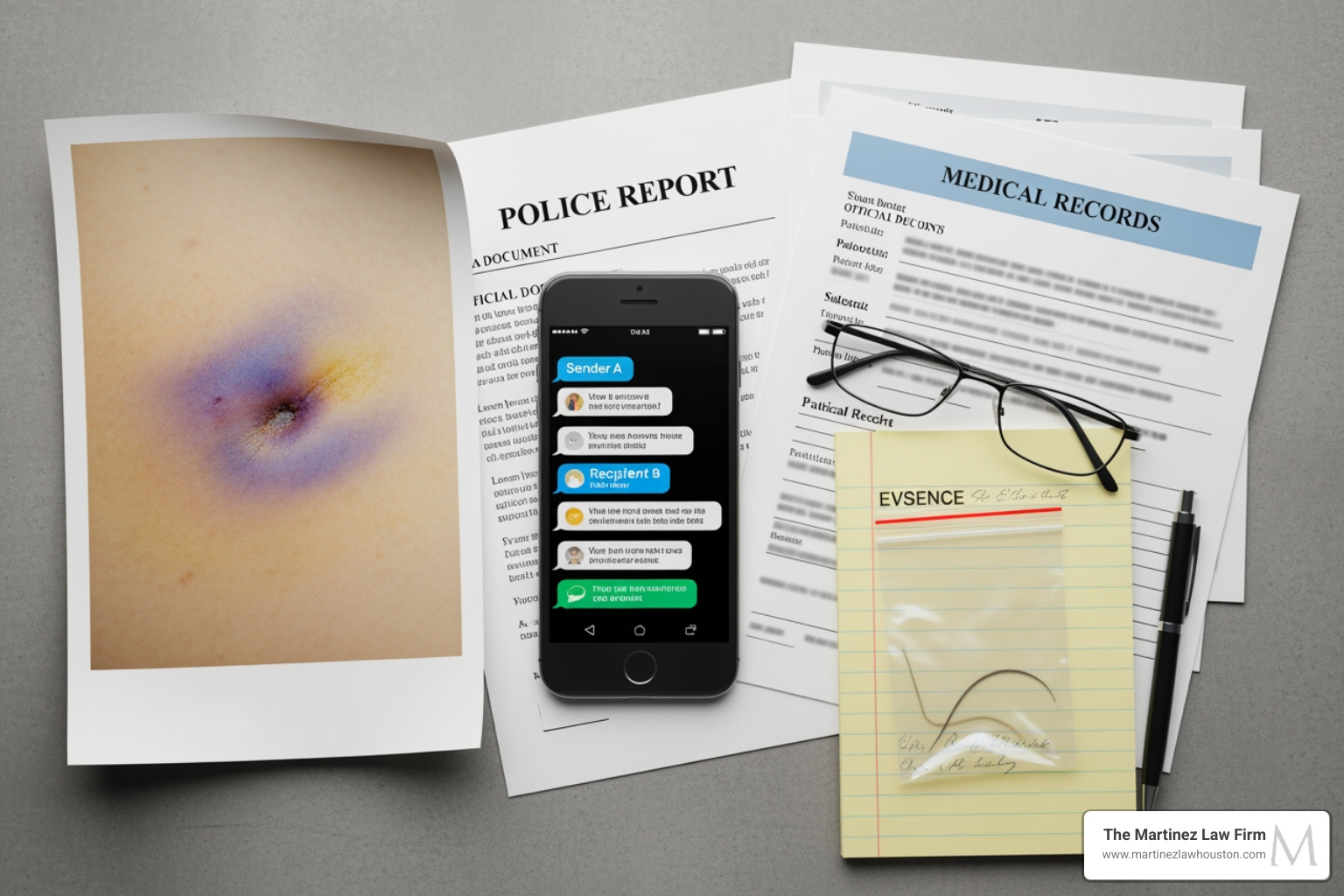
How to Prove Self-Defense in Domestic Violence with Physical and Digital Evidence
Tangible evidence is powerful because it does not lie. When we work to prove self-defense in a domestic violence case, this proof is paramount.
- Photographs and Medical Records: Immediately photograph your injuries—defensive wounds, bruises, scratches. These images, along with official medical records from a doctor or ER visit, provide third-party validation of the attack and create a supportive timeline.
- The Scene and Property: Damaged property, broken furniture, or torn clothing illustrate a violent struggle. This physical evidence corroborates your story of chaos and danger.
- Digital Communications: Threatening text messages, manipulative emails, or voicemails can be damning evidence against an accuser. Apologies admitting guilt or aggressive language can turn a case. In Texas, a one-party consent state, you can legally record conversations you are a part of.
- Social Media and 911 Calls: An accuser’s social media posts may contradict their story or brag about violence. The raw emotion and chaos captured in a 911 recording can also be crucial, showing your genuine distress in the moment.
How to Prove Self-Defense in Domestic Violence with Witness and Expert Testimony
Witnesses bring the human element to your case, helping a jury understand your reality.
- Eyewitnesses and Neighbors: Anyone who saw or heard the incident, or even the immediate aftermath, can corroborate your version of events. In Houston’s communities, neighbors are often aware of ongoing issues.
- Character Witnesses: Friends, family, and coworkers can testify to your peaceful nature, creating a counter-narrative to the prosecution’s attempt to paint you as the aggressor.
- Expert Witnesses: A psychologist specializing in domestic violence can explain concepts like Battered Woman Syndrome or trauma responses to a jury. This is especially vital in cases involving False Domestic Assault Charges, where the true victim has been wrongly accused.
Using the Accuser’s History to Build Your Narrative
One of the most effective strategies is to show your actions were a response to the accuser’s ongoing pattern of abuse.
- Criminal History and Police Calls: We investigate the accuser’s background for prior acts of violence or assault. Previous police calls to your residence from the Houston Police Department or Harris County Sheriff’s Office establish a documented history of conflict.
- Contradictory Statements and Manipulation: Liars often cannot keep their stories straight. We compare the accuser’s statements to police, medical staff, and others to find inconsistencies that destroy their credibility. We also expose any history of false allegations or using the legal system as a tool of control.
Common Challenges and How a Defense Attorney Can Help
Proving self-defense in a Houston domestic violence case is challenging. These cases often become “he said, she said” battles where police and prosecutors may be skeptical of your claim. Officers make split-second decisions at the scene and sometimes arrest the wrong person. This is why an experienced defense attorney is essential to steer the system and protect your rights.
Overcoming Obstacles in Your Self-Defense Claim
Even with obstacles, a strong defense is possible. If there are no independent witnesses, we dig deeper for physical and digital evidence to build an undeniable timeline. If you have no significant visible injuries—perhaps because you successfully defended yourself—we focus on the imminence of the threat you faced, not the outcome. The law doesn’t require you to be seriously hurt before you can act.
We also address police bias at the scene by reviewing reports for inconsistencies and overlooked evidence. When facing a skeptical prosecutorial mindset, we present a compelling narrative that forces them to see the weaknesses in their case. We explain any inconsistencies in your story as a natural result of trauma, not dishonesty. Above all, we relentlessly attack the accuser’s credibility, exposing their lies and manipulations.

Why a Former Prosecutor’s Insight is Your Advantage
My background as a Chief Prosecutor for the Harris County District Attorney’s Office is your strategic advantage. I’ve been on the other side, so I know how to anticipate the prosecution’s strategy, spot weaknesses in their evidence, and negotiate effectively. I know what arguments persuade prosecutors to reduce or dismiss charges before trial.
If a trial is necessary, that courtroom experience is invaluable. The Role of a Criminal Defense Attorney is to tell your story in a clear, believable way that resonates with a jury. We carefully prepare you and our witnesses for testimony, organize evidence for maximum impact, and confidently cross-examine the accuser. This insider knowledge can be the difference between a conviction and a “not guilty” verdict.
Frequently Asked Questions about Proving Self-Defense in Texas
When you’re facing domestic violence charges and believe you acted in self-defense, you probably have a lot of questions running through your mind. These are some of the most common concerns we hear from clients in Houston, and I want to address them directly so you understand exactly where you stand.
What happens if I successfully prove self-defense in my domestic violence case?
A successful self-defense claim is a complete defense. If a jury believes you, they must find you “not guilty.” It’s a full acquittal. Even better, a strong, evidence-backed self-defense case can convince a prosecutor to dismiss the charges before trial. This is the best possible outcome, allowing you to move on with no criminal record.
Do I have a duty to retreat from my own home in Houston, TX?
No, you do not have a duty to retreat from your own home, vehicle, or workplace in Texas. The state’s “Castle Doctrine” (Texas Penal Code § 9.32) allows you to stand your ground. If you are attacked in a place you have a lawful right to be, you are not required to try to escape before using force, including deadly force, if you reasonably believe it is necessary to protect yourself.
Can I still claim self-defense if I started the initial argument?
Yes, you can potentially claim self-defense even if you started a verbal argument. Starting a verbal disagreement does not forfeit your right to defend yourself from physical violence. However, if you provoked the physical attack, the situation is more complex. You can only regain your right to self-defense if you clearly communicated your intent to withdraw from the fight, and the other person continued their attack anyway. The specific sequence of events is critical in these situations.
Protect Your Rights with an Experienced Houston Defense Attorney
Understanding how to prove self defense in domestic violence is the first step, but executing that defense is the real challenge. It requires gathering the right evidence and presenting a story that convinces a Houston judge or jury your actions were justified. The stakes are too high to face this alone—a conviction can mean jail time, a permanent criminal record, and the loss of your rights.
At The Martinez Law Firm, we use insider knowledge to give our clients an edge. Herman Martinez’s years as a Chief Prosecutor for the Harris County District Attorney’s Office mean we know how prosecutors build cases and where their weaknesses are. We’ve used this experience to achieve “not guilty” verdicts and dismissals for our clients, and we are ready to fight for you.
We will take the time to understand your unique case, gather all available evidence, and craft a defense narrative that shows the truth: you were protecting yourself. Whether through negotiation or a jury trial, we are prepared to do what it takes.
Don’t risk your freedom and future. If you were accused of domestic violence in Houston when you were acting in self-defense, we want to help.
Get help with your Houston domestic violence case or contact us today. We’re here to protect your rights.
Why Immediate Legal Action is Critical When Facing Sex Crime Allegations
Being accused of a sex crime in Houston is a life-altering event. The public stigma and presumption of guilt can destroy your career, relationships, and reputation long before a conviction. Penalties are severe, ranging from prison to lifetime sex offender registration, which restricts where you can live and work. Immediate action is critical, as evidence can be lost and prosecutors begin building their case instantly. Sex crimes defense requires specialized expertise to protect your rights and future.
Key Defense Strategies for Sex Crimes:
- Actual Innocence – Presenting alibis or witnesses to prove the act never occurred.
- Consent – Demonstrating the sexual contact was consensual.
- Mistaken Identity – Proving the wrong person was accused.
- Challenging Evidence – Questioning the reliability of testimony or forensic evidence.
- Examining Accuser Motivations – Investigating reasons for false accusations (e.g., revenge, financial gain).
- Suppressing Illegally Obtained Evidence – Filing motions to exclude evidence from improper searches.
The founder of The Martinez Law Firm brings over 25 years of experience to sex crimes defense, including a background as a former Chief Prosecutor for the Harris County District Attorney’s Office. This dual perspective allows the firm to anticipate prosecution strategies and build aggressive, customized defenses for clients.
The Life-Altering Impact of a Sex Crime Accusation
When someone accuses you of a sex crime in Houston, your world can fall apart overnight, regardless of the truth. The damage begins immediately, destroying everything you’ve built before you ever step into a courtroom.

The personal consequences are immediate. Friends and family may distance themselves, and your reputation can crumble. While the law presumes innocence, the community often does the opposite. Your professional livelihood also suffers, as employers may suspend or terminate you, and professional licenses can be jeopardized.
Family relationships face enormous strain, with spouses and children caught in the crossfire. Social media amplifies the judgment, as a single post can go viral in Harris County. It’s crucial to understand The Burden of Proof in Sex Crimes: What to Know, because the court of public opinion convicts on rumor alone.
How Public Stigma Influences a Case
Sex crime accusations carry a unique stigma that creates a presumption of guilt in the public’s mind, pressuring prosecutors, judges, and potential jurors. Media influence is powerful, with headlines often screaming accusations but whispering acquittals. The #MeToo movement, while important, has also contributed to an environment where some rush to judgment, leading to jury bias before a trial even begins.
This public pressure can influence prosecutors’ charging decisions. Effective sex crimes defense must actively counter this pressure with facts and a strong, private defense strategy.
Long-Term Consequences Beyond the Courtroom
Even without prison time, a sex crime conviction in Texas has devastating collateral consequences. Employment opportunities can vanish due to background checks, and professional licenses may become impossible to maintain. Housing restrictions are severe, especially with sex offender registration, making it incredibly difficult to find a place to live in Houston. Child custody issues often arise, potentially leading to loss of custody or supervised visitation. The financial strain from legal fees, lost income, and fines can be overwhelming. Understanding How Much Will Sex Crime Defense Cost? is a vital first step. Finally, the psychological toll of social isolation and stress can lead to severe mental health challenges. Aggressive sex crimes defense is not just about avoiding jail—it’s about protecting your entire future.
Understanding Sex Crime Charges and Penalties in Texas
Texas laws on sex crimes are tough, and Harris County prosecutors pursue these cases with determination. The penalties are severe, so understanding the charges you face is the first step in building a strong defense.

Society views these offenses as particularly serious, which influences every stage of the legal process. As a former Chief Prosecutor, I’ve seen this heightened scrutiny firsthand. A successful sex crimes defense requires understanding both the law and the social dynamics surrounding these cases.
Defining Common Sex Offenses in Houston
In Houston, we defend against a wide range of sex crime charges, each with unique elements and consequences.
- Sexual Assault: Penetration without consent, which is the critical element in these cases.
- Indecency with a Child: Involves sexual contact or exposure with a child under 17.
- Child Molestation: Typically charged under Indecency or Sexual Assault statutes when the victim is a minor.
- Child Pornography: Possessing or distributing explicit material involving minors, often a federal offense with mandatory minimums.
- Soliciting a Prostitute: Offering to pay for sexual services, which can lead to sex offender registration.
- Public Lewdness: Engaging in sexual acts in a public place where others may be offended.
- Indecent Exposure: Exposing genitals in public with sexual intent.
- Online Stalking: Using electronic communication to harass or threaten someone.
Texas also has specific sexting laws for minors, with more serious consequences for adults. We also defend against charges like Continuous Sexual Abuse of a Child and Improper Teacher/Student Relationships.
Potential Penalties and Sentencing
Texas sex crime penalties can alter your life forever. Incarceration can range from jail time for misdemeanors to decades in prison for felonies. For example, sexual assault of a child under 14 can result in 5 to 99 years in prison. Fines can reach $10,000, and probation comes with strict terms like mandatory counseling and electronic monitoring.
Crucially, most child sex crimes in Texas are 3(g) offenses. This means a judge cannot grant probation, and if sentenced to prison, you must serve at least half your time before parole eligibility. There is no early release for good behavior. Our sex crimes defense strategy must account for these Texas-specific laws, which differ from frameworks like the Model Penal Code. Understanding these stakes is why immediate action is vital. Our Houston Sexual Assault Lawyer Discusses Admonishments to help you make informed decisions.
Building a Robust Houston Sex Crimes Defense
When facing sex crime charges in Houston, you need a strategic defense that anticipates the prosecution’s every move. At The Martinez Law Firm, Herman Martinez‘s experience as a former Chief Prosecutor for Harris County provides a unique advantage. We know how prosecutors think and how to dismantle their cases. We act immediately, investigating and preparing pre-trial motions to change the trajectory of your case from day one. For a deeper look at our approach, read our guide on Defending a Sexual Assault Case in Houston.

Key Elements of a Sex Crimes Defense Investigation
A strong sex crimes defense begins with a thorough investigation. We gather all evidence, including digital communications and social media posts, and interview all potential witnesses. We scrutinize police reports for errors and procedural violations. If there are signs of police misconduct, such as illegal searches or coerced statements, we file motions to have that evidence suppressed.
False accusations happen more often than people realize, often stemming from custody battles, divorces, or financial extortion. We carefully examine the accuser’s motivations. When children are complainants, we investigate how their testimony was obtained, as improper interview techniques can create false memories. Protecting your reputation is essential, as we discuss in Don’t Let False Allegations of Child Pornography Ruin Your Reputation.
Common Strategies in Sex Crimes Defense
We tailor our defense strategy to the specific facts of your case. Common approaches include:
- Actual Innocence: Using an alibi, receipts, or security footage to prove you weren’t there.
- Mistaken Identity: Challenging the accuser’s identification, especially in stressful situations.
- Consent: In cases involving adults, using texts or witness testimony to show the encounter was mutual.
- Lack of Intent: Demonstrating that your actions were accidental or misunderstood.
- Challenging DNA Evidence: Working with forensic experts to question how DNA was collected, analyzed, and what it truly proves.
- Entrapment Defense: Arguing that law enforcement induced you to commit a crime you otherwise wouldn’t have, which is relevant in Houston’s online sting operations.
The Role of Expert Witnesses and Cross-Examination
Complex sex crimes defense cases often require expert witnesses. We use forensic experts, DNA analysts, and psychologists to explain technical issues, challenge the state’s evidence, and evaluate the reliability of child testimony.
Cross-examining complainants is a delicate but crucial part of trial. Our attorneys are skilled at highlighting inconsistencies in testimony and exposing potential bias or ulterior motives without alienating the jury. This requires a deep understanding of courtroom dynamics, which we have honed over countless trials in Harris County. We answer more common questions in A Sexual Assault Attorney in Houston Answers Frequently Asked Questions.
Navigating the Texas Sex Offender Registry and Legal Proceedings
The legal proceedings for sex crime charges in Houston are complex and demanding. From the initial investigation through potential appeals, every step requires seasoned legal guidance. The consequences of conviction, particularly regarding the Texas Sex Offender Registry, are life-altering and extend far beyond any jail sentence or fine.

Navigating arraignments, pre-trial hearings, and motions requires seasoned legal guidance. Deciding between a plea bargain and trial is a critical choice that depends on a careful analysis of the evidence. Cases involving juvenile defendants follow different procedures focused on rehabilitation, but serious offenses can still lead to being tried as an adult. If convicted, the appeals process offers another chance to challenge legal errors that may have occurred during your trial.
The Texas Sex Offender Registry Explained
One of the most severe consequences of a sex crime conviction is mandatory registration, which is often a lifetime requirement. You must register with the Texas Department of Public Safety (TXDPS) and regularly update your personal information. Failure to comply results in new criminal charges.
The registry is publicly accessible, allowing anyone to find your name, photo, and address. This creates immense barriers:
- Residency Restrictions: You are prohibited from living near schools, parks, and daycares, making housing in Houston incredibly difficult to find.
- Employment Limitations: Background checks will reveal your registration, making many jobs and professions entirely off-limits.
- Social Stigma: The public nature of the registry can lead to social isolation and harassment.
Our sex crimes defense strategy focuses on avoiding a conviction to prevent registration. If a conviction is unavoidable, we fight to minimize the registration period or secure a lower tier. Learn more on our page about Criminal Defense: Sex Crimes: Sex Offender Registration.
Why You Need an Experienced Sex Crimes Defense Lawyer Immediately
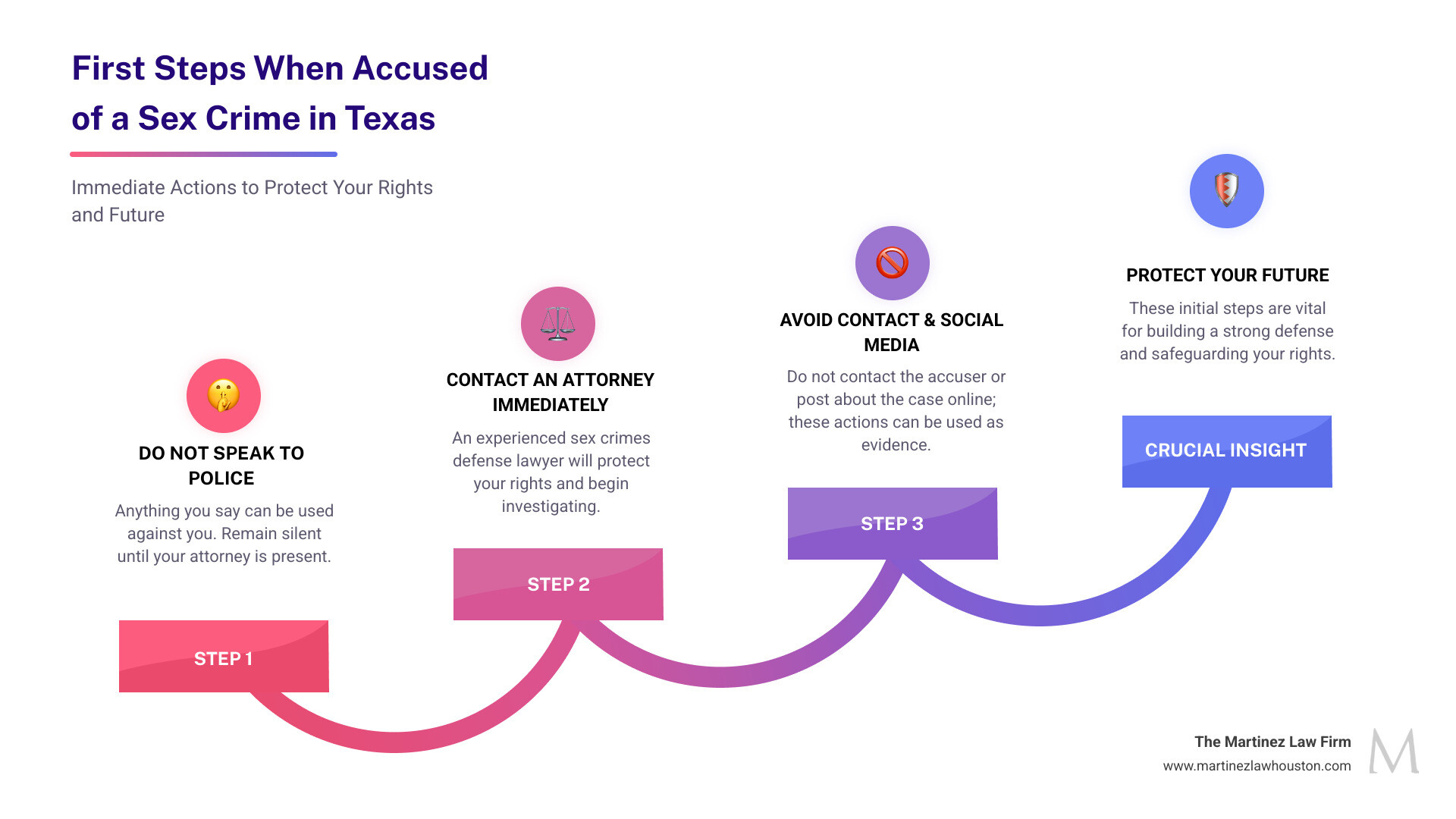
Time is your most valuable asset. You must act quickly to protect your rights and prevent self-incrimination. Never speak to police without an attorney present. Anything you say can be used against you.
Early intervention with prosecutors is where our experience as former prosecutors is invaluable. We can present evidence and arguments that may convince them not to file charges at all. We start building a defense from day one, preserving evidence and interviewing witnesses while memories are fresh. The prosecution is already building its case; you cannot afford to wait. You need a Sexual Assault Defense Attorney who understands the stakes and can steer Houston’s complex legal system to fight for your future.
Frequently Asked Questions about Sex Crime Defense in Houston
If you’re facing a sex crime accusation in Houston, you probably have urgent questions racing through your mind. I’ve heard these concerns countless times from clients sitting across from me in our office, and I want to address some of the most common ones here.
Is a case considered to have “no evidence” if it’s based solely on a person’s word?
No. In Texas, a person’s testimony is considered evidence, and a conviction can legally be based on the word of a single witness. This makes sex crimes defense particularly challenging, as a case can become a “he said, she said” battle of credibility.
Our defense strategy focuses on rigorously challenging the accuser’s credibility. We investigate inconsistencies in their statements, explore potential motivations for a false accusation, and ensure the jury understands that uncorroborated testimony must be scrutinized with extreme care.
Are women charged with sexual assault treated differently in Texas?
While Texas law is gender-neutral, public perception and sentencing outcomes can sometimes differ. We have seen cases in Houston and throughout Texas where women received lighter penalties for offenses that would likely result in prison sentences for men.
But here’s what’s important: these disparities don’t mean women accused of sex crimes should take the charges any less seriously. A conviction still carries severe consequences for anyone, including potential prison time, substantial fines, and mandatory registration as a sex offender. The social stigma, employment difficulties, and family disruption affect people of all genders.
Whether you’re male or female, you need a strong, aggressive sex crimes defense. The legal system’s complexities and the prosecutor’s determination to secure a conviction don’t change based on gender. Our firm provides unwavering defense to all clients because we understand that everyone deserves their day in court and a vigorous defense of their rights. You can read more about this topic in our article, Are Adult Females That Are Charged With Sexual Assault Treated Differently?.
Can a sex crime charge be expunged from my record in Texas?
This is where I wish I had better news for most people. If you’re convicted of a sex crime in Texas, expungement is extremely rare—in fact, it’s essentially impossible. A conviction will remain on your criminal record permanently, and you’ll likely face lifetime registration as a sex offender.
However, there’s an important distinction to understand. If your charge never resulted in a conviction, different options may be available. Specifically, if your case was dismissed (the prosecution dropped the charges), you were acquitted (found not guilty at trial), or you were no-billed by a Grand Jury (the grand jury decided there wasn’t enough evidence to indict you), you may be eligible for relief.
In these situations, you might qualify for an expunction, which completely removes all records related to the arrest, or a non-disclosure order, which seals the records from the general public (though law enforcement agencies would still have access). The eligibility requirements are strict and vary depending on your specific circumstances, including the nature of the charge and how the case was resolved.
This is another reason why winning your case or getting charges dismissed is so critical. The difference between a dismissal and a conviction isn’t just about avoiding jail time—it’s about whether you have any chance of moving forward with a clean record. An experienced attorney can evaluate whether your case qualifies for expunction or non-disclosure and guide you through this complex legal process. The sooner we start working on your defense, the better your chances of achieving an outcome that protects your future.
Protect Your Future with a Strategic Defense
When you’re facing sex crime allegations in Houston, the stakes couldn’t be higher. We’ve walked through the devastating consequences together—the immediate public judgment, the professional setbacks, the strain on your closest relationships, and the very real possibility of prison time and lifetime registration as a sex offender. These aren’t just abstract legal concepts; they’re real threats to everything you’ve built and everyone you love.
This is why a specialized, aggressive sex crimes defense isn’t just important—it’s absolutely essential.
At The Martinez Law Firm, we’ve seen how quickly these cases can spiral out of control when handled improperly. But we’ve also seen how the right defense strategy, implemented immediately and executed with precision, can change the entire trajectory of a case. Herman Martinez‘s background as a former Chief Prosecutor for the Harris County District Attorney’s Office gives us an insider’s understanding of how prosecutors think, how they build their cases, and—most importantly—where their weaknesses lie.
This former prosecutor advantage means we don’t just react to the prosecution’s moves; we anticipate them. We know which evidence they’ll prioritize, which witnesses they’ll call, and which defense strategies are most likely to succeed in Houston courtrooms. We’ve built this firm on the principle that every client deserves a defense that’s not just competent, but exceptional—one that leverages every available legal tool to protect your rights and your future.
Why Immediate Action Matters
Here’s the tough truth: sex crime cases in Harris County don’t wait. They move fast. Prosecutors often feel immense public pressure to secure convictions. This means that if you delay, critical evidence that could help your case might be lost or compromised. The defense you put together in those crucial first days and weeks after an accusation can make all the difference. It can determine if charges are filed at all, if damaging evidence is kept out of court, and ultimately, whether you regain your freedom or face a lifetime of consequences.
Don’t let fear or uncertainty paralyze you. Don’t let an accusation—whether it’s true, false, exaggerated, or motivated by revenge—define the rest of your life. You have the right to a vigorous defense, and you deserve an attorney who will fight for you with everything they’ve got.
Take control of your case right now. Your future is worth fighting for, and we’re ready to stand by your side every step of the way.
Contact an experienced Houston sex crimes defense lawyer today for a confidential consultation. Let’s start building your defense together.
What You Need to Know About a Third DWI Offense in Texas
A DWI third offense Texas is a third-degree felony with severe, life-altering penalties. Unlike misdemeanor first and second offenses, a third conviction means facing state prison, substantial fines, a lengthy license suspension, and a permanent felony record.
Quick Facts: Third DWI Offense in Texas
- Classification: Third-degree felony under Texas Penal Code §49.09
- Prison Time: 2 to 10 years in Texas Department of Criminal Justice (TDCJ)
- Fines: Up to $10,000 (plus state surcharges of $1,500-$2,000 annually for 3 years)
- License Suspension: 180 days to 2 years
- Mandatory Jail Time: Minimum 10 days even with probation
- Community Service: 160 to 600 hours required
- No Lookback Period: All prior DWI convictions count, regardless of how long ago they occurred
- Permanent Record: Cannot be expunged or sealed in Texas
Texas has no lookback period, meaning a DWI from 20 years ago counts the same as one from last year. With two prior DWI convictions from anywhere in the U.S., a third arrest is automatically a felony. This is especially true in Houston and Harris County, where prosecutors aggressively seek harsh penalties for repeat offenders. A felony conviction can destroy employment opportunities, housing prospects, professional licenses, and firearm rights. The stakes are not just about jail time; they are about your entire future.
I’m Herman Martinez, founder of The Martinez Law Firm. As a former Chief Prosecutor for the Harris County District Attorney’s Office, I have over 25 years of experience on both sides of the courtroom. This unique perspective on Texas DWI third offense cases gives me insight into how prosecutors build their cases and, more importantly, how to dismantle them to protect my clients’ freedom.
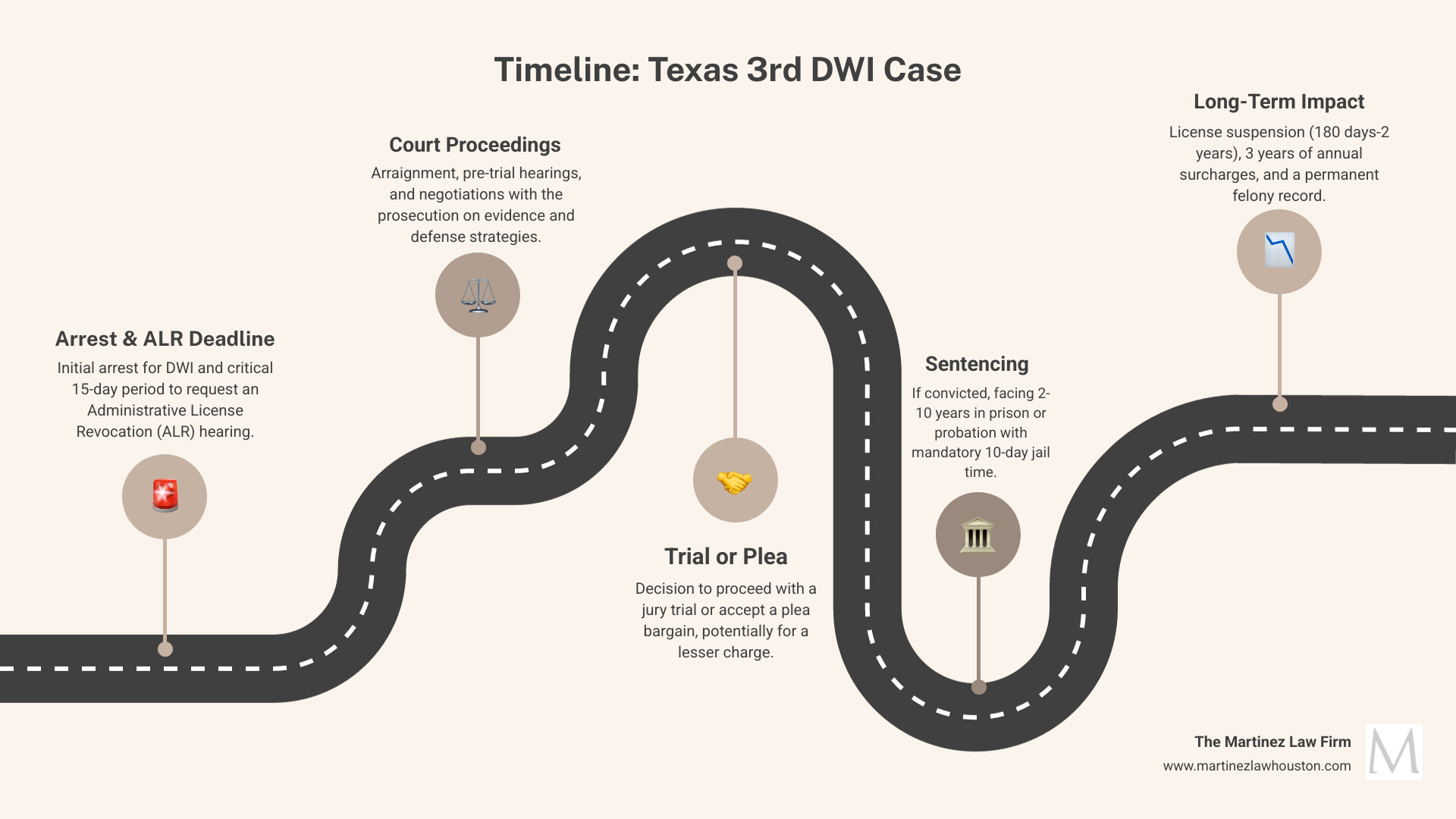
The Felony Hammer Falls: Criminal Penalties for a DWI Third Offense Texas
When you’re arrested for a DWI third offense, the charge is elevated from a misdemeanor to a felony. That single word carries immense weight in Houston and Harris County courtrooms, where judges view repeat offenders as a significant public safety risk.

The difference is stark: county jail for misdemeanors versus state prison for felonies. A felony conviction follows you permanently, affecting job applications, housing, professional licenses, and even your right to own a firearm. The situation can worsen with aggravating factors, such as having a child passenger under 15, a high blood alcohol concentration (BAC), or causing an accident. These factors often push prosecutors to seek the harshest penalties available.
Third-Degree Felony Prison Time and Fines
A DWI third offense Texas is a third-degree felony, punishable by two to ten years in the Texas Department of Criminal Justice (TDCJ). This is state prison time, not a stay in a county facility. The financial penalties are also severe, with fines reaching up to $10,000, not including thousands more in state surcharges and other costs.
Penalties can be improved further. If you have a prior felony conviction with a prison sentence, a third DWI can be upgraded to a second-degree felony, carrying two to 20 years in prison. With two prior prison trips, you could face 25 years to life under Texas’s habitual offender laws. Texas Penal Code §49.04 details these severe penalties, showing how seriously the state treats repeat offenses.
Driver’s License Suspension and ALR Hearings
Beyond criminal court, a DWI third offense Texas arrest triggers an immediate administrative process to suspend your driver’s license for 180 days to two years. This is handled by the Texas Department of Public Safety (DPS), not the criminal court.

From the moment of your arrest, you have only 15 days to request an Administrative License Revocation (ALR) hearing. If you miss this critical deadline, your license is automatically suspended. The ALR hearing is your chance to challenge the suspension by cross-examining the arresting officer and questioning the evidence. Information on these hearings is available from the Texas Department of Transportation (TxDOT). If your license is suspended, you might qualify for an occupational license for essential driving, but it will come with strict restrictions and likely require an ignition interlock device.
State Surcharges and Financial Burdens
The financial impact of a third DWI extends far beyond court fines. Texas imposes annual surcharges of $1,500 to $2,000 for three years to maintain your driver’s license after a conviction. That’s up to $6,000 in surcharges alone.
Additional costs include court fees, mandatory DWI education programs, substance abuse evaluations, and ignition interlock device installation and maintenance. Your auto insurance rates will also skyrocket, and you’ll be required to carry expensive SR-22 insurance for high-risk drivers for at least three years. The total financial cost of a DWI third offense in Texas can easily exceed $50,000, not counting lost income from a potential prison sentence or felony record.
Navigating Probation and Mandatory Requirements
Receiving probation, or community supervision, for a DWI third offense Texas is not a lenient outcome. The conditions are demanding and strictly enforced, especially in Harris County. Any violation can result in the revocation of your probation and activation of your original prison sentence.

Probation means serving your sentence in the community, but it requires strict adherence to a long list of rules designed to ensure accountability and public safety.
Strict Conditions of Community Supervision
Even with probation for a DWI third offense, you must serve a mandatory minimum of 10 days in county jail. This is non-negotiable. Other conditions include:
- Community Service: 160 to 600 hours of unpaid service.
- DWI Intervention Program: A specialized course for repeat offenders.
- Substance Abuse Evaluation: A mandatory assessment that may lead to required counseling or treatment programs.
- Regular Testing: Frequent and random drug and alcohol tests. A single failed test can lead to probation revocation.
Failing to meet any of these conditions, such as missing an appointment with your probation officer or failing a drug test, can have swift and severe consequences, often resulting in a motion to revoke your probation and send you to prison.
The Ignition Interlock Device (IID) Mandate
An Ignition Interlock Device (IID) is a near-certain requirement. This device is a breathalyzer connected to your car’s ignition, which prevents the vehicle from starting if it detects alcohol on your breath. The IID also requires random “rolling retests” while you are driving.
An IID is typically mandatory as a condition of bond while your case is pending, as a condition of probation, and often as a requirement to restore your driving privileges after your sentence is complete. The Texas Department of Transportation (TxDOT) may require it before you can legally drive again.
You are responsible for all costs, including installation ($70-$150) and monthly monitoring fees ($60-$80). While inconvenient and expensive, an IID may be the only way to retain limited driving privileges for essential needs like work and medical appointments, which can be crucial for maintaining stability while facing charges in the Houston area.
Life After Conviction: The Lasting Consequences of a Felony DWI
A DWI third offense Texas conviction creates a permanent felony record that brings lifelong obstacles. These collateral consequences—the secondary punishments not part of the official sentence—are often more challenging than the prison time or fines. In Houston’s competitive job and housing markets, the stigma of being a “convicted felon” can be devastating.
Impact on Employment, Housing, and Professional Licenses
With a felony DWI on your record, finding a job becomes incredibly difficult. Most employers conduct background checks, and a felony is an immediate red flag. Jobs involving driving, handling money, or requiring security clearances are often out of reach. Texas is an “at-will” employment state, so even your current job may be at risk.
For licensed professionals like nurses, teachers, and real estate agents, a felony conviction can trigger disciplinary action from state licensing boards, potentially leading to license suspension or revocation. This can be a career-ending event.
Housing is another major hurdle. Landlords frequently run background checks and may automatically reject applicants with felony convictions, limiting your options and creating housing insecurity. These barriers to employment and housing can create a difficult cycle to escape.
Loss of Civil Rights: Firearm and Voting Rights
A felony conviction for a DWI third offense Texas also results in the loss of fundamental civil rights. Under federal law, a convicted felon is permanently banned from owning or possessing firearms. This lifetime ban on firearm ownership rights can only be reversed through a pardon, which is extremely difficult to obtain.
Your right to vote is also suspended in Texas while you are serving your sentence, which includes time in prison, on parole, or on probation. Once you have fully completed all terms of your sentence, your voting rights are automatically restored. However, this period of disenfranchisement can last for many years, serving as another constant reminder of your felon status.
Building a Defense Against a Third DWI Charge
Facing a DWI third offense Texas charge is daunting, but an arrest is not a conviction. A strong defense is possible. At The Martinez Law Firm, my experience as a former Chief Prosecutor for Harris County provides a critical advantage. I know how prosecutors build these cases, which means I know how to find the weak spots and dismantle their arguments.

In Houston, you need a defense attorney who understands the system from the inside out. We scrutinize every detail of your case to challenge the prosecution’s evidence and protect your constitutional rights.
Common Defense Strategies for a dwi third offense texas
Every DWI case has potential vulnerabilities. Our defense strategies often focus on:
- Illegal Traffic Stop: Police need reasonable suspicion to pull you over. If the stop was unlawful, all evidence gathered afterward may be suppressed.
- Field Sobriety Test Errors: These tests are subjective and often administered incorrectly. Factors like medical conditions, fatigue, or poor conditions can render the results unreliable.
- Inaccurate Breath or Blood Tests: Breathalyzers require proper calibration, and blood samples must follow a strict chain of custody. We investigate maintenance logs, technician qualifications, and handling procedures for errors that could invalidate the results.
- Challenging Prior Convictions: The prosecution must prove your two prior DWIs. We examine the records of these convictions, especially those from out-of-state, for procedural flaws that could prevent them from being used to improve your charge to a felony.
- Procedural Errors: We review the entire arrest for violations of your rights, such as an improper reading of Miranda rights or mishandling of evidence.
Can a Texas DWI third offense charge be reduced or dismissed?
Yes, it is possible to achieve a reduction or dismissal, though it is challenging. By exposing weaknesses in the state’s case—such as a questionable stop or unreliable tests—we can create leverage for plea negotiations. This can lead to reduced charges or more favorable sentencing recommendations.
While uncommon, reducing a felony DWI to a misdemeanor is possible if there are significant legal flaws in the case. Case dismissal is the ultimate goal, which we pursue when the state cannot prove its case beyond a reasonable doubt or when critical evidence is suppressed due to constitutional violations.
My background as a former Harris County prosecutor gives me an insider’s perspective on how to counter the state’s arguments. This experience is invaluable when your freedom and future are on the line.
Frequently Asked Questions about a Third DWI in Texas
If you’re facing a DWI third offense charge in the Houston area, you likely have urgent questions. Here are straightforward answers to some of the most common concerns we hear at The Martinez Law Firm.
Can a third DWI conviction be expunged or sealed in Texas?
No. Under Texas law, DWI convictions cannot be expunged. Furthermore, a felony conviction like a dwi third offense texas is ineligible for an order of non-disclosure (record sealing). This means a conviction will remain on your criminal record permanently, visible to anyone who runs a background check. This is why fighting the charge from the outset is so critical.
What is the difference between a 3rd DWI and other felony DWI charges?
A third DWI is a felony based on your history of prior offenses. However, you can face a felony DWI charge even on a first offense if aggravating factors are present:
- Intoxication Assault: Causing serious bodily injury to another person while driving intoxicated. This is a third-degree felony, with penalties similar to a third DWI.
- Intoxication Manslaughter: Causing the death of another person due to intoxication. This is a second-degree felony, carrying a prison sentence of two to 20 years.
The key difference is the reason for the felony charge: a third DWI is based on repeat offenses, while the others are based on the harm caused in a single incident.
Do prior DWI convictions from other states count in Texas?
Yes, they almost always do. Texas is part of the Interstate Driver’s License Compact, an agreement among states to share information on traffic violations, including DWIs. Prosecutors in Harris County will use this system to pull records from other states to prove your prior convictions.
However, proving an out-of-state conviction is not always simple. The prosecution must show that the offense in the other state is legally equivalent to a Texas DWI. An experienced defense attorney can scrutinize these records for procedural errors, documentation issues, or legal differences that could disqualify the prior conviction from being used to improve your charge. Challenging these priors can sometimes mean the difference between a felony and a misdemeanor.
Facing a 3rd DWI in Houston? Take Action Now
A DWI third offense Texas charge is a direct threat to your freedom and future. In Houston and Harris County, prosecutors seek maximum penalties, including years in state prison and a permanent felony record that can cost you tens of thousands of dollars and follow you for life.
This feels overwhelming, but remember: a charge is not a conviction. You have options, but you need an attorney with the right experience to fight for you.
As a former Chief Prosecutor in the Harris County District Attorney’s Office, I know the strategies the other side will use because I used them myself. At The Martinez Law Firm, we use that insider knowledge to dismantle the prosecution’s case, challenge the evidence, and protect our clients’ rights.
The stakes are too high to wait. Critical deadlines, like the 15-day window to save your driver’s license, are passing. Evidence can be lost and witnesses’ memories fade. Your defense must start now.
Don’t let a DWI conviction define your life. You need a proven fighter in your corner. Contact The Martinez Law Firm today for a comprehensive case evaluation, and let’s start building your defense together.
Get help from an experienced Houston DWI lawyer
What You Need to Know About Deadly Conduct Charges in Texas
Deadly conduct in Texas is a serious offense under Texas Penal Code § 22.05. If you’re accused of recklessly endangering someone or dangerously discharging a firearm, understanding this charge is critical.
Quick Answer: Deadly Conduct Texas Overview
- Definition: Recklessly engaging in conduct that places another in imminent danger of serious bodily injury, OR knowingly discharging a firearm at or in the direction of people or occupied structures.
- Classification: Class A Misdemeanor (general reckless conduct) or Third-Degree Felony (involving firearms).
- Penalties: Up to 1 year in jail and a $4,000 fine (misdemeanor) OR 2-10 years in prison and a $10,000 fine (felony).
- Key Fact: No actual injury is required for a charge—the potential for harm is enough.
- Important: Pointing an unloaded firearm can lead to charges, as the law presumes recklessness.
Many people don’t realize you can face serious criminal charges for deadly conduct in Texas even if no one gets hurt. The law focuses on the danger you create, not the outcome. Actions like firing a gun into the air in Houston, brandishing a weapon during an argument, or reckless driving can all lead to these charges.
The distinction between a misdemeanor and a felony often depends on whether a firearm was knowingly discharged at a person or occupied structure. A felony conviction carries severe consequences, including prison time and the permanent loss of gun rights. In Harris County, these charges are prosecuted aggressively, impacting your employment, housing, and family life.
Key Takeaways
-
Deadly conduct in Texas does not require injury — Prosecutors can file charges if your actions create imminent danger of serious bodily injury, even if no one gets hurt.
-
Two charge paths exist under Texas Penal Code § 22.05 — Reckless endangerment is usually a Class A misdemeanor, while knowingly firing a gun toward people or occupied places is a third-degree felony.
-
Firearm cases trigger the biggest legal risk — A gun-related allegation can bring 2–10 years in prison and up to a $10,000 fine, plus long-term consequences like loss of gun rights.
-
Pointing a gun can be enough for charges — Texas law can presume recklessness when someone points a firearm at another person, even if the gun is unloaded.
-
Fast action protects outcomes — Early legal help can challenge intent (reckless vs. knowing), question imminent danger, and preserve evidence before it fades.
As a former Chief Prosecutor for the Harris County District Attorney’s Office, Herman Martinez has handled deadly conduct cases from both sides. This unique perspective allows The Martinez Law Firm to build aggressive, custom defense strategies for clients in the Houston area.
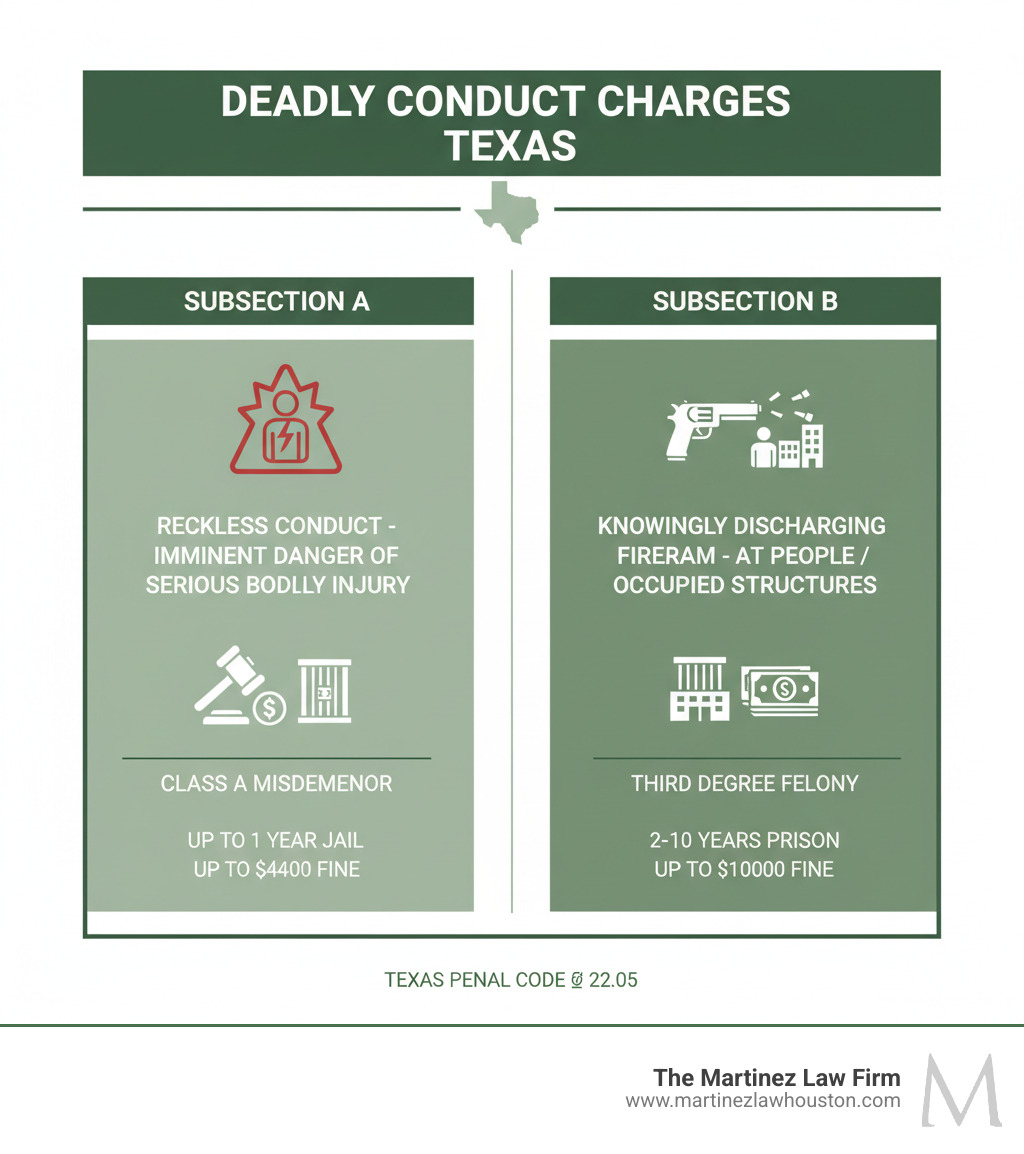
Understanding Texas Penal Code § 22.05: The Two Types of Deadly Conduct

Texas Penal Code § 22.05 defines deadly conduct in Texas and is part of the state’s “Assaultive Offenses,” showing how seriously the law treats these actions. The statute creates two distinct offenses, with penalties depending on the specific conduct and your mental state—whether you acted recklessly or knowingly.
You can read the full statute here: Texas Penal Code | Deadly Conduct. Below is a breakdown of what it means.
Subsection (a): Recklessly Placing Another in Imminent Danger
This form of deadly conduct is a Class A Misdemeanor. It occurs when a person “recklessly engages in conduct that places another in imminent danger of serious bodily injury.”
- Recklessly: This means you were aware of a substantial and unjustifiable risk of causing serious bodily injury but consciously disregarded it. It’s more than carelessness; it’s ignoring a known danger. For example, racing a car through a crowded Houston street.
- Imminent Danger: The danger must be immediate, not a future possibility.
- Serious Bodily Injury: This refers to an injury creating a substantial risk of death, permanent disfigurement, or long-term loss of a body part’s function.
Crucially, no actual injury is required. The crime is complete the moment your reckless conduct creates the potential for this level of harm. This fact often surprises people arrested in Houston, who assume that “no harm, no foul” applies.
Subsection (b): Knowingly Discharging a Firearm
This second type of deadly conduct is a Third-Degree Felony. It applies if you “knowingly discharge a firearm at or in the direction of one or more individuals, or at or in the direction of a habitation, building, or vehicle” while being reckless about whether it’s occupied.
- Knowingly: This is a higher mental state than recklessness. It means you were aware you were firing a gun and knew where it was pointed.
- Firearm: The law defines this as any device designed to expel a projectile through combustion.
The statute covers shooting at people, but also at a habitation (where people sleep), a building, or a vehicle. For these structures, the prosecution must prove you were reckless about whether anyone was inside—meaning you were aware of the risk and ignored it. A conviction for this felony offense in Harris County leads to prison time and the permanent loss of your right to own firearms.
Key Elements and Examples of a Deadly Conduct Charge

To secure a Texas deadly conduct conviction, a prosecutor must prove both a dangerous act and a specific mental state. In Houston, where confrontations can escalate quickly, understanding these elements is key.
A critical aspect of the law is a legal presumption: recklessness and danger are presumed if you knowingly point a firearm at someone, whether you believed it was loaded or not. This shifts the burden in court and makes it easier for prosecutors to build a case, even if no shot was fired and no one was hurt.
The Role of Intent: “Recklessly” vs. “Knowingly”
The line between a misdemeanor and a felony in Texas deadly conduct cases is often the difference between acting “recklessly” and “knowingly.”
- Recklessly (Misdemeanor): You are aware of a substantial risk of serious harm but consciously disregard it. You may not intend to hurt anyone, but you ignore the danger. An example is doing donuts in a car in a busy Houston parking lot.
- Knowingly (Felony): This applies specifically to discharging a firearm. It means you are aware of your conduct—that you are firing a gun and know the direction it is pointed. This higher level of awareness lifts the charge to a felony.
Proving intent is challenging, so Harris County prosecutors use circumstantial evidence: witness statements, video footage, and your own words to police. The context of the act helps establish your mental state.
Common Scenarios That Lead to Charges
Deadly conduct charges arise from a wide range of situations, often stemming from poor judgment. Common examples in the Houston area include:
- Firing a Gun in the Air: Celebratory gunfire is illegal and dangerous. A falling bullet can kill, and firing into the air can lead to misdemeanor charges if it endangers others.
- Brandishing a Weapon: Pulling out a firearm in a threatening way during an argument can be considered reckless conduct, even if you don’t point it directly at someone or fire it.
- Pointing a Firearm: Due to the legal presumption, knowingly aiming a gun at someone—even as a joke or if you think it’s unloaded—is presumed to be reckless and dangerous.
- Road Rage Incidents: Aggressive driving that intentionally endangers others, like swerving at another car or driving onto a sidewalk, can qualify as deadly conduct.
- Shooting Towards a Building or Vehicle: Discharging a firearm at a home, building, or car is a third-degree felony. The prosecution only needs to prove you were reckless about whether the structure was occupied.
Penalties and Long-Term Consequences for Deadly Conduct in Texas

A conviction for deadly conduct in Texas carries penalties that can reshape your life, extending far beyond fines and jail. In Harris County, prosecutors seek serious punishments, and the collateral consequences can follow you for years.
Penalties for a Class A Misdemeanor Conviction
A conviction under Subsection (a) for general reckless conduct is a Class A misdemeanor, the most serious type in Texas. The penalties include:
- Jail: Up to one year in county jail.
- Fines: Up to $4,000.
- Probation: Often called community supervision, it can last 12 months or more and comes with strict conditions like regular reporting, community service, and counseling.
Penalties for a Third-Degree Felony Conviction
If the charge involves knowingly discharging a firearm under Subsection (b), it is a third-degree felony with much harsher penalties:
- Prison: Between 2 and 10 years in a state prison.
- Fines: Up to $10,000.
- Loss of Rights: A felony conviction results in the permanent loss of your right to own or possess firearms and the suspension of your voting rights while incarcerated or on parole.
| Offense Classification | Jail/Prison Sentence | Fines | Other Consequences |
|---|---|---|---|
| Class A Misdemeanor | Up to 1 year in jail | Up to $4,000 | Probation, community service, criminal record |
| Third-Degree Felony | 2 to 10 years in prison | Up to $10,000 | Loss of firearm rights, voting rights impact, parole eligibility |
Beyond Fines and Jail Time
The official penalties are just the start. A Texas deadly conduct conviction creates a criminal record that brings lifelong challenges:
- Employment: Many employers in Houston run background checks and are hesitant to hire someone with a violent or firearm-related offense.
- Housing: Landlords often reject applicants with criminal records, making it difficult to find a place to live.
- Professional Licenses: A conviction can lead to the suspension or revocation of licenses for nurses, teachers, real estate agents, and other professionals.
- Immigration Status: For non-citizens, a conviction can trigger deportation proceedings and prevent future citizenship.
- Child Custody: Family courts in Harris County may restrict a parent’s custody or visitation rights due to a deadly conduct conviction, citing concerns for the child’s safety.
Building a Defense Against a Deadly Conduct Charge in Houston
An arrest for deadly conduct in Texas is frightening, but it is not a conviction. You have the right to fight the charges against you with a strong legal strategy.
At The Martinez Law Firm, we leverage attorney Herman Martinez’s experience as a former Chief Prosecutor for the Harris County District Attorney’s Office. This insider knowledge of the prosecution’s playbook allows us to build a powerful defense. We carefully analyze every piece of evidence—from witness statements to forensic reports—to find weaknesses in the state’s case and ensure your side of the story is heard.
Common Legal Defenses
While every case is unique, several common defenses can be effective against a Texas deadly conduct charge:
- Self-Defense: Texas law (Penal Code Chapter 9) allows the use of force to protect yourself from an unlawful attack. As a “stand your ground” state, you generally have no duty to retreat if you are legally present and did not provoke the incident.
- Defense of Others: You may be justified in using force if you reasonably believed it was necessary to protect another person from immediate danger.
- Lack of Intent or Recklessness: The state must prove you acted “recklessly” or “knowingly.” If we can show you did not possess the required mental state—for example, you were unaware of the risk—the charge may be defeated.
- Mistaken Identity: Eyewitness testimony can be unreliable, especially in chaotic situations. We can challenge the evidence to show you were not the person who committed the offense.
- Necessity: This defense may apply if you committed the act to prevent a greater, more immediate harm, and you had no other reasonable option.
For more on how we handle these cases, see our page on violent crime defense.
The Statute of Limitations for Deadly Conduct Texas
The state has a limited time to file charges. This deadline, known as the statute of limitations, is:
- Two years for a Class A misdemeanor deadly conduct charge.
- Three years for a third-degree felony deadly conduct charge.
The clock starts on the date of the alleged offense. However, do not wait to seek legal help. Evidence disappears and memories fade. The sooner an experienced Houston criminal defense attorney is on your case, the better your chances of a positive outcome. Early intervention can sometimes prevent charges from being filed at all.
Frequently Asked Questions about Deadly Conduct
Facing a Texas deadly conduct charge brings up many questions. Here are clear, straightforward answers to some of the most common concerns we hear at The Martinez Law Firm in Houston.
Can I be charged with deadly conduct if no one was actually hurt?
Yes. This is a critical point that many people misunderstand. The deadly conduct in Texas law focuses on the creation of danger, not the outcome. Prosecutors only need to prove your actions placed someone in “imminent danger of serious bodily injury.” For example, firing a gun into the air in a populated area can lead to charges, even if the bullet harms no one. The risk you created is the crime.
What is the difference between deadly conduct and aggravated assault?
These are both serious charges, but they are distinct. Deadly conduct is about reckless endangerment (creating a dangerous situation) or knowingly discharging a firearm in a dangerous manner. It does not require an injury.
Aggravated assault, on the other hand, requires either causing serious bodily injury to someone or using/exhibiting a deadly weapon while committing an assault (like threatening someone). The key difference is that aggravated assault involves actual harm or a direct threat of harm with a weapon during an assault, while deadly conduct focuses on the dangerous act itself.
Can pointing a toy gun lead to a deadly conduct charge?
Yes, it is possible. The charge hinges on whether your actions caused another person to reasonably fear imminent serious bodily injury. If you point a realistic-looking toy gun at someone, and that person reasonably believes it is a real firearm, your conduct could be seen as placing them in imminent danger. In these cases, the perception of the person being threatened is key. Harris County courts have seen charges filed for brandishing realistic replicas during disputes.
Protecting Your Future
A Texas deadly conduct charge is a serious matter with life-altering consequences. As this guide explains, the law focuses on the creation of danger, meaning you can be charged with a Class A misdemeanor or a third-degree felony even if no one was hurt. The penalties range from jail time and fines to a lengthy prison sentence, along with collateral consequences that affect your job, housing, and fundamental rights.
A conviction for deadly conduct in Texas can result in 2 to 10 years in prison and up to $10,000 in fines for a felony, permanently impacting your future. These are not charges you can face alone, especially in Harris County, where prosecutors are aggressive.
You need a defense team that understands the prosecution’s strategy from the inside. Herman Martinez, founder of The Martinez Law Firm, brings years of experience as a former Chief Prosecutor for the Harris County District Attorney’s Office. This unique advantage allows us to build a powerful, customized defense aimed at protecting your freedom.
Don’t wait to fight for your future. Evidence and memories fade, and your best defense starts now. If you are under investigation or have been arrested for deadly conduct in Texas in the Houston area, take immediate action. Contact a Houston criminal defense attorney for a consultation at The Martinez Law Firm today. We are here to fight for you.
Understanding the Complex Legal Status of Delta 9 in Texas
Is delta 9 legal in Texas? The answer is complicated, depending on the THC’s source and concentration:
- Hemp-Derived Delta-9 THC: Legal if the product contains 0.3% or less Delta-9 THC by dry weight.
- Marijuana-Derived Delta-9 THC: Illegal for recreational use; only allowed for registered medical patients under the Texas Compassionate Use Program (TCUP) with a 1% THC cap.
- The Catch: Even “legal” hemp products can lead to arrest because police field tests cannot distinguish between legal and illegal THC or measure its exact percentage.
Shelves in Houston’s gas stations, smoke shops, and CBD stores are stocked with products containing Delta-9 THC, creating widespread confusion. While these hemp-derived products are marketed as legal under federal and state law, Texans are still being arrested and facing felony charges for possessing them.
This legal gray area stems from the 2018 Farm Bill and Texas House Bill 1325, which legalized hemp products containing less than 0.3% Delta-9 THC. What many consumers don’t realize is that this small percentage can still be psychoactive, and more importantly, that law enforcement often cannot distinguish legal hemp from illegal marijuana during a traffic stop.
The stakes are high. In 2022, thousands of Texans were arrested for marijuana possession, many believing they carried legal hemp. Penalties can range from misdemeanors to state jail felonies with up to two years in prison and $10,000 in fines.
Key Takeaways
-
Delta-9 THC is legal in Texas only under strict limits — Hemp-derived Delta-9 is legal if the product contains ≤0.3% Delta-9 THC by dry weight, while marijuana-derived Delta-9 remains illegal except for registered patients under the Texas Compassionate Use Program (TCUP).
-
The “0.3% rule” creates a legal loophole — Because the limit is based on percentage by dry weight, products like gummies can legally contain around 10 mg of THC per serving and still remain compliant.
-
Legal products can still lead to arrest — Police field tests detect THC but cannot measure THC percentage, meaning officers often cannot distinguish legal hemp products from illegal marijuana, which can lead to charges.
-
Possession penalties can be severe — If a product exceeds the legal THC limit, it may be charged as Possession of a Controlled Substance (POCS) with penalties ranging from 180 days to life in prison depending on the amount.
-
Consumers must exercise caution when buying THC products — Choosing licensed vendors, verifying third-party lab reports (COAs), and keeping packaging and receipts can help reduce legal risk in Texas’s evolving cannabis laws.
I’m Herman Martinez, founder of The Martinez Law Firm in Houston, and I’ve seen how this confusion leads to wrongful arrests. With over 25 years in criminal defense and a background as a former Chief Prosecutor and City of Houston Judge, I have critical insight into how these cases are handled—and how to defend them effectively.
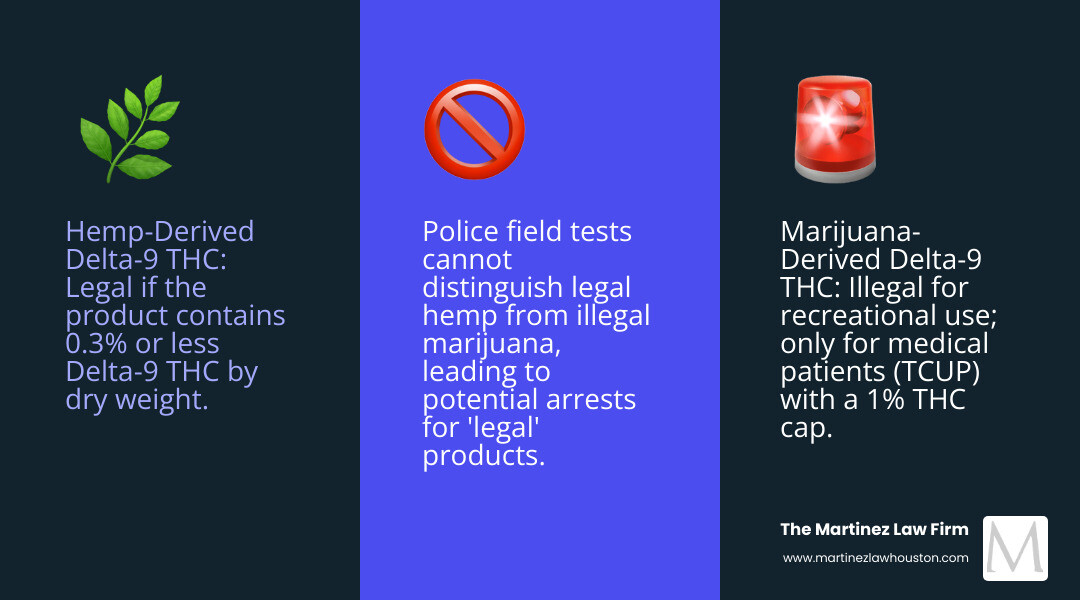
The Legal Labyrinth: Is Delta 9 Legal in Texas?
Trying to determine is delta 9 legal in Texas is one of the most confusing questions in cannabis law. The answer hinges on a 0.3% threshold that creates a legal distinction between two chemically identical products. Both hemp and marijuana come from the Cannabis sativa L. plant, but one is sold legally in Houston gas stations while the other can land you in jail.
This 0.3% limit came from the federal 2018 Farm Bill, which Texas adopted with House Bill 1325. Lawmakers likely didn’t foresee the “gummy loophole” this would create, turning convenience stores across Harris County into unlikely cannabis retailers.
How Texas Law Defines Hemp
Texas law is very specific. The Texas Agriculture Code, Section 121.001 defines hemp as “the plant Cannabis sativa L. and any part of that plant…with a delta-9 tetrahydrocannabinol concentration of not more than 0.3 percent on a dry weight basis.”
In simple terms, any part of the cannabis plant—flowers, extracts, and other derivatives—is legal hemp as long as its Delta-9 THC content is at or below 0.3%. If it crosses that line, it becomes illegal marijuana under Texas law (except for limited medical use).
This definition covers everything from CBD oils to the hemp-derived Delta-9 gummies now common in Houston. The key is that manufacturers can extract and concentrate cannabinoids, including Delta-9 THC, as long as the final product adheres to the 0.3% limit.

The “Gummy Loophole”: How a Little THC Becomes Potent
Here’s where the law creates unintended consequences. The 0.3% limit is based on the product’s total dry weight, not the dose per serving. This allows manufacturers to create intoxicating products that are technically legal.
For example, a heavy gummy can legally contain 10 milligrams of Delta-9 THC and still fall below the 0.3% threshold. For many people, 10mg is a standard dose capable of producing significant psychoactive effects.
This is the “gummy loophole.” The percentage of THC is tiny, but the total amount can be potent. Texas law only regulates the former. As a result, Houston’s smoke shops and CBD stores are filled with legal, intoxicating products like gummies, chocolates, and beverages.
But there’s a critical catch: this has created massive confusion. New users may not understand the potency of a “legal” 10mg gummy. More importantly, law enforcement officers cannot distinguish between legal hemp-derived THC and illegal marijuana-derived THC. They look, smell, and produce the same effects.
This gap between the law and practical enforcement has led to arrests and serious first-time drug offense charges across Harris County. People who made legal purchases are facing life-altering consequences because a police field test can’t measure the difference between 0.29% and 0.31% THC.
Navigating Different THC Products in Texas
Walk into any Houston smoke shop, and you’ll see that Delta-9 isn’t the only cannabinoid for sale. The market is flooded with Delta-8, Delta-10, and THCA products, each with a confusing and precarious legal status. Understanding these differences is key to avoiding potential criminal charges.
- Delta-9 THC: The most psychoactive. Legal only if hemp-derived and under 0.3% by dry weight.
- Delta-8 THC: Offers a milder high, but its legality is in question due to ongoing court battles.
- Delta-10 THC: Even less potent and generally considered legal if the product meets the 0.3% Delta-9 limit.
- THCA: Non-psychoactive until heated, when it converts to illegal Delta-9 THC, creating a major legal risk.
Hemp-Derived Delta-9 vs. Marijuana-Derived Delta-9
The Delta-9 THC molecule is the same whether it comes from hemp or marijuana. Your body can’t tell the difference, and neither can most police tests. The law, however, cares deeply about its origin.
Hemp-derived Delta-9 products are sold openly in Houston stores and online. As long as they contain no more than 0.3% Delta-9 THC by dry weight, they are legal under Texas law.
Marijuana-derived Delta-9, however, is illegal for recreational use. The state’s Texas Compassionate Use Program (TCUP) is a narrow exception, allowing patients with specific conditions like epilepsy, PTSD, or cancer to access products with up to 1% THC through a registered physician. For most Texans, marijuana remains off-limits.
The Murky Waters of Delta-8, Delta-10, and THCA
Delta-8 THC exists in a legal limbo. A court injunction currently prevents the state from classifying it as a Schedule I controlled substance, but pending litigation means its status is uncertain and users still face prosecution risks.
THCA is even more precarious. It’s non-psychoactive and legal in its raw form. However, heating it (by smoking, vaping, or cooking) converts it into illegal Delta-9 THC. This is dangerous because police field tests may involve heating, inadvertently turning your legal product into an illegal one and leading to felony charges.
Delta-10 THC is the mildest of these cannabinoids and is generally considered legal as long as the final product respects the 0.3% Delta-9 THC limit.
What are Consumable Hemp Products (CHPs)?
Texas regulates these items as Consumable Hemp Products (CHPs), which includes any edible, tincture, or beverage containing hemp. The Texas Department of State Health Services (DSHS) requires manufacturers and sellers to obtain a license, creating a system to ensure compliance with the 0.3% THC limit.
Reputable vendors provide QR codes on packaging that link to lab reports (Certificates of Analysis, or COAs) verifying the cannabinoid content. However, the system isn’t foolproof, and mislabeled products that exceed the legal limit are common. This creates serious legal problems for consumers, as Texas maintains strict controlled substances laws.
The Risks: Law Enforcement and Penalties in Houston
Even if you buy a Delta-9 THC product you believe is legal, you can still be arrested in Houston. In my 25 years as a criminal defense lawyer in Harris County, I’ve seen this happen repeatedly. The law on paper doesn’t match the dangerous reality on the streets for consumers.

Why You Can Still Be Arrested
Imagine being pulled over in Houston for a minor traffic issue. An officer sees your legally purchased hemp gummies, runs a field test, and it comes back positive for THC. You are now under arrest.
The problem is that police field tests only detect the presence of THC—they cannot measure the percentage. They can’t tell the difference between a legal 0.29% THC gummy and an illegal one. To the test, THC is THC.
After an arrest, the product is sent to a lab, but this can take months. In the meantime, you face serious charges. The situation is worsened by widespread product mislabeling. A Texas Monthly investigation found that every sample from eight Texas dispensaries exceeded the legal 0.3% THC limit.
Crucially, possessing THC concentrates or edibles over the limit isn’t a simple marijuana charge; it’s a felony Possession of a Controlled Substance (POCS). Houston’s program to decriminalize small amounts of marijuana flower does not apply to these products. At The Martinez Law Firm, we frequently defend clients facing drug possession charges for items they thought were legal.
Penalties for THC Possession in Texas
As a former Chief Prosecutor for Harris County, I know how devastating THC charges can be. Products with over 0.3% Delta-9 THC fall under Penalty Group 2 of the Texas Controlled Substances Act, which carries severe penalties:
- Less than 1 gram: A state jail felony, with 180 days to 2 years in jail and a fine up to $10,000.
- 1 to 4 grams: A third-degree felony, with 2 to 10 years in prison and a $10,000 fine.
- 4 to 400 grams: A second-degree felony, with 2 to 20 years in prison.
- Over 400 grams: A first-degree felony, with 5 to 99 years or life in prison.
A felony conviction has lifelong consequences, including the loss of firearm rights, difficulty obtaining professional licenses, and barriers to employment and housing. I’ve represented clients who bought a gummy from a Houston shop and faced years in prison because it was mislabeled. If you’re facing drug crime charges in Harris County, you need immediate legal help.
The Future of THC in Texas: A Volatile Political Climate
The answer to is delta 9 legal in Texas could change tomorrow. The legal landscape is caught between legislative battles and powerful economic and political forces.
Lt. Gov. Dan Patrick has been a vocal opponent, pushing for a total ban on hemp-derived cannabinoids over concerns about unregulated products and access by minors. Despite his efforts, legislation like Senate Bill 3 has repeatedly failed to pass, partly due to the industry’s significant economic footprint.
The Texas hemp industry generates an estimated $8 billion annually and supports over 50,000 jobs. A fiscal analysis predicted a ban would cost the state millions in revenue. This tension—pitting public safety concerns against economic benefits—has led to legislative gridlock. While some advocate for common-sense regulations like age limits and better labeling, the all-or-nothing political debate has stalled progress.
For Houston residents, this means the future is uncertain. The products on shelves today could be illegal tomorrow.
Where to Buy and What Precautions to Take
Given the political volatility and legal risks, extreme caution is essential when purchasing or possessing Delta-9 products in Houston. I’ve seen too many clients face charges over a product they assumed was safe.
- Buy from reputable vendors. Choose businesses that are transparent and provide product documentation.
- Demand third-party lab reports (COAs). This is essential. A COA from an independent lab should verify the Delta-9 THC concentration is below 0.3%. Many products have a QR code on the package linking to these results.
- Read product labels carefully. Understand the total THC content per serving and package. A product can be legally compliant but still highly intoxicating.
- Avoid products marketed to children. Packaging with cartoons or candy-like designs are major red flags for law enforcement.
- Keep receipts and original packaging. This can help demonstrate your intent to buy a legal product if questioned.
- Store products safely. When transporting, keep items sealed and out of sight, such as in the trunk, to avoid any appearance of an open container violation.
- Stay informed. Texas cannabis laws are evolving. Follow legal updates to stay current.
Even with these precautions, you operate in a legal gray area. Possessing any THC product in Texas carries inherent risks.
Frequently Asked Questions about Delta 9 in Texas
What is the current legal status of Delta-9 THC in Texas?
Hemp-derived Delta-9 is legal in Texas only if the product contains 0.3% or less Delta-9 THC by dry weight. Marijuana-derived Delta-9 is illegal for recreational use. However, this distinction creates a dangerous gray area. Police field tests can’t measure THC percentage, so you can be arrested in Houston for possessing a technically legal product. Proving its legality during a traffic stop is nearly impossible, creating serious legal risks.
Can I get a DWI for driving after consuming legal Delta 9 products in Houston?
Yes, absolutely. Texas law prohibits driving while impaired by any substance, including legally purchased hemp-derived THC. If a Delta-9 product impairs you, an officer can charge you with a DWI based on signs of intoxication. The penalties are severe, including jail time, fines, and license suspension. It’s critical to understand how long a DWI stays on your record in Texas before deciding to drive after consuming any THC product. Treat Delta-9 products like alcohol: if you consume them, do not drive.
What should I do if I’m arrested for possessing a Delta 9 product in Texas?
If you are arrested for possessing a Delta-9 product in Harris County, your first step is to protect your rights. Remain silent. You are not required to answer questions about where you bought the product or what you knew about it. Politely state that you want to speak with an attorney. Do not consent to any searches.
Immediately contact an experienced criminal defense attorney who understands Texas’s complex drug laws. The confusion over is delta 9 legal in Texas leads to many wrongful arrests. An attorney who knows how to challenge field tests and negotiate with prosecutors is essential.
At The Martinez Law Firm, we have handled countless cases involving hemp products. With Herman Martinez’s background as a former Chief Prosecutor and Judge, we know how these cases are prosecuted and how to build a strong defense. Contact us immediately for a confidential consultation.
How to Safely Steer Delta 9 Legality in Texas
The answer to is delta 9 legal in Texas is dangerously complex. While products with less than 0.3% Delta-9 THC are technically legal, this offers no real protection from arrest. Police field tests can’t distinguish legal hemp from illegal marijuana, and with mislabeled products being common, a seemingly legal purchase can lead to a felony Possession of a Controlled Substance (POCS) charge.
The stakes are incredibly high for Houston residents. A conviction carries penalties including years in prison, thousands in fines, and a permanent criminal record. The political climate remains volatile, so what is legal today could be banned tomorrow. And never forget: driving while intoxicated by legally purchased THC is still a DWI, a crime with devastating consequences. You can learn more about how long a DWI stays on your record in Texas on our site.
The legal landscape is a minefield. If you or a loved one is facing THC-related charges in the Houston area, you need an advocate who understands the system from the inside.
At The Martinez Law Firm, we bring over 25 years of criminal defense experience. My background as a former Chief Prosecutor for the Harris County District Attorney’s Office and a former City of Houston Judge provides a unique advantage in defending these complex drug cases. We’ve seen how confusion over Texas’s THC laws has ruined lives, and we fight aggressively to protect our clients’ futures.
Don’t let a questionable THC charge derail your life. Contact us today for a confidential consultation to protect your rights and explore your defense options. Learn more about defending against drug possession charges.
Understanding the Critical Differences Between DWI and DUI in Texas
Though often used interchangeably, DWI and DUI in Texas are distinct charges with different consequences based on age and circumstance. Here’s the essential breakdown:
Quick Answer: DWI vs. DUI in Texas
-
DWI (Driving While Intoxicated): Applies to drivers 21 and older with a BAC of 0.08% or higher, or with impaired mental/physical faculties due to alcohol or drugs. This is a Class B misdemeanor (Class A if BAC ≥ 0.15%), carrying jail time, fines up to $2,000-$4,000, and license suspension.
-
DUI (Driving Under the Influence): Applies to drivers under 21 with any detectable amount of alcohol in their system. This is a Class C misdemeanor with fines up to $500, community service, and license suspension—reflecting Texas’s zero-tolerance policy for underage drinking and driving.
-
Key Distinction: DWI requires proof of intoxication (0.08% BAC or impairment); DUI for minors requires only any detectable alcohol, regardless of impairment level.
An arrest in Houston or Harris County triggers two separate processes: a criminal case and an administrative action against your license. Crucially, you have only 15 days from your arrest to request an Administrative License Revocation (ALR) hearing to fight the automatic suspension of your license.
Texas takes these charges seriously. A conviction’s impact goes beyond fines and jail, potentially affecting your job, professional licenses, housing, and international travel. For minors, a DUI can jeopardize college admissions and career prospects.
This guide explains Texas DWI and DUI laws, penalties, legal processes, and defense strategies to protect your future.
I’m Herman Martinez, founder of The Martinez Law Firm. With over 25 years of experience as a former Chief Prosecutor for Harris County and a City of Houston Judge, I’ve handled cases of DWI and DUI in Texas from every angle. I now use that insider knowledge to aggressively defend clients in Houston and Harris County facing these life-altering charges.
The Core Distinction: DWI vs. DUI in Texas Law

When facing a drinking-and-driving charge in Houston, understanding the specific offense is critical. DWI and DUI in Texas are not the same; they are distinct charges under Texas law, with penalties and defenses determined by one key factor: your age.
What is Driving While Intoxicated (DWI) in Texas?
Driving While Intoxicated (DWI) applies to adults 21 and older. A DWI arrest in Harris County means you’re charged under Texas Penal Code Section 49.04 for operating a motor vehicle in a public place while intoxicated.
Texas law defines “intoxicated” in two ways. You are legally intoxicated in Texas if you have a blood alcohol concentration (BAC) of 0.08% or higher. You are also considered intoxicated if you lack the normal use of your mental or physical faculties due to alcohol, drugs, or a combination of substances.
This means an officer’s subjective observation of impairment (slurred speech, stumbling) can lead to a DWI charge, even with a BAC below 0.08% or without a test. Conversely, a BAC of 0.08% or higher is sufficient for a DWI charge, regardless of how you felt or drove.
A first-time DWI is typically a Class B Misdemeanor, but this can be liftd to a Class A Misdemeanor if your BAC was 0.15% or higher. DWI charges can result from impairment by alcohol, illegal drugs, or even prescription medications.
What is Driving Under the Influence (DUI) in Texas?
Driving Under the Influence (DUI) applies exclusively to minors under 21. Reflecting Texas’s zero-tolerance policy, a DUI charge requires only any detectable amount of alcohol in the minor’s system. Impairment is not a factor; even a trace of alcohol is enough for a DUI charge.
This means a 19-year-old with a BAC that is legal for an adult would still face criminal charges. The legal threshold for minors is effectively zero.
DUI charges are governed by the Texas Alcoholic Beverage Code and are classified as Class C Misdemeanors for a first offense. While less severe than an adult DWI, the consequences can still be devastating for a young person’s future.
Understanding the Legal Classifications
To make the distinction between dwi and dui in texas crystal clear, here’s how the charges compare:
| Characteristic | DWI (Adults) | DUI (Minors) |
|---|---|---|
| Legal Age | 21 years or older | Under 21 years |
| BAC Threshold | 0.08% or higher, OR loss of normal faculties due to impairment | Any detectable amount of alcohol |
| Governing Statute | Texas Penal Code, Chapter 49, Section 49.04 | Texas Alcoholic Beverage Code, Section 106.041 |
| Offense Class | Typically Class B Misdemeanor (first offense) | Class C Misdemeanor (first offense) |
A minor can face both charges. If an underage driver has a BAC of 0.08% or higher or is clearly impaired, Harris County prosecutors can charge them with the more serious adult DWI. The state will typically pursue the charge with the harsher penalties.
Navigating the Penalties for DWI and DUI in Texas

Penalties for DWI and DUI in Texas are harsh by design to deter impaired driving. A conviction in Houston or Harris County can disrupt your life for years. The local courts, including the specialized Harris County DWI Court Program, take these offenses extremely seriously, especially for repeat offenders.
Penalties for a First-Time DWI Offense
A first time DWI offense for an adult is a Class B Misdemeanor with severe consequences. Penalties include:
- Fines: Up to $2,000.
- State Fees: Annual surcharges of $1,000 to $2,000 for three years to keep your license.
- Jail Time: 3 to 180 days, though probation is often possible.
- License Suspension: 90 days to one year.
- Ignition Interlock Device (IID): Often mandatory, requiring you to pass a breath test to start your car.
- Education: Mandatory completion of a DWI education program.
Penalties for Subsequent DWI Offenses
Penalties escalate sharply for repeat offenders.
- Second DWI Offense: A Class A Misdemeanor with fines up to $4,000, jail time from 1 month to 1 year, and a license suspension of up to 2 years.
- Third DWI Offense: A Third-Degree Felony, carrying a $10,000 fine, 2 to 10 years in state prison, and a license suspension up to 2 years. A felony conviction results in a permanent record and the loss of rights like voting and owning firearms.
Penalties for an Underage DUI Offense
A minor’s first DUI charge is a Class C Misdemeanor, but the penalties can still impact a young person’s future. A first offense includes:
- A fine up to $500.
- A 60-day driver’s license suspension.
- 20 to 40 hours of community service.
- Mandatory alcohol awareness classes.
Failure to complete the class extends the suspension by 180 days. Importantly, if a minor’s BAC is 0.08% or higher, they can be charged with an adult DWI and face much harsher penalties, including jail time.
Improved Penalties and Aggravating Factors
Aggravating factors can significantly increase penalties for a DWI and DUI in Texas charge:
- DWI with a Child Passenger: Driving intoxicated with a child under 15 is a State Jail Felony, with up to a $10,000 fine and 2 years in jail.
- High BAC (0.15% or higher): A first offense is liftd to a Class A misdemeanor, with fines up to $4,000 and jail time up to one year.
- Open Container: Adds a mandatory minimum of 6 days in jail to a DWI charge.
- Intoxication Assault: Causing serious bodily injury is a Third-Degree Felony (2-10 years in prison).
- Intoxication Manslaughter: Causing a death is a Second-Degree Felony (2-20 years in prison).
These improved charges are life-altering and require an immediate and aggressive defense.
The Legal Aftermath: From Arrest to License Reinstatement
An arrest for DWI and DUI in Texas initiates two separate legal battles: a criminal case and an administrative process to suspend your driver’s license. Understanding both is key to protecting your driving privileges.
Refusing a Breathalyzer and the ALR Process
Under Texas’s “implied consent” law, driving on a public road means you have consented to a breath or blood test if suspected of DWI. Refusing a test has immediate consequences: an automatic 180-day license suspension for a first refusal (2 years for a subsequent one). In Harris County, officers often get warrants for a forced blood draw if you refuse, so refusal may not prevent a test.
The Administrative License Revocation (ALR) process is a civil action by the Texas Department of Public Safety, separate from your criminal case, to suspend your license. You have only 15 calendar days from your arrest to request an ALR hearing. Missing this deadline results in an automatic suspension.
An ALR hearing is a crucial first opportunity to challenge the evidence, cross-examine the officer, and potentially save your license. A win here can also strengthen your criminal defense.
Ignition Interlock Devices and SR-22 Insurance
An ignition interlock device (IID) is a car breathalyzer that prevents your vehicle from starting if it detects alcohol. An IID may be required as a condition of bond, probation, or to get an occupational license for essential driving during a suspension. It’s often mandatory for repeat offenders or those with a BAC of 0.15% or higher. The user bears the cost of installation (around $70-$100) and monthly monitoring (around $60-$90).
SR-22 insurance is a certificate your insurer files with the state to prove you have liability coverage after a DWI. It’s typically required for two years post-conviction. While not insurance itself, the SR-22 requirement labels you a high-risk driver, causing your insurance premiums to increase significantly.
Between the IID, increased insurance costs, and state surcharges, the financial burden of a DWI and DUI in Texas conviction extends far beyond the initial court fine. Fighting the charges from day one, starting with the ALR hearing, is critical.
Building a Defense and Mitigating Long-Term Consequences

Both a DWI and DUI in Texas charge can threaten your future, but it is defensible. An experienced Houston attorney can challenge the evidence, protect your rights, and work to minimize or dismiss the charges.
Common Defense Strategies for DWI and DUI in Texas
Effective defense strategies in Houston courts involve scrutinizing every detail of the arrest for weaknesses in the prosecution’s case. Common defenses include:
- Challenging the Traffic Stop: If the officer lacked reasonable suspicion for the stop, all subsequent evidence may be inadmissible.
- Questioning Field Sobriety Tests: These tests are subjective and can be affected by medical conditions, fatigue, or poor instructions, making them unreliable.
- Contesting Breathalyzer and Blood Test Accuracy: We investigate if breathalyzers were properly calibrated and if blood tests followed strict collection and storage protocols. Medical issues can also cause false high readings.
- Using the Rising BAC Defense: Your BAC may have been below the legal limit while driving but risen by the time of testing.
- Identifying Procedural Errors: Any failure by law enforcement to follow proper protocol, such as not reading your rights, can be used to your advantage.
My experience as a former Harris County Chief Prosecutor provides insider knowledge on how to exploit these weaknesses.
How Long Does a DWI Stay on Your Record?
A DWI conviction in Texas is permanent and can affect your employment, professional licenses (for doctors, nurses, lawyers, etc.), and housing applications for life.
However, in some cases, it may be possible to clear your record. An expunction can erase an arrest if your case was dismissed or you were acquitted. An order of nondisclosure can seal the record from public view if you successfully completed deferred adjudication for certain first-time offenses. These options are complex, making it vital to fight the charge from the start to avoid a conviction altogether.
Related Offenses and Other Consequences
A conviction for both a DWI and DUI in Texas has other far-reaching consequences:
- Boating While Intoxicated (BWI): Carries penalties similar to DWI.
- Firearm Ownership: A misdemeanor DWI conviction generally doesn’t affect firearm rights, but a felony DWI conviction results in a permanent ban on owning firearms.
- Open Container: Having an open container of alcohol during a DWI arrest adds a mandatory six-day jail sentence. Learn more about Texas open container laws.
- International Travel: Countries like Canada may deny entry to individuals with a DWI conviction.
Navigating the Houston legal system requires an attorney with insider knowledge. At The Martinez Law Firm, we use our prosecutorial experience to build the strongest defense for your case.
Frequently Asked Questions about DWI and DUI in Houston
If you’re facing charges of DWI and DUI in Texas, you likely have urgent questions about what comes next. These are some of the most common concerns we hear from our Houston clients.
Can a minor be charged with both a DWI and a DUI in Texas?
Yes. A minor under 21 with any detectable alcohol can be charged with DUI. If that same minor has a BAC of 0.08% or higher or is otherwise impaired, they can also be charged with the more serious adult DWI. In Harris County, prosecutors will typically pursue the DWI charge because it carries much harsher penalties. This makes experienced legal representation essential for any minor charged with a drinking and driving offense.
How does a DWI or DUI conviction affect firearm ownership rights in Texas?
The impact depends on the conviction level. A misdemeanor DWI conviction generally does not affect your firearm rights in Texas. However, a felony DWI conviction leads to the permanent loss of your right to own or possess firearms. This includes a third DWI, intoxication assault, or DWI with a child passenger. Avoiding a felony conviction is critical to protecting your Second Amendment rights.
Can an attorney get a DWI charge dismissed in Houston?
Yes. While no outcome is guaranteed, an experienced Houston DWI attorney can often get charges dismissed or reduced. A dismissal can be achieved by proving issues with the state’s case, such as:
- An illegal traffic stop without probable cause.
- Inaccurate or improperly administered breathalyzer and blood tests.
- Unreliable field sobriety test results.
- Police procedural errors or rights violations.
My experience as a former prosecutor and judge in Harris County gives me unique insight into finding these case-destroying flaws and securing dismissals for my clients.
DWI/DUI Next Steps
A DWI or DUI charge in Texas is a critical event that puts your freedom, career, and future at risk. The legal system in Houston and Harris County is tough on impaired driving, and prosecutors are aggressive. From the moment of your arrest, the clock is ticking on crucial deadlines, like the 15-day window to request an ALR hearing to save your license.
It is crucial to remember that a charge is not a conviction. A strong defense examines every detail: Was the stop legal? Were tests administered correctly? Were your rights violated? The answers to these questions can be the key to a dismissal.
The Martinez Law Firm offers a unique insider’s perspective. As a former Chief Prosecutor for Harris County and a City of Houston Judge with 25 years of experience, Herman Martinez knows how prosecutors build their cases. We now use that knowledge to dismantle them and aggressively defend our clients in Houston and Harris County.
You don’t have to face this alone. We provide the aggressive, personalized defense you need, whether it’s a first offense or a felony charge. Don’t let a dwi and dui in texas charge ruin your future. Contact The Martinez Law Firm today for a consultation to discuss your defense strategy. Time is critical—let us fight for you. Learn more about Texas open container laws and how they might affect your case, or reach out directly to schedule your consultation. Your future deserves a fierce advocate—let us be that for you.
When Your World Turns Upside Down: Understanding False Domestic Assault Charges
False domestic assault charges can destroy your life in an instant. If you’re facing a false accusation in Houston, you must act immediately to protect your rights and future. The first 48 hours are critical. You should exercise your right to remain silent, avoid all contact with your accuser, and strictly follow any court orders. Begin documenting everything and preserving evidence like text messages, alibi receipts, or witness information that can prove your innocence.
In Houston and Harris County, domestic violence accusations trigger an aggressive response. Texas’s mandatory arrest policies mean officers often make an arrest based solely on an accusation, before you can tell your side. This can lead to an immediate Emergency Protective Order (EPO), removing you from your home and preventing contact with your children. The damage to your job, reputation, and family can be immense, even if you are ultimately found not guilty.
The good news is that false accusations can be beaten with the right defense. I’m Herman Martinez, founder of The Martinez Law Firm. With over 25 years of experience, including as a Chief Prosecutor for the Harris County District Attorney’s Office, I’ve seen how these charges are used and, more importantly, how to defeat them. My unique perspective from both sides of the courtroom allows me to build winning strategies for clients facing false accusations in Houston.
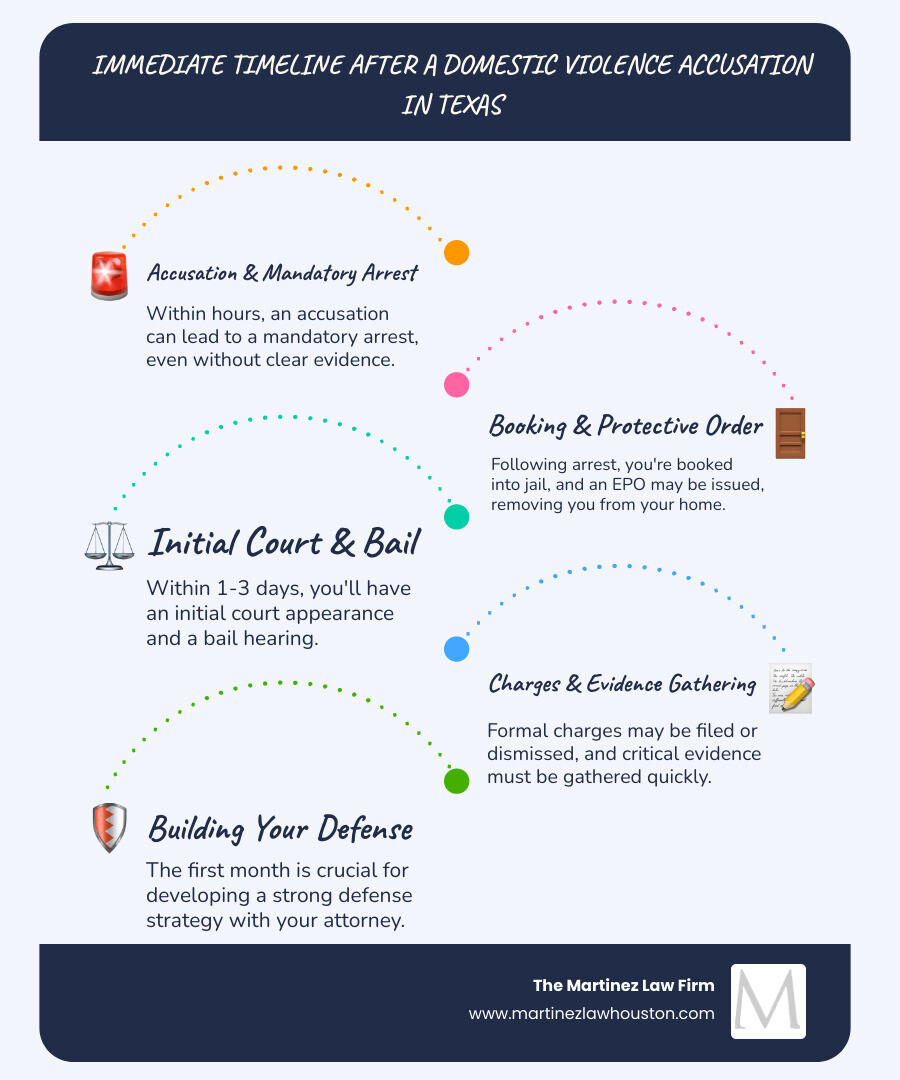
Understanding the Stakes: The Immediate Impact of a False Accusation in Houston
One minute, you’re going about your life. The next, police are at your door. When facing false domestic assault charges in Houston, you must understand how quickly and severely your world can change.
Texas law defines domestic violence broadly, including acts or even threats that place a family member in fear of harm. This means minor actions taken out of context can lead to an arrest. In Harris County, police operate under a mandatory arrest policy, meaning if they believe violence occurred, someone will be arrested, often based solely on the accuser’s word. Within hours, an Emergency Protective Order (EPO) can bar you from your home and children before formal charges are even filed.
The legal consequences are just the start. The psychological toll is immense, with many facing anxiety, depression, and symptoms similar to PTSD, as detailed in research on the psychological toll of false accusations. Your career is also at risk, as an accusation alone can lead to suspension or termination. The financial and personal strain can be overwhelming. For a deeper look at how these cases proceed locally, see our page on Houston Domestic Violence.
Common Motivations Behind False Allegations
Understanding why someone might make a false claim is key to your defense. In my 25 years as a prosecutor and defense attorney, I’ve seen several common motivations:
- Leverage in Divorce/Custody: An accusation can be a weapon to gain the upper hand in court, securing the house, assets, or sole custody of children.
- Revenge or Anger: Following a bad breakup or argument, some people use the legal system to punish their former partner.
- Financial Gain: False claims may be used to secure a more favorable financial settlement.
- Mental Health Issues: In some cases, a person’s perception of reality is distorted, leading to accusations not based in fact.
- Misinterpretation: A heated argument or defensive action can be misread and reported as a violent threat, especially during tense times like holiday gatherings and domestic violence crimes.
- Third-Party Influence: Friends or family may pressure an individual to file a report out of misguided concern or malice.
Signs an Accusation Might Be False
Recognizing red flags is critical for your defense. While every case is unique, here are common indicators of false domestic assault charges:
- Inconsistent Stories: The accuser’s story changes when told to police, friends, or in court documents.
- Delayed Reporting: An unexplained delay in reporting the incident can suggest it was fabricated later, perhaps during a custody dispute.
- Lack of Physical Evidence: Claims of physical assault are not supported by medical records or visible injuries.
- Clear Motive to Lie: The accuser stands to gain something from the accusation, such as an advantage in a divorce or custody battle.
- Contradictory Evidence: Friendly text messages, social media posts, or witness statements contradict the accuser’s claims of fear or abuse.

When we find these signs, they become powerful tools for discrediting the accuser and proving the charges are false. The key is acting quickly to preserve this evidence.
Your Immediate Defense Plan: What to Do When Falsely Accused
The moment you face false domestic assault charges in Houston, every decision matters. Your natural instinct to explain yourself or fix the misunderstanding can seriously damage your case. Do not act on these impulses.

Immediate Steps for Dealing with False Domestic Assault Charges
- Invoke your right to remain silent. This is your most powerful protection. Police are trained to gather evidence for prosecution, and your words can be twisted. Simply state, “I want to speak with my attorney.” Our guide on After an Arrest: Remaining Silent explains this in more detail.
- Do not contact the accuser. Any contact—texts, calls, or messages through friends—can be used against you as harassment or witness tampering. If a protective order exists, contact is a separate criminal offense.
- Follow all court orders. You must obey every detail of an Emergency Protective Order, even if it’s based on lies. Violating it leads to immediate arrest and makes you look guilty.
- Stay off social media. Prosecutors in Houston search social media for anything they can use. A frustrated post can be twisted into evidence of an “aggressive” personality. Learn more about protecting yourself on our After an Arrest page.
- Document everything. Start a timeline. Save every text, email, and voicemail. Preserve any evidence that supports your alibi or contradicts the accuser’s claims, such as receipts or GPS data.
Contacting a Houston Domestic Violence Lawyer
You need an experienced Houston domestic violence lawyer immediately. The first 48 hours are when the prosecution builds its case and evidence can disappear. Fighting this alone is a risk you cannot afford.
An experienced attorney protects you from the start. We know how Harris County prosecutors operate and can prevent you from making critical mistakes. During a free consultation, we’ll evaluate the allegations and create an immediate action plan.
While you’re in shock, we’re already investigating, gathering evidence, and identifying inconsistencies in the accuser’s story. As a former Chief Prosecutor for the Harris County District Attorney’s Office, I use my insider knowledge of prosecution tactics to build the strongest possible defense for you.
If you’re unsure, our article on When to Hire a Criminal Defense Attorney explains why waiting is a mistake. To start fighting back, contact a Houston Domestic Violence Lawyer from our firm today.
Building Your Case: Evidence Needed to Fight False Domestic Assault Charges
When facing false domestic assault charges, your defense is built on proving your story with credible evidence. The prosecution must prove guilt beyond a reasonable doubt; our job is to create that doubt by revealing the truth. In a Houston courtroom, facts matter more than a compelling but false story. For more on this legal standard, review our article on The Burden of Proof in Sex Crimes: What to Know.
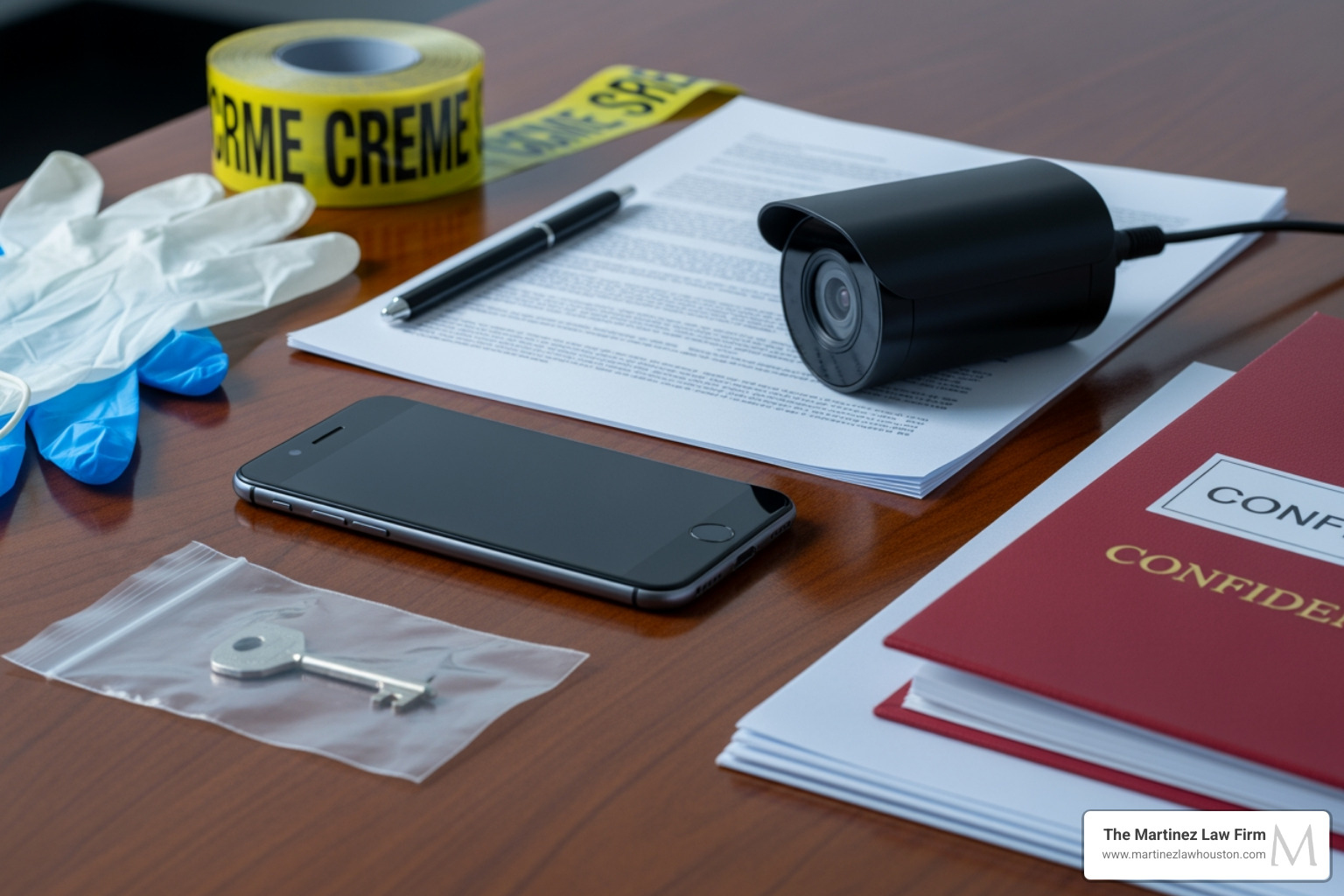
How to Prove Your Innocence with Crucial Evidence
Proving your innocence against false domestic assault charges requires a methodical approach. Here’s the evidence we use to build a strong defense in Houston:
- Digital Communications: Text messages, emails, and social media posts are often the star witnesses. We gather all communications that contradict claims of fear, reveal a motive to lie, or show a friendly relationship after the alleged incident.
- Witness Statements: Eyewitnesses can directly contradict the accuser’s story. Character witnesses who know you as a peaceful person can help a jury see the real you. We also find witnesses who can speak to the accuser’s history of dishonesty.
- Alibi Evidence: The most direct defense is proving you weren’t there. We collect receipts, credit card statements, GPS data from your phone or car, and work records to establish a timeline that exonerates you.
- Physical and Photographic Evidence: Security footage from your home or a neighbor’s can show what really happened. If you were defending yourself, it is critical to photograph your own injuries. Texas law recognizes self-defense, and photos, along with medical records, can prove you were the one who was attacked.
- Challenging the Accuser’s Motive: We investigate whether the accuser stands to gain from the allegation, such as an advantage in a divorce or custody battle. Exposing this motive undermines their credibility.
- Highlighting Inconsistencies: A liar’s story changes. We compare what the accuser told police, friends, and what they claim in court. When the versions don’t match, their credibility crumbles.
This comprehensive approach to evidence is how we dismantle false accusations. Our guide on How to Beat a Domestic Assault Charge provides additional insights into the defense process.
How a Former Prosecutor Defends Your Rights and Reputation
When you’re facing false domestic assault charges in Houston, you need an attorney who knows the prosecution’s playbook. As a former Chief Prosecutor for the Harris County District Attorney’s Office, Herman Martinez has over 25 years of experience in these courtrooms—first building cases for the state, and now taking them apart for his clients.

This insider perspective is a game-changer. We anticipate prosecution tactics, identify weaknesses in their case, and negotiate from a position of strength. We conduct our own thorough investigation, scrutinizing every police report and statement for inconsistencies the police may have missed. If the case goes to trial, you’ll have a seasoned litigator who can confidently cross-examine witnesses and clearly present your side of the story to the jury.
As former prosecutors, we know exactly what the state must prove for a conviction. We strategically attack those elements, whether by exposing the accuser’s credibility issues or establishing your alibi. To learn more, visit our page on the Role of a Criminal Defense Attorney.
Protecting Your Future from a False Conviction
A domestic violence conviction in Texas, even from a false charge, can alter your life forever. Here’s what’s at stake:
- Child Custody: A conviction can cost you your children. Family courts in Houston may restrict you to supervised visits or strip your custody rights entirely.
- Firearm Rights: You will lose your Second Amendment right to own or possess firearms in Texas.
- Career: A conviction can lead to job termination and prevent you from obtaining professional licenses. It creates a permanent red flag on background checks.
- Reputation: The damage to your personal and professional reputation can be lasting, even after you are exonerated.
- Immigration Status: For non-citizens, a domestic violence conviction can trigger deportation proceedings. Our article on Can Immigrants Be Deported After Arrest? explains this risk.
We provide comprehensive Criminal Defense services because we know this is about more than just a case—it’s about your entire future.
Frequently Asked Questions about False Domestic Violence Accusations in Texas
If you’re facing false domestic assault charges in Houston, you have questions. With over 25 years of experience, we’ve compiled answers to the ones we hear most often.
What are the penalties for someone who makes a false domestic violence report in Texas?
Knowingly making a false police report is a crime in Texas. Under the Texas Penal Code, it’s typically a Class B misdemeanor, punishable by up to 180 days in jail and a $2,000 fine. If the person lies under oath in court, they can face a felony perjury charge, which carries much stiffer penalties. Additionally, you may be able to file a civil lawsuit against the accuser for damages related to defamation or malicious prosecution. While prosecutors don’t always pursue these charges, it’s important to know they exist. You can read more on the crime of filing a false report.
How do false allegations affect child custody and divorce proceedings in Texas?
False allegations can do devastating damage in family court. Based on the “best interest of the child” standard, a judge can issue temporary orders that remove you from your home and restrict access to your children based only on the accusation. Some people use this as a weapon to gain an unfair advantage in a divorce or custody battle. However, if we can prove the allegations were fabricated to manipulate the court, it can severely damage the accuser’s credibility and may even cause them to lose custody. These cases often involve issues seen in other Violent Crimes defenses.
Can domestic violence charges be dropped if the accuser recants their story?
This is a common misconception. In Harris County, prosecutors follow a “no-drop” policy. This means the State of Texas, not the accuser, decides whether to proceed with the case. Even if the accuser signs an affidavit of non-prosecution, the District Attorney can move forward. They do this to protect genuine victims who may be coerced into recanting. However, a recantation is still incredibly valuable for your defense. It creates serious doubts about the accuser’s credibility, which we can use to negotiate a dismissal or win an acquittal at trial. If the state’s case relies solely on a now-unreliable witness, their case is significantly weakened. For general information on related charges, visit our Assault page.
Take Control of Your Case and Protect Your Future
Being falsely accused of domestic violence is a devastating experience, but you are not powerless, and this fight is winnable. We’ve outlined the stakes, the immediate steps to take, and the evidence needed to build a strong defense against false domestic assault charges in Houston.
Time is not on your side. The prosecution is already building its case. You need an advocate who can fight back effectively. At The Martinez Law Firm, my experience as a former Chief Prosecutor for the Harris County District Attorney’s Office gives our clients a critical advantage. I know how prosecutors think, and I use that knowledge to dismantle their cases and protect your future.
We have helped countless clients in Harris County clear their names and reclaim their lives. Your future should not be defined by someone else’s lie. Don’t wait another day to take action.
Contact us for a free consultation on your Houston domestic violence case and let’s discuss how we can protect your rights and start building your defense together.
What You Need to Know About Probation Duration in Texas
In Texas, how long is probation depends on whether you’re facing a criminal sentence or an employment trial period. For criminal cases, probation (officially “community supervision”) can last from 6 months to 10 years. Here’s a quick overview:
- Misdemeanor Probation: Maximum of 2 years for Class A or B misdemeanors.
- Felony Probation: Up to 10 years for most felonies (5 years for some third-degree felonies).
- Sex Offenses with Minor Victims: Minimum of 5 years.
- Employment Probation: Typically 90 days, based on the employment contract.
In Houston and Harris County, the exact duration is influenced by the offense’s severity, your criminal history, the type of probation, and the judge’s discretion.
Probation is a court-ordered alternative to incarceration with strict rules, not a “get out of jail free” card. Violating any condition can lead to revocation, meaning you could be sent to jail or prison to serve the original sentence without credit for the time you spent on probation.
If you’re facing criminal charges in Houston, understanding how probation works is critical. At The Martinez Law Firm—led by Herman Martinez, a former Chief Prosecutor for the Harris County District Attorney’s Office with over 25 years of experience—we know how probation length is set and why decisive, custom defense can shape your outcome.
How Long is Probation in Texas?
When people in Houston ask “how long is probation?” they’re usually referring to what Texas law calls “community supervision.” It’s a criminal sentence served in the community under court supervision, rather than in jail or prison. You must report to a probation officer and follow specific court-ordered rules. If you break those rules, you risk serving the original jail or prison time.
There is no single answer to how long is probation in Texas. The duration depends on the type of crime, your criminal history, and the judge’s discretion. In my 25 years in Harris County courtrooms, I’ve seen judges consider the full picture: the offense, the circumstances, and the defendant’s character. Texas sentencing guidelines provide a framework, but judges have significant leeway, which is why experienced representation is so important.
For DWI-specific probation rules, see our guide on DWI Probation in Texas: What You Need to Know.
How long is probation for misdemeanors vs. felonies?
The biggest factor determining how long is probation is whether the charge is a misdemeanor or a felony.
For misdemeanor probation in Texas (Class A or B), the maximum term is two years. Judges have flexibility as there is typically no minimum term.
Felony probation involves higher stakes and longer terms:
- Most felonies carry a maximum community supervision period of 10 years.
- Some third-degree felonies have a shorter maximum of 5 years.
- Sex offenses involving victims under 17 have a mandatory minimum of five years of probation.
For all felonies, the minimum probation term usually matches the minimum imprisonment term for that offense. The final length depends on your case, the judge, and negotiations between your defense attorney and the prosecutor.

Deferred Adjudication vs. Straight Probation
There are two main types of probation in Texas, and the difference can determine whether you end up with a permanent criminal conviction.
Deferred adjudication is often the best possible outcome. You plead guilty or no contest, but the judge defers a finding of guilt. If you successfully complete probation, the case is dismissed. This means no conviction, and you may be able to have the record sealed later. Learn more about dismissals in our article on Getting Your DWI Dismissed in Texas. The maximum term for deferred adjudication is 10 years for felonies and 2 years for misdemeanors.
Straight probation (or regular probation) is different. The judge finds you guilty and sentences you, but suspends the jail or prison time in favor of community supervision. The critical difference is that you have a conviction on your record. While it may be eligible for an order of nondisclosure later, the conviction remains.
| Feature | Deferred Adjudication | Straight Probation (Conviction Probation) |
|---|---|---|
| Conviction Status | No formal conviction entered if successfully completed | Formal conviction entered |
| Criminal Record Impact | Case dismissed, potentially eligible for expunction | Conviction remains, potentially eligible for nondisclosure |
| Purpose | Avoids conviction, offers a clean slate upon completion | Alternative to immediate jail/prison sentence |
| Eligibility | Depends on offense type, prior record, and prosecutor/judge discretion | Depends on offense type, prior record, and judge’s discretion |
| Violation Consequences | Judge can impose full range of punishment for original offense | Judge can impose original suspended sentence |
Negotiating for deferred adjudication is often a top priority in a defense strategy.
Factors That Influence Probation Duration
Judges in Houston and Harris County consider several factors when deciding how long is probation will be:
- The severity of the crime: A first-degree felony will result in a longer term than a misdemeanor.
- Your prior criminal history: First-time offenders are often viewed more favorably than those with a record.
- Plea bargain negotiations: A skilled defense attorney can often negotiate for a shorter probation term or better conditions.
- The judge’s assessment: Judges have discretion and consider pre-sentence reports, arguments from both sides, and your remorse.
- Your assessed risk level: The probation department uses risk assessment tools. A high-risk score may lead to a longer, stricter term.
- Recommendations from the prosecution: The prosecutor’s stance can significantly sway a judge’s decision.
In some cases, programs like pretrial diversion can help you avoid probation altogether. Learn more in our article: What do I need to do to get a Pretrial Diversion in Houston, Harris County, Texas?
The Rules of Probation and Consequences of Violations
Being granted probation in Houston is a serious second chance that comes with a detailed set of rules. You are entering an agreement with the court, and breaking it can land you back before a judge.
Your probation officer is a key figure who ensures you follow the rules and reports your progress to the court. You will have regular check-ins, which may be weekly or monthly. In Harris County, the Harris County Community Supervision & Corrections Department (CSCD) oversees probation cases. Their Fields Services division works with probationers to ensure compliance and provide support.

Common Probation Conditions in Harris County
While every case is different, most probation orders in Houston include similar conditions. Being prepared for these expectations is key to success.
- Regular reporting to your probation officer is mandatory.
- Staying out of trouble by following all laws is the most important rule. No new offenses.
- Financial obligations, including court costs, supervision fees, and victim restitution, must be paid.
- Community service hours are often required.
- Drug and alcohol testing is frequent and often random. Any marijuana use is typically prohibited.
- Counseling or classes custom to your offense, such as substance abuse treatment or anger management, are common.
- An ignition interlock device is often mandatory for DWI cases, as discussed in our article How Long is DUI Probation?
- Restrictions on where you can go and who you can associate with may apply.
- Maintaining steady employment and notifying your officer of any changes in your job or address is usually required.
- Prohibition from possessing firearms or other weapons.
These conditions are designed to protect public safety and help you rebuild your life. Taking every rule seriously is crucial.
What Happens if You Violate Probation?
Violating your probation terms can undo all your progress. Violations fall into two categories: technical violations (breaking a rule, like missing a meeting or failing a drug test) and new law violations (getting arrested for a new crime).
When a violation is alleged, your probation officer can file a Motion to Revoke Probation (MTR). This leads to a probation violation hearing, where the rules differ from a criminal trial. The prosecutor only needs to prove “by a preponderance of the evidence” (more likely than not) that you violated a term. This lower standard makes having an experienced attorney essential. Our guide on Probation Violation Hearing: What to Do explains this process.
If the judge finds you violated probation, the most severe consequence is serving the original suspended sentence in jail or prison. Crucially, you typically get no credit for the time you already spent on probation. The judge might also extend your probation, add more conditions, or order a short period of jail time. Getting a DUI while on probation is an especially serious scenario, which we cover in What Happens if You Get a DUI While on Probation?
If you are accused of a violation, contact a Houston criminal defense attorney immediately. Early intervention provides the best chance to avoid the worst outcomes.
Understanding Employment Probation Periods
The term “probation” is also used in the workplace, but it means something entirely different from a criminal sentence. An employment probation period is a trial run for a new job, allowing both you and the employer to assess the fit.
This is a contractual agreement, not a legal sentence. In Texas, an “at-will employment” state, either party can end the relationship at any time for nearly any non-discriminatory reason. An employment probation period is defined by your contract or employee handbook, not by state law, and often gives employers more flexibility to terminate a new hire.

How long is probation for employment in Texas?
There is no Texas law setting a specific timeframe, but the most common duration for employment probation is 90 days. This industry standard gives employers time to evaluate your performance and fit. These terms should be outlined in your offer letter or contract.
During this period, termination rights are often more straightforward for employers, and severance pay is typically not offered unless specified in your contract. However, you are still protected by anti-discrimination laws. Your employee handbook should detail the company’s policies on probation, performance expectations, and termination procedures.
Can an Employer Extend a Probation Period?
Yes, an employer in Texas can extend a probation period, but this should be done with a clear written agreement and your employee consent. Extensions are often used when an employer sees potential in an employee who needs more time to meet expectations, sometimes in conjunction with a performance improvement plan.
Legally, an extension continues the employer’s right to terminate with less formality. It’s best practice for both parties to have everything in writing to avoid disputes. If you’re facing an extended probation period, ensure you understand the new expectations and timeline.
Frequently Asked Questions about Probation
Here are answers to the most common questions I hear from clients in Houston and Harris County about how long is probation and what it entails.
Can I shorten my time on probation in Texas?
Yes, it’s possible to get off probation early through a process called early termination, but it is entirely at the judge’s discretion. To be considered, you generally must have completed at least one-third of your probation term or a minimum of two years, whichever is less. You must also have fulfilled all court-ordered conditions, paid all fines and fees, and maintained a record of good behavior with no new violations.
To request early release, your attorney must file a formal motion with the court, presenting evidence of your compliance and rehabilitation. An experienced attorney who knows the local courts can make a significant difference.
What is the difference between probation and parole?
People often confuse probation and parole, but they are fundamentally different.
- Probation is a sentence given instead of jail or prison time. It’s an alternative to incarceration, overseen by the sentencing court and a county probation officer.
- Parole is an early release from prison after an inmate has already served part of their sentence. It is granted and supervised by the Texas Board of Pardons and Paroles, not a judge.
Violating probation sends you back before the original judge, while a parole violation is handled by the parole board. For more definitions, the federal courts offer a Glossary of Legal Terms.
What happens if my probation is revoked?
Probation revocation is a serious outcome where the court finds you violated your supervision terms. The process begins with a revocation hearing, where the prosecutor must prove the violation by a “preponderance of the evidence”—a lower standard than in a criminal trial. You have the right to an attorney, which is critical at this stage, as explained in our article I Have Been Accused of Violating My Probation. What’s Next?.
If the judge finds you in violation, the most severe consequence is serving your original suspended sentence in jail or prison. You typically receive no credit for “street time”—the time you successfully spent on probation. The judge may also impose additional conditions, such as extending your probation, adding community service, or requiring a short jail stay followed by continued probation.
The stakes are incredibly high. If you are facing a potential revocation, contact an experienced criminal defense attorney immediately.
Navigating Your Probation in Houston
Knowing how long is probation is just the first step; successfully completing it in Harris County requires strict compliance. A minor mistake—a missed appointment, a failed drug test, or a traffic ticket—can escalate quickly and put your freedom at risk. What starts as a second chance can turn into jail time if you’re not careful.
Throughout this process, you have legal rights. If you’re accused of a violation, you are entitled to a hearing and to have an attorney fight for you.
At The Martinez Law Firm, we protect people facing these exact challenges. Herman Martinez’s 25+ years of experience, including as a Chief Prosecutor for the Harris County District Attorney’s Office, provides an edge most defense attorneys don’t have. We know how prosecutors build their cases and what judges look for, allowing us to create a personalized defense strategy for you.
Whether you’re just starting the process, worried about a violation, or facing a motion to revoke, you don’t have to face it alone. Your future matters, and the decision to get experienced legal help can determine the outcome.
If you’re dealing with a probation issue in Houston, we are here to help. Contact a Houston DWI Lawyer for Help today to discuss your situation. We’ll explain your options and start building a defense to protect your rights and your freedom.
What You Need to Know About Criminally Negligent Homicide in Texas
Criminally negligent homicide occurs when a person causes another’s death through criminal negligence—meaning they failed to perceive a substantial and unjustifiable risk that a reasonable person would have recognized. In Texas, this charge is the lowest level of culpable homicide, but it still carries serious felony consequences that can change your life forever.
Key Facts About Criminally Negligent Homicide:
- Legal Classification: State jail felony under Texas Penal Code § 19.05
- Prison Sentence: 180 days to 2 years in state jail
- Maximum Fine: Up to $10,000
- Mental State Required: Criminal negligence (failure to perceive risk), not intent to kill
- Key Difference from Manslaughter: Manslaughter requires recklessness (consciously disregarding a known risk), while criminally negligent homicide involves failing to perceive a risk.
- Common Examples: Fatal DWI accidents, leaving a child in a hot car, discharging a firearm negligently, driving with known dangerous vehicle defects
The line between a tragic accident and a crime is at the heart of every criminally negligent homicide case. The outcome depends on whether your actions were a “gross deviation” from what an ordinary person would do—a vague standard when you’re facing charges in Houston or Harris County.
These cases are emotionally profound because they typically involve no intent to harm. They arise from human error or a failure to appreciate danger that leads to the worst possible outcome. The legal system must decide if that failure rises to the level of criminal negligence, which is far more serious than ordinary carelessness.
I’m Herman Martinez, founder of The Martinez Law Firm in Houston. I’ve spent over 25 years on both sides of these cases—first as a Chief Prosecutor for the Harris County District Attorney’s Office and now as a defense attorney. This unique perspective shows me that winning often depends on how effectively your attorney challenges the prosecution’s claims about what you “should have known.”
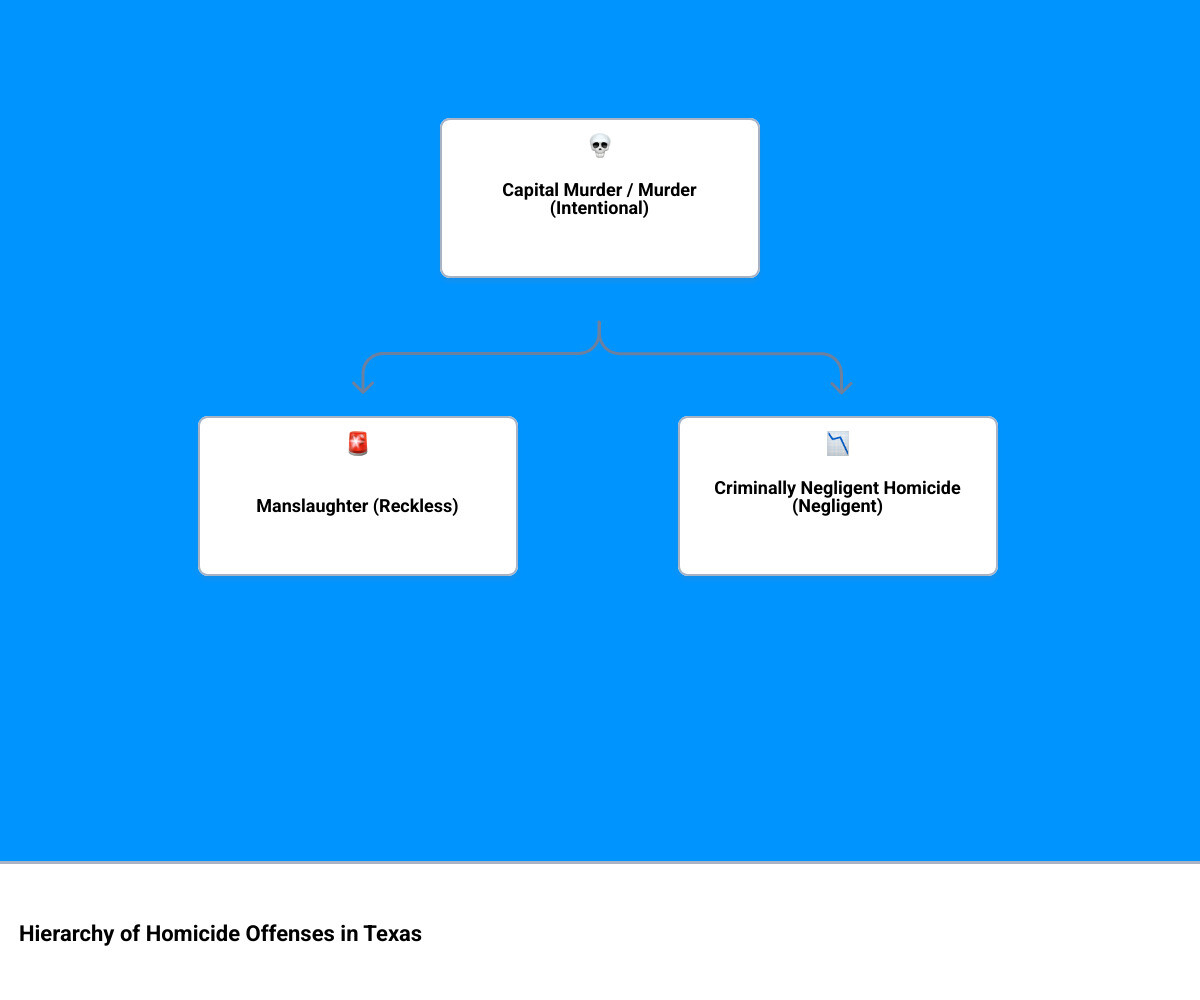
Understanding Criminally Negligent Homicide in Texas
When someone dies because of another’s actions, Texas law must determine culpability. Criminally negligent homicide is the least severe homicide charge, but it’s a state jail felony with life-altering consequences.
What makes this charge unique is the lack of intent. The accused didn’t mean for anyone to die or even consciously take a known risk. Instead, they failed to see a danger that a reasonable person would have spotted. It is this failure—this blind spot—that the law deems criminal.
But how is this different from ordinary carelessness that might lead to a lawsuit? The answer is “gross deviation from the standard of care.” Texas law doesn’t punish every mistake. Criminal negligence requires a profound failure to recognize an obvious, substantial danger.
What is the legal definition of criminally negligent homicide?
Under Texas Penal Code § 19.05, a person commits this offense by causing a death through criminal negligence. The key is defining “criminal negligence.”
Texas Penal Code § 6.03(d) states you act with criminal negligence when you ought to be aware of a substantial and unjustifiable risk but fail to perceive it. This failure must be a gross deviation from the standard of care an ordinary person would exercise.
In plain English, this means:
- A substantial and unjustifiable risk existed.
- A reasonable person would have recognized this danger.
- The accused failed to perceive the risk.
- This failure was a gross deviation from reasonable behavior, not a simple oversight.
Criminally negligent homicide involves the inadvertent creation of risk. The person wasn’t thinking about the danger. In my years defending clients in Houston, I’ve seen how this element of “should have known” becomes the central battleground of the case.
How It Differs from Murder and Manslaughter
The Texas Penal Code has four culpable mental states: intentional, knowing, reckless, and criminally negligent. Understanding this hierarchy is essential.
- Murder (§ 19.02) is a first-degree felony (5-99 years or life) where a person intentionally or knowingly caused a death.
- Manslaughter (§ 19.04) is a second-degree felony (2-20 years) involving recklessness. The person was aware of a substantial risk of death but consciously disregarded it.
- Criminally negligent homicide (§ 19.05) is a state jail felony (180 days to 2 years). There is no intent and no conscious disregard of risk, only a failure to perceive a danger they should have seen.
| Offense | Mental State (Mens Rea) | Texas Penal Code Section | Punishment Range |
|---|---|---|---|
| Murder | Intentional/Knowing: Intentionally or knowingly causes death; or intends serious bodily injury and commits dangerous act causing death; or commits felony and dangerous act causes death. | § 19.02 | First-degree felony: 5 to 99 years or life imprisonment, up to $10,000 fine. |
| Manslaughter | Reckless: Consciously disregards a substantial and unjustifiable risk that death will occur. Aware of the risk, but proceeds anyway. | § 19.04 | Second-degree felony: 2 to 20 years imprisonment, up to $10,000 fine. |
| Criminally Negligent Homicide | Criminally Negligent: Ought to be aware of a substantial and unjustifiable risk, but fails to perceive it. Gross deviation from reasonable care. | § 19.05 | State jail felony: 180 days to 2 years in state jail, up to $10,000 fine. |
The mental state is everything. Prosecutors in Harris County may initially charge manslaughter, only for it to be reduced to criminally negligent homicide when evidence shows no conscious awareness of the risk. The case of Saunders v. State, 840 SW 2d 390 (Tex.Crim.App.1992), provides a detailed legal analysis of these distinctions.
International Perspectives: A Brief Comparison
Other legal systems grapple with similar issues. The UK’s “gross negligence manslaughter” requires a breach of a duty of care so severe it is considered criminal, as detailed by the Crown Prosecution Service. Canada’s “causing death by criminal negligence” can carry a life sentence and focuses on a “wanton or reckless disregard for the lives or safety of other persons.” These comparisons show the universal challenge of distinguishing a terrible accident from a criminal act.
Common Scenarios That Can Lead to Charges

The tragic reality of criminally negligent homicide is that it often arises from everyday situations where someone fails to recognize a deadly risk. In Houston and Harris County, a moment of inattention can quickly escalate into criminal charges.
The key question is always foreseeability: would a reasonable person have predicted that their actions—or inaction—might lead to someone’s death? This is the standard prosecutors use and the battleground where these cases are won or lost.
Vehicular Incidents
Many criminally negligent homicide charges in Houston stem from our busy roads, where the line between a tragic accident and criminal negligence can be thin.
- Driving under the influence: Even if not legally intoxicated, impairment can affect a driver’s ability to perceive risks that a sober person would see.
- Texting while driving: With the dangers of distracted driving well-known, looking at a phone instead of the road is often argued as a gross deviation from reasonable care.
- Street racing: The choice to race on public roads creates substantial and unjustifiable risks, making it difficult to argue a fatal crash was unforeseeable.
- Driving with known faulty equipment: Postponing repairs on critical parts like brakes or tires can lead to charges if those failures cause a fatal accident. Prosecutors will argue the driver should have been aware of the risk.
Public frustration over traffic fatalities, as noted in reports like “Vehicular homicide sentences not harsh enough, say victims’ families,” can lead to aggressive prosecution, making an experienced defense crucial.
Child Endangerment and Neglect
Cases involving children are among the most heartbreaking. The law expects a higher standard of care around children, and any breach can lead to criminally negligent homicide charges.
- Leaving a child in a hot car: A tragic mistake, but the law expects a reasonable person to be aware of the extreme danger of heatstroke in Houston’s climate.
- Unsafe storage of firearms: If a child accesses a loaded gun and an accident occurs, the adult who failed to secure it faces serious charges.
- Failure to provide necessary medical care: If a guardian fails to get medical help for a child with a condition a reasonable person would see as severe, charges may be filed.
- Manufacturing drugs in a home with children: This exposes children to chemicals and fire risks, which prosecutors view as a profound failure to perceive danger.
Other Negligent Acts

Beyond vehicles and child safety, charges can arise from various other situations.
- Improperly handling a loaded firearm: Waving a gun around or failing to follow basic safety rules can lead to charges if it accidentally discharges and kills someone.
- Workplace safety violations: In Houston’s industrial sectors, if a death occurs from a blatant safety hazard a supervisor should have recognized, criminal charges can follow.
- Negligent medical treatment: Though rare and typically a civil matter, criminal charges are possible in egregious cases where a medical professional’s actions are a gross deviation from the standard of care.
These situations are complex and rarely involve malicious intent. My job at The Martinez Law Firm is to challenge the prosecution’s narrative about what you “should have known” and ensure your actions are judged fairly.
Penalties and Legal Defenses in a Houston Courtroom
Facing a criminally negligent homicide charge in Houston is terrifying. The Harris County criminal justice system moves fast, and these cases carry a unique emotional burden. While there’s no alleged intent to harm, a life has been lost, and you are being held accountable. A strategic, aggressive defense is everything.
Penalties for a Conviction in Texas
A criminally negligent homicide conviction is a state jail felony with severe, life-changing consequences.
- Prison: The sentence is 180 days to two years in a state jail. Critically, you are generally not eligible for parole and must serve the full time, minus any good time credit.
- Fines: You can be fined up to $10,000.
Beyond the sentence, the collateral consequences of a felony conviction are devastating. Your future can be impacted by:
- Loss of employment and professional licenses.
- Difficulty finding housing due to background checks.
- Loss of civil rights, including the right to vote (while incarcerated), serve on a jury, or own a firearm.
- Social stigma that affects you and your family.
This is why we fight to prevent a charge from becoming a conviction that follows you forever.
Potential defenses for a criminally negligent homicide charge
The prosecution must prove every element of the charge beyond a reasonable doubt. My experience as a prosecutor taught me where these cases are vulnerable.
- Lack of Causation: We investigate whether an intervening event broke the chain of causation. For example, did a medical error, not the initial injury, cause the death? If so, your actions were not the legal cause.
- The Risk Was Not Substantial or Unjustifiable: The prosecution will portray the danger as obvious. We challenge this by showing that the risk was not as clear as it seems in hindsight. We may argue that similar actions are common and rarely result in tragedy.
- No Gross Deviation from the Standard of Care: This defense argues that what happened was a true accident, not a crime. We work to show that your actions were not a “gross deviation” from what an ordinary, prudent person might have done in the same circumstances.
- Insufficient Evidence: We scrutinize every piece of the State’s evidence—police reports, witness statements, forensics—for weaknesses, inconsistencies, and gaps. If the prosecution cannot meet its high burden of proof, we push for a dismissal or acquittal.
Every case is unique, and your defense strategy will be custom to the facts. Our commitment is to challenge the State’s narrative and protect your future.
Frequently Asked Questions about Criminally Negligent Homicide

When facing a potential homicide charge, you will have urgent questions. The legal terms are confusing, and the stakes are incredibly high. Here are straight answers to common questions we hear in our Houston office.
Is criminally negligent homicide the same as involuntary manslaughter in Texas?
No. This is a common point of confusion. Texas law does not use the term “involuntary manslaughter.” Instead, Texas has two distinct charges:
- Manslaughter requires recklessness. This means you were consciously aware of a substantial risk of death but chose to disregard it. You knew better but did it anyway.
- Criminally negligent homicide involves criminal negligence. This means you failed to perceive a risk that a reasonable person would have recognized. You should have known better but didn’t realize the danger.
This distinction is critical. Recklessness is about consciously ignoring a known risk, while negligence is about a profound failure of awareness. They require entirely different defense strategies.
Can I go to jail for a car accident that wasn’t my fault?
No. A tragic accident alone is not a crime. You cannot be convicted simply because you were the driver in a fatal accident.
The Harris County prosecutor must prove you acted with criminal negligence, a very high legal standard. They must show your actions were a gross deviation from what a reasonable person would do. Simple carelessness or a momentary lapse of attention is not enough.
If you were driving lawfully and an unforeseeable event occurred—like another driver running a red light—it is a tragedy, not a crime. However, if your conduct fell far below a reasonable standard (e.g., texting extensively, driving a car you knew was unsafe), the situation is more serious. Even then, the prosecution has a high burden of proof, and we can build a strong defense.
What is the first thing I should do if I’m investigated for criminally negligent homicide?
If law enforcement contacts you about a fatal incident, you must do two things immediately: exercise your right to remain silent and contact an experienced criminal defense attorney.
Do not speak to the police without a lawyer. It’s natural to want to explain yourself, but this is dangerous. As a former Chief Prosecutor in Harris County, I saw countless people talk their way into charges. Innocent statements can be twisted and used against you. You may think you are helping, but you could be building the prosecution’s case.
Exercising your right to remain silent is not an admission of guilt; it is smart. Once you have an attorney, we can assess the situation and protect your rights. The first hours are critical for preserving evidence and building your defense. The sooner you call, the better your chances of a favorable outcome.
Protect Your Future: Why You Need an Experienced Defense
When you’re facing charges after a tragic death, understanding the difference between an accident and criminally negligent homicide is critical. A conviction is a felony that carries jail time, fines, and a permanent criminal record that can ruin your future.
The entire case hinges on what you should have known. The prosecution will argue that any reasonable person would have seen the risk and that your actions were a “gross deviation” from common sense. Challenging this narrative requires an attorney who understands how to dismantle it.
At The Martinez Law Firm, we bring a crucial advantage to your defense: intimate knowledge of how Harris County prosecutors build their cases. As a former Chief Prosecutor for the Harris County District Attorney’s Office, Herman Martinez prosecuted these very charges. We know the playbook, we see the weaknesses in the State’s case, and we know what it takes to win in a Houston courtroom.
Too many people try to explain their way out of trouble, only to have their words used against them. Don’t make that mistake. Behind every charge is a human story, often a tragedy with no malicious intent. We are here to tell that story and fight for you.
If you are under investigation or have been charged, time is not on your side. Contact a Houston criminal defense attorney for a consultation and let us start protecting your future today.