

Understanding the Legal Status of Escorts in Texas
Are escorts legal? The answer is complicated. In Texas, paying someone for their time and companionship is generally legal, but paying for sexual services is not. This legal gray area has led to countless arrests and felony charges across Houston and Harris County, ruining lives over simple misunderstandings.
Quick Answer: Are Escorts Legal in Texas?
- Legal: Hiring an escort for companionship at social events or public activities where no sexual services are exchanged.
- Illegal: Agreeing to exchange money (or anything of value) for sexual conduct, which is prostitution under Texas Penal Code § 43.02.
- The Critical Distinction: Legality hinges on the intent and agreement—not just what actually happens.
- Solicitation Charges: In Texas, even offering or agreeing to pay for sex is a state jail felony, punishable by up to 2 years in jail and a $10,000 fine.
- High Risk: Houston law enforcement actively conducts sting operations, and a simple text message can become evidence of solicitation.
The line between legal escort services and illegal prostitution is razor-thin, and crossing it carries severe criminal penalties. Many people arrested for solicitation believed they were acting legally, only to find themselves facing felony prosecution.
I’m Herman Martinez, founder of The Martinez Law Firm, and I’ve spent over 25 years in Texas criminal law, including serving as a Chief Prosecutor for the Harris County District Attorney’s Office. He has seen how easily misunderstandings about whether escorts are legal can lead to life-changing criminal charges. That experience on both sides of the courtroom provides uncommon insight into how these cases are prosecuted and how to build a strong defense.
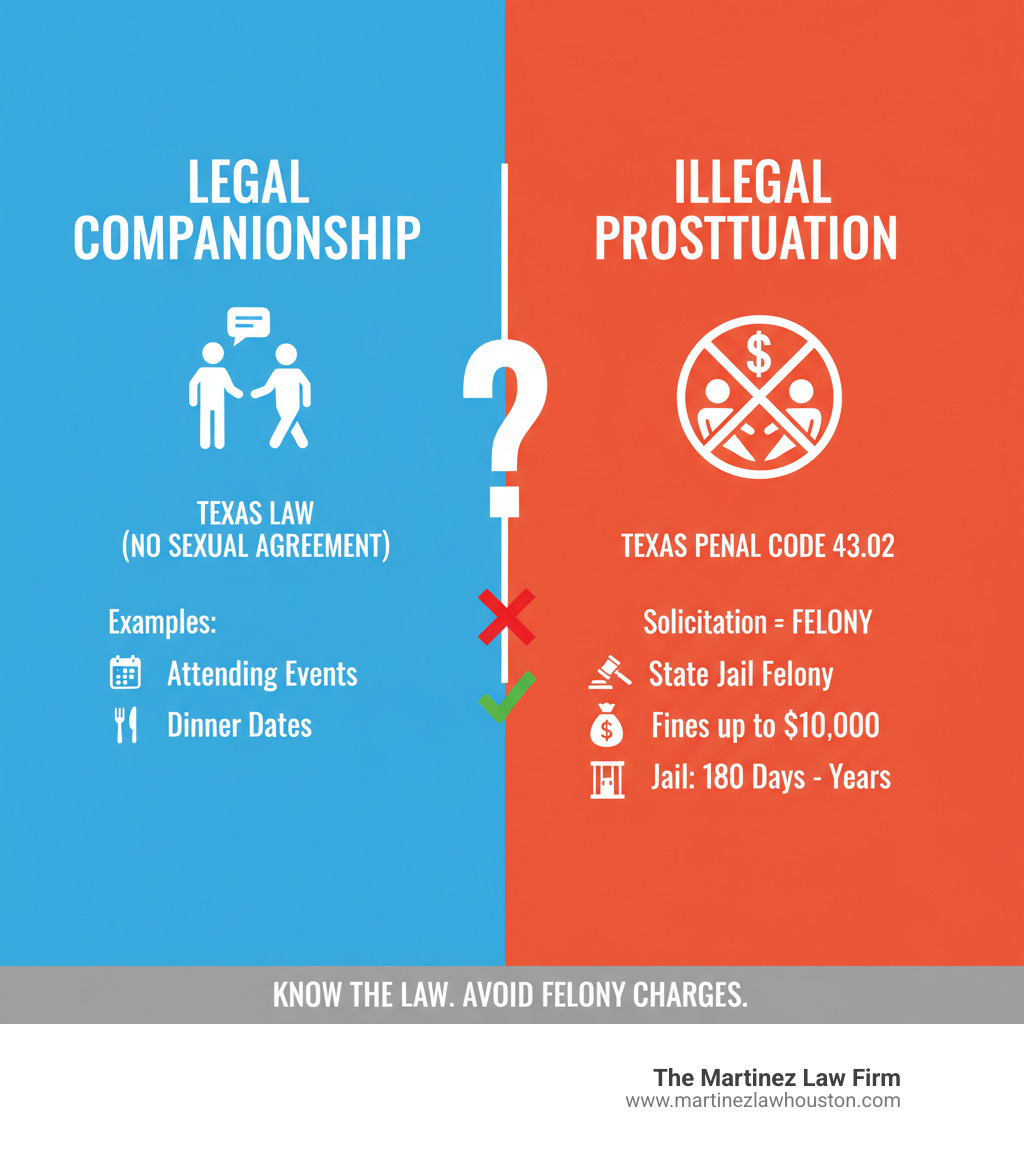
The Legal Line: Escorting vs. Prostitution in Texas
If you’re wondering are escorts legal, the answer hinges on what is being exchanged for money. In Texas, this distinction is the difference between a legal business transaction and a felony charge that could land you in jail.
Paying for time and companionship is legal. This includes hiring someone to attend a social event, a business dinner, or simply for conversation. A legal escort service operates as a companionship business, where the payment is strictly for the person’s time and presence, not for sexual acts. Clear boundaries and terms of service are essential.
Paying for sex is illegal. The moment money is exchanged with an agreement or understanding that sexual acts will occur, you have crossed into illegal prostitution. The intent and the agreement matter more than the act itself. Law enforcement doesn’t need to catch anyone in the act; they only need evidence of an agreement, which can be a text message, a recorded call, or an exchange with an undercover officer.
What is the Legal Definition of Prostitution in Texas?
Under Texas Penal Code § 43.02, prostitution occurs when someone knowingly offers or agrees to engage in sexual conduct for a fee. The crime is complete the moment the agreement is made.
- “Knowingly” means you understood what you were agreeing to.
- “Offer or agree to engage” is the key element. The act does not need to happen. This is why sting operations are so effective.
- “Sexual conduct” is broadly defined to include intercourse, oral sex, and other forms of sexual contact.
- “For a fee” includes cash, gifts, services, or anything of value exchanged for the promise of sexual conduct.
Both the person offering sex (prostitution) and the person offering to pay (solicitation) are breaking the law in Texas and face serious charges.
Are Escorts Legal in Houston, TX?
While Texas law applies statewide, the question are escorts legal in Houston comes with a warning: enforcement here is notoriously aggressive. The Houston Police Department and Harris County Sheriff’s Office actively hunt for violations, making the city a high-risk area for anyone involved in escort services.

Sophisticated sting operations are a constant threat. Officers pose as both clients and escorts, monitoring the websites, apps, and social media platforms where these services are advertised. They look for red flags like suggestive language, coded phrases (“GFE” or “full service”), or explicit photos.
Online communication is the primary evidence. What you believe is a private conversation could be a documented exchange with an undercover officer. Every text message, email, and chat log can be used to prove an illegal agreement was made. A simple “yes” to a leading question can be enough to lead to a felony charge, even if you never meet the person or exchange money.
The core of these investigations is to prove an agreement for sex in exchange for a fee. Undercover officers are trained to guide conversations toward this line. They may ask, “What does your rate include?” or “For an extra fee, can we make the night more memorable?” Agreeing to such a proposal, even vaguely, can be interpreted as committing the crime of solicitation. Your true intention of seeking non-sexual companionship becomes irrelevant if your words suggest otherwise. In Houston, you must assume every conversation with an escort service is being recorded by law enforcement.
Penalties for Solicitation and Prostitution in Houston
The consequences for crossing the line from legal escorting to illegal prostitution in Houston are severe. Texas law takes a particularly tough stance on those who buy sex. While offering sex (prostitution) may start as a misdemeanor, solicitation of prostitution—the act of buying sex—is a felony from the very first offense.

Under Texas Penal Code § 43.021, merely offering or agreeing to pay for sexual conduct can result in a felony charge. This reflects a deliberate policy to punish the demand side of prostitution, and Houston law enforcement enforces these laws aggressively.
What are the penalties for buying sex in Texas?
In 2021, Texas law (HB1540) made buying sex a felony, even for a first-time violation. If you are charged with solicitation of prostitution for the first time, you face a state jail felony, which includes:
- 180 days to 2 years in a state jail
- A fine of up to $10,000
- A permanent felony criminal record
Penalties escalate for subsequent offenses or if a minor is involved. The table below shows the stark difference in how Texas penalizes the seller versus the buyer.
| Offense Type | Charge Level | Jail Time | Maximum Fine |
|---|---|---|---|
| Prostitution (Offering/Agreeing to sell sex) | |||
| First Offense | Class B Misdemeanor | 3 – 180 days | $2,000 |
| Second Offense | Class A Misdemeanor | Up to 1 year | $4,000 |
| Third or Subsequent Offense | State Jail Felony | 180 days – 2 years | $10,000 |
| Soliciting Prostitution (Buying sex) | |||
| First Offense | State Jail Felony | 180 days – 2 years | $10,000 |
| Second Offense | Third-Degree Felony | 2 – 10 years | $10,000 |
| From someone under 18 | Second-Degree Felony | 2 – 20 years | $10,000 |
| Promoting Prostitution | |||
| General | Third-Degree Felony | 2 – 10 years | $10,000 |
| Of someone under 18 | First-Degree Felony | 5 – 99 years | $10,000 |
| Online Promotion of Prostitution | |||
| General | Third-Degree Felony | 2 – 10 years | $10,000 |
| Of someone under 18 | Second-Degree Felony | 2 – 20 years | $10,000 |
What are the potential legal consequences if an interaction crosses into prostitution?
Beyond jail time and fines, a solicitation conviction carries devastating lifelong consequences that can destroy your career, family, and future. These include:
- Public Arrest Record: Your name and mugshot become public, appearing in background checks and online searches.
- Reputational Damage: The stigma can ruin your standing in the community and strain personal relationships.
- Employment Consequences: A felony conviction can lead to immediate job termination and make it nearly impossible to find new work. It can also result in the loss of professional licenses (for doctors, lawyers, teachers, etc.).
- Vehicle Seizure: Law enforcement can seize any vehicle used to commit or facilitate the offense.
- Immigration Issues: Non-citizens may face deportation or denial of visas and citizenship applications.
- Financial Ruin: The combination of fines, legal fees, lost income, and court-mandated programs can be financially crippling.
Defending Against Solicitation Charges in Texas
Facing a solicitation charge in Houston is overwhelming, but an accusation is not a conviction. With the right legal strategy, it is possible to fight these charges and protect your future. The first and most critical step is to exercise your right to remain silent and ask for a lawyer. Do not try to explain the situation to the police; anything you say can be used against you.

As former prosecutors, we know how to find the weak points in the state’s case. A strong defense requires a meticulous review of all evidence, including police reports, recordings, and text logs. Common defense strategies include:
- Entrapment: This applies if law enforcement induced you to commit a crime you otherwise would not have. If an undercover officer used excessive pressure or coercion to get you to agree to sex for a fee, we can argue you were entrapped.
- Lack of Intent: The prosecution must prove you knowingly agreed to exchange a fee for sexual conduct. If your communication was ambiguous or genuinely focused on legal companionship, we can argue the required criminal intent was absent.
- Insufficient Evidence: We challenge the prosecution’s evidence at every turn. If text messages are vague, recordings are inaudible, or the state simply cannot prove its case beyond a reasonable doubt, the charges may be dismissed.
- Illegal Evidence Collection: If your constitutional rights were violated during the investigation or arrest, we can file a motion to suppress the illegally obtained evidence, potentially causing the prosecution’s case to collapse.
What legal advice should someone seek if facing charges?
If you are facing solicitation charges in Houston, contact an experienced criminal defense attorney immediately. The sooner we get involved, the more we can do to protect you. At The Martinez Law Firm, our unique advantage is Herman Martinez’s background as a Chief Prosecutor for the Harris County District Attorney’s Office. We know the prosecution’s playbook because we helped write it.
Our firm will:
- Immediately evaluate your case to find holes in the prosecution’s argument.
- Protect your rights and ensure you are not pressured into a bad plea deal.
- Develop a custom defense strategy aimed at the best possible outcome, whether that’s a dismissal, a favorable negotiation, or a trial.
- Steer the Harris County court system using our deep local knowledge of the judges and prosecutors.
Don’t face this alone. Let us put our insider experience to work for you.
Can an escort be charged with prostitution?
Yes. The term “escort” offers no legal protection. If a person offers or agrees to engage in sexual conduct for a fee, they can be charged with prostitution under Texas law. They face the same risks of misdemeanor and felony charges, a permanent criminal record, and the devastating collateral consequences that follow.
Furthermore, individuals involved in prostitution are often vulnerable to exploitation, violence, and human trafficking. Many are coerced or forced into this life. If you or someone you know is a victim of human trafficking, confidential help is available 24/7. Contact the National Human Trafficking Hotline at 1-888-373-7888.
Texas Escort Takeaways
The question are escorts legal in Texas has a dangerously complex answer. A thin line separates legal paid companionship from illegal prostitution, and crossing it—even through a single text message or misunderstood conversation—can lead to a felony charge.
We’ve seen it happen too many times: good people who thought they were acting legally suddenly face handcuffs and a ruined future. The consequences of a solicitation conviction in Houston are devastating: a permanent criminal record, jail time, massive fines, and destroyed careers and relationships. These charges can follow you for life.
Houston and Harris County law enforcement agencies are aggressive, using online surveillance and sting operations to build cases. The system is designed to get convictions, and navigating it without expert legal help is nearly impossible.
At The Martinez Law Firm, we leverage Herman Martinez’s experience as a former Chief Prosecutor for the Harris County District Attorney’s Office to our clients’ advantage. We know how these cases are built and, more importantly, how to take them apart. We use that insider knowledge to craft aggressive, personalized defenses that give our clients the best possible chance to protect their future.
If you are facing solicitation or prostitution charges, your next move is critical. Do not talk to the police. Your freedom, reputation, and future are on the line.
We are here to fight for you. For immediate, confidential help, Contact a Houston criminal defense attorney at The Martinez Law Firm today. Don’t face this alone—let us put our experience to work for you.
Understanding Your Real Risk of Jail Time in Texas
Is jail common for Texas drug possession? The short answer is yes. Jail time is a real possibility for any drug possession charge in Texas, even for first-time offenders with small amounts. However, whether you are actually incarcerated depends on several critical factors, including the type and amount of the drug, your criminal history, where the offense occurred, and the strength of your legal defense.
Texas classifies drugs into Penalty Groups, with Group 1 (cocaine, heroin, meth) carrying the harshest sentences. Even possessing less than one gram can result in a state jail felony, carrying 180 days to 2 years. As of August 2020, about 2,200 people were in Texas state jails for possessing such a small amount. With over 128,000 drug-related arrests in 2019, it’s clear that Texas maintains its reputation for strict drug enforcement.
I’m Herman Martinez, founder of The Martinez Law Firm. After more than 25 years as both a Chief Prosecutor for the Harris County District Attorney’s Office and now a criminal defense attorney, I’ve seen how these cases are prosecuted. My unique perspective from both sides of the courtroom provides insight into how prosecutors build their cases and where weaknesses exist that can help you avoid incarceration.
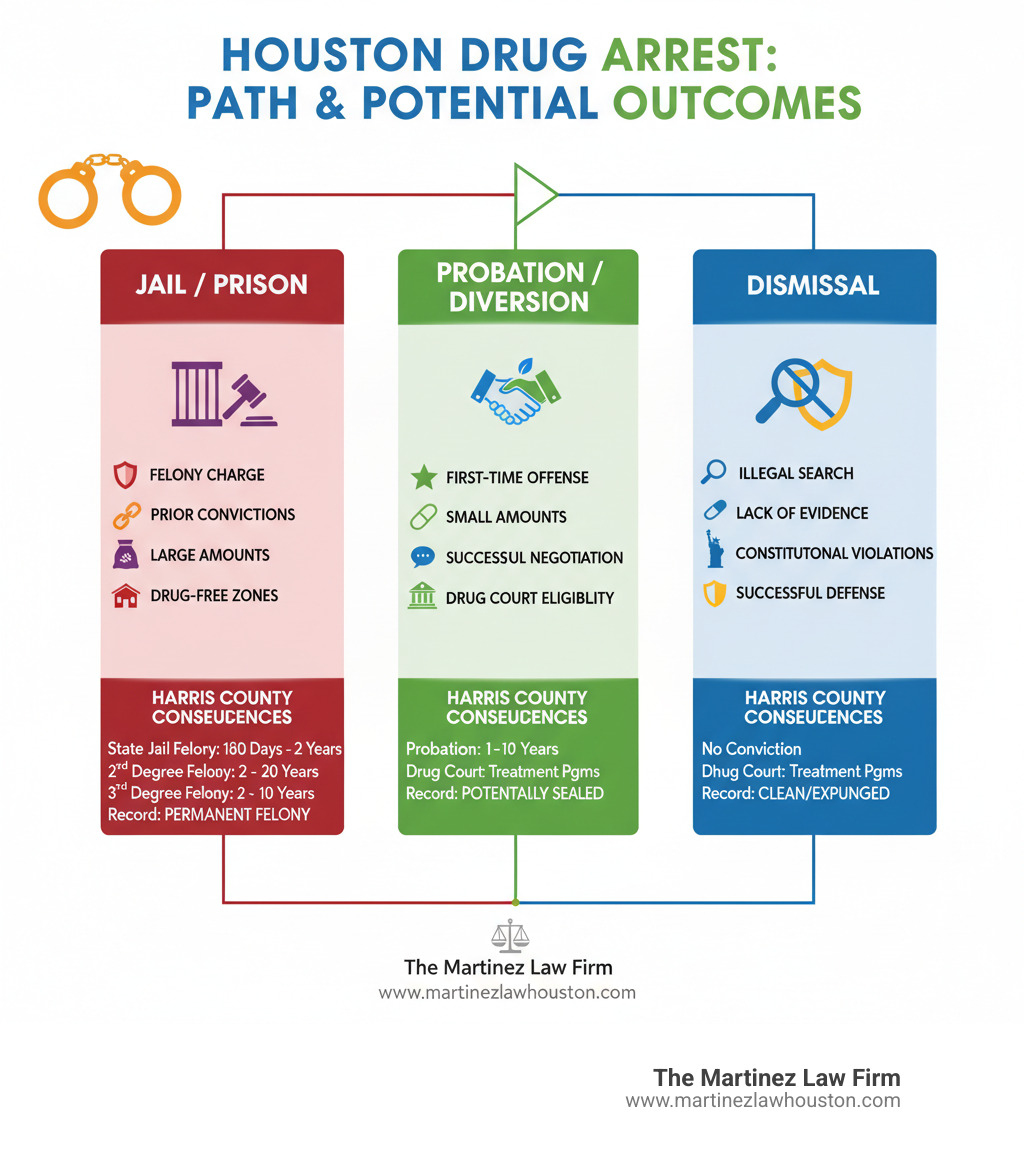
How Texas Classifies Drugs and Determines Penalties
To understand if is jail common for Texas drug possession, you must first know how Texas classifies drugs. The **Texas Controlled Substances Act** organizes drugs into Penalty Groups. This classification directly determines whether you face a misdemeanor or a felony and the potential length of your sentence.
For more details on specific substances, visit our page on controlled substances.
What are the different penalty groups for controlled substances in Texas?
Texas divides drugs into four main Penalty Groups, with marijuana treated separately. The lower the group number, the harsher the penalties.
- Penalty Group 1 (PG1): Includes cocaine, heroin, methamphetamine, and many opioids. Possession of any amount is a felony.
- Penalty Group 1A (PG1A): Reserved for LSD, which is measured in “units” instead of by weight.
- Penalty Group 1B (PG1B): A new category for fentanyl and its derivatives, reflecting the state’s aggressive stance in its War on Fentanyl.
- Penalty Group 2 (PG2): Covers hallucinogens like MDMA (ecstasy) and psychedelic mushrooms. Crucially, this group also includes THC concentrates like vape oils, edibles, and wax, meaning these products carry much harsher penalties than marijuana flower.
- Penalty Group 3 (PG3): Includes prescription drugs like Valium and Xanax when possessed without a valid prescription.
- Penalty Group 4 (PG4): Contains prescription mixtures with small amounts of narcotics, such as codeine-based cough syrups.
- Marijuana: Remains in its own category and is still illegal in Texas.
| Penalty Group | Example Drugs | Base Penalty Level (for small amounts) |
|---|---|---|
| PG 1 | Cocaine, Heroin, Methamphetamine, Opium | State Jail Felony |
| PG 1A | LSD (measured in units) | State Jail Felony |
| PG 1B | Fentanyl and its derivatives | State Jail Felony |
| PG 2 | MDMA (Ecstasy), PCP, Mescaline, Psychedelic Mushrooms, THC Concentrates | State Jail Felony |
| PG 2A | Synthetic Cannabinoids (Spice, K2) | Class B Misdemeanor |
| PG 3 | Valium, Xanax, Ritalin, Anabolic Steroids (without prescription) | Class A Misdemeanor |
| PG 4 | Prescription medications with small amounts of narcotics (e.g., codeine cough syrup) | Class B Misdemeanor |
| Marijuana | Marijuana plant (less than 2 oz) | Class B Misdemeanor |
How does the amount of a drug affect potential jail time?
The amount of a drug you possess is a critical factor. In Texas, even a microscopic “trace amount” of a PG1 drug can lead to a State Jail Felony charge, punishable by 180 days to 2 years in jail.
For Penalty Group 1, 1B, and 2 drugs (like cocaine, meth, fentanyl, and THC concentrates), the penalties escalate sharply with weight:
- Less than 1 gram: State Jail Felony (180 days – 2 years in state jail).
- 1 to 4 grams: Third-Degree Felony (2 – 10 years in prison).
- 4 to 200 grams: Second-Degree Felony (2 – 20 years in prison).
- 200 to 400 grams: First-Degree Felony (5 – 99 years or life in prison).
- Over 400 grams: Improved First-Degree Felony (10 – 99 years or life in prison).
These weight thresholds mean that a few extra grams can add years to a potential sentence. Prosecutors in Houston are known to weigh everything, including packaging, to push a case into a higher penalty range. Understanding the specific amount in your case is vital. For a detailed breakdown, see our guide on How Many Years in Jail for Drug Possession in Texas.
So, Is Jail Common for Texas Drug Possession?

So, is jail common for Texas drug possession? It absolutely is. Texas has a well-earned reputation for tough drug enforcement. In 2019, over 128,000 people were arrested for drug violations statewide, and thousands have been incarcerated for possessing less than a single gram of a controlled substance.
In Houston, prosecutors have significant discretion, and many pursue jail time, especially for substances in Penalty Group 1 or 2. Unlike in other states, Texas law does not guarantee leniency or diversion programs, even for first-time offenders or those caught with small amounts. Possessing a trace amount of cocaine can result in a State Jail Felony charge, carrying a potential sentence of 180 days to 2 years. Similarly, possessing prescription drugs like Xanax without a valid prescription can lead to serious charges and potential jail time.
If you’re facing charges in our area, learn more about what happens when you’re Arrested for Drug Possession in Houston.
What are the penalties for possessing marijuana in Texas?
While many states have legalized or decriminalized marijuana, Texas has not. Possession of less than 2 ounces of marijuana is a Class B Misdemeanor, punishable by up to 180 days in county jail and a $2,000 fine. As the amount increases, the penalties become more severe, escalating to a felony for amounts over 4 ounces.
The biggest surprise for many is the treatment of THC concentrates. Edibles, vape cartridges, wax, and dabs are not treated as marijuana. Instead, they fall under Penalty Group 2, alongside drugs like ecstasy. This means a single THC gummy or vape pen can lead to a State Jail Felony charge, with a potential sentence of 180 days to 2 years. Many people face felony charges without realizing the legal distinction.
For more on how these cases are handled, visit our page on Criminal Defense: Drug Crimes: Marijuana.
Can a first-time drug offense lead to jail time in Texas?
Yes, a first-time drug offense can absolutely lead to jail time in Texas. The law makes no automatic exception for first-time offenders. If you are caught with even a trace amount of a Penalty Group 1 drug like cocaine or heroin, you face a State Jail Felony charge and 180 days to 2 years in a state jail facility, regardless of your clean record.
However, being a first-time offender is a significant mitigating factor. It may make you eligible for diversion programs, probation, or deferred adjudication, which can help you avoid jail. These alternatives are not guaranteed and must be negotiated by a skilled attorney. Without an aggressive defense, you could end up serving time. Learn more about protecting yourself with our resource on First Time Drug Offense.
What Factors Can Increase the Likelihood of Jail?

While drug type and amount are primary factors, other circumstances can significantly increase your chances of incarceration. Understanding these aggravating factors is crucial.
- Prior Convictions: A criminal record, especially for previous drug offenses, leads to improved penalties. For habitual offenders with multiple prior felonies, sentences can be increased to decades or even life in prison.
- Intent to Distribute: Prosecutors can pursue delivery or manufacturing charges even without witnessing a sale. Evidence like large quantities of drugs, packaging materials (baggies, scales), large amounts of cash, or incriminating text messages can be used to prove intent. These charges carry far harsher penalties than simple possession. Learn more about Felony Drug Charges.
- Fentanyl: Due to the state’s War on Fentanyl, cases involving this substance are prosecuted with extreme aggression. Even trace amounts can lead to severe charges, including manufacturing or even murder if an overdose death occurs. For more on these complex charges, see our page on Criminal Defense: Drug Crimes: Manufacturing.
How do possession charges differ from manufacturing or delivery?
Simple possession is having a drug for personal use. Delivery is transferring a drug to someone else—no money needs to be exchanged. Simply sharing a pill with a friend can be legally considered delivery. Manufacturing involves producing, preparing, or packaging a drug, from running a meth lab to growing marijuana.
Prosecutors build these more serious cases using circumstantial evidence. They don’t need to see a sale happen. They use evidence like scales, baggies, and text messages to create a narrative of intent to distribute. In Houston, a simple traffic stop can quickly escalate to a manufacturing or delivery charge if officers find this type of evidence.
What are ‘drug-free zones’ and how do they impact sentencing in Houston?
Where you are arrested can be as important as the offense itself. Texas law creates “drug-free zones” that can double your potential sentence. The 1,000 feet rule applies to offenses committed within 1,000 feet (about three city blocks) of a:
- School or university
- Daycare or childcare facility
- Public park or playground
- Youth center or public swimming pool
In a dense urban area like Houston, it’s easy to be in a drug-free zone without knowing it. This penalty improvement can turn a probation-eligible offense into one with mandatory jail time. A State Jail Felony can be improved to a Third-Degree Felony, moving you from a state jail to a state prison for a much longer term. Challenging these improvements is a key defense strategy.
Are There Ways to Avoid Jail for Drug Possession in Houston?

Although jail is common for Texas drug possession, a charge does not automatically mean incarceration. Harris County offers several alternative pathways focused on rehabilitation rather than punishment. Having an experienced attorney who knows how to access these programs is key.
What alternative programs are available in Harris County?
Harris County has programs designed to keep non-violent drug offenders out of jail. These include:
- Pretrial Intervention (PTI): This program allows you to complete requirements like counseling and community service. Upon successful completion, your charges are dismissed, leaving you with no criminal record. Harris County has a progressive local policy on low-level marijuana cases that often uses diversion. Learn more about Pretrial Diversion in Houston.
- Drug Courts: These specialized courts offer a more intensive, supervised path for individuals with substance abuse issues. They combine treatment, testing, and judicial oversight. Successful completion can lead to reduced sentences or dismissal. The Texas Department of Criminal Justice provides more info on these effective programs.
- Deferred Adjudication: With this option, you are placed on probation. If you complete the terms successfully, the case is dismissed, and you avoid a final conviction. However, a violation can lead to serious consequences, as detailed on our Probation Violation page.
- Community Supervision (Probation): This allows you to serve your sentence in the community under supervision, instead of in jail.
Eligibility for these programs is not automatic and often depends on persuasive advocacy from your attorney.
How can an attorney help me avoid jail for a first-time drug offense?
An experienced attorney, especially one with a background as a prosecutor, can be your greatest asset. As a former Chief Prosecutor for the Harris County District Attorney’s Office, I know how the other side thinks and operates.
An effective defense involves:
- Negotiating with prosecutors: I speak their language and know what arguments are persuasive in securing alternatives to jail.
- Challenging evidence: We scrutinize every detail of your case, from the legality of the traffic stop to the chain of custody of the evidence. If police violated your rights, we file motions to suppress evidence, which can lead to a dismissal.
- Leveraging former prosecutor insight: My insider perspective allows us to anticipate the prosecution’s strategy and build a defense that proactively addresses their arguments.
- Advocating for diversion programs: We build a compelling case to show you are a good candidate for rehabilitation, not incarceration.
Our goal is always to achieve the best possible outcome, whether that’s a dismissal, a reduction of charges, or a favorable plea bargain that keeps you out of jail.
Understanding the Full Scope of a Texas Drug Conviction
A drug conviction in Texas extends far beyond jail time or probation. These “collateral consequences” can impact your life for years. While people ask “is jail common for Texas drug possession,” it’s crucial to understand the other penalties you’re fighting to avoid.
What are the potential consequences beyond jail time?
A drug conviction creates a permanent criminal record that can hinder your ability to find employment or housing. Other significant consequences include:
- Driver’s License Suspension: A drug conviction automatically triggers a license suspension of six months (for those over 21) or one year (for those under 21), regardless of whether a vehicle was involved. The state of Texas requires completing a drug education program for reinstatement.
- Professional License Revocation: Nurses, teachers, real estate agents, and other licensed professionals can have their licenses suspended or revoked.
- Financial Hardship: You face substantial fines (up to $10,000 for many felonies), court costs, and ineligibility for federal student loans and grants.
- Immigration Consequences: For non-citizens, a drug conviction can lead to deportation, denial of a visa or green card, and a permanent bar to citizenship.
- Loss of Civil Rights: A felony conviction means losing your right to vote until your sentence is complete and a permanent ban on owning firearms.
- Child Custody Issues: A conviction can be used against you in custody disputes, raising questions about your fitness as a parent.
How do Texas drug laws compare to federal laws or other states?
The vast majority of drug possession cases in Houston are prosecuted under Texas state law, which is significantly harsher than the laws in many other states. While some states have decriminalized or legalized marijuana, Texas continues to prosecute possession of even trace amounts of certain drugs as felonies.
This punitive stance comes at a high cost. A Texas Tribune report noted that Texas spends more on its prison system than any other state, with a large portion of inmates serving time for nonviolent drug offenses. The state spends millions annually incarcerating people for possessing small quantities of drugs.
While other states have shifted toward treatment-focused approaches, Texas has largely maintained its strict “tough on crime” stance. This makes aggressive legal representation in Houston not just beneficial, but essential.
Don’t Face a Houston Drug Charge Alone
You now know the answer to “is jail common for Texas drug possession” is a sobering yes. But a charge is not a conviction, and an arrest does not have to mean jail time. The outcome of your case depends on the specific facts and the strength of your legal defense.
My background as a former Chief Prosecutor for the Harris County District Attorney’s Office is your advantage. I know how prosecutors build cases, where their weaknesses lie, and how to negotiate effectively. The Martinez Law Firm uses this insider perspective to stay steps ahead of the prosecution.
We explore every avenue to protect your future, whether it’s fighting for a dismissal, negotiating for a diversion program, or challenging an illegal search. Your freedom and future are too important to leave to chance in the Texas justice system.
If you’re facing a drug possession charge in Houston, don’t wait. The sooner we start building your defense, the more options you will have. Contact The Martinez Law Firm today for a consultation. Let us fight to keep you out of jail and protect your future.
Why a Harris County DWI Arrest Demands Immediate Action
A Harris County DWI attorney can be the difference between a dismissal and a life-altering conviction. If you’ve been arrested for DWI in Harris County, you must act fast. Key facts to know:
- You have only 15 days from your arrest to request an Administrative License Revocation (ALR) hearing to fight for your driver’s license.
- A first-time DWI is a Class B misdemeanor (up to 180 days in jail, $2,000 fine), but it becomes a Class A misdemeanor if your BAC was .15 or higher (up to 1 year in jail, $4,000 fine).
- An arrest is not a conviction. Prosecutors must prove guilt beyond a reasonable doubt, and skilled defense attorneys know how to challenge the evidence.
- Collateral consequences include license suspension, ignition interlock devices, insurance hikes, and employment issues.
Facing a first DWI is overwhelming. With 23,075 DWI arrests in Harris County in 2022, it’s a common but serious charge. Texas law enforcement and prosecutors are aggressive, and they begin building their case against you immediately. The clock is ticking on critical deadlines, especially the 15-day window to save your license.
I’m Herman Martinez, founder of The Martinez Law Firm. As a former Chief Prosecutor for the Harris County District Attorney’s Office with over 25 years of experience, I’ve handled DWI cases from both sides. This perspective as a Harris County DWI attorney allows me to anticipate prosecution strategies and build aggressive defenses to protect my clients’ futures.
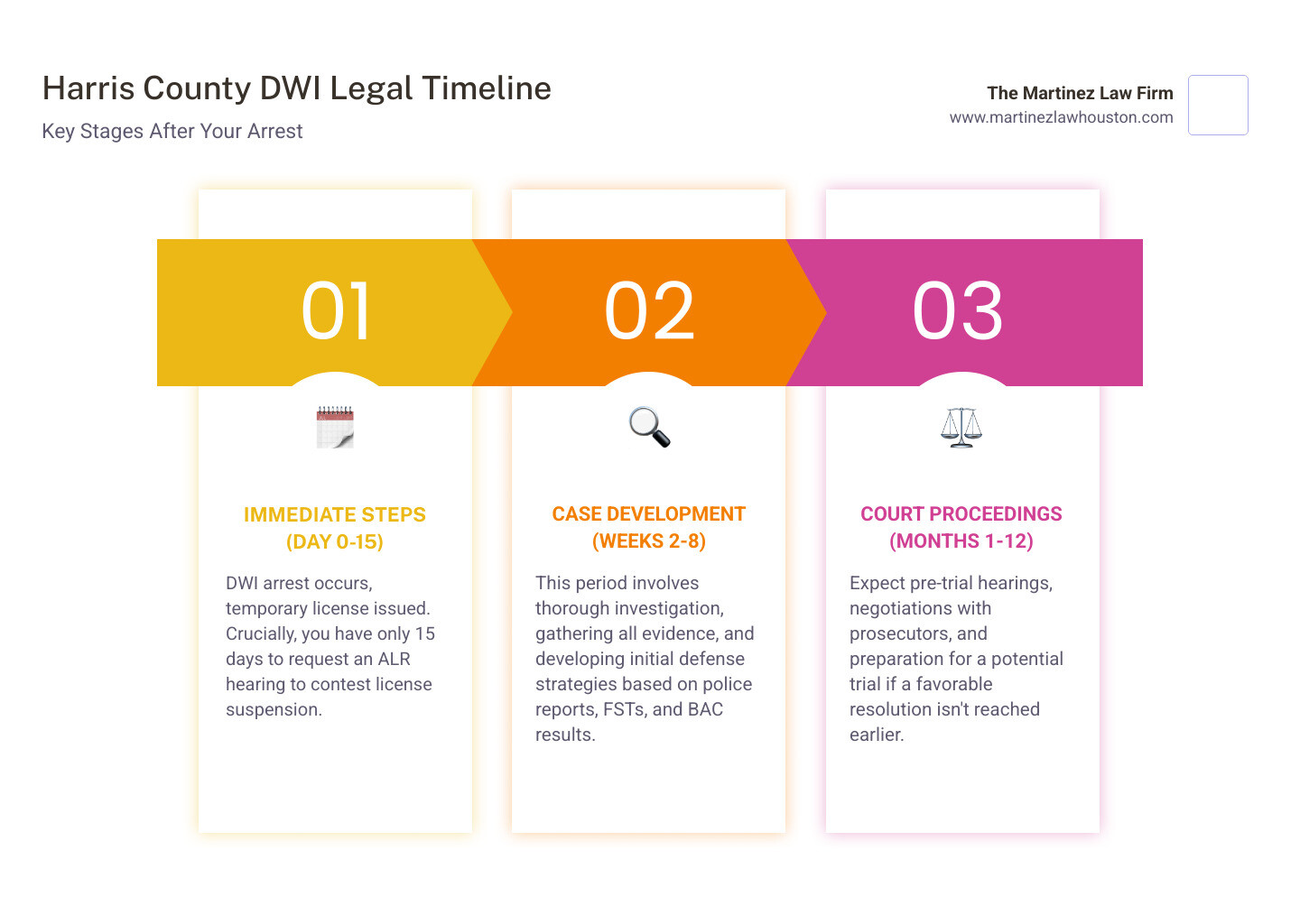
Understanding Your DWI Charge in Harris County
If you’re facing a DWI charge in Harris County, understanding the law is the first step toward protecting yourself. Let me break down what Texas law says about DWI charges.
Under Texas Penal Code § 49.04(a), a DWI occurs when you are intoxicated while operating a motor vehicle in a public place. But “intoxicated” has two legal definitions under Texas Penal Code § 49.01(2): not having the normal use of your mental or physical faculties, or having a Blood Alcohol Concentration (BAC) of 0.08 or higher.
This means you can be charged even if your BAC is below 0.08, based on an officer’s subjective opinion that you’ve lost the normal use of your faculties. As a Harris County DWI attorney who has prosecuted and defended these cases, I know this subjective element is often a key area to challenge.
Furthermore, “operating” can mean just being in physical control of the vehicle, not necessarily driving down the road. I’ve seen cases where someone sleeping in a parked car with the keys in the ignition faced DWI charges. The most important thing to remember is that an arrest is not a conviction. The state must prove its case beyond a reasonable doubt.
What are the Penalties for a First-Time DWI?
A first DWI arrest is a serious matter with significant penalties. A first-time offense is typically a Class B misdemeanor, but certain circumstances can lift it to a Class A misdemeanor with much harsher consequences.
| Offense Classification | Maximum Jail Time | Maximum Fine | Minimum Driver’s License Suspension | Other Penalties |
|---|---|---|---|---|
| Class B Misdemeanor | 180 days | $2,000 | 90 days – 1 year | Annual DPS Surcharges ($1,000 for 3 years), Ignition Interlock Device (IID) possible, community service, DWI education programs |
| Class A Misdemeanor | 1 year (365 days) | $4,000 | 90 days – 2 years | Annual DPS Surcharges ($1,500-$2,000 for 3 years), Mandatory IID, community service, DWI education programs, more extensive probation |
The jail time and fines are just the start. A conviction triggers an automatic driver’s license suspension and costly annual DPS Driver Responsibility Surcharges for three years. In Houston, where a car is essential, losing your license can disrupt your entire life. That’s why we fight so hard to protect your driving privileges.
How Your BAC Level Impacts the Charge
Your BAC reading significantly impacts the charge. While 0.08 is the legal threshold, where your BAC falls above that line matters.
If your BAC is between 0.08 and 0.14, a first offense is typically a Class B misdemeanor. This is the most common scenario I see in Harris County.
But if your BAC is 0.15 or higher, the charge is automatically improved to a Class A misdemeanor. This means you face up to a full year in jail and a $4,000 fine. The difference between 0.14 and 0.15 might seem small, but it doubles your potential penalties. It’s also worth noting the ongoing national debate on lowering BAC limits to 0.05, showing that DWI laws remain a focus of strict enforcement.
What if There Was an Open Container?
Imagine being pulled over and an officer sees an open beer can in your car. That open container just made your situation much worse.

Under Texas’s open container law, a first-time DWI with an open alcoholic beverage in your immediate possession increases the minimum jail sentence from 72 hours to six days. While still a Class B misdemeanor, this mandatory minimum jail time limits a judge’s discretion and presents new challenges for your Harris County DWI attorney.
Why You Need an Experienced Harris County DWI Attorney Immediately
If you’ve been arrested for DWI in Harris County, waiting to act is a costly mistake. The clock on your case started the moment of your arrest.

The most urgent deadline is the 15-day window to request an Administrative License Revocation (ALR) hearing. If you miss it, your driver’s license will be automatically suspended 40 days after your arrest, regardless of your criminal case’s outcome. In a city like Houston, losing your license can mean losing your job.
Beyond the deadline, evidence disappears, witness memories fade, and surveillance footage is erased. The sooner an experienced Harris County DWI attorney is involved, the better we can preserve evidence and protect your rights. Police and prosecutors are already building their case. You need an advocate who can challenge their evidence and procedures.
At The Martinez Law Firm, we bring a unique advantage to your defense. As a former Chief Prosecutor for the Harris County District Attorney’s Office, I know their strategies and weak points. This insider perspective allows us to build a defense that’s several steps ahead.
An Arrest is Not a Conviction: How a Lawyer Can Fight for You
Let me be clear: an arrest is not a conviction. Many people assume a charge means their fate is sealed, but that’s not true. The prosecutor must prove every element of the case beyond a reasonable doubt—the highest legal standard.
Our job is to create that doubt. Every DWI case has potential vulnerabilities. Was the traffic stop legal? Were field sobriety tests administered incorrectly? Was the breathalyzer calibrated? We scrutinize every detail—police reports, video footage, lab results—to find inconsistencies, procedural errors, and constitutional violations.
These findings are how we win cases. In Harris County, public records show many DWI cases end in not guilty verdicts or dismissals when a defense attorney successfully challenges the evidence. We negotiate aggressively with prosecutors for dismissals or reduced charges, and we are always prepared to go to trial if it’s your best option.
What a Top Harris County DWI Attorney Investigates
Building a strong defense means a thorough investigation. Here are critical areas where errors often occur:
The traffic stop itself is the first place we look. Police need reasonable suspicion for a stop. If their reason is invalid, any evidence gathered afterward could be thrown out.
Field sobriety tests are notoriously unreliable and have strict administration guidelines. We examine every factor—from the road surface to your health—that could invalidate the results.
Breathalyzer machines aren’t infallible. These devices require proper calibration and operation. We investigate maintenance records and potential errors, as medical conditions or even mouthwash can cause false high readings.
When it comes to blood draws, the rules are even stricter. We verify if a warrant was obtained, if the phlebotomist was qualified, and if proper sterilization procedures were followed.
Chain of custody is crucial for all samples. We demand a complete, unbroken chain of custody to ensure the evidence wasn’t contaminated or tampered with.
Finally, we compare police reports against video evidence. Discrepancies between the officer’s report and the video can undermine the officer’s credibility and the prosecution’s case.
This level of investigation is why hiring an experienced Harris County DWI attorney from day one is so critical. The sooner we start, the stronger your defense becomes.
Beyond the Courtroom: Collateral Consequences of a DWI
The penalties for a DWI conviction extend far beyond the courtroom. These collateral consequences can reshape your life long after your case is closed, as detailed by TxDOT’s overview of criminal and administrative penalties.
One of the first is the Ignition Interlock Device (IID). You may be ordered to install this device in your car at your own expense, requiring you to provide a breath sample before the vehicle will start. This is a constant financial and personal burden.
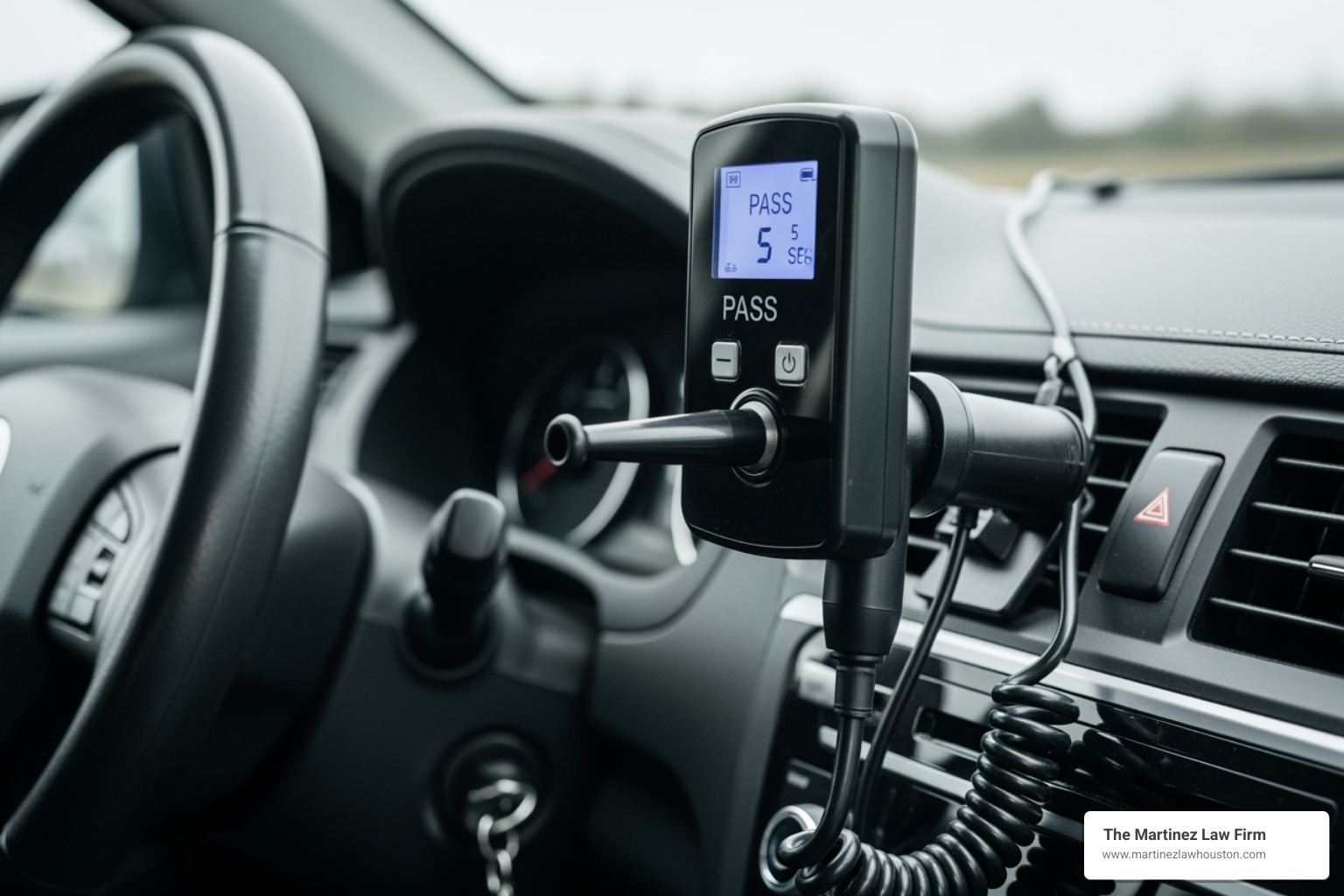
Your insurance rates will skyrocket. A DWI conviction labels you a high-risk driver, often doubling or tripling your premiums for years. Some insurers in the Houston area may drop you completely.
A DWI can threaten your career, especially if you hold a professional license. Professional license risks are serious for nurses, teachers, and others who face disciplinary action, including suspension or revocation of their license.
Employment background checks are now standard. A DWI conviction on your permanent record can limit job opportunities, as many companies are hesitant to hire individuals with a criminal history.
For parents, a DWI can have devastating child custody implications. A conviction can be used in Harris County family courts to argue for reduced custody or supervised visitation.
Finally, a DWI can lead to travel restrictions, as countries like Canada may deny entry to individuals with a criminal record.
These consequences can be more damaging than the initial penalties. As your Harris County DWI attorney, we fight to protect your entire future from these far-reaching effects.
Frequently Asked Questions about Harris County DWI Cases
If you’re facing a DWI charge in Harris County, you likely have many questions. Let’s walk through some of the most common concerns we hear from clients in Houston.
What is an ALR Hearing and Why is it So Urgent?
Your driver’s license is at risk immediately after a DWI arrest, completely separate from your criminal case. This is where the Administrative License Revocation (ALR) hearing is crucial.
You have exactly 15 days from your arrest date to request an ALR hearing. If you miss this deadline, your license is automatically suspended on the 40th day after your arrest—even if your criminal case is later dismissed. The ALR process is independent of the criminal court.
The ALR hearing is your chance to contest your license suspension. Your Harris County DWI attorney can challenge whether the officer had probable cause to stop and arrest you and question the validity of any tests. This 15-day deadline is a primary reason to contact an attorney immediately after an arrest.
Can I Refuse a Breathalyzer or Blood Test in Texas?
Yes, you can refuse a breath or blood test, but Texas’s “implied consent” law means there are automatic consequences. When you get a Texas driver’s license, you agree to provide a sample if lawfully arrested for DWI.
Refusing results in an automatic license suspension—180 days for a first refusal—which is longer than for a failed test. This suspension happens regardless of the DWI case outcome.
Furthermore, Harris County officers can—and often do—obtain a search warrant to compel a blood draw. So, you could face the automatic suspension and have blood evidence used against you. While refusal can sometimes be strategic, it’s a complex decision with immediate penalties. If you’ve already refused, don’t panic—we can still build a strong defense.
How can a Harris County DWI attorney help if I’m a first-time offender?
If this is your first offense, you may have more options available to you. The Harris County District Attorney’s office offers diversion programs for some first-time DWI offenders. Successful completion can lead to a case dismissal, leaving you with no conviction on your record.
An experienced attorney can also work to negotiate reduced charges or favorable probation terms that fit your life. As a former prosecutor, I understand how the Harris County DA’s office operates, which is a significant advantage in these negotiations.
Most importantly, we work to protect your future. A DWI conviction creates a permanent criminal record that affects jobs, housing, and insurance for years. Our goal is to minimize these long-term consequences through dismissal, acquittal, or strategic sentencing. We also guide you through the confusing legal process, ensuring you understand your options at every step.
Secure Your Defense and Protect Your Future
A DWI charge in Harris County is overwhelming, with serious penalties and consequences that can affect your job, family, and future. But remember this critical fact: an arrest is not a conviction. You have rights that deserve a powerful defense.
A strong defense is about protecting the life you’ve built. The decisions you make in the hours and days after your arrest are critical, which is why having an experienced Harris County DWI attorney is essential.
At The Martinez Law Firm in Houston, we understand what’s at stake. Herman Martinez’s experience as a former Chief Prosecutor for the Harris County District Attorney’s Office gives us unique insight into how the prosecution works—and where their cases fail. This is a powerful advantage for our clients.
Our approach is aggressive, strategic, and personalized. We challenge the evidence, scrutinize procedures, and fight for your rights. Don’t steer the Harris County legal system alone. Take the first step in your defense by contacting us today for a free, confidential consultation. We are ready to fight for you.
Why Understanding How to Beat a Domestic Assault Charge is Critical for Your Future
Understanding how to beat a domestic assault charge in Houston requires a strategic defense. The consequences of a conviction are severe, affecting your firearm rights, employment, child custody, and immigration status. Harris County prosecutors pursue these cases aggressively, often even when the alleged victim wants to drop the charges.
Key strategies for your defense include:
- Challenging the Evidence: Finding inconsistencies in statements and a lack of physical proof.
- Asserting Legal Defenses: Arguing self-defense, false allegations, or lack of intent.
- Negotiating with Prosecutors: Using weak evidence to seek a dismissal or reduced charge.
- Taking Proactive Steps: Enrolling in counseling or BIPP to show initiative.
- Hiring an Experienced Attorney: A former prosecutor knows how to dismantle the state’s case.
A charge is not a conviction. The prosecution has the burden of proof, and a skilled defense attorney can expose weaknesses in their case. There are multiple paths to a successful outcome, from proving self-defense to showing that the allegations were fabricated.
I’m Herman Martinez, founder of The Martinez Law Firm. With over 25 years of experience, including time as a Chief Prosecutor for the Harris County District Attorney’s Office, I have a unique insider’s perspective. My background as a former prosecutor and judge allows me to identify and exploit vulnerabilities in the state’s strategy, giving you a critical advantage.

Understanding Domestic Assault Charges in Houston
If you’ve been arrested for domestic assault in Houston, it’s crucial to understand the charge. In Texas, it’s officially Assault Family Violence under Texas Penal Code Section 22.01. The key distinction is your relationship with the alleged victim, which triggers mandatory arrest policies, harsh penalties, and lasting consequences.
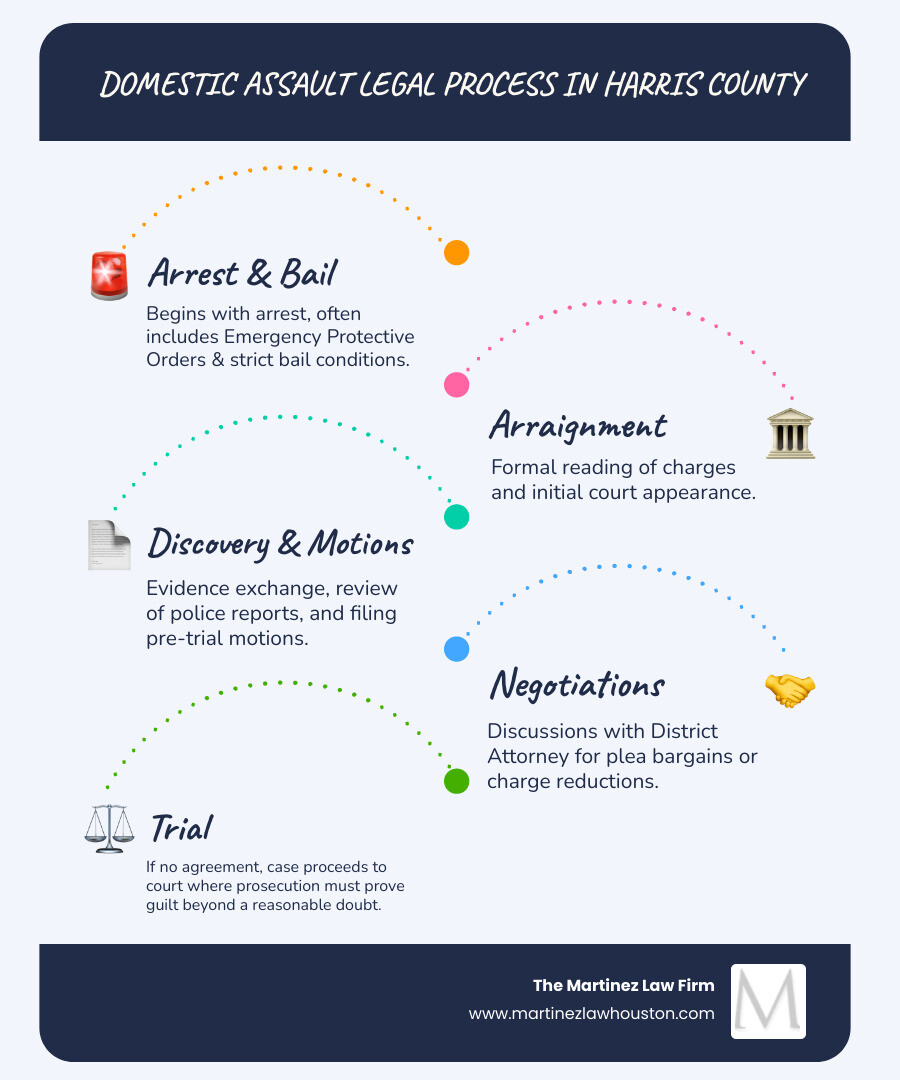
Once arrested in Harris County, you’ll likely face an Emergency Protective Order (EPO) and strict bail conditions. The case then moves through arraignment and negotiations with the District Attorney’s office. The prosecution must prove guilt beyond a reasonable doubt, which is where a strong defense strategy becomes essential.
Aggravating factors can lift a misdemeanor to a felony. An allegation of strangulation or choking results in an automatic felony charge. A prior family violence conviction also improves the charge to a felony, even if the new incident is minor. Furthermore, Continuous Violence Against the Family—two or more incidents in a 12-month period—can lead to a mandatory prison sentence, even without prior convictions.
What Constitutes Domestic Assault in Texas?
Under Texas law, domestic assault occurs if you:
- Intentionally, knowingly, or recklessly cause bodily injury to a family member, household member, or dating partner. “Bodily injury” can be as minor as pain or redness.
- Intentionally or knowingly threaten someone with imminent bodily injury. No physical contact is required.
- Intentionally or knowingly cause physical contact that the other person would find offensive, such as unwanted touching or shoving.
The relationship is what lifts a simple assault to Assault Family Violence. This includes blood relatives, spouses, household members, and individuals in a continuing romantic or intimate relationship.
Potential Penalties for a Conviction
The consequences of a domestic assault conviction in Houston are life-altering. A first-time offense is typically a Class A Misdemeanor, punishable by up to one year in jail and a $4,000 fine. With aggravating factors like strangulation or a prior conviction, it becomes a Third-Degree Felony, carrying 2 to 10 years in prison and a $10,000 fine.
Beyond jail time, a conviction leads to:
- Protective Orders: Long-term orders restricting contact and access to your home.
- Loss of Firearm Rights: A lifetime federal ban on owning guns, even for a misdemeanor conviction.
- Child Custody Issues: A conviction can lead to supervised visitation or loss of custody.
- Immigration Problems: Non-citizens face deportation and inadmissibility for green cards or citizenship.
- Employment and Housing Barriers: The conviction appears on background checks, making it difficult to find jobs and housing.
These are not just possibilities; they are common outcomes. Building a strong defense from day one is critical to protecting your future.
How to Beat a Domestic Assault Charge in Texas
If you’re wondering how to beat a domestic assault charge, know this: the alleged victim does not control the case. The Harris County District Attorney’s Office has the final say and often operates under a “no-drop” policy, pursuing charges even if the victim recants.
However, prosecutors must have a strong case to secure a conviction. An experienced defense attorney can expose weaknesses and negotiate for a dismissal. Prosecutors may drop charges if:
- The evidence is weak from the start (e.g., no visible injuries, no independent witnesses).
- The alleged victim’s statements are inconsistent.
- There is no corroborating physical evidence.
- The alleged victim provides an Affidavit of Non-Prosecution, stating they do not wish to proceed.
- The alleged victim refuses to cooperate, leaving the state without its key witness.
As a former Chief Prosecutor, I know how the DA’s office evaluates cases and what arguments persuade them to dismiss or reduce charges.
Common Legal Defenses to Beat a Domestic Assault Charge
The right defense depends on the facts of your case. Common strategies include:
- Self-Defense: Texas law allows you to use reasonable force to protect yourself, another person, or your property from imminent harm. We must show you had a reasonable belief that force was necessary. The Texas Rules of Evidence guide how we present this defense.
- False Allegations: Accusations are sometimes fabricated out of revenge or to gain leverage in a divorce or custody battle. We investigate the accuser’s motives, search for inconsistencies, and examine texts, emails, and social media for proof.
- Lack of Intent: The contact was accidental. Since assault requires an intentional, knowing, or reckless act, an accident is a complete defense.
- Mistaken Identity / Alibi: You were not there. We use surveillance footage, receipts, and witness testimony to prove you were elsewhere.
Proactive Steps to Help Beat a Domestic Assault Charge

Taking proactive steps while your case is pending can significantly influence the outcome. These actions show prosecutors and judges that you are taking the situation seriously.
- Enroll in Counseling: Voluntarily starting a Batterer’s Intervention and Prevention Program (BIPP), anger management, or substance abuse counseling demonstrates responsibility and a commitment to change.
- Consider Pre-Trial Intervention: For some first-time offenders, these programs offer a path to dismissal upon successful completion.
- Gather Your Evidence: Save all relevant text messages, emails, and social media posts. Get contact information for any witnesses who can support your side of the story.
When presented strategically by your attorney, these proactive measures become powerful negotiating tools that can lead to a more favorable resolution.
Immediate Steps to Take After an Arrest
Getting arrested for domestic assault in Houston can feel like your world is crashing down. The actions you take in those first hours can make or break your ability to beat a domestic assault charge.
Your right to remain silent is your lifeline. Police are building a case against you. Anything you say can be twisted and used in court. The only words you should say are, “I wish to remain silent and I want to speak to my lawyer.” Then, say nothing more.
Do not resist arrest, even if the charges are false. Resisting leads to a separate criminal charge that complicates your defense. Cooperate physically while remaining silent.
After release, you must strictly follow all bail conditions, including any Emergency Protective Order (EPO). Violating these orders will lead to re-arrest and make your case much harder to defend.
Finally, begin preserving evidence. Write down everything you remember, photograph any injuries you sustained, and save all relevant texts, emails, and call logs. This information is vital for building your defense.
Navigating Bail Conditions and No-Contact Orders

Bail conditions and no-contact orders in Houston domestic assault cases are strict, and violations have severe consequences. You must understand and follow them perfectly.
“Any contact” means exactly that. No calls, texts, emails, social media messages, or showing up at the alleged victim’s home or work. You cannot use children or third parties to pass messages. Indirect contact, like asking a friend to deliver a letter, is a violation.
If you share a home, you must move out immediately. Violating a protective order is a new crime. You will be re-arrested, your bond will be revoked, and you will likely remain in jail until your trial. Prosecutors use violations as proof that you are a continuing threat, which destroys any chance of a favorable negotiation.
Review every condition with your attorney. If you have any questions about what is and isn’t allowed, call your lawyer before you act. A five-minute call can prevent a mistake that could ruin your defense.
The Crucial Role of an Experienced Defense Lawyer
When you’re facing a domestic assault charge in Houston, hiring an experienced criminal defense lawyer is essential. The legal system is complicated, and the consequences of a conviction are too severe to face alone.
At The Martinez Law Firm, we offer a unique advantage: Herman Martinez’s 25+ years of experience, including his time as a Chief Prosecutor for the Harris County District Attorney’s Office. This insider’s perspective means we know the prosecution’s playbook—how they build cases and where their arguments are weakest. We use this knowledge to anticipate their strategy and build a defense designed to counter it.
Our work starts with a deep dive into the state’s evidence. We scrutinize police reports, witness statements, 911 calls, and bodycam footage, searching for inconsistencies and constitutional violations. We analyze all evidence to find weaknesses that can help us beat a domestic assault charge.
Armed with this information, we negotiate with the District Attorney’s office. Our former prosecutor experience allows us to speak their language and present compelling legal arguments for why charges should be dismissed or reduced. Our goal is always to avoid a conviction. If a trial is necessary, we are fully prepared to fight for you in court.
How a Lawyer Challenges the Prosecution’s Case
A skilled defense attorney uses multiple tools to dismantle the state’s case and create reasonable doubt.
- Filing Pre-Trial Motions: We file motions to suppress evidence obtained through illegal searches or coerced statements. Getting key evidence thrown out can cripple the prosecution’s case.
- Challenging Witness Credibility: During cross-examination, we expose inconsistencies in testimony and highlight potential biases or motives for the accuser to lie, such as a pending custody battle.
- Presenting Defense Evidence: We don’t just poke holes in the state’s case; we build our own. We present texts, emails, alibi witnesses, and other evidence that supports your side of the story and contradicts the allegations.
- Arguing Legal Defenses: We persuasively argue defenses like self-defense, false allegations, or lack of intent, using Texas law and case precedent to support our position.
By aggressively challenging every aspect of the prosecution’s case, we provide the best possible chance of a successful outcome.
Long-Term Consequences of a Domestic Assault Conviction
A domestic assault conviction has consequences that last a lifetime, affecting far more than just your freedom.

Your criminal record becomes a permanent barrier. In Texas, this conviction appears on background checks indefinitely, creating significant problems in many areas of your life.
- Employment and Professional Licenses: Many employers in Houston will not hire someone with a domestic violence conviction. Professional licenses for careers in medicine, law, and education can be suspended or revoked.
- Housing: Landlords often deny rental applications based on a conviction for a violent crime, making it difficult to find a place to live.
- Firearm Rights: Under federal law, a conviction—even for a misdemeanor—results in a lifetime ban on owning or possessing firearms.
- Family and Immigration: A conviction can be used against you in child custody battles, potentially leading to supervised visitation or loss of parental rights. For non-citizens, it can trigger deportation and prevent you from obtaining a green card or citizenship.
These are not minor inconveniences; they are life-altering consequences. This is why understanding how to beat a domestic assault charge is so critical. Our goal is not just to keep you out of jail but to protect your entire future.
Frequently Asked Questions about Beating a Domestic Assault Charge
When you’re facing a domestic assault charge in Houston, you likely have urgent questions. We’ve been helping people in your situation for over 25 years, and we know the concerns that keep you up at night. Here are answers to the most common questions we hear from clients.
Can domestic assault charges be dropped if the victim doesn’t want to press charges?
No, not automatically. The decision to drop charges belongs to the prosecutor (District Attorney), not the alleged victim. The Harris County DA’s office often pursues these cases under a “no-drop” policy, even if the victim recants.
However, the victim’s wishes are still influential. An Affidavit of Non-Prosecution, a sworn statement from the victim explaining their desire not to pursue the case, can be a powerful negotiating tool for your attorney. If the state’s case is weak without the victim’s testimony, a skilled lawyer can often leverage this to get the charges dismissed or reduced.
What is a protective order and how does it work?
A protective order is a civil court order designed to prevent future family violence. A judge can issue one for up to two years if they find that violence has occurred and is likely to happen again.
These orders typically prohibit you from contacting, harassing, or going near the victim, their home, or their workplace. They also require you to surrender any firearms for the duration of the order. Violating a protective order is a separate criminal offense. It does not matter if the victim initiated contact. Any violation can lead to your immediate arrest, new charges, and revocation of your bond, severely damaging your defense in the original case.
Is it possible to get a domestic assault charge expunged from my record in Texas?
This is very difficult. In Texas, a conviction for domestic assault generally cannot be expunged or sealed, even if you receive deferred adjudication. The law treats these offenses with unique severity.
The only reliable way to be eligible for an expunction—which completely erases the arrest record—is if your case is dismissed by the prosecutor or you are acquitted at trial (found not guilty). This is why fighting the charge from the beginning is so crucial. A conviction creates a permanent record that will affect jobs, housing, and your right to own a firearm. Our primary goal is to avoid that conviction to keep your record clear.
Secure Your Future with a Strong Defense
A domestic assault charge in Houston threatens your career, family, and freedom. While the situation is serious, a charge is not a conviction. The prosecution must prove its case beyond a reasonable doubt, and a strong defense can make all the difference.
Understanding how to beat a domestic assault charge starts with hiring the right legal team. At The Martinez Law Firm, Herman Martinez’s experience as a former Chief Prosecutor for Harris County gives us an unparalleled insider’s perspective. We know how to find the weaknesses in the state’s case and fight for the best possible outcome.
Don’t let this charge define your future. The sooner you act, the more we can do to protect your rights. With an aggressive, knowledgeable defense, you can fight back and work toward securing your freedom.
Contact a Houston domestic violence lawyer to build your defense strategy and take the first step toward protecting your future.
What is Public Intoxication in Texas?

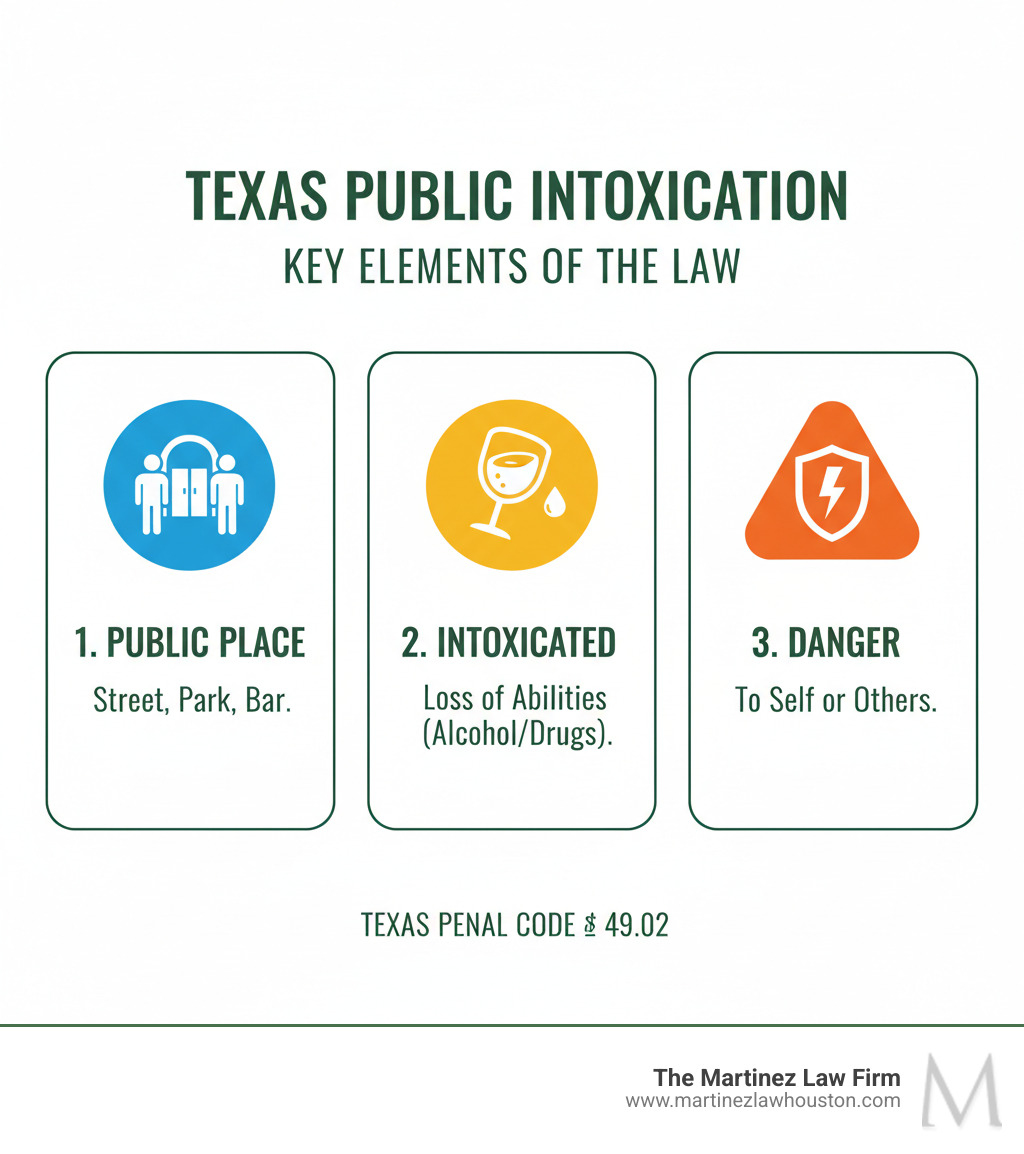
In Texas, a Public intoxication charge has three key legal requirements:
- Public Place: You must be in a place accessible to the public, such as a street, park, or bar.
- Intoxicated: You must be under the influence of alcohol or other substances, losing your normal mental or physical abilities.
- Danger: Your intoxication must make you a danger to yourself or others.
A night out in Houston can turn stressful if it ends with a Public intoxication Texas charge. This charge isn’t just about drinking too much; it’s about how your actions are perceived in public. An arrest can affect your future, job, and peace of mind, so knowing your rights is key.
I’m Herman Martinez. As a former Chief Prosecutor for the Harris County District Attorney’s Office and a City of Houston Judge, I have unique insight into Public intoxication Texas cases. I provide aggressive legal defense to help clients steer the criminal justice system.
What Constitutes Public Intoxication Under Texas Law?
Understanding Public intoxication Texas law is crucial. The charge is defined in Texas Penal Code § 49.02, which focuses on your actions and presence in public while under the influence.
The law states a person commits an offense if they “appear in a public place while intoxicated to the degree that the person may endanger the person or another.” To secure a conviction, the state must prove three elements beyond a reasonable doubt:
- You were in a “public place.”
- You were “intoxicated.”
- Your intoxication made you a “danger” to yourself or to others.
An arresting officer’s judgment is not the final word; a jury must be convinced the state has met its burden of proof. Understanding these elements is the first step in protecting your rights. For a deep dive into the official legal text, you can review the complete statute here: Read this complete Texas Penal Code – PENAL § 49.02. Public Intoxication on Westlaw.
What Qualifies as a “Public Place”?
The term “public place” is broader than you might think. Texas law defines it as “any place to which the public or a substantial group of the public has access,” which includes many locations in Houston and Harris County.
This includes obvious places like streets and sidewalks, but also highways, parking lots, bars, restaurants, and nightclubs. Even the common areas of apartment complexes can qualify. The law specifically notes that any place licensed under the Alcoholic Beverage Code is a public place. The key is public access, not ownership.
How is “Intoxication” Determined?
For a Public intoxication Texas charge, the legal definition of “intoxicated” relies heavily on observation. It means:
- Not having the normal use of your mental or physical faculties due to alcohol, drugs, or a combination of substances.
- Having an alcohol concentration of 0.08 or more.
For a PI charge, the first definition is what matters. Unlike a DWI, an officer doesn’t need a breathalyzer or field sobriety test. Their observations are often enough. They look for signs such as:
- Slurred speech
- An unsteady gait
- The odor of alcohol
- Bloodshot or watery eyes
- Disorientation or confusion
- An inability to follow instructions
You don’t have to be acting wildly. If an officer believes your faculties are impaired enough to pose a risk, it can lead to a charge.
What is Considered “Endangering” Behavior?
This is the most critical and subjective element of a Public intoxication Texas charge. The law requires that your intoxication creates a credible risk of harm to yourself or others. Simply being drunk in public is not enough.
Endangering behavior suggests a potential for harm. Common examples include:
- Stumbling into traffic
- Starting fights or physical altercations
- Being unable to stand or maintain balance
- Passing out in a public area, leaving you vulnerable
- Urinating in public
- Creating a hazard for others
- Displaying erratic or unpredictable behavior
The common thread is that your intoxicated behavior indicates a potential for harm to yourself (e.g., falling, becoming a victim) or others (e.g., causing an accident).
Penalties and Consequences for Public Intoxication Texas

A Public intoxication Texas charge is more than a minor hiccup. While typically a Class C Misdemeanor, it carries real consequences, including a criminal record, fines, and long-term effects. While jail time is rare for a first offense, the arrest is stressful, and the hidden costs—like impacts on job or housing applications—can be substantial.
Penalties for Adults (21 and Over)
For adults 21 and over, a Public intoxication Texas charge is usually a Class C Misdemeanor, which means:
- A fine of up to $500, plus court costs and administrative fees.
- No direct jail time, but you will likely be arrested and held in a “drunk tank” in Houston for 6 to 24 hours until you are sober.
- Most significantly, a conviction results in a permanent criminal record with lasting effects.
Repeat Public intoxication Texas offenses have tougher penalties. A third offense within 24 months can be liftd to a Class B Misdemeanor, with a fine up to $2,000 and up to 180 days in jail.
Improved Penalties for Minors (Under 21)
For those under 21, Public intoxication Texas penalties are more severe due to the state’s zero-tolerance policy on underage drinking.
A major penalty is driver’s license suspension—up to 30 days for a first offense, with longer suspensions for subsequent offenses. Other penalties include mandatory alcohol awareness courses, 8-12 hours of community service, and fines up to $500.
A conviction also creates a criminal record, which can negatively impact college applications, scholarships, and future job opportunities.
The Arrest and Court Process in Houston

Facing a Public intoxication Texas charge in Houston can be overwhelming. Understanding the arrest and court process can help ease anxiety. The process typically involves:
- Arrest: An officer observes signs of intoxication and danger in public and takes you into custody.
- Booking: At a local station or Harris County Jail, your information is recorded, and fingerprints and a mugshot are taken.
- “Drunk Tank” Hold: You are held in a temporary area until sober, typically for 6-24 hours. You can be held up to 72 hours before seeing a judge.
- Bail: For a Class C Misdemeanor, you might be released on your “own recognizance” with a citation and court date, or you may need to post bail.
Houston also has a Sobering Center as a jail alternative for non-violent individuals, providing a safe place to sober up. However, placement is at the arresting officer’s discretion.
Your Rights When Accused of Public Intoxication in Texas
If accused of Public intoxication Texas, remember you have powerful legal rights that are crucial for protecting your future.
- Right to Remain Silent: You are not required to answer questions beyond providing identification. Politely state that you wish to remain silent and speak with an attorney.
- Right to an Attorney: You have the right to have a lawyer present during all legal proceedings. If you cannot afford one, the court will appoint one. Contact a Houston criminal defense attorney immediately.
- Right to a Jury Trial: Even for a Class C Misdemeanor, you can have a jury trial, which allows your attorney to argue that the state has not proven its case, particularly the “danger” element.
- Challenging Officer Testimony: An experienced attorney can scrutinize the officer’s testimony for inconsistencies or lack of evidence, questioning key elements like “danger” or whether the location was public.
Exercising these rights with legal counsel is your best chance for a favorable outcome.
Common Legal Defenses
An experienced attorney can use several common legal defenses to fight a Public intoxication Texas charge:
- No Danger to Self or Others: A strong defense is arguing that your level of intoxication did not pose a danger, which is a required element of the offense.
- Not in a Public Place: If the arrest location does not legally qualify as a “public place,” the charge is invalid.
- Intoxication from Prescribed Medical Treatment: If your intoxication resulted from a substance administered by a licensed physician for therapeutic reasons, this can be a valid defense.
- Procedural Errors During Arrest: If police violated your rights, lacked probable cause, or made other procedural mistakes, the case could be dismissed.
- Insufficient Evidence: The state must prove every element beyond a reasonable doubt. If evidence is lacking for any element, we can argue for dismissal or a “not guilty” verdict.
Public Intoxication vs. DWI in Texas
Public intoxication Texas and Driving While Intoxicated (DWI) are not the same. They are separate offenses with different rules and consequences, although both involve intoxication. The key difference is whether you were operating a vehicle.
A PI charge applies to someone on foot, while a DWI charge applies to someone operating a vehicle. In Houston, this distinction is crucial.
Here’s a straightforward comparison:
| Feature | Public Intoxication (PI) | Driving While Intoxicated (DWI) |
|---|---|---|
| Elements of the Crime | In a public place, intoxicated, and a danger to self or others. | Operating a motor vehicle (or other specified conveyance) in a public place while intoxicated. |
| Vehicle Operation | Not required. Can be walking, standing, sitting. | Required. The act of driving or having actual physical control over a vehicle. |
| Typical Penalty (1st Offense) | Class C Misdemeanor (fine up to $500). Held until sober. | Class B Misdemeanor (fine up to $2,000, 72 hours to 180 days jail). |
| License Suspension | Only for minors (under 21). | Mandatory for all offenders (often 90 days to 1 year for 1st offense, even if not convicted, due to Administrative License Revocation). |
What This Means for Texans
DWI penalties are much harsher. A first-time DWI is a Class B Misdemeanor with potential jail time, larger fines, and mandatory license suspension. Repeat offenses or aggravating factors can lead to felony charges.
A first-offense Public intoxication Texas charge is a Class C Misdemeanor with a fine up to $500 and no jail time, though you will be held until sober. Repeat offenses can be liftd to a Class B Misdemeanor.
Importantly, PI is not a lesser included offense of DWI. Prosecutors cannot simply reduce a DWI to a PI charge. They are entirely separate, and the facts of the case (driving vs. on foot) determine the charge. Understanding this distinction is vital if you’re facing either charge in Harris County, as the defense strategies and stakes differ. An experienced attorney is essential.
Long-Term Impact and Clearing Your Record

Paying the fine for a Public intoxication Texas conviction doesn’t end the matter. As a Class C Misdemeanor, it creates a criminal record with hidden costs that can follow you for years.
A Public intoxication Texas conviction will appear on background checks when you apply for jobs in Houston. It can be a red flag for employers, especially for jobs requiring trust, security clearances, or driving. In Harris County, a criminal record can also make it harder to find housing, as many landlords screen tenants.
The conviction can also complicate college admissions, scholarship applications, and obtaining professional licenses. It can create issues for military enlistment and have serious immigration consequences for non-U.S. citizens. A digital criminal record is hard to hide, which is why it’s crucial to fight a Public intoxication Texas charge from the beginning.
Can a Public Intoxication Texas Charge Be Expunged?
The good news is that a Public intoxication Texas charge can often be expunged. Expungement is a legal process that erases the arrest and conviction from your record, making it as if it never happened. This is more complete than a non-disclosure order, which only seals the record from public view.
Eligibility for expungement depends on the case’s outcome. You are typically eligible if your case was dismissed, you were found not guilty at trial, or you were arrested but never formally charged. A common path to expungement in Houston is deferred disposition. This involves a probationary period with certain conditions. Upon successful completion, the case is dismissed, and you can then petition for expungement. This is a valuable option for first-time offenders to keep their record clean.
A clean record opens doors to employment, housing, and educational opportunities. An experienced Houston attorney can fight for a dismissal or deferred disposition and then guide you through the expungement process. Expungement is not automatic and involves specific legal procedures. At The Martinez Law Firm, we handle the entire process, from the initial charge to clearing your record, because we know how important a clean record is in Harris County.
Frequently Asked Questions about Public Intoxication
People facing Public intoxication Texas charges in Houston often have the same questions. Here are answers to some common concerns.
Do I have to take a breathalyzer for a PI charge?
No, you are not required to take a breathalyzer for a Public intoxication Texas charge. Unlike a DWI, refusing a breathalyzer for a PI charge carries no direct penalty, such as an automatic license suspension.
For a PI charge, the case is built on the officer’s observations of your behavior (e.g., slurred speech, unsteadiness, disorientation), not a breathalyzer result. The officer’s testimony is the primary evidence. While you have the right to refuse, it is always wise to remain polite and respectful with law enforcement.
Can I be charged with PI if I’m just a passenger in a car?
Yes, you can be charged with Public intoxication Texas as a passenger in a car. A car in a public place (like a street or parking lot) is considered a public place, so a PI charge is possible if you meet the other legal requirements.
The requirements are that you are intoxicated and a danger to yourself or others. For example, trying to open a door in a moving car, creating a disturbance, or being passed out in a concerning way could lead to a charge. The law focuses on your intoxicated and dangerous behavior in a public place, regardless of whether you are driving, are a passenger, or are on foot.
How do Texas PI laws compare to other states?
Texas has stricter public intoxication laws than many other states. In Texas, Public intoxication Texas is a criminal misdemeanor, whereas many states have moved to decriminalize it.
States like Montana, Nevada, and New York have decriminalized public intoxication. Instead of arrest, officers may take an individual to a sobering center, a medical facility, or home. These states view public intoxication as a public health issue, offering civil protective custody or treatment instead of a criminal record. The goal is to provide help rather than punishment.
This contrast shows why a Public intoxication Texas charge must be taken seriously. The consequences in Texas are more severe than in many other places. More on how other states handle PI.
How a Texas Criminal Defense Attorney Can Help
Facing a Public intoxication Texas charge in Houston can be overwhelming. The consequences go beyond a fine, leaving a mark on your criminal record that affects your job, education, and housing. A skilled legal advocate is essential.
At The Martinez Law Firm, Herman Martinez’s experience as a former Chief Prosecutor for Harris County provides a unique advantage. This insight allows us to anticipate the prosecution’s strategy and build an aggressive, personalized defense. We know the Houston and Harris County court systems inside and out.
We can help by:
- Guiding You Through the System: We explain every step of the legal process, outline your options, and ensure you know what to expect.
- Challenging the Evidence: We scrutinize all evidence, including police reports and video, to challenge the prosecution’s claims about key elements like “danger” or being in a “public place.”
- Negotiating on Your Behalf: We use our experience to negotiate with prosecutors for reduced charges, deferred adjudication, or other favorable outcomes to protect your future.
- Seeking Dismissal: We will aggressively push for a dismissal if the evidence is weak, your rights were violated, or procedural errors occurred.
- Protecting Your Rights: We are committed to upholding all your constitutional rights throughout the legal process.
Don’t let a Public intoxication Texas charge shadow your future. With our aggressive defense and proven track record, we are dedicated to securing the best possible outcome. We also handle related offenses like the Open Container Law in Texas. Contact us today for a consultation to explore your legal options.
Understanding Your DWI Probation Timeline in Texas

How long is dui probation in Texas? The duration depends on the charge:
- First-time DWI (Class B Misdemeanor): 6 months to 2 years
- Second DWI (Class A Misdemeanor): 2 to 3 years
- Third DWI or Felony DWI: 2 to 5 years
- Maximum probation period: Up to 2 years for misdemeanors, up to 10 years for felonies
For those convicted of DWI in Houston or Harris County, understanding your probation timeline is critical. DWI probation, or community supervision in Texas, can last for years and involves strict daily requirements. Unlike a fixed jail sentence, probation impacts your ability to work, travel, and live normally, and a single violation can result in jail time.
Knowing how long is dui probation is vital because Texas law prohibits early termination for DWI offenses, making full compliance essential. You will face monthly fees, mandatory classes, random drug tests, and possibly an ignition interlock device, with total costs often exceeding $6,000.
I’m Herman Martinez, founder of The Martinez Law Firm. With over 25 years of experience as both a former Chief Prosecutor for Harris County and now a defense attorney, I help clients steer their probation. My background prosecuting DWI cases provides a unique advantage in understanding how probation terms are set and what is expected for successful completion.
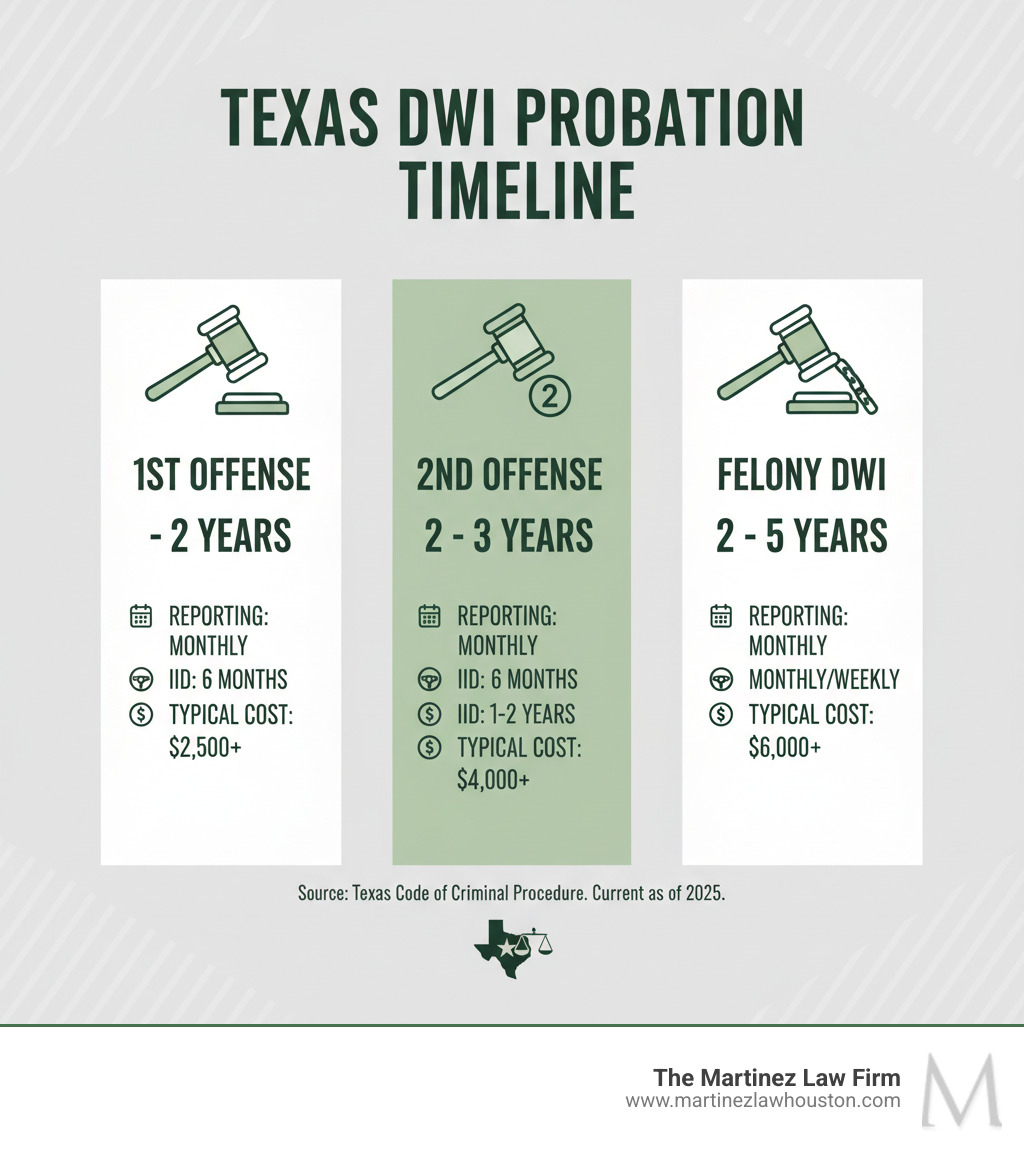
What is DWI Probation in Texas?
In Texas, what is commonly called probation is officially known as community supervision. It is not a dismissal of charges but an alternative to jail time, allowing you to live in the community under strict court supervision. This period can last for months or years, impacting every aspect of your daily life, which is why the question of how long is dui probation is so important.
The rules for community supervision are outlined in Chapter 42A of the Texas Code of Criminal Procedure. Understanding these regulations is a key part of navigating DWI Laws in Texas.

Probation vs. Parole
It’s important not to confuse probation and parole. Probation is a sentence served instead of jail time, while parole is an early, supervised release after serving part of a prison sentence. For DWI cases in Houston, the goal is often to secure probation to avoid incarceration.
Types of DWI Probation
In Harris County, there are several forms of community supervision for DWI cases:
- Regular Community Supervision: The most common form, where a judge sentences you to probation instead of jail after a guilty finding. Violating conditions can lead to revocation and serving the original jail sentence.
- Deferred Adjudication: A rare but highly favorable outcome where the judge defers a finding of guilt. Successful completion leads to a dismissal of the case, avoiding a conviction. This option is seldom available for DWI offenses.
- Pre-Trial Intervention (PTI): A program for certain first-time offenders in Harris County. Completing the program’s requirements, such as counseling and community service, results in the charges being dismissed. Our DWI Divert Program page has more details.
Securing the best possible outcome requires deep knowledge of the Harris County court system. My experience as a former Chief Prosecutor provides the insight needed to negotiate effectively on your behalf.
How Long is DUI Probation in Texas?
A common question after a DWI arrest in Houston is, “How long is dui probation going to last?” The length depends on your charge, criminal history, and the specifics of your case. While Texas law sets statutory limits, judges have discretion. Factors like your BAC, whether an accident occurred, and your cooperation all influence the final term. For more general information, see our Common DWI Questions page.

How Long is DUI Probation for a First Offense?
A first DWI is typically a Class B Misdemeanor, with probation lasting six months to two years. In Harris County, a term of 12 to 18 months is common. The final length is influenced by factors such as a high BAC or aggravating circumstances (e.g., an accident or a child passenger). Skilled legal negotiation can often lead to a shorter probation term with less restrictive conditions.
How Long is DUI Probation for Repeat Offenses?
Penalties increase significantly for repeat offenses. A second DWI (Class A Misdemeanor) usually results in two to three years of probation. A third DWI or a felony DWI can lead to probation terms of two to five years, with a maximum of 10 years for some felonies. These cases often include mandatory jail time as a condition of probation, along with more demanding supervision requirements.
Can DWI Probation Be Terminated Early in Texas?
The answer is a clear no: DWI probation cannot be terminated early in Texas. The Texas Code of Criminal Procedure specifically prohibits judges from granting early release from DWI community supervision. You must complete the entire term you are sentenced to.
However, with consistent compliance, your probation officer may have the discretion to modify certain conditions over time. For example, they might reduce the frequency of check-ins or drug testing. These adjustments are not guaranteed and depend entirely on your performance and the relationship you build with your officer. Strict adherence to all rules from day one is the only way to earn such considerations.
Navigating the Rules: Common Conditions of DWI Probation
DWI probation in Houston involves a legally binding agreement with the court. These mandatory conditions govern your daily life and are designed to ensure public safety and prevent future incidents. Common conditions include:
- Reporting to a Probation Officer: Regular check-ins (often monthly) to monitor your progress.
- Paying Fines and Fees: This includes court fines ($2,000-$10,000), monthly supervision fees ($50-$100), and costs for classes and testing.
- Community Service: Completing a set number of hours (24-200) at an approved organization.
- Zero-Tolerance for Alcohol/Drugs: You must abstain completely from alcohol and illegal drugs. This often includes a ban on visiting bars.
- Random Testing: You must submit to random drug and alcohol tests (urine, breath, or hair) on demand.
- Ignition Interlock Device (IID): Many cases require installing a breathalyzer in your vehicle that prevents it from starting if alcohol is detected. You are responsible for all associated costs.
- Maintaining Employment: You must be employed or actively seeking work.
- Avoiding New Offenses: Any new criminal charge can trigger a probation violation.
- Travel Restrictions: You must get permission before traveling outside Harris County.
Understanding these rules is crucial to avoiding a violation. For more on the consequences you might face, see our pages on DWI Penalties and What Will Happen to Your License?.
Required Classes and Programs
All DWI probations include mandatory educational programs with strict deadlines:
- DWI Education Class: A 12-hour state-approved course on the dangers and laws of impaired driving.
- Victim Impact Panel (VIP): A session, often run by Mothers Against Drunk Driving (MADD), where victims of drunk driving share their stories.
- Substance Abuse Evaluation: An assessment by a licensed counselor that may lead to required counseling or treatment.
- Alcoholics Anonymous (AA) Meetings: Some judges require regular attendance at AA meetings.
Monitoring and Testing
Harris County uses advanced technology to monitor compliance:
- Random Drug Testing: Unscheduled tests to ensure you remain substance-free.
- Ignition Interlock Device (IID): This car breathalyzer logs all tests, failures, and rolling retests, with reports sent to your probation officer. You pay for installation, monthly fees, and calibration.
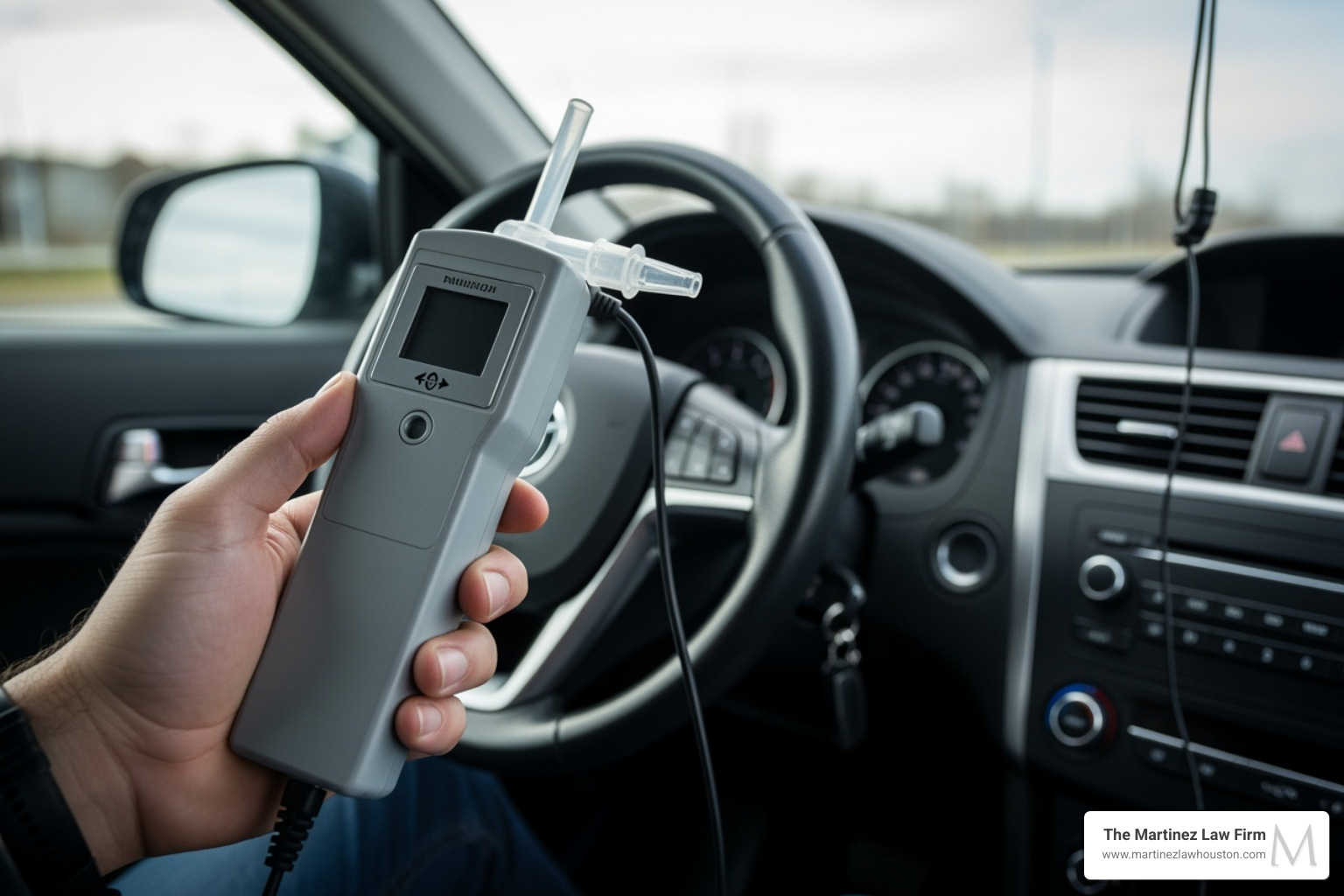
- Other Devices: In some cases, the court may order a SCRAM (Secure Continuous Remote Alcohol Monitor) ankle bracelet that tests your perspiration for alcohol 24/7, or a portable Soberlink device with facial recognition for remote breath testing.
These tools are invasive and expensive, but they are standard in modern DWI probation. Knowing how long is dui probation is critical, as you will be under this level of scrutiny for the entire term.
The Risks of Non-Compliance: Consequences of a Probation Violation
DWI probation in Houston is a court order, and breaking the rules has severe consequences. A probation violation occurs any time you fail to meet a condition, whether it’s failing a drug test, missing an appointment, or falling behind on fees. Any mistake, intentional or not, can lead to a violation.
When a violation is alleged, the prosecutor files a “Motion to Revoke Probation,” triggering a court hearing. The burden of proof is lower than in a criminal trial; the prosecutor only needs to show it’s “more likely than not” that you violated the terms. Our Probation Violation Hearing: What to Do guide explains this process in detail.
If the judge finds you in violation, they can:
- Revoke your probation and order you to serve the original jail sentence.
- Extend your probation period and add more restrictive conditions.
- Impose additional fines and require more intensive supervision.
Proper guidance is essential to avoid these preventable outcomes.
What Happens if You Get Another DWI on Probation?
Getting a new DWI while on probation is a catastrophic event. You face two simultaneous legal battles: the new DWI charge, which carries improved penalties as a repeat offense, and an automatic violation of your existing probation.
Prosecutors will immediately file to revoke your probation. A judge is highly likely to revoke it, sending you to jail to serve your original sentence. After that, you will still face sentencing for the new DWI, which will likely be much harsher because the offense occurred while you were under court supervision. For more on this, read our article on What Happens if You Get a DUI While on Probation?.
One poor decision can cost you years of your life. Your freedom depends on strict compliance.
Frequently Asked Questions about DWI Probation
Here are answers to common questions about DWI probation in Houston.
Can I travel while on DWI probation in Houston?
Travel is restricted and requires permission. The rule is to always ask before you go.
- In-State Travel: You must get advance permission from your probation officer to travel outside Harris County.
- Out-of-State Travel: This requires a formal request to your probation officer and often the court. Approval is not guaranteed.
- International Travel: This is almost always denied, as the court cannot supervise you abroad.
Leaving without permission is a probation violation that can lead to jail time.
How much does DWI probation cost in Texas?
The financial burden of probation is significant, often exceeding the initial court fine. Besides asking how long is dui probation, clients should be aware of the total cost. Expect to pay for:
- Court Fines: $2,000 to $10,000, depending on the offense.
- Monthly Supervision Fees: $50 to $100 per month.
- Required Classes: DWI Education, Victim Impact Panels, and potential substance abuse treatment can cost hundreds or thousands of dollars.
- Ignition Interlock Device (IID): Installation ($70-$150) plus monthly monitoring fees ($70-$100).
- Testing Fees: Costs for random drug and alcohol tests.
Total costs for DWI probation in Texas frequently exceed $6,000 to $10,000. Effective legal representation can help reduce these financial burdens by negotiating for shorter terms or lower fines.
Will a DWI probation show up on a background check?
Yes. A DWI conviction is a permanent part of your criminal record in Texas and will appear on most background checks. This can negatively impact:
- Employment: Many employers, especially in fields like transportation, healthcare, and education, are hesitant to hire individuals with a DWI conviction.
- Housing: Landlords often run background checks, and a conviction can make it difficult to rent an apartment or house.
- Professional Licenses: A DWI can trigger disciplinary action from licensing boards for professionals like nurses, teachers, and commercial drivers.
In the rare event you receive deferred adjudication and complete it successfully, you may be able to seal the record from public view through an Order of Nondisclosure. However, for a standard DWI conviction, this option is not available. The long-term consequences make fighting the charge from the start with an experienced attorney essential.
Your Next Steps After a Houston DWI Arrest
A DWI arrest in Houston is overwhelming, and understanding how long is dui probation is just the first step. Texas DWI probation is a complex legal order with strict, long-term conditions where a single misstep can lead to jail time. You do not have to face this challenge alone.
At The Martinez Law Firm, we defend those accused of DWI. Our founder, Herman Martinez, is a former Chief Prosecutor for the Harris County District Attorney’s Office. This unique insider experience allows us to anticipate the prosecution’s strategy and build a powerful defense.
With over 25 years in Houston courtrooms, we know how to fight for dismissals, negotiate for reduced charges and shorter probation terms, or guide you toward successful completion of your supervision. We understand the local courts, judges, and prosecutors, and we use that knowledge to protect your future.
Don’t leave your freedom and future to chance. If you’ve been arrested for DWI in Harris County, contact us for a confidential consultation. We will review your case, explain your options, and create a clear strategy to defend your rights. Visit our DWI Lawyer page to learn how we can fight for you.
Why Understanding Texas Drug Penalties Is Critical to Your Future

How many years in jail for drug possession in texas depends on the drug type, the amount, and your criminal history. Texas enforces some of the nation’s toughest drug laws, where even a small amount can lead to years in prison and life-altering consequences.
Quick Answer: Jail Time for Drug Possession in Texas
- Marijuana (less than 2 oz): Up to 180 days in jail
- Cocaine/Meth (less than 1 gram): 180 days to 2 years (State Jail Felony)
- Cocaine/Meth (1-4 grams): 2 to 10 years (Third-Degree Felony)
- Cocaine/Meth (4-200 grams): 2 to 20 years (Second-Degree Felony)
- Cocaine/Meth (200-400 grams): 5 to 99 years (First-Degree Felony)
- Cocaine/Meth (over 400 grams): 10 to 99 years (Improved First-Degree Felony)
A conviction carries consequences far beyond jail, including driver’s license suspension, employment issues, and a permanent criminal record. If you’re facing drug charges in Houston, you need to understand what’s at stake.
Key Takeaways
- Texas drug possession penalties depend on drug type and quantity — For example, less than 2 ounces of marijuana can bring up to 180 days in jail, while less than 1 gram of cocaine or meth carries 180 days to 2 years in state jail.
- Felony penalties escalate quickly with weight — Possession of 1–4 grams of Penalty Group 1 drugs (such as cocaine, heroin, or meth) can lead to 2–10 years in prison, while 200–400 grams can bring 5–99 years or life.
- THC concentrates face harsher charges than marijuana flower — Items like vape cartridges, edibles, and hash are treated as Penalty Group 1 controlled substances, meaning they can trigger felony charges similar to cocaine or heroin possession.
- Several factors can increase jail time — Prior convictions, drug-free zones (within 1,000 feet of schools or parks), and evidence of intent to distribute can significantly raise potential sentences.
- Alternatives to jail may exist for some cases — First-time or nonviolent offenders may qualify for diversion programs, drug courts, probation, or deferred adjudication, which can help avoid long-term incarceration and reduce permanent record damage.
I’m Herman Martinez, founder of The Martinez Law Firm. With over 25 years in criminal law, including as a Chief Prosecutor in Harris County, I’ve seen how these charges can derail lives. The right defense strategy is critical. Let me explain what you’re up against.
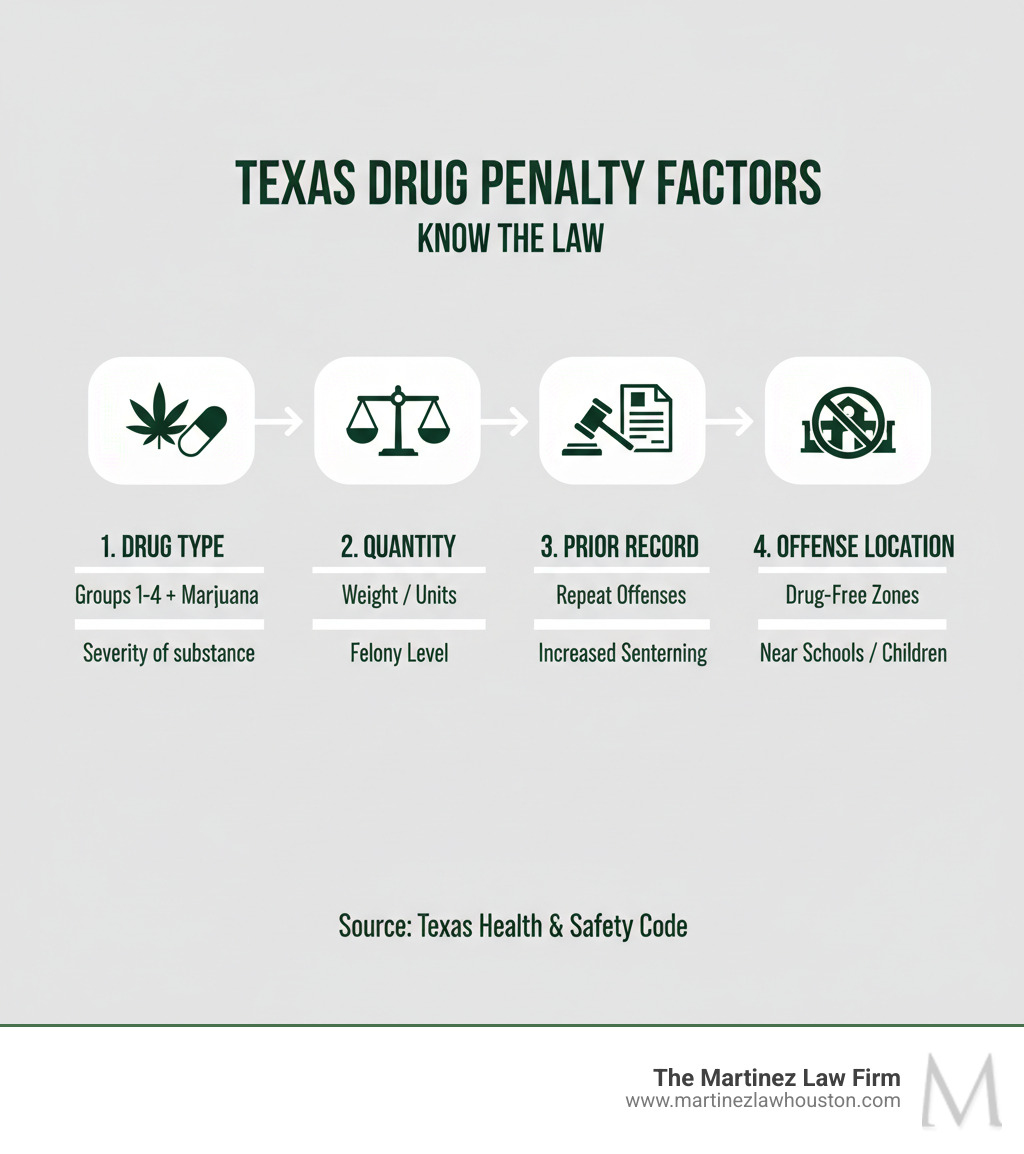
How Texas Classifies Drugs: The Penalty Group System
To answer how many years in jail for drug possession in texas, you must first understand the state’s “Penalty Group” system. Under the Texas Controlled Substances Act, drugs are categorized based on their potential for abuse and medical use. Highly addictive substances with little to no medical value fall into the most severe groups, leading to harsher penalties. For a complete overview, see our guide on controlled substances.
Penalty Group 1 & 1-B
This group includes what Texas considers the most dangerous drugs, such as cocaine, heroin, methamphetamine, and powerful opioids like oxycodone and fentanyl. Possession of even a tiny amount is a felony. The penalties are severe, reflecting the high potential for abuse. For example, heroin possession penalties in Houston are among the state’s toughest. Penalty Group 1-B covers similar substances and carries the same harsh penalties.
Penalty Group 1-A & 2
These groups also carry significant felony penalties.
- Penalty Group 1-A is almost exclusively for LSD. Penalties are measured in “abuse units” (doses) rather than by weight due to its potency.
- Penalty Group 2 includes hallucinogens and stimulants like Ecstasy (MDMA), psilocybin (magic mushrooms), and PCP. Synthetic cannabinoids (K2, Spice) may also fall into this category. These substances are deemed to have a high abuse potential with limited medical use. Learn more about Ecstasy charges to understand the specific risks.
Penalty Group 3 & 4
These groups primarily cover prescription drugs possessed without a valid prescription.
- Penalty Group 3 includes common medications like Valium, Xanax, and Ritalin, as well as various barbiturates.
- Penalty Group 4 contains compounds with lower abuse potential, including certain narcotic-based medications and anabolic steroids.
While these are “lower” penalty groups, possessing these substances illegally can still lead to jail time and fines. For more details, see our information on prescription drug charges.
Marijuana and Concentrates
Marijuana is classified separately in Texas, but the rules are tricky. While marijuana flower penalties are based on weight, THC concentrates, hashish, and edibles are treated much more harshly. Texas law does not consider concentrates to be marijuana. Instead, they are classified under Penalty Group 1. This means a THC vape cartridge or gummy can lead to the same felony charge as possessing cocaine or heroin—a fact that shocks many of our clients. Given the popularity of these products in Houston, it’s a critical distinction to understand. For a full breakdown, visit our page on marijuana charges.
How Many Years in Jail for Drug Possession in Texas? A Breakdown by Quantity
The amount of a drug you possess is the biggest factor determining how many years in jail for drug possession in texas. A few grams can be the difference between probation and a decade in prison. This table illustrates how penalties differ based on the drug type for the same weight:
| Offense | Jail Time (Approx.) | Fine (Approx.) | Felony/Misdemeanor |
|---|---|---|---|
| Possession of 1 gram of Marijuana | Up to 180 days | Up to $2,000 | Class B Misdemeanor |
| Possession of 1 gram of Cocaine (Group 1) | 180 days to 2 years | Up to $10,000 | State Jail Felony |
How many years in jail for drug possession in texas for Group 1 Drugs (Cocaine, Meth, Heroin)
Penalties for Penalty Group 1 substances escalate rapidly with weight. Even a small amount is a felony.
- Less than 1 gram: State Jail Felony, punishable by 180 days to 2 years in a state jail facility.
- 1 to 4 grams: Third-Degree Felony, with a sentence of 2 to 10 years in prison.
- 4 to 200 grams: Second-Degree Felony, carrying a penalty of 2 to 20 years in prison.
- 200 to 400 grams: First-Degree Felony, with a range of 5 to 99 years or life in prison.
- Over 400 grams: Improved First-Degree Felony, with a mandatory minimum of 10 years and a maximum of 99 years or life.
These are serious charges requiring an aggressive defense. Learn more about potential defenses for cocaine charges.
How many years in jail for drug possession in texas for Marijuana
While many states have decriminalized marijuana, Texas still imposes criminal penalties.
- Less than 2 ounces: Class B Misdemeanor, up to 180 days in county jail.
- 2 to 4 ounces: Class A Misdemeanor, up to 1 year in county jail.
- 4 ounces to 5 pounds: State Jail Felony, 180 days to 2 years in a state jail facility.
- 5 to 50 pounds: Third-Degree Felony, 2 to 10 years in prison.
- 50 to 2,000 pounds: Second-Degree Felony, 2 to 20 years in prison.
- More than 2,000 pounds: First-Degree Felony, 5 to 99 years or life in prison.
Importantly, Harris County has a local policy on low-level marijuana cases that may allow for diversion. For possession of under 4 ounces, you may be eligible for a program that leads to dismissal of the charges. This is a local policy, not state law, and an experienced Houston attorney can help you steer it.
Key Factors That Can Increase Your Sentence
Beyond drug type and quantity, other factors can dramatically increase how many years in jail for drug possession in texas. Prosecutors use these aggravating factors to seek harsher punishments.

Prior Convictions and Improved Penalties
Texas law punishes repeat offenders severely. A prior conviction can “improve” a new charge, elevating it to a higher penalty category. For example, a third state jail felony can be punished as a Third-Degree Felony, increasing potential prison time from 2 years to 10 years. Under the Texas Penal Code on habitual offenders, multiple prior felonies can lead to sentences of 25 years to life. A criminal record may also make you ineligible for probation. This is why fighting all felony drug charges is critical.
Possession vs. Manufacturing or Delivery
There is a major difference between possessing drugs for personal use and possessing them with intent to manufacture or deliver. The law treats the latter far more seriously, viewing it as participation in the drug trade. Evidence like scales, baggies, large amounts of cash, or text messages can lead prosecutors to file these liftd charges. Penalties for manufacturing or delivery are significantly higher than for simple possession of the same amount. A skilled attorney can challenge the prosecution’s claims of intent. Learn more about these serious charges on our page about drug trafficking charges.
“Constructive Possession” and Drug-Free Zones
Two other common complications are constructive possession and drug-free zones.
- Constructive Possession: You don’t need drugs on your person to be charged. If drugs are found in a place you have control over, like your car or home, you can be charged with constructive possession. This is a common issue in vehicle searches with multiple passengers. The prosecution must prove you knew about and controlled the substance, which is a key area for defense, especially in cases involving trace amounts. Learn more about possession of a trace of cocaine.
- Drug-Free Zones: Committing a drug offense within 1,000 feet of a school, daycare, or public park can double the penalties. In a dense area like Houston, it’s easy to be in a drug-free zone without realizing it. This improvement can turn a mid-level felony into a charge with a much higher minimum sentence.
Beyond Jail Time: The Hidden Consequences of a Drug Conviction
When clients ask how many years in jail for drug possession in texas, they are often unaware of the collateral consequences that follow a conviction. These hidden penalties can be more damaging than the jail sentence itself, affecting your life for years to come.

Driver’s License Suspension and Asset Forfeiture
Two immediate consequences are the loss of your license and property.
- Driver’s License Suspension: Any drug conviction in Texas triggers a mandatory six-month driver’s license suspension. This applies even if a vehicle was not involved. In a city like Houston, losing your license can mean losing your job.
- Civil Asset Forfeiture: Law enforcement can seize cash, cars, or other property they believe is connected to drug activity, even without a conviction. Getting your property back is a difficult and expensive civil process.
Penalties for Drug Paraphernalia
Possessing drug paraphernalia—items used to consume, store, or prepare drugs like pipes, scales, or baggies—is a separate crime. It’s typically a Class C Misdemeanor punishable by a fine up to $500, but it still creates a criminal record. Distributing paraphernalia is a more serious Class A Misdemeanor. These charges are often added to a possession case, complicating your defense. Read more about drug paraphernalia charges.
Long-Term Impact on Your Life and Future
The long-term effects of a drug conviction are severe. A criminal record, especially a felony, creates lifelong barriers:
- Employment: Many employers will not hire individuals with drug convictions.
- Housing: Landlords often deny rental applications based on background checks.
- Civil Rights: A felony conviction results in the loss of your right to vote (until the sentence is fully discharged) and own a firearm.
- Education: You may become ineligible for federal student loans.
- Professional Licenses: A conviction can lead to the suspension or revocation of professional licenses for nurses, teachers, lawyers, and others.
- Immigration: Non-citizens face deportation for many drug offenses.
We don’t just fight to keep you out of jail; we fight to protect your entire future from these devastating consequences.
Are There Alternatives to Jail in Texas?
While the answer to how many years in jail for drug possession in texas can be frightening, incarceration is not always the final outcome. Texas courts offer several alternatives, especially for first-time or non-violent offenders, that focus on rehabilitation over punishment.

Diversion Programs and Drug Courts
Diversion programs offer a chance to avoid a conviction altogether. These are typically for first-time offenders and involve completing requirements like drug counseling, community service, and regular drug testing. Upon successful completion, the charges are dismissed, and you may be eligible to have the arrest expunged from your record. This is a powerful tool for protecting your future, and we have more information on our page for first-time drug offenses.
Drug courts, including the robust programs in Harris County, provide a more intensive, treatment-focused alternative. Participants are closely supervised by a judge and engage in comprehensive rehabilitation. Successful completion can lead to reduced sentences or dismissal of charges. These programs are a cornerstone of Texas’s efforts to address addiction as a health issue, as detailed by the Texas Department of Criminal Justice.
Probation and Community Supervision
Probation, or “community supervision,” allows you to serve your sentence in the community instead of behind bars.
- Deferred Adjudication: With this option, you plead guilty or no contest, and the judge places you on probation without a finding of guilt. If you complete the probation successfully, the case is dismissed, and you avoid a final conviction. This is a huge advantage for future employment and housing applications.
- Straight Probation: In this scenario, you are convicted, but your jail or prison sentence is suspended. You serve your time under the supervision of a probation officer, complying with court-ordered conditions. While it results in a conviction, it keeps you out of jail.
For certain first-time state jail felony drug possession offenses, probation is mandatory unless a jury recommends otherwise. An experienced attorney can advocate for these alternatives and present your case in a way that emphasizes rehabilitation over punishment.
Frequently Asked Questions about Texas Drug Possession Penalties
As a Houston-based firm, we frequently address these common questions about Texas drug laws.
Can I go to jail for a first-time drug possession offense in Texas?
Yes, jail time is possible even for a first offense. Possessing any amount of a Penalty Group 1 drug like cocaine is a State Jail Felony, carrying 180 days to 2 years in jail. However, for many first-time offenders, alternatives like diversion programs or probation are achievable with a strong legal defense. An experienced attorney can negotiate for outcomes that keep you out of jail. Learn more about your options for a first-time drug offense.
What is a “trace case” and can I be charged for it?
Yes. A “trace case” involves a microscopic, unusable amount of a drug, often just residue in a baggie or pipe. Under Texas law, any detectable amount is enough for a possession charge. For a Penalty Group 1 substance, this means you can face a State Jail Felony charge for an amount you can’t even see. These cases are common and carry serious penalties, including up to two years in jail. We explain how to fight these charges in our article on possession of a trace of cocaine.
How do Texas drug laws compare to federal laws?
Texas drug laws are among the strictest in the U.S. and are often harsher than federal laws for simple possession. While federal agencies regulate drugs, the vast majority of possession arrests are prosecuted at the state level. This means your case will be handled by the Harris County District Attorney’s office under the Chapter 481- Texas Controlled Substances Act, not federal statutes. Federal charges are typically reserved for large-scale trafficking cases. Your defense must be custom to Texas law, which is where our firm’s local experience is invaluable.
Protecting Your Future After a Drug Possession Arrest
Understanding how many years in jail for drug possession in texas is critical, but the consequences of a conviction extend far beyond prison. Your ability to work, find housing, and secure your future are all at risk. Texas drug laws are unforgiving, and navigating the complex penalty groups, weight thresholds, and aggravating factors requires expert legal guidance.
At The Martinez Law Firm, we bring a crucial advantage to your defense. As a former Chief Prosecutor in Harris County, Herman Martinez knows how prosecutors build their cases and how to dismantle them. This insider perspective, combined with our firm’s commitment to aggressive, personalized defense, has delivered proven results for clients across Houston.
We don’t just defend against jail time—we fight to protect your future. Every case receives our full strategic attention and relentless advocacy.
Understanding the Serious Stakes of a DWI Probation Violation

A dui probation violation texas can lead to jail time, extended supervision, and severe penalties that could upend your life. Probation, or “community supervision,” is a second chance to avoid jail after a DWI conviction, but it comes with strict rules. In Harris County, any misstep is taken seriously.
When you violate DWI probation, you face:
- Immediate Arrest: Your probation officer can file a Motion to Revoke, leading to a warrant. A judge may deny bond, keeping you in jail until your hearing.
- Lower Burden of Proof: The prosecutor only needs to prove the violation by a “preponderance of the evidence” (more likely than not), a much lower standard than “beyond a reasonable doubt.”
- Severe Penalties: You could face the original jail sentence you avoided, plus additional time for the violation itself. Time served for the violation does not count toward your original sentence.
- Dual Consequences for New Offenses: A new arrest triggers penalties for both the new charge and the probation violation.
I’m Herman Martinez, founder of The Martinez Law Firm. With over 25 years in the Texas criminal justice system as a former Chief Prosecutor for Harris County and a City of Houston Judge, I have unique insight into how these cases are handled. My goal is to use that experience to build the strongest possible defense and protect your freedom.
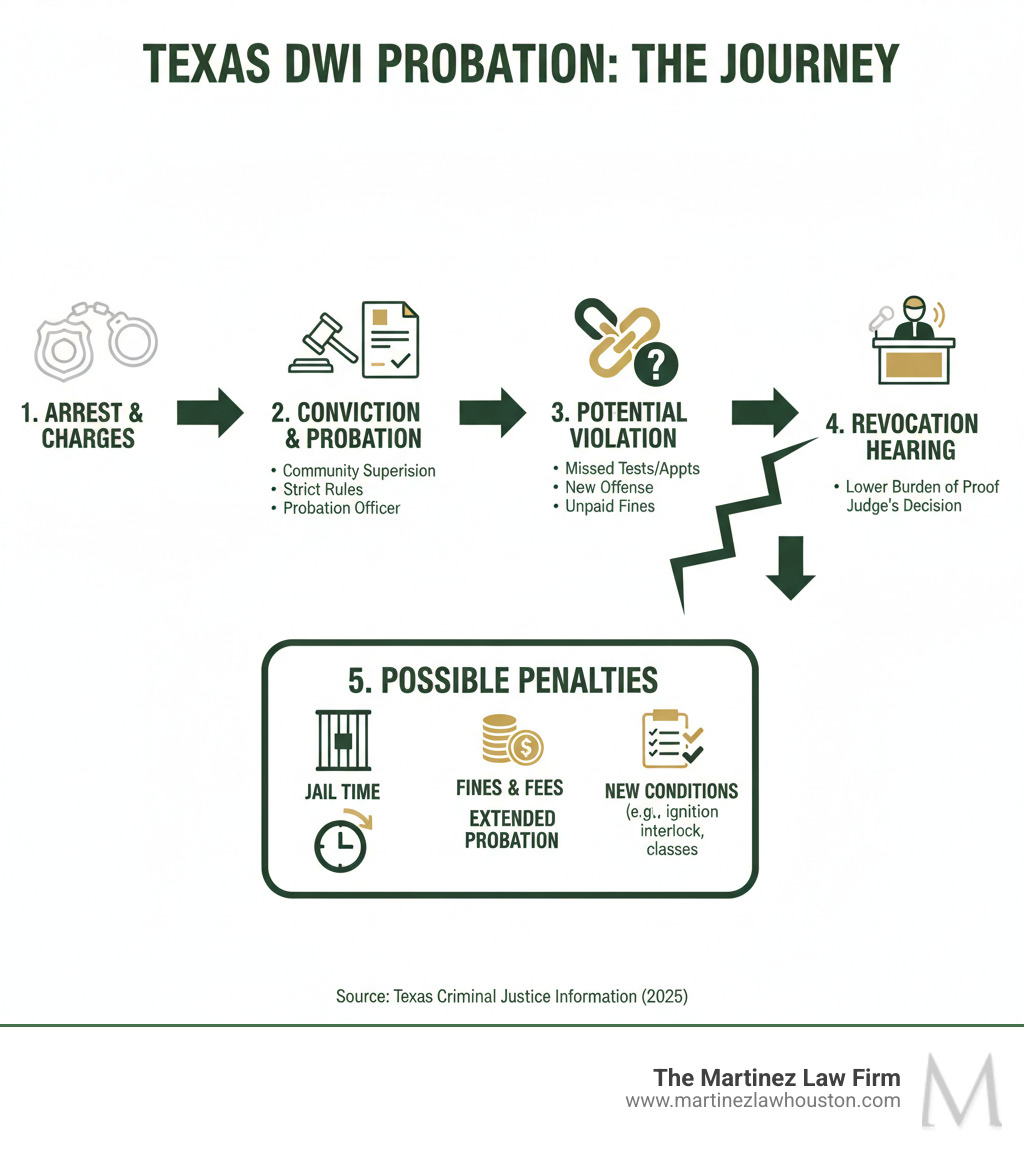
Understanding DWI Probation in Texas
When you’re convicted of DWI in Texas, “community supervision” (probation) is the court’s way of letting you avoid jail time, but with strict strings attached. You can stay in the community, keep your job, and live with your family, but you’ll be under constant court supervision.

Breaking any rule can lead to a dui probation violation texas and land you behind bars. The legal framework is outlined in the Texas Code of Criminal Procedure. For a first-time DWI in Harris County, probation typically lasts one to two years. The judge determines the length based on your case specifics and criminal history. For a full overview, see our resource on DWI Probation in Texas: What You Need to Know.
Common Conditions of DWI Probation
Every condition of your DWI probation is a legally binding order. Violating even one puts your freedom at risk. Common requirements include:
- Regular Check-ins: Mandatory meetings with your probation officer to verify compliance.
- Payments: Timely payment of all court-ordered fines, fees, and restitution.
- No New Offenses: You must not be arrested for any new crime, including minor ones.
- Abstinence and Testing: You are prohibited from consuming alcohol or illegal drugs, verified through random urine, breath, or continuous monitoring devices like a SCRAM ankle monitor.
- Mandatory Programs: Attending DWI education classes, victim impact panels, and any required substance abuse treatment.
- Ignition Interlock Device: For many, especially with a BAC of 0.15% or higher, you must install an ignition interlock device in your vehicle at your own expense. Learn more about DWI Lawyer: DWI Penalties.
- Other Rules: Completing community service, maintaining employment, adhering to travel restrictions, and avoiding people with criminal records.
These are not suggestions; they are court orders. Taking them seriously is the only way to avoid a dui probation violation texas.
Deferred Adjudication vs. Straight Probation
In Texas, there are two main types of probation: Deferred Adjudication and Straight Probation. The type you receive significantly impacts your criminal record.
With Deferred Adjudication, the judge defers a finding of guilt. If you complete probation successfully, the case is dismissed. You may then qualify for an Order of Non-Disclosure to seal your record from most background checks. However, if you violate probation, the judge can find you guilty and impose the maximum sentence for the original offense.
With Straight Probation, you are found guilty, but your jail sentence is suspended. The conviction remains on your record permanently. If you violate, the judge can revoke probation and make you serve the original suspended sentence.
Breaking Down the Differences
| Feature | Deferred Adjudication | Straight Probation (Suspended Sentence) |
|---|---|---|
| Finding of Guilt | No finding of guilt entered at the time of sentencing. Guilt is “deferred” pending successful completion of probation. | A finding of guilt is entered, but the jail sentence is “suspended,” and you’re placed on probation instead. |
| Eligibility | Generally for first-time offenders, often for misdemeanors. For DWI, it became more widely available after a 2019 law change, but typically not if you’re already on probation for another offense. | Available for a wider range of offenses, including some felonies, and after a guilty verdict or plea. |
| Record Sealing | Upon successful completion, the case is dismissed, and you may be eligible for an Order of Non-Disclosure to seal your record. This means the arrest and prosecution are not publicly available. | The conviction remains on your record. In some limited circumstances, expunction might be possible, but it’s rare for a DWI conviction. |
| Consequences of Violation | If violated, the judge can proceed with an adjudication of guilt and impose any punishment allowed by law for the original offense, including the maximum sentence. | If violated, the judge can revoke probation and impose the original suspended jail sentence. |
For DWI cases, deferred adjudication is generally only available to first-time offenders with a BAC below 0.15% and without a commercial driver’s license. The ability to avoid a permanent conviction makes deferred adjudication highly desirable, but the stakes for a violation are incredibly high.
What Constitutes a Violation of DWI Probation?
A dui probation violation texas occurs when you fail to comply with any court-ordered term of your community supervision. Even a seemingly minor slip-up can have serious consequences. Violations fall into two categories.

Technical violations are breaches of the administrative rules, such as missing an appointment with your probation officer, failing to pay fines, not completing community service, or traveling out of the county without permission. Substantive violations are more serious, as they involve committing a new criminal offense. Any new arrest, from theft to another DWI, is a substantive violation.
Either type of violation can trigger a Motion to Revoke Probation (MTR) or a Motion to Adjudicate Guilt (MTA), putting you at risk of jail time. For a comprehensive look at how violations are handled, see our guide on Probation Violation.
Getting a New DWI While on Probation
Getting arrested for a new DWI while on probation for a prior one is the most serious dui probation violation texas you can commit. This creates two simultaneous legal battles: the new DWI charge and the probation violation.
Your probation officer will file a Motion to Revoke Probation, and a judge in Harris County will likely issue an arrest warrant and may deny bond, meaning you could sit in jail until your hearing. At the same time, you face a new DWI charge, which prosecutors will pursue aggressively. The burden of proof for a probation violation is low—the prosecutor only needs to show it’s “more likely than not” that you were arrested for DWI to prove the violation. If your probation is revoked, you could serve your original sentence and then face additional penalties for the new DWI conviction. Immediate action is critical; for guidance, visit our page on DWI Arrest in Houston: What You Need to Know.
Consequences of a Failed Drug Test for a DUI Probation Violation Texas
Failing a drug or alcohol test is a clear-cut dui probation violation texas. Your probation terms require complete abstinence, and a positive test is direct evidence of a violation. In Harris County, probation officers use urine analysis (UA), breathalyzers, and continuous monitoring devices like SCRAM ankle monitors to ensure compliance.
A failed test will be reported to the court. While a first-time failure might result in a warning or stricter conditions, it often triggers a Motion to Revoke Probation. At the revocation hearing, the judge will decide whether to continue, modify, or revoke your probation and send you to jail. It is sometimes possible to challenge test results based on procedural errors or equipment inaccuracy. If you believe a test result is wrong, contact an attorney immediately. For more on testing, see our section on DWI Lawyer: Breath, Blood Tests.
The Legal Process for a DUI Probation Violation Texas
When you’re accused of violating probation, a formal legal process begins. Understanding this process is key to preparing your defense. It starts when your probation officer files a Motion to Revoke Probation (MTR) or a Motion to Adjudicate Guilt (MTA) with the court, as detailed in the Texas Code of Criminal Procedure.

Once the motion is filed, the judge will likely issue a warrant for your arrest. A significant challenge in these cases is that judges have the discretion to deny bond, meaning you could be held in jail until your hearing. This is a common practice in Harris County for serious or repeated violations. The judge’s role is to determine if a dui probation violation texas occurred and, if so, to decide the consequences. For a detailed roadmap, read our guide: I have been accused of violating my probation. What’s next?.
The Probation Violation Hearing
A probation violation hearing is not a criminal trial. The biggest difference is the burden of proof. The prosecutor doesn’t need to prove your guilt “beyond a reasonable doubt.” Instead, they only need to show by a “preponderance of the evidence” that it’s more likely than not you violated a condition. This lower standard makes it much easier for the prosecution to win.
During the hearing, the prosecutor presents evidence, such as testimony from your probation officer or drug test results. You have the right to be present, have an attorney, and present your own evidence and witnesses to challenge the allegations. After hearing both sides, the judge decides if you violated probation and what the punishment will be. Given the lower burden of proof, having a skilled attorney is essential. For more guidance, see our resource: Probation Violation Hearing: What to Do.
Potential Penalties and Consequences
The consequences for a dui probation violation texas vary based on the violation, your history, and the judge. Penalties can include:
- Probation Revocation: The most severe outcome. The judge can impose the original jail sentence that was suspended. For a first-time DWI, this could be up to 180 days in jail.
- Additional Jail Time: A judge can sentence you to jail time for the violation itself, which does not count toward your original sentence.
- Extended Probation: Your supervision period can be made longer.
- Stricter Conditions: The judge can add new rules, such as more frequent testing, a curfew, or a SCRAM ankle monitor.
- Additional Fines and Classes: You may be ordered to pay more money or complete new treatment programs.
A first-time, minor technical violation might result in a warning. However, a serious violation (like a new DWI) or a history of violations will likely lead to harsh penalties, especially if you have prior DWI convictions. For more on serious DWI charges, see our guide on Felony DWI.
Defending Against a Probation Violation Allegation
An allegation of a dui probation violation texas is not a conviction. You have rights and options. At The Martinez Law Firm, our goal is to prevent your probation from being revoked and keep you out of jail.

Strategies for a DUI Probation Violation Texas Defense
We tailor our defense to your specific situation using several key strategies:
- Disproving the Allegation: We scrutinize the prosecution’s evidence. Can we challenge the accuracy of a drug test? Is there proof of a legitimate emergency that caused a missed appointment? We look for weaknesses to dismantle the state’s case.
- Challenging a New DWI Charge: If the violation is based on a new DWI arrest, we aggressively defend against that new charge. A dismissal or “not guilty” verdict on the new case can eliminate the basis for the probation violation. Learn more about challenging DWI Lawyer: Breath, Blood Tests.
- Presenting Mitigating Factors: We tell your story to the judge. Have you been compliant with other terms? Are you employed and supporting a family? We show the court you are a whole person making genuine efforts, arguing that revocation would be counterproductive.
- Negotiating Alternatives: Even if a violation occurred, we can often negotiate for lesser penalties, such as modified conditions, additional community service, or a simple warning from the judge, instead of revocation.
- Leveraging Former Prosecutor Experience: As a former prosecutor in Harris County, I know how the state builds these cases. This insider perspective gives us a significant advantage in finding weaknesses and negotiating effectively. This is Why Hire a Former Prosecutor? can be so valuable.
Can You Appeal a Revoked Probation?
Yes, you have the right to appeal a probation revocation, but it is a difficult process. An appeal is not a second chance to argue the facts; it must be based on a specific legal error made by the judge during the hearing. The deadline to file a notice of appeal is strict, typically 30 days. As legal experts note, Individuals on probation have the right to legal representation and may appeal probationary decisions or violations. An experienced attorney is crucial for identifying grounds for an appeal and navigating the complex process.
Frequently Asked Questions about DWI Probation
Navigating DWI probation in Houston raises many questions. Here are answers to some of the most common concerns about dui probation violation texas.
Can you get off DWI probation early in Texas?
No. Texas law explicitly prohibits early termination of probation for a DWI offense (Texas Code of Criminal Procedure 42A.701). If you are sentenced to two years of probation, you must complete the full two years.
However, a judge may agree to modify the conditions of your probation over time. If you have a strong record of compliance, your attorney may be able to request less frequent check-ins or a reduction in testing frequency. Building a track record of trustworthiness with your probation officer is key to having such modifications considered.
How long does a DWI stay on your record in Texas?
A DWI conviction stays on your Texas criminal record for life. It does not automatically fall off after a certain number of years. The only way to completely remove a DWI conviction is through an expunction, which is only available in very limited circumstances, such as if your case was dismissed or you were found not guilty at trial.
If you successfully completed deferred adjudication, you may be eligible for an Order of Non-Disclosure, which seals the record from public view. However, a conviction from straight probation is permanent and cannot be sealed. A DWI on your record can impact employment, housing, and professional licensing, which is why it’s critical to fight the charge from the start. Learn more about Clearing Your Record.
Can you get probation for a second or subsequent DWI in Texas?
It is possible, but highly unlikely and much more difficult than for a first offense. Prosecutors and judges in Harris County take repeat DWI offenses very seriously.
- Second DWI: Texas law requires a mandatory minimum of 30 days in jail as a condition of probation.
- Third DWI: A third DWI is automatically a third-degree felony, punishable by 2 to 10 years in prison. While a judge can technically grant probation, most defendants face significant prison time.
If you get a new DWI while on probation for a prior one, you face a severe dui probation violation texas situation with compounded penalties. You need an aggressive defense attorney immediately. For more details, see our page on DWI Lawyer: DWI Penalties.
Protect Your Freedom with an Experienced Houston Defense Attorney
A dui probation violation texas is a direct threat to your freedom. In Harris County, judges and prosecutors treat these violations with extreme seriousness, and the consequences—from jail time to a permanent record—can be devastating.
The Martinez Law Firm offers a critical advantage. As a former Chief Prosecutor for the Harris County District Attorney’s Office and a City of Houston Judge, Herman Martinez knows the system from the inside. We understand how prosecutors build their cases and, more importantly, how to take them apart. This unique experience allows us to build aggressive, personalized defenses aimed at protecting your future.
Don’t wait to act. The stakes are too high. If you are facing a probation violation, your freedom is on the line. Contact an experienced Houston DWI Lawyer to build your defense today for a confidential consultation and let us put our proven track record to work for you.
Why Understanding Texas Open Container Law Exceptions Matters
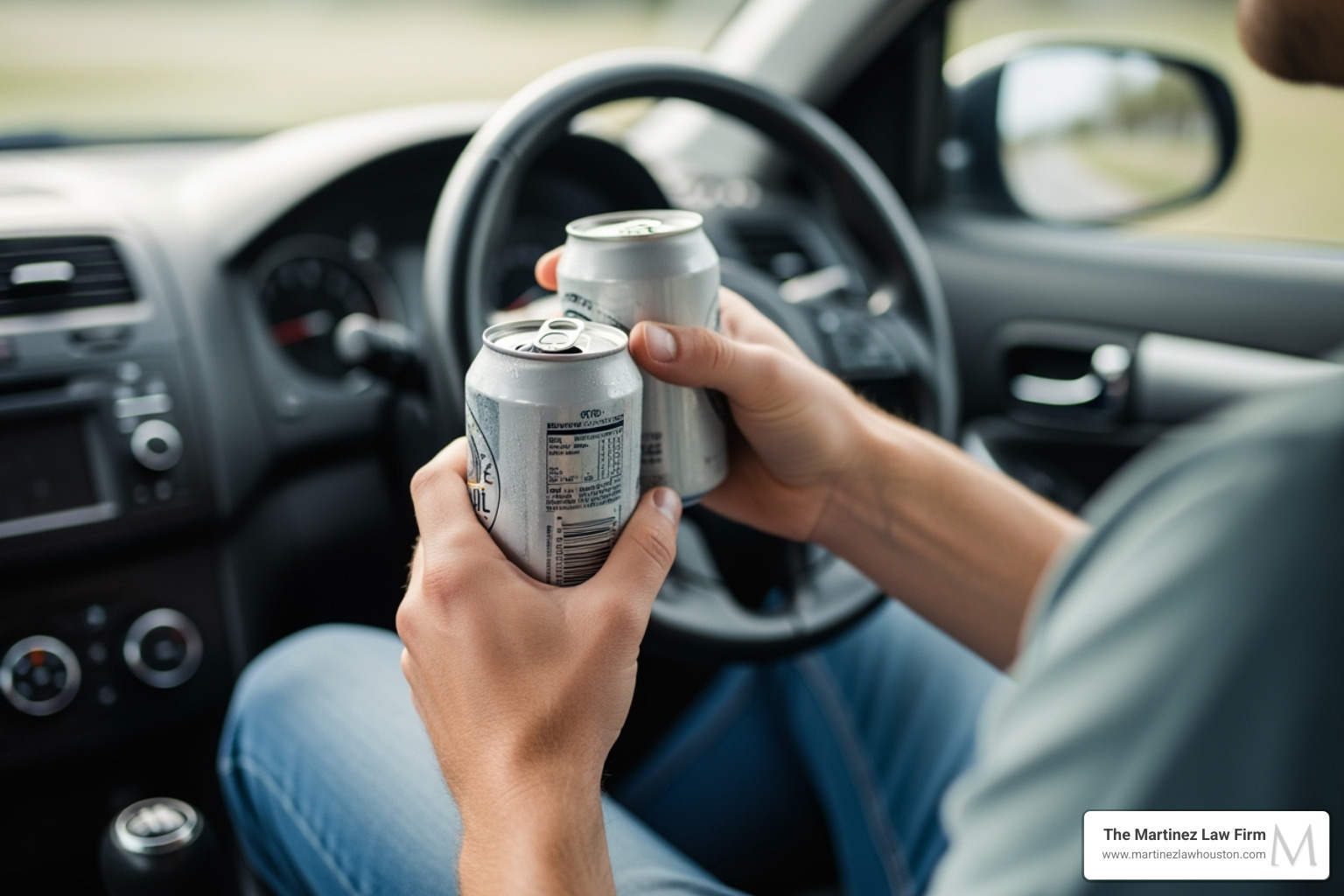
Open container law texas exceptions are critical for any driver in the Lone Star State. The main exceptions allowing open containers in specific situations are:
- Passengers in vehicles for hire – Taxis, limousines, party buses, and chartered vehicles where passengers pay for transportation
- Living quarters of RVs and motorhomes – The residential area (not the driver’s cab) of motorized house coaches, trailers, and campers
- Locked storage areas – Locked glove compartments, trunks, and the area behind the last upright seat in vehicles without trunks
- Boats on Texas waterways – Open containers are legal on boats, though operating while intoxicated is still illegal
Texas law makes it a Class C misdemeanor to knowingly possess an open container in the passenger area of a motor vehicle on a public highway. This means a fine up to $500 and a permanent criminal record—even if you’re sober.
What many people don’t realize is that both drivers and passengers can be charged, even if the driver hasn’t had a drop to drink. An open container is often used as probable cause to investigate for DWI, which carries far more serious penalties.
Common Confusion
The confusion doesn’t stop there. What counts as “open”? A re-corked wine bottle from dinner, a to-go cocktail with a broken seal, or even an empty beer can that’s still cool to the touch can be considered an open container under Texas case law.
In Houston and Harris County, law enforcement takes these violations seriously. An open container charge might seem minor, but it can affect employment, insurance rates, and if combined with a DWI charge, it increases the minimum jail time to six days for a first offense.
I’m Herman Martinez, founder of The Martinez Law Firm. As a former Chief Prosecutor for the Harris County District Attorney’s Office with over 25 years of experience, I’ve seen how open container law texas exceptions can mean the difference between a conviction and a dismissed case. Understanding these exceptions isn’t just legal trivia—it’s essential protection for your rights and future.
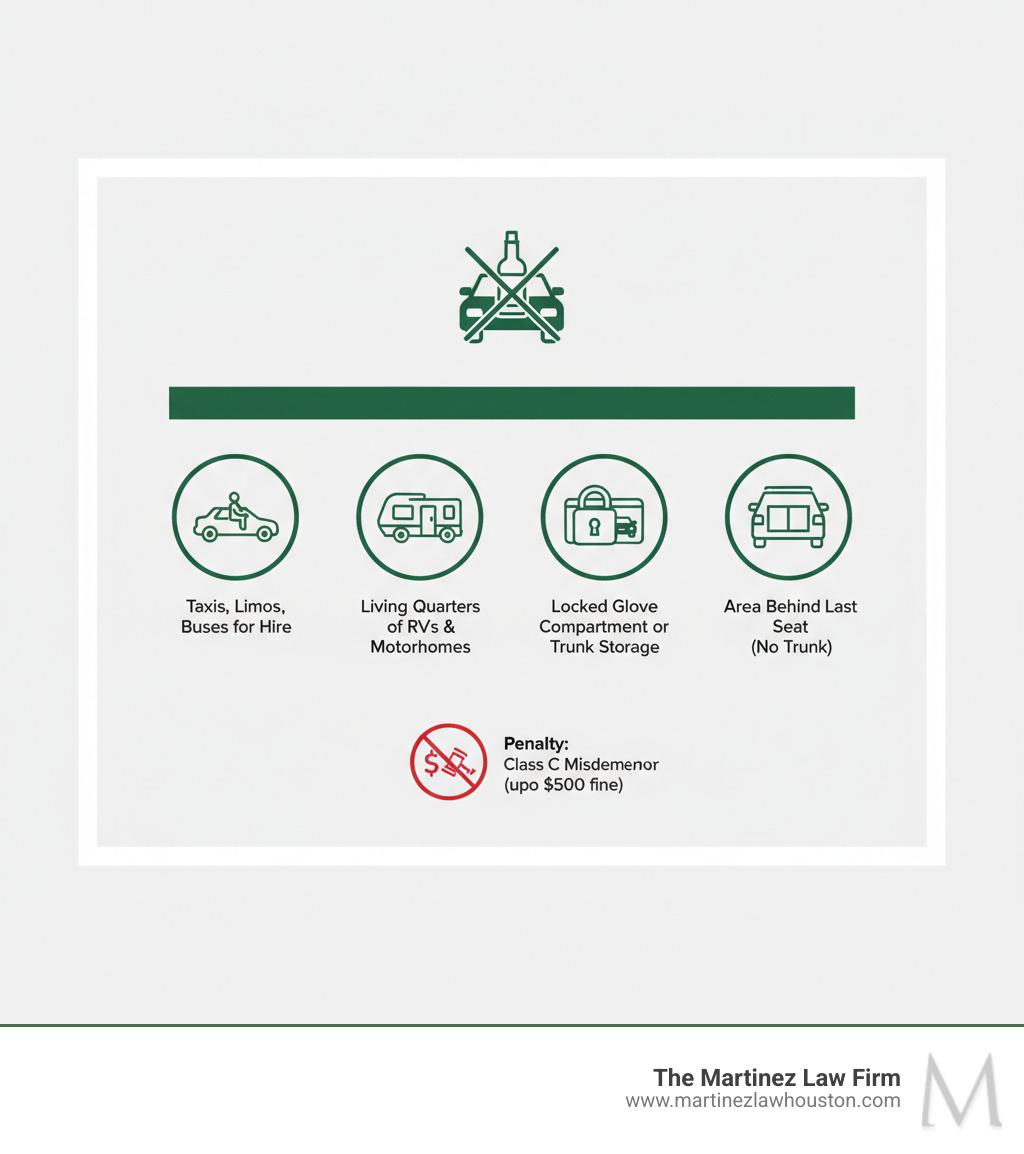
Understanding the Basics: What is Texas’s Open Container Law?
Before diving into open container law texas exceptions, you must understand the basics. Texas Penal Code § 49.031 makes it illegal to knowingly possess an open alcoholic beverage container in the passenger area of a motor vehicle on a public highway.

What catches people off guard is that it doesn’t matter if you’re driving, stopped, or parked. If you’re on a public highway with an open container in the passenger area, you’re breaking the law.
And here’s the kicker—both drivers and passengers can be charged. I’ve represented many sober drivers in Houston cited for an open container violation because a passenger had one. The law doesn’t care who’s drinking, only that someone knowingly possessed the open container.
Defining “Open Container”
So what exactly is an “open container”? It’s not just a half-finished beer in your cup holder.
Under Texas law, an open container is any bottle, can, or other receptacle that contains any amount of alcohol and has been opened, has a broken seal, or has had some of its contents removed.
This includes a re-corked bottle of wine from a Houston restaurant, a to-go cocktail with a broken seal, or a whiskey bottle with the original seal gone. I’ve even seen cases where an “empty” beer can was considered an open container because it was still cold. The bottom line is simple: if the original seal is broken, it’s open under Texas law.
The “Passenger Area” Explained
Understanding where you can and can’t have an open container is crucial. The passenger area is anywhere the driver or passengers can easily reach.
This includes the driver’s seat, passenger seats, center console, door pockets, and under the seats—basically anywhere within arm’s reach. If someone can grab it without unbuckling, it’s likely in the passenger area.
But this is where open container law texas exceptions matter. Certain areas are excluded from the “passenger area” definition:
- Locked glove compartments (not just closed—actually locked)
- The trunk of your vehicle
- The area behind the last upright seat in SUVs, hatchbacks, and vans without a traditional trunk
These are your legal safe zones. If you’re transporting an opened bottle of wine, put it in the trunk. In an SUV, place it in the cargo area behind the back seat. For Houston’s many pickup trucks, the bed of the truck works—just not the cabin.
What Counts as a “Public Highway”?
The term “public highway” is broader than you’d think, extending beyond I-45 or the Katy Freeway.
A public highway is any public road, street, highway, interstate, or other publicly maintained way open to motor vehicle travel. This includes shoulders, the right-of-way, and public parking lots connected to public streets.
Your neighborhood street in the Heights? Public highway. The parking lot at Findy Green? If it’s open to the public and connects to a public road, it counts. That gas station lot off Westheimer where you pulled over? Still a public highway under Texas law.
The key is whether the public has access for vehicle travel. If so, the open container law applies whether you’re moving or parked with the engine off.
The Core of the Matter: Texas Open Container Law Exceptions
While Texas law is strict about open containers, it provides specific exceptions. These aren’t loopholes but carefully defined open container law texas exceptions that recognize certain vehicles and situations are different.
Crucially, these exceptions almost always apply to passengers, not drivers. The person behind the wheel must always remain sober and cannot have an open container within reach, regardless of the vehicle type.

The legal gray areas can be confusing, especially when planning a night out in Houston. Let’s break down when and where these exceptions protect you.
Passengers in Vehicles for Hire
One of the most practical exceptions covers passengers in vehicles for hire. If you’re paying for transportation in a vehicle designed for carrying passengers, you can generally have an open container.
This exception covers taxis, limousines, buses (city and chartered), and party buses common in Houston’s entertainment districts. Passengers in these vehicles can legally drink while traveling.
What about Uber and Lyft? The law covers vehicles “used primarily for transporting persons for compensation.” While rideshares fit this description, both Uber and Lyft have company policies prohibiting open containers. Drivers can refuse service or end a ride for violations. So, while the legal exception may apply, company policy often forbids it.
Remember the absolute rule: the driver cannot have an open container or consume alcohol, period. This exception only protects passengers.
Living Quarters of RVs and Motorhomes
Texas law recognizes RVs as homes on wheels. The open container law doesn’t apply to the living quarters of motorized house coaches, self-contained trailers, and campers.
The key is “living quarters”—the residential section with beds, a kitchen, or a couch. Passengers in these areas can legally have open containers while traveling down I-45.
However, the driver’s cab is completely separate and subject to normal open container rules. The driver’s seat, front passenger seat, and anything within the driver’s reach are off-limits. We’ve seen cases where someone handing a beer forward from the back of an RV led to a citation. Keep all open containers well away from the cab and ensure the driver is sober.
Other Notable Texas Open Container Law Exceptions
Other situations also have specific rules:
Boats on Texas waterways operate differently. You can have open containers on a boat on Lake Conroe or Galveston Bay. However, operating a boat while intoxicated (BWI) is as serious as a DWI. The operator must stay sober.
Tailgating is a Texas tradition, especially in Houston. Many stadiums like NRG Stadium have designated tailgating zones where public consumption is permitted on private property with the owner’s permission. Always check posted signs and local rules, as this doesn’t apply to all parking lots.
Private property is another consideration. The state’s open container law targets public highways. On private property with the owner’s consent, the state law generally doesn’t apply. However, Houston and Harris County have their own ordinances about public consumption, so a privately owned but publicly accessible lot might still have restrictions. Don’t assume private property is a free-for-all.
For complete legal language, you can review the official statute, which is the authoritative source.
Penalties and Related Charges in Houston
An open container violation might not sound like a big deal at first. After all, it’s not like you were driving drunk, right? But here in Houston and Harris County, law enforcement takes these charges seriously, and the consequences can surprise you. What starts as a simple traffic stop can quickly turn into something that affects your wallet, your record, and even your future opportunities.

Standard Penalties for an Open Container Violation
In Texas, an open container violation is classified as a Class C Misdemeanor. You might think, “Well, at least it’s not a felony,” and you’d be right. But don’t let the classification fool you—this charge still carries real consequences that can follow you for years.
The most immediate impact is financial. You’re looking at fines up to $500 for a single violation. While multiple open containers found during one stop typically count as a single offense, the officer and the court have discretion in how they handle your case.
But here’s what really catches people off guard: you’ll have a criminal record. Even though a Class C misdemeanor doesn’t come with jail time, it’s still a criminal conviction. That record doesn’t just disappear after you pay the fine.
The ripple effects can be frustrating. When you’re applying for jobs, especially in fields that require background checks, that open container conviction shows up. We’ve worked with clients who lost job opportunities or professional licenses because of what they thought was “just a ticket.” Your insurance rates might jump too, as providers often see any alcohol-related violation as a red flag that you’re a higher risk to insure.
For students, the stakes are even higher. College admissions offices and financial aid departments review criminal records. A misdemeanor conviction could affect your acceptance to certain programs or your eligibility for scholarships and federal aid.
In most cases, you’ll receive a citation and a notice to appear in court rather than being arrested on the spot. But make no mistake—this is a legal charge that requires your attention and a proper response.
How an Open Container Improves a DWI Charge
This is where things get serious, and it’s something every driver in Houston needs to understand. If you’re charged with DWI and there’s an open container in your vehicle, that open container doesn’t just add a separate charge—it actually “improves” or “improves” your DWI charge under Texas law. (I know, “improves” seems like an odd word choice for making things worse, but that’s the legal terminology.)
Here’s what that means in practice. A first-offense DWI is typically a Class B misdemeanor. But when an open container is involved, the minimum jail time jumps from 72 hours to six days. That’s mandatory time behind bars, not something a judge can waive or reduce. Those extra days might not sound like much, but they can mean losing your job, missing important obligations, and experiencing the very real stress of incarceration.
The financial penalties climb higher too. While the maximum fine for a Class B misdemeanor DWI is $2,000, having that open container improvement often pushes judges toward the higher end of the sentencing range. Add in court costs, attorney fees, and other expenses, and you’re looking at a significant financial burden.
License Suspension
Your license suspension becomes more likely and potentially longer—up to a year for a first offense. And if you refuse a breath or blood test during the DWI stop, you’re facing an automatic administrative license suspension regardless of whether you’re ultimately convicted. Many defendants also face requirements to install an ignition interlock device in their vehicles, which prevents the car from starting if it detects alcohol on your breath.
Here’s something important to remember: the open container charge is separate from the DWI charge. You could be found not guilty of DWI but still convicted of the open container violation. However, when both charges stick, the combination creates much harsher penalties than either would carry alone.
A Consistent Pattern
We see this pattern constantly in Houston. An officer pulls someone over for a minor traffic violation, spots an open container in the car, and suddenly has probable cause to investigate for DWI. What started as a broken taillight turns into a life-changing legal battle. Understanding open container law texas exceptions and proper storage methods isn’t just helpful—it’s essential protection against these escalating charges.
At The Martinez Law Firm, we’ve defended countless clients facing these exact situations. With over 25 years of experience, including my time as Chief Prosecutor for the Harris County District Attorney’s Office, I know how these cases develop and how to fight them effectively.
Frequently Asked Questions about Texas Open Container Laws
We get a lot of questions about Texas open container laws, and honestly, that makes sense. The rules can be tricky, and the consequences are real. Here are some of the most common questions we hear from clients right here in Houston.
Can I be charged with an open container violation if my car is parked?
Yes, and this surprises a lot of people. It’s one of the biggest misconceptions we encounter at The Martinez Law Firm. Many folks assume that if they’re not actually driving, they’re in the clear. Unfortunately, that’s not how Texas law works.
Texas Penal Code § 49.031 makes it clear that the offense applies whether your vehicle is “being operated or is stopped or parked.” The engine doesn’t have to be running. You don’t have to be behind the wheel. If there’s an open container in the passenger area and your vehicle is on a public highway, you can be charged.
What does that mean in practical terms? If you’re parked on the side of a Houston street waiting for a friend, sitting in a grocery store parking lot, or pulled over on the shoulder of I-10 to take a call, the open container law still applies. Public parking lots are typically considered part of the public highway system for these purposes, so that HEB or Target parking lot isn’t a safe haven.
We’ve represented clients who thought they were being responsible by pulling over to finish a drink before driving home. Instead, they ended up with a citation and a criminal record. The location matters more than whether you’re moving.
How do local Houston ordinances affect the state’s open container law?
This is where things can get even more complicated. The state law sets the baseline, but cities like Houston have the authority to add their own restrictions on top of it. Local ordinances can be stricter than state law, though they can’t be more lenient.
In Houston, there are additional rules about public consumption of alcohol that go beyond what happens in your vehicle. Certain areas—like parks, entertainment districts, or near specific facilities—have their own prohibitions against possessing or consuming alcohol in public spaces. You might see similar rules in other Harris County communities as well.
Here’s a real-world example: let’s say you’re a passenger in a party bus, which would normally fall under the open container law texas exceptions. That’s perfectly legal while you’re in the vehicle. But if you step out onto the sidewalk in certain parts of downtown Houston with that same drink, you could be violating a local ordinance about public consumption.
Always pay attention to posted signs, especially in popular gathering spots like Findy Green, the Heights, or Midtown. What’s legal in your vehicle might not be legal once you’re on the sidewalk or in a public park. When in doubt, it’s better to ask or simply avoid the situation altogether.
Can I legally transport a previously opened bottle of wine from a restaurant?
Yes, you absolutely can, but the details matter here. This is actually a great example of how understanding the open container law texas exceptions and proper storage rules can keep you out of trouble.
Many Houston restaurants—from the fine dining spots in the Galleria area to neighborhood favorites in Montrose—will offer to re-cork or re-seal your unfinished bottle of wine if you purchased it with a meal. This is perfectly legal to take home with you. The same goes for to-go cocktails that some establishments now offer, as long as they’re properly sealed.
The critical part is how you transport it. That re-corked bottle can’t just ride in your cup holder or sit on the passenger seat. To avoid an open container violation, it must be stored in one of the specifically excluded areas of your vehicle: the trunk, a locked glove compartment, or the area behind the last upright seat if you’re driving an SUV, hatchback, or van without a traditional trunk.
Think of it this way: if the driver or any passenger can easily reach it while seated, it’s in the wrong spot. We’ve seen cases where someone had a properly sealed bottle from a restaurant but placed it in the back seat next to them. That’s still considered the passenger area, and it can lead to a citation.
Take the extra thirty seconds to pop your trunk and store it properly. It’s a small effort that can save you from a $500 fine, a criminal record, and all the headaches that come with it. And if you’re ever unsure about whether you’re following the rules correctly, that’s exactly the kind of question we’re here to answer at The Martinez Law Firm.
Facing a Charge? Know Your Next Steps
We’ve covered a lot of ground together—from what qualifies as an open container to the specific situations where open container law texas exceptions apply. You now know that passengers in limousines and party buses have more flexibility, that the living quarters of your RV are treated differently than the driver’s cab, and that storing opened bottles in your trunk or locked glove compartment keeps you on the right side of the law.
But here’s the reality: even with this knowledge, mistakes happen. Maybe a friend left a beer can under the seat. Perhaps you thought that re-corked wine bottle was secure enough where it was. Or you might have been completely unaware that an open container in your vehicle could add six days of mandatory jail time to a DWI charge.

If you’re facing an open container charge in Houston or anywhere in Harris County, don’t brush it off as “just a ticket.” That Class C misdemeanor creates a permanent criminal record that can follow you for years. It can complicate job applications, raise your insurance rates, and if it’s connected to a DWI, the consequences multiply dramatically.
The most important step you can take right now is to get experienced legal representation. Not all attorneys understand how prosecutors think or how they build their cases. Having someone on your side who’s actually stood in their shoes makes a real difference.
Call an Experienced Attorney
At The Martinez Law Firm, I bring more than 25 years of experience to your defense, including my time as Chief Prosecutor for the Harris County District Attorney’s Office. I know how the other side operates because I used to be the other side. That insider knowledge allows me to build aggressive, personalized defenses that challenge every aspect of your charge—from whether the stop was legal to whether the container truly qualified as “open” under the statute.
We’ve helped countless clients in Houston steer these exact situations, often getting charges reduced or dismissed entirely. Your future matters, and one mistake shouldn’t define it.
Protect your rights with an experienced Houston defense attorney. Let’s talk about your case and find the best path forward together.
The High Stakes of a DWI While on Probation

What happens if you get a dui while on probation creates two separate legal battles. You face:
Immediate Consequences:
- Probation Violation Hearing – Your probation officer files a Motion to Revoke (MTR), and a judge decides whether to revoke your probation and impose your original sentence.
- New DWI Criminal Case – You face separate criminal charges with penalties including jail time, fines, and license suspension.
- Dual Penalties – If convicted on both, you could serve the suspended sentence from your original offense plus penalties for the new DWI.
- Lower Burden of Proof – The probation violation only requires a “preponderance of evidence” (more likely than not), making it easier to prove than the criminal case.
In Harris County, this situation is particularly serious. An arrest alone can violate your probation, leading to a bench warrant and potential revocation by the original judge.
In Houston, this means fighting on two fronts. Consequences range from stricter probation to serving your original sentence plus new jail time. The process is fast, and early mistakes are costly.
I’m Herman Martinez, a former Chief Prosecutor for Harris County and a City of Houston Judge with over 25 years of experience. I’ve seen what happens if you get a dui while on probation from both sides and know the strategies that protect your freedom.
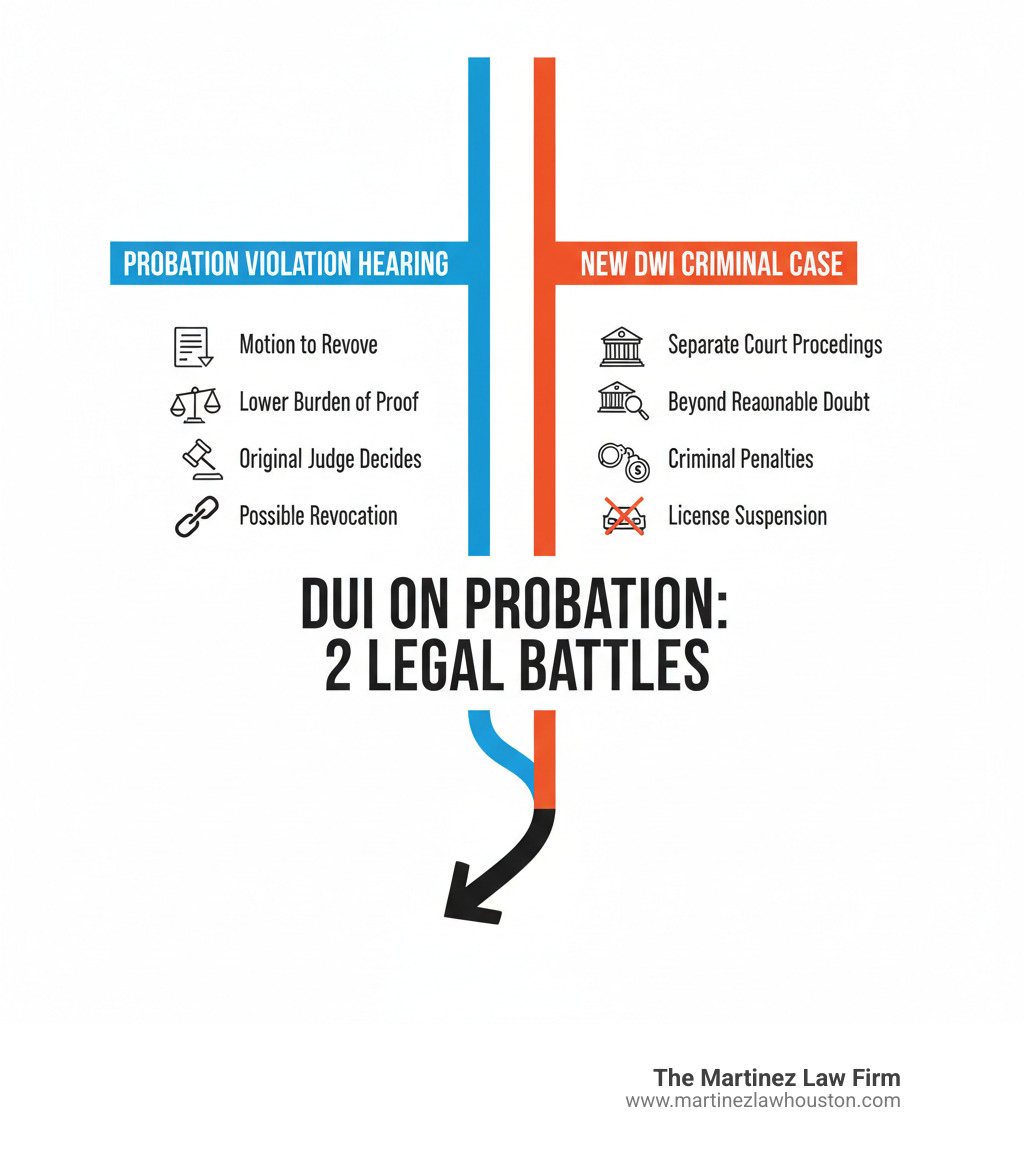
Understanding Your Probation and How a DWI Violates It
Probation in Texas—officially community supervision—is a second chance to avoid jail. But it’s a privilege with strict rules. Breaking them can lead to more trouble than your original offense.

Probation is a contract with the court. You agree to follow conditions to avoid jail time. The most fundamental rule is simple: don’t commit any new crimes.
A DWI arrest is a serious problem. It almost always triggers a probation violation, even if not explicitly mentioned in your paperwork. Your probation officer can file a Motion to Revoke Probation (MTR), putting your freedom in jeopardy.
For more background on how DWI probation works in Texas, check out our guide on DWI Probation in Texas: What You Need to Know.
General Terms of Probation in Harris County
Most probation agreements in Harris County share common conditions designed to keep you accountable. Specifics depend on your offense, history, and judge.
- No new offenses is the top rule. A DWI charge directly violates this, regardless of conviction.
- Regular check-ins with your probation officer and timely payment of all fines and fees are mandatory.
- You may also have to complete community service hours and attend counseling or classes, such as substance abuse programs or victim impact panels.
- Other conditions can include no-contact orders, travel restrictions, and maintaining lawful employment.
- For DWI probation, you must abstain from alcohol and drugs, often verified by random testing. An ignition interlock device (IID) may also be required. As probation agreements emphasize, these rules aren’t suggestions—they’re court orders.
How a DWI Arrest Triggers a Violation
A DWI arrest creates immediate problems, even before a conviction.
A DWI is a new criminal offense, violating the “obey all laws” clause. Your probation officer will learn of the arrest quickly and can file a Motion to Revoke.
Crucially, you don’t need to be convicted of the DWI for it to violate your probation. The arrest alone can be enough. Probation violations only require a “preponderance of the evidence”—a much lower standard than the “beyond a reasonable doubt” needed for a criminal conviction.
If your probation has a “no alcohol” condition, any measurable amount of alcohol in your system can trigger a violation, even if you’re not legally intoxicated.
Notifying your probation officer of the arrest is critical. Most agreements require immediate reporting (usually within 24-48 hours). Failure to report is a separate, serious violation that judges often view harshly. Hiding the arrest only makes things worse.
The bottom line: a DWI arrest while on probation in Harris County starts two legal battles—the new criminal case and a probation violation hearing. Both require immediate, experienced legal representation.
What Happens if You Get a DWI While on Probation: The Two-Front Legal Battle
Getting a DWI while on probation in Houston means fighting on two fronts. It’s two separate legal battles, each with its own rules and potentially devastating consequences. Understanding what happens if you get a dui while on probation means recognizing this dual threat.
On one side is the probation violation hearing for breaking your probation terms. On the other is a separate criminal case for the new DWI charge. These proceedings are independent but can influence each other.
The key challenge is the different standards of proof. A probation violation only requires a preponderance of the evidence (more likely than not). The new DWI case requires proof beyond a reasonable doubt. This means you could beat the DWI charge but still have your probation revoked.
You’ll also likely face an Administrative License Revocation (ALR) hearing. This civil proceeding with the Texas Department of Public Safety determines if your driver’s license will be suspended, adding another layer of complexity.
Navigating these interconnected proceedings requires a strategic approach. For more detailed guidance, check out our article on What to do at a Probation Violation Hearing.
The Probation Violation Hearing Process
Once your probation officer learns of your DWI arrest, they will file a Motion to Revoke (MTR) Probation with the court. The judge will then likely issue a bench warrant for your arrest. You can be arrested at any time, which catches many people by surprise.
After arrest, you’ll be held in custody. The judge has enormous discretion and can set a high bond or deny bond entirely, meaning you could be jailed for weeks or months awaiting your hearing.
The hearing is before the same judge who gave you probation. There is no jury; the judge alone decides your fate. The judge has several options: reinstate your probation with a warning, modify your probation with stricter terms, or revoke your probation entirely, sending you to serve the original suspended sentence.
The probation violation hearing is separate from your DWI criminal case, but you also need to be aware of the ALR hearing. Learn more in our guide, What Happens at an ALR Hearing?.
Fighting the New DWI Charge
Simultaneously, you’re fighting a separate court case for the new DWI charge, where the state must prove guilt beyond a reasonable doubt.
A new DWI conviction carries serious penalties, including fines, jail time, license suspension, and a possible ignition interlock device. The severity depends on if it’s a first, second, or subsequent offense and any aggravating factors. You can find detailed information about the potential consequences in our section on DWI penalties in Texas.
The DWI arrest also triggers an administrative license suspension. You have only 15 days from your arrest to request a hearing to challenge it. Missing this deadline means automatic suspension. We’ve written extensively about The 15-Day Rule because it’s a critical deadline.
Your attorney might negotiate a plea bargain. However, even pleading to a lesser charge still counts as a new crime and can violate your probation.
The outcome of the DWI case directly impacts the probation violation. An acquittal or dismissal strengthens your position, while a conviction makes revocation highly likely.
This is why a coordinated defense is essential. At The Martinez Law Firm, we handle both the DWI case and the probation violation simultaneously. My background as a former prosecutor and judge provides a strategic advantage in protecting your freedom.
Facing Double Penalties: Consequences for the Violation and the New DWI
Getting a DWI on probation is like facing double penalties. You’re penalized for the new DWI and for violating the court’s trust.

The consequences can include:
- Revocation of Probation and reinstatement of your original sentence.
- New DWI Penalties, including fines, jail time, and license suspension.
- Fines and Surcharges for both the original offense and the new DWI.
- Ignition Interlock Device (IID) requirements.
- Increased Costs, which can be immense. Our article on The Financial Costs of a DWI goes into more detail.
You could face penalties for both, leading to much harsher outcomes than a single charge.
Penalties if Your Probation is Revoked
If the judge revokes your probation, the consequences are severe. The court takes back the privilege of community supervision and orders you to serve the originally suspended sentence.
- Serving Suspended Sentence: You will be ordered to serve the original jail or prison sentence. For a misdemeanor, this could be up to six months in county jail. For a felony, it could be years in state prison.
- No Credit for Time Served on Probation: In most cases, the time you successfully spent on probation does not count toward your jail or prison sentence. It’s a harsh reality that adds to the punishment.
Judges have broad discretion and often view a new crime on probation as a direct defiance of their orders.
Penalties for the New DWI Conviction Itself
In addition to the probation violation, you face separate penalties for the new DWI charge in Texas, which stack on top of any revocation consequences.
| Offense | Jail Time | Fines (up to) | License Suspension (up to) | Other Common Penalties |
|---|---|---|---|---|
| First DWI | 3 days to 180 days (Class B Misdemeanor) | $2,000 | 1 year | Annual surcharge ($1,000-$2,000 for 3 years), DWI education program, possible IID, community service. |
| Second DWI | 30 days to 1 year (Class A Misdemeanor) | $4,000 | 2 years | Annual surcharge ($1,500-$2,000 for 3 years), mandatory IID, DWI education program, community service. |
| Third DWI | 2 to 10 years (Third-Degree Felony) | $10,000 | 2 years | Annual surcharge ($1,500-$2,000 for 3 years), mandatory IID, DWI education program, community service. |
Penalties can be improved by aggravating factors like a high BAC, an accident, or a child passenger. For more information, see our pages on Aggravated DWI factors and Texas DWI Laws.
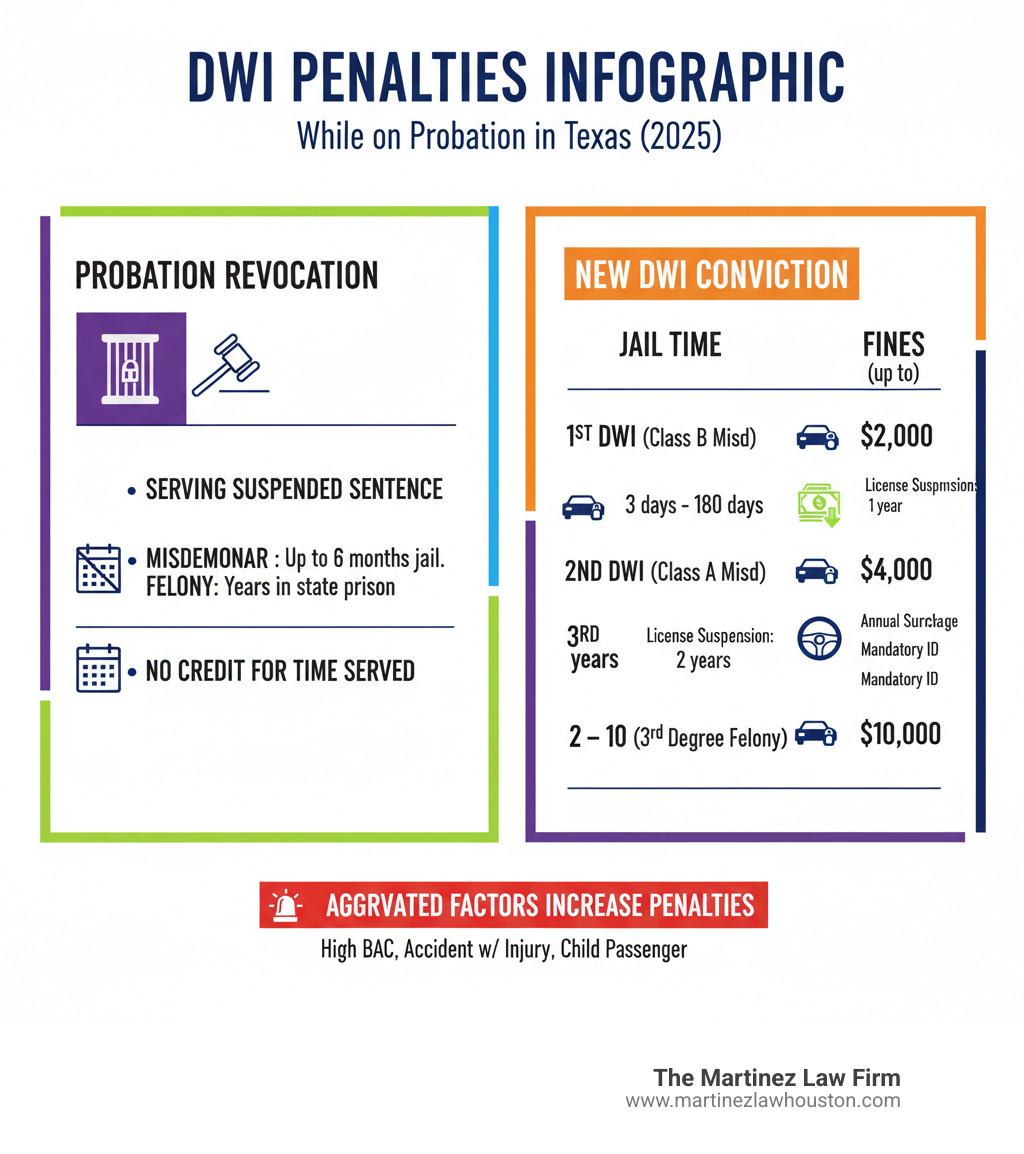
The combination of these penalties makes getting a DWI on probation one of the most serious legal situations you can face.
Building Your Defense: The Crucial Role of a DWI Lawyer
Facing a DWI on probation is a legal emergency. You need an experienced DWI lawyer. At The Martinez Law Firm, our advantage is Herman Martinez’s background as a former Chief Prosecutor. We know how the prosecution thinks and where their case is weak.
We use a dual defense strategy, tackling both the new DWI and the probation violation. An attorney can review your case for defenses, protect your rights, negotiate with prosecutors, and fight for alternatives to jail time, like treatment programs.
What happens if you get a DWI while on probation and need a defense?
A robust defense is your best bet. Common strategies include:
- Unlawful Traffic Stop: Police need reasonable suspicion for a traffic stop. If the stop was illegal, evidence gathered from it may be suppressed. We have experience Challenging the Evidence.
- Improperly Administered Field Sobriety Tests (FSTs): These tests are subjective and often flawed. Medical conditions, weather, and other factors can affect performance. We can challenge their validity.
- Inaccurate Breath or Blood Tests: Breathalyzers can be faulty or improperly used. Blood tests can be compromised by poor handling. We scrutinize the scientific validity and chain of custody for these tests.
- Rising BAC Defense: Your Blood Alcohol Concentration (BAC) may have been lower while driving than when tested later. This complex defense often requires expert testimony.
- Challenging the MTR Evidence: In the probation hearing, we can challenge the probation officer’s evidence, arguing against its sufficiency even with the lower burden of proof.
Navigating these complexities requires a dedicated legal professional. The value of having an attorney for a DWI charge cannot be overstated.
Can Probation Be Reinstated After a Violation?
Yes, probation can sometimes be reinstated or modified after a violation, but it’s not guaranteed and depends on the judge’s discretion.
Here’s how we work to achieve this:
- Judge’s Discretion: Judges have broad leeway and can choose to reinstate or modify probation instead of revoking it, even for a new DWI.
- Mitigating Factors: We present factors like prior compliance, employment, family responsibilities, and rehabilitation efforts to the court.
- Proactive Steps: Voluntarily enrolling in treatment programs, attending AA meetings, or seeking counseling shows a commitment to change that can sway a judge. The Alcoholics Anonymous program has helped many.
- Arguing for Modification vs. Revocation: We often argue for modifying probation (e.g., extending the term, adding an IID) rather than revocation. This is usually a better outcome than jail time.

Convincing a judge requires a compelling argument. Our experience in Houston courts allows us to effectively advocate for your second chance.
Frequently Asked Questions about DWI and Probation in Texas
Facing a DWI on probation brings up many questions. With over 25 years of experience in Houston courts, I’ve heard them all. Here are answers to the most common ones.
Can you be around alcohol while on probation for a DWI?
The short answer is: it depends on your specific orders, but it’s extremely risky. Most Texas DWI probation terms include a strict “no-alcohol” clause, often monitored through random testing or devices like SCRAM ankle monitors.
Even if not explicitly forbidden, being in places like bars looks bad to a probation officer and the court. It’s wise to avoid these situations entirely. The bottom line: Remaining drug and alcohol-free is a common condition of probation. It’s not worth the risk when what happens if you get a dui while on probation could mean losing your freedom.
What happens if you get a DWI while on probation for a different crime?
The process is the same, regardless of your original crime. A DWI is a new offense, which violates the standard probation condition to “obey all laws.”
You will still face a Motion to Revoke Probation (MTR) for the original crime and separate criminal charges for the new DWI, creating the same two-front battle. The court won’t distinguish between the crimes; a violation is a violation. The judge will see the new DWI as a breach of trust.
Can you get early release from DWI probation in Texas?
Unfortunately, the answer is no. This is a common misconception.
The Texas Code of Criminal Procedure 42A § 701 explicitly states that judges cannot grant early release from probation for a DWI offense, even though they can for other crimes.
This means you must complete the full term of your DWI probation, typically one to two years. Even perfect compliance won’t change this. This highlights the strictness of Texas DWI probation and why avoiding a new charge while on probation is so critical.
Don’t Face a Probation Violation Alone
A DWI arrest while on probation in Houston is a legal emergency. You face potential jail time for both the original offense and the new charge. Don’t wait and hope for the best.
The stakes are incredibly high. You’re fighting two legal battles at once, and one misstep can have devastating, long-term consequences for your freedom and future.
In this complex situation, an experienced attorney is crucial. At The Martinez Law Firm, we understand what happens if you get a dui while on probation. Herman Martinez’s background as a former Chief Prosecutor and City of Houston Judge gives us unique insight into how to build a successful defense in Houston courtrooms.
We build a coordinated defense for both your probation violation and the new DWI charge. We know how these cases interconnect and use that knowledge to challenge evidence, negotiate with prosecutors, and argue for your second chance.
We have helped many clients in Harris County steer this exact situation, achieving outcomes like reinstated probation or reduced charges. Immediate, strategic action is the key to a manageable outcome.
The longer you wait, the fewer options you have. Don’t let this predicament become a permanent problem.
If you’re facing a DWI on probation, contact us now. We will review your case and start building the aggressive defense you need. Your freedom is worth fighting for. Contact an experienced DWI lawyer today to protect your future.