

Understanding the Critical Differences Between DWI and DUI in Texas
Though often used interchangeably, DWI and DUI in Texas are distinct charges with different consequences based on age and circumstance. Here’s the essential breakdown:
Quick Answer: DWI vs. DUI in Texas
-
DWI (Driving While Intoxicated): Applies to drivers 21 and older with a BAC of 0.08% or higher, or with impaired mental/physical faculties due to alcohol or drugs. This is a Class B misdemeanor (Class A if BAC ≥ 0.15%), carrying jail time, fines up to $2,000-$4,000, and license suspension.
-
DUI (Driving Under the Influence): Applies to drivers under 21 with any detectable amount of alcohol in their system. This is a Class C misdemeanor with fines up to $500, community service, and license suspension—reflecting Texas’s zero-tolerance policy for underage drinking and driving.
-
Key Distinction: DWI requires proof of intoxication (0.08% BAC or impairment); DUI for minors requires only any detectable alcohol, regardless of impairment level.
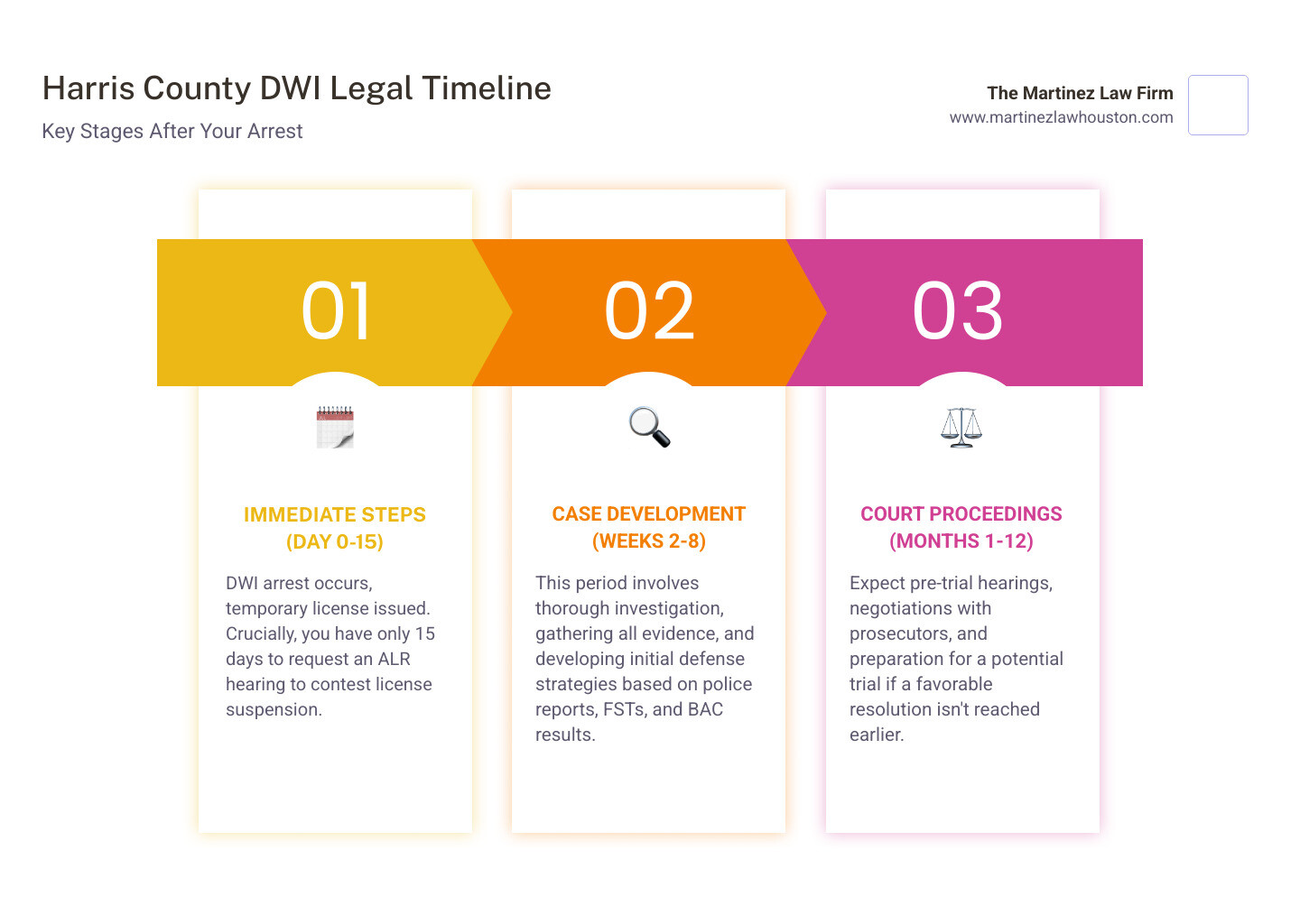
An arrest in Houston or Harris County triggers two separate processes: a criminal case and an administrative action against your license. Crucially, you have only 15 days from your arrest to request an Administrative License Revocation (ALR) hearing to fight the automatic suspension of your license.
Texas takes these charges seriously. A conviction’s impact goes beyond fines and jail, potentially affecting your job, professional licenses, housing, and international travel. For minors, a DUI can jeopardize college admissions and career prospects.
This guide explains Texas DWI and DUI laws, penalties, legal processes, and defense strategies to protect your future.
I’m Herman Martinez, founder of The Martinez Law Firm. With over 25 years of experience as a former Chief Prosecutor for Harris County and a City of Houston Judge, I’ve handled cases of DWI and DUI in Texas from every angle. I now use that insider knowledge to aggressively defend clients in Houston and Harris County facing these life-altering charges.
The Core Distinction: DWI vs. DUI in Texas Law

When facing a drinking-and-driving charge in Houston, understanding the specific offense is critical. DWI and DUI in Texas are not the same; they are distinct charges under Texas law, with penalties and defenses determined by one key factor: your age.
What is Driving While Intoxicated (DWI) in Texas?
Driving While Intoxicated (DWI) applies to adults 21 and older. A DWI arrest in Harris County means you’re charged under Texas Penal Code Section 49.04 for operating a motor vehicle in a public place while intoxicated.
Texas law defines “intoxicated” in two ways. You are legally intoxicated in Texas if you have a blood alcohol concentration (BAC) of 0.08% or higher. You are also considered intoxicated if you lack the normal use of your mental or physical faculties due to alcohol, drugs, or a combination of substances.
This means an officer’s subjective observation of impairment (slurred speech, stumbling) can lead to a DWI charge, even with a BAC below 0.08% or without a test. Conversely, a BAC of 0.08% or higher is sufficient for a DWI charge, regardless of how you felt or drove.
A first-time DWI is typically a Class B Misdemeanor, but this can be liftd to a Class A Misdemeanor if your BAC was 0.15% or higher. DWI charges can result from impairment by alcohol, illegal drugs, or even prescription medications.
What is Driving Under the Influence (DUI) in Texas?
Driving Under the Influence (DUI) applies exclusively to minors under 21. Reflecting Texas’s zero-tolerance policy, a DUI charge requires only any detectable amount of alcohol in the minor’s system. Impairment is not a factor; even a trace of alcohol is enough for a DUI charge.
This means a 19-year-old with a BAC that is legal for an adult would still face criminal charges. The legal threshold for minors is effectively zero.
DUI charges are governed by the Texas Alcoholic Beverage Code and are classified as Class C Misdemeanors for a first offense. While less severe than an adult DWI, the consequences can still be devastating for a young person’s future.
Understanding the Legal Classifications
To make the distinction between dwi and dui in texas crystal clear, here’s how the charges compare:
| Characteristic | DWI (Adults) | DUI (Minors) |
|---|---|---|
| Legal Age | 21 years or older | Under 21 years |
| BAC Threshold | 0.08% or higher, OR loss of normal faculties due to impairment | Any detectable amount of alcohol |
| Governing Statute | Texas Penal Code, Chapter 49, Section 49.04 | Texas Alcoholic Beverage Code, Section 106.041 |
| Offense Class | Typically Class B Misdemeanor (first offense) | Class C Misdemeanor (first offense) |
A minor can face both charges. If an underage driver has a BAC of 0.08% or higher or is clearly impaired, Harris County prosecutors can charge them with the more serious adult DWI. The state will typically pursue the charge with the harsher penalties.
Navigating the Penalties for DWI and DUI in Texas

Penalties for DWI and DUI in Texas are harsh by design to deter impaired driving. A conviction in Houston or Harris County can disrupt your life for years. The local courts, including the specialized Harris County DWI Court Program, take these offenses extremely seriously, especially for repeat offenders.
Penalties for a First-Time DWI Offense
A first time DWI offense for an adult is a Class B Misdemeanor with severe consequences. Penalties include:
- Fines: Up to $2,000.
- State Fees: Annual surcharges of $1,000 to $2,000 for three years to keep your license.
- Jail Time: 3 to 180 days, though probation is often possible.
- License Suspension: 90 days to one year.
- Ignition Interlock Device (IID): Often mandatory, requiring you to pass a breath test to start your car.
- Education: Mandatory completion of a DWI education program.
Penalties for Subsequent DWI Offenses
Penalties escalate sharply for repeat offenders.
- Second DWI Offense: A Class A Misdemeanor with fines up to $4,000, jail time from 1 month to 1 year, and a license suspension of up to 2 years.
- Third DWI Offense: A Third-Degree Felony, carrying a $10,000 fine, 2 to 10 years in state prison, and a license suspension up to 2 years. A felony conviction results in a permanent record and the loss of rights like voting and owning firearms.
Penalties for an Underage DUI Offense
A minor’s first DUI charge is a Class C Misdemeanor, but the penalties can still impact a young person’s future. A first offense includes:
- A fine up to $500.
- A 60-day driver’s license suspension.
- 20 to 40 hours of community service.
- Mandatory alcohol awareness classes.
Failure to complete the class extends the suspension by 180 days. Importantly, if a minor’s BAC is 0.08% or higher, they can be charged with an adult DWI and face much harsher penalties, including jail time.
Improved Penalties and Aggravating Factors
Aggravating factors can significantly increase penalties for a DWI and DUI in Texas charge:
- DWI with a Child Passenger: Driving intoxicated with a child under 15 is a State Jail Felony, with up to a $10,000 fine and 2 years in jail.
- High BAC (0.15% or higher): A first offense is liftd to a Class A misdemeanor, with fines up to $4,000 and jail time up to one year.
- Open Container: Adds a mandatory minimum of 6 days in jail to a DWI charge.
- Intoxication Assault: Causing serious bodily injury is a Third-Degree Felony (2-10 years in prison).
- Intoxication Manslaughter: Causing a death is a Second-Degree Felony (2-20 years in prison).
These improved charges are life-altering and require an immediate and aggressive defense.
The Legal Aftermath: From Arrest to License Reinstatement
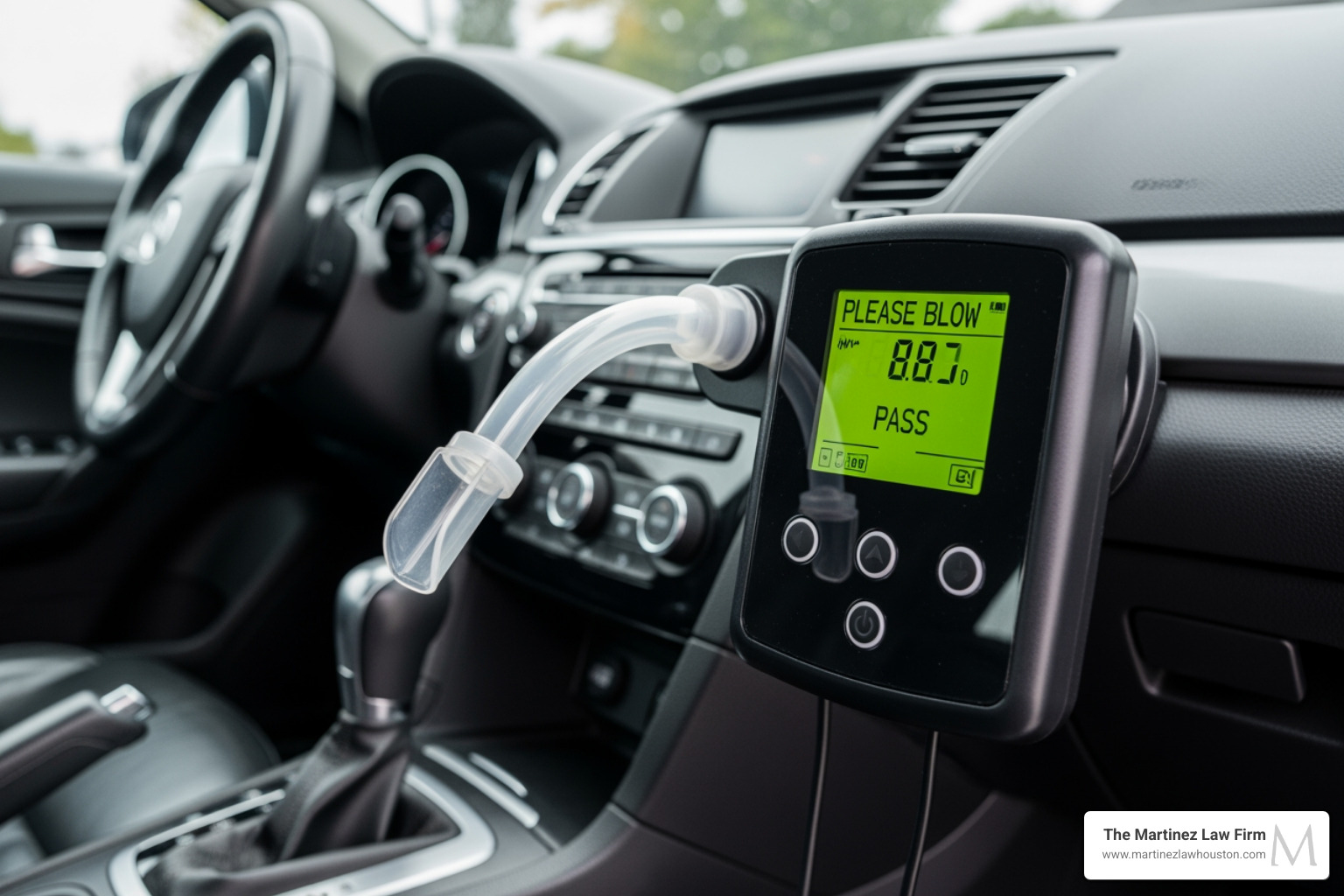
An arrest for DWI and DUI in Texas initiates two separate legal battles: a criminal case and an administrative process to suspend your driver’s license. Understanding both is key to protecting your driving privileges.
Refusing a Breathalyzer and the ALR Process
Under Texas’s “implied consent” law, driving on a public road means you have consented to a breath or blood test if suspected of DWI. Refusing a test has immediate consequences: an automatic 180-day license suspension for a first refusal (2 years for a subsequent one). In Harris County, officers often get warrants for a forced blood draw if you refuse, so refusal may not prevent a test.
The Administrative License Revocation (ALR) process is a civil action by the Texas Department of Public Safety, separate from your criminal case, to suspend your license. You have only 15 calendar days from your arrest to request an ALR hearing. Missing this deadline results in an automatic suspension.
An ALR hearing is a crucial first opportunity to challenge the evidence, cross-examine the officer, and potentially save your license. A win here can also strengthen your criminal defense.
Ignition Interlock Devices and SR-22 Insurance
An ignition interlock device (IID) is a car breathalyzer that prevents your vehicle from starting if it detects alcohol. An IID may be required as a condition of bond, probation, or to get an occupational license for essential driving during a suspension. It’s often mandatory for repeat offenders or those with a BAC of 0.15% or higher. The user bears the cost of installation (around $70-$100) and monthly monitoring (around $60-$90).
SR-22 insurance is a certificate your insurer files with the state to prove you have liability coverage after a DWI. It’s typically required for two years post-conviction. While not insurance itself, the SR-22 requirement labels you a high-risk driver, causing your insurance premiums to increase significantly.
Between the IID, increased insurance costs, and state surcharges, the financial burden of a DWI and DUI in Texas conviction extends far beyond the initial court fine. Fighting the charges from day one, starting with the ALR hearing, is critical.
Building a Defense and Mitigating Long-Term Consequences

Both a DWI and DUI in Texas charge can threaten your future, but it is defensible. An experienced Houston attorney can challenge the evidence, protect your rights, and work to minimize or dismiss the charges.
Common Defense Strategies for DWI and DUI in Texas
Effective defense strategies in Houston courts involve scrutinizing every detail of the arrest for weaknesses in the prosecution’s case. Common defenses include:
- Challenging the Traffic Stop: If the officer lacked reasonable suspicion for the stop, all subsequent evidence may be inadmissible.
- Questioning Field Sobriety Tests: These tests are subjective and can be affected by medical conditions, fatigue, or poor instructions, making them unreliable.
- Contesting Breathalyzer and Blood Test Accuracy: We investigate if breathalyzers were properly calibrated and if blood tests followed strict collection and storage protocols. Medical issues can also cause false high readings.
- Using the Rising BAC Defense: Your BAC may have been below the legal limit while driving but risen by the time of testing.
- Identifying Procedural Errors: Any failure by law enforcement to follow proper protocol, such as not reading your rights, can be used to your advantage.
My experience as a former Harris County Chief Prosecutor provides insider knowledge on how to exploit these weaknesses.
How Long Does a DWI Stay on Your Record?
A DWI conviction in Texas is permanent and can affect your employment, professional licenses (for doctors, nurses, lawyers, etc.), and housing applications for life.
However, in some cases, it may be possible to clear your record. An expunction can erase an arrest if your case was dismissed or you were acquitted. An order of nondisclosure can seal the record from public view if you successfully completed deferred adjudication for certain first-time offenses. These options are complex, making it vital to fight the charge from the start to avoid a conviction altogether.
Related Offenses and Other Consequences
A conviction for both a DWI and DUI in Texas has other far-reaching consequences:
- Boating While Intoxicated (BWI): Carries penalties similar to DWI.
- Firearm Ownership: A misdemeanor DWI conviction generally doesn’t affect firearm rights, but a felony DWI conviction results in a permanent ban on owning firearms.
- Open Container: Having an open container of alcohol during a DWI arrest adds a mandatory six-day jail sentence. Learn more about Texas open container laws.
- International Travel: Countries like Canada may deny entry to individuals with a DWI conviction.
Navigating the Houston legal system requires an attorney with insider knowledge. At The Martinez Law Firm, we use our prosecutorial experience to build the strongest defense for your case.
Frequently Asked Questions about DWI and DUI in Houston
If you’re facing charges of DWI and DUI in Texas, you likely have urgent questions about what comes next. These are some of the most common concerns we hear from our Houston clients.
Can a minor be charged with both a DWI and a DUI in Texas?
Yes. A minor under 21 with any detectable alcohol can be charged with DUI. If that same minor has a BAC of 0.08% or higher or is otherwise impaired, they can also be charged with the more serious adult DWI. In Harris County, prosecutors will typically pursue the DWI charge because it carries much harsher penalties. This makes experienced legal representation essential for any minor charged with a drinking and driving offense.
How does a DWI or DUI conviction affect firearm ownership rights in Texas?
The impact depends on the conviction level. A misdemeanor DWI conviction generally does not affect your firearm rights in Texas. However, a felony DWI conviction leads to the permanent loss of your right to own or possess firearms. This includes a third DWI, intoxication assault, or DWI with a child passenger. Avoiding a felony conviction is critical to protecting your Second Amendment rights.
Can an attorney get a DWI charge dismissed in Houston?
Yes. While no outcome is guaranteed, an experienced Houston DWI attorney can often get charges dismissed or reduced. A dismissal can be achieved by proving issues with the state’s case, such as:
- An illegal traffic stop without probable cause.
- Inaccurate or improperly administered breathalyzer and blood tests.
- Unreliable field sobriety test results.
- Police procedural errors or rights violations.
My experience as a former prosecutor and judge in Harris County gives me unique insight into finding these case-destroying flaws and securing dismissals for my clients.
DWI/DUI Next Steps
A DWI or DUI charge in Texas is a critical event that puts your freedom, career, and future at risk. The legal system in Houston and Harris County is tough on impaired driving, and prosecutors are aggressive. From the moment of your arrest, the clock is ticking on crucial deadlines, like the 15-day window to request an ALR hearing to save your license.
It is crucial to remember that a charge is not a conviction. A strong defense examines every detail: Was the stop legal? Were tests administered correctly? Were your rights violated? The answers to these questions can be the key to a dismissal.
The Martinez Law Firm offers a unique insider’s perspective. As a former Chief Prosecutor for Harris County and a City of Houston Judge with 25 years of experience, Herman Martinez knows how prosecutors build their cases. We now use that knowledge to dismantle them and aggressively defend our clients in Houston and Harris County.
You don’t have to face this alone. We provide the aggressive, personalized defense you need, whether it’s a first offense or a felony charge. Don’t let a dwi and dui in texas charge ruin your future. Contact The Martinez Law Firm today for a consultation to discuss your defense strategy. Time is critical—let us fight for you. Learn more about Texas open container laws and how they might affect your case, or reach out directly to schedule your consultation. Your future deserves a fierce advocate—let us be that for you.
Why a Harris County DWI Arrest Demands Immediate Action
A Harris County DWI attorney can be the difference between a dismissal and a life-altering conviction. If you’ve been arrested for DWI in Harris County, you must act fast. Key facts to know:
- You have only 15 days from your arrest to request an Administrative License Revocation (ALR) hearing to fight for your driver’s license.
- A first-time DWI is a Class B misdemeanor (up to 180 days in jail, $2,000 fine), but it becomes a Class A misdemeanor if your BAC was .15 or higher (up to 1 year in jail, $4,000 fine).
- An arrest is not a conviction. Prosecutors must prove guilt beyond a reasonable doubt, and skilled defense attorneys know how to challenge the evidence.
- Collateral consequences include license suspension, ignition interlock devices, insurance hikes, and employment issues.
Facing a first DWI is overwhelming. With 23,075 DWI arrests in Harris County in 2022, it’s a common but serious charge. Texas law enforcement and prosecutors are aggressive, and they begin building their case against you immediately. The clock is ticking on critical deadlines, especially the 15-day window to save your license.
I’m Herman Martinez, founder of The Martinez Law Firm. As a former Chief Prosecutor for the Harris County District Attorney’s Office with over 25 years of experience, I’ve handled DWI cases from both sides. This perspective as a Harris County DWI attorney allows me to anticipate prosecution strategies and build aggressive defenses to protect my clients’ futures.
Understanding Your DWI Charge in Harris County
If you’re facing a DWI charge in Harris County, understanding the law is the first step toward protecting yourself. Let me break down what Texas law says about DWI charges.
Under Texas Penal Code § 49.04(a), a DWI occurs when you are intoxicated while operating a motor vehicle in a public place. But “intoxicated” has two legal definitions under Texas Penal Code § 49.01(2): not having the normal use of your mental or physical faculties, or having a Blood Alcohol Concentration (BAC) of 0.08 or higher.
This means you can be charged even if your BAC is below 0.08, based on an officer’s subjective opinion that you’ve lost the normal use of your faculties. As a Harris County DWI attorney who has prosecuted and defended these cases, I know this subjective element is often a key area to challenge.
Furthermore, “operating” can mean just being in physical control of the vehicle, not necessarily driving down the road. I’ve seen cases where someone sleeping in a parked car with the keys in the ignition faced DWI charges. The most important thing to remember is that an arrest is not a conviction. The state must prove its case beyond a reasonable doubt.
What are the Penalties for a First-Time DWI?
A first DWI arrest is a serious matter with significant penalties. A first-time offense is typically a Class B misdemeanor, but certain circumstances can lift it to a Class A misdemeanor with much harsher consequences.
| Offense Classification | Maximum Jail Time | Maximum Fine | Minimum Driver’s License Suspension | Other Penalties |
|---|---|---|---|---|
| Class B Misdemeanor | 180 days | $2,000 | 90 days – 1 year | Annual DPS Surcharges ($1,000 for 3 years), Ignition Interlock Device (IID) possible, community service, DWI education programs |
| Class A Misdemeanor | 1 year (365 days) | $4,000 | 90 days – 2 years | Annual DPS Surcharges ($1,500-$2,000 for 3 years), Mandatory IID, community service, DWI education programs, more extensive probation |
The jail time and fines are just the start. A conviction triggers an automatic driver’s license suspension and costly annual DPS Driver Responsibility Surcharges for three years. In Houston, where a car is essential, losing your license can disrupt your entire life. That’s why we fight so hard to protect your driving privileges.
How Your BAC Level Impacts the Charge
Your BAC reading significantly impacts the charge. While 0.08 is the legal threshold, where your BAC falls above that line matters.
If your BAC is between 0.08 and 0.14, a first offense is typically a Class B misdemeanor. This is the most common scenario I see in Harris County.
But if your BAC is 0.15 or higher, the charge is automatically improved to a Class A misdemeanor. This means you face up to a full year in jail and a $4,000 fine. The difference between 0.14 and 0.15 might seem small, but it doubles your potential penalties. It’s also worth noting the ongoing national debate on lowering BAC limits to 0.05, showing that DWI laws remain a focus of strict enforcement.
What if There Was an Open Container?
Imagine being pulled over and an officer sees an open beer can in your car. That open container just made your situation much worse.

Under Texas’s open container law, a first-time DWI with an open alcoholic beverage in your immediate possession increases the minimum jail sentence from 72 hours to six days. While still a Class B misdemeanor, this mandatory minimum jail time limits a judge’s discretion and presents new challenges for your Harris County DWI attorney.
Why You Need an Experienced Harris County DWI Attorney Immediately
If you’ve been arrested for DWI in Harris County, waiting to act is a costly mistake. The clock on your case started the moment of your arrest.

The most urgent deadline is the 15-day window to request an Administrative License Revocation (ALR) hearing. If you miss it, your driver’s license will be automatically suspended 40 days after your arrest, regardless of your criminal case’s outcome. In a city like Houston, losing your license can mean losing your job.
Beyond the deadline, evidence disappears, witness memories fade, and surveillance footage is erased. The sooner an experienced Harris County DWI attorney is involved, the better we can preserve evidence and protect your rights. Police and prosecutors are already building their case. You need an advocate who can challenge their evidence and procedures.
At The Martinez Law Firm, we bring a unique advantage to your defense. As a former Chief Prosecutor for the Harris County District Attorney’s Office, I know their strategies and weak points. This insider perspective allows us to build a defense that’s several steps ahead.
An Arrest is Not a Conviction: How a Lawyer Can Fight for You
Let me be clear: an arrest is not a conviction. Many people assume a charge means their fate is sealed, but that’s not true. The prosecutor must prove every element of the case beyond a reasonable doubt—the highest legal standard.
Our job is to create that doubt. Every DWI case has potential vulnerabilities. Was the traffic stop legal? Were field sobriety tests administered incorrectly? Was the breathalyzer calibrated? We scrutinize every detail—police reports, video footage, lab results—to find inconsistencies, procedural errors, and constitutional violations.
These findings are how we win cases. In Harris County, public records show many DWI cases end in not guilty verdicts or dismissals when a defense attorney successfully challenges the evidence. We negotiate aggressively with prosecutors for dismissals or reduced charges, and we are always prepared to go to trial if it’s your best option.
What a Top Harris County DWI Attorney Investigates
Building a strong defense means a thorough investigation. Here are critical areas where errors often occur:
The traffic stop itself is the first place we look. Police need reasonable suspicion for a stop. If their reason is invalid, any evidence gathered afterward could be thrown out.
Field sobriety tests are notoriously unreliable and have strict administration guidelines. We examine every factor—from the road surface to your health—that could invalidate the results.
Breathalyzer machines aren’t infallible. These devices require proper calibration and operation. We investigate maintenance records and potential errors, as medical conditions or even mouthwash can cause false high readings.
When it comes to blood draws, the rules are even stricter. We verify if a warrant was obtained, if the phlebotomist was qualified, and if proper sterilization procedures were followed.
Chain of custody is crucial for all samples. We demand a complete, unbroken chain of custody to ensure the evidence wasn’t contaminated or tampered with.
Finally, we compare police reports against video evidence. Discrepancies between the officer’s report and the video can undermine the officer’s credibility and the prosecution’s case.
This level of investigation is why hiring an experienced Harris County DWI attorney from day one is so critical. The sooner we start, the stronger your defense becomes.
Beyond the Courtroom: Collateral Consequences of a DWI
The penalties for a DWI conviction extend far beyond the courtroom. These collateral consequences can reshape your life long after your case is closed, as detailed by TxDOT’s overview of criminal and administrative penalties.
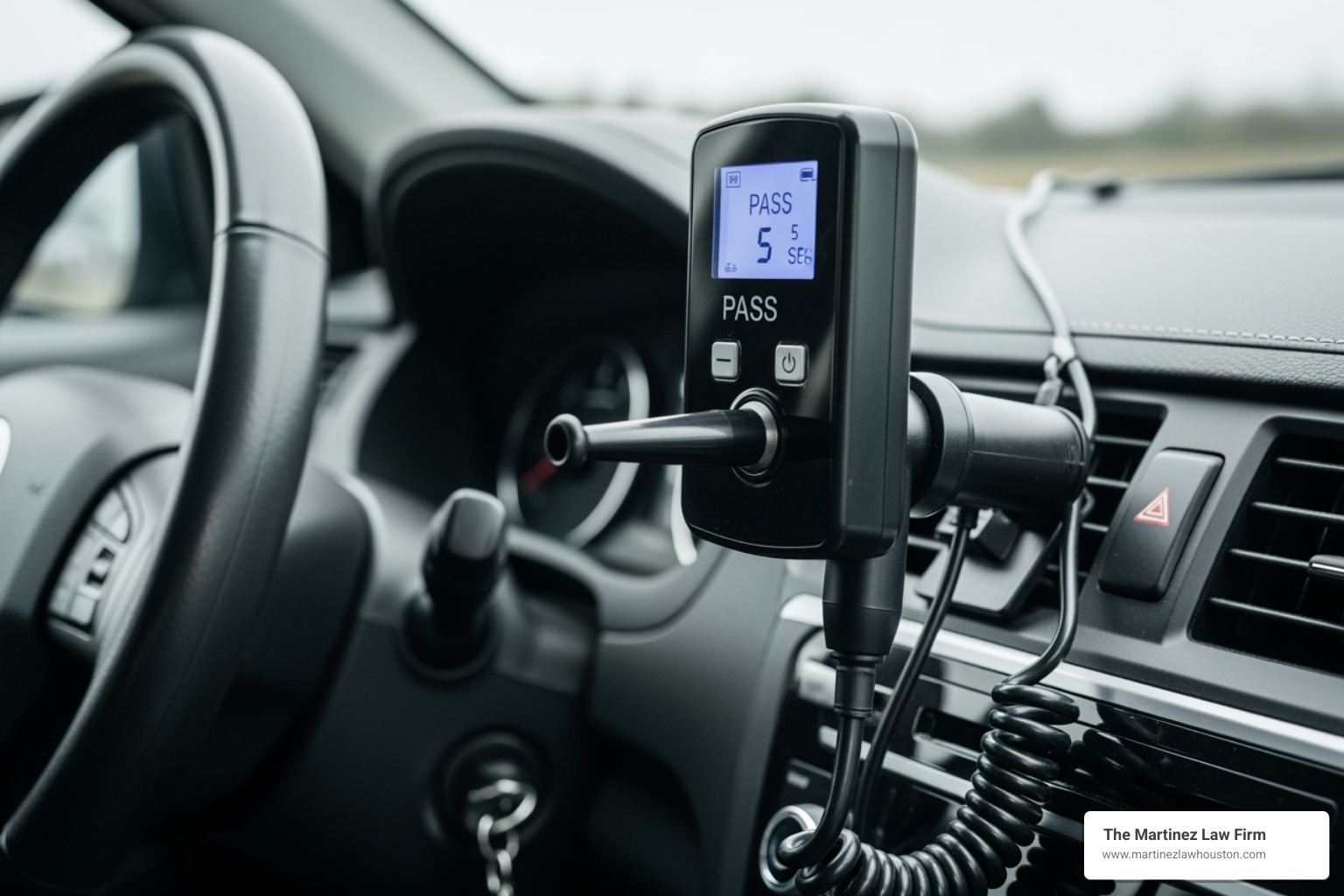
One of the first is the Ignition Interlock Device (IID). You may be ordered to install this device in your car at your own expense, requiring you to provide a breath sample before the vehicle will start. This is a constant financial and personal burden.
Your insurance rates will skyrocket. A DWI conviction labels you a high-risk driver, often doubling or tripling your premiums for years. Some insurers in the Houston area may drop you completely.
A DWI can threaten your career, especially if you hold a professional license. Professional license risks are serious for nurses, teachers, and others who face disciplinary action, including suspension or revocation of their license.
Employment background checks are now standard. A DWI conviction on your permanent record can limit job opportunities, as many companies are hesitant to hire individuals with a criminal history.
For parents, a DWI can have devastating child custody implications. A conviction can be used in Harris County family courts to argue for reduced custody or supervised visitation.
Finally, a DWI can lead to travel restrictions, as countries like Canada may deny entry to individuals with a criminal record.
These consequences can be more damaging than the initial penalties. As your Harris County DWI attorney, we fight to protect your entire future from these far-reaching effects.
Frequently Asked Questions about Harris County DWI Cases
If you’re facing a DWI charge in Harris County, you likely have many questions. Let’s walk through some of the most common concerns we hear from clients in Houston.
What is an ALR Hearing and Why is it So Urgent?
Your driver’s license is at risk immediately after a DWI arrest, completely separate from your criminal case. This is where the Administrative License Revocation (ALR) hearing is crucial.
You have exactly 15 days from your arrest date to request an ALR hearing. If you miss this deadline, your license is automatically suspended on the 40th day after your arrest—even if your criminal case is later dismissed. The ALR process is independent of the criminal court.
The ALR hearing is your chance to contest your license suspension. Your Harris County DWI attorney can challenge whether the officer had probable cause to stop and arrest you and question the validity of any tests. This 15-day deadline is a primary reason to contact an attorney immediately after an arrest.
Can I Refuse a Breathalyzer or Blood Test in Texas?
Yes, you can refuse a breath or blood test, but Texas’s “implied consent” law means there are automatic consequences. When you get a Texas driver’s license, you agree to provide a sample if lawfully arrested for DWI.
Refusing results in an automatic license suspension—180 days for a first refusal—which is longer than for a failed test. This suspension happens regardless of the DWI case outcome.
Furthermore, Harris County officers can—and often do—obtain a search warrant to compel a blood draw. So, you could face the automatic suspension and have blood evidence used against you. While refusal can sometimes be strategic, it’s a complex decision with immediate penalties. If you’ve already refused, don’t panic—we can still build a strong defense.
How can a Harris County DWI attorney help if I’m a first-time offender?
If this is your first offense, you may have more options available to you. The Harris County District Attorney’s office offers diversion programs for some first-time DWI offenders. Successful completion can lead to a case dismissal, leaving you with no conviction on your record.
An experienced attorney can also work to negotiate reduced charges or favorable probation terms that fit your life. As a former prosecutor, I understand how the Harris County DA’s office operates, which is a significant advantage in these negotiations.
Most importantly, we work to protect your future. A DWI conviction creates a permanent criminal record that affects jobs, housing, and insurance for years. Our goal is to minimize these long-term consequences through dismissal, acquittal, or strategic sentencing. We also guide you through the confusing legal process, ensuring you understand your options at every step.
Secure Your Defense and Protect Your Future
A DWI charge in Harris County is overwhelming, with serious penalties and consequences that can affect your job, family, and future. But remember this critical fact: an arrest is not a conviction. You have rights that deserve a powerful defense.
A strong defense is about protecting the life you’ve built. The decisions you make in the hours and days after your arrest are critical, which is why having an experienced Harris County DWI attorney is essential.
At The Martinez Law Firm in Houston, we understand what’s at stake. Herman Martinez’s experience as a former Chief Prosecutor for the Harris County District Attorney’s Office gives us unique insight into how the prosecution works—and where their cases fail. This is a powerful advantage for our clients.
Our approach is aggressive, strategic, and personalized. We challenge the evidence, scrutinize procedures, and fight for your rights. Don’t steer the Harris County legal system alone. Take the first step in your defense by contacting us today for a free, confidential consultation. We are ready to fight for you.
What is Public Intoxication in Texas?

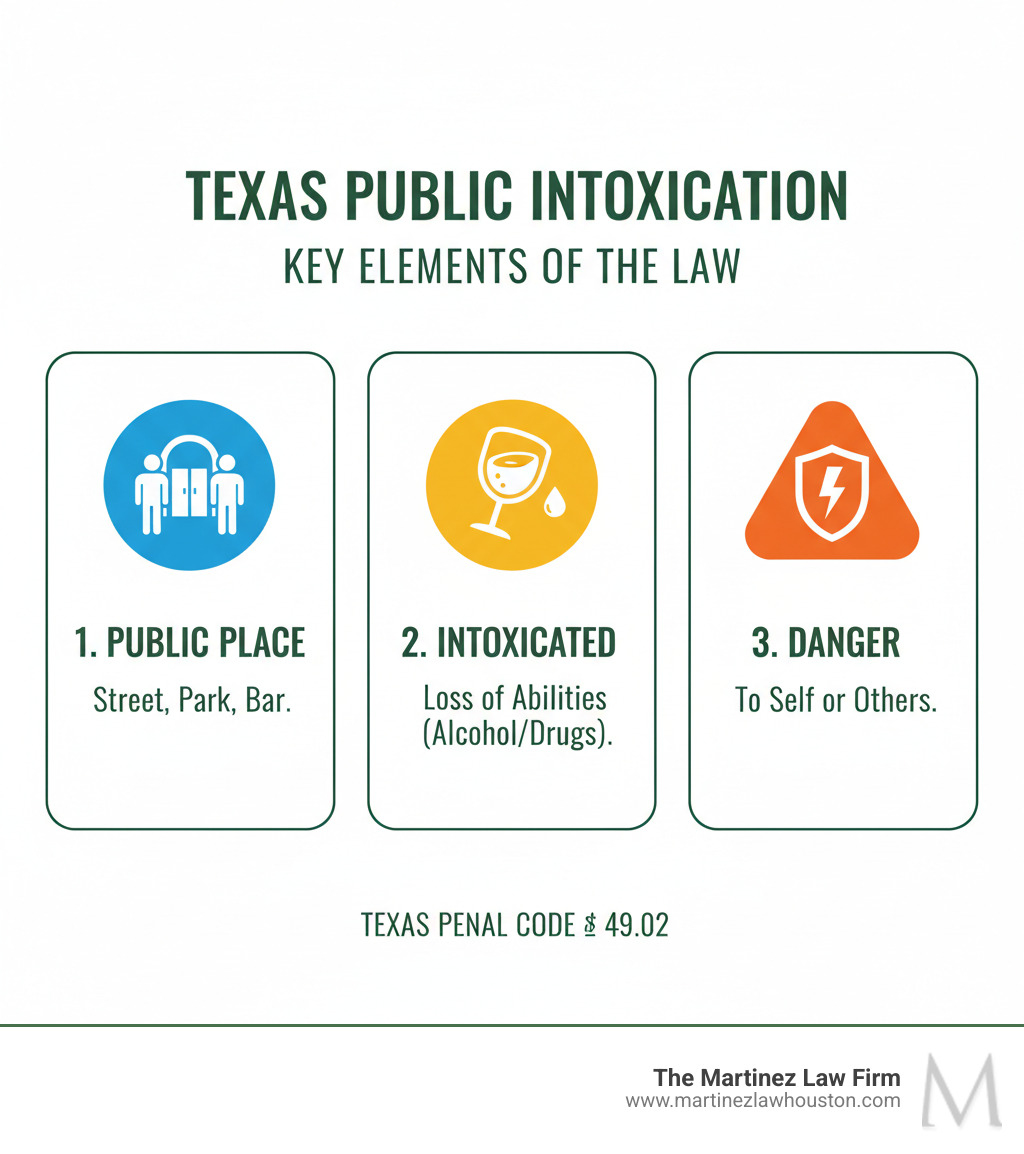
In Texas, a Public intoxication charge has three key legal requirements:
- Public Place: You must be in a place accessible to the public, such as a street, park, or bar.
- Intoxicated: You must be under the influence of alcohol or other substances, losing your normal mental or physical abilities.
- Danger: Your intoxication must make you a danger to yourself or others.
A night out in Houston can turn stressful if it ends with a Public intoxication Texas charge. This charge isn’t just about drinking too much; it’s about how your actions are perceived in public. An arrest can affect your future, job, and peace of mind, so knowing your rights is key.
I’m Herman Martinez. As a former Chief Prosecutor for the Harris County District Attorney’s Office and a City of Houston Judge, I have unique insight into Public intoxication Texas cases. I provide aggressive legal defense to help clients steer the criminal justice system.
What Constitutes Public Intoxication Under Texas Law?
Understanding Public intoxication Texas law is crucial. The charge is defined in Texas Penal Code § 49.02, which focuses on your actions and presence in public while under the influence.
The law states a person commits an offense if they “appear in a public place while intoxicated to the degree that the person may endanger the person or another.” To secure a conviction, the state must prove three elements beyond a reasonable doubt:
- You were in a “public place.”
- You were “intoxicated.”
- Your intoxication made you a “danger” to yourself or to others.
An arresting officer’s judgment is not the final word; a jury must be convinced the state has met its burden of proof. Understanding these elements is the first step in protecting your rights. For a deep dive into the official legal text, you can review the complete statute here: Read this complete Texas Penal Code – PENAL § 49.02. Public Intoxication on Westlaw.
What Qualifies as a “Public Place”?
The term “public place” is broader than you might think. Texas law defines it as “any place to which the public or a substantial group of the public has access,” which includes many locations in Houston and Harris County.
This includes obvious places like streets and sidewalks, but also highways, parking lots, bars, restaurants, and nightclubs. Even the common areas of apartment complexes can qualify. The law specifically notes that any place licensed under the Alcoholic Beverage Code is a public place. The key is public access, not ownership.
How is “Intoxication” Determined?
For a Public intoxication Texas charge, the legal definition of “intoxicated” relies heavily on observation. It means:
- Not having the normal use of your mental or physical faculties due to alcohol, drugs, or a combination of substances.
- Having an alcohol concentration of 0.08 or more.
For a PI charge, the first definition is what matters. Unlike a DWI, an officer doesn’t need a breathalyzer or field sobriety test. Their observations are often enough. They look for signs such as:
- Slurred speech
- An unsteady gait
- The odor of alcohol
- Bloodshot or watery eyes
- Disorientation or confusion
- An inability to follow instructions
You don’t have to be acting wildly. If an officer believes your faculties are impaired enough to pose a risk, it can lead to a charge.
What is Considered “Endangering” Behavior?
This is the most critical and subjective element of a Public intoxication Texas charge. The law requires that your intoxication creates a credible risk of harm to yourself or others. Simply being drunk in public is not enough.
Endangering behavior suggests a potential for harm. Common examples include:
- Stumbling into traffic
- Starting fights or physical altercations
- Being unable to stand or maintain balance
- Passing out in a public area, leaving you vulnerable
- Urinating in public
- Creating a hazard for others
- Displaying erratic or unpredictable behavior
The common thread is that your intoxicated behavior indicates a potential for harm to yourself (e.g., falling, becoming a victim) or others (e.g., causing an accident).
Penalties and Consequences for Public Intoxication Texas

A Public intoxication Texas charge is more than a minor hiccup. While typically a Class C Misdemeanor, it carries real consequences, including a criminal record, fines, and long-term effects. While jail time is rare for a first offense, the arrest is stressful, and the hidden costs—like impacts on job or housing applications—can be substantial.
Penalties for Adults (21 and Over)
For adults 21 and over, a Public intoxication Texas charge is usually a Class C Misdemeanor, which means:
- A fine of up to $500, plus court costs and administrative fees.
- No direct jail time, but you will likely be arrested and held in a “drunk tank” in Houston for 6 to 24 hours until you are sober.
- Most significantly, a conviction results in a permanent criminal record with lasting effects.
Repeat Public intoxication Texas offenses have tougher penalties. A third offense within 24 months can be liftd to a Class B Misdemeanor, with a fine up to $2,000 and up to 180 days in jail.
Improved Penalties for Minors (Under 21)
For those under 21, Public intoxication Texas penalties are more severe due to the state’s zero-tolerance policy on underage drinking.
A major penalty is driver’s license suspension—up to 30 days for a first offense, with longer suspensions for subsequent offenses. Other penalties include mandatory alcohol awareness courses, 8-12 hours of community service, and fines up to $500.
A conviction also creates a criminal record, which can negatively impact college applications, scholarships, and future job opportunities.
The Arrest and Court Process in Houston

Facing a Public intoxication Texas charge in Houston can be overwhelming. Understanding the arrest and court process can help ease anxiety. The process typically involves:
- Arrest: An officer observes signs of intoxication and danger in public and takes you into custody.
- Booking: At a local station or Harris County Jail, your information is recorded, and fingerprints and a mugshot are taken.
- “Drunk Tank” Hold: You are held in a temporary area until sober, typically for 6-24 hours. You can be held up to 72 hours before seeing a judge.
- Bail: For a Class C Misdemeanor, you might be released on your “own recognizance” with a citation and court date, or you may need to post bail.
Houston also has a Sobering Center as a jail alternative for non-violent individuals, providing a safe place to sober up. However, placement is at the arresting officer’s discretion.
Your Rights When Accused of Public Intoxication in Texas
If accused of Public intoxication Texas, remember you have powerful legal rights that are crucial for protecting your future.
- Right to Remain Silent: You are not required to answer questions beyond providing identification. Politely state that you wish to remain silent and speak with an attorney.
- Right to an Attorney: You have the right to have a lawyer present during all legal proceedings. If you cannot afford one, the court will appoint one. Contact a Houston criminal defense attorney immediately.
- Right to a Jury Trial: Even for a Class C Misdemeanor, you can have a jury trial, which allows your attorney to argue that the state has not proven its case, particularly the “danger” element.
- Challenging Officer Testimony: An experienced attorney can scrutinize the officer’s testimony for inconsistencies or lack of evidence, questioning key elements like “danger” or whether the location was public.
Exercising these rights with legal counsel is your best chance for a favorable outcome.
Common Legal Defenses
An experienced attorney can use several common legal defenses to fight a Public intoxication Texas charge:
- No Danger to Self or Others: A strong defense is arguing that your level of intoxication did not pose a danger, which is a required element of the offense.
- Not in a Public Place: If the arrest location does not legally qualify as a “public place,” the charge is invalid.
- Intoxication from Prescribed Medical Treatment: If your intoxication resulted from a substance administered by a licensed physician for therapeutic reasons, this can be a valid defense.
- Procedural Errors During Arrest: If police violated your rights, lacked probable cause, or made other procedural mistakes, the case could be dismissed.
- Insufficient Evidence: The state must prove every element beyond a reasonable doubt. If evidence is lacking for any element, we can argue for dismissal or a “not guilty” verdict.
Public Intoxication vs. DWI in Texas
Public intoxication Texas and Driving While Intoxicated (DWI) are not the same. They are separate offenses with different rules and consequences, although both involve intoxication. The key difference is whether you were operating a vehicle.
A PI charge applies to someone on foot, while a DWI charge applies to someone operating a vehicle. In Houston, this distinction is crucial.
Here’s a straightforward comparison:
| Feature | Public Intoxication (PI) | Driving While Intoxicated (DWI) |
|---|---|---|
| Elements of the Crime | In a public place, intoxicated, and a danger to self or others. | Operating a motor vehicle (or other specified conveyance) in a public place while intoxicated. |
| Vehicle Operation | Not required. Can be walking, standing, sitting. | Required. The act of driving or having actual physical control over a vehicle. |
| Typical Penalty (1st Offense) | Class C Misdemeanor (fine up to $500). Held until sober. | Class B Misdemeanor (fine up to $2,000, 72 hours to 180 days jail). |
| License Suspension | Only for minors (under 21). | Mandatory for all offenders (often 90 days to 1 year for 1st offense, even if not convicted, due to Administrative License Revocation). |
What This Means for Texans
DWI penalties are much harsher. A first-time DWI is a Class B Misdemeanor with potential jail time, larger fines, and mandatory license suspension. Repeat offenses or aggravating factors can lead to felony charges.
A first-offense Public intoxication Texas charge is a Class C Misdemeanor with a fine up to $500 and no jail time, though you will be held until sober. Repeat offenses can be liftd to a Class B Misdemeanor.
Importantly, PI is not a lesser included offense of DWI. Prosecutors cannot simply reduce a DWI to a PI charge. They are entirely separate, and the facts of the case (driving vs. on foot) determine the charge. Understanding this distinction is vital if you’re facing either charge in Harris County, as the defense strategies and stakes differ. An experienced attorney is essential.
Long-Term Impact and Clearing Your Record

Paying the fine for a Public intoxication Texas conviction doesn’t end the matter. As a Class C Misdemeanor, it creates a criminal record with hidden costs that can follow you for years.
A Public intoxication Texas conviction will appear on background checks when you apply for jobs in Houston. It can be a red flag for employers, especially for jobs requiring trust, security clearances, or driving. In Harris County, a criminal record can also make it harder to find housing, as many landlords screen tenants.
The conviction can also complicate college admissions, scholarship applications, and obtaining professional licenses. It can create issues for military enlistment and have serious immigration consequences for non-U.S. citizens. A digital criminal record is hard to hide, which is why it’s crucial to fight a Public intoxication Texas charge from the beginning.
Can a Public Intoxication Texas Charge Be Expunged?
The good news is that a Public intoxication Texas charge can often be expunged. Expungement is a legal process that erases the arrest and conviction from your record, making it as if it never happened. This is more complete than a non-disclosure order, which only seals the record from public view.
Eligibility for expungement depends on the case’s outcome. You are typically eligible if your case was dismissed, you were found not guilty at trial, or you were arrested but never formally charged. A common path to expungement in Houston is deferred disposition. This involves a probationary period with certain conditions. Upon successful completion, the case is dismissed, and you can then petition for expungement. This is a valuable option for first-time offenders to keep their record clean.
A clean record opens doors to employment, housing, and educational opportunities. An experienced Houston attorney can fight for a dismissal or deferred disposition and then guide you through the expungement process. Expungement is not automatic and involves specific legal procedures. At The Martinez Law Firm, we handle the entire process, from the initial charge to clearing your record, because we know how important a clean record is in Harris County.
Frequently Asked Questions about Public Intoxication
People facing Public intoxication Texas charges in Houston often have the same questions. Here are answers to some common concerns.
Do I have to take a breathalyzer for a PI charge?
No, you are not required to take a breathalyzer for a Public intoxication Texas charge. Unlike a DWI, refusing a breathalyzer for a PI charge carries no direct penalty, such as an automatic license suspension.
For a PI charge, the case is built on the officer’s observations of your behavior (e.g., slurred speech, unsteadiness, disorientation), not a breathalyzer result. The officer’s testimony is the primary evidence. While you have the right to refuse, it is always wise to remain polite and respectful with law enforcement.
Can I be charged with PI if I’m just a passenger in a car?
Yes, you can be charged with Public intoxication Texas as a passenger in a car. A car in a public place (like a street or parking lot) is considered a public place, so a PI charge is possible if you meet the other legal requirements.
The requirements are that you are intoxicated and a danger to yourself or others. For example, trying to open a door in a moving car, creating a disturbance, or being passed out in a concerning way could lead to a charge. The law focuses on your intoxicated and dangerous behavior in a public place, regardless of whether you are driving, are a passenger, or are on foot.
How do Texas PI laws compare to other states?
Texas has stricter public intoxication laws than many other states. In Texas, Public intoxication Texas is a criminal misdemeanor, whereas many states have moved to decriminalize it.
States like Montana, Nevada, and New York have decriminalized public intoxication. Instead of arrest, officers may take an individual to a sobering center, a medical facility, or home. These states view public intoxication as a public health issue, offering civil protective custody or treatment instead of a criminal record. The goal is to provide help rather than punishment.
This contrast shows why a Public intoxication Texas charge must be taken seriously. The consequences in Texas are more severe than in many other places. More on how other states handle PI.
How a Texas Criminal Defense Attorney Can Help
Facing a Public intoxication Texas charge in Houston can be overwhelming. The consequences go beyond a fine, leaving a mark on your criminal record that affects your job, education, and housing. A skilled legal advocate is essential.
At The Martinez Law Firm, Herman Martinez’s experience as a former Chief Prosecutor for Harris County provides a unique advantage. This insight allows us to anticipate the prosecution’s strategy and build an aggressive, personalized defense. We know the Houston and Harris County court systems inside and out.
We can help by:
- Guiding You Through the System: We explain every step of the legal process, outline your options, and ensure you know what to expect.
- Challenging the Evidence: We scrutinize all evidence, including police reports and video, to challenge the prosecution’s claims about key elements like “danger” or being in a “public place.”
- Negotiating on Your Behalf: We use our experience to negotiate with prosecutors for reduced charges, deferred adjudication, or other favorable outcomes to protect your future.
- Seeking Dismissal: We will aggressively push for a dismissal if the evidence is weak, your rights were violated, or procedural errors occurred.
- Protecting Your Rights: We are committed to upholding all your constitutional rights throughout the legal process.
Don’t let a Public intoxication Texas charge shadow your future. With our aggressive defense and proven track record, we are dedicated to securing the best possible outcome. We also handle related offenses like the Open Container Law in Texas. Contact us today for a consultation to explore your legal options.
Understanding Your DWI Probation Timeline in Texas

How long is dui probation in Texas? The duration depends on the charge:
- First-time DWI (Class B Misdemeanor): 6 months to 2 years
- Second DWI (Class A Misdemeanor): 2 to 3 years
- Third DWI or Felony DWI: 2 to 5 years
- Maximum probation period: Up to 2 years for misdemeanors, up to 10 years for felonies
For those convicted of DWI in Houston or Harris County, understanding your probation timeline is critical. DWI probation, or community supervision in Texas, can last for years and involves strict daily requirements. Unlike a fixed jail sentence, probation impacts your ability to work, travel, and live normally, and a single violation can result in jail time.
Knowing how long is dui probation is vital because Texas law prohibits early termination for DWI offenses, making full compliance essential. You will face monthly fees, mandatory classes, random drug tests, and possibly an ignition interlock device, with total costs often exceeding $6,000.
I’m Herman Martinez, founder of The Martinez Law Firm. With over 25 years of experience as both a former Chief Prosecutor for Harris County and now a defense attorney, I help clients steer their probation. My background prosecuting DWI cases provides a unique advantage in understanding how probation terms are set and what is expected for successful completion.
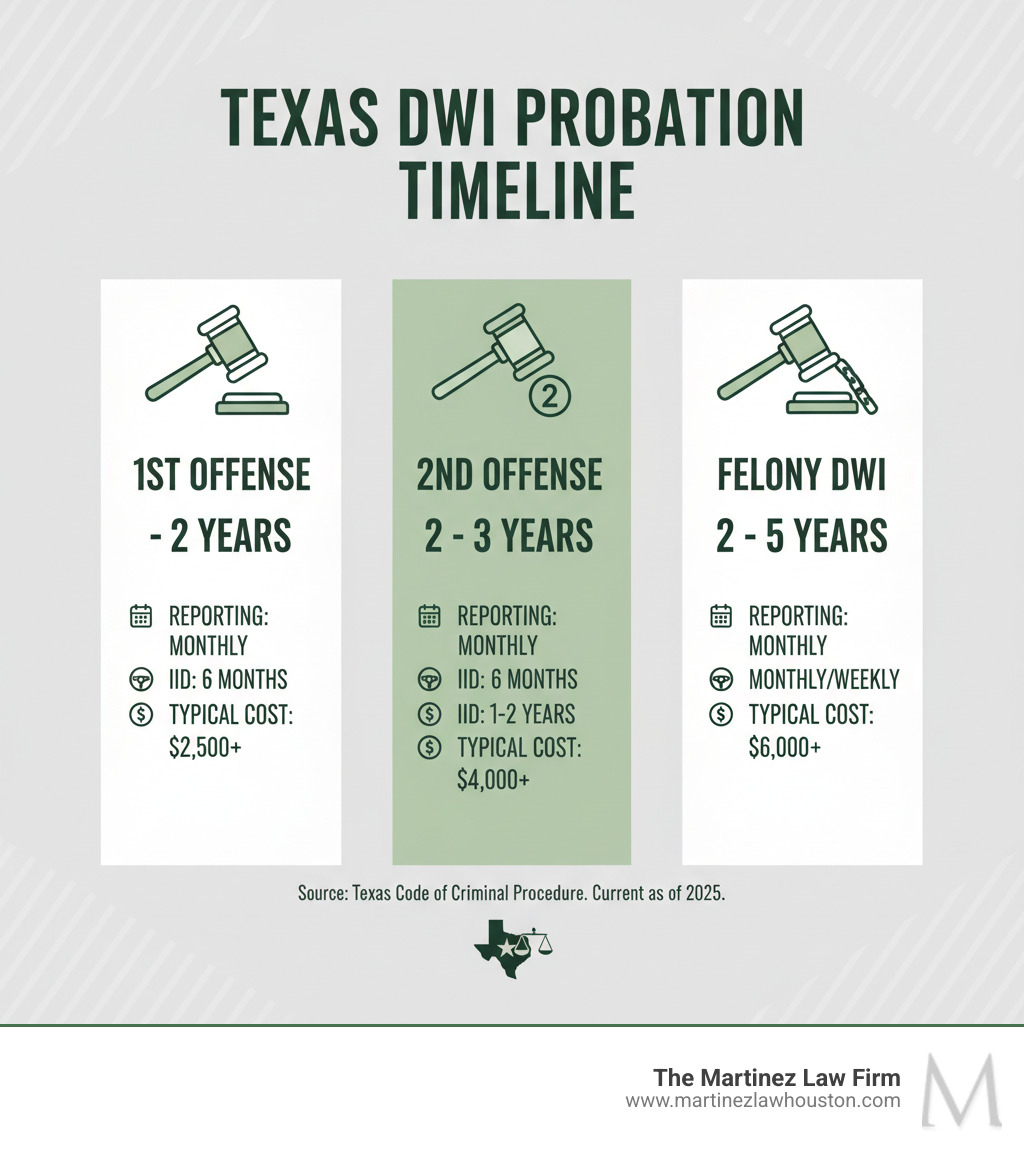
What is DWI Probation in Texas?
In Texas, what is commonly called probation is officially known as community supervision. It is not a dismissal of charges but an alternative to jail time, allowing you to live in the community under strict court supervision. This period can last for months or years, impacting every aspect of your daily life, which is why the question of how long is dui probation is so important.
The rules for community supervision are outlined in Chapter 42A of the Texas Code of Criminal Procedure. Understanding these regulations is a key part of navigating DWI Laws in Texas.

Probation vs. Parole
It’s important not to confuse probation and parole. Probation is a sentence served instead of jail time, while parole is an early, supervised release after serving part of a prison sentence. For DWI cases in Houston, the goal is often to secure probation to avoid incarceration.
Types of DWI Probation
In Harris County, there are several forms of community supervision for DWI cases:
- Regular Community Supervision: The most common form, where a judge sentences you to probation instead of jail after a guilty finding. Violating conditions can lead to revocation and serving the original jail sentence.
- Deferred Adjudication: A rare but highly favorable outcome where the judge defers a finding of guilt. Successful completion leads to a dismissal of the case, avoiding a conviction. This option is seldom available for DWI offenses.
- Pre-Trial Intervention (PTI): A program for certain first-time offenders in Harris County. Completing the program’s requirements, such as counseling and community service, results in the charges being dismissed. Our DWI Divert Program page has more details.
Securing the best possible outcome requires deep knowledge of the Harris County court system. My experience as a former Chief Prosecutor provides the insight needed to negotiate effectively on your behalf.
How Long is DUI Probation in Texas?
A common question after a DWI arrest in Houston is, “How long is dui probation going to last?” The length depends on your charge, criminal history, and the specifics of your case. While Texas law sets statutory limits, judges have discretion. Factors like your BAC, whether an accident occurred, and your cooperation all influence the final term. For more general information, see our Common DWI Questions page.

How Long is DUI Probation for a First Offense?
A first DWI is typically a Class B Misdemeanor, with probation lasting six months to two years. In Harris County, a term of 12 to 18 months is common. The final length is influenced by factors such as a high BAC or aggravating circumstances (e.g., an accident or a child passenger). Skilled legal negotiation can often lead to a shorter probation term with less restrictive conditions.
How Long is DUI Probation for Repeat Offenses?
Penalties increase significantly for repeat offenses. A second DWI (Class A Misdemeanor) usually results in two to three years of probation. A third DWI or a felony DWI can lead to probation terms of two to five years, with a maximum of 10 years for some felonies. These cases often include mandatory jail time as a condition of probation, along with more demanding supervision requirements.
Can DWI Probation Be Terminated Early in Texas?
The answer is a clear no: DWI probation cannot be terminated early in Texas. The Texas Code of Criminal Procedure specifically prohibits judges from granting early release from DWI community supervision. You must complete the entire term you are sentenced to.
However, with consistent compliance, your probation officer may have the discretion to modify certain conditions over time. For example, they might reduce the frequency of check-ins or drug testing. These adjustments are not guaranteed and depend entirely on your performance and the relationship you build with your officer. Strict adherence to all rules from day one is the only way to earn such considerations.
Navigating the Rules: Common Conditions of DWI Probation
DWI probation in Houston involves a legally binding agreement with the court. These mandatory conditions govern your daily life and are designed to ensure public safety and prevent future incidents. Common conditions include:
- Reporting to a Probation Officer: Regular check-ins (often monthly) to monitor your progress.
- Paying Fines and Fees: This includes court fines ($2,000-$10,000), monthly supervision fees ($50-$100), and costs for classes and testing.
- Community Service: Completing a set number of hours (24-200) at an approved organization.
- Zero-Tolerance for Alcohol/Drugs: You must abstain completely from alcohol and illegal drugs. This often includes a ban on visiting bars.
- Random Testing: You must submit to random drug and alcohol tests (urine, breath, or hair) on demand.
- Ignition Interlock Device (IID): Many cases require installing a breathalyzer in your vehicle that prevents it from starting if alcohol is detected. You are responsible for all associated costs.
- Maintaining Employment: You must be employed or actively seeking work.
- Avoiding New Offenses: Any new criminal charge can trigger a probation violation.
- Travel Restrictions: You must get permission before traveling outside Harris County.
Understanding these rules is crucial to avoiding a violation. For more on the consequences you might face, see our pages on DWI Penalties and What Will Happen to Your License?.
Required Classes and Programs
All DWI probations include mandatory educational programs with strict deadlines:
- DWI Education Class: A 12-hour state-approved course on the dangers and laws of impaired driving.
- Victim Impact Panel (VIP): A session, often run by Mothers Against Drunk Driving (MADD), where victims of drunk driving share their stories.
- Substance Abuse Evaluation: An assessment by a licensed counselor that may lead to required counseling or treatment.
- Alcoholics Anonymous (AA) Meetings: Some judges require regular attendance at AA meetings.
Monitoring and Testing
Harris County uses advanced technology to monitor compliance:
- Random Drug Testing: Unscheduled tests to ensure you remain substance-free.
- Ignition Interlock Device (IID): This car breathalyzer logs all tests, failures, and rolling retests, with reports sent to your probation officer. You pay for installation, monthly fees, and calibration.
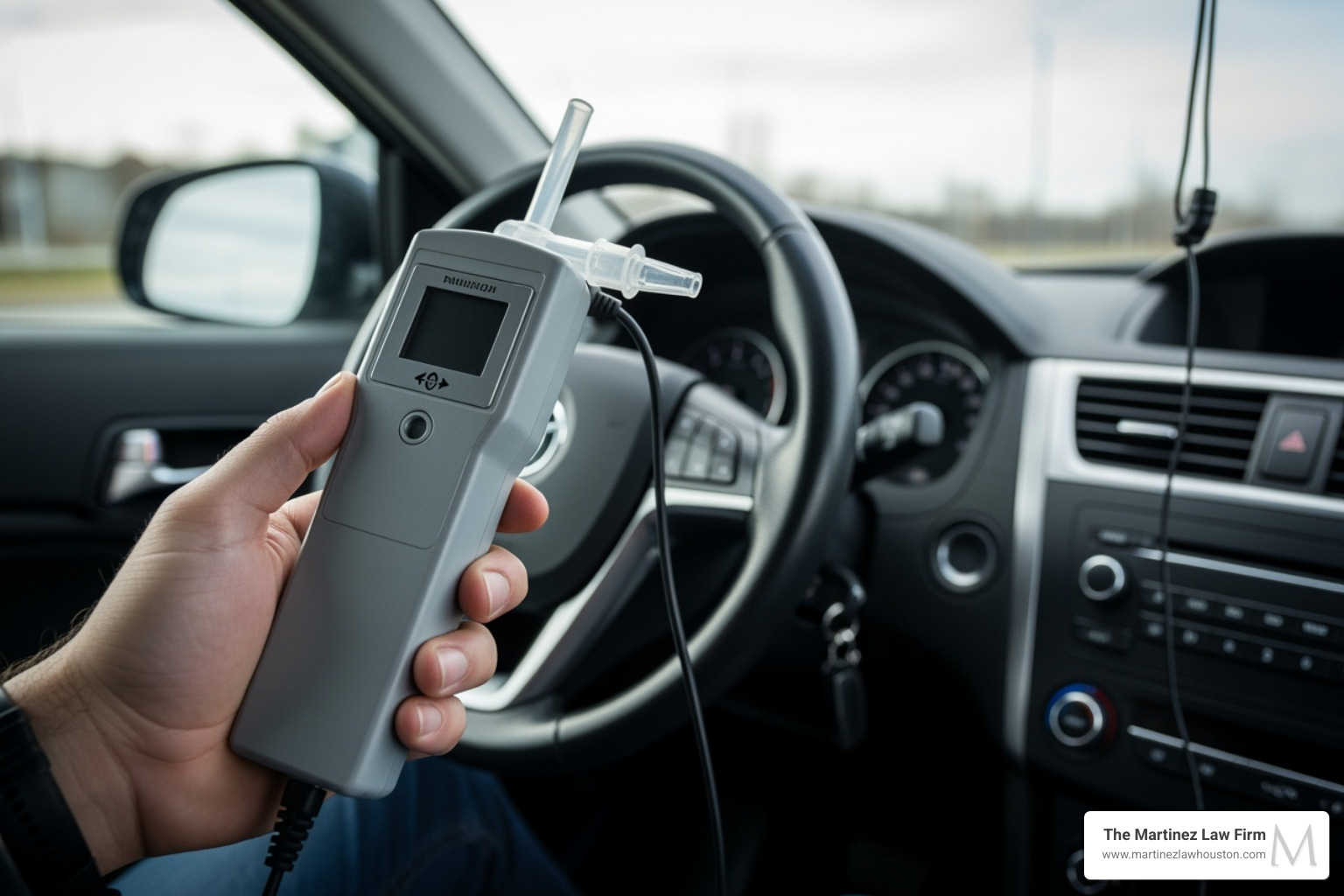
- Other Devices: In some cases, the court may order a SCRAM (Secure Continuous Remote Alcohol Monitor) ankle bracelet that tests your perspiration for alcohol 24/7, or a portable Soberlink device with facial recognition for remote breath testing.
These tools are invasive and expensive, but they are standard in modern DWI probation. Knowing how long is dui probation is critical, as you will be under this level of scrutiny for the entire term.
The Risks of Non-Compliance: Consequences of a Probation Violation
DWI probation in Houston is a court order, and breaking the rules has severe consequences. A probation violation occurs any time you fail to meet a condition, whether it’s failing a drug test, missing an appointment, or falling behind on fees. Any mistake, intentional or not, can lead to a violation.
When a violation is alleged, the prosecutor files a “Motion to Revoke Probation,” triggering a court hearing. The burden of proof is lower than in a criminal trial; the prosecutor only needs to show it’s “more likely than not” that you violated the terms. Our Probation Violation Hearing: What to Do guide explains this process in detail.
If the judge finds you in violation, they can:
- Revoke your probation and order you to serve the original jail sentence.
- Extend your probation period and add more restrictive conditions.
- Impose additional fines and require more intensive supervision.
Proper guidance is essential to avoid these preventable outcomes.
What Happens if You Get Another DWI on Probation?
Getting a new DWI while on probation is a catastrophic event. You face two simultaneous legal battles: the new DWI charge, which carries improved penalties as a repeat offense, and an automatic violation of your existing probation.
Prosecutors will immediately file to revoke your probation. A judge is highly likely to revoke it, sending you to jail to serve your original sentence. After that, you will still face sentencing for the new DWI, which will likely be much harsher because the offense occurred while you were under court supervision. For more on this, read our article on What Happens if You Get a DUI While on Probation?.
One poor decision can cost you years of your life. Your freedom depends on strict compliance.
Frequently Asked Questions about DWI Probation
Here are answers to common questions about DWI probation in Houston.
Can I travel while on DWI probation in Houston?
Travel is restricted and requires permission. The rule is to always ask before you go.
- In-State Travel: You must get advance permission from your probation officer to travel outside Harris County.
- Out-of-State Travel: This requires a formal request to your probation officer and often the court. Approval is not guaranteed.
- International Travel: This is almost always denied, as the court cannot supervise you abroad.
Leaving without permission is a probation violation that can lead to jail time.
How much does DWI probation cost in Texas?
The financial burden of probation is significant, often exceeding the initial court fine. Besides asking how long is dui probation, clients should be aware of the total cost. Expect to pay for:
- Court Fines: $2,000 to $10,000, depending on the offense.
- Monthly Supervision Fees: $50 to $100 per month.
- Required Classes: DWI Education, Victim Impact Panels, and potential substance abuse treatment can cost hundreds or thousands of dollars.
- Ignition Interlock Device (IID): Installation ($70-$150) plus monthly monitoring fees ($70-$100).
- Testing Fees: Costs for random drug and alcohol tests.
Total costs for DWI probation in Texas frequently exceed $6,000 to $10,000. Effective legal representation can help reduce these financial burdens by negotiating for shorter terms or lower fines.
Will a DWI probation show up on a background check?
Yes. A DWI conviction is a permanent part of your criminal record in Texas and will appear on most background checks. This can negatively impact:
- Employment: Many employers, especially in fields like transportation, healthcare, and education, are hesitant to hire individuals with a DWI conviction.
- Housing: Landlords often run background checks, and a conviction can make it difficult to rent an apartment or house.
- Professional Licenses: A DWI can trigger disciplinary action from licensing boards for professionals like nurses, teachers, and commercial drivers.
In the rare event you receive deferred adjudication and complete it successfully, you may be able to seal the record from public view through an Order of Nondisclosure. However, for a standard DWI conviction, this option is not available. The long-term consequences make fighting the charge from the start with an experienced attorney essential.
Your Next Steps After a Houston DWI Arrest
A DWI arrest in Houston is overwhelming, and understanding how long is dui probation is just the first step. Texas DWI probation is a complex legal order with strict, long-term conditions where a single misstep can lead to jail time. You do not have to face this challenge alone.
At The Martinez Law Firm, we defend those accused of DWI. Our founder, Herman Martinez, is a former Chief Prosecutor for the Harris County District Attorney’s Office. This unique insider experience allows us to anticipate the prosecution’s strategy and build a powerful defense.
With over 25 years in Houston courtrooms, we know how to fight for dismissals, negotiate for reduced charges and shorter probation terms, or guide you toward successful completion of your supervision. We understand the local courts, judges, and prosecutors, and we use that knowledge to protect your future.
Don’t leave your freedom and future to chance. If you’ve been arrested for DWI in Harris County, contact us for a confidential consultation. We will review your case, explain your options, and create a clear strategy to defend your rights. Visit our DWI Lawyer page to learn how we can fight for you.
Understanding the Serious Stakes of a DWI Probation Violation

A dui probation violation texas can lead to jail time, extended supervision, and severe penalties that could upend your life. Probation, or “community supervision,” is a second chance to avoid jail after a DWI conviction, but it comes with strict rules. In Harris County, any misstep is taken seriously.
When you violate DWI probation, you face:
- Immediate Arrest: Your probation officer can file a Motion to Revoke, leading to a warrant. A judge may deny bond, keeping you in jail until your hearing.
- Lower Burden of Proof: The prosecutor only needs to prove the violation by a “preponderance of the evidence” (more likely than not), a much lower standard than “beyond a reasonable doubt.”
- Severe Penalties: You could face the original jail sentence you avoided, plus additional time for the violation itself. Time served for the violation does not count toward your original sentence.
- Dual Consequences for New Offenses: A new arrest triggers penalties for both the new charge and the probation violation.
I’m Herman Martinez, founder of The Martinez Law Firm. With over 25 years in the Texas criminal justice system as a former Chief Prosecutor for Harris County and a City of Houston Judge, I have unique insight into how these cases are handled. My goal is to use that experience to build the strongest possible defense and protect your freedom.
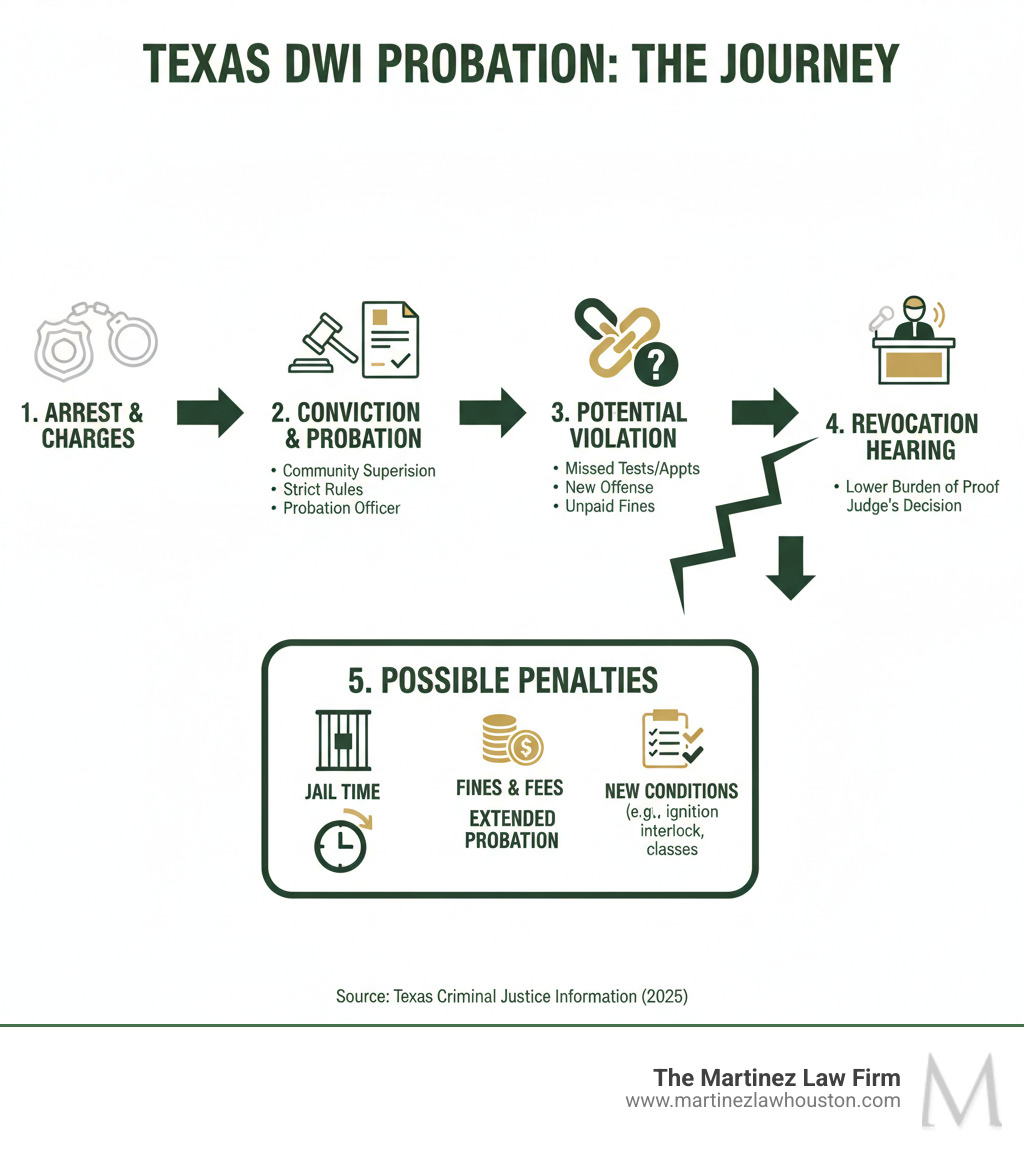
Understanding DWI Probation in Texas
When you’re convicted of DWI in Texas, “community supervision” (probation) is the court’s way of letting you avoid jail time, but with strict strings attached. You can stay in the community, keep your job, and live with your family, but you’ll be under constant court supervision.

Breaking any rule can lead to a dui probation violation texas and land you behind bars. The legal framework is outlined in the Texas Code of Criminal Procedure. For a first-time DWI in Harris County, probation typically lasts one to two years. The judge determines the length based on your case specifics and criminal history. For a full overview, see our resource on DWI Probation in Texas: What You Need to Know.
Common Conditions of DWI Probation
Every condition of your DWI probation is a legally binding order. Violating even one puts your freedom at risk. Common requirements include:
- Regular Check-ins: Mandatory meetings with your probation officer to verify compliance.
- Payments: Timely payment of all court-ordered fines, fees, and restitution.
- No New Offenses: You must not be arrested for any new crime, including minor ones.
- Abstinence and Testing: You are prohibited from consuming alcohol or illegal drugs, verified through random urine, breath, or continuous monitoring devices like a SCRAM ankle monitor.
- Mandatory Programs: Attending DWI education classes, victim impact panels, and any required substance abuse treatment.
- Ignition Interlock Device: For many, especially with a BAC of 0.15% or higher, you must install an ignition interlock device in your vehicle at your own expense. Learn more about DWI Lawyer: DWI Penalties.
- Other Rules: Completing community service, maintaining employment, adhering to travel restrictions, and avoiding people with criminal records.
These are not suggestions; they are court orders. Taking them seriously is the only way to avoid a dui probation violation texas.
Deferred Adjudication vs. Straight Probation
In Texas, there are two main types of probation: Deferred Adjudication and Straight Probation. The type you receive significantly impacts your criminal record.
With Deferred Adjudication, the judge defers a finding of guilt. If you complete probation successfully, the case is dismissed. You may then qualify for an Order of Non-Disclosure to seal your record from most background checks. However, if you violate probation, the judge can find you guilty and impose the maximum sentence for the original offense.
With Straight Probation, you are found guilty, but your jail sentence is suspended. The conviction remains on your record permanently. If you violate, the judge can revoke probation and make you serve the original suspended sentence.
Breaking Down the Differences
| Feature | Deferred Adjudication | Straight Probation (Suspended Sentence) |
|---|---|---|
| Finding of Guilt | No finding of guilt entered at the time of sentencing. Guilt is “deferred” pending successful completion of probation. | A finding of guilt is entered, but the jail sentence is “suspended,” and you’re placed on probation instead. |
| Eligibility | Generally for first-time offenders, often for misdemeanors. For DWI, it became more widely available after a 2019 law change, but typically not if you’re already on probation for another offense. | Available for a wider range of offenses, including some felonies, and after a guilty verdict or plea. |
| Record Sealing | Upon successful completion, the case is dismissed, and you may be eligible for an Order of Non-Disclosure to seal your record. This means the arrest and prosecution are not publicly available. | The conviction remains on your record. In some limited circumstances, expunction might be possible, but it’s rare for a DWI conviction. |
| Consequences of Violation | If violated, the judge can proceed with an adjudication of guilt and impose any punishment allowed by law for the original offense, including the maximum sentence. | If violated, the judge can revoke probation and impose the original suspended jail sentence. |
For DWI cases, deferred adjudication is generally only available to first-time offenders with a BAC below 0.15% and without a commercial driver’s license. The ability to avoid a permanent conviction makes deferred adjudication highly desirable, but the stakes for a violation are incredibly high.
What Constitutes a Violation of DWI Probation?
A dui probation violation texas occurs when you fail to comply with any court-ordered term of your community supervision. Even a seemingly minor slip-up can have serious consequences. Violations fall into two categories.

Technical violations are breaches of the administrative rules, such as missing an appointment with your probation officer, failing to pay fines, not completing community service, or traveling out of the county without permission. Substantive violations are more serious, as they involve committing a new criminal offense. Any new arrest, from theft to another DWI, is a substantive violation.
Either type of violation can trigger a Motion to Revoke Probation (MTR) or a Motion to Adjudicate Guilt (MTA), putting you at risk of jail time. For a comprehensive look at how violations are handled, see our guide on Probation Violation.
Getting a New DWI While on Probation
Getting arrested for a new DWI while on probation for a prior one is the most serious dui probation violation texas you can commit. This creates two simultaneous legal battles: the new DWI charge and the probation violation.
Your probation officer will file a Motion to Revoke Probation, and a judge in Harris County will likely issue an arrest warrant and may deny bond, meaning you could sit in jail until your hearing. At the same time, you face a new DWI charge, which prosecutors will pursue aggressively. The burden of proof for a probation violation is low—the prosecutor only needs to show it’s “more likely than not” that you were arrested for DWI to prove the violation. If your probation is revoked, you could serve your original sentence and then face additional penalties for the new DWI conviction. Immediate action is critical; for guidance, visit our page on DWI Arrest in Houston: What You Need to Know.
Consequences of a Failed Drug Test for a DUI Probation Violation Texas
Failing a drug or alcohol test is a clear-cut dui probation violation texas. Your probation terms require complete abstinence, and a positive test is direct evidence of a violation. In Harris County, probation officers use urine analysis (UA), breathalyzers, and continuous monitoring devices like SCRAM ankle monitors to ensure compliance.
A failed test will be reported to the court. While a first-time failure might result in a warning or stricter conditions, it often triggers a Motion to Revoke Probation. At the revocation hearing, the judge will decide whether to continue, modify, or revoke your probation and send you to jail. It is sometimes possible to challenge test results based on procedural errors or equipment inaccuracy. If you believe a test result is wrong, contact an attorney immediately. For more on testing, see our section on DWI Lawyer: Breath, Blood Tests.
The Legal Process for a DUI Probation Violation Texas
When you’re accused of violating probation, a formal legal process begins. Understanding this process is key to preparing your defense. It starts when your probation officer files a Motion to Revoke Probation (MTR) or a Motion to Adjudicate Guilt (MTA) with the court, as detailed in the Texas Code of Criminal Procedure.

Once the motion is filed, the judge will likely issue a warrant for your arrest. A significant challenge in these cases is that judges have the discretion to deny bond, meaning you could be held in jail until your hearing. This is a common practice in Harris County for serious or repeated violations. The judge’s role is to determine if a dui probation violation texas occurred and, if so, to decide the consequences. For a detailed roadmap, read our guide: I have been accused of violating my probation. What’s next?.
The Probation Violation Hearing
A probation violation hearing is not a criminal trial. The biggest difference is the burden of proof. The prosecutor doesn’t need to prove your guilt “beyond a reasonable doubt.” Instead, they only need to show by a “preponderance of the evidence” that it’s more likely than not you violated a condition. This lower standard makes it much easier for the prosecution to win.
During the hearing, the prosecutor presents evidence, such as testimony from your probation officer or drug test results. You have the right to be present, have an attorney, and present your own evidence and witnesses to challenge the allegations. After hearing both sides, the judge decides if you violated probation and what the punishment will be. Given the lower burden of proof, having a skilled attorney is essential. For more guidance, see our resource: Probation Violation Hearing: What to Do.
Potential Penalties and Consequences
The consequences for a dui probation violation texas vary based on the violation, your history, and the judge. Penalties can include:
- Probation Revocation: The most severe outcome. The judge can impose the original jail sentence that was suspended. For a first-time DWI, this could be up to 180 days in jail.
- Additional Jail Time: A judge can sentence you to jail time for the violation itself, which does not count toward your original sentence.
- Extended Probation: Your supervision period can be made longer.
- Stricter Conditions: The judge can add new rules, such as more frequent testing, a curfew, or a SCRAM ankle monitor.
- Additional Fines and Classes: You may be ordered to pay more money or complete new treatment programs.
A first-time, minor technical violation might result in a warning. However, a serious violation (like a new DWI) or a history of violations will likely lead to harsh penalties, especially if you have prior DWI convictions. For more on serious DWI charges, see our guide on Felony DWI.
Defending Against a Probation Violation Allegation
An allegation of a dui probation violation texas is not a conviction. You have rights and options. At The Martinez Law Firm, our goal is to prevent your probation from being revoked and keep you out of jail.

Strategies for a DUI Probation Violation Texas Defense
We tailor our defense to your specific situation using several key strategies:
- Disproving the Allegation: We scrutinize the prosecution’s evidence. Can we challenge the accuracy of a drug test? Is there proof of a legitimate emergency that caused a missed appointment? We look for weaknesses to dismantle the state’s case.
- Challenging a New DWI Charge: If the violation is based on a new DWI arrest, we aggressively defend against that new charge. A dismissal or “not guilty” verdict on the new case can eliminate the basis for the probation violation. Learn more about challenging DWI Lawyer: Breath, Blood Tests.
- Presenting Mitigating Factors: We tell your story to the judge. Have you been compliant with other terms? Are you employed and supporting a family? We show the court you are a whole person making genuine efforts, arguing that revocation would be counterproductive.
- Negotiating Alternatives: Even if a violation occurred, we can often negotiate for lesser penalties, such as modified conditions, additional community service, or a simple warning from the judge, instead of revocation.
- Leveraging Former Prosecutor Experience: As a former prosecutor in Harris County, I know how the state builds these cases. This insider perspective gives us a significant advantage in finding weaknesses and negotiating effectively. This is Why Hire a Former Prosecutor? can be so valuable.
Can You Appeal a Revoked Probation?
Yes, you have the right to appeal a probation revocation, but it is a difficult process. An appeal is not a second chance to argue the facts; it must be based on a specific legal error made by the judge during the hearing. The deadline to file a notice of appeal is strict, typically 30 days. As legal experts note, Individuals on probation have the right to legal representation and may appeal probationary decisions or violations. An experienced attorney is crucial for identifying grounds for an appeal and navigating the complex process.
Frequently Asked Questions about DWI Probation
Navigating DWI probation in Houston raises many questions. Here are answers to some of the most common concerns about dui probation violation texas.
Can you get off DWI probation early in Texas?
No. Texas law explicitly prohibits early termination of probation for a DWI offense (Texas Code of Criminal Procedure 42A.701). If you are sentenced to two years of probation, you must complete the full two years.
However, a judge may agree to modify the conditions of your probation over time. If you have a strong record of compliance, your attorney may be able to request less frequent check-ins or a reduction in testing frequency. Building a track record of trustworthiness with your probation officer is key to having such modifications considered.
How long does a DWI stay on your record in Texas?
A DWI conviction stays on your Texas criminal record for life. It does not automatically fall off after a certain number of years. The only way to completely remove a DWI conviction is through an expunction, which is only available in very limited circumstances, such as if your case was dismissed or you were found not guilty at trial.
If you successfully completed deferred adjudication, you may be eligible for an Order of Non-Disclosure, which seals the record from public view. However, a conviction from straight probation is permanent and cannot be sealed. A DWI on your record can impact employment, housing, and professional licensing, which is why it’s critical to fight the charge from the start. Learn more about Clearing Your Record.
Can you get probation for a second or subsequent DWI in Texas?
It is possible, but highly unlikely and much more difficult than for a first offense. Prosecutors and judges in Harris County take repeat DWI offenses very seriously.
- Second DWI: Texas law requires a mandatory minimum of 30 days in jail as a condition of probation.
- Third DWI: A third DWI is automatically a third-degree felony, punishable by 2 to 10 years in prison. While a judge can technically grant probation, most defendants face significant prison time.
If you get a new DWI while on probation for a prior one, you face a severe dui probation violation texas situation with compounded penalties. You need an aggressive defense attorney immediately. For more details, see our page on DWI Lawyer: DWI Penalties.
Protect Your Freedom with an Experienced Houston Defense Attorney
A dui probation violation texas is a direct threat to your freedom. In Harris County, judges and prosecutors treat these violations with extreme seriousness, and the consequences—from jail time to a permanent record—can be devastating.
The Martinez Law Firm offers a critical advantage. As a former Chief Prosecutor for the Harris County District Attorney’s Office and a City of Houston Judge, Herman Martinez knows the system from the inside. We understand how prosecutors build their cases and, more importantly, how to take them apart. This unique experience allows us to build aggressive, personalized defenses aimed at protecting your future.
Don’t wait to act. The stakes are too high. If you are facing a probation violation, your freedom is on the line. Contact an experienced Houston DWI Lawyer to build your defense today for a confidential consultation and let us put our proven track record to work for you.
Why Understanding Texas Open Container Law Exceptions Matters
Open container law texas exceptions are critical for any driver in the Lone Star State. The main exceptions allowing open containers in specific situations are:
- Passengers in vehicles for hire – Taxis, limousines, party buses, and chartered vehicles where passengers pay for transportation
- Living quarters of RVs and motorhomes – The residential area (not the driver’s cab) of motorized house coaches, trailers, and campers
- Locked storage areas – Locked glove compartments, trunks, and the area behind the last upright seat in vehicles without trunks
- Boats on Texas waterways – Open containers are legal on boats, though operating while intoxicated is still illegal
Texas law makes it a Class C misdemeanor to knowingly possess an open container in the passenger area of a motor vehicle on a public highway. This means a fine up to $500 and a permanent criminal record—even if you’re sober.
What many people don’t realize is that both drivers and passengers can be charged, even if the driver hasn’t had a drop to drink. An open container is often used as probable cause to investigate for DWI, which carries far more serious penalties.
Common Confusion
The confusion doesn’t stop there. What counts as “open”? A re-corked wine bottle from dinner, a to-go cocktail with a broken seal, or even an empty beer can that’s still cool to the touch can be considered an open container under Texas case law.
In Houston and Harris County, law enforcement takes these violations seriously. An open container charge might seem minor, but it can affect employment, insurance rates, and if combined with a DWI charge, it increases the minimum jail time to six days for a first offense.
I’m Herman Martinez, founder of The Martinez Law Firm. As a former Chief Prosecutor for the Harris County District Attorney’s Office with over 25 years of experience, I’ve seen how open container law texas exceptions can mean the difference between a conviction and a dismissed case. Understanding these exceptions isn’t just legal trivia—it’s essential protection for your rights and future.
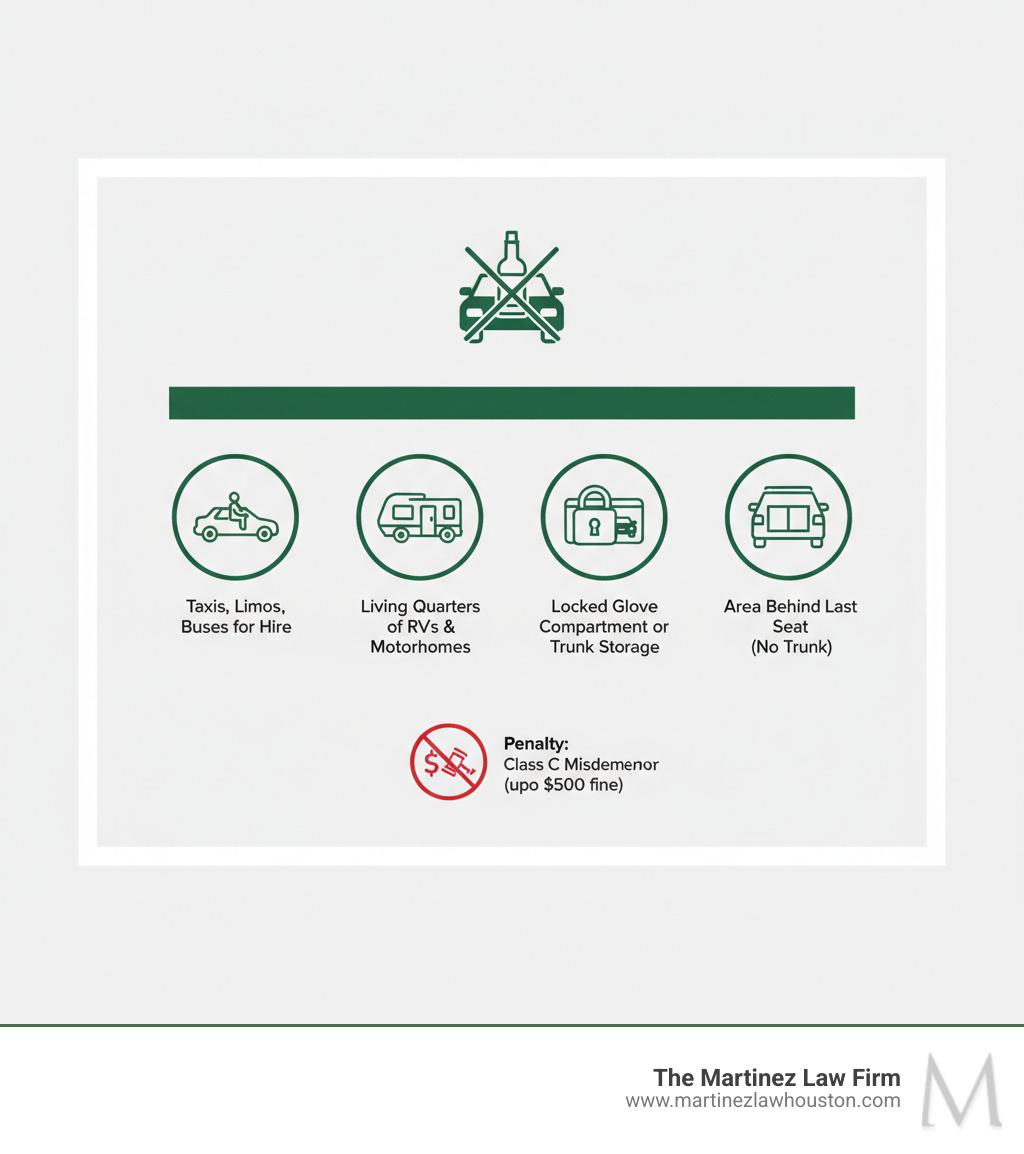
Understanding the Basics: What is Texas’s Open Container Law?
Before diving into open container law texas exceptions, you must understand the basics. Texas Penal Code § 49.031 makes it illegal to knowingly possess an open alcoholic beverage container in the passenger area of a motor vehicle on a public highway.

What catches people off guard is that it doesn’t matter if you’re driving, stopped, or parked. If you’re on a public highway with an open container in the passenger area, you’re breaking the law.
And here’s the kicker—both drivers and passengers can be charged. I’ve represented many sober drivers in Houston cited for an open container violation because a passenger had one. The law doesn’t care who’s drinking, only that someone knowingly possessed the open container.
Defining “Open Container”
So what exactly is an “open container”? It’s not just a half-finished beer in your cup holder.
Under Texas law, an open container is any bottle, can, or other receptacle that contains any amount of alcohol and has been opened, has a broken seal, or has had some of its contents removed.
This includes a re-corked bottle of wine from a Houston restaurant, a to-go cocktail with a broken seal, or a whiskey bottle with the original seal gone. I’ve even seen cases where an “empty” beer can was considered an open container because it was still cold. The bottom line is simple: if the original seal is broken, it’s open under Texas law.
The “Passenger Area” Explained
Understanding where you can and can’t have an open container is crucial. The passenger area is anywhere the driver or passengers can easily reach.
This includes the driver’s seat, passenger seats, center console, door pockets, and under the seats—basically anywhere within arm’s reach. If someone can grab it without unbuckling, it’s likely in the passenger area.
But this is where open container law texas exceptions matter. Certain areas are excluded from the “passenger area” definition:
- Locked glove compartments (not just closed—actually locked)
- The trunk of your vehicle
- The area behind the last upright seat in SUVs, hatchbacks, and vans without a traditional trunk
These are your legal safe zones. If you’re transporting an opened bottle of wine, put it in the trunk. In an SUV, place it in the cargo area behind the back seat. For Houston’s many pickup trucks, the bed of the truck works—just not the cabin.
What Counts as a “Public Highway”?
The term “public highway” is broader than you’d think, extending beyond I-45 or the Katy Freeway.
A public highway is any public road, street, highway, interstate, or other publicly maintained way open to motor vehicle travel. This includes shoulders, the right-of-way, and public parking lots connected to public streets.
Your neighborhood street in the Heights? Public highway. The parking lot at Findy Green? If it’s open to the public and connects to a public road, it counts. That gas station lot off Westheimer where you pulled over? Still a public highway under Texas law.
The key is whether the public has access for vehicle travel. If so, the open container law applies whether you’re moving or parked with the engine off.
The Core of the Matter: Texas Open Container Law Exceptions
While Texas law is strict about open containers, it provides specific exceptions. These aren’t loopholes but carefully defined open container law texas exceptions that recognize certain vehicles and situations are different.
Crucially, these exceptions almost always apply to passengers, not drivers. The person behind the wheel must always remain sober and cannot have an open container within reach, regardless of the vehicle type.

The legal gray areas can be confusing, especially when planning a night out in Houston. Let’s break down when and where these exceptions protect you.
Passengers in Vehicles for Hire
One of the most practical exceptions covers passengers in vehicles for hire. If you’re paying for transportation in a vehicle designed for carrying passengers, you can generally have an open container.
This exception covers taxis, limousines, buses (city and chartered), and party buses common in Houston’s entertainment districts. Passengers in these vehicles can legally drink while traveling.
What about Uber and Lyft? The law covers vehicles “used primarily for transporting persons for compensation.” While rideshares fit this description, both Uber and Lyft have company policies prohibiting open containers. Drivers can refuse service or end a ride for violations. So, while the legal exception may apply, company policy often forbids it.
Remember the absolute rule: the driver cannot have an open container or consume alcohol, period. This exception only protects passengers.
Living Quarters of RVs and Motorhomes
Texas law recognizes RVs as homes on wheels. The open container law doesn’t apply to the living quarters of motorized house coaches, self-contained trailers, and campers.
The key is “living quarters”—the residential section with beds, a kitchen, or a couch. Passengers in these areas can legally have open containers while traveling down I-45.
However, the driver’s cab is completely separate and subject to normal open container rules. The driver’s seat, front passenger seat, and anything within the driver’s reach are off-limits. We’ve seen cases where someone handing a beer forward from the back of an RV led to a citation. Keep all open containers well away from the cab and ensure the driver is sober.
Other Notable Texas Open Container Law Exceptions
Other situations also have specific rules:
Boats on Texas waterways operate differently. You can have open containers on a boat on Lake Conroe or Galveston Bay. However, operating a boat while intoxicated (BWI) is as serious as a DWI. The operator must stay sober.
Tailgating is a Texas tradition, especially in Houston. Many stadiums like NRG Stadium have designated tailgating zones where public consumption is permitted on private property with the owner’s permission. Always check posted signs and local rules, as this doesn’t apply to all parking lots.
Private property is another consideration. The state’s open container law targets public highways. On private property with the owner’s consent, the state law generally doesn’t apply. However, Houston and Harris County have their own ordinances about public consumption, so a privately owned but publicly accessible lot might still have restrictions. Don’t assume private property is a free-for-all.
For complete legal language, you can review the official statute, which is the authoritative source.
Penalties and Related Charges in Houston
An open container violation might not sound like a big deal at first. After all, it’s not like you were driving drunk, right? But here in Houston and Harris County, law enforcement takes these charges seriously, and the consequences can surprise you. What starts as a simple traffic stop can quickly turn into something that affects your wallet, your record, and even your future opportunities.

Standard Penalties for an Open Container Violation
In Texas, an open container violation is classified as a Class C Misdemeanor. You might think, “Well, at least it’s not a felony,” and you’d be right. But don’t let the classification fool you—this charge still carries real consequences that can follow you for years.
The most immediate impact is financial. You’re looking at fines up to $500 for a single violation. While multiple open containers found during one stop typically count as a single offense, the officer and the court have discretion in how they handle your case.
But here’s what really catches people off guard: you’ll have a criminal record. Even though a Class C misdemeanor doesn’t come with jail time, it’s still a criminal conviction. That record doesn’t just disappear after you pay the fine.
The ripple effects can be frustrating. When you’re applying for jobs, especially in fields that require background checks, that open container conviction shows up. We’ve worked with clients who lost job opportunities or professional licenses because of what they thought was “just a ticket.” Your insurance rates might jump too, as providers often see any alcohol-related violation as a red flag that you’re a higher risk to insure.
For students, the stakes are even higher. College admissions offices and financial aid departments review criminal records. A misdemeanor conviction could affect your acceptance to certain programs or your eligibility for scholarships and federal aid.
In most cases, you’ll receive a citation and a notice to appear in court rather than being arrested on the spot. But make no mistake—this is a legal charge that requires your attention and a proper response.
How an Open Container Improves a DWI Charge
This is where things get serious, and it’s something every driver in Houston needs to understand. If you’re charged with DWI and there’s an open container in your vehicle, that open container doesn’t just add a separate charge—it actually “improves” or “improves” your DWI charge under Texas law. (I know, “improves” seems like an odd word choice for making things worse, but that’s the legal terminology.)
Here’s what that means in practice. A first-offense DWI is typically a Class B misdemeanor. But when an open container is involved, the minimum jail time jumps from 72 hours to six days. That’s mandatory time behind bars, not something a judge can waive or reduce. Those extra days might not sound like much, but they can mean losing your job, missing important obligations, and experiencing the very real stress of incarceration.
The financial penalties climb higher too. While the maximum fine for a Class B misdemeanor DWI is $2,000, having that open container improvement often pushes judges toward the higher end of the sentencing range. Add in court costs, attorney fees, and other expenses, and you’re looking at a significant financial burden.
License Suspension
Your license suspension becomes more likely and potentially longer—up to a year for a first offense. And if you refuse a breath or blood test during the DWI stop, you’re facing an automatic administrative license suspension regardless of whether you’re ultimately convicted. Many defendants also face requirements to install an ignition interlock device in their vehicles, which prevents the car from starting if it detects alcohol on your breath.
Here’s something important to remember: the open container charge is separate from the DWI charge. You could be found not guilty of DWI but still convicted of the open container violation. However, when both charges stick, the combination creates much harsher penalties than either would carry alone.
A Consistent Pattern
We see this pattern constantly in Houston. An officer pulls someone over for a minor traffic violation, spots an open container in the car, and suddenly has probable cause to investigate for DWI. What started as a broken taillight turns into a life-changing legal battle. Understanding open container law texas exceptions and proper storage methods isn’t just helpful—it’s essential protection against these escalating charges.
At The Martinez Law Firm, we’ve defended countless clients facing these exact situations. With over 25 years of experience, including my time as Chief Prosecutor for the Harris County District Attorney’s Office, I know how these cases develop and how to fight them effectively.
Frequently Asked Questions about Texas Open Container Laws
We get a lot of questions about Texas open container laws, and honestly, that makes sense. The rules can be tricky, and the consequences are real. Here are some of the most common questions we hear from clients right here in Houston.
Can I be charged with an open container violation if my car is parked?
Yes, and this surprises a lot of people. It’s one of the biggest misconceptions we encounter at The Martinez Law Firm. Many folks assume that if they’re not actually driving, they’re in the clear. Unfortunately, that’s not how Texas law works.
Texas Penal Code § 49.031 makes it clear that the offense applies whether your vehicle is “being operated or is stopped or parked.” The engine doesn’t have to be running. You don’t have to be behind the wheel. If there’s an open container in the passenger area and your vehicle is on a public highway, you can be charged.
What does that mean in practical terms? If you’re parked on the side of a Houston street waiting for a friend, sitting in a grocery store parking lot, or pulled over on the shoulder of I-10 to take a call, the open container law still applies. Public parking lots are typically considered part of the public highway system for these purposes, so that HEB or Target parking lot isn’t a safe haven.
We’ve represented clients who thought they were being responsible by pulling over to finish a drink before driving home. Instead, they ended up with a citation and a criminal record. The location matters more than whether you’re moving.
How do local Houston ordinances affect the state’s open container law?
This is where things can get even more complicated. The state law sets the baseline, but cities like Houston have the authority to add their own restrictions on top of it. Local ordinances can be stricter than state law, though they can’t be more lenient.
In Houston, there are additional rules about public consumption of alcohol that go beyond what happens in your vehicle. Certain areas—like parks, entertainment districts, or near specific facilities—have their own prohibitions against possessing or consuming alcohol in public spaces. You might see similar rules in other Harris County communities as well.
Here’s a real-world example: let’s say you’re a passenger in a party bus, which would normally fall under the open container law texas exceptions. That’s perfectly legal while you’re in the vehicle. But if you step out onto the sidewalk in certain parts of downtown Houston with that same drink, you could be violating a local ordinance about public consumption.
Always pay attention to posted signs, especially in popular gathering spots like Findy Green, the Heights, or Midtown. What’s legal in your vehicle might not be legal once you’re on the sidewalk or in a public park. When in doubt, it’s better to ask or simply avoid the situation altogether.
Can I legally transport a previously opened bottle of wine from a restaurant?
Yes, you absolutely can, but the details matter here. This is actually a great example of how understanding the open container law texas exceptions and proper storage rules can keep you out of trouble.
Many Houston restaurants—from the fine dining spots in the Galleria area to neighborhood favorites in Montrose—will offer to re-cork or re-seal your unfinished bottle of wine if you purchased it with a meal. This is perfectly legal to take home with you. The same goes for to-go cocktails that some establishments now offer, as long as they’re properly sealed.
The critical part is how you transport it. That re-corked bottle can’t just ride in your cup holder or sit on the passenger seat. To avoid an open container violation, it must be stored in one of the specifically excluded areas of your vehicle: the trunk, a locked glove compartment, or the area behind the last upright seat if you’re driving an SUV, hatchback, or van without a traditional trunk.
Think of it this way: if the driver or any passenger can easily reach it while seated, it’s in the wrong spot. We’ve seen cases where someone had a properly sealed bottle from a restaurant but placed it in the back seat next to them. That’s still considered the passenger area, and it can lead to a citation.
Take the extra thirty seconds to pop your trunk and store it properly. It’s a small effort that can save you from a $500 fine, a criminal record, and all the headaches that come with it. And if you’re ever unsure about whether you’re following the rules correctly, that’s exactly the kind of question we’re here to answer at The Martinez Law Firm.
Facing a Charge? Know Your Next Steps
We’ve covered a lot of ground together—from what qualifies as an open container to the specific situations where open container law texas exceptions apply. You now know that passengers in limousines and party buses have more flexibility, that the living quarters of your RV are treated differently than the driver’s cab, and that storing opened bottles in your trunk or locked glove compartment keeps you on the right side of the law.
But here’s the reality: even with this knowledge, mistakes happen. Maybe a friend left a beer can under the seat. Perhaps you thought that re-corked wine bottle was secure enough where it was. Or you might have been completely unaware that an open container in your vehicle could add six days of mandatory jail time to a DWI charge.

If you’re facing an open container charge in Houston or anywhere in Harris County, don’t brush it off as “just a ticket.” That Class C misdemeanor creates a permanent criminal record that can follow you for years. It can complicate job applications, raise your insurance rates, and if it’s connected to a DWI, the consequences multiply dramatically.
The most important step you can take right now is to get experienced legal representation. Not all attorneys understand how prosecutors think or how they build their cases. Having someone on your side who’s actually stood in their shoes makes a real difference.
Call an Experienced Attorney
At The Martinez Law Firm, I bring more than 25 years of experience to your defense, including my time as Chief Prosecutor for the Harris County District Attorney’s Office. I know how the other side operates because I used to be the other side. That insider knowledge allows me to build aggressive, personalized defenses that challenge every aspect of your charge—from whether the stop was legal to whether the container truly qualified as “open” under the statute.
We’ve helped countless clients in Houston steer these exact situations, often getting charges reduced or dismissed entirely. Your future matters, and one mistake shouldn’t define it.
Protect your rights with an experienced Houston defense attorney. Let’s talk about your case and find the best path forward together.
The High Stakes of a DWI While on Probation

What happens if you get a dui while on probation creates two separate legal battles. You face:
Immediate Consequences:
- Probation Violation Hearing – Your probation officer files a Motion to Revoke (MTR), and a judge decides whether to revoke your probation and impose your original sentence.
- New DWI Criminal Case – You face separate criminal charges with penalties including jail time, fines, and license suspension.
- Dual Penalties – If convicted on both, you could serve the suspended sentence from your original offense plus penalties for the new DWI.
- Lower Burden of Proof – The probation violation only requires a “preponderance of evidence” (more likely than not), making it easier to prove than the criminal case.
In Harris County, this situation is particularly serious. An arrest alone can violate your probation, leading to a bench warrant and potential revocation by the original judge.
In Houston, this means fighting on two fronts. Consequences range from stricter probation to serving your original sentence plus new jail time. The process is fast, and early mistakes are costly.
I’m Herman Martinez, a former Chief Prosecutor for Harris County and a City of Houston Judge with over 25 years of experience. I’ve seen what happens if you get a dui while on probation from both sides and know the strategies that protect your freedom.
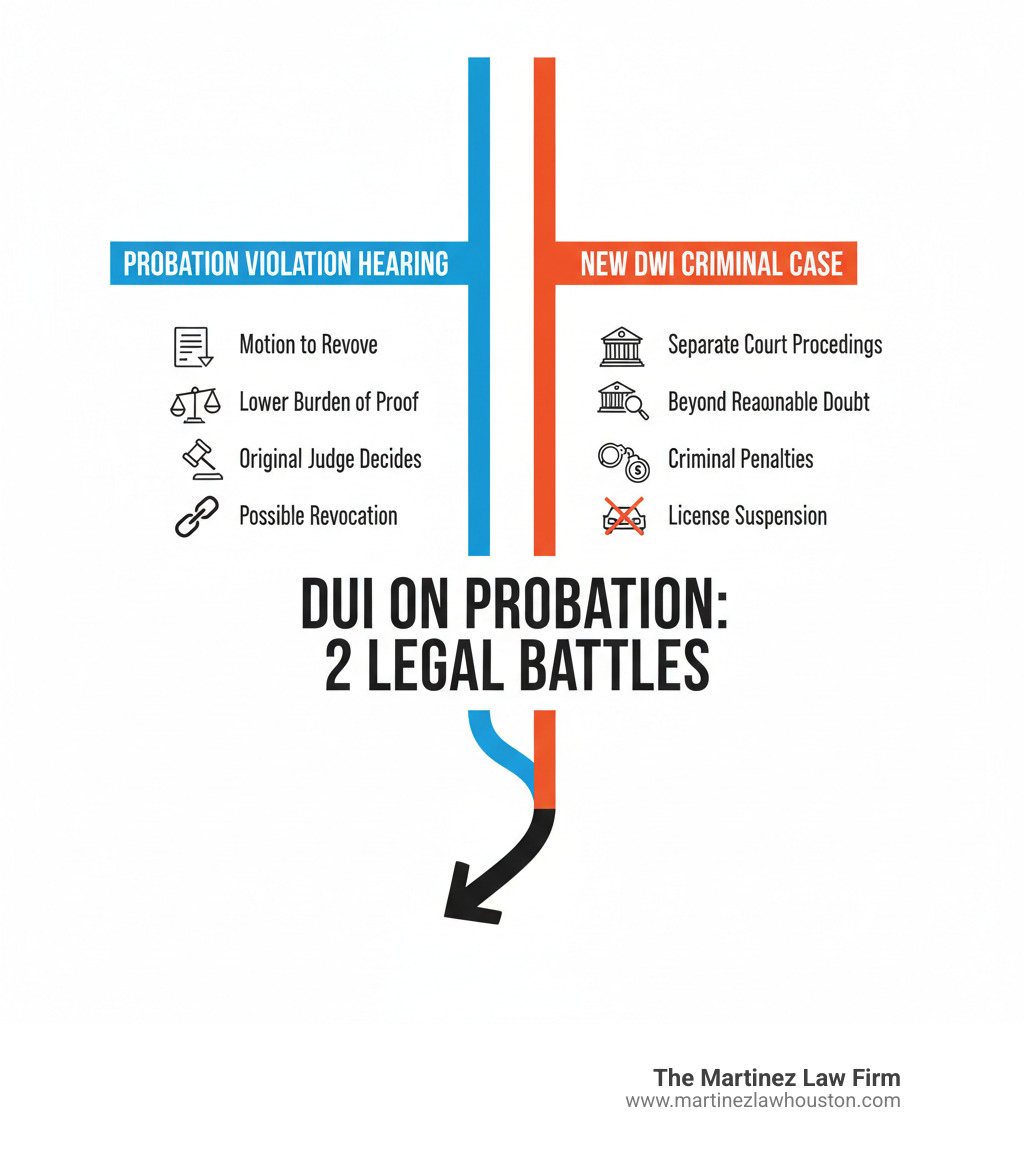
Understanding Your Probation and How a DWI Violates It
Probation in Texas—officially community supervision—is a second chance to avoid jail. But it’s a privilege with strict rules. Breaking them can lead to more trouble than your original offense.

Probation is a contract with the court. You agree to follow conditions to avoid jail time. The most fundamental rule is simple: don’t commit any new crimes.
A DWI arrest is a serious problem. It almost always triggers a probation violation, even if not explicitly mentioned in your paperwork. Your probation officer can file a Motion to Revoke Probation (MTR), putting your freedom in jeopardy.
For more background on how DWI probation works in Texas, check out our guide on DWI Probation in Texas: What You Need to Know.
General Terms of Probation in Harris County
Most probation agreements in Harris County share common conditions designed to keep you accountable. Specifics depend on your offense, history, and judge.
- No new offenses is the top rule. A DWI charge directly violates this, regardless of conviction.
- Regular check-ins with your probation officer and timely payment of all fines and fees are mandatory.
- You may also have to complete community service hours and attend counseling or classes, such as substance abuse programs or victim impact panels.
- Other conditions can include no-contact orders, travel restrictions, and maintaining lawful employment.
- For DWI probation, you must abstain from alcohol and drugs, often verified by random testing. An ignition interlock device (IID) may also be required. As probation agreements emphasize, these rules aren’t suggestions—they’re court orders.
How a DWI Arrest Triggers a Violation
A DWI arrest creates immediate problems, even before a conviction.
A DWI is a new criminal offense, violating the “obey all laws” clause. Your probation officer will learn of the arrest quickly and can file a Motion to Revoke.
Crucially, you don’t need to be convicted of the DWI for it to violate your probation. The arrest alone can be enough. Probation violations only require a “preponderance of the evidence”—a much lower standard than the “beyond a reasonable doubt” needed for a criminal conviction.
If your probation has a “no alcohol” condition, any measurable amount of alcohol in your system can trigger a violation, even if you’re not legally intoxicated.
Notifying your probation officer of the arrest is critical. Most agreements require immediate reporting (usually within 24-48 hours). Failure to report is a separate, serious violation that judges often view harshly. Hiding the arrest only makes things worse.
The bottom line: a DWI arrest while on probation in Harris County starts two legal battles—the new criminal case and a probation violation hearing. Both require immediate, experienced legal representation.
What Happens if You Get a DWI While on Probation: The Two-Front Legal Battle
Getting a DWI while on probation in Houston means fighting on two fronts. It’s two separate legal battles, each with its own rules and potentially devastating consequences. Understanding what happens if you get a dui while on probation means recognizing this dual threat.
On one side is the probation violation hearing for breaking your probation terms. On the other is a separate criminal case for the new DWI charge. These proceedings are independent but can influence each other.
The key challenge is the different standards of proof. A probation violation only requires a preponderance of the evidence (more likely than not). The new DWI case requires proof beyond a reasonable doubt. This means you could beat the DWI charge but still have your probation revoked.
You’ll also likely face an Administrative License Revocation (ALR) hearing. This civil proceeding with the Texas Department of Public Safety determines if your driver’s license will be suspended, adding another layer of complexity.
Navigating these interconnected proceedings requires a strategic approach. For more detailed guidance, check out our article on What to do at a Probation Violation Hearing.
The Probation Violation Hearing Process
Once your probation officer learns of your DWI arrest, they will file a Motion to Revoke (MTR) Probation with the court. The judge will then likely issue a bench warrant for your arrest. You can be arrested at any time, which catches many people by surprise.
After arrest, you’ll be held in custody. The judge has enormous discretion and can set a high bond or deny bond entirely, meaning you could be jailed for weeks or months awaiting your hearing.
The hearing is before the same judge who gave you probation. There is no jury; the judge alone decides your fate. The judge has several options: reinstate your probation with a warning, modify your probation with stricter terms, or revoke your probation entirely, sending you to serve the original suspended sentence.
The probation violation hearing is separate from your DWI criminal case, but you also need to be aware of the ALR hearing. Learn more in our guide, What Happens at an ALR Hearing?.
Fighting the New DWI Charge
Simultaneously, you’re fighting a separate court case for the new DWI charge, where the state must prove guilt beyond a reasonable doubt.
A new DWI conviction carries serious penalties, including fines, jail time, license suspension, and a possible ignition interlock device. The severity depends on if it’s a first, second, or subsequent offense and any aggravating factors. You can find detailed information about the potential consequences in our section on DWI penalties in Texas.
The DWI arrest also triggers an administrative license suspension. You have only 15 days from your arrest to request a hearing to challenge it. Missing this deadline means automatic suspension. We’ve written extensively about The 15-Day Rule because it’s a critical deadline.
Your attorney might negotiate a plea bargain. However, even pleading to a lesser charge still counts as a new crime and can violate your probation.
The outcome of the DWI case directly impacts the probation violation. An acquittal or dismissal strengthens your position, while a conviction makes revocation highly likely.
This is why a coordinated defense is essential. At The Martinez Law Firm, we handle both the DWI case and the probation violation simultaneously. My background as a former prosecutor and judge provides a strategic advantage in protecting your freedom.
Facing Double Penalties: Consequences for the Violation and the New DWI
Getting a DWI on probation is like facing double penalties. You’re penalized for the new DWI and for violating the court’s trust.
The consequences can include:
- Revocation of Probation and reinstatement of your original sentence.
- New DWI Penalties, including fines, jail time, and license suspension.
- Fines and Surcharges for both the original offense and the new DWI.
- Ignition Interlock Device (IID) requirements.
- Increased Costs, which can be immense. Our article on The Financial Costs of a DWI goes into more detail.
You could face penalties for both, leading to much harsher outcomes than a single charge.
Penalties if Your Probation is Revoked
If the judge revokes your probation, the consequences are severe. The court takes back the privilege of community supervision and orders you to serve the originally suspended sentence.
- Serving Suspended Sentence: You will be ordered to serve the original jail or prison sentence. For a misdemeanor, this could be up to six months in county jail. For a felony, it could be years in state prison.
- No Credit for Time Served on Probation: In most cases, the time you successfully spent on probation does not count toward your jail or prison sentence. It’s a harsh reality that adds to the punishment.
Judges have broad discretion and often view a new crime on probation as a direct defiance of their orders.
Penalties for the New DWI Conviction Itself
In addition to the probation violation, you face separate penalties for the new DWI charge in Texas, which stack on top of any revocation consequences.
| Offense | Jail Time | Fines (up to) | License Suspension (up to) | Other Common Penalties |
|---|---|---|---|---|
| First DWI | 3 days to 180 days (Class B Misdemeanor) | $2,000 | 1 year | Annual surcharge ($1,000-$2,000 for 3 years), DWI education program, possible IID, community service. |
| Second DWI | 30 days to 1 year (Class A Misdemeanor) | $4,000 | 2 years | Annual surcharge ($1,500-$2,000 for 3 years), mandatory IID, DWI education program, community service. |
| Third DWI | 2 to 10 years (Third-Degree Felony) | $10,000 | 2 years | Annual surcharge ($1,500-$2,000 for 3 years), mandatory IID, DWI education program, community service. |
Penalties can be improved by aggravating factors like a high BAC, an accident, or a child passenger. For more information, see our pages on Aggravated DWI factors and Texas DWI Laws.
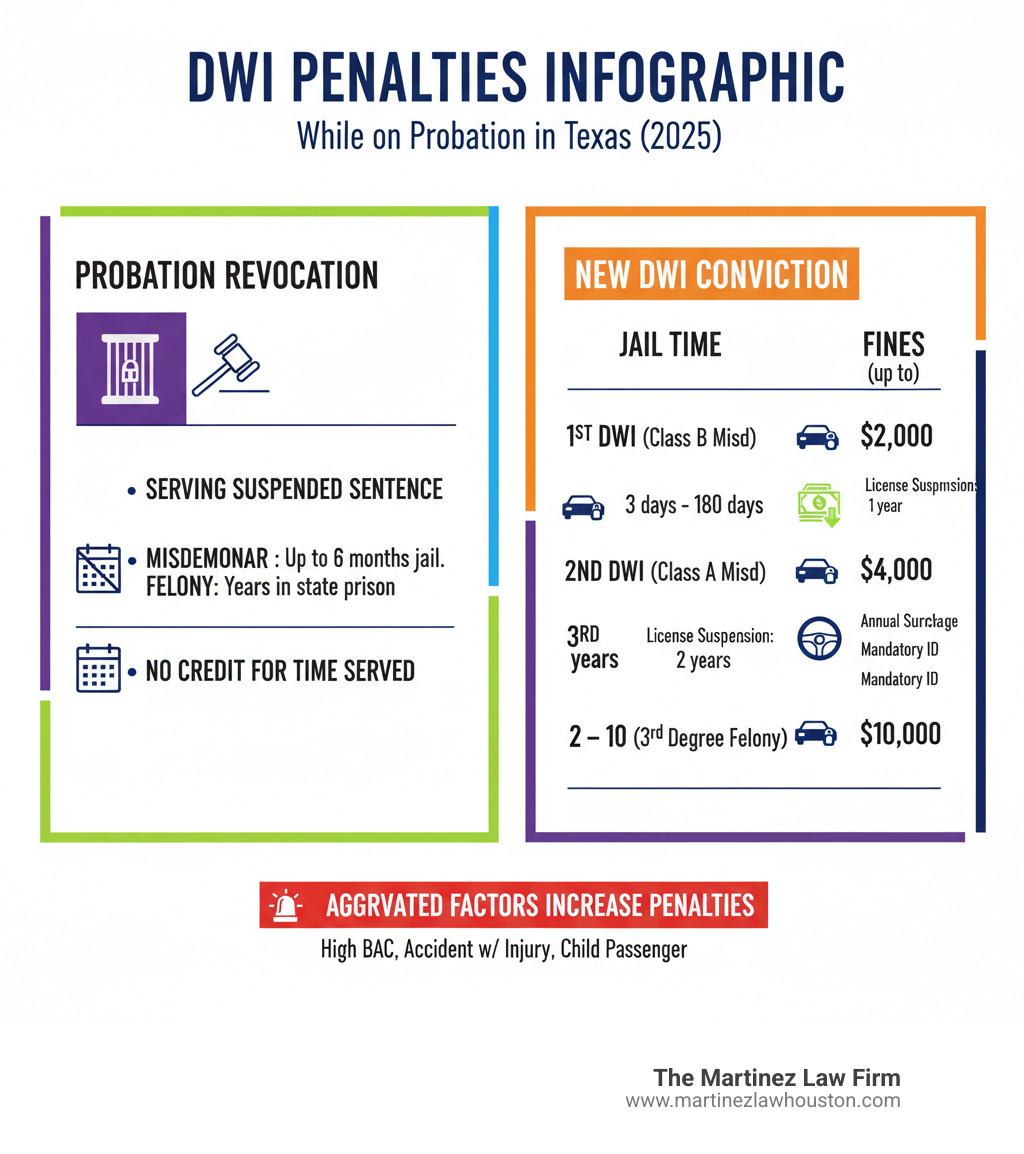
The combination of these penalties makes getting a DWI on probation one of the most serious legal situations you can face.
Building Your Defense: The Crucial Role of a DWI Lawyer
Facing a DWI on probation is a legal emergency. You need an experienced DWI lawyer. At The Martinez Law Firm, our advantage is Herman Martinez’s background as a former Chief Prosecutor. We know how the prosecution thinks and where their case is weak.
We use a dual defense strategy, tackling both the new DWI and the probation violation. An attorney can review your case for defenses, protect your rights, negotiate with prosecutors, and fight for alternatives to jail time, like treatment programs.
What happens if you get a DWI while on probation and need a defense?
A robust defense is your best bet. Common strategies include:
- Unlawful Traffic Stop: Police need reasonable suspicion for a traffic stop. If the stop was illegal, evidence gathered from it may be suppressed. We have experience Challenging the Evidence.
- Improperly Administered Field Sobriety Tests (FSTs): These tests are subjective and often flawed. Medical conditions, weather, and other factors can affect performance. We can challenge their validity.
- Inaccurate Breath or Blood Tests: Breathalyzers can be faulty or improperly used. Blood tests can be compromised by poor handling. We scrutinize the scientific validity and chain of custody for these tests.
- Rising BAC Defense: Your Blood Alcohol Concentration (BAC) may have been lower while driving than when tested later. This complex defense often requires expert testimony.
- Challenging the MTR Evidence: In the probation hearing, we can challenge the probation officer’s evidence, arguing against its sufficiency even with the lower burden of proof.
Navigating these complexities requires a dedicated legal professional. The value of having an attorney for a DWI charge cannot be overstated.
Can Probation Be Reinstated After a Violation?
Yes, probation can sometimes be reinstated or modified after a violation, but it’s not guaranteed and depends on the judge’s discretion.
Here’s how we work to achieve this:
- Judge’s Discretion: Judges have broad leeway and can choose to reinstate or modify probation instead of revoking it, even for a new DWI.
- Mitigating Factors: We present factors like prior compliance, employment, family responsibilities, and rehabilitation efforts to the court.
- Proactive Steps: Voluntarily enrolling in treatment programs, attending AA meetings, or seeking counseling shows a commitment to change that can sway a judge. The Alcoholics Anonymous program has helped many.
- Arguing for Modification vs. Revocation: We often argue for modifying probation (e.g., extending the term, adding an IID) rather than revocation. This is usually a better outcome than jail time.

Convincing a judge requires a compelling argument. Our experience in Houston courts allows us to effectively advocate for your second chance.
Frequently Asked Questions about DWI and Probation in Texas
Facing a DWI on probation brings up many questions. With over 25 years of experience in Houston courts, I’ve heard them all. Here are answers to the most common ones.
Can you be around alcohol while on probation for a DWI?
The short answer is: it depends on your specific orders, but it’s extremely risky. Most Texas DWI probation terms include a strict “no-alcohol” clause, often monitored through random testing or devices like SCRAM ankle monitors.
Even if not explicitly forbidden, being in places like bars looks bad to a probation officer and the court. It’s wise to avoid these situations entirely. The bottom line: Remaining drug and alcohol-free is a common condition of probation. It’s not worth the risk when what happens if you get a dui while on probation could mean losing your freedom.
What happens if you get a DWI while on probation for a different crime?
The process is the same, regardless of your original crime. A DWI is a new offense, which violates the standard probation condition to “obey all laws.”
You will still face a Motion to Revoke Probation (MTR) for the original crime and separate criminal charges for the new DWI, creating the same two-front battle. The court won’t distinguish between the crimes; a violation is a violation. The judge will see the new DWI as a breach of trust.
Can you get early release from DWI probation in Texas?
Unfortunately, the answer is no. This is a common misconception.
The Texas Code of Criminal Procedure 42A § 701 explicitly states that judges cannot grant early release from probation for a DWI offense, even though they can for other crimes.
This means you must complete the full term of your DWI probation, typically one to two years. Even perfect compliance won’t change this. This highlights the strictness of Texas DWI probation and why avoiding a new charge while on probation is so critical.
Don’t Face a Probation Violation Alone
A DWI arrest while on probation in Houston is a legal emergency. You face potential jail time for both the original offense and the new charge. Don’t wait and hope for the best.
The stakes are incredibly high. You’re fighting two legal battles at once, and one misstep can have devastating, long-term consequences for your freedom and future.
In this complex situation, an experienced attorney is crucial. At The Martinez Law Firm, we understand what happens if you get a dui while on probation. Herman Martinez’s background as a former Chief Prosecutor and City of Houston Judge gives us unique insight into how to build a successful defense in Houston courtrooms.
We build a coordinated defense for both your probation violation and the new DWI charge. We know how these cases interconnect and use that knowledge to challenge evidence, negotiate with prosecutors, and argue for your second chance.
We have helped many clients in Harris County steer this exact situation, achieving outcomes like reinstated probation or reduced charges. Immediate, strategic action is the key to a manageable outcome.
The longer you wait, the fewer options you have. Don’t let this predicament become a permanent problem.
If you’re facing a DWI on probation, contact us now. We will review your case and start building the aggressive defense you need. Your freedom is worth fighting for. Contact an experienced DWI lawyer today to protect your future.
Navigating Child Molestation Accusations: Your First Steps

Facing accusations of child molestation is terrifying and calls for immediate action from a skilled child molestation defense lawyer. The mere accusation alone can shatter your life, reputation, and freedom. It’s a very serious crime with devastating consequences, even if you are innocent.
If you are accused, here are the crucial first steps to take:
- Do not speak to the police, Child Protective Services (CPS), or anyone else about the allegations without your lawyer present. Anything you say can be used against you, even if you think you’re explaining.
- Contact an experienced child molestation defense lawyer immediately. Time is critical. The sooner your lawyer gets involved, the better they can protect your rights and gather evidence.
- Do not contact the alleged victim or anyone connected to them. This can be seen as witness tampering or intimidation, leading to more serious charges.
You are presumed innocent until proven guilty. But in these cases, public perception can be harsh. A strong, strategic defense is essential to protect your rights, your future, and your reputation.
I’m Herman Martinez, founder of The Martinez Law Firm. With over 25 years of experience as a Chief Prosecutor and City of Houston Judge, I bring a unique perspective to defending those accused of child molestation, ensuring your rights are protected from every angle.
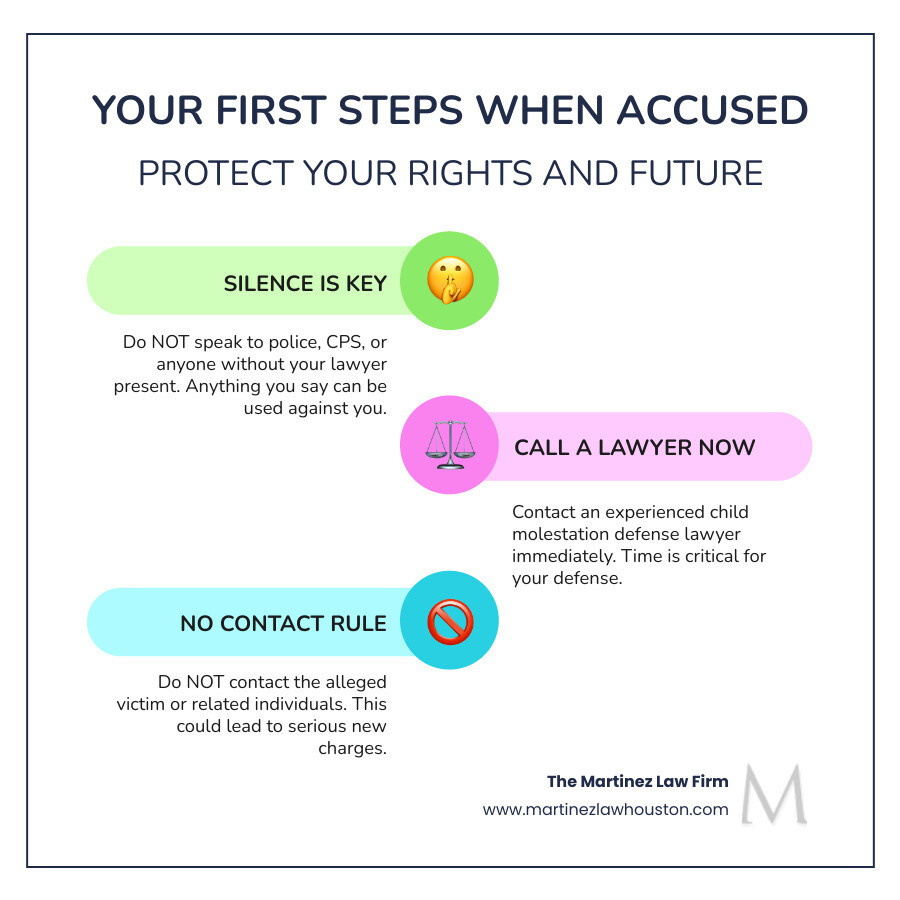
Understanding the Charges and What’s at Stake
When you’re facing child molestation accusations, you’re fighting for your entire future. These charges carry some of the harshest penalties in the Texas legal system, and understanding what you’re up against is crucial.

In Texas, the law doesn’t use the term “child molestation.” Instead, the state of Texas defines child molestation as a crime involving “indecency, sexual contact, or sexual abuse…of anyone under the age of 17.” This covers several specific charges, including indecency with a child, sexual assault of a child, and continuous sexual abuse. All are felonies with life-changing consequences.
The prosecution has the burden of proof and must prove guilt beyond a reasonable doubt. As your child molestation defense lawyer, our job is to hold them to that high standard. You can learn more in our article, The Burden of Proof in Sex Crimes: What to Know.
Potential Penalties and Lifelong Consequences
The penalties for child molestation convictions in Texas are severe and lifelong.
Most charges are second-degree felonies, carrying 2 to 20 years in prison and fines up to $10,000. If the victim is under 14, it becomes a first-degree felony, with a potential sentence of 5 to 99 years or life.
Some charges, like continuous sexual abuse, have mandatory minimum sentences of at least 25 years without parole.
Beyond prison, a conviction means lifetime sex offender registration under Megan’s Law. Your photo, address, and conviction details become public. This creates massive restrictions on where you can live and work, making it difficult to find housing or employment. You’ll be barred from living near schools or playgrounds.
Your career prospects diminish, as professional licenses can be revoked, and you’ll be unable to work in fields like education or healthcare. Your family relationships will also suffer, potentially leading to loss of custody or visitation rights.
We explain more about the legal warnings judges must give in our article, Houston Sexual Assault Lawyer Discusses Admonishments.
Related Offenses: Child Pornography and Online Solicitation
The digital age has introduced related charges like online solicitation and child pornography, which carry penalties as severe as physical offenses.
Online solicitation charges can arise from communicating with someone believed to be a minor for sexual purposes, even if no meeting occurs and the “minor” is an undercover officer. These cases rely on digital evidence from complex sting operations.
Child pornography charges address both possession and distribution. Merely possessing such images is a serious offense, often a federal charge with mandatory minimum sentences. The difference between possession and distribution can mean decades in prison. Federal cases are aggressively prosecuted and carry harsh penalties.
Digital forensics is central to these cases, as law enforcement recovers files and traces internet activity. However, this evidence is not infallible. Warrants can be invalid and procedures flawed. Our role is to scrutinize how all digital evidence was obtained and analyzed.
We’ve written more about these defenses in our articles Don’t Allow False Allegations of Child Pornography Ruin Your Reputation and Criminal Defense: Federal Crimes: Child Pornography.
These cases require an experienced child molestation defense lawyer to challenge the prosecution’s case immediately.
How a Child Molestation Defense Lawyer Builds Your Defense
Facing child molestation accusations requires a proactive defense team. At The Martinez Law Firm, our approach is thorough and built on years of experience.
We immediately begin a full investigation process, actively gathering evidence and scrutinizing the prosecution’s case. As a former prosecutor, our founder, Herman Martinez, provides an invaluable ‘insider’ view of their playbook, allowing us to build an aggressive, personalized defense.
From the start, protecting your rights is our top priority. We ensure law enforcement follows the rules, challenge illegally obtained evidence, and advocate for you at every stage. Our goal is to achieve the best possible outcome, from dropped charges to an acquittal at trial. Learn more about our approach on our page on Defending a Sexual Assault Case in Houston.
Common Defenses Used by a Child Molestation Defense Lawyer
A skilled child molestation defense lawyer uses several common strategies to challenge these serious accusations.
Accusations can be false. While studies from the National Sexual Violence Resource Center show they make up just 2 to 10 percent of all claims, they do happen and can stem from intense child custody battles, divorces, a child’s misunderstanding, or revenge motives. We investigate the motivation behind the claims and the accuser’s credibility.
Other defenses include lack of intent or accidental contact. Many laws require proof of specific sexual intent. If we can show contact was accidental or lacked intent, it can be a powerful defense.
Factual defenses like mistaken identity or a solid alibi are also crucial. We may also need to challenge accuser credibility by highlighting inconsistencies in their story or a history of false claims, always handling this sensitive issue ethically while fighting for your rights.
How a Child Molestation Defense Lawyer Challenges Evidence
Forensic evidence like DNA or digital files is common in these cases, but it’s not always perfect. As your child molestation defense lawyer, our job is to scrutinize every piece of evidence and challenge anything that is flawed or was obtained improperly.
We conduct a thorough forensic evidence analysis. DNA evidence can be mishandled or contaminated, so we often use independent experts to re-check it. For internet-related cases, computer forensics is key. We challenge the methods used to collect digital evidence, the reliability of software, and the legality of search warrants.
Our firm focuses on challenging search warrants and file motions to suppress evidence from illegal searches. We also spend significant time questioning police procedures, reviewing reports and interrogations to find mistakes or rights violations.
To understand more about how we challenge evidence, visit our page on Child Molestation Defense Lawyer.
Navigating Child Witness Testimony
When a child is a witness, it adds a sensitive and challenging layer to the case. The legal system has special rules for child witnesses to protect them, but these rules can sometimes make it harder for the accused to get a fair trial.
Children’s testimony often comes from forensic interviews, but children can be highly susceptible to leading questions or suggestion. Their memories can change with repeated questioning or external pressure. We understand the suggestibility of children.
As your child molestation defense lawyer, we review all interview recordings and transcripts for signs of influence or inconsistencies. We may use expert testimony on child psychology to explain how a child’s memory works. While cross-examination techniques of a child witness must be handled delicately, our goal is to ensure their testimony is accurate and that you receive a fair trial.
Navigating the Legal System from Investigation to Trial
The legal journey for a child molestation charge is complex. Understanding the process helps you prepare and allows your child molestation defense lawyer to protect your rights effectively.
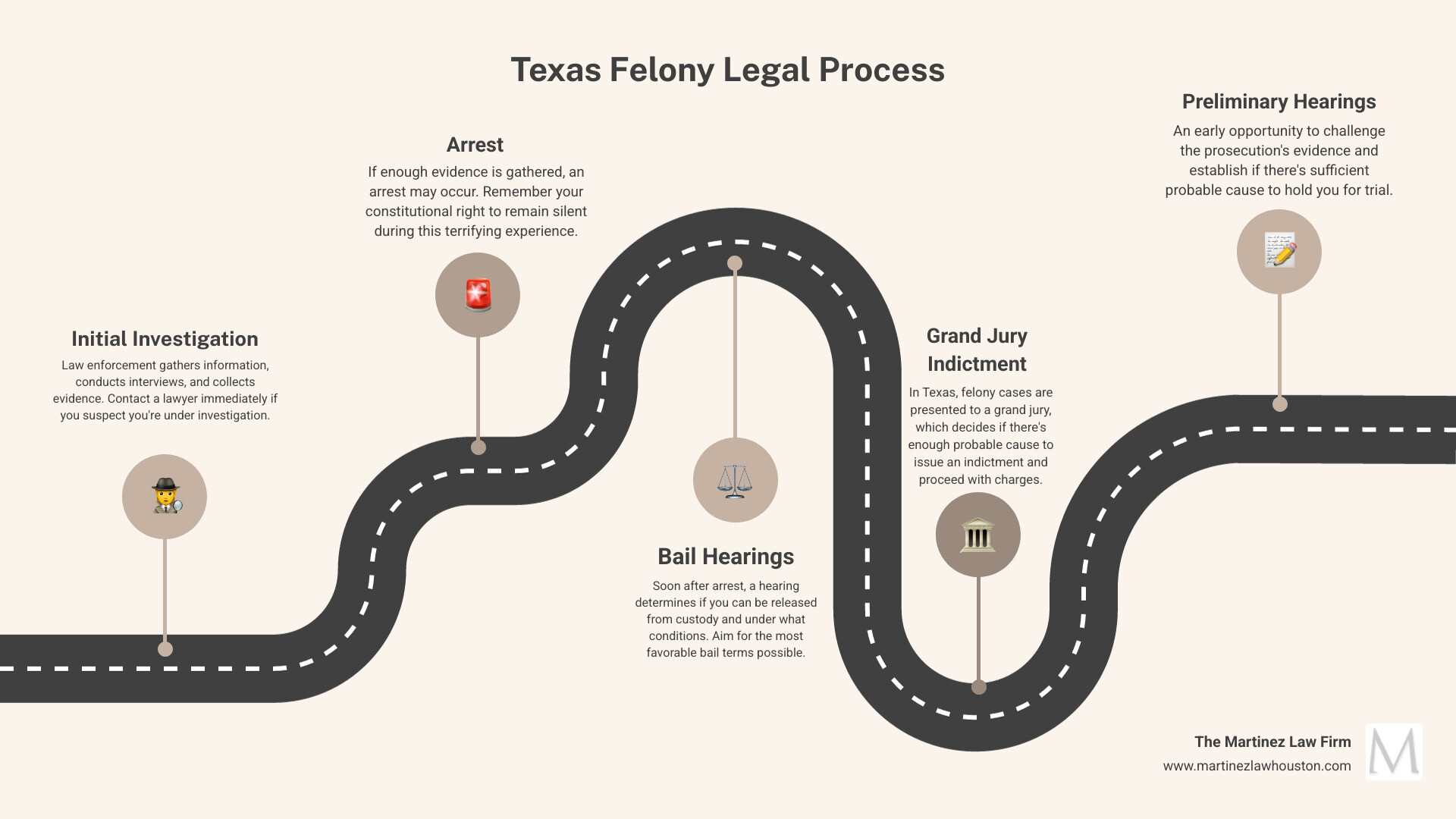
The process starts with an initial investigation and potential arrest. It is critical to remain silent and contact a lawyer immediately. After an arrest, a bail hearing determines if you can be released pending trial. We fight for favorable bail terms to avoid the disadvantage of fighting your case from jail.
Felony cases then go to a grand jury, which decides if there is enough evidence to indict. A preliminary hearing (examining trial) may also occur, giving us an early chance to challenge the state’s evidence.
During the findy process (findy), both sides exchange evidence. We carefully review the prosecution’s files for weaknesses. This is also when plea negotiations may happen. We advise you on any offers and negotiate for the best possible terms.
If no agreement is reached, the case goes to trial, where we present your defense. If a conviction occurs, we argue for the most lenient punishment at sentencing and can explore appeals to challenge legal errors.
Your Constitutional Rights When Accused
Your constitutional rights are your lifeline when facing these accusations. We ensure they are protected from the start.
Your right to remain silent under the Fifth Amendment is your most important protection. You do not have to speak to police or investigators. Talking without your lawyer present almost always hurts your case.
The right to an attorney under the Sixth Amendment means you can have legal counsel during any questioning. An experienced child molestation defense lawyer who specializes in these cases provides a significant advantage.
Your protection against unreasonable searches and seizures under the Fourth Amendment means law enforcement needs proper legal authority to search your property. Illegally obtained evidence can often be suppressed.
Your right to a fair trial includes the right to confront accusers, present a defense, and be judged by an impartial jury. This ensures the prosecution must prove its case beyond a reasonable doubt.
The Importance of Pre-Trial Motions and Hearings
Pre-trial motions can dramatically change a case’s outcome. These legal maneuvers are opportunities to challenge evidence and sometimes get charges dismissed.
A motion to suppress evidence is a powerful tool. If police violated your rights during a search or interrogation, we can ask the court to exclude that evidence, which can devastate the prosecution’s case.
Motions to dismiss attack the foundation of the case, arguing a lack of evidence or procedural errors.
The preliminary inquiry (or examining trial in Texas) gives us a chance to cross-examine key witnesses before trial. This helps us uncover inconsistencies and develop our defense strategy.
These pre-trial processes allow us to challenge the prosecution’s case aggressively from the beginning, setting the stage for the strongest possible defense.
Frequently Asked Questions about Child Molestation Defense
It’s normal to have questions when facing such serious accusations. We’re here to provide clear, straightforward answers to help you steer this difficult time.
What should I do if I’m being investigated but haven’t been charged?
If you suspect you’re under investigation, even before charges are filed, your actions are critical.
- First, immediately contact a skilled child molestation defense lawyer. Early legal help can significantly impact your case’s outcome by allowing us to build a defense before the prosecution solidifies its case.
- Second, do not speak to the police, Child Protective Services (CPS), or any investigator without your lawyer. Anything you say can be used against you, so politely state that you wish to speak with your attorney.
- Third, do not destroy any potential evidence, such as electronic devices or documents, as this can lead to additional charges. Instead, preserve communications like texts and emails related to the allegations. Our firm can protect your rights from the very beginning.
Can a conviction be removed from my record?
Unfortunately, removing a child molestation conviction from your record in Texas is extremely difficult. Most convictions result in mandatory lifetime sex offender registration, which is a public record that cannot be easily removed.
While some juvenile records may be sealed, as we discuss in our article Can You Seal Your Juvenile Court Records?, adult convictions are typically permanent.
The rare legal paths for sex offender de-registration are incredibly challenging and require the expertise of a seasoned child molestation defense lawyer. Because the consequences are so profound, our primary focus is on preventing a conviction in the first place.
How much does it cost to hire a defense lawyer for this type of case?
Defending against child molestation charges is a significant financial investment, as these are among the most complex and time-consuming cases in criminal law.
Several factors influence the cost:
- Case Complexity: Intricate facts, numerous witnesses, and complex evidence (like digital forensics) require more resources.
- Expert Witness Fees: We often hire specialists like forensic scientists or psychologists, whose fees are part of the defense cost.
- Investigation Costs: A thorough investigation may involve private investigators and extensive document review.
- Trial Duration: A lengthy trial requires extensive preparation and courtroom time from your legal team.
Fees can be structured as a flat fee or an hourly rate. While the cost is substantial, investing in an experienced child molestation defense lawyer is an investment in your freedom and future. The cost of a conviction—lost income, fines, and lifetime sex offender registration—far outweighs the legal fees.
Your Future Depends on Expert Defense
Facing accusations of child molestation is an experience that can feel isolating and overwhelming. The headlines and public perception are often against you from the start. But remember, you have rights, and you have options.
At The Martinez Law Firm, we understand the immense stakes involved. We believe in fighting for your future with compassion, dedication, and an aggressive defense strategy. Our unique advantage, stemming from Herman Martinez’s extensive experience as a former prosecutor, allows us to anticipate the prosecution’s moves and build a robust defense custom to your specific circumstances. We are committed to protecting your freedom, your family, and your reputation in Houston, Harris County, Fort Bend County, Montgomery County, Galveston County, Sugar Land, Pasadena, Missouri City, and Pearland.
The path ahead may be challenging, but you don’t have to walk it alone. Taking the first step towards your defense by contacting an experienced child molestation defense lawyer is the most crucial decision you can make. Let us put our expertise to work for you, guiding you through every legal hurdle and fighting tirelessly for the best possible outcome.
Your future hangs in the balance. Contact us today to discuss your case and begin building your defense. Visit our Sex Crimes page for more information on how we can help.
The Grave Reality: DWI with a Child Passenger in Houston

Imagine this scenario: you’re out for dinner with your family. You had a couple of drinks and thought you were fine to drive. On the way home, you get pulled over. Now, you face a felony charge for DWI because your child was in the car.
When facing charges for a DWI with a child passenger, finding the right houston dwi with child passenger defense attorneys is crucial. This is not a standard DWI. It’s a state jail felony in Texas, even for a first offense. This means much tougher penalties and a serious impact on your life and family.
Why is hiring a specialized Houston DWI with child passenger defense attorney essential?
- Felony Charges: Unlike standard DWIs, which are often misdemeanors, a DWI with a child passenger is an automatic felony.
- Severe Penalties: You face jail time (up to 2 years), hefty fines (up to $10,000), and a criminal record.
- Child Endangerment: You could also face separate child endangerment charges, impacting child custody.
- License Suspension: Your driver’s license is at risk, with strict deadlines (15 days) to fight suspension.
- Complex Defense: These cases require unique legal strategies to challenge evidence and protect your future.
Backed by over 25 years of experience and leadership from a former Chief Prosecutor and City Judge, The Martinez Law Firm aggressively defends clients facing these serious charges. This perspective enables our team to deliver top-tier representation as houston dwi with child passenger defense attorneys, safeguarding your rights and your future.
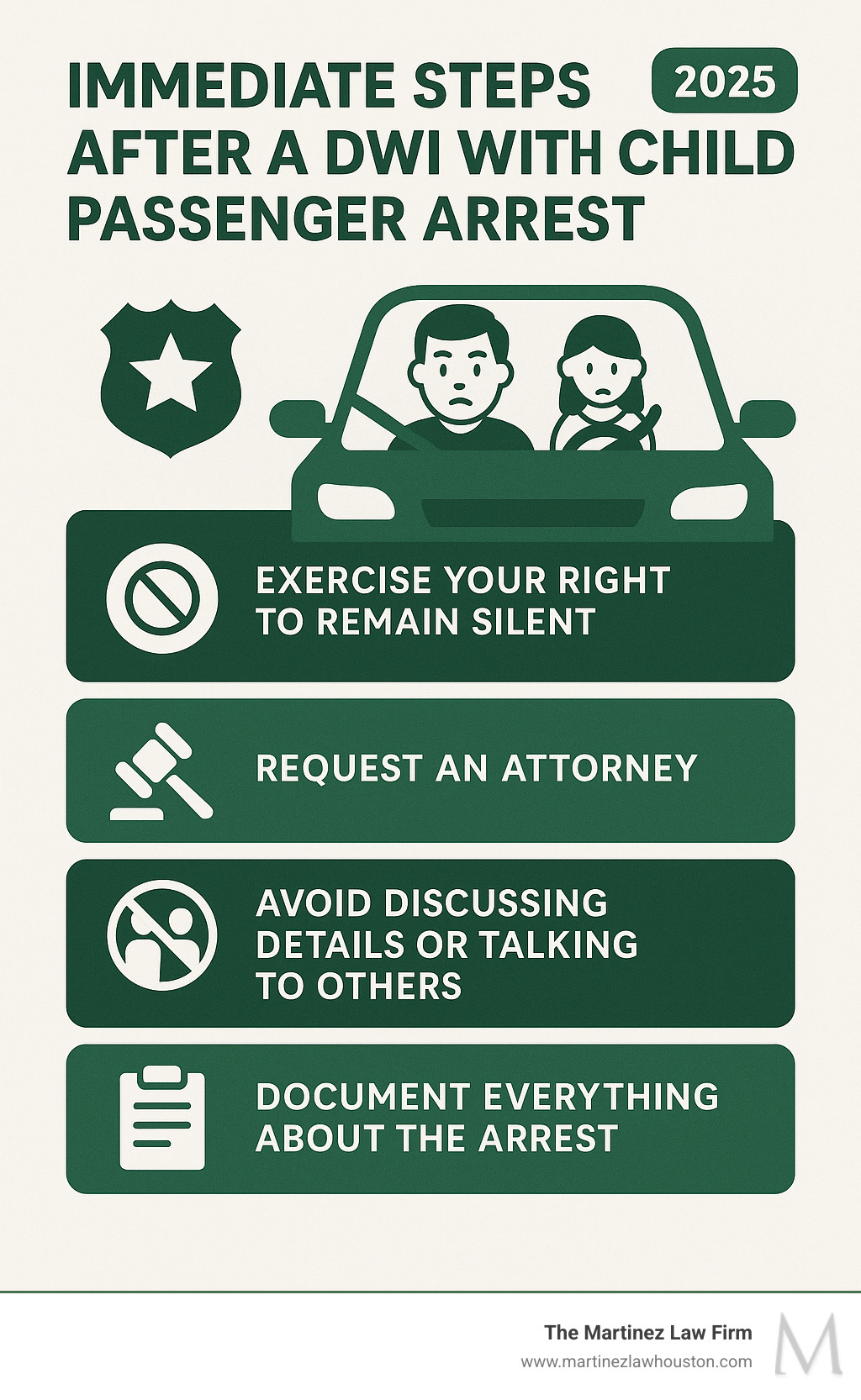
The Automatic Felony: What Constitutes DWI with a Child Passenger in Texas?

It’s easy to think a DWI is just a DWI, but in Texas, when a child is in the car, everything changes. This isn’t just a typical traffic offense; it’s a deeply serious charge that immediately lifts to a felony, even if it’s your first time. This is why understanding the law and getting the right help is so vital.
So, what exactly turns a regular DWI into an “automatic felony” with a child passenger in Texas? It all comes down to Texas Penal Code Section 49.045. This law states that you commit this offense if you are intoxicated while driving a vehicle in a public place, and there’s a passenger younger than 15 years old in the car.
What You Need to Know
Let’s break down those key terms:
- Intoxication: Most people think of this as having a blood alcohol concentration (BAC) of .08% or higher. But here’s an important point: Texas law also considers you intoxicated if you’ve lost the normal use of your mental or physical abilities due to alcohol or drugs. This means even if your BAC is below .08%, you could still be charged if your impairment is clear.
- Operating a Motor Vehicle: This simply means you have actual control over the vehicle, whether it’s moving or parked.
- Public Place: Think of any street, highway, or area generally open for public use.
- Passenger Younger Than 15: This is the crucial part that makes the charge so much more severe. It means any child who is 14 years old or younger.
The moment these four elements come together, you’re looking at a State Jail Felony. This is a game-changer, and it’s precisely why you need knowledgeable houston dwi with child passenger defense attorneys on your side. For a deeper dive into Texas DWI laws, you can explore our page on DWI Laws in Texas.
How is this different from a standard DWI?
The difference between a standard DWI and a DWI with a child passenger is like night and day when it comes to legal consequences. A typical first-offense DWI in Texas is usually a Class B Misdemeanor. While still serious, it pales in comparison to the immediate State Jail Felony classification of a DWI with a child passenger. This isn’t just an upgrade in severity; it brings a whole new set of mandatory, harsher penalties.
To give you a clearer picture, let’s look at how these charges stack up against each other:
| Aspect | Standard DWI (First Offense) | DWI with Child Passenger (First Offense) |
|---|---|---|
| Offense Class | Class B Misdemeanor | State Jail Felony |
| Jail Time | 3 days to 180 days | 180 days to 2 years |
| Fines | Up to $2,000 | Up to $10,000 |
| License Suspension | Up to 1 year | Up to 180 days |
As you can plainly see, the penalties for a DWI with a child passenger are significantly more severe from the very beginning. This felony classification means a conviction often leads to mandatory jail time, not just the possibility of it. And beyond these immediate penalties, a felony conviction casts a long shadow, impacting your life in ways you might not even imagine yet. We’ll dig into those long-term consequences in the next section. For more general information on DWI penalties, visit our page on DWI Penalties.
Beyond the Courtroom: The Full Scope of Penalties and Consequences

When you’re facing a DWI with a child passenger charge, the consequences reach far beyond what happens in the courtroom. Yes, the criminal penalties are severe, but the real impact touches every corner of your life – your family, your job, your future.
Let’s be honest about what you’re facing. A conviction for this state jail felony brings jail time between 180 days and two years. This isn’t just any jail – it’s a state facility, which is a much more serious situation than county jail.
The financial hit is equally devastating. You could face fines up to $10,000, plus the cost of mandatory DWI education classes. The court may also order up to 1,000 hours of community service.
Your driving privileges take a major hit too. Beyond the potential 180-day license suspension, you’ll likely need to install an ignition interlock device on your vehicle. This device won’t let your car start if it detects any alcohol on your breath. You’ll also face annual surcharge fees between $1,000 and $2,000 for three years just to keep your license after suspension.
These direct penalties are just the beginning. The ripple effects of a felony conviction can follow you for years. For more information about improved DWI charges, visit our page on Aggravated DWI in Texas.
Will I Lose My Kids? The Role of Child Protective Services (CPS)
This is the question that keeps parents awake at night, and unfortunately, it’s a very real concern. When you’re arrested for DWI with a child passenger, you’re not just dealing with criminal court – you may also face the Texas Department of Family and Protective Services (TDFPS), commonly known as CPS.
Here’s what many people don’t realize: driving while intoxicated with a child under 15 can result in separate child endangerment charges under Texas law. The state doesn’t care if no one got hurt. In their eyes, putting a child in that situation shows a dangerous disregard for their safety.
When CPS gets involved, they launch a full investigation into your family’s situation. This can be incredibly intrusive and stressful. They’re looking at your home environment, your parenting abilities, and whether your children are safe in your care.
The potential consequences are terrifying for any parent. CPS may recommend temporary removal of your children from your home. They might place them with relatives or even in foster care while the investigation continues. In the most severe cases, they could pursue termination of your parental rights entirely.
Even if you don’t lose full custody, your visitation rights might become restricted or supervised. If you’re going through a divorce or custody battle, this conviction becomes powerful ammunition for the other side in family court.
The state of Texas takes child protection very seriously, and CPS has broad powers to act quickly when they believe a child is in danger. This is why having experienced houston dwi with child passenger defense attorneys becomes crucial – you need someone who understands both the criminal case and the potential civil proceedings with CPS.
What is an Administrative License Revocation (ALR) Hearing?
While you’re dealing with criminal charges, there’s another legal process happening that could immediately impact your ability to drive. This is called an Administrative License Revocation (ALR) hearing, and it operates completely separately from your criminal case.
The Texas Department of Public Safety (DPS) handles ALR hearings as civil proceedings. Their sole focus is deciding whether your driving privileges should be suspended. This process kicks in automatically if you either refused a chemical test when the officer requested it, or if you failed a chemical test with a BAC of .08% or higher.
Here’s the critical part that catches many people off guard: you have only 15 days from the date you received notice (usually when you were arrested) to request an ALR hearing. Miss this deadline, and your license gets suspended automatically, regardless of what happens in your criminal case.
Many people think they should just skip the ALR hearing and focus on their criminal case. This is a mistake. An ALR hearing with a skilled attorney gives you several advantages. Your lawyer can challenge the suspension by presenting evidence and arguments to prevent or reduce the length of suspension.
The hearing also provides an opportunity to gather valuable evidence for your criminal case. Your attorney can subpoena police officers and evidence, essentially getting a preview of the prosecution’s case against you.
Most importantly, even if the suspension stands, the hearing might help you secure an occupational license. This allows you to drive for essential activities like work, school, and household duties.
The ALR process is unforgiving and moves quickly. The deadlines are strict, and the consequences of missing them are immediate. For more information about the implications of test refusal, check our page on DWI if You Refuse a Blood or Breath Test.
Crafting a Defense: How Houston DWI with Child Passenger Defense Attorneys Can Help
Facing a DWI with a child passenger charge can feel incredibly overwhelming. It’s like the weight of the world just landed on your shoulders. But here’s the crucial thing to remember: an arrest is not a conviction. With the right houston dwi with child passenger defense attorneys by your side, you absolutely have a fighting chance.
At The Martinez Law Firm, we build our defense on a strong foundation of aggressive, personalized care. Our approach is unique, largely thanks to attorney Herman Martinez’s past experience as a prosecutor. This means we’ve been on the other side. We understand exactly how the prosecution constructs their case, and more importantly, we know how to strategically challenge and dismantle it. We know their playbook, their weak points, and how to use that knowledge to your advantage.
Our Process
When you choose to partner with us, we commit to working tirelessly for you. We start by conducting a thorough case evaluation, digging into every single detail of your arrest, from the moment you were pulled over to how any tests were handled. We leave no stone unturned. Our priority is to protect your rights, making sure that your constitutional rights weren’t violated at any point. If they were, we’ll fight hard to get that illegally obtained evidence thrown out.
Guidance
The Texas legal system can be incredibly confusing, so we’re here to steer you through it, explaining each step in clear, simple terms so you’re always in the loop. While we always prepare for trial, we also engage in strong plea negotiations with prosecutors. Our goal is to get the best possible outcome for you, which might mean reduced charges or other sentencing options.
And if a fair agreement can’t be reached, rest assured, we are fully ready for trial preparation, building a compelling defense to present to a judge and jury. For more insight into how we approach these challenging situations, please read our guide on Fighting a DWI in Houston.
Common Defense Strategies for Your Case
Building a strong defense against a DWI with a child passenger charge means looking at every angle. Our houston dwi with child passenger defense attorneys explore every possible way to challenge the prosecution’s case.
Challenges
One common strategy involves challenging the traffic stop itself. Police officers need a good reason, or “reasonable suspicion,” to pull you over. If that stop wasn’t lawful, any evidence they gathered afterward might not be allowed in court. We carefully review police reports and dashcam footage to see if there was a true legal reason for the stop.
We also often find success in questioning Field Sobriety Tests (FSTs). These tests are often very subjective and can be easily affected by things like weather, the road surface, your shoes, or even medical conditions you might have. We highlight how unreliable these tests can be, arguing that they don’t definitively prove intoxication. You can learn more about common misconceptions on our page about DWI Field Sobriety Myths.
Another key area is disputing chemical test results. This includes:
- Breathalyzer errors: These machines need to be precisely calibrated and regularly maintained. Errors can happen due to improper use, something called “mouth alcohol,” certain medical conditions (like GERD), or simply a machine malfunction.
- Blood test contamination or errors: Blood samples must be collected, stored, and analyzed following very strict rules. Contamination, improper storage, fermentation of the sample, or mistakes in the lab can all lead to inaccurate results. We thoroughly investigate the chain of custody and lab procedures to find any potential flaws.
- Lack of probable cause for a blood draw: After a Supreme Court decision (Missouri v. McNeely), police generally need a warrant to take a blood sample if you don’t consent. If a warrant wasn’t properly obtained, those blood test results might be thrown out.
Perceived Impairment
Beyond challenging the tests, we can also argue that even if alcohol was consumed, you were not truly impaired, or that any perceived impairment was due to factors other than alcohol or drugs. This is part of challenging the definition of intoxication. Finally, in a DWI with a child passenger case, a vital detail is the child’s age. If we can show that the passenger was 15 years old or older, the serious felony charge might be reduced to a standard DWI. This is a technical defense.
Every single case is unique. We always tailor our defense strategy to the specific facts and circumstances of your situation. For more details on challenging chemical tests, please visit our page on DWI Lawyer: Breath, Blood Tests.
Can a skilled Houston DWI with child passenger defense attorney get my charge reduced?
Yes, absolutely! One of the main goals for experienced houston dwi with child passenger defense attorneys is to work towards getting your charges reduced or even dismissed entirely. While a DWI with a child passenger is a very serious felony, it doesn’t automatically mean a conviction is guaranteed.
We use several key strategies to work toward a reduced charge:
Our experience as former prosecutors gives us a significant advantage when negotiating with the District Attorney’s office. We understand what motivates them and how to present a compelling argument for a plea bargain. This could lead to your charge being reduced to a lesser offense, such as:
- Reckless Driving, which is a traffic misdemeanor with much less severe penalties than a DWI.
- Obstruction of a Highway, another misdemeanor offense that helps you avoid a DWI conviction on your record.
- Public Intoxication, a Class C misdemeanor.
How We Can Help You
We also pursue pre-trial motions to suppress evidence. If we can successfully argue that evidence was obtained illegally – maybe due to an unlawful stop, improper field sobriety tests, faulty chemical tests, or a blood draw without a proper warrant – the court might agree to exclude that evidence. When key evidence is removed, the prosecution’s case can become much weaker, often leading to a dismissal or a much more favorable plea offer.
In certain situations, especially for first-time offenders with no prior criminal history, prosecutors might consider diversion programs. Successfully completing such a program could lead to the charges being dropped or significantly reduced. We also work to demonstrate any mitigating circumstances in your case. This means presenting any factors that might lessen the severity of the offense, such as a strong family background, stable employment, or your willingness to enroll in alcohol education programs.
Our ultimate aim is always to achieve the best possible outcome for our clients. Whether that means a full dismissal, a reduction to a less severe charge, or a favorable plea agreement that helps you avoid the harshest felony penalties, we are here to fight for you. For more information on how we approach reducing DWI charges, please see our page on How to Reduce Houston DWI Charges.
Frequently Asked Questions about Houston DWI with Child Passenger Defense Attorneys

When you’re facing a DWI with a child passenger charge, you likely have many questions and concerns. Here, we address some of the most common inquiries we receive as houston dwi with child passenger defense attorneys.
What is the very first thing I should do after being arrested for DWI with a child?
The very first and most crucial thing you should do after being arrested for DWI with a child passenger is to remain silent. Do not answer any questions beyond providing your identification and vehicle documents. Do not admit guilt or discuss the incident with law enforcement. Anything you say can and will be used against you.
Immediately after this, contact an experienced DWI attorney. Time is of the essence, especially with the 15-day deadline for your Administrative License Revocation (ALR) hearing. Your attorney can advise you on how to proceed, protect your rights, and begin building your defense. We have a detailed guide on What to Do After a DWI Arrest in Houston, TX that can provide more immediate steps.
Remember to:
- Politely refuse to answer questions about your alcohol consumption.
- Politely refuse to perform Field Sobriety Tests.
- Politely refuse to provide a breath or blood sample without a warrant (though refusal has its own consequences, which your attorney can explain).
- Request an ALR hearing within the 15-day window.
Can I go to jail for a first-time DWI with a child passenger offense?
Yes, absolutely. Unlike a standard first-time DWI, which might sometimes result in probation without jail time, a DWI with a child passenger is a state jail felony. This means that a conviction carries a mandatory minimum jail sentence.
If convicted, even as a first-time offender, you face a minimum of 180 days (six months) up to two years in state jail. While probation might be an option in some cases, it is not guaranteed and often comes with strict conditions, including an Ignition Interlock Device, community service, and substance abuse counseling.
The potential for mandatory jail time highlights the severity of this charge and underscores the critical importance of having skilled houston dwi with child passenger defense attorneys fighting on your behalf. Our goal is to work towards an outcome that avoids jail time whenever possible, either through dismissal, reduction of charges, or securing probation. For more insights into probation, visit our page on DWI Probation in Texas.
How does a felony conviction affect my life long-term?
A felony conviction, especially for a DWI with a child passenger, carries profound and lasting consequences that extend far beyond the immediate fines and jail time. These collateral consequences can impact nearly every aspect of your life for years to come:
- Criminal Record: A felony conviction becomes a permanent part of your public record, visible to employers, landlords, and anyone performing a background check.
- Employment Difficulties: Many professions, especially those requiring licenses (e.g., healthcare, education, finance), will be inaccessible. Even general employment can be challenging, as employers are often hesitant to hire individuals with felony convictions.
- Professional Licensing Issues: If you hold a professional license (e.g., nursing, teaching, real estate), it may be suspended or revoked, making it impossible to continue in your chosen career.
- Loss of Right to Vote: In Texas, a felony conviction can result in the loss of your right to vote until you have completed your sentence, including any parole or probation.
- Loss of Right to Own a Firearm: Federal and state laws prohibit convicted felons from possessing firearms.
- Housing Applications: Landlords often conduct background checks, and a felony conviction can make it extremely difficult to secure housing.
- Educational Opportunities: Scholarships and admission to certain educational programs may be denied.
- Immigration Consequences: For non-citizens, a felony conviction can have severe immigration consequences, including deportation.
- Reputation and Social Stigma: The social stigma associated with a felony, particularly one involving a child, can be significant and impact personal relationships.
Given these severe long-term impacts, fighting a DWI with a child passenger charge is not just about avoiding immediate penalties; it’s about protecting your future and your ability to lead a normal life.
Secure Your Future and Your Family: Partner with an Experienced DWI Attorney
When you’re charged with DWI with a child passenger in Houston, it feels like the weight of the world just landed on your shoulders. This isn’t just another legal hurdle; it’s a profound challenge that can threaten your freedom, your financial stability, and most importantly, your precious relationship with your children. The stakes truly couldn’t be higher.
At The Martinez Law Firm, we genuinely understand the fear, anxiety, and deep uncertainty that comes with such a serious charge. The thought of a felony conviction, potential family separation, and a permanent criminal record is, understandably, terrifying. That’s precisely why we emphasize the critical importance of taking immediate action and securing experienced legal representation right away.
Our firm is deeply committed to providing an aggressive, yet personalized defense for every single client. Attorney Herman Martinez’s unique background as a former prosecutor gives us unparalleled insight into how the state plans and executes its cases. We use this invaluable knowledge to anticipate their moves, carefully challenge their evidence, and build the strongest possible defense specifically for you. We will fight tirelessly to protect your rights, your future, and the well-being of your family.
You’re Not Alone
You absolutely do not have to face this daunting legal battle on your own. The time to act is now. Please, reach out to our experienced houston dwi with child passenger defense attorneys for a confidential consultation. Let us put our extensive experience and unwavering dedication to work for you, guiding you through this complex process and fighting for the best possible outcome. Your future, and the well-being of your family, truly depend on it.
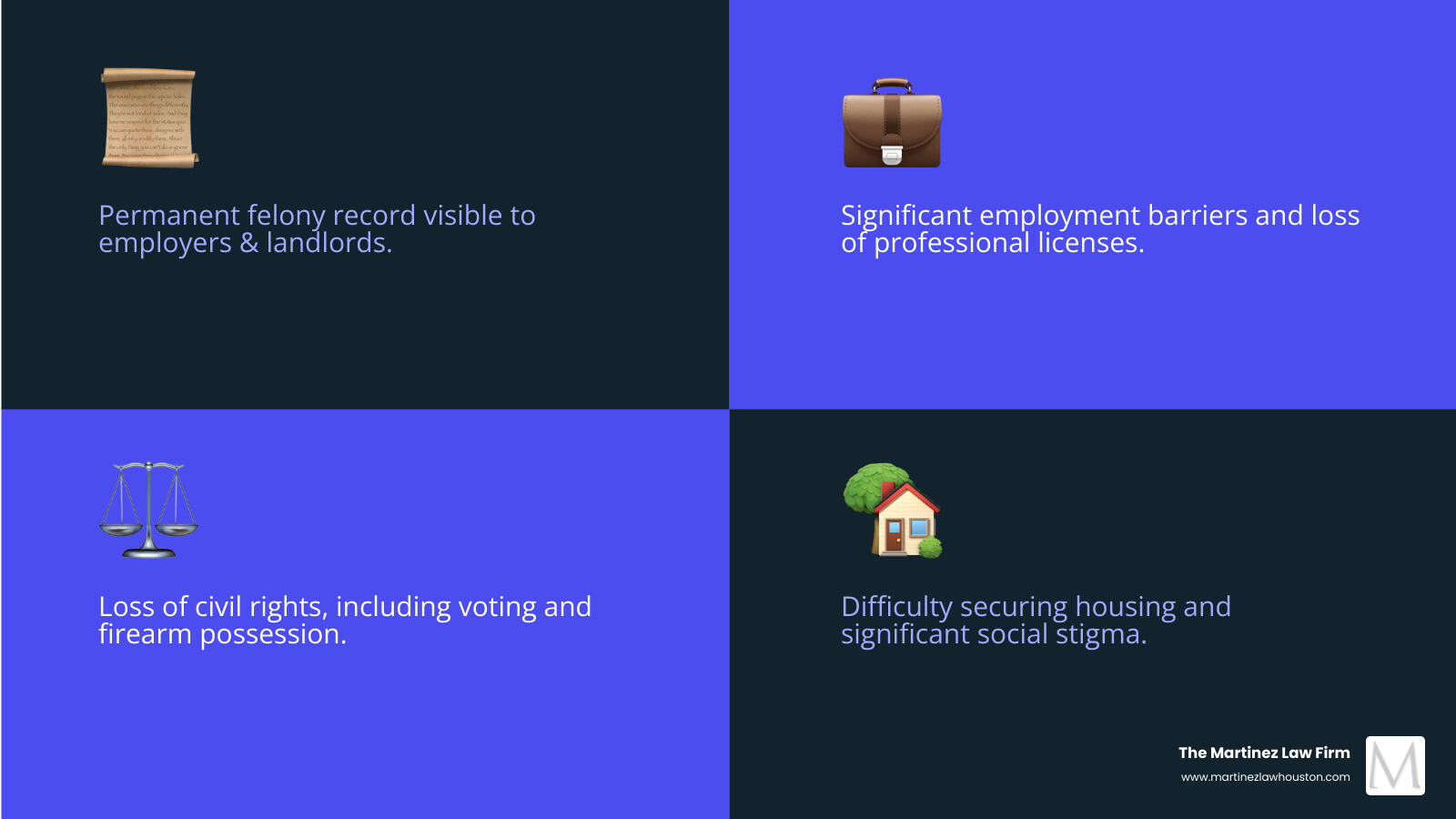
Don’t let a single mistake define your entire life. Contact us today for a consultation and take that crucial first step towards securing your future. Visit our main page to Contact an experienced Houston DWI Lawyer for a consultation.
More Than Just a Criminal Charge: Houston DWI Defense for Professionals

Facing a DWI charge in Houston can be terrifying for anyone. But for licensed professionals, the stakes are far higher. If you’re a licensed professional in Houston, securing a houston dwi defense for licensed professionals attorney is not just about avoiding jail time; it’s about protecting your entire career.
A DWI arrest triggers two immediate, critical battles:
- Criminal Case: This deals with the legal penalties like jail time, fines, and driver’s license suspension.
- Professional License Investigation: This involves your specific licensing board. It can initiate disciplinary actions. This might lead to license suspension or even revocation.
Many professionals fear the criminal charges. But often, the threat to their professional license is the most devastating consequence. It can derail years of education, hard work, and dedicated service. Professionals facing DWI charges need specialized legal defense. This defense must protect both their legal standing and their professional licenses.
My name is Herman Martinez. As the founder of The Martinez Law Firm, I bring over 25 years of experience, including time as a Chief Prosecutor and City of Houston Judge, to providing houston dwi defense for licensed professionals attorney services.
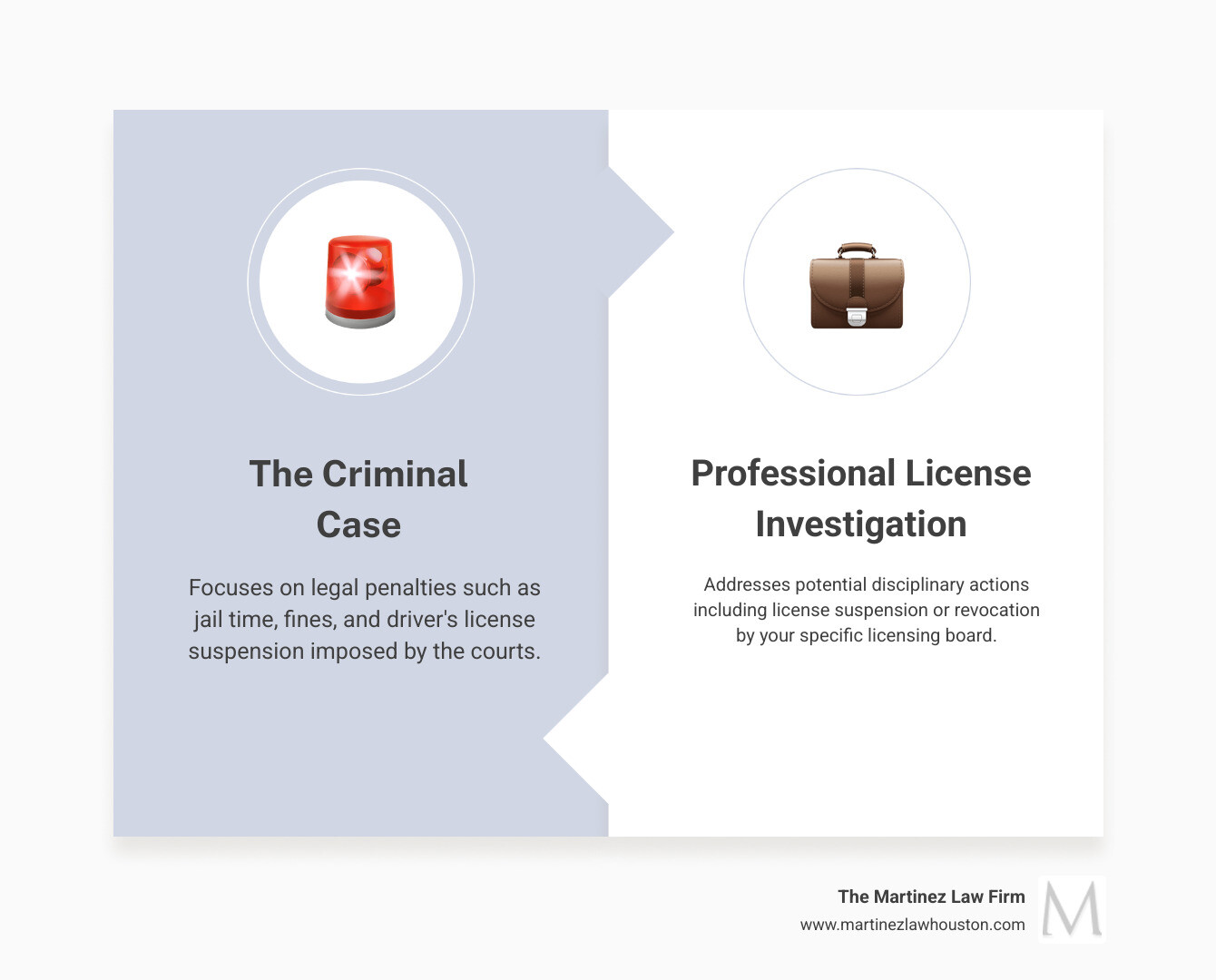
The High Stakes: How a Houston DWI Impacts Your Professional License
For licensed professionals in Houston, a DWI isn’t just a legal headache; it’s a potential earthquake for your entire career. While anyone facing a DWI worries about fines, jail time, and losing their driver’s license, you have something far more precious at stake: your livelihood. We understand that your family, your years of hard work, and your future are hanging in the balance.
Imagine losing the ability to practice the profession you’ve dedicated your life to. That’s the stark reality a DWI arrest or conviction can bring. Licensing bodies are here to protect the public, and they take their job very seriously. They need to trust that their professionals are of good character, competent, and respect the law. Even a first-time DWI, which might seem like ‘just’ a mistake, can look like a serious breach of that trust in their eyes.
This perception alone can trigger a deep dive into your professional life. And the consequences? They can be devastating. Beyond direct disciplinary action on your license—which could mean a reprimand, suspension, or even outright revocation—you could face:
- Losing your valued patients or clients.
- Having your hospital or employment privileges revoked.
- Seeing your malpractice or professional liability insurance premiums skyrocket.
- And perhaps most heartbreaking, significant damage or even ruin of your professional career, even if you never had a substance abuse issue.
This is exactly why securing a houston dwi defense for licensed professionals attorney isn’t just an option; it’s absolutely paramount.
Professionals We Help
We often help professionals from a wide range of fields steer these choppy waters. Here are some of the Texas Licensing Boards that pay very close attention to DWI offenses:
- Texas Medical Board
- Texas Board of Nursing
- State Bar of Texas
- Texas State Board of Public Accountancy
- Texas Real Estate Commission
- State Board for Educator Certification
- Federal Aviation Administration (FAA) for pilots – yes, even federal licenses are at risk!

The Authority of Texas Licensing Bodies
Texas licensing bodies aren’t just advisory committees; they hold real power. Their main job is to keep the public safe and ensure that licensed professionals are honest, trustworthy, and good at what they do. You can learn more about Texas’s occupational licensing bodies right here: Texas’s occupational licensing bodies.
The Texas Occupations Code gives these boards broad authority. Specific sections, like 165.001 et. seq and 164.051, lay out the grounds for disciplinary action. A DWI, even if it seems completely unrelated to your daily work, will definitely trigger their scrutiny. It’s simply seen as a serious professional issue.
It doesn’t matter if your DWI is a misdemeanor or a felony; the board will assess how it impacts your fitness to practice. Even a first-time Texas DWI, which is usually a Class B misdemeanor, can have massive professional repercussions. For example, the Texas Occupations Code allows medical boards to impose fines and penalties. And the Texas Nursing Practice Act permits discipline for both felony and misdemeanor convictions. They aren’t messing around.
DWI Arrest vs. Conviction: How Boards View Them Differently
Here’s a common misunderstanding: many professionals think only a DWI conviction can hurt their license. The truth is, an arrest alone can be a huge red flag. It can trigger an investigation by your board, even before a conviction.
Licensing bodies often require you to tell them about arrests, convictions, and other legal troubles. While a conviction is solid proof of misconduct in their eyes, an arrest can still signal a potential issue. They might start asking questions to see if there are deeper problems that could affect your professional duties.
And here’s a crucial point: failing to report a DWI charge or conviction, even if it’s later dismissed, can lead to even more severe discipline from your licensing board. For instance, the Texas Board of Nursing specifically warns nurses that they must self-report a DWI or related conviction, often during license renewal. However, some boards might require you to tell them even sooner.
Our advice? It’s almost always better to report with the help of your attorney. Why? Because we’ve seen it time and again: the “cover-up” of a DWI is often seen as worse than the initial charge by the board. They value honesty and transparency.
How Boards Learn About DWIs
So, how do these licensing bodies find out about your DWI arrest or conviction? It’s not always through self-reporting. They have several ways:
- Self-reporting: As mentioned, many professions require you to tell them within a certain timeframe.
- Background checks: Regular checks, especially during license renewal, can reveal your criminal history.
- Public records: DWI arrests and convictions are public information. Anyone can find them.
- Complaints: Unfortunately, colleagues, employers, or even patients can report incidents to your board.
The bottom line is this: discipline is possible even if you’re never convicted. If the board believes your behavior shows poor judgment or a risk to the public, they can still take action. That’s why having a houston dwi defense for licensed professionals attorney on your side from day one is so important.
Navigating the Dual Battle: A Two-Pronged Defense Strategy

When you’re a licensed professional facing a DWI charge in Houston, you’re fighting two battles at once. Think of it like playing chess on two boards simultaneously – one move affects both games. You’re dealing with the criminal courts while also facing potential discipline from your professional licensing board.
This dual challenge makes your situation far more complex than a typical DWI case. As a professional, you’re held to higher standards. Your licensing board expects you to be a model citizen. One mistake can trigger investigations that threaten not just your freedom, but your entire career.
That’s why you need a houston dwi defense for licensed professionals attorney who understands both battlefronts. At The Martinez Law Firm, we’ve developed a comprehensive strategy that protects you on both fronts. We know that winning the criminal case but losing your license is still a devastating loss.
Defending the Criminal Case in Houston Courts
Let’s start with the criminal side. This is where my experience as a former prosecutor really pays off. I know exactly how the state builds these cases – and more importantly, where they make mistakes.
Challenging the traffic stop is often our first line of defense. Police can’t just pull you over because they feel like it. They need probable cause. We dig deep into the circumstances of your stop. Was the officer’s reason legitimate? Did they follow proper procedures? If the stop was illegal, everything that followed gets thrown out.
Field sobriety tests might look scientific, but they’re far from foolproof. These tests are subjective and affected by countless factors. Were you wearing high heels? Do you have a medical condition? Was the surface uneven? Law enforcement mistakes in Texas happen more often than you’d think, and we know how to spot them.
Breath and blood tests seem like slam-dunk evidence, but they’re not. Breathalyzer machines need regular calibration. Blood samples can be contaminated or mishandled. We’ve gotten cases dismissed even when clients tested well over the legal limit, simply by proving the tests were unreliable.
Here’s something critical that many people miss: the Administrative License Revocation (ALR) hearing. You only have 15 days from your arrest to request this hearing. Miss this deadline, and your license is automatically suspended. This hearing is separate from your criminal case, but it can provide valuable evidence for your defense.
Protecting Your Professional License from Board Sanctions
While we’re fighting your criminal case, we’re simultaneously working to protect your professional license. This is where things get tricky, and where specialized knowledge makes all the difference.
Self-Reporting
Self-reporting strategy is crucial but delicate. Most licensing boards require you to report arrests or convictions, but the timing and approach matter enormously. Some boards want immediate notification, others only require disclosure during renewal. The Nursing Practice Act reporting rules are different from medical board requirements, which differ from bar rules. We help you steer these requirements properly.
Active Communication
Communicating with investigators from your licensing board requires careful handling. These aren’t criminal investigators – they’re administrative personnel with different goals and procedures. We handle all communications to ensure you don’t accidentally harm your case.
Mitigation
Presenting mitigating evidence is where we tell your whole story. You’re not just someone who got arrested – you’re a dedicated professional with years of service. We gather character references, professional achievements, and evidence of your commitment to your field.
Mistake vs Substance Abuse
Distinguishing a mistake from a substance abuse problem is often critical. Many DWI arrests have nothing to do with addiction. Maybe you had wine with dinner and misjudged your tolerance. Maybe you were on medication that interacted poorly with alcohol. We work to show this was an isolated incident, not a pattern of behavior.
Data on professionals and addiction shows that certain professions do have higher rates of substance abuse, which makes boards more suspicious. But that doesn’t mean every DWI involves addiction, and we fight to prevent unfair assumptions.
Consent Orders
Negotiating consent orders becomes important if some discipline is unavoidable. Rather than face suspension or revocation, we often negotiate agreements that let you continue practicing with conditions like monitoring or continuing education.
Representation
Representation in board hearings requires understanding administrative law, not just criminal law. These proceedings have different rules, different standards of evidence, and different goals than criminal court.
The key to success is coordination. What we do in criminal court affects your licensing case, and vice versa. That’s why you need an attorney who understands both systems and can develop a strategy that protects you completely.
We’ve seen too many professionals lose their careers because their attorney only focused on one side of the battle. Don’t let that happen to you.
Why You Need a Specialized Houston DWI Defense for Licensed Professionals Attorney
When your professional license and career are on the line, simply hiring a general criminal defense attorney might not be enough. You need someone who truly understands the unique pressures you face. You need a houston dwi defense for licensed professionals attorney with specialized knowledge. This kind of attorney knows the ins and outs of both criminal law and the administrative rules that govern your license.
At The Martinez Law Firm, we’re equipped to handle this delicate, dual-track defense. Our goal is always to protect both your livelihood and your freedom. With my background as a former prosecutor, I bring a unique perspective. This allows us to provide an aggressive, personalized defense, crafted just for your situation. We know what’s at stake for you.
The Critical Role of a Board-Certified DWI Specialist
So, why does Board Certification matter so much for a professional facing a DWI? It’s simple: it means your attorney has gone above and beyond. Board Certification isn’t just another certificate on the wall. It shows a deep level of expertise and hands-on experience that goes far beyond standard legal practice. It means your lawyer is a true expert in both the criminal law of DWI and the complex administrative rules that licensing boards follow.
A Board Certified DWI attorney truly understands:
- DWI Science: They know the science behind breath and blood tests, and how field sobriety tests work (or don’t). This deep scientific knowledge is vital for challenging the evidence against you.
- Administrative Law: They are experts in the specific rules, procedures, and disciplinary steps of the various Texas licensing boards. They know what to expect and how to guide you through these often tricky administrative processes.
- A Proven Track Record: They have a history of achieving good results in both DWI cases and licensing board actions. For example, we’ve successfully defended clients, even leading to “not guilty” verdicts in complex DWI cases. This kind of proven experience is priceless when your career is hanging in the balance.
- The High Stakes for Professionals: Most importantly, they truly get that for professionals, the fallout from a DWI – like losing your job, higher insurance, or a damaged reputation – can be much worse than the criminal penalties themselves.
That’s why having a Board Certified DWI defense attorney is absolutely crucial. They can effectively steer both your criminal charges and your licensing board issues.
Can a DWI Charge Be Kept Off My Record?
This is a question many professionals ask, and it’s a critical one for your license. The good news is, yes, a DWI charge can often be kept off your public record, or at least its impact can be greatly reduced. Here’s how:
- Dismissal: If we can successfully challenge the evidence or the way procedures were followed, the prosecutor might just dismiss the charges. A dismissal means the case is dropped, and you’re not convicted.
- Acquittal: If your case goes to trial and the jury finds you “not guilty,” you are acquitted. Again, no conviction.
- Reduction of Charges: Sometimes, we can work to get the DWI charge reduced to a lesser offense. For instance, Obstruction of a Highway carries much less severe penalties and might have a different, less damaging impact on your professional license.
Your Options
Even if a charge is dismissed or you are found not guilty, the arrest itself might still show up on background checks. But in Texas, you might be eligible for:
- Expunction: If your case is dismissed, you’re acquitted, or you complete a deferred disposition, you could get an expunction. This legally erases the arrest from your record as if it never happened. It makes it unavailable to most employers and licensing boards.
- Non-Disclosure: If you successfully complete deferred adjudication for a lesser offense (DWI itself usually isn’t eligible for deferred adjudication, but a reduced charge might be), you could get an Order of Non-Disclosure. This seals your record from public view. While some government agencies and licensing boards might still have access, it’s a huge step toward protecting your privacy.
The ability to keep a DWI charge off your public record is a key part of protecting your professional license. This is exactly why getting strategic legal guidance from an experienced houston dwi defense for licensed professionals attorney right from the start is so important.
Choosing the Right Houston DWI Defense for Licensed Professionals Attorney
Choosing the right legal team is one of the most important decisions you’ll make after a DWI arrest. For professionals like you, this choice is even more critical. We believe in providing an aggressive, yet personalized, defense. We bring over 25 years of experience to the table, including my time as a Chief Prosecutor and City of Houston Judge.
When you’re looking for someone to stand by your side, here are some key qualities that truly set an attorney apart:
- Experience with your specific licensing board: An attorney who understands the unique rules of the Texas Medical Board, the Texas Board of Nursing, or the State Bar of Texas, for instance, will be far better equipped to protect your license.
- Board Certification in DWI/Criminal Law: This credential shows a high level of specialized knowledge and proven experience in these complex areas of law.
- A proven track record defending professionals: Look for a firm with a history of successfully representing hundreds of Texas professionals in DWI cases and before their licensing boards.
- A clear strategy for handling both the criminal and administrative cases: Your attorney should be able to explain their comprehensive plan for tackling both legal battles at the same time.
- Former prosecutor experience: Our background as former prosecutors gives us unique insight into how the state builds its DWI cases. This allows us to anticipate their moves and build an even stronger defense for you.

Frequently Asked Questions about DWI and Professional Licenses in Texas
It’s completely normal to feel overwhelmed and have a million questions swirling in your mind after a DWI arrest, especially when your professional license is on the line. We understand this is a deeply stressful time. To help bring you some clarity, here are some of the most common questions we hear from licensed professionals in Houston who are facing DWI charges.
Do I have to report my DWI arrest to my licensing board?
This is a really important question, and the answer isn’t a simple “yes” or “no.” It absolutely depends on your specific licensing board’s rules. What we can tell you is that failing to report when you’re required to is often seen as a separate, and very serious, offense by the board. This can lead to even harsher penalties than the DWI itself.
Every board is different. Some might require you to disclose an arrest right away. Others might only require disclosure upon a conviction, or perhaps during your license renewal process. For example, the Texas Board of Nursing, in their Nursing Practice Act, specifically requires nurses to self-report certain convictions.
This is why you must consult with an attorney who understands these nuances. We need to carefully review your board’s specific regulations together. Our experience has shown that being upfront and transparent, always guided by legal counsel, often leads to a much better outcome than trying to hide the information. Many licensing bodies have the authority to discipline you simply for not reporting, even if your DWI charge eventually gets dismissed.
Will I automatically lose my professional license if convicted of a DWI?
This is a huge fear for many professionals, and we want to reassure you: no, not automatically. A DWI conviction will certainly trigger a mandatory review by your licensing board, and it can lead to disciplinary action. However, it doesn’t mean your license is immediately revoked.
The outcome truly depends on several factors. These include the specific facts of your case, your history with the board, how cooperative you are during their investigation, and, perhaps most critically, the quality of your legal defense. While a conviction can definitely be grounds for disciplinary action (as outlined in Section 164.051 of the Occupations Code), it’s not an automatic career-ender.
Our job as your legal team is to work tirelessly to mitigate these potential consequences. We’ll present your case in the strongest possible light and negotiate with the board. Our goal is always to protect your ability to practice, aiming for outcomes like probation, limited licenses, or other solutions that allow you to continue your career.
What’s the first thing I should do after a DWI arrest in Houston?
This is the most crucial piece of advice we can give you. The absolute first thing you should do after a DWI arrest in Houston is to remain silent and immediately contact a qualified houston dwi defense for licensed professionals attorney. Make sure they specialize in representing licensed professionals.
Do not discuss your case with anyone, especially law enforcement, without your legal counsel present. Anything you say can and will be used against you.
You also have a critical deadline approaching fast: you only have 15 days from the date of your arrest to request an Administrative License Revocation (ALR) hearing. This hearing is your chance to fight to keep your driver’s license from being automatically suspended. If you miss this 15-day window, your driving privileges will be suspended without a fight.
Time is truly against you in these situations. Securing experienced legal representation quickly is the most proactive and impactful step you can take. It will help to mitigate damage to both your criminal case and your professional career.
Take Control of Your Future: Secure Your Career and Freedom
It’s natural to feel overwhelmed when a DWI charge threatens not just your freedom, but the career you’ve worked so hard to build. For licensed professionals in Houston, a DWI isn’t just a legal headache; it’s a direct assault on your professional standing. You’re facing a unique and formidable challenge, a two-front battle attacking both your personal life and your very livelihood. The stakes are incredibly high, and remember that one difficult moment shouldn’t be allowed to jeopardize years of dedication, education, and service in your chosen field.
At The Martinez Law Firm, we truly understand these complexities. Our approach is deeply rooted in empathy and a profound understanding of what you stand to lose. Our founder, Herman Martinez, brings over 25 years of experience to the table, including invaluable time as a former prosecutor and City of Houston Judge. This unique insight allows us to anticipate the prosecution’s every move, building an aggressive, personalized defense specifically designed to protect both your freedom and your professional license.
We believe that every professional deserves a fighting chance to protect their future. That’s why we’re committed to providing the specialized legal defense you need to safeguard your standing. We’ve had the privilege of helping countless professionals steer these challenging waters in Houston and the surrounding counties, including Harris County, Fort Bend County, Montgomery County, Galveston County, Sugar Land, Pasadena, Missouri City, and Pearland. Our goal is to ensure that a single mistake doesn’t define your entire career.
Don’t face this dual battle alone. When your career, reputation, and future are on the line, securing a houston dwi defense for licensed professionals attorney is the most crucial step you can take. Let us stand with you, providing the clear strategy and fierce advocacy you deserve.